Precious Metals Decline Alongside, What Signal is Gold Sending to the Market?

marsbitPublicado a 2026-06-24Actualizado a 2026-06-24

Resumen

Gold and silver prices have declined recently, moving in tandem with a sell-off in risk assets like South Korean semiconductor stocks. This is unusual, as gold typically rises when equities fall due to its safe-haven status. The synchronized drop signals a shift in market focus: it's not about finding safety, but about the rising cost of holding assets that do not yield interest. This cost is the real interest rate. The key driver is a change in Federal Reserve policy expectations under new Chair Kevin Warsh. Despite holding rates steady, the Fed's rhetoric has turned more hawkish, emphasizing persistent inflation risks. This has led markets to price in a "higher for longer" rate environment, increasing the appeal of cash and bonds while pressuring zero-yield assets like gold and tech stocks with high future cash flow valuations. Technically, gold breached the $4,100/oz support level, approaching the critical $4,000 psychological and technical zone. A break below could trigger accelerated selling from momentum traders and ETFs. While long-term supportive factors like central bank buying and geopolitical risks remain, short-term price action is dominated by liquidity and opportunity cost dynamics. The South Korean market meltdown, driven by crowded AI-trade unwinding, is a symptom—not the cause—of this broader macro repricing. Both markets are reacting to the same pressures: higher real rates and a stronger US dollar. In summary, the concurrent decline in equities and prec...

TL;DR

Since June, South Korea's KOSPI index, dragged down by heavyweight semiconductor stocks, has fallen over 8% at one point, triggering a circuit breaker. Gold and silver also declined during the same time window.

The anomaly is that if it were merely a traditional decline in risk appetite, investors would typically sell stocks and buy gold. But this time, both risk assets and precious metals are being sold. The Korean market provides an extreme case: stocks like Samsung Electronics and SK Hynix, core players in the AI supply chain, fell, while gold and silver also faced simultaneous pressure. The market is not currently trading "where is the safest," but rather "the cost of holding uncertain assets has increased."

This cost is the real interest rate. Simply put, the real interest rate is the true price of money after deducting inflation expectations. When it rises, bonds and cash become more attractive, while assets like gold and silver that do not generate interest become less worthwhile; high-valuation tech stocks also see their valuations compressed because a higher discount rate makes future profits less valuable.

Therefore, the Korean circuit breaker is the surface-level shock, while gold's decline alongside is the more crucial signal. The narrative that supported the simultaneous rise of AI semiconductors and precious metals in 2025 is now being tested by the same macro variable. It does not necessarily mean the end of the AI bull market, nor does it prove that gold's safe-haven attribute has failed. However, it at least indicates that, following the hardening tone from the Federal Reserve under Kevin Warsh's leadership, interest rates and the dollar have regained short-term pricing power.

Gold Under Pressure: Opportunity Cost Trumps Safe-Haven Demand

Gold does not always rise during panic. Its greatest fear is not simply a stock market decline, but a strengthening dollar and rising real interest rates.

Following Kevin Warsh's swearing-in as Fed Chairman on May 22, the June 17 FOMC meeting kept the target range for the federal funds rate unchanged at 3.50%-3.75%. On the surface, this was a hold; but the statement continued to emphasize that inflation remains above the 2% target and mentioned that supply shocks, including energy, are pushing up some prices.

For the market, this is more important than an immediate rate hike. Previously, investors were betting on a dovish pivot; now they are once again facing the prospect of high rates persisting longer, with the risk of rate hikes even re-entering the pricing.

The decline in gold and silver occurred after this shift in the macro anchor. By June 24, major data sources showed gold had fallen below $4,100 per ounce, with Trading Economics' intraday quote around $4,069 at one point, leaving only about 2% to the key psychological $4,000 level. This level is significant not only because it's a round number, but also because several technical analyses identify $4,000 as a key support zone for this pullback. After losing $4,100, the market is no longer just trading an ordinary retracement, but whether gold is formally testing the $4,000 support.
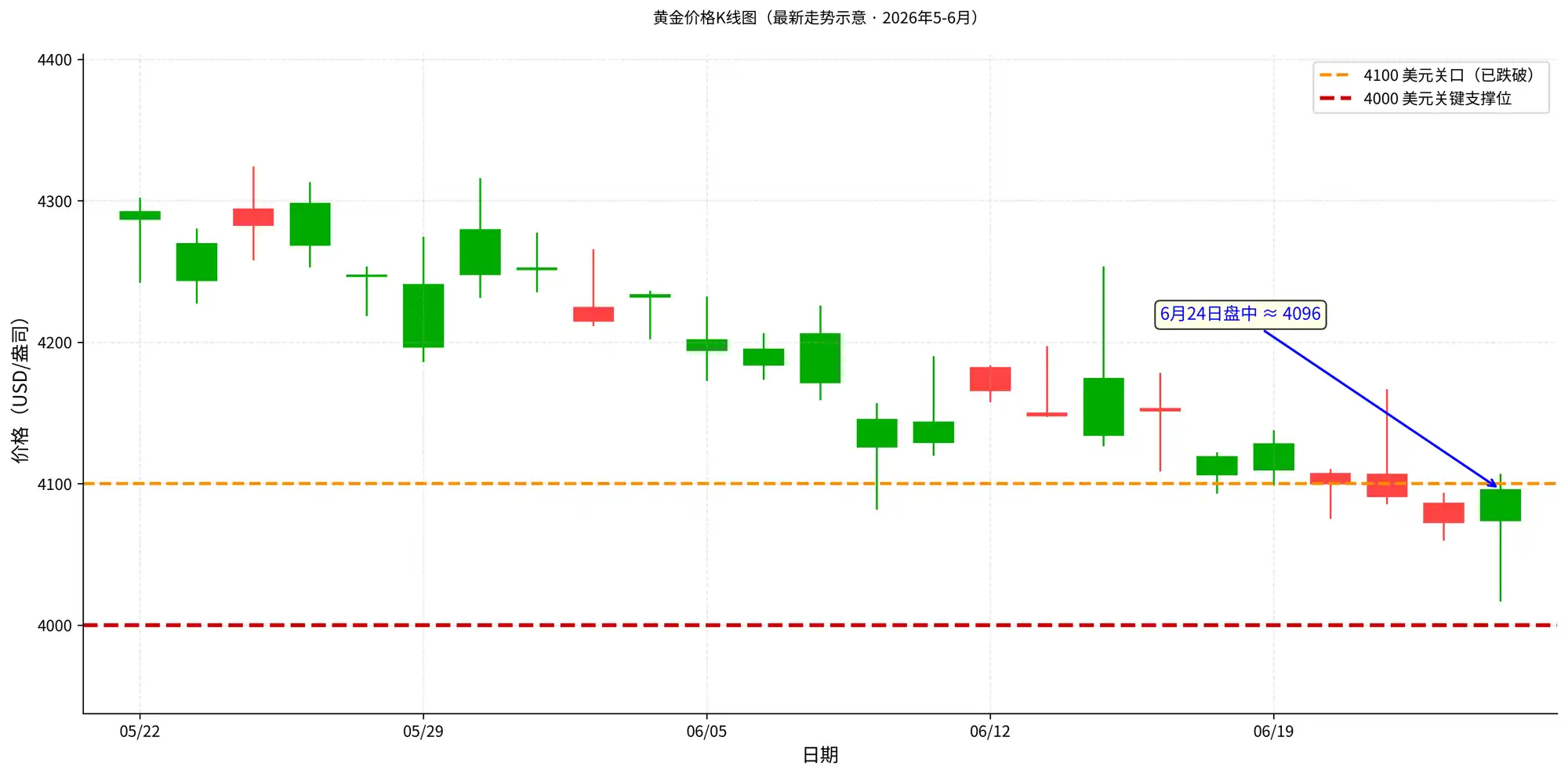
If $4,000 is decisively broken, the issue is not simply how much lower the price might go, but assessing whether the correction could amplify into a sharp sell-off. Gold has seen significant gains and holds substantial profit positions. Once a key integer level is breached, simultaneous selling pressure from short-term stop-losses, trend fund de-risking, ETF outflows, and margin calls could emerge. In such a scenario, gold would still have long-term supports like central bank purchases and safe-haven demand, but the short-term price would first obey liquidity and risk controls. Market confidence in "gold's defensive capability" might be tested anew.
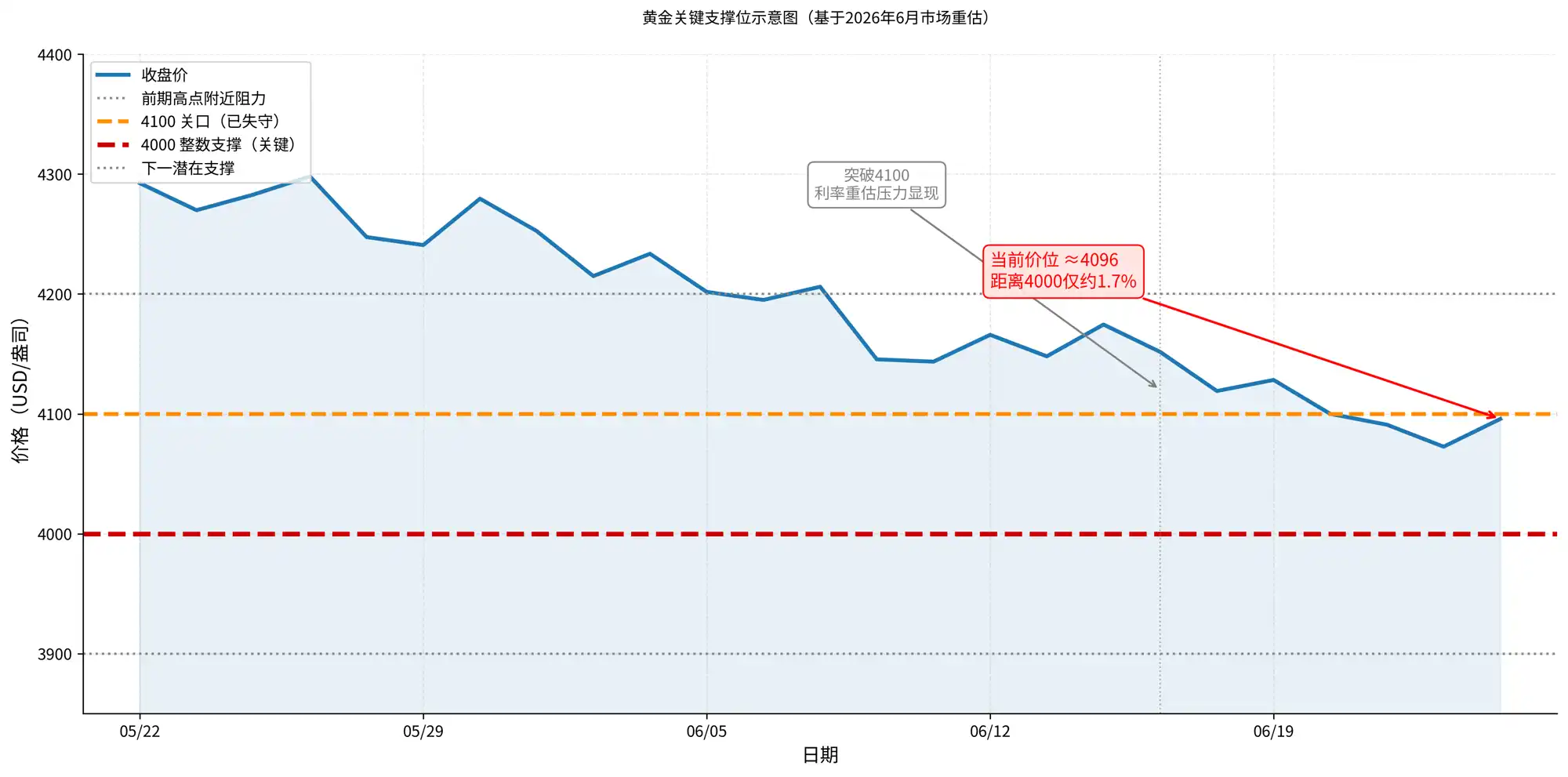
This is not to say that geopolitical risks, central bank buying, or industrial demand are unimportant. Gold's strong rally in 2025 was indeed supported by multiple factors including central bank purchases, a weaker dollar, and safe-haven demand. Silver's even larger gains were also related to its industrial attributes and supply-demand expectations. But when interest rate expectations are suddenly revised upward, precious metals are first revalued as non-yielding assets.

The reasons for holding gold haven't disappeared for investors; they are just being temporarily suppressed in the short term by higher opportunity costs for capital. Risk events will stimulate safe-haven buying, while high interest rates increase the cost of holding gold. When the latter dominates, gold can fall alongside stocks.

Gold and Silver Falling Together Indicate the Market is Selling Liquidity

The simultaneous decline of gold and silver cannot be simplistically interpreted as "safe-haven assets failing." More accurately, the market is repricing liquidity.

When dovish expectations are strong, gold can benefit simultaneously from a weaker dollar, falling real rates, and safe-haven demand. Silver adds industrial attributes and supply-demand expectations on top, giving it greater elasticity. But when the Fed signals a renewed hawkish tilt, the pricing logic reverses: a stronger dollar weighs on dollar-denominated gold and silver, rising real rates increase the opportunity cost of non-yielding assets, and the market actively reduces positions in more volatile assets.

This is also why gold and silver fall alongside stocks. On the surface, they belong to different asset classes, but in short-term trading, they both depend on the same variable: the price of money. If money becomes more expensive, the market will first sell the most crowded, most profitable, and most liquid positions, rather than first distinguishing whether these assets' long-term narratives still hold. Silver is more sensitive because it also carries industrial attributes; once risk assets correct in unison, industrial demand expectations are also discounted.

Therefore, the core of this decline is not "why isn't gold acting as a safe haven," but rather that the direction of market safe-haven flows has changed. In an environment of higher interest rate expectations, the short-term safe-haven assets chosen by capital may be the US dollar, cash, and short-term bonds. Gold remains a long-term safe-haven tool, but during a phase of rapid interest rate repricing, it will first face the impact of opportunity cost.

Korea is a Magnifying Glass, Not the Cause of Precious Metals' Decline

The reason the Korean market's sharp drop is observed alongside gold is not because Korean semiconductors directly determine gold prices, but because it amplifies the pressure from the same macro trade.

The Korean stock market benefited from AI memory demand in 2025, with semiconductor heavyweights like Samsung Electronics and SK Hynix driving a significant index rally. By 2026, the question became: if too much capital is crowded into the same trade, once macro rates rise, who sells first and how much they sell may impact prices more than short-term changes in company fundamentals. The KOSPI falling over 8% and triggering a circuit breaker in June is the result of such a crowded trade being re-examined.

However, the causality needs clarification. Current public evidence does not prove that "Korean deleveraging directly spilled over to global precious metals positions." A more prudent judgment is that Korean semiconductors and precious metals are simultaneously bearing the same macro pressure: rising interest rates, a strengthening dollar, and more expensive liquidity. The Korean market shows a more violent price reaction due to index concentration and crowded AI positioning; gold and silver are directly exposed to interest rate repricing due to their non-yielding and dollar-denominated nature.

In other words, Korea is not the cause of gold's decline, but rather a display screen for market risk appetite and leverage levels. It tells investors: when expectations for higher rates resurface, assets that have seen significant gains and heavy positioning over the past year will be inspected first. Precious metals, while not tech stocks, also face repricing when the cost of capital rises.

AI Volatility Affects Sentiment, But Gold and Silver Still Look to Interest Rates

AI semiconductor volatility affects market sentiment and assets like silver that possess industrial attributes, but it is not the main driver explaining gold and silver price movements.

If the key variable for gold and silver is the real interest rate, then the key variable for AI semiconductors is order fulfillment. Micron's earnings can serve as a window into risk appetite because they influence the market's judgment on "whether high-valuation assets can still withstand high rates." If AI chain earnings remain strong, risk appetite may find support, and silver's industrial attributes could be more easily re-priced. If guidance falls short, the market may further reduce growth asset positions, and contracting risk appetite will continue to pressure high-beta assets.

But the core pricing factor for gold must still return to the Fed, the dollar, and real interest rates. No matter how strong AI earnings are, they can hardly directly offset the pressure from rising real rates on gold. Similarly, weaker AI earnings do not necessarily drive gold higher unless they simultaneously trigger expectations for rate cuts, a weaker dollar, or stronger safe-haven demand.

This is the difference between market repricing and fundamental disproval. Repricing means the discount rate has changed, and investors are willing to assign a lower valuation to the same profits. Disproval means demand itself has a problem, and future profits must also be revised downward. For precious metals, the former is more important now: the market is first revaluing gold and silver based on higher capital costs, not changing the long-term safe-haven logic due to isolated changes in a specific industry chain.

Interest Rates and the Dollar Are Validating This Decline

The easiest overstatement to make now is to equate the synchronous decline directly with the end of a trend. Gold falling does not mean the end of the gold bull market; a Korean circuit breaker does not mean AI demand has already collapsed. A more reasonable assessment is that the market has entered a validation window: interest rate pressure first compresses valuations and non-yielding asset prices, followed by waiting for data to confirm whether this is a correction or a reversal.

The Fed under Warsh's leadership is the first validation line. If subsequent inflation and employment data continue to show strength, and energy prices maintain their pressure, the FOMC's hawkish tone may further translate into more explicit rate hike expectations. Then, gold and silver would face not just a short-term technical correction, but more sustained real rate pressure.

The dollar is the second validation line. Gold and silver are priced in dollars. A stronger dollar directly increases holding costs for non-US dollar investors and weakens short-term demand for precious metals. If dollar strength coincides with rising real rates, precious metals typically find it harder to reverse the pressure relying solely on a single safe-haven narrative.

Silver has an additional validation line: industrial demand expectations. It is more susceptible to risk asset sentiment than gold and more prone to amplified volatility when growth expectations change. If AI, semiconductors, and other high-beta assets remain under pressure, silver may face a double revaluation of both its precious metal and industrial attributes.

The simultaneous decline of gold, silver, and AI stocks sends investors a straightforward reminder: seemingly different assets in a portfolio may be exposed to the same risk from a single macro variable. The winning trades of 2025 will not necessarily lose their fundamentals simultaneously in 2026, but they will simultaneously face more expensive capital costs. The variables that will truly land on precious metals prices going forward are how long the pressure from interest rates and the dollar can persist, and whether safe-haven demand, central bank purchases, and industrial demand can arrive quickly enough to offset this pressure.


Preguntas relacionadas

QWhy have gold and silver prices fallen alongside risk assets like equities, according to the article?

AAccording to the article, the core reason is not a failure of their safe-haven status, but a shift in market focus toward the higher cost of holding uncertain assets. This cost is represented by rising real interest rates. When real rates (the real cost of money after inflation) increase, interest-bearing assets like bonds and cash become more attractive. This makes non-yielding assets like gold and silver less favorable to hold, as their opportunity cost increases. Simultaneously, higher discount rates pressure the valuation of high-growth tech stocks.

QWhat key signal does the article suggest is more critical than the South Korean market's circuit breaker, and what does it indicate?

AThe article suggests that gold falling in tandem with equities is the more critical signal than the South Korean circuit breaker. It indicates that the 2025 narrative supporting both AI semiconductors and precious metals is being tested by the same macro variable—real interest rates. It shows that under new Fed Chair Kevin Warsh's firmer stance, interest rates and the US dollar have regained short-term pricing power in the market.

QWhat is the most significant threat to the price of gold mentioned in the article?

AThe article states that what gold fears most is not simply a stock market decline, but a strengthening US dollar and rising real interest rates. These factors directly increase the holding cost (opportunity cost) for gold, which produces no yield, and can suppress its price even during periods of risk aversion.

QHow does the article differentiate between the primary drivers for gold versus silver during this market phase?

AThe article states that the key variable for both gold and silver is real interest rates. However, silver has an additional layer of sensitivity due to its industrial properties. This means silver is more susceptible to swings in risk asset sentiment and expectations for industrial demand (e.g., from the AI/semiconductor sector), which can amplify its volatility compared to gold during this repricing phase.

QWhat are the main validation lines or factors that will determine the future trajectory for gold and silver, as per the article's conclusion?

AThe article outlines several validation lines: 1) The Federal Reserve's policy path under Chair Warsh, particularly if strong inflation and employment data solidify hawkish expectations. 2) The strength of the US Dollar, which directly impacts dollar-denominated gold and silver. 3) For silver specifically, the expectations for industrial demand, which are tied to the health of risk assets like AI and semiconductors. The interplay between these pressures (rates/dollar) and supporting factors (safe-haven demand, central bank buying, industrial demand) will determine the price path.

Lecturas Relacionadas

If It's Not a Clear Yes, It's a No: A Nine-Year Retrospective by a VC Who Survived Four Cycles

**"Invest Only When Certain": A Nine-Year Retrospective from a VC Across Four Cycles** IOSG founder Jocy shares hard-earned lessons from nine years and over a hundred investments in Web3. The core challenge isn't identifying successful founders, but understanding why talented founders with solid ideas still fail. Through building a "failed founder database," IOSG identified six recurring failure patterns. **Founder Trait Red Flags:** 1. **Emotionally Unstable:** Founders who react defensively to criticism or publicly lash out under pressure (e.g., 80% drawdowns) often fail. Resilience is key. 2. **Lacking Hunger / Having a Fallback:** Founders with significant safety nets (family wealth, cushy fallback jobs) may lack the "do-or-die" commitment needed to survive crypto's brutal cycles. 3. **Unchecked Ego:** Includes "polished execution machines" who excel in known frameworks but struggle when paradigms shift, and "professor-types" who are technically brilliant but resistant to commercial feedback or coaching. **Project Structure Red Flags:** 4. **Token-First, Not Product-First:** Treating the token solely as a fundraising tool with no real utility or connection to product value is a major warning sign. The project should have value even if the token goes to zero. 5. **No Day-1 Exit Thesis:** Founders must have a clear, staged capital strategy from the start, understanding what each funding round needs to prove to unlock the next. "Exit before entry" is crucial. 6. **No Full-Cycle Experience:** Founders who haven't lived through a complete crypto bull/bear cycle (e.g., 2018, 2022) often underestimate their vulnerability. IOSG limits initial checks for such teams to $250k, sizing for risk. **The Positive Flipside: Desirable Founder Traits** The ideal candidate exhibits: obsessive problem-depth, being a second-time founder with a non-consensus vision, strong communication skills with *controlled* ego, relentless perseverance, and a global perspective with agency and taste (increasingly vital in the AI era). **Three Survival Tips for Founders:** 1. **Cash Flow Over Narrative:** Real revenue is what sustains projects, not vanity metrics. 2. **Tokens Are a Liability:** Avoid issuing a token unless absolutely necessary. The hidden costs (market making, liquidity, compliance) are immense, often a multi-million-dollar burden. 3. **Respect Liquidity:** Sell during peaks to build treasury, buy back to support the protocol during troughs. Be realistic about valuations and your ability to deliver for the next round. The final principle is simple yet paramount: **"If it's a borderline 'yes' or 'no,' don't invest."** In an industry that reinvents itself every few years, the discipline to consistently say "no" is the ultimate secret to longevity.

Foresight NewsHace 10 min(s)

If It's Not a Clear Yes, It's a No: A Nine-Year Retrospective by a VC Who Survived Four Cycles

Foresight NewsHace 10 min(s)

SemiAnalysis Deep Dive into CXMT: $50 Billion Revenue, An IPO Amidst a Supercycle

SemiAnalysis' in-depth report on ChangXin Memory Technologies (CXMT) details its rapid rise as China's largest upcoming semiconductor IPO. Founded in 2016 by Zhu Yiming, CXMT built its DRAM foundation on acquired patents and talent from the bankrupt German firm Qimonda. It achieved its first annual profit in 2025 after nearly a decade of significant capital support, primarily from patient Hefei municipal investors who fostered a local supply chain. The company is now capitalizing on a strong DRAM supercycle. Its revenue soared from ~$3.3B in 2024 to ~$8.6B in 2025, with Q1 2026 alone reaching ~$7.3B. SemiAnalysis projects full-year 2026 revenue could exceed $50B, driven by soaring ASPs rather than massive market share gains. While CXMT is closing the capacity gap with Micron, its product mix remains heavily focused on commodity DDR/LPDDR, which currently offers higher margins than its nascent HBM business. CXMT faces significant challenges in HBM, struggling with yield and stability for HBM3 8-Hi stacks while lagging behind the big three (Samsung, SK Hynix, Micron) in advanced nodes. However, strategic national priorities for AI self-sufficiency may push it to accelerate HBM capacity. Its complex IPO structure reveals heavy state-backed ownership and voting control over its fabs, with Alibaba appearing as both a key cloud customer and a minority shareholder. The IPO aims to raise ~$4.1B, primarily to strengthen its core DRAM manufacturing base.

marsbitHace 30 min(s)

SemiAnalysis Deep Dive into CXMT: $50 Billion Revenue, An IPO Amidst a Supercycle

marsbitHace 30 min(s)

From Corning to Ciena: The 10x Opportunity in the AI Optical Communication Chain

The transition from copper to optical communication in AI data centers is creating significant investment opportunities beyond just chipmakers. The entire photonics supply chain, from glass and fiber to connectors and test equipment, is critical. Corning, a key fiber supplier, has locked in multi-billion dollar, multi-year contracts with major cloud providers (Meta, Amazon, Google, Microsoft, OpenAI, NVIDIA), demonstrating pricing power and scale. Its profit growth is outpacing revenue growth. In the interconnect layer, Amphenol benefits from high growth in AI data centers, driven by strategic acquisitions and operational efficiency, while Credo Technology acts as a bridge between copper and optical solutions, though with high customer concentration risk. At the systems level, Ciena enables higher data capacity on existing fiber lines, with a strong backlog and cloud customer adoption. Further upstream, AXT is a bottleneck supplier of key indium phosphide wafers for lasers but faces geopolitical supply chain risks. VEO Solutions provides essential testing equipment for the entire photonics industry. A new pure-play photonics ETF (FOTO) offers a consolidated investment approach. The core thesis is that the physical limits of copper are driving an inevitable shift to optical technologies, with wealth flowing to essential, often overlooked, suppliers across the photonics value chain.

marsbitHace 42 min(s)

From Corning to Ciena: The 10x Opportunity in the AI Optical Communication Chain

marsbitHace 42 min(s)

Collector Crypt's DAU Is Only 800, Yet It's Already One of Crypto's Most Profitable Projects?

"Collector Crypt: A Highly Profitable Crypto Project with Only 800 Daily Active Users?" Collector Crypt (CARDS) is a crypto project tokenizing physical graded trading cards (primarily Pokémon) on Solana, achieving significant real-world profitability and growth. According to a Maelstrom Fund analysis, it generated approximately $53M in annualized profit in May, with a June run-rate nearing $109M, against a $550M FDV. Its core revenue driver is a digital pack-opening 'Gacha' system. The platform bulk-buys cards at a 5-15% discount. Users can open digital packs and choose to keep cards or sell them back to the platform at a 7-15% discount to market price. Most users sell back common cards, creating an efficient model: users get packs with a ~2% positive expected value, while Collector Crypt captures ~4.5% profit. The project aims to disrupt the inefficient $22.2B GMV (Q1 2026) eBay trading card market, which charges sellers 16-20% in total fees. Collector Crypt offers 2% fees, instant settlement, insured custody, and one-click trading. Beyond Gacha, future revenue streams include secondary market trading fees, infrastructure partnerships, and an eBay "snipe" tool. It holds ~$23M in card inventory and ~$10M in cash, and has already begun token buybacks. With a total supply of 2B tokens, effective circulation post-2027 unlocks is estimated at ~1.3B. Trading primarily on DEXs has so far limited large institutional entry. The project is expanding into sports cards and attracting Web2 users. Maelstrom Fund's price target is $4 by summer's end, positioning Collector Crypt at the forefront of migrating collectibles on-chain.

Foresight NewsHace 54 min(s)

Collector Crypt's DAU Is Only 800, Yet It's Already One of Crypto's Most Profitable Projects?

Foresight NewsHace 54 min(s)

Trading

Spot
Futuros
活动图片