The Entire Internet Hails Noam's Joining, But OpenAI's Loss Bill Just Got Thicker

marsbitPublicado a 2026-06-19Actualizado a 2026-06-19

Resumen

While the AI community celebrates Noam Shazeer, co-author of the "Attention Is All You Need" paper, joining OpenAI as Head of Architectural Research, the company's audited financials reveal a starkly different reality. In 2025, OpenAI reported $13.07 billion in revenue but a massive $20.92 billion operating loss. Even excluding a one-time accounting charge, the cash burn is severe, with $3.7 billion consumed in Q1 2026 alone. This high-profile hiring occurs against a backdrop of significant internal research talent drain, with key founders and researchers departing as the company's focus shifts from exploratory research to product iteration. Meanwhile, OpenAI's fundamental business model faces a deep crisis. It paid Microsoft $10.59 billion for compute in 2025, while its vast user base of 9 billion weekly actives includes only 50 million paying customers, making growth a direct driver of escalating costs. The article argues Shazeer's recruitment is less about technical necessity and more about crafting a compelling narrative for OpenAI's upcoming IPO, aiming to justify a rumored $1 trillion valuation to future public market investors. It contrasts OpenAI's strategy with Anthropic's reported path to profitability, which relies on a strong enterprise customer base and cost control, rather than star-powered narratives. Ultimately, the piece concludes that while Shazeer's architectural work may take 1-2 years to materialize, OpenAI's financial clock is ticking much faster, wit...

By | AI Chang Fan Tiao

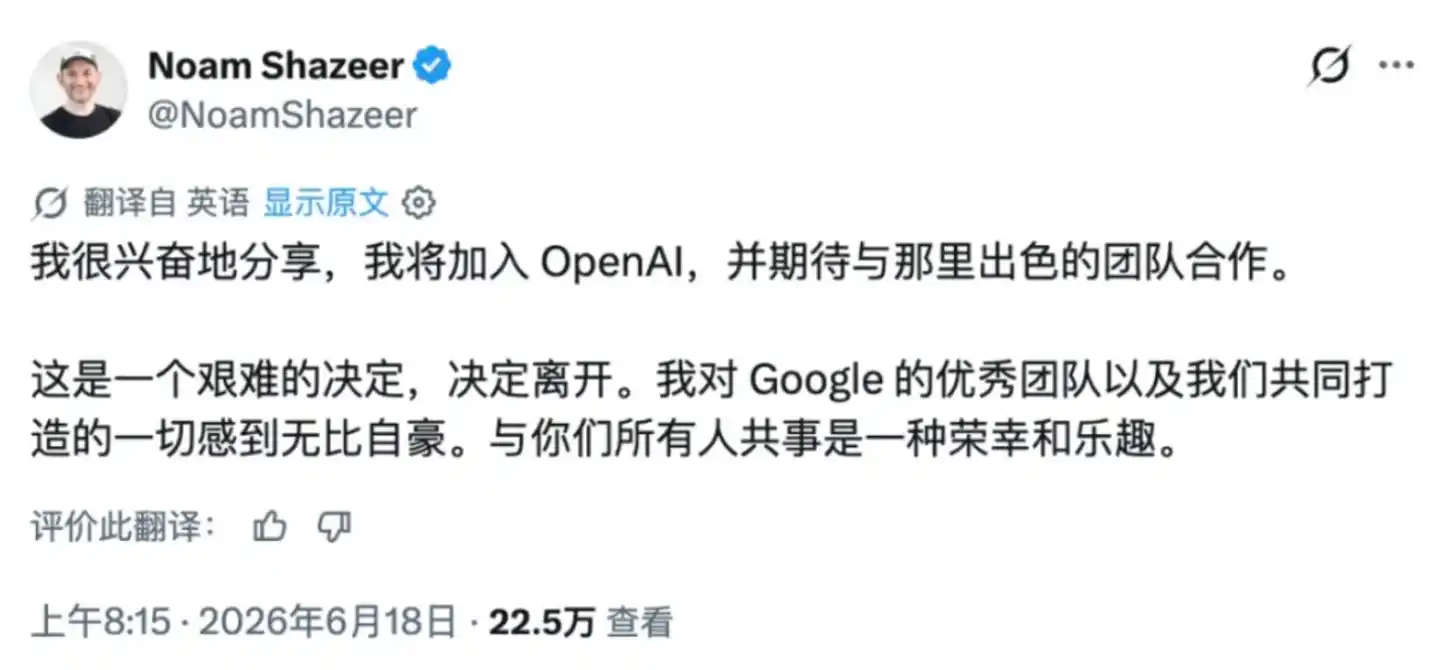
Altman wrote on X: "Noam was one of the people I most wanted to work with when I started OpenAI. It only took 10 years. Worth it."

OpenAI's Chief Research Officer Mark Chen promptly announced: Noam Shazeer joins as Head of Architecture Research.
The entire internet lined up to cheer, "With the father of Transformer in charge, the next super-intelligence is guaranteed."

The same week, another document circulated within the industry: the first complete exposure of audited financial data shows OpenAI's 2025 revenue at $13.07 billion, with an operating loss of $20.92 billion. Including a one-time non-cash provision for restructuring, the net loss was nearly $39 billion. Even deducting that non-recurring accounting phantom loss, the real cash flow operating hemorrhage remains a bottomless pit. In Q1 2026, cash burn was $3.7 billion, exceeding half of the revenue for the same period.

So before hastily cheering that "OpenAI is steady," this isn't a technical success story at all—it's merely a check written on the back of $20.92 billion in operating losses. What OpenAI bought has nothing to do with the future; it's just a page in a story for the next round of investors.

Talent Is Leaking, Stars Are Filling In

Noam's resume is indeed dazzling. Core author of the 2017 paper "Attention Is All You Need," key contributor to Transformer, MoE, and T5. He left Google in 2021 to found Character.AI. In 2024, Google brought him back with a $2.7 billion technology licensing agreement, appointing him co-lead of Gemini. Less than two years later, he departed again.

Google proved one thing with $2.7 billion: Money can buy someone's time, but it can't buy the soil that makes them stay. Now OpenAI intends to try again with equity.

But OpenAI's soil isn't necessarily more suitable for pure research than Google's. Over the past three years, this company has been witnessing a talent swap: co-founder Karpathy left, Ilya Sutskever left, John Schulman left, and Jan Leike, head of the superalignment team, left. Large swaths of the core founding team have departed, leaving few in the core decision-making layer.

According to public industry data, research positions accounted for 23% of OpenAI's total hires in 2021 but dropped to 4.4% by 2024. Former internal researchers bluntly stated: The team's focus has shifted entirely from "exploratory research" to "product iteration." A few people jumping ship is just the surface. The truth that the research soil is being inch-by-inch squeezed out by product KPIs can no longer be hidden.

What he's facing is fundamentally not a lab starting from scratch. The system that Karpathy couldn't tolerate—and could only pursue "personal projects" within—is the mess Noam is inheriting. He's merely filling the hole left by the departure of Karpathy and others.

Sky-High Talent Buys Can't Save the Accounting Dilemma

Everyone is discussing what new architecture Noam can bring to OpenAI. But OpenAI's current predicament has nothing to do with "lacking someone who can write Transformer."

The financial figures are laid bare: In 2025 alone, R&D expenses included a $10.59 billion computing power leasing fee paid to Microsoft; total annual R&D cost was $19.18 billion; inference computing costs were $7.5 billion; and sales and marketing investments were $5.73 billion. On the other side are 900 million weekly active users, with only 50 million being paid users. Massive free traffic is a pure cost bottomless pit—the larger the user scale, the heavier the computing bill.

Even OpenAI itself is cutting costs: leaked documents show it has scaled back the Sora video model and trimmed non-core businesses to control costs. Cutting businesses to save money on one hand while spending exorbitantly to hire people on the other is anxious procurement.

The anxiety isn't unique to OpenAI; the industry wind has shifted long ago.

Microsoft's own Copilot Cowork has already abandoned the unlimited pricing model for a pay-per-use system due to high costs, and reportedly even considered integrating DeepSeek V4 as a cost-effective option. Even GitHub, under Microsoft, has turned to AWS for support due to AI computing shortages. If the financier's own computing pool isn't sufficient, who will foot OpenAI's astronomical computing bill next?

Cook publicly warned that the AI boom has driven storage chip prices up fourfold since 2024, a trend expected to continue until 2027, potentially increasing the price of the next iPhone by $270. These numbers serve more as industry indicators; the real hard math is inside OpenAI: computing hardware costs continue to climb, and efficiency gains from model architecture optimization simply can't keep pace with hardware price hikes. Noam can design more efficient model structures, but he can't fix the CFO's nightmare. Every additional free user adds another rigid computing bill.

The technical side offers no answers; the capital side must.

OpenAI is in a critical window of IPO preparation, with valuations touted as high as $1 trillion. Underwriters need sufficiently impactful stories to support the valuation. "The father of Transformer overseeing R&D" is exactly the kind of narrative material capital markets love most. The calculation for this investment isn't about how much model performance improved; the core question is whether it adds another highlight to the roadshow PPT.

Retail investors might get excited about "the father of Transformer joining," feeling the technical moat has thickened. But institutional investors, seeing the $20.92 billion operating loss in 2025, will only ask three practical questions:

Will this person suddenly make free users willing to pay?

Can he get Microsoft to discount the $10.59 billion computing bill?

Can he make departed research veterans return?

If the answer to all is no, then his value is merely a footnote in the valuation story. The biggest winners are always the early shareholders and underwriters. One more "genius in charge" story allows them to gracefully transfer the risk of $20.92 billion in operating losses to secondary market bag holders.

The Winner Between Two Paths Is Already Emerging

What is Anthropic doing during the same period?

In enterprise adoption rate statistics from multiple institutions, Anthropic's share has climbed to the 35%-40% range, significantly narrowing the lead with OpenAI and even surpassing it in some samples. More critically is its customer mix, with about 80% of revenue coming from enterprise clients; many Fortune 100 companies have already listed Claude on their procurement sheets. The company reportedly achieved its first profitable quarter in history and has confidentially filed for an IPO. Anthropic opens an office in Seoul, taking orders from NAVER and Nexon, earning real cash flow.

Anthropic didn't poach the "father of Transformer," nor does it rely on a single genius to prop up valuation. It relies on its enterprise-focused, compliant, neutral positioning, controllable token costs, and deep integration of Claude Code into development scenarios. What enterprise clients want has little to do with parameter counts; they want a "safety net that won't cause trouble" and a ledger that makes sense.

Google DeepMind's Hassabis hasn't moved in a decade, and Google didn't spend $2.7 billion to "redeem" him from outside. True innovative soil, which grows and retains research talent, cannot be bought annually for billions spent on external stars. The soil is only alive when it nurtures and keeps its own talent.

Anthropic has proven one thing: Profitability has little to do with individual genius; the foundation lies in the commercial soil.

OpenAI has also proven one thing: Individual genius cannot mask the hardening of commercial soil. Especially when you're buying talent at sky-high prices while watching your homegrown talent leave.

Conclusion

The next-generation architecture led by Noam will take at least 1 to 2 years to materialize. Yet, extrapolating from the Q1 2026 burn rate of $3.7 billion, annual cash consumption will not be less than $14.8 billion. This hasn't even accounted for the inevitably inflated marketing and compliance costs before the IPO.

Google spent $2.7 billion to rent one person for two years; OpenAI now intends to rent again using equity. The difference isn't the payment method. Google at least had its income statement to cushion it then; OpenAI's money for this is written on the back of $20.92 billion in operating losses, discounted by IPO valuation bubbles.

The ledger doesn't care about genius. The ledger only cares: How many quarters do you have left to wait?


Criptos en tendencia

Preguntas relacionadas

QWhat is the main argument of the article regarding OpenAI's hiring of Noam Shazeer?

AThe article argues that OpenAI's high-profile hiring of Noam Shazeer is primarily a strategic move to create a compelling narrative for its upcoming IPO and to appease investors, rather than a genuine solution to its deep-seated financial and structural problems. It suggests the company is using the 'Transformer co-inventor' story to divert attention from its massive operating losses and ongoing cash burn.

QWhat financial challenges for OpenAI are highlighted in the article?

AThe article highlights severe financial challenges: an operating loss of $20.92 billion in 2025, a net loss nearing $39 billion after accounting adjustments, and a cash burn of $3.7 billion in Q1 2026 alone. Key cost drivers include a $10.59 billion compute rental fee paid to Microsoft, $19.18 billion in total R&D costs, and the burden of serving a massive free user base (900M WAUs) with only 50M paying users.

QHow does the article contrast OpenAI's approach with that of its competitor Anthropic?

AThe article contrasts OpenAI's reliance on star hires and consumer-focused growth with Anthropic's business-oriented, sustainable model. Anthropic is reported to have reached profitability, with around 80% of its revenue from enterprise clients, focusing on compliance, controlled costs, and deep product integration (like Claude Code). This is presented as a more stable path compared to OpenAI's high-burn, narrative-driven strategy.

QWhat point does the article make about the 'research soil' or culture at OpenAI?

AThe article contends that OpenAI's internal 'research soil' has deteriorated, shifting from exploratory research towards product iteration and KPIs. This is evidenced by the exodus of founding researchers (like Karpathy, Sutskever) and a sharp drop in research hiring (from 23% of hires in 2021 to 4.4% in 2024). It suggests Noam Shazeer is entering a system that previously couldn't retain top research talent, questioning the long-term viability of a pure research role there.

QWhat is the article's view on the real value of hiring a top AI researcher like Noam Shazeer for OpenAI's core problems?

AThe article is skeptical, arguing that a brilliant architect like Noam Shazeer cannot solve OpenAI's fundamental business model flaws. His technical optimizations cannot significantly reduce the crippling compute costs, convert free users to paid ones, or lower Microsoft's bills. His primary value, according to the article, is as a 'footnote' in a valuation story to help justify a high IPO price and transfer financial risk to public market investors.

Lecturas Relacionadas

Behind the AI Scorecards Lies a Chinese 'Question Setter'

Behind the AI scorecards that dominate industry discussions—benchmarks like MMLU-Pro, MMMU, and MMMU-Pro—stands a Chinese-Canadian researcher: Wenhu Chen. As an assistant professor at the University of Waterloo and founder of the TIGER Lab, Chen has become a key "exam-setter" for evaluating large language and multimodal models. Chen first gained broader recognition with MMLU-Pro, a more challenging and stable update to the popular MMLU benchmark. As top models like OpenAI’s o3 began achieving near-perfect scores on the original MMLU, it became difficult to distinguish their true capabilities. MMLU-Pro introduced more complex reasoning questions, expanded answer choices, and filtered out ambiguous or simple items, effectively reintroducing differentiation among state-of-the-art models. His work on MMMU addressed the evaluation of multimodal models, requiring them to integrate visual information (like charts, diagrams, or tables) with textual knowledge across diverse academic subjects. Even the strongest models initially scored only around 56-59%, highlighting significant room for improvement in genuine multimodal reasoning. MMMU-Pro further refined this by preventing models from bypassing visual cues. Chen’s research focus has long been on complex information understanding and reasoning. His background—including a PhD at UC Santa Barbara, research at Google/DeepMind on Gemini, and now a role in Meta’s superintelligence lab—provides deep insight into model development and their potential weaknesses. His TIGER Lab also builds models (e.g., for video understanding and generation), ensuring his evaluation benchmarks are grounded in practical challenges. While AI headlines often spotlight company leaders and product launches, Chen’s work exemplifies the critical, behind-the-scenes contributions of researchers crafting the rigorous standards that define and drive progress in AI capabilities.

marsbitHace 31 min(s)

Behind the AI Scorecards Lies a Chinese 'Question Setter'

marsbitHace 31 min(s)

STRC Unpegged by 11%, Can Strategy's Perpetual Motion Machine Keep Turning?

STRC, the perpetual preferred stock of MicroStrategy, is experiencing a persistent de-pegging from its target par value of $100, with the discount recently widening to over 11%. This de-anchoring challenges the core design of STRC, which was intended as a stable, income-oriented security operating near $100. As a crucial funding engine for MicroStrategy's Bitcoin acquisition strategy, STRC's price reflects market confidence in the company's entire capital model. The company's "capital flywheel" relies on issuing STRC at or above $100 via an At-the-Market (ATM) program to raise cash for buying Bitcoin, thereby boosting company equity and theoretically supporting STRC's value. A monthly adjustable dividend mechanism was designed to maintain this peg. Despite raising the dividend to 11.5% and increasing payment frequency, the de-pegging persists. Market concerns extend beyond technical factors like leveraged arbitrage unwinding. Analysts point to MicroStrategy's limited cash reserves relative to its ~$1.7 billion annual dividend obligation for preferred shares. While the company counters that its vast Bitcoin holdings could cover decades of payments, this argument hinges on the potential need to sell Bitcoin—a shift from its longstanding "hodl" narrative. The company's recent sale of a small amount of BTC, framed as a test, amplified these liquidity and strategy concerns. If STRC remains discounted, impairing MicroStrategy's ability to raise cheap capital, fears may grow that the company could sell more Bitcoin to meet obligations. This scenario could transform MicroStrategy from a major market buyer into a potential seller, posing significant downside risk for Bitcoin. The re-pegging of STRC is thus a key indicator for the health of MicroStrategy's capital structure and its market impact.

Odaily星球日报Hace 45 min(s)

STRC Unpegged by 11%, Can Strategy's Perpetual Motion Machine Keep Turning?

Odaily星球日报Hace 45 min(s)

Silicon Valley's Most Sought-After New Role Has Emerged

Silicon Valley's New Most Wanted Job: The Rise of the Forward Deployment Engineer The AI industry is witnessing a significant shift. The focus has moved from developing cutting-edge models to deploying them effectively within enterprises. This has made the "Forward Deployment Engineer" (FDE) a critical and highly sought-after role at major firms like OpenAI, Anthropic, and Google. For the past three years, the industry prioritized model scientists. However, companies are now facing a harsh reality: purchasing powerful AI tools does not guarantee productivity gains or organizational change. The biggest hurdle is not the technology itself, but integrating it into complex legacy systems, workflows, and corporate cultures. This includes challenges like data silos, compliance requirements, and internal resistance. The FDE role, pioneered by Palantir Technologies, addresses this "last-mile" problem. FDEs are deployed on-site with clients for extended periods. Their job is to deeply understand the client's specific organizational structure, processes, and pain points, then tailor and implement the AI solution accordingly. They combine skills in technology, project management, and organizational change. A clear signal of this trend emerged in May 2026 when three AI giants made major moves. Anthropic launched a $1.5B joint venture for enterprise deployment. OpenAI formed an independent deployment subsidiary, DeployCo, with over $4B in commitments and acquired a deployment consultancy. Google Cloud's CEO publicly announced a large-scale recruitment drive for FDEs. This shift represents a fundamental change in the software business model: from selling tools to selling guaranteed outcomes. FDEs are the agents of this change, responsible for delivering a working system within the production environment, not just a demo. Real-world cases, such as challenges at Goldman Sachs (compliance barriers) and Target (internal cultural resistance), illustrate that the primary obstacles to AI adoption are organizational, not technical. An FDE's value lies in navigating these human and procedural complexities to facilitate a successful "AI migration." In essence, as core AI technology becomes more accessible and affordable, the true premium is shifting to the human expertise required to understand organizations and drive change—making the FDE role pivotal for the next phase of the AI revolution.

marsbitHace 45 min(s)

Silicon Valley's Most Sought-After New Role Has Emerged

marsbitHace 45 min(s)

When the World Cup Collides with Agents: From Web2 to Web3, How Are Wallets Evolving into Agentic Wallets?

World Cup as a Catalyst for Agentic Wallets: From Web2 to Web3 This article explores how the World Cup provides a real-world scenario for observing the evolution of digital wallets from simple asset managers towards "Agentic Wallets"—intelligent, AI-powered interfaces. Using the example of prediction markets like Polymarket, it illustrates how AI Agents can lower the barrier to Web3 interaction. Instead of navigating complex DApps, users can express intent in natural language (e.g., "I think Portugal will win") within platforms like Discord or web pages. The Agent then interprets this intent, finds the relevant market, and seamlessly guides the user through the on-chain transaction via their wallet. The core shift is from wallets as mere "function menus" for signing transactions to "intent interpreters" that understand user goals. The article highlights parallel developments in traditional finance, such as Mastercard's "Agent Pay" and WeChat Pay's AI tests, which focus on granting AI controlled, authorized, and auditable payment capabilities. This underscores a broader trend of AI entering the financial layer. However, the article emphasizes that the primary challenge for Agentic Wallets in Web3 is not automation but establishing clear security boundaries. Unlike traditional systems with chargebacks, on-chain transactions are often irreversible. Therefore, future wallets must ensure users retain ultimate control and comprehension. They need to transparently communicate an Agent's permissions, spending limits, authorized durations, and provide easy ways to pause or revoke access. The World Cup experiments represent early steps toward wallets that are not just applications but ubiquitous, intelligent interfaces that simplify Web3 while keeping users securely in control.

marsbitHace 2 hora(s)

When the World Cup Collides with Agents: From Web2 to Web3, How Are Wallets Evolving into Agentic Wallets?

marsbitHace 2 hora(s)

Options Don't Work in DeFi? Vitalik Might Not Agree

For years, the prevailing view has been that options struggle to gain traction in DeFi due to complexity, fragmented liquidity, and lack of natural demand compared to products like perpetual futures. However, a recent algorithmic stablecoin design proposed by Vitalik Buterin presents a different perspective, using options not as a standalone trading product, but as foundational infrastructure for other financial instruments. In this design, one unit of ETH is split into two components: a "stable" side (P) that retains value up to a specified strike price, and an "upside" side (N) that captures all appreciation above that strike. Combined, they always equal one ETH, eliminating debt, margin, and liquidation risks inherent in typical collateralized debt position (CDP) stablecoins. The stable component essentially mimics the payoff of a covered call option. To function as a stablecoin, this structure requires continuously rolling deep in-the-money calls, which introduces challenges like rollover slippage, predictable transaction flow vulnerable to front-running, and persistent liquidity needs. A core hurdle is finding consistent buyers for the leveraged ETH upside exposure (N). While it offers leverage without funding rates or liquidation, it must compete with simpler alternatives like direct call options or perpetuals. The system's scalability depends on a sustained demand for this specific form of leverage. The author draws parallels to their experience with Rysk, where earlier versions of DeFi options protocols struggled. The breakthrough came with Rysk V12, which aligns incentives: asset holders generate yield by selling covered calls against their holdings, while market makers efficiently acquire the desired option exposure. This demonstrates that options can find product-market fit when embedded as a risk distribution and pricing engine within structured products, stablecoins, or yield-generating assets, rather than marketed as a complex direct trading instrument. Vitalik's proposal reinforces this architectural approach—using fully collateralized, non-custodial, and physically settled options as a fundamental building block. The real opportunity for options in DeFi may lie not in becoming the next perpetual swap, but in powering the next generation of on-chain financial products.

marsbitHace 2 hora(s)

Options Don't Work in DeFi? Vitalik Might Not Agree

marsbitHace 2 hora(s)

Trading

Spot
Futuros

Artículos destacados

Cómo comprar BILL

¡Bienvenido a HTX.com! Hemos hecho que comprar Billions Network (BILL) sea simple y conveniente. Sigue nuestra guía paso a paso para iniciar tu viaje de criptos.Paso 1: crea tu cuenta HTXUtiliza tu correo electrónico o número de teléfono para registrarte y obtener una cuenta gratuita en HTX. Experimenta un proceso de registro sin complicaciones y desbloquea todas las funciones.Obtener mi cuentaPaso 2: ve a Comprar cripto y elige tu método de pagoTarjeta de crédito/débito: usa tu Visa o Mastercard para comprar Billions Network (BILL) al instante.Saldo: utiliza fondos del saldo de tu cuenta HTX para tradear sin problemas.Terceros: hemos agregado métodos de pago populares como Google Pay y Apple Pay para mejorar la comodidad.P2P: tradear directamente con otros usuarios en HTX.Over-the-Counter (OTC): ofrecemos servicios personalizados y tipos de cambio competitivos para los traders.Paso 3: guarda tu Billions Network (BILL)Después de comprar tu Billions Network (BILL), guárdalo en tu cuenta HTX. Alternativamente, puedes enviarlo a otro lugar mediante transferencia blockchain o utilizarlo para tradear otras criptomonedas.Paso 4: tradear Billions Network (BILL)Tradear fácilmente con Billions Network (BILL) en HTX's mercado spot. Simplemente accede a tu cuenta, selecciona tu par de trading, ejecuta tus trades y monitorea en tiempo real. Ofrecemos una experiencia fácil de usar tanto para principiantes como para traders experimentados.

275 Vistas totalesPublicado en 2026.05.07Actualizado en 2026.06.02

Cómo comprar BILL

Discusiones

Bienvenido a la comunidad de HTX. Aquí puedes mantenerte informado sobre los últimos desarrollos de la plataforma y acceder a análisis profesionales del mercado. A continuación se presentan las opiniones de los usuarios sobre el precio de BILL (BILL).

活动图片