Commerce Ministry's Latest Export Controls Target 10 US Companies: Three Market-Moving Threads Explained

marsbitPublicado a 2026-06-22Actualizado a 2026-06-22

Resumen

China's Ministry of Commerce placed 10 U.S. entities, including MP Materials, USA Rare Earth, Red Cat Holdings, and Teal Drones, on an export control list, banning the export of dual-use items. This move is seen as part of an ongoing countermeasure in the rare earth sector. The analysis suggests the primary impact is on U.S. companies within the **military, drone, and rare earth** sectors, aiming to restrict their access to critical Chinese materials and technology. For the Chinese market, the event is interpreted as reinforcing the **strategic value and pricing power** of domestic rare earth suppliers. However, the potential stock market reactions are nuanced: 1. **Chinese Rare Earth Upstream:** Companies like Northern Rare Earth are near yearly highs, indicating this event's "beneficiary" logic is largely priced in. It may confirm the trend but is unlikely to be a new major catalyst. 2. **Chinese Rare Earth Mid/Downstream & Drones:** Sectors like magnetic materials (e.g., Da Di Bear, Zhenghai Magnetic) and military drones (e.g., China Aerospace) are relatively undervalued. While the drone listing highlights sectoral competition, it doesn't directly translate to new orders for Chinese firms. 3. **Impact on Listed U.S. Companies:** The effect on stocks like MP Materials is ambiguous. While Chinese restrictions pose a challenge, these companies are also core to U.S. supply chain security efforts and may receive increased government support, potentially offsetting negative...

Author: David, Chao Xiang Research

On June 22nd, the Ministry of Commerce issued Announcement No. 23 of 2026, adding 10 U.S. entities including Ivex, Red Cat Holdings, and MP Materials to the export control list, prohibiting the export of dual-use items to them; on the same day, an additional 46 U.S. companies were added to the government procurement restriction list.

(Author's note: Dual-use items refer to goods, technologies, and services that have both civilian and military applications or can enhance military potential.)

This marks another round in the normalization of China's rare earth countermeasures since October 2025. The 10 targeted U.S. companies are primarily concentrated in three sectors: defense, drones, and rare earths.

The two most prominent names on the list are MP Materials and USA Rare Earth, both flagships of the U.S. rare earth industry. China's action against them prompted the market's initial reaction to favor the A-share rare earth sector: with competitors being restricted, domestic players gain greater scarcity and value.

The question is, the rare earth sector has been rising from last October until now, with leading upstream companies already near their year-to-date highs. Is it too late to react now?

If it is late, where might the money go?

The Commerce Ministry's control list involves more than just the rare earth thread. The fully appreciated rare earth sector might still have further catalysts ahead, and overlooked, less popular threads might still be under the radar.

We attempt to outline the potentially affected threads and place them on a price coordinate for reference.

Key Conclusions

1 The upstream A-share rare earth sector is fully priced-in; this control measure is not a new catalyst.

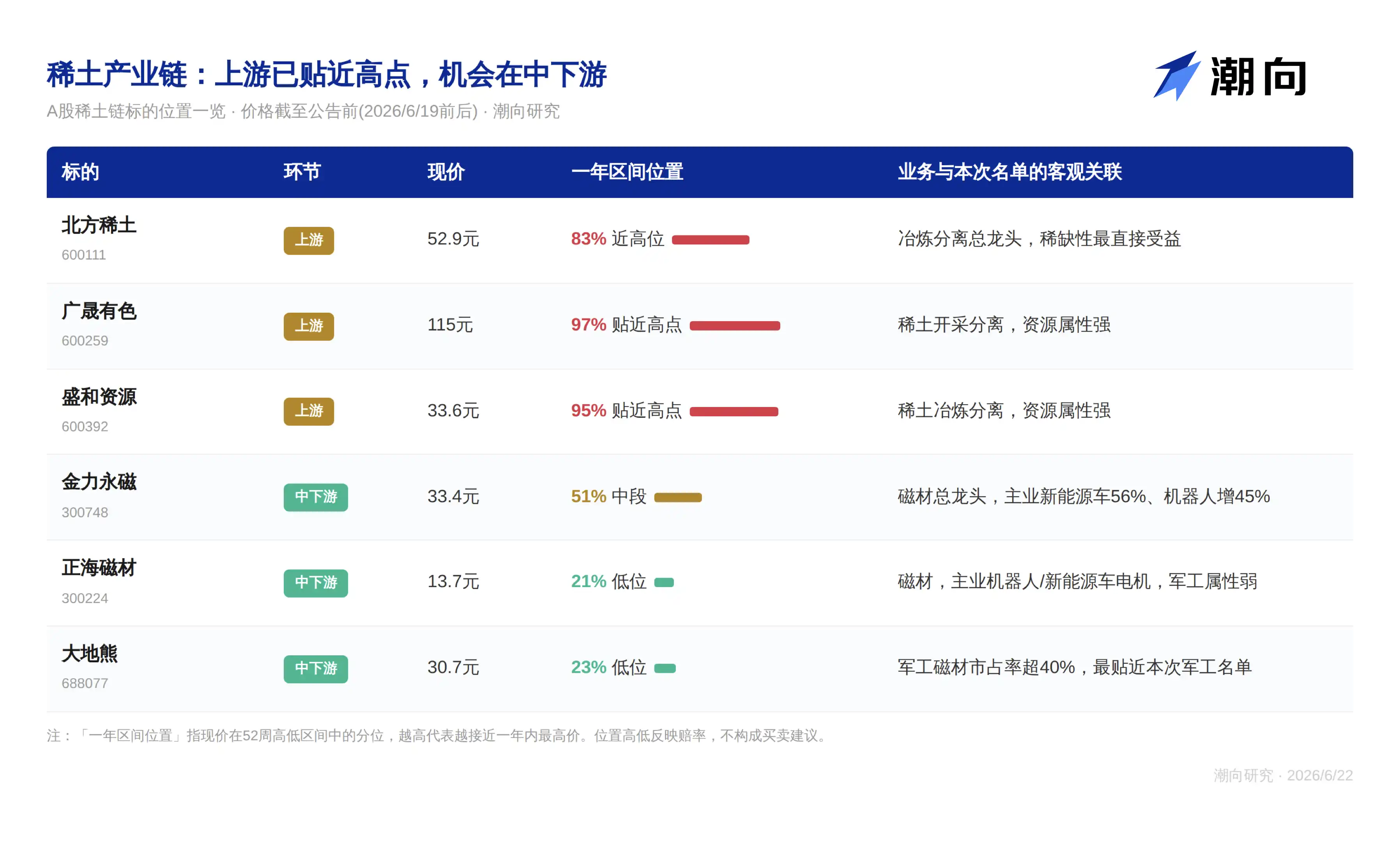
Northern Rare Earth's current price of 52.9 yuan is only about 20% away from its one-year high of 63.6 yuan; Guangdong Rising Nonferrous Metals at 115 yuan and Shenghe Resources at 33.6 yuan are both close to their one-year highs. These upstream resource stocks have been trending upward since October last year, and the logic of "benefiting from rare earth countermeasures" has largely been priced in. For the upstream rare earth industry, this control measure is more of a reconfirmation of the trend rather than a new starting point for a rally.

2 The relatively underpriced segments are the mid-to-downstream rare earth magnet materials and the drone industry chain.

Within the same rare earth chain, valuations in the midstream and downstream are significantly lower than upstream:

Magnet sector players like Earth-Panda (30.7 yuan) and Sinomag (13.7 yuan) are still near the lower end of their one-year ranges, their gains notably lagging behind upstream resource stocks. The drone sector corresponding to Red Cat and Teal Drones on the control list is even quieter, with Avic UAS near its one-year low and receiving limited market attention. The pricing progress of various segments is not uniform under the same event.

3 The targeted U.S. stocks do not necessarily constitute a one-sided negative; the open market needs to verify.

MP Materials and USA Rare Earth are core players in the U.S. domestic rare earth supply chain, with MP having background investment from the U.S. Department of Defense.

For such companies, China's export controls and U.S. policy support are two coexisting forces, and their impact directions may not align. All three mentioned stocks were not at low levels before the announcement. The announcement was made on Monday before U.S. markets opened, so their true pricing reaction awaits the market's verdict.

Investors holding related positions should pay close attention to the post-open price action.

Why Do Export Controls Benefit Domestic Rare Earths?

Many find it counterintuitive at first glance: banning exports means Chinese businesses do less trade, so how is that a positive?

The key lies in the direction of the control. This ban prevents China from selling rare earth-related items to those 10 U.S. companies, cutting off the supply sources for these American firms, not the raw material procurement for Chinese manufacturers.

China's rare earth industry, from mining, smelting, and separation to magnet manufacturing, is the world's most complete chain, self-sufficient and not reliant on sourcing from the U.S. In other words, this announcement does not affect Chinese suppliers' upstream operations; they can produce and export as usual.

It's the U.S. side that is truly pinched.

Companies like MP Materials and USA Rare Earth want to build a self-reliant supply chain bypassing China, yet they still depend on China for separation technology, equipment, and some intermediate materials. Restricting competitors' access conversely enhances the scarcity and bargaining power of Chinese companies within the global rare earth landscape, which is the real reason the market interprets this as positive for A-share rare earths.

Rare Earth Upstream is Fully Priced; Money Hasn't Flowed Downstream

First, clarify the chain. Rare earths are mined, then smelted and separated into materials like praseodymium-neodymium oxide; this is the upstream, handled by companies like Northern Rare Earth, Guangdong Rising Nonferrous Metals, and Shenghe Resources.

These raw materials are further processed into NdFeB permanent magnet materials and installed into various motors; this is the midstream and downstream, where JL Mag, Sinomag, and Earth-Panda operate.

The upstream sells raw materials; the downstream sells magnet materials.

In this round of market movement, money primarily surged into the upstream. Northern Rare Earth at 52.9 yuan, Guangdong Rising Nonferrous Metals at 115 yuan, and Shenghe Resources at 33.6 yuan are all near their one-year highs. The logic is straightforward: every time rare earths' strategic importance is emphasized, the first beneficiaries are the upstream players with mines and smelting capacity, whose scarcity is tangible.

In my view, this control event is a positive in the same direction for the upstream, but the price has already digested this expectation. Entering now is more like taking over at high levels, offering less favorable risk-reward.
Moving downstream to magnet materials, the pricing progress is noticeably slower.

Among the three magnet leaders, JL Mag, with 7.7 billion yuan in revenue and doubled net profit, saw its 2025 stock price rise over 90%, placing it at a high level. However, Sinomag and Earth-Panda are still pressed near the lower end of their one-year price ranges, not catching up with the upstream gains.

There is a background detail easily overlooked:

Since the second half of 2025, China has opened up exports to U.S. magnet manufacturers. For instance, JL Mag's U.S. sales reached 500 million yuan for the full year, up 40%; Sinomag and Earth-Panda also obtained U.S. export licenses. China's addition of 10 companies to the control list this time is a precise move under the framework of "allowing ordinary commercial customers while cutting off specific defense entities," not a comprehensive embargo.

Therefore, the impact of this logic on magnet companies' financial statements is actually limited.

The 10 restricted U.S. companies were not among their major clients to begin with. The real revenue for JL Mag and Sinomag comes from new energy vehicle and robot motors, largely unrelated to defense exports to the U.S.

This control measure is more of a sentiment boost for the magnet stock sector, unlikely to translate into tangible orders. However, regarding the rare earth downstream, what's truly noteworthy might be which company's business aligns more closely with the defense theme of this list.
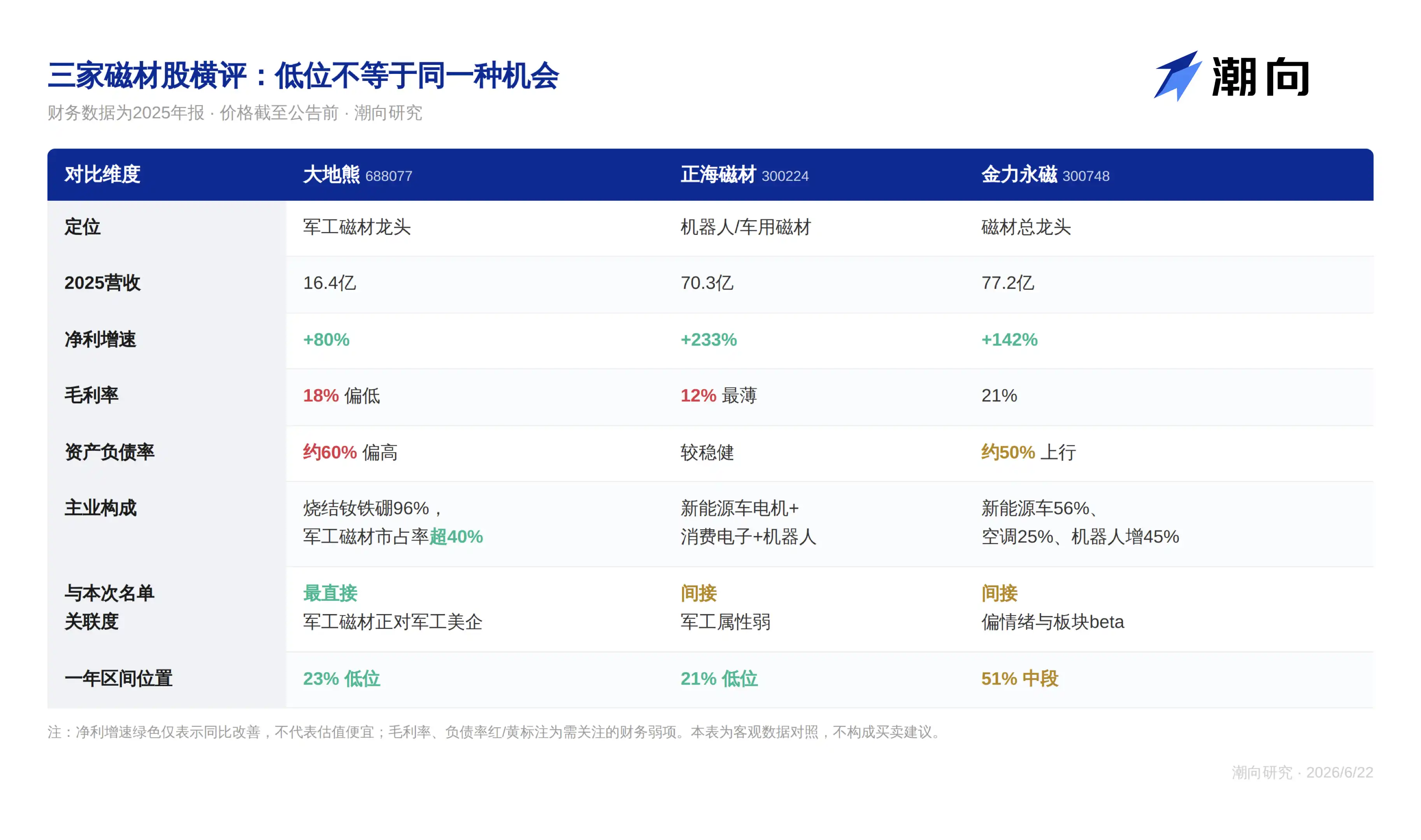
On this point, Earth-Panda aligns better than the other two.

Earth-Panda has a small market cap, with 2025 revenue of 1.6 billion yuan and net profit of 57.4 million yuan. However, it is a major domestic supplier of defense magnet materials, with publicly available data showing over 40% market share in this segment. Its products are used in equipment like aero engines and missiles, directly corresponding to the targeted defense and drone U.S. companies on the control list. This is its most direct narrative link to the event.

However, narrative alignment doesn't equal stability: financially, its gross margin is only 18%, and its debt ratio is nearing 60%, indicating weaker profitability and financial safety compared to peers. Combined with its small market cap, its stock price can bounce up quickly but also plummet sharply.

It suits those who can tolerate volatility and prioritize "purest theme," not as a cornerstone holding.

Sinomag represents another type. Its 2025 net profit more than tripled, a reversal much stronger than Earth-Panda's, but driven by humanoid robots and new energy vehicle motors, largely unrelated to this defense list. Its low price is more due to the robotics story not being fully priced in by the market yet.

Therefore, reading the rare earth thread reveals two different situations upstream and downstream.

Upstream holds resources with the most tangible scarcity, but prices have already reflected the positives; it's now a high-level handoff. Downstream magnet materials are still at low levels. Earth-Panda aligns more with the defense list, at the cost of a small market cap and weak finances. Sinomag is cheap but has weak relevance.

Drones: The List Points to This Thread, But No Direct Positive

Red Cat Holdings and its subsidiary Teal Drones on the control list produce military reconnaissance and strike drones in the U.S., exactly the type of military drone suppliers the U.S. aims to support to replace Chinese products.

The market naturally associates this with the A-share military drone sector, but the positive logic here is likely not the same as for rare earths. This won't directly bring orders to any specific Chinese drone company. It's more about bringing "Sino-U.S. competition in military drones" to the forefront, prompting the market to refocus on the strategic value and military export competitiveness of domestic military drones.

Following this thread to find corresponding A-share targets, the most business-aligned company is Avic UAS.

Avic UAS is a leader in large domestic military drones. Its core product is the Wing Loong series of reconnaissance-strike integrated drones, with drone systems accounting for over 90% of its main revenue. It primarily exports through military trade, being a main force in China's military drone exports.

In terms of business alignment, it indeed competes in the same arena as the targeted U.S. drone companies, making it the highest relevance play on this thread.

Its current price is 44 yuan, at the lower end of its one-year range. However, this position formed after a decline from highs, not from a lack of movement.

Its 2025 financial report shows significant performance growth with military trade orders, with revenue in the first three quarters more than tripling year-on-year, and the stock price once reached 48 yuan. The current pullback is more akin to cooling off after realization.

It's important to note that military trade revenue heavily depends on single large orders. Revenue fell nearly 70% year-on-year in 2024, turning to a loss, then rebounded strongly in 2025. This boom-bust characteristic means judging its cheapness based on price position is unreliable. The real variable is the signing and delivery rhythm of subsequent military trade orders. Valuation-wise, the company's P/E ratio has long been in the tens, not constituting undervaluation.

Export Restrictions Do Not Equate to Pure Negatives for Corresponding U.S. Stocks

This is the primary concern for holders of related U.S. stocks, and the answer might differ from intuition: not necessarily.

The most significant names on the export control list, MP Materials and USA Rare Earth, are core vehicles for the U.S. to reduce its reliance on Chinese rare earths. MP is the only vertically integrated rare earth producer of scale in the U.S., receiving investment from the U.S. Department of Defense in 2025, making it an object of national strategic support. This status determines its dual-sided situation:

China cuts off its access to Chinese dual-use items, but precisely due to supply chain security concerns, the U.S. government might instead provide it with more orders and subsidies.

Pre-announcement prices also support this view. MP, USA Rare Earth, and Red Cat Holdings were not at low levels before the control news emerged. The market did not sell off in advance due to "potential sanctions," indicating investors had not previously priced them simply as victims.

Of course, the final direction depends on the market opening. The announcement was made on Monday before U.S. markets opened. Whether sanctions are read as a material negative or offset by support expectations will be answered by post-open trading.
Note: This article is for information organization and viewpoint analysis. The mentioned stocks, ratings, and target prices are from public sources and are time-sensitive, constituting no investment advice. The market involves risks; decisions require independent judgment.


Criptos en tendencia

Preguntas relacionadas

QAccording to the article, which A-share sectors are most impacted by China's new export controls on 10 US companies, and what is their current market pricing situation?

AThe export controls primarily impact three A-share sectors: 1) Rare Earth Upstream (e.g., Northern Rare Earth, Guang Sheng Nonferrous): These stocks are already trading near their yearly highs, meaning the 'benefit from export controls' logic is largely priced in. 2) Rare Earth Mid/Downstream (Magnet materials like Da Di Bear, Zhenghai Magnetic Material): These are still at the lower end of their yearly price range, with valuations significantly lagging behind upstream stocks. 3) Drone Sector (e.g., AVIC UAV): Specifically, military drones like AVIC UAV are mentioned as thematically related to the sanctioned US drone companies, but the stock is near its yearly low without a direct order boost from this event.

QWhy does the article suggest that the export controls could be a positive for China's rare earth sector, even though it restricts business?

AThe controls restrict Chinese companies from selling dual-use items *to* the 10 listed US firms, cutting off their supply sources. Since China's rare earth sector has a complete, self-sufficient supply chain and does not rely on raw materials from the US, its production is unaffected. By constraining key US competitors like MP Materials and USA Rare Earth (which still depend on some Chinese technology/inputs), the controls enhance the scarcity and bargaining power of Chinese rare earth suppliers in the global market, which is interpreted as a positive for the sector.

QAmong the rare earth magnet material (downstream) companies mentioned, which one is highlighted as having the most direct thematic link to the US entities on the sanctions list, and what are the associated risks?

ADa Di Bear (大地熊) is highlighted as having the most direct link because it is a major domestic supplier of rare earth magnets for military applications (e.g., aircraft engines, missiles), aligning with the sanctioned US defense and drone companies. The associated risks are its smaller market capitalization, weaker financials (lower gross margin, higher debt ratio), and higher stock price volatility, making it suitable only for investors who can tolerate high risk and prioritize thematic purity.

QWhat is the article's assessment of the potential impact on the US companies (like MP Materials) added to the export control list? Is it purely negative?

ANo, the impact is not necessarily purely negative. The article argues that for core US strategic companies like MP Materials (which has US Department of Defense investment), the situation is two-sided. While Chinese export controls cut off access to certain Chinese dual-use items, these companies are also central to US efforts to build domestic supply chains. This strategic importance may lead to increased US government orders, subsidies, and policy support, which could counteract the negative impact of the sanctions. The market's pre-announcement pricing (these stocks were not at lows) also suggested investors hadn't priced them as simple victims.

QRegarding the drone sector, which A-share company is considered the most thematically aligned with the sanctioned US drone firms, and what key factor drives its investment value according to the article?

AAVIC UAV (中无人机) is considered the most thematically aligned, as its core product, the Wing Loong series of military reconnaissance/strike drones, competes directly in the same military export market as the sanctioned US companies (Red Cat, Teal Drones). However, the article states the export controls do not directly translate into new orders for AVIC UAV. Its investment value is primarily driven by the rhythm of subsequent military export order signings and deliveries, not its current stock price level. The company's revenue is characterized by significant year-to-year fluctuations based on large individual contracts.

Lecturas Relacionadas

Report Interpretation: J.P. Morgan Details Micron's Pre-Earnings Sentiment, Current Hardware Sector Dynamics

Morgan Stanley analyst Joshua Meyers' report (June 21, 2026) highlights key trends in the hardware and semiconductor sector ahead of Micron's earnings. The core takeaways are: 1. **Micron & Memory:** Memory remains a high-conviction long theme, driven by strong AI demand and rising ASPs. However, investor focus is shifting to the sustainability of Micron's >80% gross margins and the specifics of potential new long-term supply agreements (SCAs). 2. **Hardware Supply Chain:** AI-related demand for servers, networking, and storage remains robust, but company performance is diverging. Celestica (CLS) shows improved margin confidence, Western Digital and Seagate benefit from pricing, Fabrinet (FN) sees predictable AI optics growth, and Teradyne (TER) anticipates a new Google customer. 3. **AI Capex & WFE Forecasts:** JPMorgan increased its Wafer Fab Equipment (WFE) market growth forecasts to 28% in 2026 and 29% in 2027. AI infrastructure financing is evolving, with higher project-level debt reducing constraints on capex expansion. The report signals that while the AI-driven hardware cycle is strong, the market is entering a phase focused on execution verification (e.g., Micron's SCA details, Fabrinet's ramp with Amazon) and valuation sustainability. Key near-term signals include Micron's guidance, Arista Networks' outlook, and the pace of demand normalization post potential tariff-related pull-ins.

marsbitHace 5 hora(s)

Report Interpretation: J.P. Morgan Details Micron's Pre-Earnings Sentiment, Current Hardware Sector Dynamics

marsbitHace 5 hora(s)

Research Report Analysis: The Fed's New Chair's Debut – New Leader, But Same Script?

Report Analysis: Federal Reserve's New Chair Debut – A New Captain, But the Same Script? Morgan Stanley's chief global economist Seth B. Carpenter analyzes the first FOMC meeting under new Fed Chair Kevin Warsh in a June 21 report. Warsh deliberately avoided providing forward guidance on interest rates, aligning with his philosophy. However, market expectations for a rate hike this year were reinforced. Key signals lie elsewhere: inflation may fall more than expected, and quantitative tightening (QT) could be more aggressive than anticipated. The FOMC's "dot plot" suggests only one rate hike in 2026. Carpenter argues that if inflation undershoots forecasts, the logic for even a single hike weakens, especially as projections indicate potential rate cuts in 2027. On QT, Warsh's stance is clear. Carpenter notes that measures like halving the Treasury's account balance could shrink the Fed's balance sheet by around $500 billion with minimal market impact. Combined with adjustments to reserve interest and liquidity rules, the ultimate QT scale may exceed expectations, though its market effect might be less disruptive unless the Fed actively sells Mortgage-Backed Securities (MBS). While Warsh initiated a review of the Fed's policy framework, the 2% inflation target remains intact for now. The report concludes that the market may be overestimating the significance of reduced forward guidance and the near-term rate hike risk, while potentially underestimating the scope and manageable nature of the coming balance sheet reduction. The key debates will hinge on upcoming core PCE data, the specifics of the QT path, and the framework review's findings.

marsbitHace 6 hora(s)

Research Report Analysis: The Fed's New Chair's Debut – New Leader, But Same Script?

marsbitHace 6 hora(s)

Critical Game Week: BTC Retracement Confirmation vs. HYPE Support Battle | Guest Analysis

This weekly analysis outlines a critical juncture for BTC and HYPE markets, focusing on key price level confirmations. **BTC Analysis:** BTC is at a pivotal point after a five-wave rally from the June 5th low of $59,100. The price has broken below a short-term rising channel's lower boundary, with the current move seen as a pullback to test this breakdown. Failure to reclaim this level could lead to a retest of the $59,000-$60,000 support zone. The core scenario hinges on this channel retest outcome. * **Key Levels:** Resistance at $64,500-$65,000 (channel boundary) and $69,500-$70,500. Support at $59,000-$60,000 and $55,000. * **Strategy:** A core bearish stance is maintained (20% short from last week), with short-term plans for tactical trades. Three detailed contingency plans (A/B/C) are provided for short positions on resistance tests or breakdowns, emphasizing strict stop-loss discipline. **HYPE Analysis:** HYPE shows strong momentum but is currently in a corrective phase after hitting a new high of $76.94. The price is retesting the crucial $64-$66 support area. * **Key Levels:** Resistance near $77 and $80-$82. Support at $64-$66 and $52-$54. * **Strategy:** The short-term approach is "buy on dips, avoid chasing rallies." A long position is considered only if clear stabilization signals appear at the $64-$66 or deeper $52-$54 support zones, with tight risk controls. **General Risk Management:** A standardized trailing stop-loss protocol is emphasized: set initial stop, breakeven at +1% profit, then trail stops upward to lock in gains. *Disclaimer: All analysis is presented as a personal trading framework, not investment advice. Market conditions are complex and require dynamic adjustment.*

marsbitHace 6 hora(s)

Critical Game Week: BTC Retracement Confirmation vs. HYPE Support Battle | Guest Analysis

marsbitHace 6 hora(s)

Trading

Spot
Futuros

Artículos destacados

Qué es $S$

Entendiendo SPERO: Una Visión General Completa Introducción a SPERO A medida que el panorama de la innovación continúa evolucionando, la aparición de tecnologías web3 y proyectos de criptomonedas juega un papel fundamental en la configuración del futuro digital. Un proyecto que ha atraído la atención en este campo dinámico es SPERO, denotado como SPERO,$$s$. Este artículo tiene como objetivo reunir y presentar información detallada sobre SPERO, para ayudar a entusiastas e inversores a comprender sus fundamentos, objetivos e innovaciones dentro de los dominios web3 y cripto. ¿Qué es SPERO,$$s$? SPERO,$$s$ es un proyecto único dentro del espacio cripto que busca aprovechar los principios de descentralización y tecnología blockchain para crear un ecosistema que promueva la participación, la utilidad y la inclusión financiera. El proyecto está diseñado para facilitar interacciones de igual a igual de nuevas maneras, proporcionando a los usuarios soluciones y servicios financieros innovadores. En su esencia, SPERO,$$s$ tiene como objetivo empoderar a los individuos al proporcionar herramientas y plataformas que mejoren la experiencia del usuario en el espacio de las criptomonedas. Esto incluye habilitar métodos de transacción más flexibles, fomentar iniciativas impulsadas por la comunidad y crear caminos para oportunidades financieras a través de aplicaciones descentralizadas (dApps). La visión subyacente de SPERO,$$s$ gira en torno a la inclusividad, buscando cerrar brechas dentro de las finanzas tradicionales mientras aprovecha los beneficios de la tecnología blockchain. ¿Quién es el Creador de SPERO,$$s$? La identidad del creador de SPERO,$$s$ sigue siendo algo oscura, ya que hay recursos públicos limitados que proporcionan información de fondo detallada sobre su(s) fundador(es). Esta falta de transparencia puede derivarse del compromiso del proyecto con la descentralización, una ética que muchos proyectos web3 comparten, priorizando las contribuciones colectivas sobre el reconocimiento individual. Al centrar las discusiones en torno a la comunidad y sus objetivos colectivos, SPERO,$$s$ encarna la esencia del empoderamiento sin señalar a individuos específicos. Como tal, comprender la ética y la misión de SPERO sigue siendo más importante que identificar a un creador singular. ¿Quiénes son los Inversores de SPERO,$$s$? SPERO,$$s$ cuenta con el apoyo de una diversa gama de inversores que van desde capitalistas de riesgo hasta inversores ángeles dedicados a fomentar la innovación en el sector cripto. El enfoque de estos inversores generalmente se alinea con la misión de SPERO, priorizando proyectos que prometen avances tecnológicos sociales, inclusión financiera y gobernanza descentralizada. Estas fundaciones de inversores suelen estar interesadas en proyectos que no solo ofrecen productos innovadores, sino que también contribuyen positivamente a la comunidad blockchain y sus ecosistemas. El respaldo de estos inversores refuerza a SPERO,$$s$ como un contendiente notable en el dominio de proyectos cripto que evoluciona rápidamente. ¿Cómo Funciona SPERO,$$s$? SPERO,$$s$ emplea un marco multifacético que lo distingue de los proyectos de criptomonedas convencionales. Aquí hay algunas de las características clave que subrayan su singularidad e innovación: Gobernanza Descentralizada: SPERO,$$s$ integra modelos de gobernanza descentralizada, empoderando a los usuarios para participar activamente en los procesos de toma de decisiones sobre el futuro del proyecto. Este enfoque fomenta un sentido de propiedad y responsabilidad entre los miembros de la comunidad. Utilidad del Token: SPERO,$$s$ utiliza su propio token de criptomoneda, diseñado para servir diversas funciones dentro del ecosistema. Estos tokens permiten transacciones, recompensas y la facilitación de servicios ofrecidos en la plataforma, mejorando la participación y la utilidad general. Arquitectura en Capas: La arquitectura técnica de SPERO,$$s$ apoya la modularidad y escalabilidad, permitiendo la integración fluida de características y aplicaciones adicionales a medida que el proyecto evoluciona. Esta adaptabilidad es fundamental para mantener la relevancia en el cambiante paisaje cripto. Participación de la Comunidad: El proyecto enfatiza iniciativas impulsadas por la comunidad, empleando mecanismos que incentivan la colaboración y la retroalimentación. Al nutrir una comunidad sólida, SPERO,$$s$ puede abordar mejor las necesidades de los usuarios y adaptarse a las tendencias del mercado. Enfoque en la Inclusión: Al ofrecer tarifas de transacción bajas e interfaces amigables para el usuario, SPERO,$$s$ busca atraer a una base de usuarios diversa, incluyendo a individuos que anteriormente pueden no haber participado en el espacio cripto. Este compromiso con la inclusión se alinea con su misión general de empoderamiento a través de la accesibilidad. Cronología de SPERO,$$s$ Entender la historia de un proyecto proporciona información crucial sobre su trayectoria de desarrollo y hitos. A continuación se presenta una cronología sugerida que mapea eventos significativos en la evolución de SPERO,$$s$: Fase de Conceptualización e Ideación: Las ideas iniciales que forman la base de SPERO,$$s$ fueron concebidas, alineándose estrechamente con los principios de descentralización y enfoque comunitario dentro de la industria blockchain. Lanzamiento del Whitepaper del Proyecto: Tras la fase conceptual, se lanzó un whitepaper completo que detalla la visión, los objetivos y la infraestructura tecnológica de SPERO,$$s$ para generar interés y retroalimentación de la comunidad. Construcción de Comunidad y Primeras Interacciones: Se realizaron esfuerzos de divulgación activa para construir una comunidad de primeros adoptantes y posibles inversores, facilitando discusiones en torno a los objetivos del proyecto y obteniendo apoyo. Evento de Generación de Tokens: SPERO,$$s$ llevó a cabo un evento de generación de tokens (TGE) para distribuir sus tokens nativos a los primeros seguidores y establecer liquidez inicial dentro del ecosistema. Lanzamiento de la dApp Inicial: La primera aplicación descentralizada (dApp) asociada con SPERO,$$s$ se puso en marcha, permitiendo a los usuarios interactuar con las funcionalidades centrales de la plataforma. Desarrollo Continuo y Alianzas: Actualizaciones y mejoras continuas a las ofertas del proyecto, incluyendo alianzas estratégicas con otros actores en el espacio blockchain, han moldeado a SPERO,$$s$ en un jugador competitivo y en evolución en el mercado cripto. Conclusión SPERO,$$s$ se erige como un testimonio del potencial de web3 y las criptomonedas para revolucionar los sistemas financieros y empoderar a los individuos. Con un compromiso con la gobernanza descentralizada, la participación comunitaria y funcionalidades diseñadas de manera innovadora, allana el camino hacia un paisaje financiero más inclusivo. Como con cualquier inversión en el espacio cripto que evoluciona rápidamente, se anima a los posibles inversores y usuarios a investigar a fondo y participar de manera reflexiva con los desarrollos en curso dentro de SPERO,$$s$. El proyecto muestra el espíritu innovador de la industria cripto, invitando a una mayor exploración de sus innumerables posibilidades. Mientras el viaje de SPERO,$$s$ aún se desarrolla, sus principios fundamentales pueden, de hecho, influir en el futuro de cómo interactuamos con la tecnología, las finanzas y entre nosotros en ecosistemas digitales interconectados.

86 Vistas totalesPublicado en 2024.12.17Actualizado en 2024.12.17

Qué es $S$

Qué es AGENT S

Agent S: El Futuro de la Interacción Autónoma en Web3 Introducción En el paisaje en constante evolución de Web3 y las criptomonedas, las innovaciones están redefiniendo constantemente cómo los individuos interactúan con las plataformas digitales. Uno de estos proyectos pioneros, Agent S, promete revolucionar la interacción humano-computadora a través de su marco agente abierto. Al allanar el camino para interacciones autónomas, Agent S busca simplificar tareas complejas, ofreciendo aplicaciones transformadoras en inteligencia artificial (IA). Esta exploración detallada profundizará en las complejidades del proyecto, sus características únicas y las implicaciones para el dominio de las criptomonedas. ¿Qué es Agent S? Agent S se presenta como un marco agente abierto innovador, diseñado específicamente para abordar tres desafíos fundamentales en la automatización de tareas informáticas: Adquisición de Conocimiento Específico del Dominio: El marco aprende inteligentemente de diversas fuentes de conocimiento externas y experiencias internas. Este enfoque dual le permite construir un rico repositorio de conocimiento específico del dominio, mejorando su rendimiento en la ejecución de tareas. Planificación a Largo Plazo de Tareas: Agent S emplea planificación jerárquica aumentada por la experiencia, un enfoque estratégico que facilita la descomposición y ejecución eficiente de tareas complejas. Esta característica mejora significativamente su capacidad para gestionar múltiples subtareas de manera eficiente y efectiva. Manejo de Interfaces Dinámicas y No Uniformes: El proyecto introduce la Interfaz Agente-Computadora (ACI), una solución innovadora que mejora la interacción entre agentes y usuarios. Utilizando Modelos de Lenguaje Multimodal de Gran Escala (MLLMs), Agent S puede navegar y manipular diversas interfaces gráficas de usuario sin problemas. A través de estas características pioneras, Agent S proporciona un marco robusto que aborda las complejidades involucradas en la automatización de la interacción humana con las máquinas, preparando el terreno para una multitud de aplicaciones en IA y más allá. ¿Quién es el Creador de Agent S? Si bien el concepto de Agent S es fundamentalmente innovador, la información específica sobre su creador sigue siendo elusiva. El creador es actualmente desconocido, lo que resalta ya sea la etapa incipiente del proyecto o la elección estratégica de mantener a los miembros fundadores en el anonimato. Independientemente de la anonimidad, el enfoque sigue siendo en las capacidades y el potencial del marco. ¿Quiénes son los Inversores de Agent S? Dado que Agent S es relativamente nuevo en el ecosistema criptográfico, la información detallada sobre sus inversores y patrocinadores financieros no está documentada explícitamente. La falta de información disponible públicamente sobre las bases de inversión u organizaciones que apoyan el proyecto plantea preguntas sobre su estructura de financiamiento y hoja de ruta de desarrollo. Comprender el respaldo es crucial para evaluar la sostenibilidad del proyecto y su posible impacto en el mercado. ¿Cómo Funciona Agent S? En el núcleo de Agent S se encuentra una tecnología de vanguardia que le permite funcionar de manera efectiva en diversos entornos. Su modelo operativo se basa en varias características clave: Interacción Humano-Computadora Similar a la Humana: El marco ofrece planificación avanzada de IA, esforzándose por hacer que las interacciones con las computadoras sean más intuitivas. Al imitar el comportamiento humano en la ejecución de tareas, promete elevar las experiencias de los usuarios. Memoria Narrativa: Empleada para aprovechar experiencias de alto nivel, Agent S utiliza memoria narrativa para hacer un seguimiento de las historias de tareas, mejorando así sus procesos de toma de decisiones. Memoria Episódica: Esta característica proporciona a los usuarios una guía paso a paso, permitiendo que el marco ofrezca apoyo contextual a medida que se desarrollan las tareas. Soporte para OpenACI: Con la capacidad de ejecutarse localmente, Agent S permite a los usuarios mantener el control sobre sus interacciones y flujos de trabajo, alineándose con la ética descentralizada de Web3. Fácil Integración con APIs Externas: Su versatilidad y compatibilidad con varias plataformas de IA aseguran que Agent S pueda encajar sin problemas en ecosistemas tecnológicos existentes, convirtiéndolo en una opción atractiva para desarrolladores y organizaciones. Estas funcionalidades contribuyen colectivamente a la posición única de Agent S dentro del espacio cripto, ya que automatiza tareas complejas y de múltiples pasos con una intervención humana mínima. A medida que el proyecto evoluciona, sus posibles aplicaciones en Web3 podrían redefinir cómo se desarrollan las interacciones digitales. Cronología de Agent S El desarrollo y los hitos de Agent S pueden encapsularse en una cronología que resalta sus eventos significativos: 27 de septiembre de 2024: El concepto de Agent S fue lanzado en un documento de investigación integral titulado “Un Marco Agente Abierto que Usa Computadoras Como un Humano”, mostrando las bases del proyecto. 10 de octubre de 2024: El documento de investigación fue puesto a disposición del público en arXiv, ofreciendo una exploración profunda del marco y su evaluación de rendimiento basada en el benchmark OSWorld. 12 de octubre de 2024: Se lanzó una presentación en video, proporcionando una visión visual de las capacidades y características de Agent S, involucrando aún más a posibles usuarios e inversores. Estos marcadores en la cronología no solo ilustran el progreso de Agent S, sino que también indican su compromiso con la transparencia y la participación comunitaria. Puntos Clave Sobre Agent S A medida que el marco Agent S continúa evolucionando, varios atributos clave destacan, subrayando su naturaleza innovadora y potencial: Marco Innovador: Diseñado para proporcionar un uso intuitivo de las computadoras similar a la interacción humana, Agent S aporta un enfoque novedoso a la automatización de tareas. Interacción Autónoma: La capacidad de interactuar de manera autónoma con las computadoras a través de GUI significa un salto hacia soluciones informáticas más inteligentes y eficientes. Automatización de Tareas Complejas: Con su metodología robusta, puede automatizar tareas complejas y de múltiples pasos, haciendo que los procesos sean más rápidos y menos propensos a errores. Mejora Continua: Los mecanismos de aprendizaje permiten a Agent S mejorar a partir de experiencias pasadas, mejorando continuamente su rendimiento y eficacia. Versatilidad: Su adaptabilidad en diferentes entornos operativos como OSWorld y WindowsAgentArena asegura que pueda servir a una amplia gama de aplicaciones. A medida que Agent S se posiciona en el paisaje de Web3 y criptomonedas, su potencial para mejorar las capacidades de interacción y automatizar procesos significa un avance significativo en las tecnologías de IA. A través de su marco innovador, Agent S ejemplifica el futuro de las interacciones digitales, prometiendo una experiencia más fluida y eficiente para los usuarios en diversas industrias. Conclusión Agent S representa un audaz avance en la unión de la IA y Web3, con la capacidad de redefinir cómo interactuamos con la tecnología. Aunque aún se encuentra en sus primeras etapas, las posibilidades para su aplicación son vastas y atractivas. A través de su marco integral que aborda desafíos críticos, Agent S busca llevar las interacciones autónomas al primer plano de la experiencia digital. A medida que nos adentramos más en los reinos de las criptomonedas y la descentralización, proyectos como Agent S sin duda desempeñarán un papel crucial en la configuración del futuro de la tecnología y la colaboración humano-computadora.

496 Vistas totalesPublicado en 2025.01.14Actualizado en 2025.01.14

Qué es AGENT S

Cómo comprar S

¡Bienvenido a HTX.com! Hemos hecho que comprar Sonic (S) sea simple y conveniente. Sigue nuestra guía paso a paso para iniciar tu viaje de criptos.Paso 1: crea tu cuenta HTXUtiliza tu correo electrónico o número de teléfono para registrarte y obtener una cuenta gratuita en HTX. Experimenta un proceso de registro sin complicaciones y desbloquea todas las funciones.Obtener mi cuentaPaso 2: ve a Comprar cripto y elige tu método de pagoTarjeta de crédito/débito: usa tu Visa o Mastercard para comprar Sonic (S) al instante.Saldo: utiliza fondos del saldo de tu cuenta HTX para tradear sin problemas.Terceros: hemos agregado métodos de pago populares como Google Pay y Apple Pay para mejorar la comodidad.P2P: tradear directamente con otros usuarios en HTX.Over-the-Counter (OTC): ofrecemos servicios personalizados y tipos de cambio competitivos para los traders.Paso 3: guarda tu Sonic (S)Después de comprar tu Sonic (S), guárdalo en tu cuenta HTX. Alternativamente, puedes enviarlo a otro lugar mediante transferencia blockchain o utilizarlo para tradear otras criptomonedas.Paso 4: tradear Sonic (S)Tradear fácilmente con Sonic (S) en HTX's mercado spot. Simplemente accede a tu cuenta, selecciona tu par de trading, ejecuta tus trades y monitorea en tiempo real. Ofrecemos una experiencia fácil de usar tanto para principiantes como para traders experimentados.

1.0k Vistas totalesPublicado en 2025.01.15Actualizado en 2026.06.02

Cómo comprar S

Discusiones

Bienvenido a la comunidad de HTX. Aquí puedes mantenerte informado sobre los últimos desarrollos de la plataforma y acceder a análisis profesionales del mercado. A continuación se presentan las opiniones de los usuarios sobre el precio de S (S).

活动图片