
The battery giant is making another investment move.
Investor.com has learned that the full-stack open-source bipedal humanoid robot company RoboParty has successively completed nearly 500 million yuan in Angel++ and Pre-A round financing. The Pre-A round was exclusively invested by CATL.
This is a rare case where CATL has made a direct investment using its group strategic investment arm.
The founder is 22-year-old Huang Yi, a "prodigy" who almost fulfills all of VC's imagination: born in 2004, admitted to Harbin Institute of Technology, he "handcrafted" a bipedal humanoid robot AlexBot in his dormitory during his freshman year. After open-sourcing the full stack, it has been replicated and applied by over a dozen companies and universities.
In 2025, he graduated a year early from his bachelor's degree, moved with a group of classmates to Shanghai Zhangjiang Robot Valley, and started RoboParty. As the wave of Embodied AI swept the venture capital circle, the young Huang Yi quickly entered the VC spotlight—within 8 months, 6 rounds of financing, valuation increased over 20 times.
"Go big or go home, must all in." At the end of July, we met this young team in Shanghai Zhangjiang Robot Valley. The office spans three floors, disassembled joint modules are scattered on R&D desks, a group of 00s engineers from top institutions like Harbin Institute of Technology, Tsinghua Yao Class, Peking University Zhi Class buried themselves in tackling tough problems. They have only one goal: to prove the generality of humanoid robots, "make the cake bigger," and truly promote robots entering the real world.
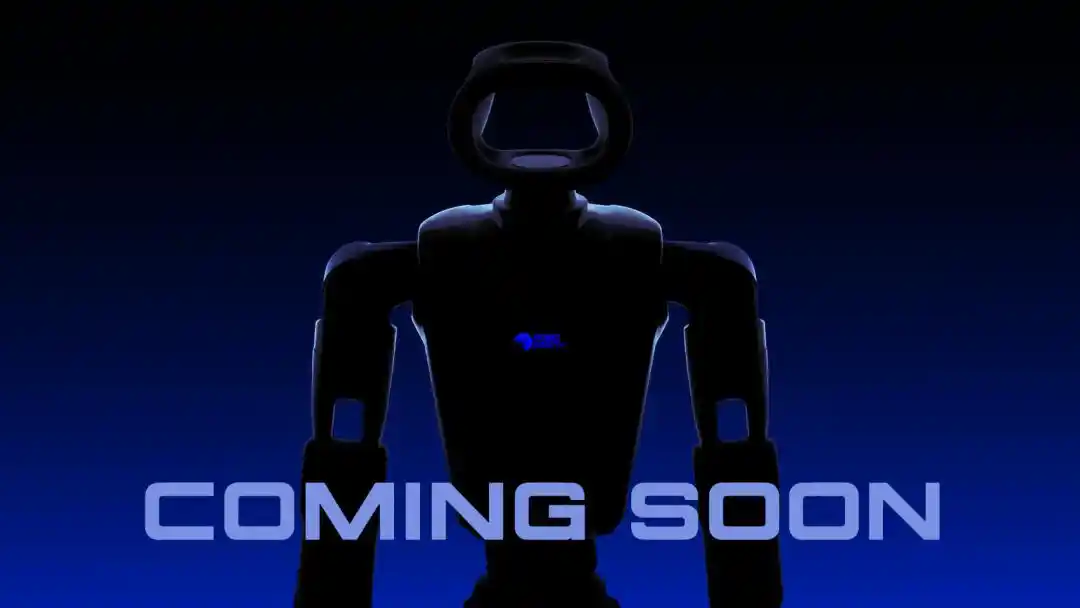
From Harbin to Shanghai, a 00s Team Builds Robots
"The happiest moment in entrepreneurship? Probably when tinkering alone, getting a drone to fly."
Huang Yi's eyes light up when talking about robots. Born in 2004, admitted to the Future Technology College of Harbin Institute of Technology in 2022, he won awards in national university science and technology competitions with an amphibious air-land drone project during his freshman year. Within dozens of days, he and his roommate handcrafted a bipedal robot AlexBot and open-sourced it, gaining some fame during his student days.
"Want to make the coolest robots in the world." Huang Yi's wish is simple to the point of being somewhat romantic, even insisting the logo and decor must be "a cool blue."
The venue was initially set up in an 80-square-meter office in Harbin, with a team of just over ten people. In February 2025, Huang Yi graduated early from school and founded RoboParty in Shanghai with several Harbin Institute of Technology classmates, focusing on the R&D of full-stack open-source bipedal humanoid robots.
"Our tastes matched, everyone wanted to add more fuel to the industry." The team quickly attracted technical talent from top domestic and international universities like Tsinghua Yao Class, Peking University Zhi Class, Zhejiang University, Carnegie Mellon University, Stanford, etc., with a high concentration of 00s, even many interns.
Huang Yi observed that embodied model companies lack physical bodies, but existing body companies mostly have closed systems, making it difficult to meet the needs of different model vendors. Could they build a physical platform that understands models well and is open and easy to use enough? This inspired the team.
RoboParty's positioning is precisely an open-source full-stack embodied platform—everything from the body to modules is made public, possessing capabilities in whole-machine self-research, vertical integration and mass production, foundational model capabilities, and open ecosystem capabilities, connecting the body, models, and developer ecosystem, becoming the most important infrastructure for embodied AI.
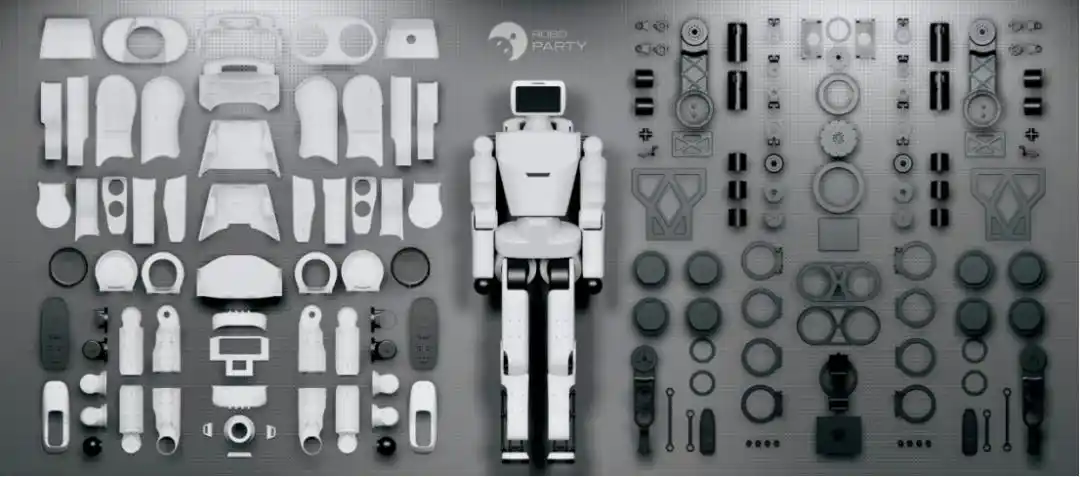
In January this year, RoboParty released the full-stack open-source bipedal humanoid robot project RPO, an entry-level open-source platform for global developers to go "from 0 to 1." It has currently gained attention from nearly 10,000 people in the global developer community, over 2000 Stars on GitHub, and attracted nearly a thousand orders from global developers, universities, research institutions, and model teams. RP1 will be launched in the fourth quarter of this year, focusing on higher performance, higher reliability, and continuous development and deployment needs in more complex real-world scenarios.
These robots, which can be disassembled, assembled, and modified, have become an excellent starting point for hands-on developers, attracting many research enthusiasts. In addition, robot model companies needing real machines for demos, and industrial ends requiring co-design of bodies and hardware/software systems are also RoboParty's customers.
Having just an open-source body is far from enough. In embodied R&D, issues like where data comes from, how to handle actions, whether the training framework is stable, and how to deploy strategies to real machines are tedious and time-consuming. RoboParty introduced a reusable, verifiable, and extensible R&D foundation—Party OS, solidifying the aforementioned underlying capabilities into a complete system, allowing developers to quickly turn ideas into results.
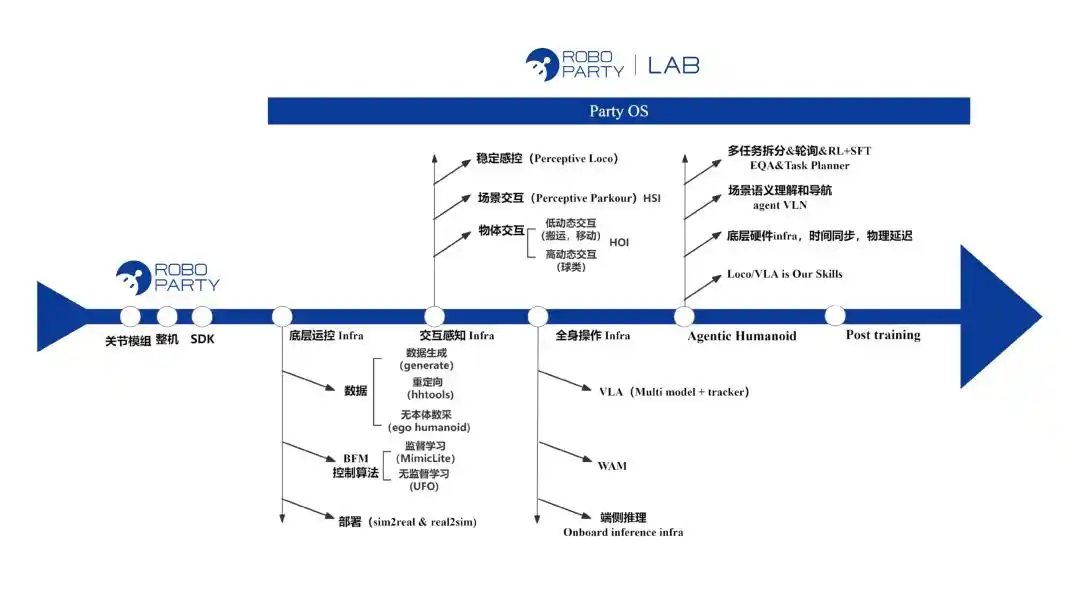
Currently, around Party OS, RoboParty has open-sourced three core tools: MimicLite, UFO, and Human-to-Humanoid Tools, targeting key aspects such as general motion tracking, unsupervised reinforcement learning control, and motion retargeting, respectively, receiving enthusiastic responses in the open-source community.
The body brings customers, revenue, and real-world entry points; Party OS accumulates data and physical interaction experience; a collaboratively evolving full-stack open-source embodied platform is gradually unfolding.
Six Rounds in a Year, the Battery King Arrives
Talking about Huang Yi, investors unanimously offer the evaluation: restrained, pure, technical geek, yet possessing a business understanding that is remarkably clear-headed for his age.
At 22, Huang Yi has an ultimate product taste, a taste that also extends to the selection of investors.
That was shortly after RoboParty's founding. Huang Yi and the team had already spent several million yuan on R&D, with little left in the account. "At that time, we were hesitant to even buy a graphics card." To survive, they initiated fundraising. Soon, a listed company approached with a quite tempting offer: invest money while locking in over a hundred overseas orders.
Surprisingly, Huang Yi refused.
"Before technology, production capacity, and brand are mature, pursuing rapid scaling is only superficial success." Such orders wouldn't bring real developers, nor should they overextend themselves at this stage for a good story. In his view, RoboParty needed to build the underlying ecosystem at that time; order quality was more important than order quantity, product refinement was more urgent than fundraising stories.
Soon, he found like-minded people. In the summer of 2025, a seed round of tens of millions of US dollars, formed by Matrix Partners, Xiaomi Strategic Investment, Galaxy Universal, and Guangyuan Entrepreneurs Fund, was quickly approved. For a team that just walked out of the dormitory, this lineup carried enough weight. "If we hadn't gotten that seed round, the company might very well not exist." Looking back, Huang Yi is quite emotional.
Since then, the financing pace gradually accelerated, closing rounds almost every month or so. Beyond Matrix, Xiaomi, and Galaxy Universal, renowned institutions like SenseTime Guoxiang Capital, BV Baidu Ventures, Vision Knight Capital, Pudong Venture Capital, Shanghai Future Industry Fund, Anchuang Capital, Saina Capital, Baichuan Capital, Shunwei Capital, etc., successively joined.
After successively completing key deployments in open-source humanoid body R&D, developer ecosystem construction, whole-machine engineering, mass production preparation, and Humanoid Foundation Model R&D, RoboParty welcomed an even more symbolic investor—CATL.
Looking across the embodied field, CATL's moves are often seen as a bellwether. Quite notably, this investment in RoboParty was made directly by CATL's group strategic investment arm, the signaling significance is self-evident. To some extent, this is not just a financial investment, but a link in industrial chain synergy.
And the deeper value lies in the open-source revolution brought by DeepSeek in the large model field, turning technology from a privilege of the few into infrastructure for all. RoboParty is using the same approach to reshape the technological foundation of humanoid robots. As Huang Yi repeatedly says: "If closed systems are a symbol of power, then open-source is the faith of civilization."
What the Battery King is betting on might be the "DeepSeek moment" for embodied AI. Next, the two parties will jointly explore more possibilities for humanoid robots in upstream and downstream industrial chain synergy, real manufacturing, and complex operational scenarios.
Thus, RoboParty secured almost the most "friendly" money in the venture capital circle. It is reported that the company's current investment terms all include no valuation adjustment mechanisms or buyback clauses. This is a rare trust: it is recognition of its product potential and real-world scenario value, and also means its label is not limited to open-source, but a full-stack platform with the opportunity to enter real manufacturing, energy, supply chain, and complex operational scenarios.
At this moment, more and more investors are proactively approaching RoboParty, "the scale of the TS for the next round is already quite considerable."
Post-Unitree Era
"Why, after two years, hasn't a robot more impressive than Unitree's G1 appeared on the market?"
During the conversation, Huang Yi frequently sighed. In his view, many companies in the industry are not dedicated in their direction, and frequent pivots cause resource waste—"pushing mass production without verifying PMF, pushing commercialization before it's time."
This is also why RoboParty prioritized polishing technical indicators and product performance from the beginning. "The significance of hundreds of orders is far less than attracting a hundred high-quality developers." With a unified and focused team, the only remaining thing is to be fast enough.
"Maintain SOTA"—the goal Huang Yi set for the team is simple. SOTA means achieving the best indicators on recognized benchmarks. Behind this is the uninterrupted rapid iteration across various levels: algorithms, data, engineering, etc.
Investor.com learned a detail: RoboParty regularly studies the detailed performance of existing robots and lists existing pain points on a whiteboard. "Loud noise, slippery feet, no remote emergency stop"... once there were twenty or thirty items. Followed by targeted innovations one by one.
Even internal meetings are based on communication theory—channels must match payloads, use documents to transmit facts, face-to-face meetings to convey emotions, meetings are only for resolving disagreements, making decisions, and other parts that cannot be "asynchronously transmitted." Everything serves high-bandwidth, low-latency information exchange.
Looking back, in just half a year, RoboParty formed systematic R&D capabilities from core module motors, motion control algorithms to whole-machine product definition, open-source systems, and supply chain implementation. The originally envisioned investment scale of several million yuan quickly slid towards raising over a hundred million, so fast that Huang Yi himself didn't anticipate.
The latest scene is that the company's self-developed Behavior Foundation Model (BFM) Off-policy Tracker has reached SOTA levels in core tasks like full-body motion tracking. The related open-source training system MimicLite used only 8 RTX 4090s, about 4 hours of training, and exceeded the key metrics of SONIC, compressing training compute requirements to about 1/500 of traditional solutions.
Just two weeks later, the team proposed a new framework INTACT based on the JEPA World Model scheme, converting state-conditioned motion intentions directly into action blocks, achieving about a 300-fold reduction in planning latency, even earning a personal like from Turing Award winner Yann LeCun.
And open-source is the finishing touch for embodied technology to explode faster.
Let's still use the communication system analogy: different robots' hardware configurations, control algorithms, etc., vary widely, making knowledge and experience difficult to reuse, resulting in low system signal-to-noise ratio. Open-sourcing a set of models and toolchains is like providing channel coding and standardization protocols; while developers' experience flowing back to the community will establish a huge feedback loop, allowing industry technology to converge in a shorter time.
"Working behind closed doors will only lead to homogeneous, inefficient competition." Not worried about losing barriers, Huang Yi is quite optimistic about open-source—there's almost no downside to making the cake bigger. As long as the team keeps iterating, they can have a place in the final outcome.
Inside RoboParty, few see building robots as just a job. They sit on the floor in sample rooms, testing rooms, chat freely in the pantry, running dense programs on computers. Perhaps initially, they just harbored dreams like Nuwa creating humans, but they gathered because of passion, constructing the distinctive background of the new generation of 00s entrepreneurs.
Thus, it also endows new possibilities for embodied AI moving towards the open-source era.
This article is from the WeChat public account "Investor.com" (ID: pedaily2012), authors: Yu Mengying, Zhou Jiali