Recent Mass Shutdowns of DeFi Protocols: They All Have One Thing in Common

marsbitPublicado a 2026-03-06Actualizado a 2026-03-06

Resumen

In recent months, multiple DeFi protocols have announced shutdowns, not due to exit scams but because of a lack of users, funding, or both. Projects like Angle Protocol, Polynomial, MilkyWay, and Step Finance—despite having functional products and significant past traction—were unable to sustain operations. Common challenges included an inability to attract liquidity (especially critical in derivatives), failure to achieve product-market fit, and high costs of expanding to new chains or narratives. Many teams pivoted repeatedly to chase trends like restaking or real-world assets but ran out of capital before finding sustainable demand. Others, like ZeroLend, suffered from deploying on smaller blockchains that lost liquidity during market downturns. Despite these failures, the projects shut down responsibly, allowing users to withdraw funds and avoiding reckless token launches—a sign of industry maturation compared to the reckless exits of 2022.

Author: Ignas

Compiled by: Chopper, Foresight News

Over the past two months, at least 10 crypto protocols have announced their closure. Not rug pulls, but due to no users, no money, or both.
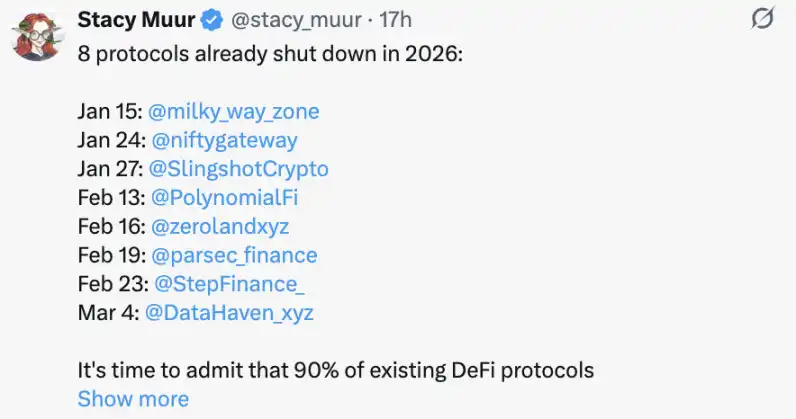
Not to mention mining companies like BlockFills and lending platforms freezing withdrawals. Just yesterday, Angle also announced (https://x.com/AngleProtocol/status/2029161525580112263) the gradual shutdown of its EURA and USDA stablecoins, despite having reached a Total Value Locked (TVL) of $250 million and having strong business partnerships.

Angle stated bluntly in the announcement, "The decentralized stablecoin landscape has completely changed. Yield-bearing stablecoins today are essentially just branded wrappers over existing vaults and lending protocols; there's no longer a need to maintain a separate, independent infrastructure."

These shuttered projects almost all had functional products:

  • Polynomial processed a cumulative trading volume of $4 billion across 70 markets
  • MilkyWay's TVL once reached $250 million
  • Step Finance had a peak of 300,000 monthly active users

I've used, or at least tried, these products. The technology wasn't the issue, but no one was willing to pay the fees needed for the projects to survive.

MilkyWay is a typical example: four pivots in less than two years. Starting with Celestia liquid staking, then moving to restaking, RWA tokenization, and crypto debit cards for rent payments... each pivot chased the hype of the moment.

Their description of the restaking pivot is poignant: "We identified the restaking opportunity early, designed the system, TVL to $250M, completed security audits, and were ready to launch. But the market moved on from restaking faster than anyone anticipated."

In the end, they had to admit the funding wouldn't last long enough to find product-market fit.

The Polynomial team was brutally honest about the reason for failure, offering a lesson for all perpetual contract projects: "In derivatives, good tech is useless. We improved execution speed, optimized UX, built innovative infrastructure, but none of it mattered. Traders go where the liquidity is. We didn't have it. Everything else is just a nice-to-have feature."

The conclusion is even harsher: "Liquidity is the only moat in derivatives. You can't beat liquidity with innovation, you can't beat it with marketing, you can't beat it with development."

ZeroLend's shutdown sounds a warning bell for dApps trying to launch on multiple blockchains. They bet on supporting projects on niche chains like Manta, Zircuit, and Xlayer, but when the market turned bearish, liquidity on these chains dried up, and oracle providers stopped their services.

Ultimately, operating at a long-term loss was unsustainable.

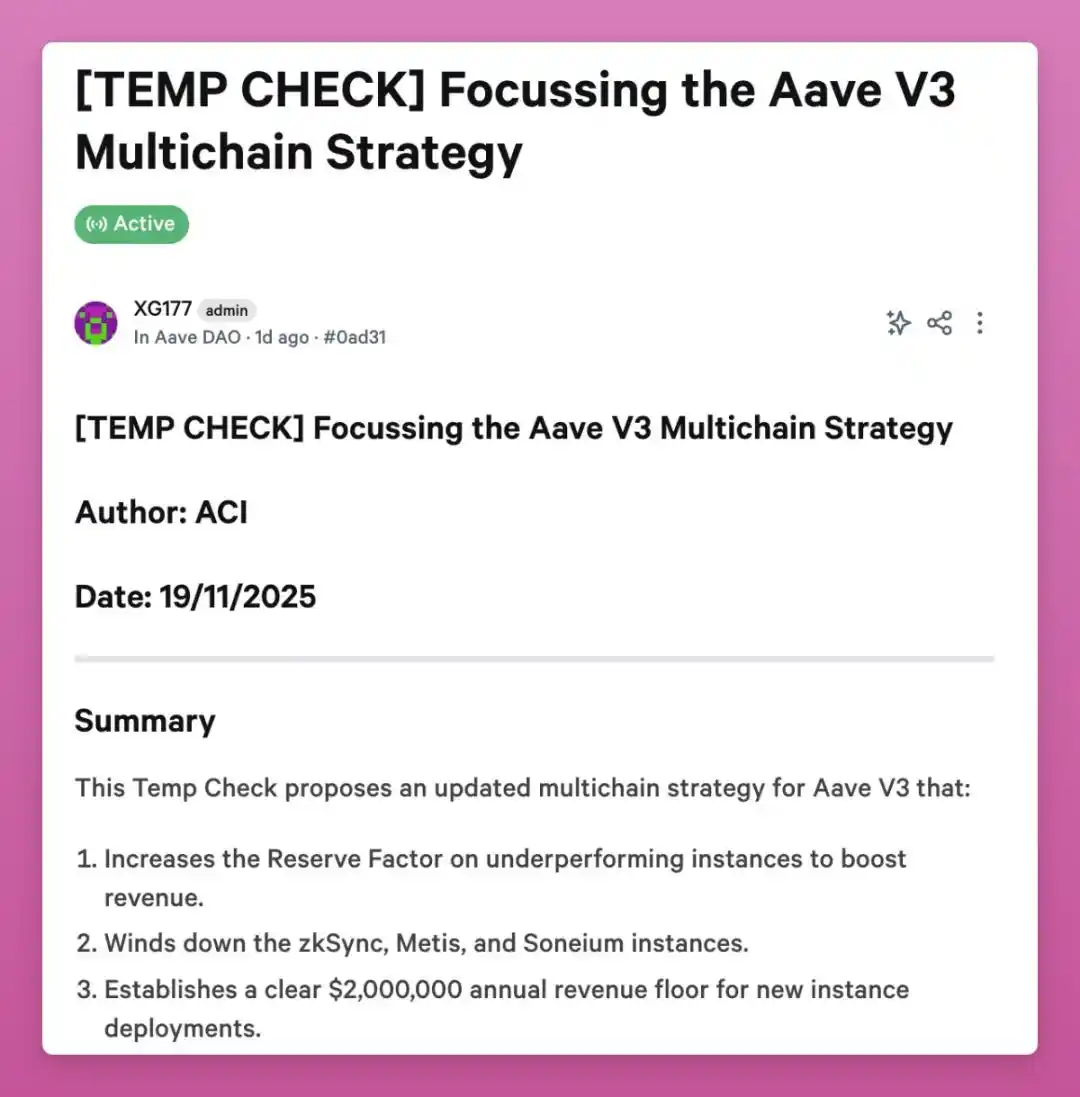
Aave recently also voted to shut down services on several chains, citing the same reason of unprofitable operation.
Then there's Parsec, once a legendary tool in the circle used to track Terra, 3AC, and the stETH depeg. But the team admitted, "After the FTX collapse, DeFi spot trading, lending, and leverage never returned to their former state. The market changed, on-chain behavior changed, and we didn't truly understand it."

Simply put, the market moved on, and we were left behind. The market is cruel.

Slingshot was acquired and completely shut down. Eden cut 80% of its unprofitable products, keeping only the core business.

As they said, "The 80/20 rule became a reality; the products that cost us 80% of our expenses brought in only 20% of the revenue."

Finally, Step Finance's case is more unique: it was hacked for $26 million on January 31st, which was a death sentence. "We tried fundraising, acquisition, nothing worked."

What's the common thread among these deceased projects? They failed to adapt to the ever-changing market and lacked sufficient capital to pivot again.

Each team bet on a particular ecosystem experiencing explosive growth, but the growth either wasn't fast enough or didn't happen at all. Celestia DeFi never truly took off, on-chain derivatives struggled to compete with Hyperliquid, and even established platforms like dYdX and GMX are having a hard time.

And expanding into new chains and narrative areas is costly.

For players like me, moving funds from one platform to another is effortless and cheap. But applications need to invest significant time and financial resources to prepare for potential new user bases.

The good news is, these were all "dignified deaths." All projects gave users time to withdraw funds; the teams didn't run away or issue tokens to cash out. Compared to the outright rug pulls of 2022, the industry has indeed learned to die responsibly.


Preguntas relacionadas

QWhat is the common reason behind the recent shutdowns of multiple DeFi protocols?

AThe common reason is that these protocols failed to adapt to the rapidly changing market conditions and lacked sufficient funding to pivot or sustain operations, despite having functional products.

QAccording to Angle Protocol, why did they decide to shut down their stablecoin operations?

AAngle Protocol stated that the decentralized stablecoin landscape has fundamentally changed, and yield-bearing stablecoins are now essentially just branded wrappers over existing vaults and lending protocols, making it unnecessary to maintain independent infrastructure.

QWhat did Polynomial identify as the only moat in the derivatives space?

APolynomial identified liquidity as the only moat in the derivatives space, emphasizing that innovation, marketing, or development cannot overcome the advantage of liquidity.

QWhat lesson did ZeroLend's shutdown provide for decentralized applications?

AZeroLend's shutdown served as a warning for dApps launching on multiple blockchains, as betting on smaller chains like Manta and Xlayer led to liquidity drying up and oracle services halting when the bear market hit.

QHow did the shutdowns of these protocols demonstrate responsible behavior compared to past incidents?

AThese protocols allowed users time to withdraw funds, did not engage in exit scams, and avoided issuing worthless tokens, showing that the industry has learned to 'die responsibly' compared to the outright fraud seen in 2022.

Lecturas Relacionadas

VCs on 2025 Crypto Investments: 84% of 118 Tokens Break Issue Price, Only One Type of Company is Quietly Making Money

Crypto investor Ching Tseng categorizes the market into four quadrants based on two axes: crypto-native vs. traditional finance (TradFi)-oriented, and having traction vs. no traction. In 2025, 84.7% of 118 tracked token launches fell below their issuance price, with a median fully diluted valuation drop of 71%. Crypto-native projects without traction are experiencing massive capital destruction, often relying on speculative narratives without sustainable revenue or user retention. Crypto-native teams with traction, often built in prior cycles, generate real revenue but face structural challenges with their tokens lacking direct value capture mechanisms. While some have implemented successful buyback programs, the core issue remains finding growth beyond crypto volatility. TradFi-oriented startups without traction face long, costly enterprise sales cycles but benefit from a robust M&A environment, with crypto acquisitions reaching a record $8.6 billion in 2025. The current winners are TradFi-oriented companies with traction, particularly in the Real World Asset (RWA) tokenization space, which grew from $5.5B to $18.6B in 2025. They are winning through enterprise sales, building alliances, and improving unit economics on established compliance stacks. Their main risk is being bypassed by large incumbent institutions building their own infrastructure. The overarching theme is market maturation, where narrative alone is insufficient for long-term success.

marsbitHace 12 min(s)

VCs on 2025 Crypto Investments: 84% of 118 Tokens Break Issue Price, Only One Type of Company is Quietly Making Money

marsbitHace 12 min(s)

Trading

Spot
Futuros

Artículos destacados

Cómo comprar ONE

¡Bienvenido a HTX.com! Hemos hecho que comprar Harmony (ONE) sea simple y conveniente. Sigue nuestra guía paso a paso para iniciar tu viaje de criptos.Paso 1: crea tu cuenta HTXUtiliza tu correo electrónico o número de teléfono para registrarte y obtener una cuenta gratuita en HTX. Experimenta un proceso de registro sin complicaciones y desbloquea todas las funciones.Obtener mi cuentaPaso 2: ve a Comprar cripto y elige tu método de pagoTarjeta de crédito/débito: usa tu Visa o Mastercard para comprar Harmony (ONE) al instante.Saldo: utiliza fondos del saldo de tu cuenta HTX para tradear sin problemas.Terceros: hemos agregado métodos de pago populares como Google Pay y Apple Pay para mejorar la comodidad.P2P: tradear directamente con otros usuarios en HTX.Over-the-Counter (OTC): ofrecemos servicios personalizados y tipos de cambio competitivos para los traders.Paso 3: guarda tu Harmony (ONE)Después de comprar tu Harmony (ONE), guárdalo en tu cuenta HTX. Alternativamente, puedes enviarlo a otro lugar mediante transferencia blockchain o utilizarlo para tradear otras criptomonedas.Paso 4: tradear Harmony (ONE)Tradear fácilmente con Harmony (ONE) en HTX's mercado spot. Simplemente accede a tu cuenta, selecciona tu par de trading, ejecuta tus trades y monitorea en tiempo real. Ofrecemos una experiencia fácil de usar tanto para principiantes como para traders experimentados.

186 Vistas totalesPublicado en 2024.12.12Actualizado en 2025.03.21

Cómo comprar ONE

Discusiones

Bienvenido a la comunidad de HTX. Aquí puedes mantenerte informado sobre los últimos desarrollos de la plataforma y acceder a análisis profesionales del mercado. A continuación se presentan las opiniones de los usuarios sobre el precio de ONE (ONE).

活动图片