Cardano Founder Hoskinson Says He’s ‘Taking A Break’: Here’s What Happened

bitcoinistPublicado a 2026-06-04Actualizado a 2026-06-04

Resumen

Cardano founder Charles Hoskinson announced he is "taking a break" on X, following a tense livestream where he expressed frustration over his limited power within Cardano's decentralized governance system. This comes amid growing ecosystem pressures, highlighted by the shutdown of the key analytics platform TapTools due to senior departures and rising costs. Hoskinson argued that Cardano's governance, designed to shift control to the community, now leaves him with no unilateral authority over the treasury, protocol upgrades, or brand infrastructure. He noted he is often blamed for ADA's price and ecosystem issues despite having no direct control. This dynamic was recently seen when a Cardano Foundation funding proposal for a 2026 summit was rejected by the community vote. The situation underscores a central tension for Cardano: its governance can reject major spending but may struggle to act swiftly to support critical infrastructure during a downturn. Hoskinson's break reflects the personal strain of this decentralized model, where founder influence is intentionally limited.

Charles Hoskinson, the founder of Cardano and CEO of Input Output, abruptly told followers on X that he is “taking a break,” following a tense livestream on June 2 in which he questioned what power he actually has to stop project failures and funding disputes inside Cardano’s decentralized governance system.

The post was brief: “I’m taking a break. TTYL.” Hoskinson gave no explicit explanation. But the timing points to a broader frustration that has been building around Cardano’s ecosystem funding, the shutdown of TapTools, and the practical consequences of Voltaire-era governance moving authority away from founding entities and toward on-chain decision-making.

TapTools Shutdown Puts Cardano Governance Under Pressure

TapTools, one of the most visible analytics and data platforms in the Cardano ecosystem, said it would wind down operations after nearly four years, citing a series of senior departures and rising operating costs. According to the platform, both co-founders, its chief operating officer and chief technology officer had already left earlier this year. A backend developer who stepped into the CTO role later also departed, leaving the company without technical capacity it said could not be replaced quickly enough to keep the platform running responsibly.

The shutdown clearly hit a nerve. In his livestream, Hoskinson warned that the second half of the year could bring further stress across Cardano DeFi.

“So this year is going to be very hard. The second half of the year for Cardano, we’re probably going to see more dApps in DeFi die and a consolidation happen. I’m not exactly sure what my role or place is to resolve this.”

His core argument was not that Cardano lacked resources, but that the network’s governance and funding architecture no longer gives him unilateral control over those resources. Hoskinson said he is often blamed for ADA’s market performance and ecosystem setbacks, while having no direct command over the treasury, protocol upgrades or brand infrastructure.

“You know, I keep getting criticized relentlessly online. People every single day post on my Twitter feed the price of ADA and blame me for it collapsing. And I’d really like to know, I just like to understand what my agency is here.”

Hoskinson Says He Lacks Control

The comments reflect a deeper tension in Cardano’s current phase. Cardano’s governance system was designed to shift control from founding entities to ADA holders, delegated representatives and other governance bodies. That structure gives the community more formal authority over treasury withdrawals and protocol decisions, but it also makes emergency coordination more difficult when key ecosystem companies are under pressure.

The same governance dynamic was visible days earlier when the Cardano Foundation canceled Cardano Summit 2026 in Singapore after its treasury funding proposal failed to reach the required two-thirds approval threshold. A revised request for roughly 7.8 million ADA received majority support but still fell short, while a smaller EMURGO proposal for a Cardano presence at TOKEN2049 Singapore was approved.

For Hoskinson, TapTools appears to have become a case study in the limits of founder influence after decentralization. He said the resources intended to grow and govern the ecosystem were assigned to separate entities, not to him personally.

“I don’t have any special powers with Cardano. I don’t have any governance keys. I don’t have any ability to even initiate a hard fork, much less a protocol parameter change. I don’t have access to the treasury. I don’t even own the trademark for the name Cardano.”

He continued: “All of the funding that was given for growing the ecosystem and governing the ecosystem was given to separate entities. And at the all-time high, it was billions of dollars. It was not given to me.”

The episode leaves Cardano facing an uncomfortable test. Its governance system is now powerful enough to reject major spending requests, including those from core ecosystem institutions. The harder question is whether it can also move quickly enough to preserve critical infrastructure during a market downturn without recreating the centralized dependency it was designed to remove.

At press time, ADA traded at $0.1886.
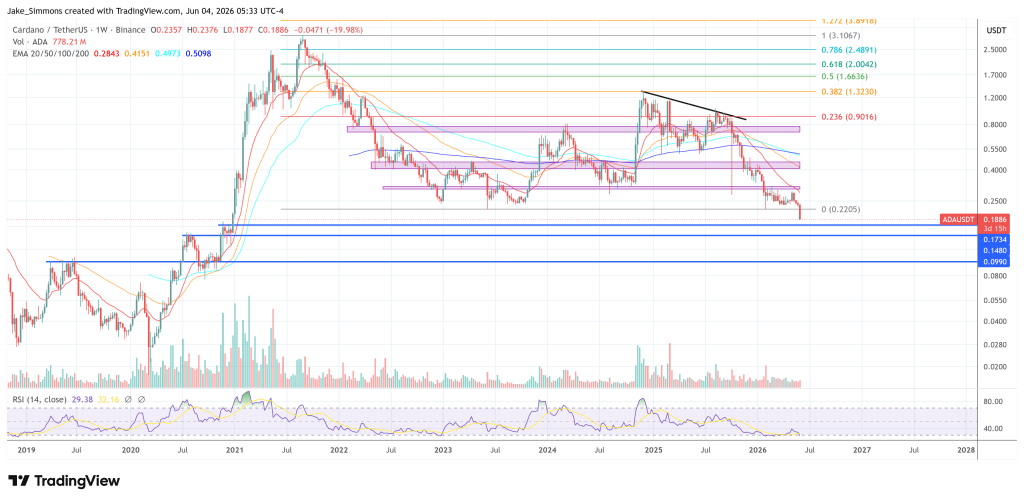
ADA drops below key support, 1-day chart | Source: ADAUSDT on TradingView.com

Preguntas relacionadas

QWhy did Charles Hoskinson announce he is taking a break?

ACharles Hoskinson announced he is taking a break after a tense livestream where he expressed frustration over his limited power to intervene in project failures and funding disputes within Cardano's decentralized governance system.

QWhat recent event contributed to the pressure on Cardano's governance?

AThe recent shutdown of TapTools, a major analytics and data platform in the Cardano ecosystem, contributed significantly to the pressure. It highlighted challenges in ecosystem funding and the practical difficulties of decentralized governance during market stress.

QAccording to Hoskinson, what does he lack control over in the Cardano ecosystem?

AHoskinson stated he lacks unilateral control over key aspects of Cardano. He has no governance keys, cannot initiate hard forks or protocol changes, has no access to the treasury, and does not own the Cardano trademark. Funding for ecosystem growth was allocated to separate entities, not to him personally.

QWhat was the outcome of the Cardano Foundation's proposal for Cardano Summit 2026?

AThe Cardano Foundation's treasury funding proposal for Cardano Summit 2026 in Singapore failed to reach the required two-thirds approval threshold. A revised request for about 7.8 million ADA received majority support but still fell short, leading to the event's cancellation.

QWhat broader challenge for Cardano does the TapTools shutdown and funding disputes illustrate?

AThese events illustrate the broader challenge of whether Cardano's decentralized governance system, while effective at preventing centralized control, can act quickly and decisively enough to preserve critical ecosystem infrastructure and respond to emergencies during a market downturn.

Lecturas Relacionadas

Should You Buy SpaceX Stock at $1.7 Trillion? Here's What the Market Is Worried About

SpaceX is preparing for a massive IPO aiming to raise around $75 billion at a valuation of approximately $1.75 trillion. While its achievements in reusable rockets and the profitable Starlink satellite internet service are clear, the market is concerned about the aggressive valuation. Key issues include: the current $1.75 trillion valuation, which is about 94 times 2025 revenue, seems to price in not just existing businesses but also unproven future ventures like AI infrastructure and orbital data centers. Financially, while Starlink is profitable, the AI division, bolstered by the acquisition of xAI, is incurring massive losses and consuming the majority of capital expenditures. This acquisition also introduced complex related-party financing arrangements and debt onto SpaceX's balance sheet. Furthermore, corporate governance poses a challenge. SpaceX's dual-class share structure ensures founder Elon Musk retains absolute control, limiting ordinary shareholders' influence over high-risk, long-term strategic decisions. The future success of ambitious projects like the Starship rocket—critical for lowering costs and enabling new services—remains a significant variable for the valuation. In summary, the market's apprehension (FUD) centers not on doubting SpaceX's past technological triumphs but on questioning how much premium public investors should pay for a future that combines proven profits with highly speculative and capital-intensive new ventures, all under a governance structure that offers limited shareholder oversight.

marsbitHace 3 min(s)

Should You Buy SpaceX Stock at $1.7 Trillion? Here's What the Market Is Worried About

marsbitHace 3 min(s)

Breaking the DeFi Cascading Liquidation Curse: Vitalik Proposes a New Solution

Vitalik Buterin has proposed a new DeFi design to eliminate the automatic liquidation mechanism that causes market instability during sharp downturns. The current system, used by protocols like Aave, triggers forced sales when collateral value falls below a threshold, often exacerbating price drops and creating systemic selling pressure. Buterin's alternative model is based on splitting an asset like ETH into two synthetic option-like tokens, P and N, pegged to a price index. Their combined value always equals one ETH. Instead of sudden liquidation, a position's value gradually drifts from its target peg if the market moves. Users must proactively rebalance their holdings to maintain their desired exposure, transferring the management burden from the protocol to the user or automated tools. A key advantage is the reduced reliance on real-time oracles. Pricing decisions are deferred until contract expiry, allowing for more robust, fault-tolerant oracle designs. This removes a clear liquidation threshold that speculators can target for manipulation or MEV extraction. However, significant challenges remain. Frequent rebalancing could incur high slippage and transaction costs, necessitating new liquidity provider models. The design is better suited for hedging instruments than for stablecoins requiring a rigid 1:1 peg. While not an immediate replacement for existing systems, the proposal challenges the foundational assumption that instantaneous forced liquidation is an unavoidable necessity in DeFi, opening the door for fundamentally different risk management architectures.

marsbitHace 8 min(s)

Breaking the DeFi Cascading Liquidation Curse: Vitalik Proposes a New Solution

marsbitHace 8 min(s)

The End of Single-Factor Cryptography

The article "The End of Single-Factor Crypto" posits a fundamental shift in the cryptocurrency ecosystem. It argues the era where crypto asset valuations were predominantly driven by, and correlated with, Bitcoin's price is ending. The space is bifurcating into two distinct economies: endogenous and exogenous. The endogenous economy represents traditional crypto, where token and project values are directly tied to crypto market prices. The emerging exogenous economy comprises projects and businesses that may utilize blockchain technology or tokens but derive their fundamental value from external, non-crypto factors like consumer demand, subscription revenue, or real-world utility. Examples include AI inference platforms like Venice, fintech lenders using blockchain for efficiency, and stablecoin/payment infrastructure companies acquired by giants like Mastercard and Stripe. This shift means investment analysis must change. For exogenous assets, evaluating traditional business fundamentals—such as revenue streams, unit economics, and competitive moats—becomes more critical than tracking Bitcoin charts. While endogenous assets like Bitcoin remain relevant, the growth of the exogenous category is driven by measurable demand independent of crypto price cycles, paving the way for a new, more diversified market phase. Consequently, crypto is evolving from a single-factor, reflexive asset class into a multifaceted ecosystem with varied drivers and investment theses.

marsbitHace 8 min(s)

The End of Single-Factor Cryptography

marsbitHace 8 min(s)

Morning Post | Bitmine Plans to Raise $300 Million Through Preferred Stock Issuance; Polymarket Accuses Kalshi of Commercial Espionage

ChainCatcher's Daily Crypto Brief: Key developments from the past 24 hours include significant funding moves, regulatory actions, and market predictions. Bitmine announced a $300 million preferred stock fundraising. Polymarket accused rival prediction platform Kalshi of corporate espionage, citing numerous suspicious coincidences in product launches, a claim Kalshi strongly denied. The U.S. Department of Justice, in a joint "Disruption Week" anti-fraud operation with companies like Coinbase and Meta, froze over $3.8 million in cryptocurrency linked to scams. In infrastructure news, Macau completed its integration with the multi-central bank digital currency bridge, mBridge, aiming to build efficient cross-border payment channels. Cosmos Labs acquired the block explorer Mintscan. Market-wise, Geoffrey Kendrick, Standard Chartered's Head of Digital Assets Research, stated Bitcoin is nearing a bottom around $63,000, maintaining a year-end target of $100,000. He noted stability in U.S. spot Bitcoin ETF holdings. Ahead of SpaceX's anticipated IPO, internal insiders at Rocket Lab (RKLB) sold over $18.41 million in stock. In tokenization, Goldman Sachs partnered with Apex and Archax to launch a tokenized real estate fund. The meme token tracker GMGN reported the top trending tokens: on Ethereum, HEX, SHIB, LINK, PEPE, mUSD; on Solana, TROLL, swarms, WORLDCUP, neet, Buttcoin; and on Base, PEPE, toby, ODDS, ELSA, SKI.

链捕手Hace 23 min(s)

Morning Post | Bitmine Plans to Raise $300 Million Through Preferred Stock Issuance; Polymarket Accuses Kalshi of Commercial Espionage

链捕手Hace 23 min(s)

55TB to 28TB? The Rumor and Panic Behind Rubin's Memory Being Halved

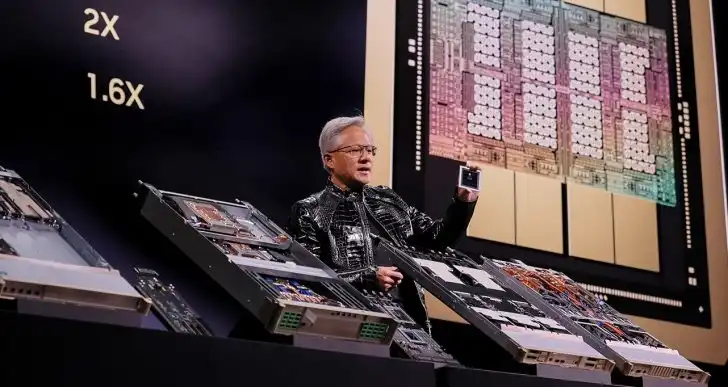
Title: 55TB to 28TB? The Rumor and Panic Behind the Potential Halving of Rubin's Memory. On June 4th, a report from SemiAnalysis suggested NVIDIA's next-gen Vera Rubin NVL72 AI rack may ship with roughly 28TB of SOCAMM DRAM per rack instead of the anticipated 55TB, primarily using 96GB modules. This sparked a market panic, causing Micron's stock to drop over 10% on fears of halved memory demand. However, the article argues this panic is misguided for several key reasons. First, SOCAMM modules are socketed and upgradeable, not soldered. Lower initial configuration doesn't mean permanent demand loss. Second, the primary driver is a severe 2026 LPDDR5X supply shortage, not diminished need. NVIDIA is likely prioritizing rack shipments with available components. Third, with fixed total LPDDR5X supply, using less per rack could allow NVIDIA to ship *more* racks, not necessarily reducing overall memory orders. Micron's sharp drop was also attributed to a broader semiconductor sell-off triggered by Broadcom's earnings, with the SemiAnalysis report providing a convenient narrative for profit-taking after Micron's massive rally. In summary: the report on lower default configurations is likely accurate, but interpreting it as a demand collapse is wrong. The real risk for Micron lies in its reportedly minimal HBM4 share for Rubin, not in potentially flexible SOCAMM demand. The sell-off appears more like a correction amplified by coinciding negative catalysts.

marsbitHace 40 min(s)

55TB to 28TB? The Rumor and Panic Behind Rubin's Memory Being Halved

marsbitHace 40 min(s)

Trading

Spot
Futuros

Artículos destacados

Cómo comprar ADA

¡Bienvenido a HTX.com! Hemos hecho que comprar Cardano (ADA) sea simple y conveniente. Sigue nuestra guía paso a paso para iniciar tu viaje de criptos.Paso 1: crea tu cuenta HTXUtiliza tu correo electrónico o número de teléfono para registrarte y obtener una cuenta gratuita en HTX. Experimenta un proceso de registro sin complicaciones y desbloquea todas las funciones.Obtener mi cuentaPaso 2: ve a Comprar cripto y elige tu método de pagoTarjeta de crédito/débito: usa tu Visa o Mastercard para comprar Cardano (ADA) al instante.Saldo: utiliza fondos del saldo de tu cuenta HTX para tradear sin problemas.Terceros: hemos agregado métodos de pago populares como Google Pay y Apple Pay para mejorar la comodidad.P2P: tradear directamente con otros usuarios en HTX.Over-the-Counter (OTC): ofrecemos servicios personalizados y tipos de cambio competitivos para los traders.Paso 3: guarda tu Cardano (ADA)Después de comprar tu Cardano (ADA), guárdalo en tu cuenta HTX. Alternativamente, puedes enviarlo a otro lugar mediante transferencia blockchain o utilizarlo para tradear otras criptomonedas.Paso 4: tradear Cardano (ADA)Tradear fácilmente con Cardano (ADA) en HTX's mercado spot. Simplemente accede a tu cuenta, selecciona tu par de trading, ejecuta tus trades y monitorea en tiempo real. Ofrecemos una experiencia fácil de usar tanto para principiantes como para traders experimentados.

1.5k Vistas totalesPublicado en 2024.12.10Actualizado en 2026.06.02

Cómo comprar ADA

Discusiones

Bienvenido a la comunidad de HTX. Aquí puedes mantenerte informado sobre los últimos desarrollos de la plataforma y acceder a análisis profesionales del mercado. A continuación se presentan las opiniones de los usuarios sobre el precio de ADA (ADA).

活动图片