Crude Oil Surges, Gold Advances Strongly

Publicado a 2026-08-11Actualizado a 2026-08-11

Resumen

Just as Iran indicated that negotiations concerning the Strait of Hormuz were nearing an end, Trump put forth new demands, asking Iran to compensate for war casualties. This has once again cast a shadow over the prospects for the talks. As both sides are currently "talking past each other," the existing situation of "neither war nor peace" may persist for a long time.

Just as Iran indicated that negotiations concerning the Strait of Hormuz were nearing their conclusion, Trump put forward new demands, calling for Iran to compensate for war casualties, casting a shadow once again over the prospects of the talks. As both sides are engaged in "exchanges of rhetoric," the current situation of "neither war nor peace" may persist in the long term.

With Trump oscillating between seeking talks and issuing threats, international oil prices surged 5% on Monday, climbing back above $80. Ironically, Iran continues to consolidate its control over the strait, while the US is moving further away from its strategic wartime objectives (if any exist).

The US Dollar Index halted its decline and rebounded overnight, but the key level around 99.50 still requires attention. The US CPI data on Wednesday will be crucial in influencing the direction of the dollar and forex markets.
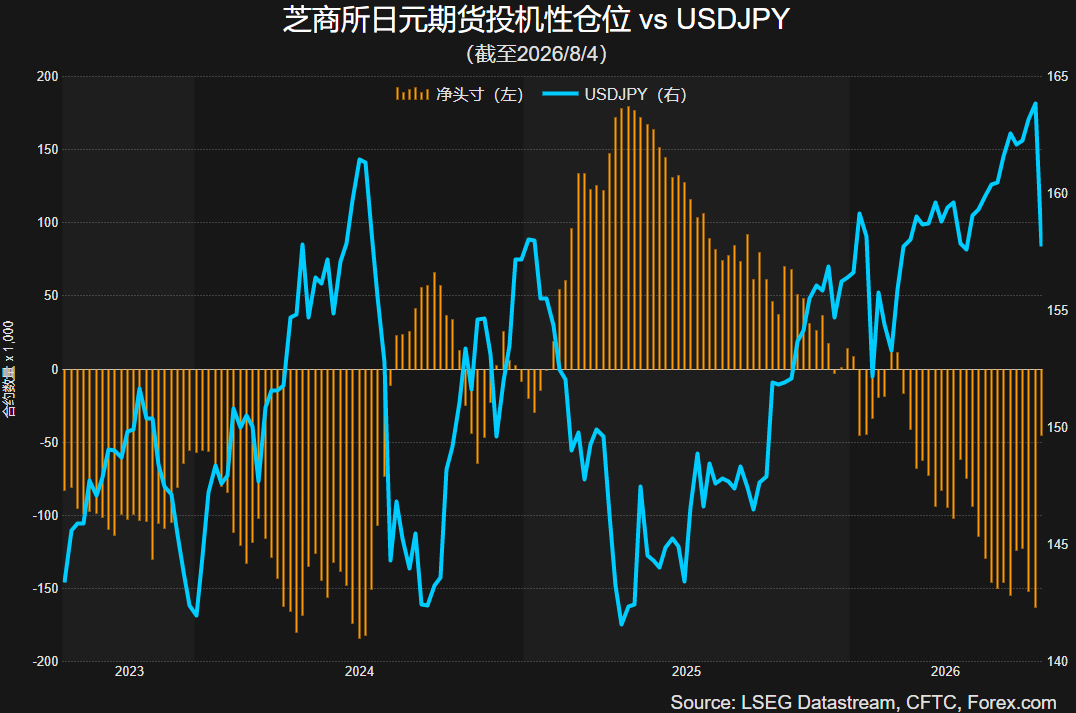
With the Japanese yen recording its largest single-day decline in five months, USD/JPY surged above 159. The latest data shows that speculative short positions on the yen decreased significantly in the week ending August 4, following joint US-Japan intervention. However, intervention only provided temporary support for the yen and bought time for the Bank of Japan's rate hikes; weak fundamentals remain the underlying reason driving USD/JPY higher. Tuesday is a holiday in Japan. In the absence of further intervention, the exchange rate may fluctuate upward, testing the 160 level.

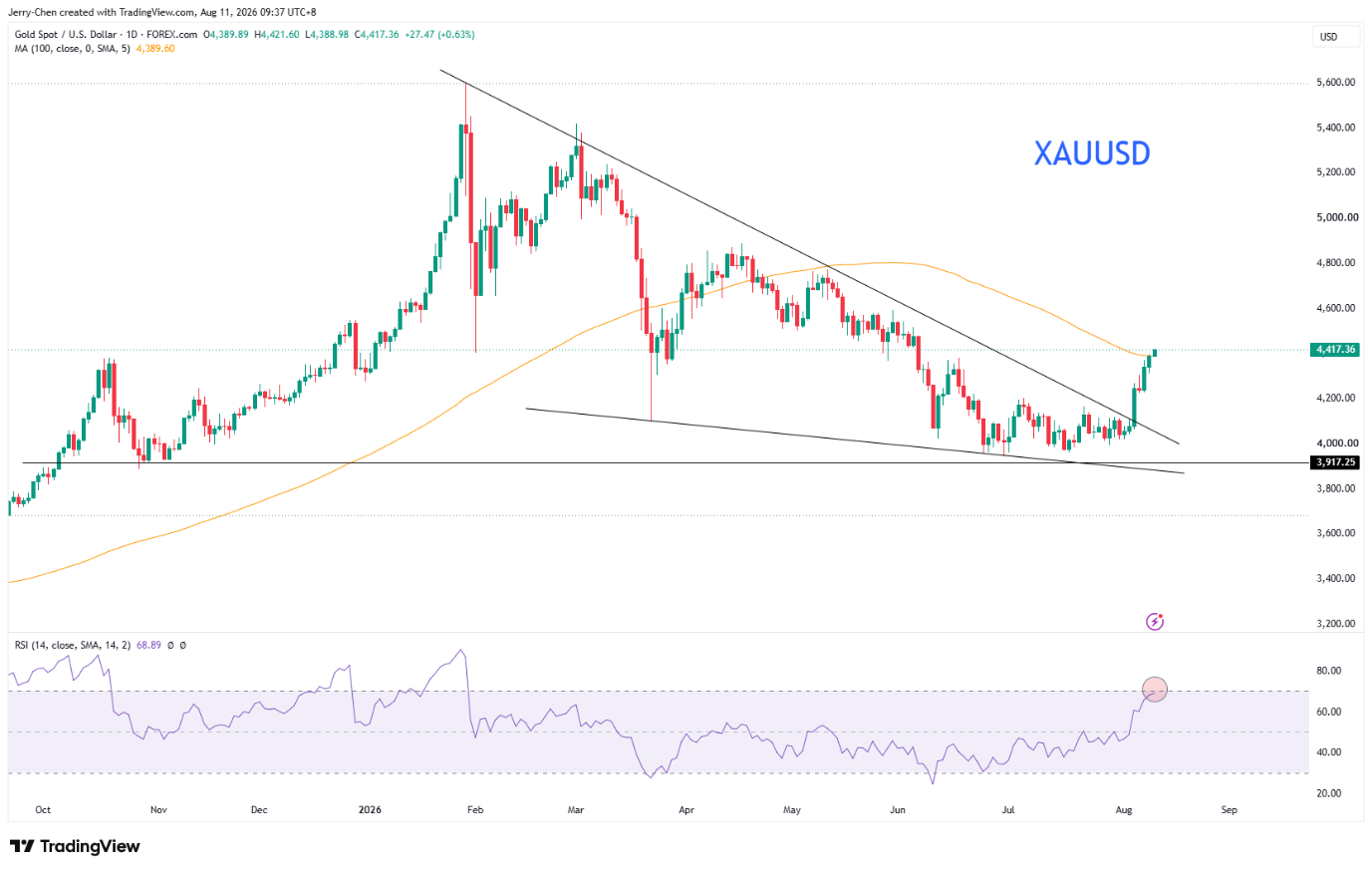
Gold and silver continued their upward momentum at the start of the week, with gold prices breaking through $4,400 in early Tuesday trading. Having broken a six-month downtrend, the metal is displaying strong upward momentum. Speculative long positions in gold reached their highest level since the end of January in the week ending August 4. Although the 100-day moving average and overbought signals may pose some trouble for the bulls, gold prices are likely to continue their rise ahead of the US CPI release. Maintaining a bullish view above $4,380, the next target for the bulls is near $4,580.
The three major US stock indices closed slightly lower overnight. The Nasdaq 100 index encountered resistance around 29,870, but its upward structure remains intact. Nvidia's stock fell 2.8% after it teamed up with Wall Street giants to launch a $500 billion financing project, while Intel's stock dropped 4% as it sought to issue $20 billion in new shares. This indicates lingering market skepticism about AI capital expenditures, although there has been a noticeable improvement compared to before this earnings season.

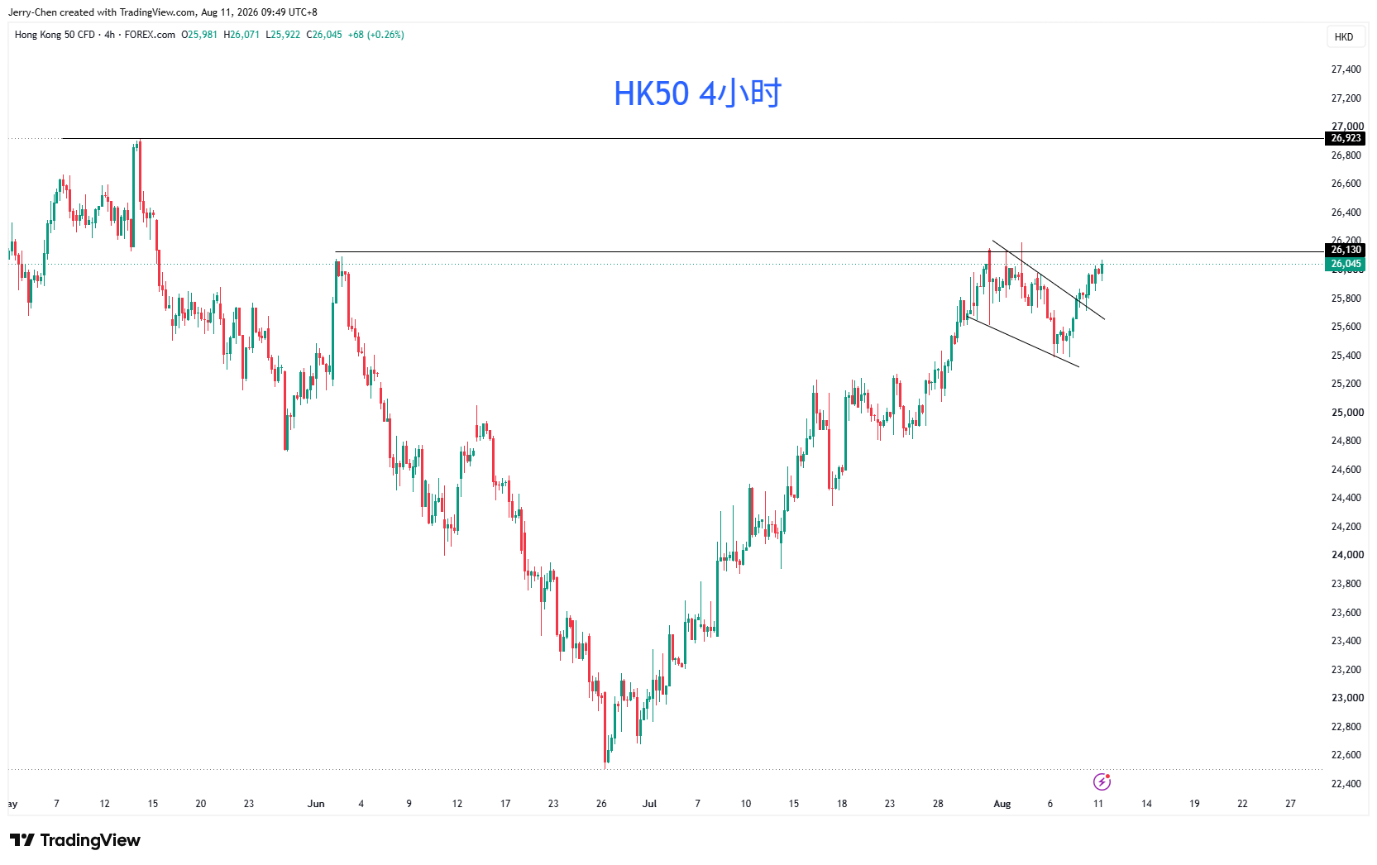
The Hang Seng Index steadied after a week of adjustments. The 26,000 level is the next target for the bulls. A breakthrough above this level would extend the rebound trend since the end of June, potentially allowing the bulls to challenge the May high near 26,900, which is a resistance level extended from the 2018 peak.
On Tuesday, attention turns to the Reserve Bank of Australia's interest rate decision (12:30 GMT). Keeping rates on hold is almost a foregone conclusion. Interest rate markets are pricing in less than a 50% probability of another rate hike by the central bank before the end of the year. However, a "hawkish pause" in the policy statement could still boost the Australian dollar.


Lecturas Relacionadas

Citi Research Report Analysis: U.S. Proposed Ban on Chinese Optical Modules Has No Substantial Progress, Short-term Enforcement Faces Supply Constraints

Citi Report Analysis: U.S. Proposed Ban on Chinese Optical Modules Lacks Substantive Progress, Faces Supply Bottlenecks in Short Term. Reuters reported on August 4th that the U.S. government and FCC are considering a ban on Chinese optical modules. Citi's August 9th report clarifies that optical modules are not listed on any effective FCC ban. The FCC's Order 26-50 established two restricted list mechanisms (based on manufacturer and production location), but optical modules were only mentioned once, as an example in a disclosure requirement, not as a restricted product. The reported ban remains at a proposal stage. Citi estimates Chinese suppliers provide 60-70% of high-speed optical modules for U.S. hyperscalers. Non-Chinese suppliers cannot fill this gap in the short term, making the immediate implementation of a genuine ban unlikely. Future regulatory paths could be manufacturer-based (least likely), location-based covering all offshore production (strictest), or location-based covering only China (more feasible but with unresolved definitions). A ban would pressure U.S. AI infrastructure, conflicting with stated policy goals. Citi sees low near-term implementation probability, with the issue potentially becoming a negotiation chip in bilateral talks. U.S. domestic capacity build-out is a key long-term variable. Among Chinese companies, XSENS and Dongshan Precision have the highest U.S. exposure, while Tianfu Communication, as a passive component supplier, is relatively insulated. Citi maintains Buy ratings on all three with respective price targets. The conclusion is that Chinese modules are currently irreplaceable in the U.S. AI supply chain, creating a longer timeline for potential restrictions than the market may expect.

marsbitHace 14 min(s)

Citi Research Report Analysis: U.S. Proposed Ban on Chinese Optical Modules Has No Substantial Progress, Short-term Enforcement Faces Supply Constraints

marsbitHace 14 min(s)

Lead Analyst Claims Bitcoin is at a Critical Stage: 'We are at the Bear Market Bottom, What Happens Next…'

Renowned cryptocurrency analyst Benjamin Cowen, in his latest analysis video, examined recent events and historical cycles in the Bitcoin market. Noting Bitcoin's trading range of $64,000 to $65,000, Cowen stated that market dynamics and investor interest show similarities to past cycles, suggesting the upcoming period marks a critical turning point. Cowen observed a significant decline in public interest and investor enthusiasm for the crypto market, with social risk metrics falling to 0.2, far below levels seen four years ago. He added that market volatility has notably decreased, and a sense of distrust prevails among investors, drawing parallels to the ends of bear markets in 2018 and 2022. Historical data indicates Bitcoin markets typically bottom in summer months, followed by a period of stagnation with low volatility, implying a major move could occur in the year's final quarter. However, Cowen noted on-chain indicators like the MVRV Z-Score have not yet signaled a definitive bottom. Cowen believes an event in the coming weeks could shake the market, potentially triggering a final sell-off wave. Such an event, he argues, would bring investors back and pave the way for a new bull cycle. He predicts October as the most likely bottoming period, while acknowledging September or November are also possible, advising crypto users to remain cautious and prepared for a decisive market moment.

cryptonews.ruHace 23 min(s)

Lead Analyst Claims Bitcoin is at a Critical Stage: 'We are at the Bear Market Bottom, What Happens Next…'

cryptonews.ruHace 23 min(s)

Bitcoin Community in Uproar: Deciphering the New Scaling War Sparked by BIP-110

On August 10, Luke Dashjr, a long-time Bitcoin Improvement Proposal (BIP) editor and co-founder of Ocean mining pool, was removed from the BIP editing team for bypassing discussion protocols and preemptively assigning a number to BIP-110, a controversial soft fork proposal he helped draft. The conflict stems from Bitcoin Core's version 30 release in October 2025, which removed the default 83-byte limit on OP_RETURN, a field used for embedding non-transaction data. In response, BIP-110 aimed to enforce this limit as a consensus rule. It controversially lowered the activation threshold for miners to 55% and included a mandatory activation clause, causing significant community backlash. Major mining pools like Foundry USA and AntPool did not support it, with public criticism from figures like F2Pool's Wang Chun and Michael Saylor, who argued it compromised Bitcoin's neutrality. On August 8, at block height 961,632, nodes running the BIP-110 patch rejected the main chain block, causing a chain split. The minority chain, supported by only about 2.53% of the network's hash rate, produced just one additional block before stalling. The main chain quickly outpaced it by over 240 blocks. No major exchanges have supported the minority chain. The event highlighted Bitcoin's governance reality: while rules can be proposed by a few, ultimate authority lies with the economic majority—miners willing to expend hash power and users/exchanges recognizing a chain's validity. Following the failed split, BIP-110 proponents, including Luke Dashjr, have begun discussing a change to the proof-of-work algorithm to create a separate coin, though this remains in early discussion stages.

marsbitHace 44 min(s)

Bitcoin Community in Uproar: Deciphering the New Scaling War Sparked by BIP-110

marsbitHace 44 min(s)

Trading

Spot
活动图片