Prediction Markets Advise Holding Positions, While Citadel Securities Forecasts Fed Rate Hike Amid Trump Pressure on Central Bank

cryptonews.ruPublicado a 2026-07-28Actualizado a 2026-07-28

Resumen

The U.S. Federal Reserve's FOMC meeting on July 28-29 is the main focus, with markets largely expecting interest rates to hold steady at 3.50-3.75%. CME's FedWatch tool gives a 66.3% probability for no change, while prediction markets like Kalshi and Polymarket show ~73% odds for unchanged rates. However, Citadel Securities' head of macro strategy, Frank Flight, predicts a surprise 25-basis-point hike to reinforce the Fed's inflation-fighting credibility under Chair Warsch. This meeting occurs amid political pressure, as former President Trump again called for rate cuts. Persistent inflation, driven partly by energy costs, and Middle East-related oil price volatility add uncertainty. The outcome is significant for Bitcoin and risk assets, which typically see larger moves when the Fed acts against consensus expectations. An unexpected hike could strengthen the dollar and pressure crypto prices, while a hold would shift market focus to the September meeting.

The Federal Open Market Committee (FOMC) meeting is scheduled for July 28 and 29, with the rate announcement expected on Wednesday afternoon. The current target range stands at 3.50-3.75% and has remained unchanged since the June meeting, which was the first for Warsh as Chairman. The CME Group's Fedwatch tool, which calculates probabilities based on 30-day federal funds futures prices, estimates a 66.3% probability of rates remaining unchanged.
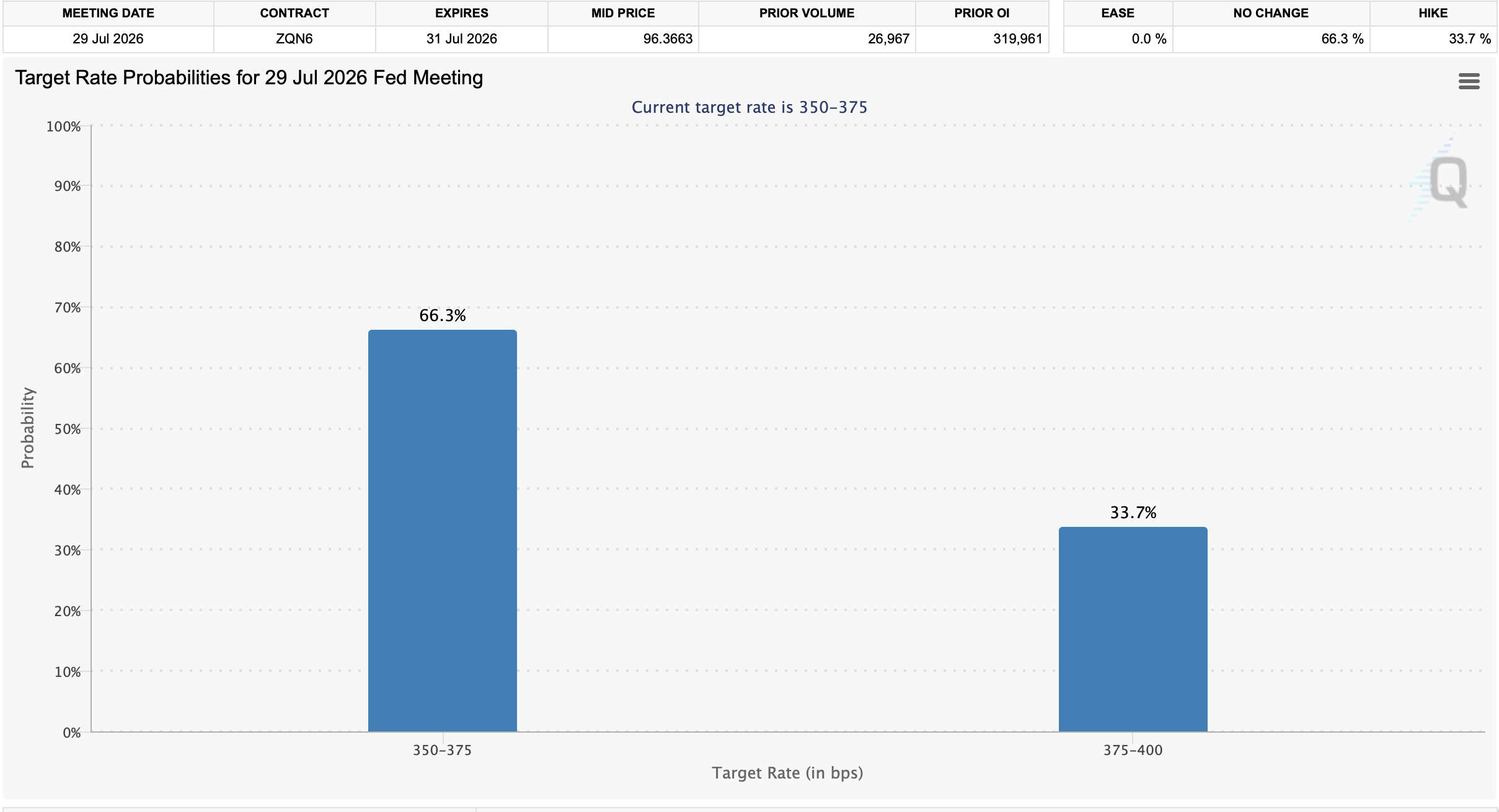
Thus, the market is pricing in a 33.7% chance of a quarter-percentage-point rate hike. According to the tool's current data, the probability of a rate cut is zero. Looking further ahead, Fedwatch shows a 54.3% probability of a rate hike by the September 16 meeting, with most market participants expecting at least one more hike by year-end.

Prediction Markets Lean Toward Unchanged Rates

Prediction markets show a similar picture with slightly different figures. The Kalshi contract on the Fed's decision, with trading volume exceeding $42 million, indicates a 73% probability of unchanged rates—this figure has surged after a 10-percentage-point shift toward this outcome in recent days. The probability of a 25-basis-point hike is 26%, while the likelihood of a more significant hike is less than 1%.
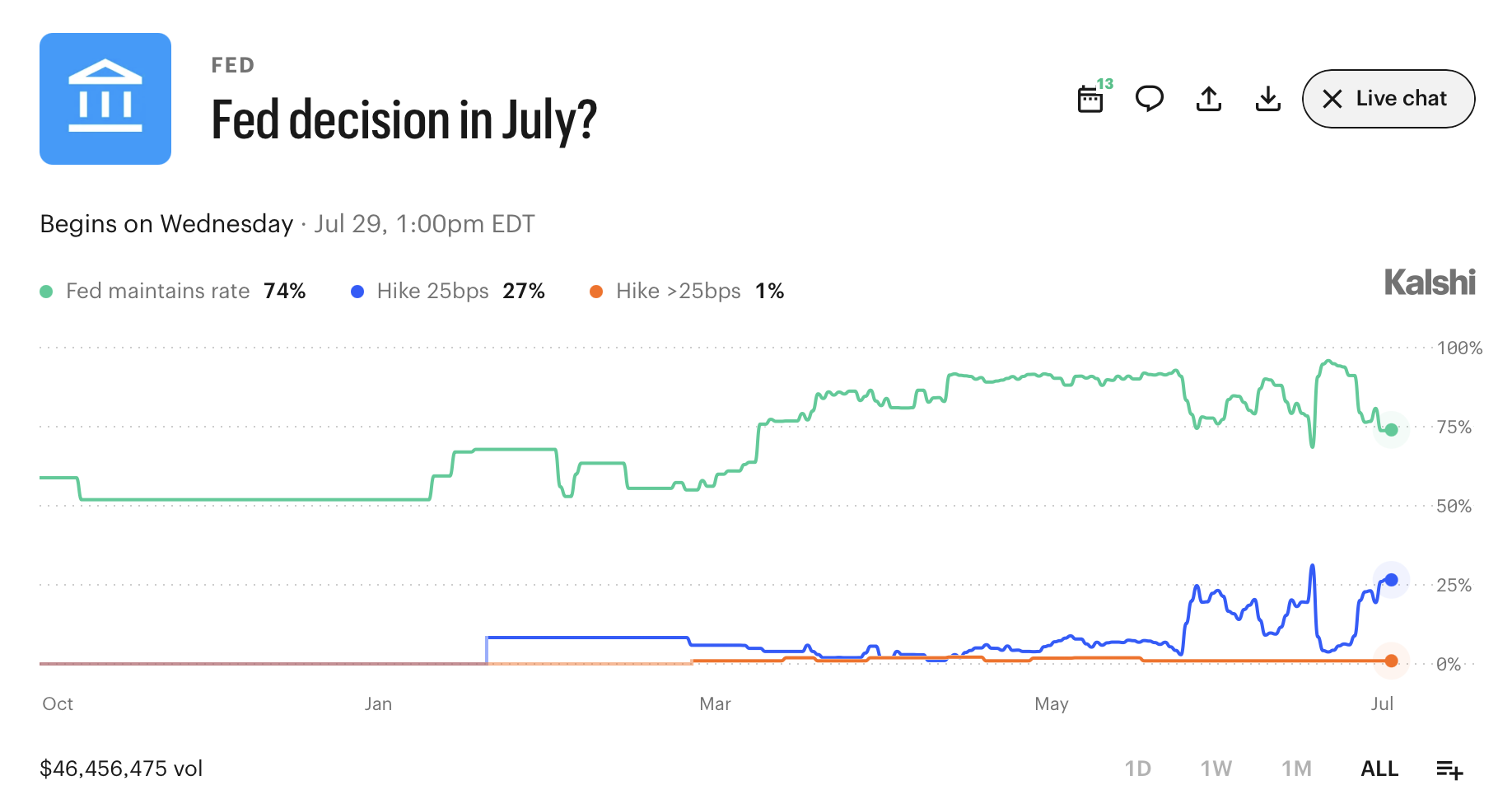
Traders on Polymarket have placed nearly $100 million on this outcome, spreading bets across five possible ranges. This market shows a 73% probability for unchanged rates and 26.5% for a quarter-point hike, with the likelihood of a more significant hike or a cut assessed at below 1%. The narrowing gap between the two leading outcomes reflects what typically happens ahead of major Fed decisions: confidence wanes as traders hedge risks on both sides rather than holding a single consensus view.

Citadel Securities' Unconventional Forecast

Frank Flight, Head of Macro Strategy at Citadel Securities, has broken from this consensus. In a client note reported by Bloomberg on July 27, Flight expressed the view that the Fed could unexpectedly raise rates by a quarter percentage point this week, although most analysts still expect rates to remain unchanged.

Flight joined Citadel Securities in late 2025 after seven years at Goldman Sachs, where he rose to Vice President for Interest Rates and Macro Strategy, and later held portfolio manager roles at Brevan Howard and Soros Fund Management. In April, Financial News included him in its "Rising Stars of European Finance" list, highlighting his work across asset class valuations.

Frank Flight, Head of Macro Strategy at Citadel Securities. Flight believes a surprise quarter-point rate hike awaits on Wednesday.

His reasoning is based more on a question of credibility than on any single inflation indicator. This line of argument holds weight because central bank communication is often assessed over several meetings, not one. Raising rates now, he wrote, would reinforce Warsh's stated commitment to price stability and signal that the Fed no longer needs to announce each move well in advance.

Flight has held this stance for several months. In a note dated June 19, he described the Warsh-led Fed as transitioning from an inertial, data-dependent stance to an adaptive one that reacts quickly to inflation deviations. He then pointed to the July meeting as the immediate opportunity and maintained rate hike forecasts for September, December, and March 2027 in his outlook. Consistency has been a defining feature of this forecast: the July meeting remained central to this concept, not adjusted to align with shifting market expectations.

Trump Again Pressures for Lower Rates

On July 27, President Trump spoke with journalists aboard Air Force One, calling Warsh "fantastic" while simultaneously insisting on lowering borrowing costs. He stated that Warsh wants to do the right thing but characterized other Fed board members as politicized, adding that some of them might have bad intentions.

Trump asserted that rates should come down and that with lower rates, the country's economy could grow at an annual pace of 8% to 12%. He reiterated his long-standing view that the U.S. should have the world's lowest interest rates, adding that rates here are higher than in the Eurozone, Japan, and China.

Trump insisted that the Fed must lower rates and that other countries pay much less to borrow. He noted that Warsh would still have to work with the rest of the board, reminding that the Chair sets the tone for discussion but does not set policy alone.

Trump has been pressuring the Fed to lower rates since his return to office in January 2025 and previously called for cuts to 1% or below. Some Fed officials, including Dallas Fed President Lorie Logan, have recently expressed concerns about persistent inflation and a willingness to, on the contrary, raise rates.

Inflation and Oil Offer No Clear Forecast

May Consumer Price Index (CPI) data, showing a 4.2% year-over-year increase primarily driven by energy costs, keeps the possibility of a rate hike alive, even though most market participants lean toward unchanged rates. Volatility in oil prices related to Middle East events adds another layer of uncertainty ahead of Wednesday's meeting. Sentiment in interest rate markets has gradually shifted: where the meeting was once seen as routine, it is now acknowledged that enough uncertainty remains to justify hedging both outcomes.

What This Means for Bitcoin and Risk Assets

Bitcoin tends to react more sharply precisely when the Fed deviates from expectations, rather than when it delivers a consensus-aligned decision. Unchanged rates, still the market's baseline scenario, are likely to leave crypto traders' positions largely unchanged heading into the announcement. An unexpected rate hike, which Flight continues to highlight, would likely have broader repercussions.

A rate hike typically strengthens the dollar and redirects capital to fixed-income assets—a trend that has repeatedly pressured Bitcoin and altcoins during previous monetary tightening cycles. Traders tracking ETF flows and derivatives positioning ahead of Wednesday will look for signs that institutional investors are quietly building downside protection, rather than opening outright bearish positions.

This distinction often matters more than the headline probabilities, as hedging often begins before expectations shift on futures or prediction markets. For traders assessing their positions ahead of the decision, the situation resembles previous weeks leading up to Fed meetings. When policy aligns with expectations, the initial price move in Bitcoin and major altcoins often fades quickly as traders unwind event-driven positions.

When the Fed surprises markets, liquidity can dry up within seconds, allowing prices to move much further than consensus forecasts anticipate.

What Comes Next

Keeping rates unchanged would extend the current range for a third consecutive meeting and shift focus to September, where the probability of a quarter-point hike already stands at 54.3% according to CME Fedwatch. A hike this week would mark the first move under Warsh's tenure and likely lead to rising short-term bond yields and a stronger dollar heading into the fall.

After the decision on Wednesday, Warsh will take questions from journalists. This press conference, along with the statement itself, will show whether the committee continues to signal a measured course or begins to lay the groundwork for the more nimble monetary policy response that Flight has been discussing since June.

end-content

Criptos en tendencia

Preguntas relacionadas

QWhat is the consensus view from prediction markets on the upcoming Fed rate decision as per the article?

AAccording to the article, prediction markets lean heavily toward the Federal Reserve holding interest rates steady. Specifically, contracts on Kalshi indicate a 73% probability of no change, while Polymarket traders show a similar 73% probability for unchanged rates, with about a 26-27% chance of a 25 basis point hike.

QWho is Frank Flight and what is his contrarian forecast regarding the Fed's upcoming meeting?

AFrank Flight is the head of macro strategy at Citadel Securities. He holds a contrarian view that the Fed could surprise markets by raising interest rates by a quarter percentage point at the July meeting, diverging from the prevailing market consensus which expects rates to remain unchanged.

QWhat is President Trump's stated position on Federal Reserve policy according to the article?

APresident Trump is pressuring the Federal Reserve to lower interest rates. He argues that the U.S. should have the world's lowest rates and claims the economy could grow at 8-12% annually with lower borrowing costs. He has been advocating for rate cuts since returning to office in January 2025, previously calling for rates as low as 1% or below.

QHow does the article describe Bitcoin's typical reaction to Fed policy decisions?

AThe article states that Bitcoin tends to react more strongly when the Fed deviates from market expectations rather than when its decision aligns with the consensus. An unexpected rate hike would likely strengthen the dollar and divert capital to fixed-income assets, putting pressure on Bitcoin and altcoins, similar to past tightening cycles.

QWhat key data point maintains the possibility of a rate hike despite market expectations for a pause?

AThe key data point is the May Consumer Price Index (CPI) data, which showed an annual increase of 4.2%, largely driven by energy costs. This persistent inflation, along with volatility in oil prices due to events in the Middle East, contributes to the uncertainty and maintains the possibility of a rate hike.

Lecturas Relacionadas

What Happens When Two Miners Find a Block in the Same Second? How the 'Orphan Race' Unfolds

Bitcoin mining is a race without a real-time referee. A newly mined block must physically propagate across the global peer-to-peer network before consensus is reached on the chain's tip. This takes seconds, sometimes longer on congested connections. If a second miner finds a valid block before learning of a competing one, they build on their last-known version and broadcast their own block. For a short time, two equally valid blocks exist at the same height, creating a temporary chain split. The network resolves this not by voting or timestamps, but by Proof-of-Work: the chain that accumulates the most work becomes canonical. Blocks on the losing side are "orphaned" or "stale." Their miners lose the block reward and fees, though unconfirmed transactions return to the mempool. Usually, a single subsequent block resolves the tie. A notable two-block reorganization occurred on March 24, 2026. Antpool and Foundry USA mined competing versions of block 941,881 seconds apart. ViaBTC extended Antpool's chain, while Foundry extended its own, creating a one-block split. Foundry then pulled ahead by mining six consecutive blocks, making its chain the heaviest. All nodes switched to Foundry's chain, orphaning blocks from Antpool and ViaBTC. While such multi-block reorganizations are rare, the underlying race condition is common. Analysis shows about 9.2% of block intervals in a sample period were under 60 seconds, each representing a potential short-lived race. Fast relay networks have reduced propagation delays, making prolonged splits rarer. However, the event highlighted a trend of hash rate concentration, where well-resourced pools have a higher chance of winning any specific race and mining consecutive blocks, marginalizing smaller miners.

cryptonews.ruHace 4 min(s)

What Happens When Two Miners Find a Block in the Same Second? How the 'Orphan Race' Unfolds

cryptonews.ruHace 4 min(s)

AmericanFortress proposed a scheme to protect crypto wallets from quantum threats

AmericanFortress has published a preprint detailing ZKPoSP, a cryptographic scheme designed to protect hierarchically deterministic (HD) cryptocurrency wallets from potential quantum attacks without requiring users to change their addresses. The proposed scheme replaces classical digital signatures with non-interactive zero-knowledge (NIZK) proofs, aiming to maintain compatibility with existing address formats. The company also introduced the QBIP32 scheme, intended to generate a signing scalar, a separate quantum-resistant proof, and a chain code in a single function call. According to the authors, QBIP32 can be applied to various elliptic curves of prime order, including secp256k1 and Ed25519. The post-quantum security of the scheme is described as "conjectured," relying on the quantum resistance of the underlying hash functions and NIZK proofs. However, for the scheme to function in a given blockchain network (like Bitcoin, Ethereum, or Solana), nodes would need to support verification of these new proofs instead of standard signatures—a capability currently not implemented. An implementation in Rust using RISC Zero reportedly takes 12–13 seconds to generate a proof and 9–10 milliseconds to verify it. The publication follows other industry efforts to address quantum threats, including reports from Galaxy on vulnerable assets, new hardware wallets like the PQ1, and consortiums like the Bitcoin Security Consortium pledging funding for post-quantum cryptography research. This new work specifically focuses on HD wallets and positions ZKPoSP/QBIP32 as a general mechanism for multiple curves and networks.

cryptonews.ruHace 14 min(s)

AmericanFortress proposed a scheme to protect crypto wallets from quantum threats

cryptonews.ruHace 14 min(s)

Weekly On-Chain Data Review: Robinhood Chain Explodes, FWA Goes Viral, Mantle Doubles Down on RWA

**Chain Data Weekly Digest: Vault Regulation, Robinhood Memecoin Surge, and FWA's NFT Gamble** * **Vault Managers Face SEC Scrutiny:** SEC Commissioner Hester Peirce warned that some DeFi Vault strategies could trigger investment advisor regulations. This may lead to licensing requirements, potentially sidelining smaller managers while bringing more traditional finance firms on-chain. The industry debates whether Vaults are purely code-driven or resemble discretionary portfolio management. * **Robinhood Chain's Memecoin-Led Boom:** Despite its initial RWA focus, Robinhood Chain has seen explosive early growth driven by memecoin trading and launchpads, which now dominate its DEX volume. The chain facilitates memecoin trading via tokenized stock pairs. It boasts over $800M in on-chain assets, $5B in stablecoin market cap, and strong fee revenue, positioning it as a consumer trading hub. * **FWA Revives NFT Activity with a Gamble:** The Fake World Assets (FWA) protocol, a gachapon-style system on Ethereum where users pay to randomly win deposited NFTs, has rapidly captured 10% of Ethereum's mainnet gas consumption in its first week. It demonstrates how simple, consumer-facing mechanics can reignite NFT engagement, attracting a broad user base. * **CEX Consolidation & DEX Growth:** The closures of BitMEX and BitMart highlight intense central exchange (CEX) competition and consolidation. Meanwhile, the DEX/CEX spot trading volume ratio hit a record high of 24.3% in July, signaling a shift of trading activity and innovation to on-chain venues. * **Mantle's RWA Focus at 3 Years:** Celebrating its third anniversary, Mantle Network is solidifying its role as a "full-stack distribution layer" for tokenized real-world assets (RWA). It ended Q2 with $1.2B in DeFi TVL, $955M in stablecoin market cap, and a growing suite of native RWA trading infrastructure like Fluxion and xChange.

marsbitHace 24 min(s)

Weekly On-Chain Data Review: Robinhood Chain Explodes, FWA Goes Viral, Mantle Doubles Down on RWA

marsbitHace 24 min(s)

Trading

Spot

Artículos destacados

Qué es $BANK

Banco AI: Un Paso Revolucionario en el Futuro de la Banca Introducción En una era marcada por avances rápidos en tecnología, Banco AI se sitúa en la intersección de la inteligencia artificial (IA) y los servicios bancarios. Este proyecto innovador busca redefinir el panorama financiero, mejorando la eficiencia operativa, las medidas de seguridad y las experiencias del cliente a través del poder de la IA. Al embarcarnos en esta exploración de Banco AI, profundizaremos en lo que implica el proyecto, sus dinámicas operativas, su contexto histórico y hitos significativos. ¿Qué es Banco AI? En su esencia, Banco AI representa una iniciativa transformadora destinada a integrar la inteligencia artificial en varias operaciones bancarias. Este proyecto aprovecha las capacidades de la IA para automatizar procesos, mejorar los protocolos de gestión de riesgos y mejorar la interacción con los clientes a través de servicios personalizados. Los objetivos principales de Banco AI incluyen: Automatización de Funciones Bancarias: Al aprovechar las tecnologías de IA, Banco AI tiene como objetivo automatizar tareas rutinarias, reduciendo la carga sobre los recursos humanos y mejorando la eficiencia. Mejora en la Gestión de Riesgos: El proyecto utiliza algoritmos de IA para predecir e identificar riesgos, fortaleciendo así las medidas de seguridad contra fraudes y otras amenazas. Personalización de Servicios Bancarios: Banco AI se centra en ofrecer productos y servicios financieros a medida al analizar datos y comportamientos de los clientes. Mejoramiento de la Experiencia del Cliente: La implementación de soluciones impulsadas por IA, como chatbots y asistentes virtuales, tiene como objetivo proporcionar a los usuarios interacciones más humanas, revolucionando la forma en que los clientes se relacionan con los bancos. Con estos objetivos, Banco AI se posiciona como un jugador crucial para hacer que la banca sea más eficiente, segura y centrada en el usuario. ¿Quién es el Creador de Banco AI? Los detalles sobre el creador de Banco AI siguen siendo desconocidos. Como tal, no se ha identificado a ninguna persona u organización específica en la información disponible. El anonimato que rodea el inicio del proyecto plantea preguntas, pero no resta valor a su ambiciosa visión y objetivos. ¿Quiénes Son los Inversores de Banco AI? Al igual que con el creador del proyecto, no se ha divulgado información específica sobre los inversores u organizaciones que apoyan a Banco AI. Sin esta información, es un desafío delinear el respaldo financiero y el apoyo institucional que podrían estar impulsando el proyecto hacia adelante. No obstante, la importancia de contar con una sólida base de inversión es fundamental para sostener el desarrollo en un campo tan innovador. ¿Cómo Funciona Banco AI? Banco AI opera en múltiples frentes innovadores, centrándose en factores únicos que lo diferencian de los marcos bancarios tradicionales. A continuación, se presentan las características operativas clave: Automatización: Al aplicar algoritmos de aprendizaje automático, Banco AI automatiza varios procesos manuales dentro de los bancos. Esto resulta en la reducción de costos operativos y permite que los trabajadores humanos redirijan sus esfuerzos hacia actividades más estratégicas. Gestión Avanzada de Riesgos: La integración de la IA en las prácticas de gestión de riesgos equipa a los bancos con herramientas para predecir con precisión amenazas potenciales como el fraude, garantizando que la información y los activos de los clientes permanezcan seguros. Recomendaciones Financieras Personalizadas: A través del aprendizaje continuo a partir de las interacciones con los clientes, los sistemas de IA desarrollan una comprensión matizada de las necesidades del usuario, lo que les permite ofrecer consejos adaptados sobre decisiones financieras. Interacciones Mejoradas con los Clientes: Al utilizar chatbots y asistentes virtuales impulsados por IA, Banco AI permite una experiencia más atractiva para el cliente, permitiendo a los usuarios resolver sus consultas rápidamente, reduciendo así los tiempos de espera y mejorando los niveles de satisfacción. En conjunto, estas características operativas posicionan a Banco AI como un pionero en el sector bancario, estableciendo nuevos parámetros para la entrega de servicios y la excelencia operativa. Línea de Tiempo de Banco AI Entender la trayectoria de Banco AI requiere mirar su contexto histórico. A continuación, se presenta una línea de tiempo que destaca hitos y desarrollos importantes: Inicios de 2010: La conceptualización de la integración de la IA en los servicios bancarios comenzó a ganar atención a medida que las instituciones bancarias reconocieron los posibles beneficios. 2018: Se produjo un aumento notable en la implementación de tecnologías de IA cuando los bancos comenzaron a utilizar herramientas de IA como chatbots para el servicio al cliente básico y sistemas de gestión de riesgos para mejorar la seguridad. 2023: La sofisticación de la IA continuó avanzando, con la introducción de IA generativa para tareas más complejas como el procesamiento de documentos y análisis de inversiones en tiempo real. Este año marcó un salto significativo en las capacidades que la tecnología de IA otorgó a los bancos. 2024-Estatus Actual: A partir de este año, Banco AI se encuentra en una trayectoria ascendente, con investigaciones y desarrollos en curso que pronto mejorarán las capacidades en las operaciones bancarias. La continua exploración de las aplicaciones de IA sugiere emocionantes desarrollos aún por venir. Puntos Clave Sobre Banco AI Integración de la IA en la Banca: Banco AI se centra en adoptar inteligencia artificial para optimizar los procesos bancarios y mejorar la experiencia del usuario. Enfoque en Automatización y Gestión de Riesgos: El proyecto enfatiza fuertemente estas áreas, con el objetivo de desplazar la carga de tareas rutinarias mientras mejora los marcos de seguridad a través de análisis predictivos. Soluciones Bancarias Personalizadas: Al aprovechar los datos de los clientes, Banco AI permite servicios bancarios adaptados a las necesidades individuales de los usuarios. Compromiso con el Desarrollo: Banco AI se mantiene comprometido con esfuerzos de investigación y desarrollo continuos, asegurando su adaptabilidad y relevancia continua a medida que la tecnología sigue evolucionando. Conclusión En resumen, Banco AI ejemplifica un paso crucial hacia adelante en la industria bancaria, aprovechando la inteligencia artificial para redefinir los paradigmas operativos, mejorar la seguridad y promover la satisfacción del cliente. A pesar de las lagunas en la información sobre el creador y los inversores, los objetivos claros y los mecanismos funcionales de Banco AI proporcionan una sólida base para su evolución continua. A medida que la tecnología de IA sigue avanzando y fusionándose con el sector bancario, Banco AI está bien posicionado para impactar significativamente el futuro de los servicios financieros, mejorando la forma en que entendemos e interactuamos con la banca.

189 Vistas totalesPublicado en 2024.04.06Actualizado en 2024.12.03

Qué es $BANK

Cómo comprar BANK

¡Bienvenido a HTX.com! Hemos hecho que comprar Lorenzo Protocol (BANK) sea simple y conveniente. Sigue nuestra guía paso a paso para iniciar tu viaje de criptos.Paso 1: crea tu cuenta HTXUtiliza tu correo electrónico o número de teléfono para registrarte y obtener una cuenta gratuita en HTX. Experimenta un proceso de registro sin complicaciones y desbloquea todas las funciones.Obtener mi cuentaPaso 2: ve a Comprar cripto y elige tu método de pagoTarjeta de crédito/débito: usa tu Visa o Mastercard para comprar Lorenzo Protocol (BANK) al instante.Saldo: utiliza fondos del saldo de tu cuenta HTX para tradear sin problemas.Terceros: hemos agregado métodos de pago populares como Google Pay y Apple Pay para mejorar la comodidad.P2P: tradear directamente con otros usuarios en HTX.Over-the-Counter (OTC): ofrecemos servicios personalizados y tipos de cambio competitivos para los traders.Paso 3: guarda tu Lorenzo Protocol (BANK)Después de comprar tu Lorenzo Protocol (BANK), guárdalo en tu cuenta HTX. Alternativamente, puedes enviarlo a otro lugar mediante transferencia blockchain o utilizarlo para tradear otras criptomonedas.Paso 4: tradear Lorenzo Protocol (BANK)Tradear fácilmente con Lorenzo Protocol (BANK) en HTX's mercado spot. Simplemente accede a tu cuenta, selecciona tu par de trading, ejecuta tus trades y monitorea en tiempo real. Ofrecemos una experiencia fácil de usar tanto para principiantes como para traders experimentados.

823 Vistas totalesPublicado en 2025.05.09Actualizado en 2026.06.02

Cómo comprar BANK

Discusiones

Bienvenido a la comunidad de HTX. Aquí puedes mantenerte informado sobre los últimos desarrollos de la plataforma y acceder a análisis profesionales del mercado. A continuación se presentan las opiniones de los usuarios sobre el precio de BANK (BANK).

活动图片