AI's Deceptive Perfection: How Can Crypto Users Defend Against New Scams?

Foresight NewsPublicado a 2026-06-08Actualizado a 2026-06-08

Resumen

AI-generated content is making cryptocurrency scams more sophisticated and harder to detect. Previously, users could spot phishing attempts through poor grammar and spelling errors. Now, AI tools allow scammers to produce flawless, professional-looking emails, websites, and social media posts, often personalized using stolen user data. This shift poses unique risks in crypto, where transactions are irreversible and self-custody wallets can be compromised by a single malicious authorization. The article advises a shift from relying on visual cues to adopting rigorous verification as the primary defense. Key recommendations include: manually checking website URLs against official sources, scrutinizing wallet permissions before approving transactions, verifying smart contract addresses directly from project websites or block explorers, and being wary of unsolicited "urgent" messages from impersonated customer support. The core message is that in the AI era, a polished appearance is no guarantee of safety; every link, request, and interaction must be independently verified before any action is taken.


Author: Dilip Kumar Patairya

Compiled by: Chopper, Foresight News


In the past, cybersecurity education often taught simple methods to identify scams: watch for spelling errors, awkward phrasing, and abnormal formatting. In early phishing attacks, this approach was indeed effective. Scam emails were often hastily written, poorly translated, and full of obvious flaws. Over time, people began to view clumsy writing as a red flag.


The emergence of artificial intelligence has completely changed this landscape.


Using advanced AI tools, fraudsters can quickly produce fluent emails, realistic customer service chats, professional-looking websites, and highly deceptive social media content. Scammers no longer need strong writing skills to create convincing traps. In the crypto space, where a single click to authorize a transaction can lead to instant asset loss, this shift presents entirely new security risks.


Today, the threat no longer comes from information riddled with errors. Instead, well-written, seemingly legitimate scam content is more likely to lower people's guard.


As AI technology continues to evolve, the mindset of crypto users regarding security must also change. Rather than obsessing over whether information itself seems suspicious, it's better to verify each operational request through independent channels.
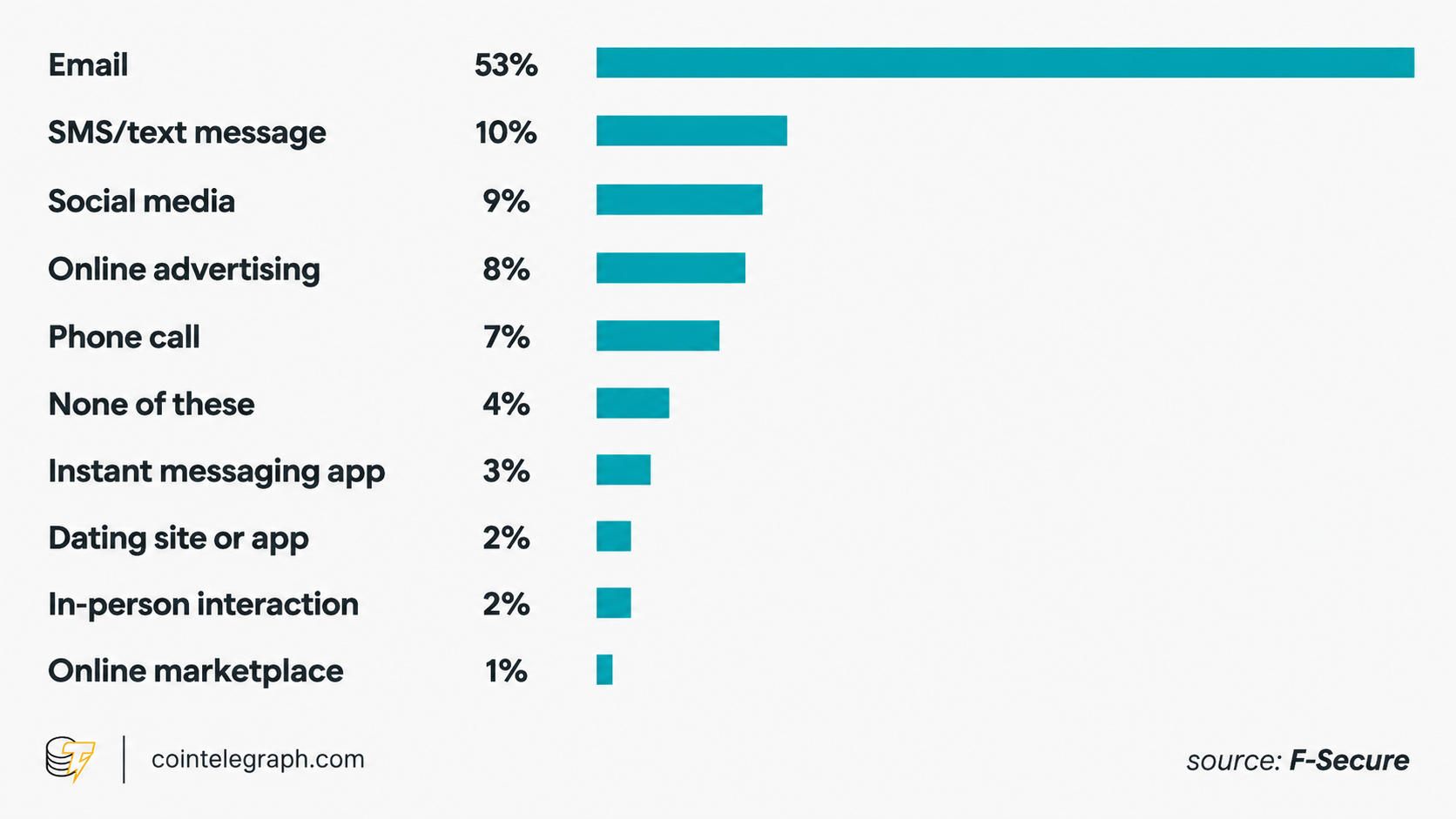

Common Scam Channels


Why Text Authentication Used to Work


Early phishing scams focused on casting a wide net, prioritizing quantity over content quality. Scammers sent out mass messages, hoping just a few people would bite.


Since most scam operations were based overseas or used simple translation tools, the sent information often contained grammatical errors, awkward expressions, and messy formatting. Users gradually learned to treat these details as warning signs.


Various cybersecurity awareness campaigns also popularized a series of basic identification techniques:


  • Check if the text contains spelling mistakes.
  • Avoid messages with poor grammar.
  • Be wary of strange or unusual phrasing.
  • Watch for abnormal formatting.


These small tricks could quickly filter out crudely made scam content.


However, this was never a foolproof defense method, serving only as a reminder. But over time, many people began to assume that professional, fluent writing equated to trustworthy content. The widespread adoption of AI has completely shattered this ingrained perception.


AI tools can generate well-formatted and eloquently phrased phishing content in bulk. Relying on spotting textual errors to prevent scams is becoming increasingly unreliable.


How AI Upgrades Scam Tactics


Large language models can generate natural, fluent text in multiple languages, allowing fraudsters to fabricate various types of false content:


  • Falsify customer service chat logs
  • Produce sophisticated phishing emails
  • Impersonate legitimate exchange notifications
  • Write highly enticing investment pitches
  • Post realistic Telegram group announcements
  • Create customized fake wallet recovery guides


Simultaneously, AI also assists in implementing precise targeted attacks. Scammers use data breach information and user data from platforms like LinkedIn, X, Discord, and Telegram to tailor scam narratives.


Information received by users might mention these details:


  • Tokens you recently purchased
  • Your exchange account information
  • The wallet service provider you are using
  • Decentralized Finance (DeFi) platforms you've interacted with
  • Customer service questions you've asked in public channels


Highly customized content significantly increases the credibility of scams.


Furthermore, AI image generation and voice cloning technologies make identity impersonation much easier. Forging executive videos, simulating customer service voices, and replicating brand visual elements can now be achieved effortlessly.


Unique Risks Faced by Crypto Users


The security logic of crypto assets is fundamentally different from traditional banking. In traditional finance, if you encounter a mistaken transfer or scam, you can usually contact your bank, payment institution, or risk control team to recover the funds. However, once a crypto transaction is confirmed on the blockchain, it is essentially irreversible.


Self-custody wallets also expand the attack surface. Scammers may not need to steal passwords or private keys; often, simply tricking users into authorizing malicious transactions or granting high-risk wallet permissions is enough to succeed.


This means that even if users never leak their seed phrase, well-crafted scam interfaces still pose a significant risk.


Common scam forms in the crypto space include:


  • Fake airdrop claim websites
  • Counterfeit NFT minting events
  • Impersonated exchange login pages
  • Inducement to connect to malicious wallets
  • Pop-ups prompting authorization of malicious tokens
  • Fake staking or mining interfaces
  • Impersonation of official customer support
  • High-imitation accounts registered on platforms like Telegram and Discord


With the help of AI, such scams can be produced in bulk while maintaining high fidelity in content and interface design.


Core Verification Methods Users Should Master


Facing increasingly realistic scams, crypto users can no longer rely on superficial judgment; verification must become the primary rule.


1) Scrutinize the Domain Name Carefully


A website's appearance can be copied, but the URL is difficult to replicate perfectly. Fraudulent domains commonly use these tricks: adding extra characters, inserting random hyphens, using look-alike symbols, tampering with subdomains, choosing obscure top-level domains.


Even if the page looks identical to a legitimate platform, do not trust it based solely on logos and visual effects. Recommended practices include:


  • Manually type the URLs of commonly used platforms.
  • For wallets and exchanges, prioritize using saved bookmarks.
  • Always verify the domain name before connecting a wallet.
  • Avoid clicking links in unfamiliar messages or promotional content.


A beautiful page does not equate to a legitimate website.


2) Prioritize Links from Official Channels


Fake announcements, impersonated influencer accounts, and scam accounts are common vectors for spreading scams. Fraudulent links primarily spread through: Telegram groups, Discord channels, X (formerly Twitter) comment sections, paid search ads, fake customer service messages.


Always confirm that links originate from the project's official website or officially announced channels. Cross-referencing information across multiple official accounts can further reduce risk.


Be highly vigilant when receiving unsolicited private messages claiming your account has an urgent issue.
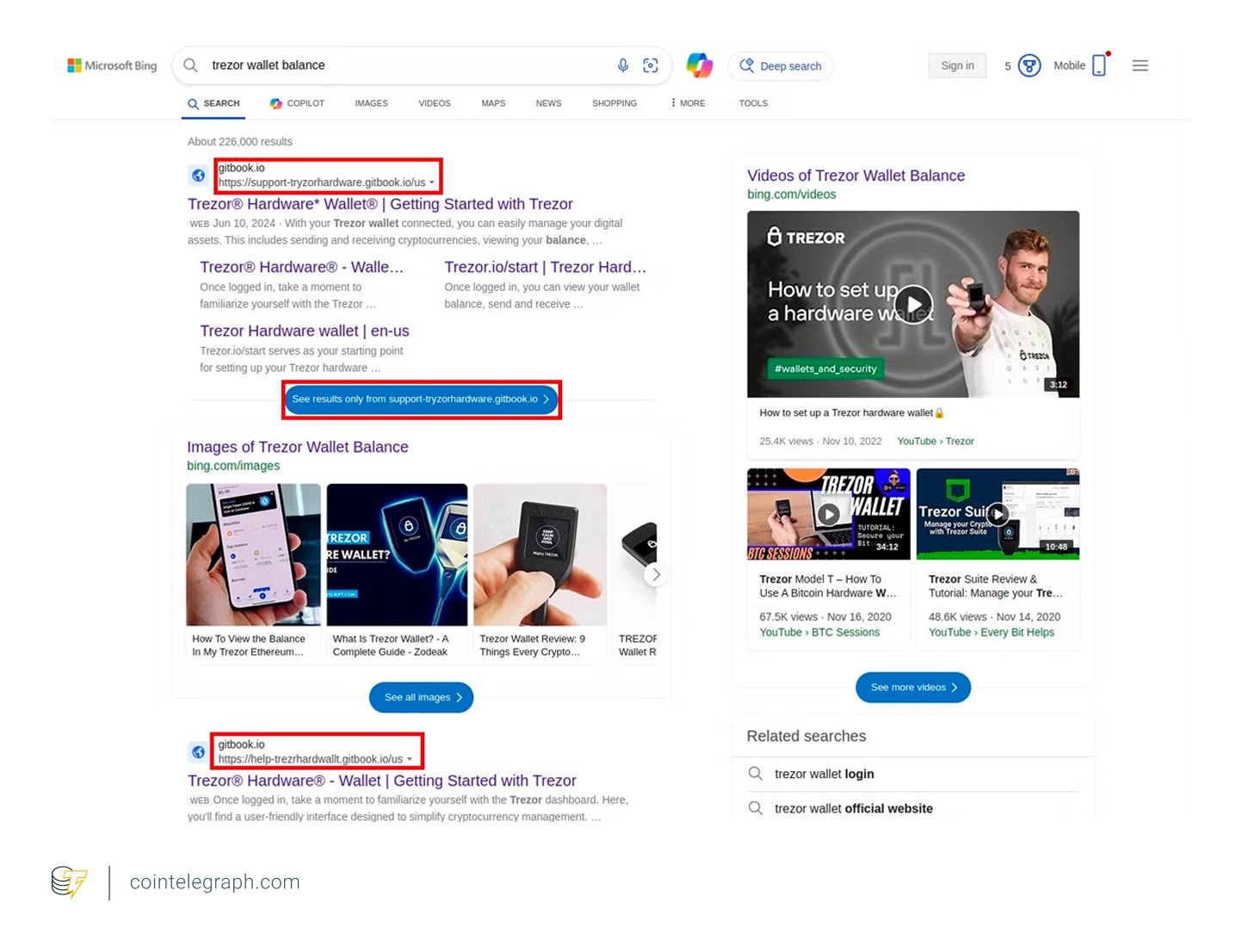

Malicious Trezor Balance Check Link Found in Bing Search


3) Understand Wallet Permissions Before Authorizing


Many users have the misconception that any request popping up from their wallet must be safe. Especially when faced with professional-looking websites, people often casually click confirm, overlooking permission details.


Wallet interactions involve various operation types: connecting a wallet, signing messages, authorizing token transfers, granting general permissions, triggering smart contract interactions, etc.


Among these, unlimited approvals carry the highest risk, allowing malicious contracts to transfer your assets arbitrarily in the future. Before approving, always verify that the token types, allowed transfer amounts, the requesting contract address, and the operation details match your expectations.


Even if a website looks flawless, it might trigger high-risk wallet operations.


4) Verify All Details Before Signing a Transaction


AI scams often exploit a sense of urgency to rush users into quick confirmation. Before signing any transaction, meticulously check the recipient address, token amount, selected blockchain, contract interaction information, fee structure, and approval scope.


If a page is labeled "Claim Reward" but requests unlimited token permissions, or labeled "Wallet Verification" but initiates an asset transfer, stop immediately and investigate the risk.


Once transaction details deviate from expectations, do not proceed.


Many wallet scams begin when users publicly complain about account issues on social media. Scammers monitor such posts and then impersonate customer support via private messages.


5) Verify Contract Addresses, Don't Blindly Trust Token Names


Scammers can copy token names and icons to create high-imitation fake tokens. A token that appears to be named "USDT" or "ETH Earnings" might be issued by a completely unrelated entity.


Verification method: Confirm the token's corresponding contract address through the project's official website, legitimate blockchain explorers, officially published materials, or mainstream exchange information. As AI scams become more convincing, relying solely on token names and icons to judge authenticity is increasingly risky.


6) Be Wary of Unsolicited Customer Service Private Messages


Impersonating official customer support remains a prevalent scam method in the crypto space. Scammers monitor users' help-seeking comments on social platforms, then send private messages posing as staff. They may induce users to perform wallet "verification," ask for seed phrases, send malicious links, recommend remote control tools, or guide users to complete dangerous authorizations.


Legitimate official customer support almost never initiates private contact first. Platforms will also never ask for private keys or seed phrases. If you encounter a problem, proactively contact support through official channels. Do not respond to unsolicited private messages.


7) Urgent Pressure is Often a Sign of a Scam


Even the most professionally crafted scams often use psychological pressure to create urgency. Common narratives include: "Your wallet has been hacked," "Tokens are about to expire, claim now," "Account will be suspended soon," "KYC failed," "Security update required immediately."


Such tactics can cloud judgment. The more someone pressures you to act immediately, the more you should slow down and verify carefully.


A simple rule for crypto security: Whenever you're asked to act on your wallet immediately, pause and calmly verify first.


Polished Appearance No Longer Equals Security


Today's scam websites can accurately replicate brand logos, color schemes, page layouts, and writing styles. AI can also help create high-fidelity FAQ pages, fake customer service replies, impersonated news articles, and complete new user onboarding flows and promotional copy.


Judging a platform's trustworthiness based on visual appeal alone is no longer possible. Attackers only need to catch a user off guard for a moment to execute irreversible asset theft.


The core of security protection remains verification: check the domain name, inspect the contract, review wallet requests, confirm support identities, clarify transaction purposes. A beautifully designed interface does not equate to trustworthiness.


Crypto Security Has Evolved into a Battle of Verification


AI hasn't created entirely new scam models; it has simply significantly upgraded the presentation and disguise of traditional scam techniques. In the past, people relied on surface characteristics to identify risks but neglected the act of verification itself. This mindset can lead to massive losses in the crypto industry.


Behind a perfectly phrased paragraph, a malicious link might lurk. Within a seemingly professional customer service reply, instructions to authorize asset transfers could be hidden. A convincingly realistic website might also request high-risk permissions.


The core takeaway is simple: fluent copy, exquisite interfaces, and familiar brand imagery cannot serve as security credentials. Faced with every link, every wallet pop-up, every customer service message: verify first, then act.


Preguntas relacionadas

QHow has the use of AI by scammers fundamentally changed the nature of phishing attacks in the cryptocurrency space?

AAI has shifted phishing attacks from relying on easily identifiable signs like poor grammar, spelling errors, and awkward phrasing to generating highly polished, fluent, and contextually convincing content. This makes scams appear legitimate and professional, breaking users' long-held association of sloppy text with danger.

QWhat are some of the unique risks cryptocurrency users face compared to traditional banking users, especially in the context of AI-enhanced scams?

ACryptocurrency transactions are irreversible once confirmed on the blockchain, unlike traditional banking where chargebacks are often possible. AI can create convincing fake websites and interfaces that trick users into signing malicious transactions or granting unlimited token approvals, leading to instant asset loss even if seed phrases are never shared.

QAccording to the article, what is the most critical principle for crypto users to adopt for security in the age of AI scams?

AThe core principle is 'verification before action.' Users must move beyond judging content by its polished appearance and instead rigorously verify every request through independent channels. This includes checking domains, contract addresses, wallet permissions, and the identity of support personnel.

QWhat are three specific verification methods the article recommends for crypto users to protect themselves?

A1) Carefully verify website URLs and domain names, avoiding links from unknown sources. 2) Always check the details of any wallet transaction or signature request before approving, especially the token permissions and recipient addresses. 3) Verify token authenticity by checking the official contract address, not just the name or logo, and be wary of unsolicited private messages from 'support staff.'

QWhy is a sense of urgency often a red flag in potential crypto scams, even if the communication looks professional?

AScammers use urgency (e.g., claims of a hacked wallet, expiring tokens, or account suspension) to create psychological pressure and short-circuit a user's normal verification process. The article advises that the more a message pressures you to act immediately, the more you should slow down and perform thorough checks.

Lecturas Relacionadas

Farewell to Traditional Bulls and Bears: The Market Has Entered an Era of Rotating Bubbles

Farewell to traditional bull and bear markets; we have entered an era of rolling bubbles. This article uses a meteorological analogy to explain the modern market's shift from slow-moving, long-term trends to a chain of rapid, successive speculative frenzies. The old market resembled "stratiform" weather—slow, broad cycles lasting years. Today's market is like a "mesoscale convective system," where isolated storms (bubbles in sectors like AI, GLP-1 drugs, or crypto) form in sequence. Each is triggered by the outflow of capital and sentiment from the previous one, creating a self-perpetuating chain of booms and busts. This structural change is driven by eight permanent shifts: the democratization of speculation (zero-commission trading, retail options activity), perpetual buying from defined-contribution retirement plans, the dominance of passive investing (creating price-insensitive flows), the rise of multi-strategy funds and high-frequency trading (weakening price discovery), suppressed volatility that erupts violently, an index composition now dominated by long-duration, narrative-driven tech stocks, the elimination of information delays, and a permissive fiscal/monetary backdrop. These conditions ensure that rolling bubbles are the new normal. To navigate this environment, investors should either become deep-sector experts who understand the underlying technologies and business models or become adept observers of trends and capital flows. While chaotic from within each "storm," a higher-altitude view reveals a predictable pattern of serial booms. The key is to avoid being emotionally swept up in any single narrative and to recognize the market's new, permanent structure.

marsbitHace 3 min(s)

Farewell to Traditional Bulls and Bears: The Market Has Entered an Era of Rotating Bubbles

marsbitHace 3 min(s)

The Right Way to Use Skills: 5 Reflections After Anthropic Publicly Shared Its Internal Methodology

A deep dive into Anthropic's internal methodology for building effective AI "Skills" reveals five key insights for maximizing their value. First, Skills should focus on capturing "Gotchas" and tacit organizational knowledge—like common pitfalls and undocumented rules—rather than restating general information the AI already knows. Second, think of Skills as a form of "Context Engineering"; they are best structured as folders, not monolithic documents. A core `SKILL.md` file should act as a navigational index, progressively pulling in detailed references, examples, and assets only as needed to avoid overwhelming the model's context window. Third, whenever possible, automate repetitive tasks with scripts. This preserves the model's reasoning capacity for judgment and analysis, while scripts reliably handle the execution, saving tokens and improving accuracy. Instructions within a Skill provide the "why" and the expert judgment, while scripts provide the concrete "how." Fourth, a Skill's description is critical and often misunderstood. It should not be a list of features but a routing rule that clearly signals *when* the Skill should be triggered based on user intent and common phrasing. Finally, as Skills scale from personal tools to team-wide assets, management is crucial. Anthropic advocates for a lightweight, organic approach: let new Skills spread organically within small groups first. Those that prove genuinely useful through adoption naturally graduate to a formal marketplace, ensuring the curated library contains only high-value, battle-tested tools.

marsbitHace 20 min(s)

The Right Way to Use Skills: 5 Reflections After Anthropic Publicly Shared Its Internal Methodology

marsbitHace 20 min(s)

Vying for the AI Payment Track: Traditional Card Networks Face Off Against Coinbase

As AI agents increasingly conduct commercial transactions, a battle for control over the underlying payment infrastructure is unfolding. The competition centers on two divergent and incompatible technical approaches for autonomous AI payments. One camp, led by traditional card networks Visa and Mastercard, relies on tokenized card credentials within the established banking rails. Visa's "Intelligent Commerce" and Mastercard's "Agent Pay" services extend their existing tokenization technology to authorized AI agents for consumer retail transactions, leveraging decades of fraud protection and dispute resolution systems. Their partners include major AI firms like Anthropic, OpenAI, and Microsoft. The opposing camp, spearheaded by Coinbase, advocates for an open internet protocol using stablecoins. Coinbase's x402 protocol utilizes the HTTP 402 status code to enable direct, machine-to-machine micropayments with USDC on-chain. This model eliminates card fees and is designed for high-frequency, low-value transactions between AI agents, such as paying for API calls or data streams, where traditional card costs are prohibitive. Currently, application scenarios are clearly divided. Mainstream consumer-facing AI shopping services (e.g., ChatGPT's "one-click checkout," Amazon's AI-assisted shopping) predominantly use card channels due to their mature consumer protections and merchant networks. Conversely, the stablecoin channel dominates machine-to-machine payments, as seen in Amazon Bedrock's core payment service using Base blockchain. Significantly, traditional card networks are not solely defending their turf; they are also investing in the stablecoin arena. Visa has rapidly expanded its stablecoin settlement volume and partnered with Coinbase on interoperability, while Mastercard moved to acquire stablecoin platform BVNK. This dual-strategy indicates their intent to become the fee-collecting gateway for all payment flows, regardless of the underlying rail. The short-term outlook is for coexistence: cards for personal retail, stablecoins for machine transactions. The long-term outcome hinges on whether AI-driven commerce will resemble traditional retail or evolve into a vast network of machine micropayments. Visa and Mastercard's hedging strategy suggests they are prepared for either future, while companies betting on a single channel face greater risk.

Foresight NewsHace 22 min(s)

Vying for the AI Payment Track: Traditional Card Networks Face Off Against Coinbase

Foresight NewsHace 22 min(s)

For the First Time, Pure Human Video Pretrained VLA for Dexterous Manipulation: Deployable with Minimal Fine-Tuning Data

For the first time, a purely human-video-pretrained Vision-Language-Action (VLA) model for dexterous manipulation requires only a small amount of data for fine-tuning to achieve successful real-world deployment. Achieving human-level dexterous manipulation remains a core challenge in robotics. While multi-fingered hands offer hardware potential, Visual-Language-Action (VLA) models lag behind due to the high cost of collecting diverse, high-quality robot data. A novel framework, VITRA, developed by Microsoft Research Asia and Tsinghua University, addresses this by automatically transforming massive, unlabeled real-world human activity videos into a structured V-L-A training dataset. Key innovations include precise 3D hand motion annotation from monocular video, atomic action segmentation based on hand-speed minima, and automated instruction generation using VLMs combined with 3D trajectory visualization. This process created a massive dataset of 1 million clips. Pretrained exclusively on this human video data, the VLA model (combining a VLM backbone with a Diffusion Transformer action expert) demonstrates strong zero-shot hand motion prediction in unseen environments. Crucially, it requires minimal fine-tuning (~1.2k demonstrations) on real robot data to achieve high-success-rate dexterous manipulation tasks like grasping, placing, pouring, and sweeping on hardware like the Realman robot with the XHAND1 dexterous hand. The model shows exceptional generalization to novel objects and environments. The research also observes promising scaling behavior, where performance improves with more pretraining data, paving the way for more generalized embodied intelligence.

marsbitHace 32 min(s)

For the First Time, Pure Human Video Pretrained VLA for Dexterous Manipulation: Deployable with Minimal Fine-Tuning Data

marsbitHace 32 min(s)

Trading

Spot
Futuros

Artículos destacados

Qué es $S$

Entendiendo SPERO: Una Visión General Completa Introducción a SPERO A medida que el panorama de la innovación continúa evolucionando, la aparición de tecnologías web3 y proyectos de criptomonedas juega un papel fundamental en la configuración del futuro digital. Un proyecto que ha atraído la atención en este campo dinámico es SPERO, denotado como SPERO,$$s$. Este artículo tiene como objetivo reunir y presentar información detallada sobre SPERO, para ayudar a entusiastas e inversores a comprender sus fundamentos, objetivos e innovaciones dentro de los dominios web3 y cripto. ¿Qué es SPERO,$$s$? SPERO,$$s$ es un proyecto único dentro del espacio cripto que busca aprovechar los principios de descentralización y tecnología blockchain para crear un ecosistema que promueva la participación, la utilidad y la inclusión financiera. El proyecto está diseñado para facilitar interacciones de igual a igual de nuevas maneras, proporcionando a los usuarios soluciones y servicios financieros innovadores. En su esencia, SPERO,$$s$ tiene como objetivo empoderar a los individuos al proporcionar herramientas y plataformas que mejoren la experiencia del usuario en el espacio de las criptomonedas. Esto incluye habilitar métodos de transacción más flexibles, fomentar iniciativas impulsadas por la comunidad y crear caminos para oportunidades financieras a través de aplicaciones descentralizadas (dApps). La visión subyacente de SPERO,$$s$ gira en torno a la inclusividad, buscando cerrar brechas dentro de las finanzas tradicionales mientras aprovecha los beneficios de la tecnología blockchain. ¿Quién es el Creador de SPERO,$$s$? La identidad del creador de SPERO,$$s$ sigue siendo algo oscura, ya que hay recursos públicos limitados que proporcionan información de fondo detallada sobre su(s) fundador(es). Esta falta de transparencia puede derivarse del compromiso del proyecto con la descentralización, una ética que muchos proyectos web3 comparten, priorizando las contribuciones colectivas sobre el reconocimiento individual. Al centrar las discusiones en torno a la comunidad y sus objetivos colectivos, SPERO,$$s$ encarna la esencia del empoderamiento sin señalar a individuos específicos. Como tal, comprender la ética y la misión de SPERO sigue siendo más importante que identificar a un creador singular. ¿Quiénes son los Inversores de SPERO,$$s$? SPERO,$$s$ cuenta con el apoyo de una diversa gama de inversores que van desde capitalistas de riesgo hasta inversores ángeles dedicados a fomentar la innovación en el sector cripto. El enfoque de estos inversores generalmente se alinea con la misión de SPERO, priorizando proyectos que prometen avances tecnológicos sociales, inclusión financiera y gobernanza descentralizada. Estas fundaciones de inversores suelen estar interesadas en proyectos que no solo ofrecen productos innovadores, sino que también contribuyen positivamente a la comunidad blockchain y sus ecosistemas. El respaldo de estos inversores refuerza a SPERO,$$s$ como un contendiente notable en el dominio de proyectos cripto que evoluciona rápidamente. ¿Cómo Funciona SPERO,$$s$? SPERO,$$s$ emplea un marco multifacético que lo distingue de los proyectos de criptomonedas convencionales. Aquí hay algunas de las características clave que subrayan su singularidad e innovación: Gobernanza Descentralizada: SPERO,$$s$ integra modelos de gobernanza descentralizada, empoderando a los usuarios para participar activamente en los procesos de toma de decisiones sobre el futuro del proyecto. Este enfoque fomenta un sentido de propiedad y responsabilidad entre los miembros de la comunidad. Utilidad del Token: SPERO,$$s$ utiliza su propio token de criptomoneda, diseñado para servir diversas funciones dentro del ecosistema. Estos tokens permiten transacciones, recompensas y la facilitación de servicios ofrecidos en la plataforma, mejorando la participación y la utilidad general. Arquitectura en Capas: La arquitectura técnica de SPERO,$$s$ apoya la modularidad y escalabilidad, permitiendo la integración fluida de características y aplicaciones adicionales a medida que el proyecto evoluciona. Esta adaptabilidad es fundamental para mantener la relevancia en el cambiante paisaje cripto. Participación de la Comunidad: El proyecto enfatiza iniciativas impulsadas por la comunidad, empleando mecanismos que incentivan la colaboración y la retroalimentación. Al nutrir una comunidad sólida, SPERO,$$s$ puede abordar mejor las necesidades de los usuarios y adaptarse a las tendencias del mercado. Enfoque en la Inclusión: Al ofrecer tarifas de transacción bajas e interfaces amigables para el usuario, SPERO,$$s$ busca atraer a una base de usuarios diversa, incluyendo a individuos que anteriormente pueden no haber participado en el espacio cripto. Este compromiso con la inclusión se alinea con su misión general de empoderamiento a través de la accesibilidad. Cronología de SPERO,$$s$ Entender la historia de un proyecto proporciona información crucial sobre su trayectoria de desarrollo y hitos. A continuación se presenta una cronología sugerida que mapea eventos significativos en la evolución de SPERO,$$s$: Fase de Conceptualización e Ideación: Las ideas iniciales que forman la base de SPERO,$$s$ fueron concebidas, alineándose estrechamente con los principios de descentralización y enfoque comunitario dentro de la industria blockchain. Lanzamiento del Whitepaper del Proyecto: Tras la fase conceptual, se lanzó un whitepaper completo que detalla la visión, los objetivos y la infraestructura tecnológica de SPERO,$$s$ para generar interés y retroalimentación de la comunidad. Construcción de Comunidad y Primeras Interacciones: Se realizaron esfuerzos de divulgación activa para construir una comunidad de primeros adoptantes y posibles inversores, facilitando discusiones en torno a los objetivos del proyecto y obteniendo apoyo. Evento de Generación de Tokens: SPERO,$$s$ llevó a cabo un evento de generación de tokens (TGE) para distribuir sus tokens nativos a los primeros seguidores y establecer liquidez inicial dentro del ecosistema. Lanzamiento de la dApp Inicial: La primera aplicación descentralizada (dApp) asociada con SPERO,$$s$ se puso en marcha, permitiendo a los usuarios interactuar con las funcionalidades centrales de la plataforma. Desarrollo Continuo y Alianzas: Actualizaciones y mejoras continuas a las ofertas del proyecto, incluyendo alianzas estratégicas con otros actores en el espacio blockchain, han moldeado a SPERO,$$s$ en un jugador competitivo y en evolución en el mercado cripto. Conclusión SPERO,$$s$ se erige como un testimonio del potencial de web3 y las criptomonedas para revolucionar los sistemas financieros y empoderar a los individuos. Con un compromiso con la gobernanza descentralizada, la participación comunitaria y funcionalidades diseñadas de manera innovadora, allana el camino hacia un paisaje financiero más inclusivo. Como con cualquier inversión en el espacio cripto que evoluciona rápidamente, se anima a los posibles inversores y usuarios a investigar a fondo y participar de manera reflexiva con los desarrollos en curso dentro de SPERO,$$s$. El proyecto muestra el espíritu innovador de la industria cripto, invitando a una mayor exploración de sus innumerables posibilidades. Mientras el viaje de SPERO,$$s$ aún se desarrolla, sus principios fundamentales pueden, de hecho, influir en el futuro de cómo interactuamos con la tecnología, las finanzas y entre nosotros en ecosistemas digitales interconectados.

72 Vistas totalesPublicado en 2024.12.17Actualizado en 2024.12.17

Qué es $S$

Qué es AGENT S

Agent S: El Futuro de la Interacción Autónoma en Web3 Introducción En el paisaje en constante evolución de Web3 y las criptomonedas, las innovaciones están redefiniendo constantemente cómo los individuos interactúan con las plataformas digitales. Uno de estos proyectos pioneros, Agent S, promete revolucionar la interacción humano-computadora a través de su marco agente abierto. Al allanar el camino para interacciones autónomas, Agent S busca simplificar tareas complejas, ofreciendo aplicaciones transformadoras en inteligencia artificial (IA). Esta exploración detallada profundizará en las complejidades del proyecto, sus características únicas y las implicaciones para el dominio de las criptomonedas. ¿Qué es Agent S? Agent S se presenta como un marco agente abierto innovador, diseñado específicamente para abordar tres desafíos fundamentales en la automatización de tareas informáticas: Adquisición de Conocimiento Específico del Dominio: El marco aprende inteligentemente de diversas fuentes de conocimiento externas y experiencias internas. Este enfoque dual le permite construir un rico repositorio de conocimiento específico del dominio, mejorando su rendimiento en la ejecución de tareas. Planificación a Largo Plazo de Tareas: Agent S emplea planificación jerárquica aumentada por la experiencia, un enfoque estratégico que facilita la descomposición y ejecución eficiente de tareas complejas. Esta característica mejora significativamente su capacidad para gestionar múltiples subtareas de manera eficiente y efectiva. Manejo de Interfaces Dinámicas y No Uniformes: El proyecto introduce la Interfaz Agente-Computadora (ACI), una solución innovadora que mejora la interacción entre agentes y usuarios. Utilizando Modelos de Lenguaje Multimodal de Gran Escala (MLLMs), Agent S puede navegar y manipular diversas interfaces gráficas de usuario sin problemas. A través de estas características pioneras, Agent S proporciona un marco robusto que aborda las complejidades involucradas en la automatización de la interacción humana con las máquinas, preparando el terreno para una multitud de aplicaciones en IA y más allá. ¿Quién es el Creador de Agent S? Si bien el concepto de Agent S es fundamentalmente innovador, la información específica sobre su creador sigue siendo elusiva. El creador es actualmente desconocido, lo que resalta ya sea la etapa incipiente del proyecto o la elección estratégica de mantener a los miembros fundadores en el anonimato. Independientemente de la anonimidad, el enfoque sigue siendo en las capacidades y el potencial del marco. ¿Quiénes son los Inversores de Agent S? Dado que Agent S es relativamente nuevo en el ecosistema criptográfico, la información detallada sobre sus inversores y patrocinadores financieros no está documentada explícitamente. La falta de información disponible públicamente sobre las bases de inversión u organizaciones que apoyan el proyecto plantea preguntas sobre su estructura de financiamiento y hoja de ruta de desarrollo. Comprender el respaldo es crucial para evaluar la sostenibilidad del proyecto y su posible impacto en el mercado. ¿Cómo Funciona Agent S? En el núcleo de Agent S se encuentra una tecnología de vanguardia que le permite funcionar de manera efectiva en diversos entornos. Su modelo operativo se basa en varias características clave: Interacción Humano-Computadora Similar a la Humana: El marco ofrece planificación avanzada de IA, esforzándose por hacer que las interacciones con las computadoras sean más intuitivas. Al imitar el comportamiento humano en la ejecución de tareas, promete elevar las experiencias de los usuarios. Memoria Narrativa: Empleada para aprovechar experiencias de alto nivel, Agent S utiliza memoria narrativa para hacer un seguimiento de las historias de tareas, mejorando así sus procesos de toma de decisiones. Memoria Episódica: Esta característica proporciona a los usuarios una guía paso a paso, permitiendo que el marco ofrezca apoyo contextual a medida que se desarrollan las tareas. Soporte para OpenACI: Con la capacidad de ejecutarse localmente, Agent S permite a los usuarios mantener el control sobre sus interacciones y flujos de trabajo, alineándose con la ética descentralizada de Web3. Fácil Integración con APIs Externas: Su versatilidad y compatibilidad con varias plataformas de IA aseguran que Agent S pueda encajar sin problemas en ecosistemas tecnológicos existentes, convirtiéndolo en una opción atractiva para desarrolladores y organizaciones. Estas funcionalidades contribuyen colectivamente a la posición única de Agent S dentro del espacio cripto, ya que automatiza tareas complejas y de múltiples pasos con una intervención humana mínima. A medida que el proyecto evoluciona, sus posibles aplicaciones en Web3 podrían redefinir cómo se desarrollan las interacciones digitales. Cronología de Agent S El desarrollo y los hitos de Agent S pueden encapsularse en una cronología que resalta sus eventos significativos: 27 de septiembre de 2024: El concepto de Agent S fue lanzado en un documento de investigación integral titulado “Un Marco Agente Abierto que Usa Computadoras Como un Humano”, mostrando las bases del proyecto. 10 de octubre de 2024: El documento de investigación fue puesto a disposición del público en arXiv, ofreciendo una exploración profunda del marco y su evaluación de rendimiento basada en el benchmark OSWorld. 12 de octubre de 2024: Se lanzó una presentación en video, proporcionando una visión visual de las capacidades y características de Agent S, involucrando aún más a posibles usuarios e inversores. Estos marcadores en la cronología no solo ilustran el progreso de Agent S, sino que también indican su compromiso con la transparencia y la participación comunitaria. Puntos Clave Sobre Agent S A medida que el marco Agent S continúa evolucionando, varios atributos clave destacan, subrayando su naturaleza innovadora y potencial: Marco Innovador: Diseñado para proporcionar un uso intuitivo de las computadoras similar a la interacción humana, Agent S aporta un enfoque novedoso a la automatización de tareas. Interacción Autónoma: La capacidad de interactuar de manera autónoma con las computadoras a través de GUI significa un salto hacia soluciones informáticas más inteligentes y eficientes. Automatización de Tareas Complejas: Con su metodología robusta, puede automatizar tareas complejas y de múltiples pasos, haciendo que los procesos sean más rápidos y menos propensos a errores. Mejora Continua: Los mecanismos de aprendizaje permiten a Agent S mejorar a partir de experiencias pasadas, mejorando continuamente su rendimiento y eficacia. Versatilidad: Su adaptabilidad en diferentes entornos operativos como OSWorld y WindowsAgentArena asegura que pueda servir a una amplia gama de aplicaciones. A medida que Agent S se posiciona en el paisaje de Web3 y criptomonedas, su potencial para mejorar las capacidades de interacción y automatizar procesos significa un avance significativo en las tecnologías de IA. A través de su marco innovador, Agent S ejemplifica el futuro de las interacciones digitales, prometiendo una experiencia más fluida y eficiente para los usuarios en diversas industrias. Conclusión Agent S representa un audaz avance en la unión de la IA y Web3, con la capacidad de redefinir cómo interactuamos con la tecnología. Aunque aún se encuentra en sus primeras etapas, las posibilidades para su aplicación son vastas y atractivas. A través de su marco integral que aborda desafíos críticos, Agent S busca llevar las interacciones autónomas al primer plano de la experiencia digital. A medida que nos adentramos más en los reinos de las criptomonedas y la descentralización, proyectos como Agent S sin duda desempeñarán un papel crucial en la configuración del futuro de la tecnología y la colaboración humano-computadora.

476 Vistas totalesPublicado en 2025.01.14Actualizado en 2025.01.14

Qué es AGENT S

Cómo comprar S

¡Bienvenido a HTX.com! Hemos hecho que comprar Sonic (S) sea simple y conveniente. Sigue nuestra guía paso a paso para iniciar tu viaje de criptos.Paso 1: crea tu cuenta HTXUtiliza tu correo electrónico o número de teléfono para registrarte y obtener una cuenta gratuita en HTX. Experimenta un proceso de registro sin complicaciones y desbloquea todas las funciones.Obtener mi cuentaPaso 2: ve a Comprar cripto y elige tu método de pagoTarjeta de crédito/débito: usa tu Visa o Mastercard para comprar Sonic (S) al instante.Saldo: utiliza fondos del saldo de tu cuenta HTX para tradear sin problemas.Terceros: hemos agregado métodos de pago populares como Google Pay y Apple Pay para mejorar la comodidad.P2P: tradear directamente con otros usuarios en HTX.Over-the-Counter (OTC): ofrecemos servicios personalizados y tipos de cambio competitivos para los traders.Paso 3: guarda tu Sonic (S)Después de comprar tu Sonic (S), guárdalo en tu cuenta HTX. Alternativamente, puedes enviarlo a otro lugar mediante transferencia blockchain o utilizarlo para tradear otras criptomonedas.Paso 4: tradear Sonic (S)Tradear fácilmente con Sonic (S) en HTX's mercado spot. Simplemente accede a tu cuenta, selecciona tu par de trading, ejecuta tus trades y monitorea en tiempo real. Ofrecemos una experiencia fácil de usar tanto para principiantes como para traders experimentados.

968 Vistas totalesPublicado en 2025.01.15Actualizado en 2026.06.02

Cómo comprar S

Discusiones

Bienvenido a la comunidad de HTX. Aquí puedes mantenerte informado sobre los últimos desarrollos de la plataforma y acceder a análisis profesionales del mercado. A continuación se presentan las opiniones de los usuarios sobre el precio de S (S).

活动图片