55 Billion Dollars: Musk's 'Chip Factory' Becomes a Reality

marsbitPublicado a 2026-05-08Actualizado a 2026-05-08

Resumen

Elon Musk's "Terafab" Chip Factory Vision Begins with a $55 Billion Bet SpaceX has formally proposed investing $55 billion to initiate construction of a "Terafab" chip manufacturing facility in Grimes County, Texas, with the total cost potentially reaching $119 billion in later phases. This massive project, a joint initiative by SpaceX and Tesla, marks a pivotal step in Elon Musk's strategy of vertical integration for his company ecosystem. The core logic is that Musk's ventures—SpaceX, Tesla, xAI, and future projects like the Optimus robot—consume enormous amounts of AI computing power. Terafab is envisioned not merely as a factory but as a "full-stack AI infrastructure strategy," aiming to bring chip production, energy sourcing, and compute deployment under one umbrella to secure a self-sufficient supply of this critical resource. Analysts describe this as a bold "15-year strategy" with significant execution risks. Building a leading-edge semiconductor fab requires 3-5 years, specialized equipment like ASML's EUV lithography machines, and a skilled workforce, with the earliest chip output not expected until mid-2028 at best. It mirrors a broader industry trend where giants like Microsoft and Google are also pouring billions into custom AI chips, driven by the belief that in the AI era, controlling computing power means controlling the future. Timed alongside SpaceX's impending IPO, the Terafab announcement also serves as a powerful narrative, linking Tesla to SpaceX's a...

Author: Birch Forest Dance King

In the 1980s, Japan's semiconductor industry was at its peak, once accounting for over 50% of the global chip market share.

Americans became restless—not because they couldn't buy chips, but because they realized that a country that couldn't control its own "silicon" was effectively handing over its strategic lifeline to others. This led to the *Semiconductor Agreement*, the subsequent resurgence of Intel, and today's *CHIPS Act*.

Four decades later, a similar anxiety has manifested in a more personal way with Elon Musk.

Except this time, the entity seeking to control "silicon" is not a country, but an individual—and the cluster of companies under his control.

On May 6th, Bloomberg disclosed a document: SpaceX has formally proposed a $55 billion investment in Grimes County, Texas, to initiate the construction plan for the "Terafab" chip manufacturing facility. If all subsequent phases proceed, the total capital expenditure could surge to $119 billion.

First, let's translate these numbers to grasp the scale.

$55 billion is more than double TSMC's total revenue in 2023. $119 billion is close to NVIDIA's peak revenue for its entire 2024 fiscal year. This isn't an "investment"; it's a high-stakes gamble—or perhaps, a strategic declaration.

This project is a joint initiative by SpaceX and Tesla. Musk's logic is clear: His group of companies—SpaceX, Tesla, xAI—consumes a massive amount of GPU computing power annually. Training Grok requires chips, the Starlink ground station network requires chips, Tesla's Autopilot requires chips, and the future humanoid robot Optimus will also require chips.

Rather than paying NVIDIA billions every year, why not invest that money in himself?

From a strategic logic standpoint, this is impeccable.

01 Musk's Ambition for Vertical Integration

To understand Terafab, you first need to understand what Musk has been doing over the past two years.

In 2025, xAI acquired the social media platform X. Earlier this year, SpaceX absorbed xAI in an all-stock deal. Meanwhile, SpaceX's IPO plan is advancing, with the roadshow window reportedly opening around June 8th, and the S-1 registration document expected to be submitted later this month.

This is an increasingly dense web: rockets, satellite broadband, AI models, social platforms, electric vehicles, humanoid robots... And now, chip manufacturing is to be added to the portfolio.

DataCenter Knowledge's analysis hit the nail on the head: Terafab should best not be understood as a "factory," but as *a "full-stack AI infrastructure strategy"* —an attempt to unify compute production, energy procurement, and compute deployment under the same roof.

This is like Amazon not just wanting to sell books, but also wanting to build its own shipping network, its own data centers, its own logistics satellites—except Musk is adding one more layer on top: building a "factory for producing computation."

Apple's move to design its own A-series chips was considered one of the most successful vertical integration decisions in tech history. But Apple only "designs" the chips; manufacturing is still outsourced to TSMC. What Musk wants to do is take over the manufacturing as well.

That's an ambition even Apple hasn't dared to touch.

02 Behind the "15-Year Strategy"

However, there's always a deep chasm between strategic vision and engineering reality.

Chip analyst Ben Bajarin from Creative Strategies used an interesting phrase, *saying Musk is pursuing a "15-year strategy"* —which sounds like praise, but the implication is: don't expect returns in the short term.

Morgan Stanley's forecast is more direct. They estimate that even under the most optimistic construction assumptions, *the initial chip output from Terafab wouldn't arrive until mid-2028 at the earliest*. That's over two years from now. And where will the technological generation of AI chips be by then? No one knows.

The brutality of semiconductor manufacturing lies in it being one of the world's least forgiving industries for "PPT promises."

Building an advanced-node wafer fab typically takes 3-5 years, requiring extremely precise lithography machines (only ASML can make high-end EUV machines globally), thousands of highly specialized engineers, a stable supply of ultra-pure water and electricity, and an entire suite of sophisticated cleanroom management systems. Intel has spent hundreds of billions of dollars and years of time, yet still struggles to catch up with TSMC in process technology.

Finance Monthly's analysis directly pointed out this risk: chip projects are prone to underestimating execution difficulties—slow, expensive, easily delayed, reliant on specialized machinery, skilled labor, and already highly strained supply chains.

Interestingly, when asked about Terafab, Intel CEO Pat Gelsinger offered a subtly worded response, saying he was *"excited to explore innovative ways to re-architect silicon technology."* This can be interpreted as a signal of willingness to cooperate, or as an indirect acknowledgment of the tight market supply and demand—or perhaps both.

03 More Than Just Business

But viewing Terafab solely through the lens of business investment returns might be applying the wrong analytical framework from the start.

The truly interesting aspect of this project is how it reflects the AI industry's deepening obsession with "compute autonomy."

Over the past three years, the nature of the AI arms race has evolved from "whose model is smarter" to "who can secure more computing power." NVIDIA's H100, H200, GB200 are in critically short supply, and TSMC's advanced node capacity is booked years in advance. Microsoft, Google, Amazon, and Meta have invested tens of billions of dollars in developing their own AI chips.

Musk's logic is fundamentally the same as that of these tech giants: *In the AI era, computing power is the means of production. Whoever controls the chips controls AI.*

And the emergence of Terafab, layered on top of SpaceX's upcoming IPO, adds another dimension of complexity. A tech media editor commented that part of the announcement's design was to *"tie Tesla, which is under pressure, to the narratives of SpaceX's impending IPO and AI supercomputing."*

This assessment may not be entirely fair, but it's not baseless. Just a few months ago, Musk himself admitted that *"xAI was not built correctly,"* forcing SpaceX to step in for the integration. Against this backdrop, Terafab's high-profile unveiling serves as both a strategic maneuver and a capital narrative—two things that are not mutually exclusive.

Musk never does just one thing.

Right now, the launch window for Starship Flight 12 is between May 12th and 18th, and the Dragon cargo spacecraft will fly to the International Space Station on the same day. SpaceX's rocket business continues to operate with great momentum.

And in Grimes County, Texas, a plot of land that could potentially reshape the AI-era chip supply chain remains just coordinates on a document.

No one can guarantee that $119 billion will turn into a fully operational wafer fab. But one thing is already certain—when a company famous for building rockets decides to build chips, the boundaries of this industry are once again being redefined.

Preguntas relacionadas

QWhat is the estimated initial investment for SpaceX's Terafab chip manufacturing facility, and where is it planned to be built?

AThe estimated initial investment for SpaceX's Terafab chip manufacturing facility is $55 billion, and it is planned to be built in Grimes County, Texas.

QAccording to the article, what is the primary strategic reason for Elon Musk's companies to build their own chip manufacturing plant?

AThe primary strategic reason is to achieve vertical integration and 'compute sovereignty'. Musk's companies (SpaceX, Tesla, xAI) consume vast amounts of GPU compute power, and building their own plant ensures control over this critical AI-era production resource, reducing dependence on suppliers like NVIDIA.

QWhat major challenge or risk does the article associate with the Terafab project, according to analysts and industry examples?

AThe major challenge is the extreme difficulty and long timeline of advanced semiconductor manufacturing. It requires 3-5 years for construction, highly specialized equipment (like EUV lithography machines from ASML), skilled engineers, stable utilities, and a complex supply chain. The article cites Intel's struggles to catch up with TSMC as an example of these execution risks.

QHow does the article interpret the timing of the Terafab announcement in relation to SpaceX's other corporate activities?

AThe article suggests the Terafab announcement serves a dual purpose. It is a strategic move for vertical integration, but its timing also helps craft a compelling capital narrative by linking Tesla (which is under pressure) with the upcoming SpaceX IPO and the powerful 'AI supercomputing' story.

QWhat broader industry trend does the Terafab project represent, as mentioned in the article?

AThe Terafab project represents the broader AI industry's deep-seated drive for 'compute autonomy' or 'compute sovereignty'. Major tech firms (Microsoft, Google, Amazon, Meta) are investing billions in custom AI chips, reflecting the belief that in the AI era, controlling the chip supply is synonymous with controlling AI itself.

Lecturas Relacionadas

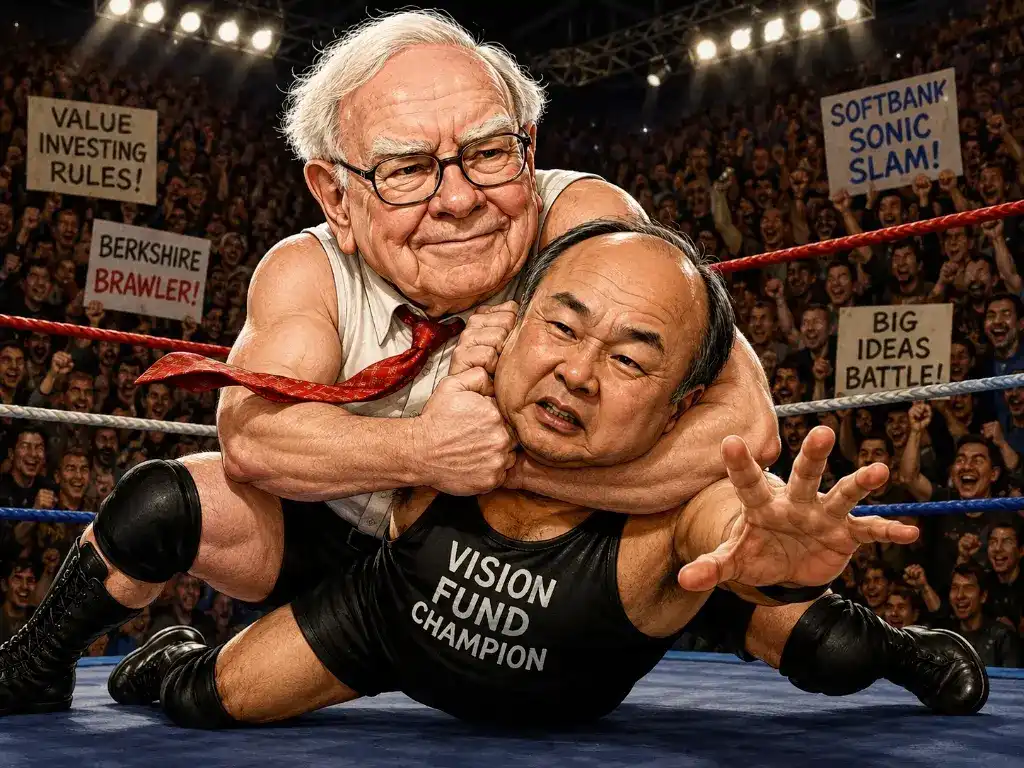
Berkshire Hathaway and SoftBank: One Must Die

"Berkshire Hathaway vs. SoftBank: One Must 'Die'" In May 2026, with half-empty seats at its annual meeting, Berkshire Hathaway, under new CEO Greg Abel, faces investor pressure over its massive $397.4 billion cash pile—nearly 40% of its market cap. This hoard, largely in US Treasuries, resulted from 14 consecutive quarters of net equity sales, including massive Apple divestments. Abel inherits Buffett's "nothing looks attractive" stance in an expensive market likened to "a casino next to a church." However, Berkshire's significant underperformance versus the S&P 500 and a future of sustained high valuations could force a historic choice: returning capital via special dividends or breaking up the conglomerate. Berkshire's "death" would be a slow, existential one—the erosion of its value-investing identity post-Buffett. Conversely, SoftBank, led by Masayoshi Son, is in a frantic race against debt. It has pledged a staggering $64.6 billion for a 13% stake in OpenAI, financed by escalating parent-company debt (over ¥16.3 trillion), a historic $40 billion bridge loan, and the fire-sale of assets like Nvidia, T-Mobile, and Alibaba shares. The plan hinges on a successful OpenAI IPO and the $100 billion listing of its Roze AI unit to refinance. Son's high-wire act faces three correlated triggers for potential collapse: an OpenAI IPO delay or stumble, a sharp de-rating of its key liquid asset Arm (trading at 70x forward P/E), or a failure to refinance the massive 2027 bridge loan at increasingly costly rates. The conclusion: One philosophy must "die." In a prolonged bull market, SoftBank could triumph, realizing Son's AI vision, while Berkshire's conservative model fades into irrelevance. In a downturn, SoftBank's leveraged bet could unravel violently, while Berkshire's fortress balance sheet survives. Their fates are inversely tied to the market cycle's turn.

marsbitHace 4 hora(s)

Berkshire Hathaway and SoftBank: One Must Die

marsbitHace 4 hora(s)

Coinbase Q1 Earnings Report: Nearly $4 Billion Loss, Trading Volume Halved. Can AI + RWA Turn Things Around?

Coinbase's Q1 2026 earnings report revealed a net loss of $394 million, largely driven by $482 million in unrealized losses on its crypto asset holdings. Total revenue fell 31% year-over-year to $1.41 billion. Transaction revenue declined 40% to $756 million, reflecting a market-wide slump in crypto trading volumes. Consumer trading was particularly weak, down 48%, though Coinbase's global spot market share rose to a record 8.6%. Key bright spots included institutional trading revenue, which grew 37%, and a surge in derivatives activity following the Deribit acquisition. Subscription and services revenue of $584 million was more resilient, with stablecoin revenue up 11% to $305 million. Adjusted EBITDA remained positive at $303 million. Ahead of earnings, Coinbase announced a 14% workforce reduction (~700 employees) to accelerate its transition to an "AI-native" organizational model. Strategically, the company is pursuing its "Everything Exchange" vision, expanding into derivatives and predictive markets. Its partnership with Circle on USDC remains a core revenue moat, with over 25% of the stablecoin's $80 billion supply held on its platform. The company is actively engaged in shaping stablecoin legislation like the CLARITY Act. Despite significant losses and cyclical pressures, Coinbase is positioning itself as a broader on-chain financial infrastructure provider.

链捕手Hace 4 hora(s)

Coinbase Q1 Earnings Report: Nearly $4 Billion Loss, Trading Volume Halved. Can AI + RWA Turn Things Around?

链捕手Hace 4 hora(s)

Trading

Spot
Futuros

Artículos destacados

Cómo comprar CHIP

¡Bienvenido a HTX.com! Hemos hecho que comprar USD.AI (CHIP) sea simple y conveniente. Sigue nuestra guía paso a paso para iniciar tu viaje de criptos.Paso 1: crea tu cuenta HTXUtiliza tu correo electrónico o número de teléfono para registrarte y obtener una cuenta gratuita en HTX. Experimenta un proceso de registro sin complicaciones y desbloquea todas las funciones.Obtener mi cuentaPaso 2: ve a Comprar cripto y elige tu método de pagoTarjeta de crédito/débito: usa tu Visa o Mastercard para comprar USD.AI (CHIP) al instante.Saldo: utiliza fondos del saldo de tu cuenta HTX para tradear sin problemas.Terceros: hemos agregado métodos de pago populares como Google Pay y Apple Pay para mejorar la comodidad.P2P: tradear directamente con otros usuarios en HTX.Over-the-Counter (OTC): ofrecemos servicios personalizados y tipos de cambio competitivos para los traders.Paso 3: guarda tu USD.AI (CHIP)Después de comprar tu USD.AI (CHIP), guárdalo en tu cuenta HTX. Alternativamente, puedes enviarlo a otro lugar mediante transferencia blockchain o utilizarlo para tradear otras criptomonedas.Paso 4: tradear USD.AI (CHIP)Tradear fácilmente con USD.AI (CHIP) en HTX's mercado spot. Simplemente accede a tu cuenta, selecciona tu par de trading, ejecuta tus trades y monitorea en tiempo real. Ofrecemos una experiencia fácil de usar tanto para principiantes como para traders experimentados.

251 Vistas totalesPublicado en 2026.04.21Actualizado en 2026.04.21

Cómo comprar CHIP

Discusiones

Bienvenido a la comunidad de HTX. Aquí puedes mantenerte informado sobre los últimos desarrollos de la plataforma y acceder a análisis profesionales del mercado. A continuación se presentan las opiniones de los usuarios sobre el precio de CHIP (CHIP).

活动图片