By: Gino Matos
Compiled by: Saoirse, Foresight News
In the June 14th match where Spain faced Cape Verde, Spain dominated possession at nearly 75% and fired off 27 shots — statistics that, in most tournaments, would guarantee a victory. However, the final score was 0-0, with Cape Verde's 40-year-old goalkeeper Vozinha named Man of the Match. This draw caused significant losses for many bettors on Polymarket, while simultaneously allowing an unknown wallet to rake in approximately $9 million in a single day.
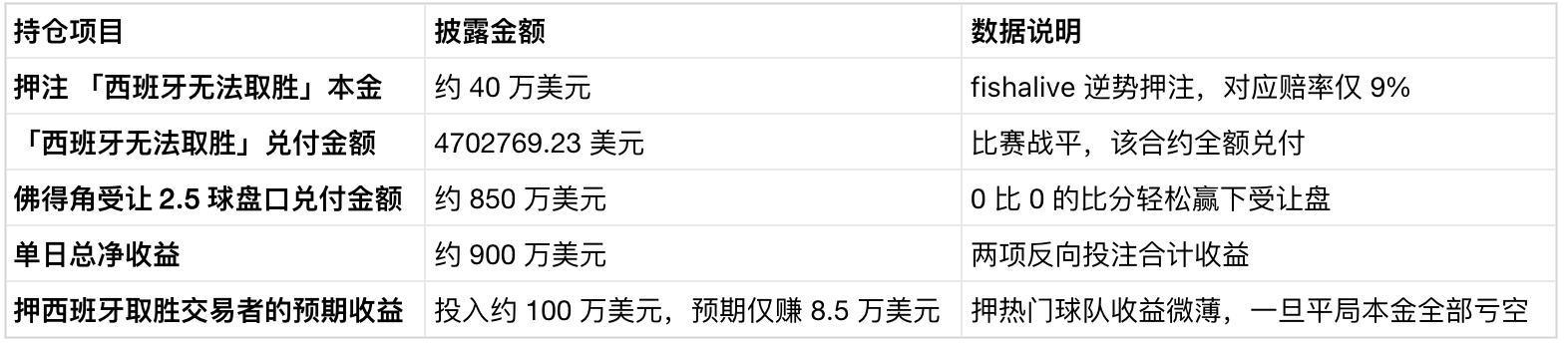
The wallet, belonging to an account named 'fishalive', was only registered on Polymarket in June 2026, with only two predictive bets in its public record. The account bet on the contract "Spain will not win," cashing out around $4.7 million; simultaneously, it placed a bet on the Cape Verde +2.5 handicap spread (a sports betting rule to balance odds between strong and weak teams, manually adding 2.5 goals to Cape Verde's total before comparing scores), securing another approximately $8.5 million. With an initial investment of only about $400,000, it netted nearly $9 million.
Data from Polymarket's sports section shows that this $400,000 bet had an initial implied probability of only 9%, with a final payout reaching $4,702,769.23. The bet's size, timing (placed just 8 minutes before kickoff), and the account's recent registration sparked extensive online discussion. Commenters noted that the $4.5 million position was established just 8 minutes before the match started.
This newly registered wallet accurately predicted Cape Verde's chances, and the platform's fully public on-chain ledger allowed everyone to witness the entire process of this massive profit realization in real-time.
Position and Profit Data Overview:
In the single market for the World Cup winner alone, Polymarket's trading volume reached $24.6 billion. Market odds show France leading in championship expectations at about 17.6%, followed closely by Spain at 13.9%; Portugal and England are not far behind at 10.8% and 10.5% respectively. The winner contract will settle around July 20th. Polymarket states that for the 2026 World Cup, there are a total of 362 active trading markets across all categories, with total volume exceeding $25 billion.
The enormous trading scale turns individual football matches into independent financial trading events. For the Spain vs. Cape Verde match alone, platform trading volume reached $64 million.
Popular Teams Suffer Upsets, Bettors Face Widespread Losses
A trader named 'betoor619' bet on a Spain win with an implied probability as high as 92%. He invested nearly $1 million in principal, with a potential profit of only $85,000. The draw rendered this position completely worthless.
Days earlier, Polymarket's sports section had recorded a similar operation: another user invested $1 million betting on Spain to defeat Cape Verde, which would have returned only $1,085,943.48 if successful. Cape Verde held firm for the entire match, not conceding even in stoppage time, earning their first-ever World Cup point and voiding both bets on a Spanish victory.
The same script played out again within 24 hours. Media outlet Inc. reported that trader 'FlickRaw' incurred total losses of approximately $4.2 million: $2.7 million betting on the Netherlands to defeat Japan and $1.5 million on Belgium to defeat Egypt. Japan equalized twice, with an 88th-minute goal locking the final score at 2-2; Belgium conceded to Egypt in the 19th minute, equalized in the 66th, but ultimately settled for a 1-1 draw.

The draw between Belgium and Egypt also wiped out the single largest bet of the tournament so far: trader 'leeeeeroyjenkins' invested $8.6 million on a Belgium win. Had the team succeeded, he would have received a payout of about $13.1 million. Polymarket's sports section updated the match odds in real-time, first announcing Egypt's 1-0 halftime lead and finally confirming the draw, resulting in a complete loss for this massive bet.
Why Do Bets on Favorites Lead to Widespread Losses?
Theoretically, Spain, the Netherlands, and Belgium were clearly stronger, a judgment shared by the trading markets. However, "team to win" contracts only pay out under a single outcome, while draws are common in football. Once the final whistle blows with a tied score, even the most dominant performance renders the bet slip worthless.
Shares for "team to win" were priced as high as 92 cents, with the market assuming victory was almost certain. But if the team fails to score one more goal, the share value plummets to zero. 'fishalive's' two bets were profitable because the "Spain will not win" contract and the Cape Verde +2.5 handicap spread both pay out in the event of a draw. All traders betting on favorites to win this week fell victim to the draw.
The championship expectation rankings reflect shifts in market sentiment. As match results come in, traders continuously reassess each national team's probability of winning. Single-match contracts have extremely high visibility: they settle in 90 minutes, and screenshots of large profits and losses spread easily on social media, meaning unreasonable large bets pay the price immediately.
Large traders concentrated heavily on favorites to win, but the contracts offering high asymmetric returns are always those like handicap spreads and "team will not win" bets, which price in the risk of a draw in advance.
Pre-tournament predictive models from Goldman Sachs gave Spain a 26% probability of winning the tournament, higher than France's 19%. However, after Cape Verde held Spain to a draw, Polymarket's market funds repriced, and France's championship expectations directly overtook Spain's.
The World Cup has a global audience, and fans generally understand match outcome logic. The dense group stage schedule creates new market hotspots every few hours. National team events carry strong emotional attributes, independent of financial gains or losses. Simultaneously, the transparent settlement mechanism generates a complete, screenshot-worthy transaction record for every large bet. All these characteristics allow prediction markets to break through the crypto industry bubble and reach a mainstream audience.
Two Major Development Trends Ahead
As the knockout stage approaches, World Cup-related trading volume will continue to expand. Public on-chain wallet records, real-time odds movements, and emotionally charged national team events keep Polymarket a focal point for ongoing sports media coverage.
The profit story from the Cape Verde match and the massive loss case from the Belgium match are just the beginning of this tournament. New high-profile, large-scale trading stories will emerge every few days. Compared to traditional sports betting, single-match trading markets offer a faster pace and more immediate impact from profits and losses.
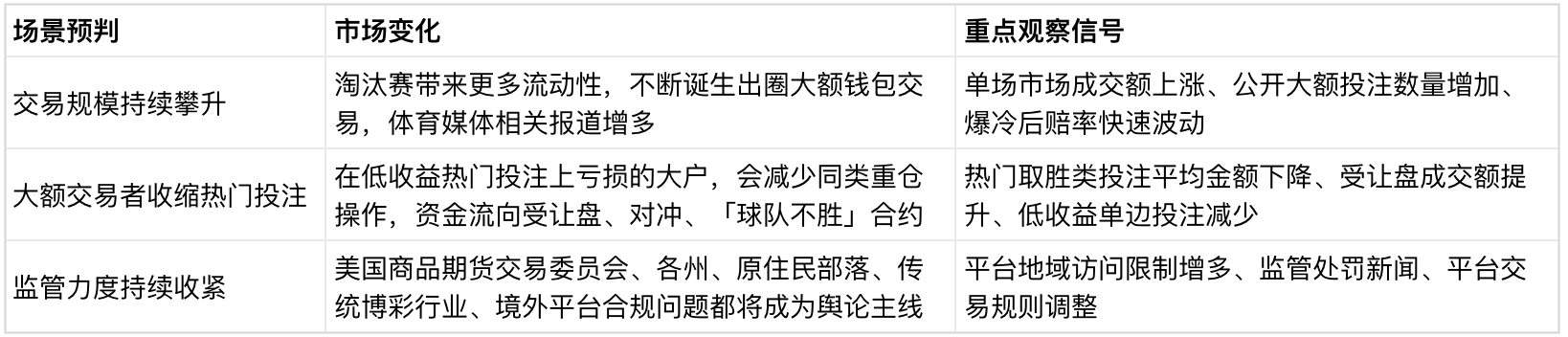
A scenario where major players reduce their betting is foreseeable: many traders, like those betting on Spain to win, invested millions expecting only tens of thousands in returns. After consecutive losses, they will reduce one-sided heavy positions, and funds will shift towards contracts that hedge draw risk in advance, such as handicap spreads and反向投注合约 contracts.
Regulatory resistance will further accelerate this trend. On June 10th, the U.S. Commodity Futures Trading Commission (CFTC) released a draft rule proposal aiming to establish a federal regulatory framework for prediction markets, while acknowledging the price discovery value of sports-related contracts. However, U.S. states, Native American tribes, and the traditional gambling industry collectively oppose this regulatory approach. A survey by the American Gaming Association shows that 85% of the U.S. public classify these prediction contracts as gambling.
As early as late May, Spain briefly banned Polymarket and Kalshi due to compliance qualification issues. This incident also shifted the focus of public debate from market growth to regulatory controversy: whether anonymous wallets and multi-million dollar sports bets should be subject to the same regulatory standards as financial derivatives.
It is currently impossible to determine whether 'fishalive's' massive profit resulted from accurate market judgment, pure luck, or exploitation of a pricing flaw in one-sided "win" contracts — Polymarket's on-chain ledger alone cannot provide the answer. But the ledger clearly records, match after match, funds flowing from bettors convinced of the favorite's certain victory to traders who understand the risk of a football draw.