Research Report Analysis: Is Intel Making a Comeback with Apple? Bernstein's Calculations Show the Right Direction, but the Price Is Already Overvalued

marsbitPublicado a 2026-06-22Actualizado a 2026-06-22

Resumen

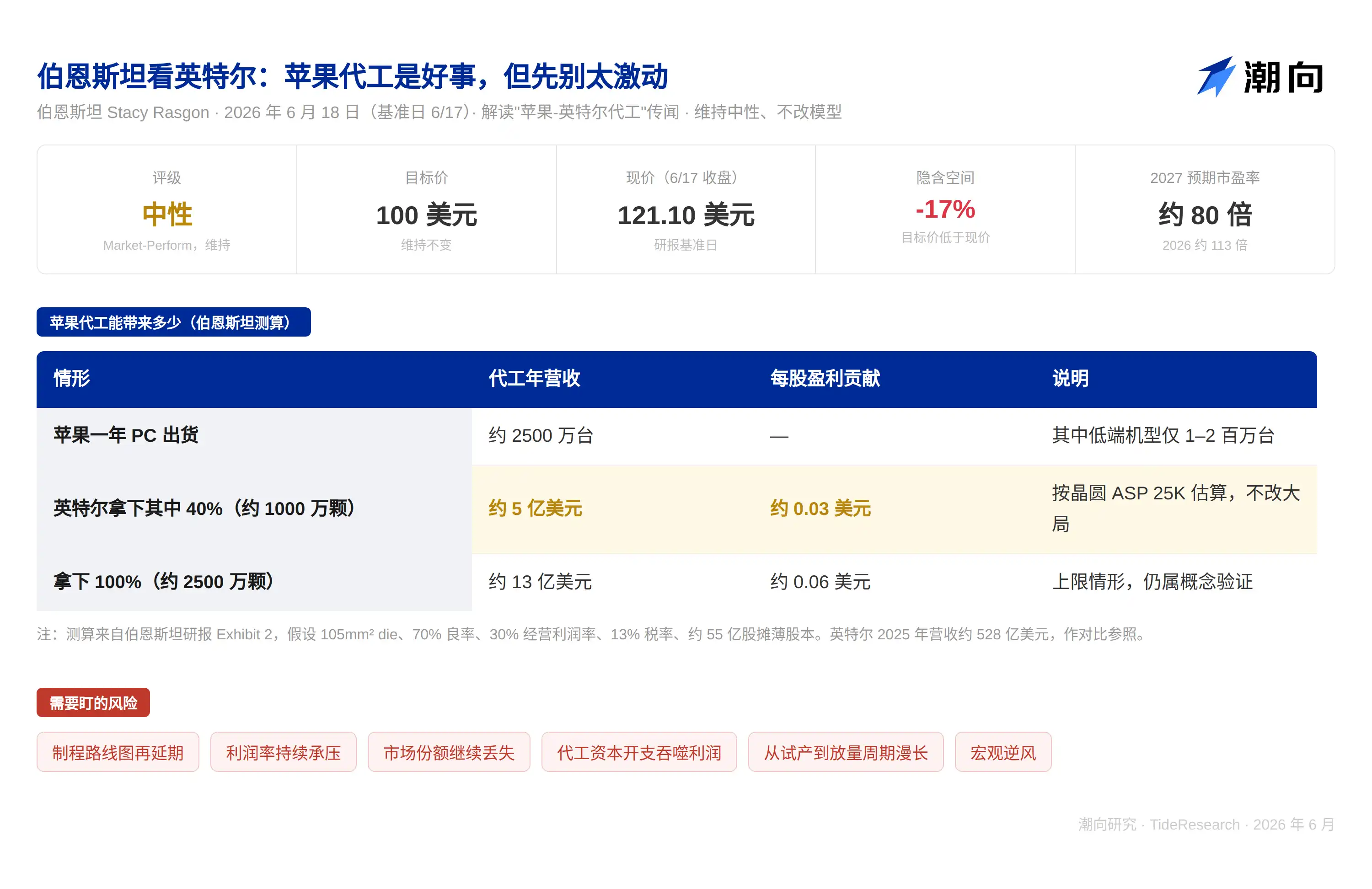
Bernstein analyst Stacy A. Rasgon published a report on June 18 regarding Intel, assessing the potential impact of recent political support for a US-based PC chip design and manufacturing collaboration between Apple and Intel. The report views this as a significant signal for the foundry landscape shift but concludes the initial financial contribution would be minimal. Key conclusions: 1) An Apple deal is seen as a small-scale "proof of concept." Even if Intel wins 40% of Apple's premium notebook chip orders (~5 million units/year), Bernstein estimates it would generate only about $500M in annual revenue and ~$0.03 EPS, negligible against Intel's ~$55B revenue. 2) Political encouragement is not equivalent to enforceable mandates. Winning orders ultimately depends on Intel demonstrating competitive technology (like its 18A node), cost, and reliable supply. 3) The path from validation to large-scale production involves significant challenges, capital investment, and time. Due to these uncertainties, Bernstein maintains a Market-Perform (Hold) rating with a $100 price target, implying potential downside from the ~$121.10 price at the report date. The analysis highlights the tension between near-term validation value—serving as a crucial trust signal for Intel's foundry ambitions and US supply chain resilience—and the long-term opportunity to attract larger cloud and AI chip customers. The investment thesis hinges on successful 18A execution and sustained policy support, not on...

Author: Tide Research

By: Rita

Tide Research Guide

Bernstein analyst Stacy A. Rasgon released a research report on Intel on June 18, assessing Trump's recent statements supporting Apple and Intel collaborating on PC chip design and manufacturing in the U.S. The report views this as a turning point signal for the chip manufacturing landscape, but with limited initial scale—more a proof-of-concept than an immediate profit opportunity. Bernstein maintains its "Market-Perform" rating and $100 price target for Intel, signaling a positive direction but insufficient momentum for further stock price gains. This report is suitable for investors focusing on U.S. chip manufacturing policy trends, Intel's capacity layout, and government subsidy policies.

Three Key Conclusions

1. Apple's Entry into Intel's Foundry is a "Small-scale Trial," with Negligible Short-term Revenue Contribution

According to Bernstein's data, Apple shipped approximately 23.68 million laptops in the past 12 months, with high-end models (priced above $700) accounting for about 22.15 million units. If Intel ultimately wins 40% of these orders as an initial target, the corresponding annual PC chip foundry volume would be around 5 million sets. Based on Bernstein's assumptions, if the average selling price per wafer is $25,000, this business would generate only about $500 million in annual revenue, contributing roughly $0.03 per share in earnings.

Compared to Intel's annual revenue of approximately $55 billion and annual EPS of about $1.50, this potential contract is almost negligible at the financial level.

The report emphasizes that the value of this order lies not in its current revenue scale but in the endorsement it represents—U.S. client trust in Intel's manufacturing capabilities.

2. The Temperature of Trump's Promoted Policy Needs a Question Mark

Trump recently publicly encouraged Apple and Intel to design and manufacture chips in the U.S., but Bernstein notes that this encouragement is not "enforcement." The analysis suggests that clients will not be "forced" to adopt a particular supplier unless the supplier can prove three conditions: the ability to produce according to specifications, a competitive cost structure, and stable, reliable supply. Intel is currently in the risk production stage for its 18A process, demonstrating credible technological progress, but mature capacity and cost competitiveness still require observation.

In other words, policy encouragement is a plus but cannot replace market competitiveness.

3. The "Transition Challenge" from Proof-of-Concept to Mass Production Persists, Bernstein Does Not Upgrade Rating Accordingly

Bernstein's report repeatedly emphasizes "there is still a lot of wood to chop here," meaning that moving from small-scale proof-of-concept to large-scale mass production still requires significant work, considerable time, and substantial capital investment.

In other words, for Intel to truly cross this stage, it must simultaneously address several issues: investing tens of billions of dollars to expand capacity, passing complex and rigorous customer qualification processes, and proving its cost and yield advantages in the intense foundry price competition.

Precisely due to this uncertainty, while Bernstein acknowledges the positive significance of this collaboration, it maintains a Market-Perform (Hold) rating and does not upgrade to Outperform (Outperform). Its given target price is approximately $100, implying some downside potential compared to the stock price of about $121.10 (as of the report's base date).
The Geopolitical Logic Behind Chip Supply Diversification

Apple has long adopted a supplier diversification strategy to reduce reliance on any single foundry. Historically, this diversification was mainly reflected in choices among different foundry systems and process nodes like TSMC, Samsung, and Intel.

However, in recent years, geopolitical factors have become a new core variable. The U.S. government, through the CHIPS and Science Act, has invested massive subsidies to promote the reshoring of critical chip manufacturing. In this context, Apple shifting some of its high-end PC chip orders to Intel's U.S. factories not only aligns with policy direction but also helps enhance supply chain resilience and mitigate over-reliance risks on a single region (especially Taiwan).

For Intel, this collaboration is more like a crucial market confidence test. Having previously lost Apple's foundry trust due to lagging process technology, re-entering Apple's supply chain for design collaboration and manufacturing cooperation now inherently signifies that its 18A process has reached a certain level of usability. This signal may also have spillover effects on other potential clients (such as data center CPU or AI accelerator manufacturers).

The Tension Between Short-Term Validation and Long-Term Vision

The core of Bernstein's analysis is to reveal a structural contradiction: the vast gap between short-term scale and the long-term narrative.

In the model assumptions, even if Intel secures about 40% of Apple's PC chip orders, the annual shipment volume would only be around 100,000 to 150,000 sets. Within Intel's overall foundry business plan, this still falls under the "pilot validation" or "proof-of-concept" stage, with very limited revenue contribution—only equivalent to a few hundred million dollars—impacting EPS by mere cents, insufficient to materially alter the company's overall growth trajectory.

However, in the long term, this "small-scale entry" holds significant path-dependent value. If Intel can leverage the Apple order to prove its process stability and delivery capabilities, it may subsequently compete for larger-scale foundry orders in areas like cloud computing chips, AI accelerators, and communication chips. The total market size for these segments far exceeds that of PC chips, offering substantial long-term expansion potential.

Bernstein's report does not quantify this "option-like long-term value" but merely notes its existence, while emphasizing that realizing it remains highly dependent on subsequent customer acquisition and continuous process improvement.

Investment Thesis: What to Bet On? What Not to Bet On? What to Watch?

Bet On:

  • Intel's 18A process progress not falling significantly below market expectations
  • Continuity of U.S. policy support for semiconductor manufacturing localization

Do Not Bet On:

  • The Apple collaboration significantly improving Intel's financial performance in the short term
  • Government subsidies directly and rapidly boosting Intel's overall profit margins

Key Signals to Monitor:

  • Revenue recognition and gross margin changes for Intel's foundry business in the next quarterly earnings report
  • The pace of yield improvement and cost reduction curve for the 18A process
  • Whether other major clients besides Apple formally adopt Intel's foundry services
  • The actual fulfillment pace and scale of CHIPS Act-related subsidies

This article is Tide Research's compilation and interpretation of a third-party brokerage research report. The cited ratings, target prices, earnings forecasts, and related judgments are the views of that brokerage analyst, representing only the stance of their institution. They do not represent Tide Research's views and do not constitute any investment advice.

When reading, please note three points: First, target prices are analysts' expectations for approximately the next 12 months—they are forecasts, not promises, and are subject to repeated adjustments based on performance and market conditions. Second, sell-side research reports are inherently bullish, and some covered companies may have business relationships with the brokerage. Third, the value of research reports lies in their core logic and underlying assumptions, not just a single target price. Focus on the logic, not just the price.

The market carries risks; decisions should be made independently. This article should not serve as the basis for trading any securities.

Data Source: Bernstein Research Report (Stacy Rasgon, June 18, 2026) · Intel Historical Financial Data (SEC)

Tide Research · TideResearch · June 2026

Preguntas relacionadas

QWhat are the three key conclusions from Bernstein's report on Intel and Apple's potential cooperation?

A1. Apple entering Intel's foundry is a 'small test' with minimal short-term revenue contribution. Bernstein estimates it would only add about $0.03 to EPS. 2. The political encouragement from the Trump administration is not a mandate; market competitiveness in technology, cost, and supply reliability remains key for Intel. 3. There is a significant 'transition gap' from proof-of-concept to mass production, requiring substantial time and capital. Hence, Bernstein maintains a 'Market-Perform' rating and a $100 price target, seeing positive direction but insufficient for a higher rating.

QAccording to Bernstein's analysis, why is the potential Apple-Intel deal significant despite its small initial financial impact?

AThe significance lies not in immediate financials but in the strategic validation it provides. It represents a key vote of confidence from a major US customer (Apple) in Intel's manufacturing capabilities, specifically its 18A process. This endorsement could help Intel rebuild market trust and potentially attract other large customers like data center CPU or AI accelerator manufacturers, serving as a crucial step in its foundry business strategy.

QWhat is Bernstein's rating and price target for Intel, and how does it compare to the current stock price mentioned in the report?

ABernstein maintains a 'Market-Perform' (Hold) rating for Intel with a price target of $100. This target price implies a potential downside from the reported current price of approximately $121.10 (as of the report's baseline date), suggesting the analyst sees the stock as somewhat overvalued based on the current prospects.

QWhat major challenge does Bernstein identify for Intel in transitioning the Apple collaboration from concept to large-scale production?

ABernstein highlights the 'transition gap' or 'a lot of wood to chop.' The major challenge is scaling from small proof-of-concept volumes to cost-competitive, high-yield mass production. This requires hundreds of billions in capital investment for capacity expansion, navigating complex customer qualification processes, and proving cost and yield advantages in the fiercely competitive foundry market.

QFrom an investment perspective, what are the key signals investors should watch regarding Intel's foundry business, according to the article's summary of the report?

AInvestors should focus on: 1. Revenue recognition and gross margin changes for the foundry business in Intel's quarterly earnings. 2. The pace of yield improvement and cost reduction for the 18A process. 3. Whether other major clients besides Apple formally adopt Intel's foundry services. 4. The actual disbursement pace and scale of subsidies related to the CHIPS Act.

Lecturas Relacionadas

Report Interpretation: J.P. Morgan Details Micron's Pre-Earnings Sentiment, Current Hardware Sector Dynamics

Morgan Stanley analyst Joshua Meyers' report (June 21, 2026) highlights key trends in the hardware and semiconductor sector ahead of Micron's earnings. The core takeaways are: 1. **Micron & Memory:** Memory remains a high-conviction long theme, driven by strong AI demand and rising ASPs. However, investor focus is shifting to the sustainability of Micron's >80% gross margins and the specifics of potential new long-term supply agreements (SCAs). 2. **Hardware Supply Chain:** AI-related demand for servers, networking, and storage remains robust, but company performance is diverging. Celestica (CLS) shows improved margin confidence, Western Digital and Seagate benefit from pricing, Fabrinet (FN) sees predictable AI optics growth, and Teradyne (TER) anticipates a new Google customer. 3. **AI Capex & WFE Forecasts:** JPMorgan increased its Wafer Fab Equipment (WFE) market growth forecasts to 28% in 2026 and 29% in 2027. AI infrastructure financing is evolving, with higher project-level debt reducing constraints on capex expansion. The report signals that while the AI-driven hardware cycle is strong, the market is entering a phase focused on execution verification (e.g., Micron's SCA details, Fabrinet's ramp with Amazon) and valuation sustainability. Key near-term signals include Micron's guidance, Arista Networks' outlook, and the pace of demand normalization post potential tariff-related pull-ins.

marsbitHace 1 hora(s)

Report Interpretation: J.P. Morgan Details Micron's Pre-Earnings Sentiment, Current Hardware Sector Dynamics

marsbitHace 1 hora(s)

Research Report Analysis: The Fed's New Chair's Debut – New Leader, But Same Script?

Report Analysis: Federal Reserve's New Chair Debut – A New Captain, But the Same Script? Morgan Stanley's chief global economist Seth B. Carpenter analyzes the first FOMC meeting under new Fed Chair Kevin Warsh in a June 21 report. Warsh deliberately avoided providing forward guidance on interest rates, aligning with his philosophy. However, market expectations for a rate hike this year were reinforced. Key signals lie elsewhere: inflation may fall more than expected, and quantitative tightening (QT) could be more aggressive than anticipated. The FOMC's "dot plot" suggests only one rate hike in 2026. Carpenter argues that if inflation undershoots forecasts, the logic for even a single hike weakens, especially as projections indicate potential rate cuts in 2027. On QT, Warsh's stance is clear. Carpenter notes that measures like halving the Treasury's account balance could shrink the Fed's balance sheet by around $500 billion with minimal market impact. Combined with adjustments to reserve interest and liquidity rules, the ultimate QT scale may exceed expectations, though its market effect might be less disruptive unless the Fed actively sells Mortgage-Backed Securities (MBS). While Warsh initiated a review of the Fed's policy framework, the 2% inflation target remains intact for now. The report concludes that the market may be overestimating the significance of reduced forward guidance and the near-term rate hike risk, while potentially underestimating the scope and manageable nature of the coming balance sheet reduction. The key debates will hinge on upcoming core PCE data, the specifics of the QT path, and the framework review's findings.

marsbitHace 2 hora(s)

Research Report Analysis: The Fed's New Chair's Debut – New Leader, But Same Script?

marsbitHace 2 hora(s)

Critical Game Week: BTC Retracement Confirmation vs. HYPE Support Battle | Guest Analysis

This weekly analysis outlines a critical juncture for BTC and HYPE markets, focusing on key price level confirmations. **BTC Analysis:** BTC is at a pivotal point after a five-wave rally from the June 5th low of $59,100. The price has broken below a short-term rising channel's lower boundary, with the current move seen as a pullback to test this breakdown. Failure to reclaim this level could lead to a retest of the $59,000-$60,000 support zone. The core scenario hinges on this channel retest outcome. * **Key Levels:** Resistance at $64,500-$65,000 (channel boundary) and $69,500-$70,500. Support at $59,000-$60,000 and $55,000. * **Strategy:** A core bearish stance is maintained (20% short from last week), with short-term plans for tactical trades. Three detailed contingency plans (A/B/C) are provided for short positions on resistance tests or breakdowns, emphasizing strict stop-loss discipline. **HYPE Analysis:** HYPE shows strong momentum but is currently in a corrective phase after hitting a new high of $76.94. The price is retesting the crucial $64-$66 support area. * **Key Levels:** Resistance near $77 and $80-$82. Support at $64-$66 and $52-$54. * **Strategy:** The short-term approach is "buy on dips, avoid chasing rallies." A long position is considered only if clear stabilization signals appear at the $64-$66 or deeper $52-$54 support zones, with tight risk controls. **General Risk Management:** A standardized trailing stop-loss protocol is emphasized: set initial stop, breakeven at +1% profit, then trail stops upward to lock in gains. *Disclaimer: All analysis is presented as a personal trading framework, not investment advice. Market conditions are complex and require dynamic adjustment.*

marsbitHace 2 hora(s)

Critical Game Week: BTC Retracement Confirmation vs. HYPE Support Battle | Guest Analysis

marsbitHace 2 hora(s)

Research Report Interpretation: Citi Attends AWS Summit, Bullish on Cloud Business Acceleration but Data Governance Remains Key Variable

Citi analyst Tyler Radke's team attended the AWS New York Summit (June 17-18), engaging with over 10 clients and partners. In a June 19 report, they highlighted the summit's focus on scaling agent AI for enterprise deployment. Citi maintains a "Buy" rating on Amazon, forecasting AWS revenue growth to accelerate to 37% in FY27 from 30% in FY26, noting this estimate may be conservative. Key takeaways: 1. **AWS Strategy Shift:** AWS is moving from proof-of-concepts to scalable deployment. New offerings like AWS Context (building enterprise knowledge graphs), Amazon Quick (cross-application AI assistant), and security tool Continuum address core enterprise pain points for AI adoption. 2. **Data Infrastructure Beneficiaries:** Data infrastructure companies like Snowflake, Elastic, Oracle, and ClickHouse are seen as direct beneficiaries of scaling AI workloads, as evidenced by strong growth and use cases presented. 3. **Critical Role of Data Governance:** As AI agents scale from hundreds to thousands, effective data governance becomes the key variable for deploying AI in core business processes. AWS Context represents AWS's strategic extension from providing compute/models to offering a data governance infrastructure layer. The report emphasizes that without solving data governance, AI will remain confined to pilot projects. The investment thesis focuses on AWS revenue acceleration and data infrastructure vendors' growth, while monitoring signals like AWS's quarterly revenue growth, Bedrock AgentCore task volume, and pricing impacts on companies like Elastic.

marsbitHace 2 hora(s)

Research Report Interpretation: Citi Attends AWS Summit, Bullish on Cloud Business Acceleration but Data Governance Remains Key Variable

marsbitHace 2 hora(s)

Trading

Spot
Futuros
活动图片