Mining Scale Skyrockets: Why Can't Bitdeer Hold onto Its Bitcoin?

Foresight NewsPublicado a 2026-06-22Actualizado a 2026-06-22

Resumen

Bitdeer's May 2026 operational data reveals a stark contrast: while its Bitcoin mining output surged to 921 BTC, a 370% year-over-year increase, its end-of-month holdings plummeted to just 171 BTC. This significant disparity highlights that the company, amidst a strategic pivot towards AI cloud infrastructure, continues to rely heavily on selling newly mined Bitcoin to fund operations and expansion, despite reporting a steady $69 million in annualized recurring AI revenue. The trend is consistent with Q1 2026 figures, where mining output reached 2,033 BTC but holdings were a mere 31 BTC, with $206.8 million from digital asset disposals. While the AI business, showing 90% GPU utilization, offers a potential future cash flow buffer to reduce dependency on Bitcoin sales, its current contribution to actual confirmed revenue remains limited. The transformation introduces new risks related to client acquisition, capital-intensive data center projects like Tydal, and delivery timelines. The core question raised is whether the AI venture will successfully generate sufficient stable cash flow to allow Bitdeer to retain more of its mining proceeds as Bitcoin treasury assets, or if the shift merely changes the form of financial pressure while Bitcoin reserves continue to dwindle.


Written by: Liam Akiba Wright

Compiled by: Chopper, Foresight News


TL;DR


  • Bitdeer mined 921 bitcoins in May 2026, but held only 171 bitcoins by month-end.
  • Behind this data discrepancy, Bitdeer is simultaneously developing its AI cloud business, which in theory could reduce the need to sell bitcoin for liquidity.
  • However, May's operational data shows that Bitdeer's bitcoin holdings remain low. Whether AI business revenue can support corporate expansion and reduce bitcoin selling remains uncertain.


The latest operational data from Bitdeer reveals the realistic contradiction behind the collective pivot of bitcoin mining companies to the AI track: while mining output has soared, the total bitcoin holdings at month-end have shrunk significantly compared to the same period last year.


Bitdeer disclosed that it mined a cumulative 921 bitcoins in May 2026, a 370% year-on-year surge; yet its month-end bitcoin holdings were only 171. In contrast, the company's financial report for May 2025 showed mining output of 196 bitcoins and holdings as high as 1,351.


The stark contrast between output and holdings points directly to the selling pressure in the context of mining companies' transition to AI. The valuation logic Bitdeer conveys to investors is that a complete business map will be formed by its computing power mining farms, self-developed mining machines, power sites, AI cloud computing resources, and future data center colocation revenue. However, the bitcoin holding data on the balance sheet indicates that this transformation strategy still heavily relies on selling newly mined bitcoins to maintain operational cash flow.


The current situation presents both encouraging and concerning aspects. In theory, AI business revenue could create a cash buffer, alleviating the pressure for companies to sell tokens during downturns in the mining industry. A combined look at May and Q1 disclosure data shows: Bitdeer's mining output continues to rise, but its book bitcoin inventory has plummeted; simultaneously, the newly developing AI infrastructure business introduces a new dimension of risk.


The Discrepancy Between Bitcoin Production and Holdings is the Clearest Signal


Comparing the May data from the two years, the two core metrics show completely opposite trends. Mining output increased from 196 to 921 bitcoins, while bitcoin holdings plunged from 1,351 to 171.


Supplementary note: The May 2026 mining statistics include both proprietary and pooled mining output, while the May 2025 period only counted proprietary mining. Even after adjusting for this statistical difference, the vast disparity in holding size remains highly pronounced.
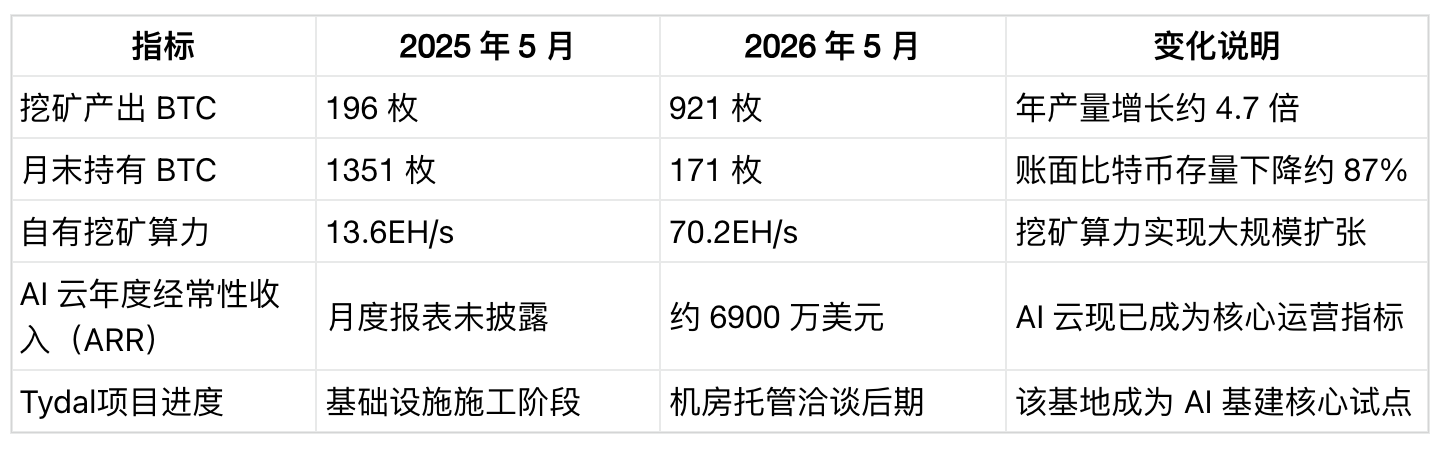


A rough estimate based on Bitcoin's price range of approximately $62,700 to $62,900 on June 19th: the total value of Bitdeer's May mining output was about $57.9 million, while the market value of its month-end bitcoin holdings was only $10.7 million.


This is merely an estimation based on spot prices and not official financial data disclosed by the company, yet it sufficiently illustrates the scale difference. While the monthly mining output volume is substantial, the retained bitcoin size on the books is severely mismatched with the company's overall operational scale.


Monthly holdings are a static point-in-time data point, unable to fully depict the entire flow of funds or precisely calculate how much of the month's output was sold, pledged, retained, or used for other purposes. However, this data is enough to prove that expanding computing power and increasing mining output have not translated into bitcoin treasury reserves for the company.


For a bitcoin miner transitioning to AI infrastructure, this data gap alters the investment logic: new AI revenue should either help the company retain more bitcoin or be used to fund capital-intensive infrastructure expansion.


Bitdeer's Q1 2026 financial report further confirms the trend seen in the May data. In Q1, Bitdeer mined 2,033 BTC, compared to only 350 BTC in the same period of 2025; quarter-end bitcoin holdings were a mere 31 BTC, compared to 1,156 BTC a year earlier. The company also disclosed the disposal of digital assets, realizing a total of $206.8 million.


As mining farm scale expands, Bitdeer's mining revenue has grown significantly, while bitcoin holdings on the balance sheet continue to decline, indicating the company is consistently converting mined bitcoins into funds needed for operations and expansion.


The company reported a net cash outflow of $346.9 million from operating activities in Q1; capital expenditures were $93.7 million, used for data center infrastructure, GPU procurement, tariff payments, and mining machine deployment; total corporate liabilities reached $1.9 billion. Total Q1 revenue was $188.9 million, with adjusted EBITDA at $14.4 million, and cash, cash equivalents, and restricted cash combined amounted to $297.7 million.


The company is progressing with a large-scale capital investment plan, where bitcoin reserves, debt financing, and infrastructure investment are interlinked, forming a unified development strategy.


Can AI Business Cash Flow Alleviate Bitcoin Selling Pressure?


Bitdeer's AI cloud business data is the core argument supporting market optimism. In May, the company disclosed that its AI Cloud Annual Recurring Revenue (ARR) remained stable at $69 million, with GPU utilization at 90%. It had deployed 4,248 GPUs, with an additional 3,305 GPUs under external lease agreements; two Nvidia GB300 NVL72 computing clusters were launched, and its Model Studio had been adapted for the Nvidia Nemotron 3 large language model.


AI cloud revenue had seen rapid growth prior to May. March monthly data showed ARR at about $43 million, rising to $69 million in April and maintaining that level in May. The growth rhythm shifted from high-speed expansion to steady operation, testing the business's sustainability.


Annual Recurring Revenue is merely an annualized projection metric. In Q1, the company's recognized AI cloud revenue booked into the income statement was only $3.7 million. There is a clear gap between the two: annualized revenue represents potential future revenue space, while recognized revenue is actual cash flow recorded in the profit and loss statement. A $69 million ARR figure might seem to reduce reliance on bitcoin sales, but the cash flow must still cover electricity costs, interest, capital expenditures, and costs associated with the cyclical volatility of the mining industry.


This monthly data from Bitdeer also raises an industry-wide debate about miners transitioning to AI. As CryptoSlate previously reported, even though most AI computing facilities are not yet operational, Wall Street is willing to assign higher valuations to bitcoin miners laying out AI and High-Performance Computing (HPC) plans. Bitdeer's May operational report localizes this industry question onto a single company: when AI business scale has reached a level warranting separate disclosure, yet the company's bitcoin treasury remains meager, how should this be interpreted?


The benefits for bitcoin miners venturing into AI cloud and data center colocation are apparent: long-term computing power lease contracts can smooth cash flow, reduce the need to sell bitcoin during market downturns, and allow proprietary power resources to generate additional value beyond the simple pricing system of mining.


However, the transition path also presents challenges: building AI infrastructure requires substantial capital, stable clients, mature delivery capabilities, and sufficient time. During this transition period, the bitcoin treasury likely serves more as a liquidity reserve rather than a long-term value asset.


The Tydal Project: Hidden Implementation Risks


The Tydal data center is the most tangible project illustrating Bitdeer's business model transformation. In March, the company disclosed that its Tydal data center subsidiary had partnered with a third-party institution to convert the campus into a 180-megawatt AI computing center, primarily to host Nvidia Vera Rubin equipment in a colocation model, with the project expected to be completed as early as December 2026.


The latest update in May indicated that the Tydal site had entered advanced negotiations with potential colocation clients. This project also serves as the company's core evidence: power sites originally serving bitcoin mining can be transformed to host client computing power leases, generating long-term contract revenue, no longer relying solely on bitcoin mining profits.


The bitcoin mining business exposes Bitdeer to risks related to computing power unit price, mining difficulty, transaction fees, energy costs, mining machine performance, and bitcoin price. The AI data center colocation business, however, introduces new risks: client creditworthiness, delivery milestones, GPU supply, construction timelines, power allocation, contract terms, and financing costs. Overall risk volatility might be reduced, but the sources of risk have shifted.


Therefore, Bitdeer's May operational report is less of a stellar report card and more akin to an ongoing stress test of its operations. CryptoSlate's report in February about Bitdeer's large-scale reduction in bitcoin reserves also addressed the market's core question: even as miners continuously produce bitcoin, they will still sell tokens to raise funds to support operational expansion.


Currently, Bitdeer's mining computing power continues to expand, bitcoin holdings saw a slight recovery after the March low, AI ARR stabilized at $69 million, and the AI data center colocation business continues to advance. However, the critical gap remains unfilled: AI annualized revenue cannot stably translate into sustained cash flow, and mining output hasn't accumulated as corporate bitcoin reserves.


If this profitability link is successfully established in the future, the AI business will become a safety cushion buffering the company's routine bitcoin selling operations. If this link fails to materialize, the transformation merely changes the form of risk: book bitcoin continues to dwindle, the company becomes highly dependent on computing power leasing business, while simultaneously bearing pressure from power parks, client development, and capital markets.


This is precisely the core question Bitdeer's May operational data leaves for the market: while mining 921 BTC in a month is certainly noteworthy, the mere 171 BTC held by month-end is the number that warrants deeper reflection.

Criptos en tendencia

Preguntas relacionadas

QAccording to Bitdeer's May 2026 operational data, what was the significant discrepancy between its Bitcoin mining output and its end-of-month Bitcoin holdings?

AIn May 2026, Bitdeer mined 921 BTC, but its end-of-month holdings were only 171 BTC, showing a large disparity between production and retained inventory.

QWhat is the core argument presented in the article regarding why Bitdeer cannot retain more of its mined Bitcoin despite its AI cloud business?

AThe article argues that while Bitdeer's AI cloud business theoretically provides a cash buffer, its operational data shows the company is still largely dependent on selling newly mined Bitcoin to fund its capital-intensive expansion plans and cover operational expenses.

QWhat is the key metric Bitdeer disclosed for its AI cloud business in May, and what caveat does the article mention about this figure?

ABitdeer disclosed an Annual Recurring Revenue (ARR) of $69 million for its AI cloud business in May. The article cautions that ARR is a forward-looking, annualized projection, distinct from the actual $3.7 million in AI cloud revenue recognized on the income statement for Q1.

QWhat is the Tydal data center project, and what new business risks does it introduce for Bitdeer according to the article?

AThe Tydal project involves converting a 180MW site into an AI computing center for client hosting. It introduces new risks like client qualification, project delivery timelines, GPU supply, construction schedules, and contract terms, shifting the company's risk profile away from pure Bitcoin mining volatility.

QWhat does the article conclude is the 'core question' left by Bitdeer's May operational data?

AThe article concludes that the core question is not the impressive mining output of 921 BTC, but the meaning behind the company holding only 171 BTC at month-end, highlighting the ongoing challenge of transforming its business model to rely less on Bitcoin sales for cash flow.

Lecturas Relacionadas

Dialogue with KK, Founder of Hash Global: Do VCs Still Invest in Blockchain Games Now? What Kind of Projects Can Still Get Funding?

**Title: Dialogue with KK, Founder of Hash Global: Do VCs Still Invest in Blockchain Games? What Kind of Projects Can Still Get Funding?** **Summary:** KK, partner at Hash Global, discussed the evolving landscape of Web3 investment and blockchain games in a recent interview. He noted that the industry has moved past its initial hype phase into a more sober "second half," where VCs now prioritize core questions: Is the game actually fun? Does it have real users? Can it generate revenue? Key insights include: * **Web3 Investment Evolution:** The sector is increasingly adopting traditional investment logic, focusing on business models, value capture, and tangible worth over pure narrative. * **Blockchain Game Fundamentals:** The paramount criterion for any game is being genuinely fun and engaging. Web3 elements (like asset issuance and value distribution) should enhance an already solid product, not be a substitute for poor gameplay. Play-to-Earn is seen as a potential final stage, not a starting point. * **Current Investment Thesis:** Hash Global remains active in gaming, favoring projects with low barriers to entry, strong social/competitive elements, and the ability to generate real revenue (e.g., through ads, skins) like traditional Web2 games before scaling. Essential criteria are: 1) A fun core loop understandable without Web3 knowledge, 2) Web3 mechanisms that genuinely improve asset distribution and community participation, and 3) A capable, long-term-focused team with proven product-building experience. * **Team Focus:** The firm concentrates on investing in Chinese teams, leveraging cultural familiarity and judgment. * **Web3 Application Outlook:** Large-scale adoption may be accelerated by AI in areas with significant pain points in distribution (e.g., creator economy) or in "Non-Financial RWA" sectors like entertainment/culture. * **BNB Ecosystem:** Hash Global is bullish on BNB, viewing its ecosystem as significantly undervalued, with real users and global capital access. * **Investor Advice:** In the current bear market, KK expresses respect for new institutional investors entering Web3, as it indicates deep research rather than hype-chasing. A key lesson is managing pace—maintaining optimism tempered with realism to ensure longevity.

marsbitHace 7 min(s)

Dialogue with KK, Founder of Hash Global: Do VCs Still Invest in Blockchain Games Now? What Kind of Projects Can Still Get Funding?

marsbitHace 7 min(s)

A New Player Enters at Third Place, Rothera Disrupts the Prediction Market Landscape

"Rothera Skyrockets to Third in Prediction Market Rankings, Disrupting Industry Landscape" Rothera, Robinhood's newly launched prediction market platform, has rapidly climbed to become the third-largest player in the sector by trading volume, trailing only giants Kalshi and Polymarket. Its growth is attributed not to attracting new users, but to migrating existing Robinhood user orders away from partner Kalshi. Previously, Robinhood served as a major distribution channel for Kalshi, accounting for an estimated 25%-35% of its volume. With the launch of Rothera, Robinhood now internally executes events like World Cup contracts, capturing revenue that was previously shared with Kalshi. Data shows Rothera's weekly trading volume surged from $21.9 million to $559 million within weeks, reaching nearly one-fifth of Polymarket's volume. Analysts estimate Robinhood's prediction market business could generate around $10 billion in annual revenue at this pace, potentially surpassing its historical crypto revenue peak. In response, Kalshi is reportedly exploring new distribution channels by engaging with investment banks for a potential IPO, requiring them to integrate their systems with Kalshi to access institutional clients. This shift highlights a new competitive focus in prediction markets: controlling user access and distribution channels rather than just product offerings.

marsbitHace 15 min(s)

A New Player Enters at Third Place, Rothera Disrupts the Prediction Market Landscape

marsbitHace 15 min(s)

Commerce Ministry's Latest Export Controls Target 10 US Companies: Three Market-Moving Threads Explained

China's Ministry of Commerce placed 10 U.S. entities, including MP Materials, USA Rare Earth, Red Cat Holdings, and Teal Drones, on an export control list, banning the export of dual-use items. This move is seen as part of an ongoing countermeasure in the rare earth sector. The analysis suggests the primary impact is on U.S. companies within the **military, drone, and rare earth** sectors, aiming to restrict their access to critical Chinese materials and technology. For the Chinese market, the event is interpreted as reinforcing the **strategic value and pricing power** of domestic rare earth suppliers. However, the potential stock market reactions are nuanced: 1. **Chinese Rare Earth Upstream:** Companies like Northern Rare Earth are near yearly highs, indicating this event's "beneficiary" logic is largely priced in. It may confirm the trend but is unlikely to be a new major catalyst. 2. **Chinese Rare Earth Mid/Downstream & Drones:** Sectors like magnetic materials (e.g., Da Di Bear, Zhenghai Magnetic) and military drones (e.g., China Aerospace) are relatively undervalued. While the drone listing highlights sectoral competition, it doesn't directly translate to new orders for Chinese firms. 3. **Impact on Listed U.S. Companies:** The effect on stocks like MP Materials is ambiguous. While Chinese restrictions pose a challenge, these companies are also core to U.S. supply chain security efforts and may receive increased government support, potentially offsetting negative impacts. Their pre-announcement stock prices did not indicate panic selling. In summary, the export controls strengthen China's position in the global rare earth supply chain but have uneven effects across related stock market segments, with upstream Chinese gains likely priced in and downstream/drone sectors receiving more indirect, sentiment-driven attention. The outcome for the targeted U.S. stocks depends on the balance between restriction impacts and potential compensatory U.S. policy support.

marsbitHace 25 min(s)

Commerce Ministry's Latest Export Controls Target 10 US Companies: Three Market-Moving Threads Explained

marsbitHace 25 min(s)

Trading

Spot
Futuros

Artículos destacados

Qué es BITCOIN

Entendiendo HarryPotterObamaSonic10Inu (ERC-20) y Su Posición en el Espacio Cripto En los últimos años, el mercado de criptomonedas ha sido testigo de un aumento en la popularidad de las monedas meme, capturando el interés no solo de los comerciantes, sino también de aquellos que buscan compromiso comunitario y valor de entretenimiento. Entre estos tokens únicos se encuentra HarryPotterObamaSonic10Inu (ERC-20), un proyecto intrigante que mezcla referencias culturales en el tejido de las criptomonedas. Este artículo profundiza en los aspectos clave de HarryPotterObamaSonic10Inu, explorando sus mecanismos, ethos impulsado por la comunidad y su relación con el paisaje cripto más amplio. ¿Qué es HarryPotterObamaSonic10Inu (ERC-20)? Como su nombre sugiere, HarryPotterObamaSonic10Inu es una moneda meme construida sobre la blockchain de Ethereum, clasificada bajo el estándar ERC-20. A diferencia de las criptomonedas tradicionales que pueden enfatizar la utilidad práctica o el potencial de inversión, este token prospera en el valor de entretenimiento y la fuerza de su comunidad. El proyecto tiene como objetivo fomentar un entorno donde los usuarios comprometidos puedan reunirse, compartir ideas y participar en actividades inspiradas por diversos fenómenos culturales. Una característica notable de HarryPotterObamaSonic10Inu es su cero impuestos en las transacciones. Este atractivo elemento tiene como objetivo incentivar el comercio y la participación comunitaria, sin cargos adicionales que puedan disuadir a los comerciantes de pequeña escala. El suministro total de la moneda está establecido en mil millones de tokens, una cifra que marca su intención de mantener una circulación sustancial dentro de la comunidad. Creador de HarryPotterObamaSonic10Inu (ERC-20) Los orígenes de HarryPotterObamaSonic10Inu están algo envueltos en misterio; los detalles sobre el creador siguen siendo desconocidos. El desarrollo de este token carece de un equipo identificable o de un plan explícito, lo cual no es inusual dentro del sector de monedas meme. En cambio, el proyecto ha surgido de manera orgánica, con su progreso muy dependiente del entusiasmo y la participación de su comunidad. Inversores de HarryPotterObamaSonic10Inu (ERC-20) En cuanto a inversiones externas y respaldo, HarryPotterObamaSonic10Inu también sigue siendo ambiguo. El token no lista ninguna fundación de inversión conocida o apoyo organizacional significativo. En cambio, la savia del proyecto es su comunidad de base, que informa su crecimiento y sostenibilidad a través de la acción colectiva y el compromiso en el espacio cripto. ¿Cómo Funciona HarryPotterObamaSonic10Inu (ERC-20)? Como una moneda meme, HarryPotterObamaSonic10Inu opera principalmente fuera de los marcos tradicionales que a menudo rigen el valor de los activos. Hay varios aspectos distintivos que definen cómo funciona el proyecto: Transacciones Sin Impuestos: Sin tarifas impositivas en las transacciones, los usuarios pueden comprar y vender el token libremente sin preocuparse por costos ocultos. Compromiso Comunitario: El proyecto prospera en la interacción comunitaria, aprovechando plataformas de redes sociales para crear entusiasmo y facilitar la participación. Las discusiones, el intercambio de contenido y el compromiso son elementos cruciales que ayudan a expandir su alcance y fomentar la lealtad entre los seguidores. Sin Utilidad Práctica: Cabe señalar que HarryPotterObamaSonic10Inu no ofrece utilidad concreta dentro del ecosistema financiero. Más bien, se clasifica como un token principalmente para actividades de entretenimiento y comunitarias. Referencia Cultural: El token incorpora astutamente elementos de la cultura popular para atraer interés, conectando con entusiastas de los memes y seguidores de las criptomonedas por igual. HarryPotterObamaSonic10Inu ejemplifica cómo las monedas meme operan de manera diferente a los proyectos de criptomonedas más tradicionales, ingresando al mercado como construcciones sociales innovadoras en lugar de activos utilitarios. Cronología de HarryPotterObamaSonic10Inu (ERC-20) La historia de HarryPotterObamaSonic10Inu está marcada por varios hitos notables: Creación: El token surgió de un meme viral, capturando la imaginación de muchos entusiastas de las criptomonedas. Las fechas específicas de creación no están disponibles, subrayando su ascenso orgánico. Listado en Exchanges: HarryPotterObamaSonic10Inu ha llegado a varios exchanges, permitiendo un acceso y comercio más fácil por parte de la comunidad. Iniciativas de Compromiso Comunitario: Actividades continuas destinadas a mejorar la interacción comunitaria, incluyendo concursos, campañas en redes sociales y generación de contenido por parte de fanáticos y defensores. Planes de Expansión Futuros: La hoja de ruta del proyecto incluye el lanzamiento de una colección de NFT, mercancía y un sitio de comercio electrónico relacionado con sus temas culturales, involucrando aún más a la comunidad e intentando añadir más dimensiones a su ecosistema. Puntos Clave Sobre HarryPotterObamaSonic10Inu (ERC-20) Naturaleza Impulsada por la Comunidad: El proyecto prioriza la participación colectiva y la creatividad, asegurando que la involucración de los usuarios esté a la vanguardia de su desarrollo. Clasificación como Moneda Meme: Representa la epítome de las criptomonedas basadas en el entretenimiento, diferenciándose de los vehículos de inversión tradicionales. Sin Afiliación Directa con Bitcoin: A pesar de la similitud en el nombre del ticker, HarryPotterObamaSonic10Inu es distinto y no tiene relación con Bitcoin u otras criptomonedas establecidas. Enfoque en la Colaboración: HarryPotterObamaSonic10Inu está diseñado para crear un espacio para la colaboración y el intercambio de historias entre sus poseedores, proporcionando una vía para la creatividad y el vínculo comunitario. Perspectivas Futuras: La ambición de expandirse más allá de su premisa inicial hacia NFTs y mercancías describe un camino para que el proyecto potencialmente ingrese a avenidas más tradicionales dentro de la cultura digital. A medida que las monedas meme continúan capturando la imaginación de la comunidad de criptomonedas, HarryPotterObamaSonic10Inu (ERC-20) se destaca debido a sus lazos culturales y su enfoque centrado en la comunidad. Si bien puede no encajar en el molde típico de un token impulsado por la utilidad, su esencia radica en la alegría y la camaradería fomentadas entre sus seguidores, destacando la naturaleza en evolución de las criptomonedas en una era cada vez más digital. A medida que el proyecto continúa desarrollándose, será importante observar cómo las dinámicas comunitarias influyen en su trayectoria en el cambiante paisaje de la tecnología blockchain.

1.8k Vistas totalesPublicado en 2024.04.01Actualizado en 2024.12.03

Qué es BITCOIN

Cómo comprar BTC

¡Bienvenido a HTX.com! Hemos hecho que comprar Bitcoin (BTC) sea simple y conveniente. Sigue nuestra guía paso a paso para iniciar tu viaje de criptos.Paso 1: crea tu cuenta HTXUtiliza tu correo electrónico o número de teléfono para registrarte y obtener una cuenta gratuita en HTX. Experimenta un proceso de registro sin complicaciones y desbloquea todas las funciones.Obtener mi cuentaPaso 2: ve a Comprar cripto y elige tu método de pagoTarjeta de crédito/débito: usa tu Visa o Mastercard para comprar Bitcoin (BTC) al instante.Saldo: utiliza fondos del saldo de tu cuenta HTX para tradear sin problemas.Terceros: hemos agregado métodos de pago populares como Google Pay y Apple Pay para mejorar la comodidad.P2P: tradear directamente con otros usuarios en HTX.Over-the-Counter (OTC): ofrecemos servicios personalizados y tipos de cambio competitivos para los traders.Paso 3: guarda tu Bitcoin (BTC)Después de comprar tu Bitcoin (BTC), guárdalo en tu cuenta HTX. Alternativamente, puedes enviarlo a otro lugar mediante transferencia blockchain o utilizarlo para tradear otras criptomonedas.Paso 4: tradear Bitcoin (BTC)Tradear fácilmente con Bitcoin (BTC) en HTX's mercado spot. Simplemente accede a tu cuenta, selecciona tu par de trading, ejecuta tus trades y monitorea en tiempo real. Ofrecemos una experiencia fácil de usar tanto para principiantes como para traders experimentados.

5.2k Vistas totalesPublicado en 2024.12.12Actualizado en 2026.06.02

Cómo comprar BTC

Qué es $BITCOIN

ORO DIGITAL ($BITCOIN): Un Análisis Integral Introducción al ORO DIGITAL ($BITCOIN) ORO DIGITAL ($BITCOIN) es un proyecto basado en blockchain que opera en la red Solana, cuyo objetivo es combinar las características de los metales preciosos tradicionales con la innovación de las tecnologías descentralizadas. Aunque comparte un nombre con Bitcoin, a menudo referido como “oro digital” debido a su percepción como un refugio de valor, ORO DIGITAL es un token separado diseñado para crear un ecosistema único dentro del paisaje Web3. Su meta es posicionarse como un activo digital alternativo viable, aunque los detalles sobre sus aplicaciones y funcionalidades aún están en desarrollo. ¿Qué es ORO DIGITAL ($BITCOIN)? ORO DIGITAL ($BITCOIN) es un token de criptomoneda diseñado explícitamente para su uso en la blockchain de Solana. A diferencia de Bitcoin, que proporciona un papel de almacenamiento de valor ampliamente reconocido, este token parece centrarse en aplicaciones y características más amplias. Aspectos notables incluyen: Infraestructura Blockchain: El token está construido sobre la blockchain de Solana, conocida por su capacidad para manejar transacciones de alta velocidad y bajo costo. Dinámicas de Suministro: ORO DIGITAL tiene un suministro máximo limitado a 100 cuatrillones de tokens (100P $BITCOIN), aunque los detalles sobre su suministro circulante no se han divulgado actualmente. Utilidad: Si bien las funcionalidades precisas no están delineadas explícitamente, hay indicios de que el token podría ser utilizado para diversas aplicaciones, potencialmente involucrando aplicaciones descentralizadas (dApps) o estrategias de tokenización de activos. ¿Quién es el Creador de ORO DIGITAL ($BITCOIN)? En la actualidad, la identidad de los creadores y el equipo de desarrollo detrás de ORO DIGITAL ($BITCOIN) sigue siendo desconocida. Esta situación es típica entre muchos proyectos innovadores dentro del espacio blockchain, particularmente aquellos alineados con las finanzas descentralizadas y fenómenos de monedas meme. Si bien tal anonimato puede fomentar una cultura impulsada por la comunidad, intensifica las preocupaciones sobre la gobernanza y la responsabilidad. ¿Quiénes son los Inversores de ORO DIGITAL ($BITCOIN)? La información disponible indica que ORO DIGITAL ($BITCOIN) no tiene patrocinadores institucionales conocidos ni inversiones destacadas de capital de riesgo. El proyecto parece operar en un modelo de peer-to-peer centrado en el apoyo y la adopción de la comunidad en lugar de rutas de financiamiento tradicionales. Su actividad y liquidez se sitúan principalmente en intercambios descentralizados (DEX), como PumpSwap, en lugar de plataformas de trading centralizadas establecidas, lo que resalta aún más su enfoque de base. Cómo Funciona ORO DIGITAL ($BITCOIN) Los mecanismos operativos de ORO DIGITAL ($BITCOIN) pueden elaborarse en función de su diseño blockchain y atributos de red: Mecanismo de Consenso: Al aprovechar el único proof-of-history (PoH) de Solana combinado con un modelo de proof-of-stake (PoS), el proyecto asegura una validación de transacciones eficiente que contribuye al alto rendimiento de la red. Tokenómica: Si bien los mecanismos deflacionarios específicos no se han detallado extensamente, el vasto suministro máximo de tokens implica que podría atender microtransacciones o casos de uso nicho que aún están por definirse. Interoperabilidad: Existe el potencial de integración con el ecosistema más amplio de Solana, incluyendo varias plataformas de finanzas descentralizadas (DeFi). Sin embargo, los detalles sobre integraciones específicas permanecen no especificados. Cronología de Eventos Clave Aquí hay una cronología que destaca hitos significativos relacionados con ORO DIGITAL ($BITCOIN): 2023: El despliegue inicial del token ocurre en la blockchain de Solana, marcado por su dirección de contrato. 2024: ORO DIGITAL gana visibilidad al estar disponible para trading en intercambios descentralizados como PumpSwap, permitiendo a los usuarios comerciar contra SOL. 2025: El proyecto presencia actividad de trading esporádica y potencial interés en compromisos liderados por la comunidad, aunque no se han documentado asociaciones notables o avances técnicos hasta el momento. Análisis Crítico Fortalezas Escalabilidad: La infraestructura subyacente de Solana soporta altos volúmenes de transacciones, lo que podría mejorar la utilidad de $BITCOIN en varios escenarios de transacción. Accesibilidad: El potencial bajo precio de trading por token podría atraer a inversores minoristas, facilitando una participación más amplia debido a oportunidades de propiedad fraccionada. Riesgos Falta de Transparencia: La ausencia de patrocinadores, desarrolladores o un proceso de auditoría conocidos públicamente puede generar escepticismo sobre la sostenibilidad y confiabilidad del proyecto. Volatilidad del Mercado: La actividad de trading depende en gran medida del comportamiento especulativo, lo que puede resultar en una volatilidad de precios significativa y en incertidumbre para los inversores. Conclusión ORO DIGITAL ($BITCOIN) surge como un proyecto intrigante pero ambiguo dentro del ecosistema de Solana en rápida evolución. Si bien intenta aprovechar la narrativa del “oro digital”, su alejamiento del papel establecido de Bitcoin como refugio de valor subraya la necesidad de una diferenciación más clara de su utilidad y estructura de gobernanza previstas. La aceptación y adopción futura dependerán probablemente de abordar la actual opacidad y de definir sus estrategias operativas y económicas de manera más explícita. Nota: Este informe abarca información sintetizada disponible hasta octubre de 2023, y pueden haber ocurrido desarrollos más allá del período de investigación.

96 Vistas totalesPublicado en 2025.05.13Actualizado en 2025.05.13

Qué es $BITCOIN

Discusiones

Bienvenido a la comunidad de HTX. Aquí puedes mantenerte informado sobre los últimos desarrollos de la plataforma y acceder a análisis profesionales del mercado. A continuación se presentan las opiniones de los usuarios sobre el precio de BTC (BTC).

活动图片