Foundation Steps Back, Ethlabs Steps Forward: Ethereum Undergoes Its Largest Restructuring in History

链捕手Publicado a 2026-06-23Actualizado a 2026-06-23

Resumen

On June 23rd, the Ethereum ecosystem witnessed two major shifts, signaling a significant governance realignment. First, former Ethereum Foundation researchers established Ethlabs, a new independent non-profit. Backed by major ETH holders like Bitmine and SharpLink, Ethlabs aims to address practical needs for institutional adoption, including faster settlement, native asset issuance, cross-chain transactions, and mainnet scaling. Secondly, the Ethereum Foundation announced a major restructuring, laying off 54 employees (20% of its staff) to become a leaner entity focused on protocol governance and maintenance rather than being the primary builder. This move represents a pivotal correction. Criticisms had mounted over the Foundation's perceived slowness, lack of clear strategy, and over-reliance on Vitalik Buterin's influence. Ethlabs emerges as a more execution-oriented, "industrialized" layer focused on market adoption—bridging the gap between research and real-world use. Notably, Vitalik Buterin is absent from its list of supporters, interpreted as an intentional step to avoid excessive personal endorsement and allow the organization to build independent credibility. The Ethereum Foundation's downsizing and redefinition mark a retreat from its former central coordinating role. It now aims to share the "privilege of stewarding Ethereum" with other emerging groups like Ethlabs, the Ethereum Applications Guild, and The Ethereum Economic Zone. Analysts frame this dual shift a...

Author: Gu Yu, ChainCatcher

On June 23, the long-questioned Ethereum ecosystem welcomed two significant announcements.

First, several former Ethereum Foundation researchers established an independent nonprofit organization, Ethlabs, with major funding support from key ETH holders such as Bitmine and SharpLink. According to its introduction, Ethlabs' early work will focus on key requirements for large-scale institutional on-chain adoption, including faster settlement speeds, native asset issuance, cross-chain transactions based on robust infrastructure, mainnet capacity scaling, and foundational research supporting ETH's monetary properties.

Soon after, the Ethereum Foundation announced it had completed a restructuring lasting several months, laying off 54 people, approximately 20% of its previous workforce. This adjustment continues the "Lean Ethereum" strategic transformation, repositioning the Ethereum Foundation as a lighter-weight protocol governance and maintainer, rather than the primary core builder.

With one stepping forward and the other stepping back, Ethereum is sending a clear signal: the Foundation is proactively yielding ground, with ecosystem organizations taking on more execution responsibilities. Ethereum is no longer attempting to have a centralized nonprofit organization oversee the roadmap, development, promotion, and adoption entirely.

For Ethereum, this may be the most important governance correction in the past decade.

Over the past year, external criticism of Ethereum has extended beyond ETH's price performance to target its organizational efficiency, strategic articulation, and ecosystem mobilization capabilities. Ethereum had at times appeared overly "correct," overly slow, and overly reliant on the implicit endorsement of the Foundation and Vitalik.

Today's two changes precisely respond to these criticisms: Ethereum is not directionless; it is attempting to change the way direction is generated.

I. Ethlabs Gains Ecosystem Support, but Vitalik is Absent

The establishment of Ethlabs first signifies the emergence of a new organization within the Ethereum ecosystem that is closer to an "industrialized execution layer."

Unlike traditional research institutions, Ethlabs' goal is not merely to propose new cryptographic directions or long-term roadmaps but to more explicitly address practical issues like institutional on-chain adoption, financial asset issuance, cross-chain transactions, mainnet capacity, and ETH's monetary properties. These issues correspond to Ethereum's core anxieties in recent years: it remains the most important smart contract network, but its advantages in real institutional adoption, on-chain financial scale, and user experience are not as solid as the market imagines.

Ethereum does not lack research or vision. What it lacks is the intermediate layer that translates research into market adoption. This is precisely the significance of Ethlabs' emergence.

Among the list of supporters on Ethlabs' official website, one can see many high-influence figures within the Ethereum ecosystem, including several important figures from the Ethereum Foundation, investors from VCs like Dragonfly and Electric Capital, and ecosystem contributors from Base, Flashbots, Uniswap. It is worth noting, however, that Vitalik is not on this list of supporters.
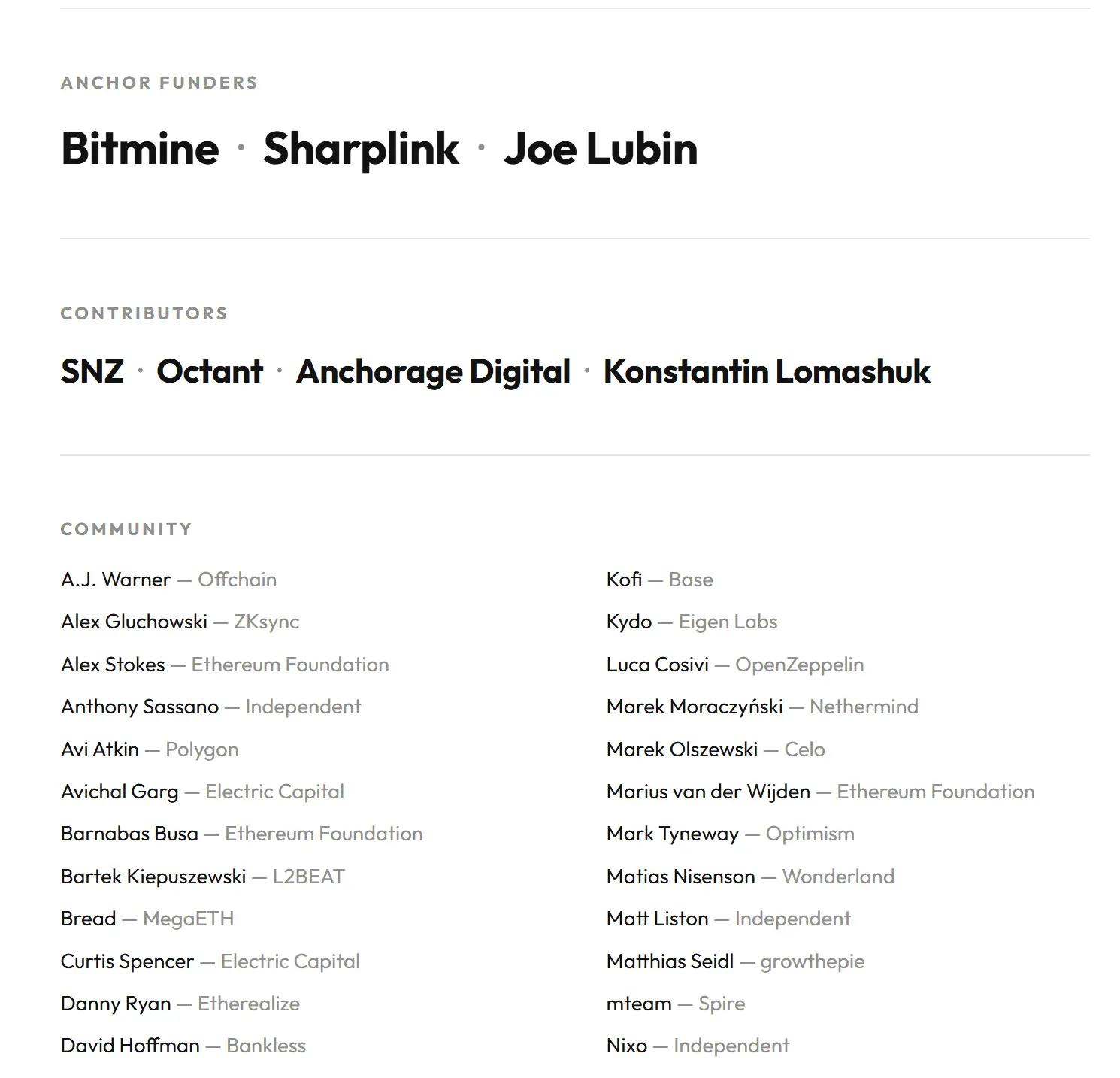
This does not necessarily mean Vitalik disagrees with Ethlabs. On the contrary, a more reasonable understanding is that he is intentionally avoiding forming too strong a personal endorsement or path interference for this new organization.

For many years, Vitalik has held immense symbolic significance for the Ethereum ecosystem. He has proposed many forward-looking directions like soulbound tokens, DeSoc, privacy, account abstraction, and public goods funding, but not many have achieved large-scale market adoption.

The issue is not that these directions lack value, but that when every expression by Vitalik is viewed by the market as "the next phase narrative for Ethereum," the entire ecosystem can fall into a kind of implicit dependency, mistakenly investing excessive time and capital costs.

So far this year, Vitalik has only published 2 articles on his official blog, whereas he previously published at least 15 articles annually. This change itself is noteworthy. It does not represent a decline in Vitalik's influence over Ethereum but rather appears to be an active restraint: letting Ethereum gradually shift from "founder-driven public narrative" to a "technical network driven by multiple organizations, teams, and stakeholders."

If Ethlabs is to take on stronger institutional, financial, and execution functions, it cannot be merely an extension of Vitalik's will. It must prove it can gain ecosystem trust without the founder's direct endorsement and respond to the market with tangible results.

II. The New Structure and Positioning of the Ethereum Foundation

As Ethlabs steps forward, the Ethereum Foundation is stepping back.

For a long time, although nominally just a nonprofit supporting the Ethereum ecosystem, the Ethereum Foundation has in practice long played multiple roles: strategic coordinator, research funder, protocol roadmap setter, and cultural center. It has been unwilling to become a traditional corporate headquarters yet has taken on similar functions on many critical issues.

This structure once helped Ethereum maintain neutrality and decentralization but also brought side effects: slow decision-making, ambiguous communication, unclear responsibility boundaries. The outside world both hoped the Foundation would provide clearer strategy and criticized it for having too much influence.

Simultaneously, internal disagreements within the Ethereum Foundation have been reported. According to a previous report by The Guardian, there were clear disagreements within the Ethereum Foundation regarding strategic direction, leadership changes, and institutional adoption, with tensions also existing in the community between the "cypherpunk faction" and the "pragmatic business faction"; the Foundation's appointment of Hsiao-Wei Wang and Tomasz Stańczak as co-executive directors in March 2025 was also seen as a compromise between these two cultures.

However, it became clear that after both executive directors left their posts, the Foundation's 2025 team restructuring was declared a failure. Key figures like Josh Stark, Trenton Van Epps, and Dankrad Feist left successively. Coupled with persistently low token prices and growing skepticism, the Ethereum Foundation had to restructure again.

After this restructuring, the Ethereum Foundation split its organization into clusters such as the protocol layer, access layer, user layer, community layer, and institutional layer, and laid off 54 people, about 20% of its previous workforce. This is not a simple cost-cutting and efficiency improvement, but a contraction of boundaries: the Foundation is repositioning itself as a lighter-weight protocol governance and maintainer, rather than the primary builder for all directions in the ecosystem.

In fact, besides Ethlabs, multiple other nonprofit organizations like Ethereum Applications Guild, The Ethereum Economic Zone, and Argot Collective have emerged within the Ethereum ecosystem over the past year. They contribute from different angles, such as promoting applications, Rollup collaboration, and maintaining Solidity.

"The privilege to manage Ethereum should not be monopolized but carefully shared with those committed to building self-sovereign infrastructure, whether they are old friends or newcomers," the Ethereum Foundation clearly stated in its latest post.

III. Turning "Correct" into "Effective"

In the past, Ethereum's advantages came from its developer community, DeFi liquidity, L2 ecosystem, and protocol security. But over the past two years, these advantages have not fully translated into ETH's market performance. The community's criticism of the EF is, in essence, a form of "shareholder anxiety."

Enterprise Ethereum Alliance Chairman Paul Brody once commented that the Ethereum community, to some extent, behaves like ordinary shareholders, "They want a return on investment." This statement is harsh but true.

A month ago, Bankless co-founder Ryan Sean Adams tweeted, "Ethereum's future can no longer rely on the Ethereum Foundation (EF). The EF is important, but Ethereum needs new institutions to step in and fill the gaps. We need an organization that truly wants the Ethereum asset (ETH) to win—for its quantity to grow—and that dares to speak out and execute effectively. The EF is not that, and never will be."

Now, Ethlabs emerges, carrying the expectations of major ETH holders Bitmine, SharpLink, and the broader token-holding community. These two companies hold a combined total of over 6 million ETH. Their demand for Ethereum is clearly not just about whether the technical roadmap continues to advance, but whether ETH can deliver substantial returns for their shareholders.

This inherently differs from the Ethereum Foundation's positioning. The EF must maintain credible neutrality; it cannot directly serve ETH's price like a listed company, nor can it simplify protocol governance to maximizing token holder interests. But new organizations like Ethlabs can take on more explicit market-oriented functions.

In other words, the EF is responsible for keeping Ethereum "correct," while Ethlabs needs to prove Ethereum remains "effective."

Ethereum could previously respond to market skepticism with "long-termism." But when Hyperliquid captures the derivatives narrative, Solana captures the meme narrative, and Bitcoin captures the asset narrative, Ethereum must prove it is not only the most secure smart contract platform but also the network most capable of hosting the next wave of on-chain financial expansion.

Of course, this shift is not without risks. Ethlabs receiving support from major ETH holders and institutionalized forces may raise new concerns about "whether Ethereum is moving from Foundation centralization to whale centralization." Institutional adoption may also create tension with Ethereum's original cypherpunk spirit.

But for Ethereum today, the greater risk is not turning too fast, but continuing to linger between technical correctness and organizational sluggishness.

The market ultimately will not reward vision alone, nor will it reward a stance of decentralization alone. It will reward networks that can maintain credible neutrality while continuously attracting capital, applications, developers, and institutions.

The establishment of Ethlabs and the Foundation's restructuring are key steps Ethereum is taking in that direction.

Criptos en tendencia

Preguntas relacionadas

QAccording to the article, what is the primary focus of the newly established Ethlabs organization in its early work?

AAccording to the article, Ethlabs's early work will focus on key demands for institutional-scale blockchain adoption, including faster settlement speeds, native asset issuance, cross-chain transactions based on robust infrastructure, mainnet capacity scaling, and fundamental research supporting ETH's monetary properties.

QHow does the article describe the role shift of the Ethereum Foundation (EF) after its major restructuring?

AThe article states that the Ethereum Foundation has repositioned itself as a lighter-weight protocol governance and maintenance body through its restructuring and downsizing, stepping back from its previous role as a primary core builder and strategic coordinator for the ecosystem.

QWhat significant absence is noted in Ethlabs's list of supporters, and what is the suggested interpretation for this according to the article?

AEthereum co-founder Vitalik Buterin is notably absent from Ethlabs's list of supporters. The article suggests this is likely an intentional move to avoid his personal endorsement creating strong path dependency or interference, allowing Ethlabs to operate and gain trust independently of the founder's direct influence.

QWhat core difference in function between the Ethereum Foundation (EF) and Ethlabs is highlighted in the article's conclusion?

AThe article concludes that the core functional difference is that the Ethereum Foundation is responsible for keeping Ethereum 'correct' (maintaining credible neutrality and protocol integrity), while Ethlabs needs to prove Ethereum is still 'effective' (driving market adoption, institutional use, and tangible results).

QWhat two companies are mentioned as major ETH holders providing primary funding for Ethlabs, and what is their combined approximate ETH holding?

AThe two major ETH holder companies providing primary funding for Ethlabs are Bitmine and SharpLink. Their combined ETH holdings exceed 6 million tokens.

Lecturas Relacionadas

Second Half of U.S. Crypto Policy: The Clarity Act Aims for 60 Votes, CFTC's "One-Person Commission" Becomes Biggest Variable

In a pivotal year for US crypto policy, the "CLARITY Act" is advancing in the Senate but faces a high hurdle, needing 60 votes to pass. Key challenges include bridging partisan divides on ethics and swaying undecided Republican senators within a tight legislative calendar of only about 40 working days. The policy "second half" involves intense negotiations on a broader framework for Web3 and DeFi, including crypto tax reforms and the Blockchain Regulatory Certainty Act. A significant uncertainty is the understaffed CFTC, operating with four commissioner vacancies, which complicates regulatory clarity. Meanwhile, the departure of key "crypto champions"—SEC Commissioner Hester Peirce and Senator Cynthia Lummis—will impact ongoing policy efforts. Industry experts are cautiously optimistic but realistic. Sara K. Weed notes that while progress is being made, CLARITY is unlikely to pass this Congress, pushing agencies like the SEC and CFTC to provide more guidance. Sulolit Mukherjee suggests meaningful crypto tax legislation is more likely to be attached to larger must-pass bills. Rashan Colbert discusses the jurisdictional debate over prediction markets, emphasizing the need for a regulatory framework that fosters their development as financial tools rather than treating them broadly as gambling. The clock is ticking, but opportunities remain for substantive progress through continued bipartisan dialogue and pragmatic efforts.

marsbitHace 6 hora(s)

Second Half of U.S. Crypto Policy: The Clarity Act Aims for 60 Votes, CFTC's "One-Person Commission" Becomes Biggest Variable

marsbitHace 6 hora(s)

Dan Koe's New Essay: Escaping the Fate of the Wage Slave, How to Survive the AI Replacement Wave?

Dan Koe argues that the true threat in the AI era isn't technology itself, but a reliance on others for one's livelihood and happiness. The core problem is "wage slavery"—spending life on unfulfilling work. To survive and thrive, one must escape this by building their own enterprise. The key is developing five elements: Agency (initiative), Taste (discernment), Persuasion, Persistence, and Iteration. These boil down to problem-solving skills and experiential knowledge, which cannot be learned passively but only through doing your own projects. The solution is to become "unemployable" by shifting your identity. This requires: 1) Radically changing your environment to force growth, 2) Choosing a medium (like content creation) that provides real feedback through trial and error, and 3) Mastering either code or, preferably, media (content). Content creation is more valuable because its subjective nature and need for human perspective create a durable advantage over generic AI output. To start, define your life's work by answering foundational questions about your innate knowledge, unique abilities, and contrarian beliefs. Then, immediately act by publishing your first piece of content. The cycle of creating, receiving feedback, and iterating is the essential path to developing the skills needed for an independent, meaningful career and financial resilience.

marsbitHace 6 hora(s)

Dan Koe's New Essay: Escaping the Fate of the Wage Slave, How to Survive the AI Replacement Wave?

marsbitHace 6 hora(s)

Research Report Analysis: Morgan Stanley Details SanDisk SNDK, The Truth About Cloud Data Center Pricing Power and AI Inference Benefits

Morgan Stanley raised its price target for SanDisk (SNDK) from $1100 to $1750 on June 22, maintaining an Overweight rating. The upgrade is driven by AI inference demand reshaping the NAND market, particularly for KV Cache and context window storage in cloud data centers. These cloud clients exhibit price inelasticity and sign long-term contracts, granting SanDisk significant pricing power. SanDisk's New Business Model (NBM) agreements, covering over one-third of FY27 bit shipments with 3-5 year terms and fixed price/price collar structures, are crucial. They are projected to sustain gross margins around 80% even at floor prices, providing a buffer against cyclical downturns. Morgan Stanley forecasts gross margins to surge from 30.3% in FY25 to 86.7% in FY27e. With NAND supply expected to remain tight into 2026/2027 and cloud/data centers becoming the largest end-market, SanDisk holds supply-side pricing power. The company targets 15-19% bit growth via technology transitions, not capacity expansion. Revenue is projected to grow ~6.6x from FY25 to FY27, with EPS rising from $2.74 to $14.73, driven by high-margin cloud business. Key upside catalysts include faster enterprise SSD adoption and edge AI growth. Downside risks involve slower industry growth, competitor capex increases, market share loss, and competition from Chinese players like YMTC. The investment thesis rests on AI-driven structural demand, NBM's margin protection, and sustained supply tightness. The $1750 target implies ~28x FY27e P/E.

marsbitHace 6 hora(s)

Research Report Analysis: Morgan Stanley Details SanDisk SNDK, The Truth About Cloud Data Center Pricing Power and AI Inference Benefits

marsbitHace 6 hora(s)

Trading

Spot
Futuros

Artículos destacados

Qué es ETH 2.0

ETH 2.0: Una Nueva Era para Ethereum Introducción ETH 2.0, conocido ampliamente como Ethereum 2.0, marca una actualización monumental para la blockchain de Ethereum. Esta transición no es solo una mejora superficial; busca mejorar fundamentalmente la escalabilidad, seguridad y sostenibilidad de la red. Con un cambio del mecanismo de consenso intensivo en energía Prueba de Trabajo (PoW) a una Prueba de Participación (PoS) más eficiente, ETH 2.0 promete un enfoque transformador para el ecosistema blockchain. ¿Qué es ETH 2.0? ETH 2.0 es un conjunto de actualizaciones interconectadas y distintivas centradas en optimizar las capacidades y el rendimiento de Ethereum. La reestructuración está diseñada para abordar desafíos críticos que el mecanismo actual de Ethereum ha enfrentado, particularmente en lo que respecta a la velocidad de transacción y la congestión de la red. Objetivos de ETH 2.0 Los objetivos principales de ETH 2.0 giran en torno a mejorar tres aspectos clave: Escalabilidad: Con el objetivo de aumentar significativamente el número de transacciones que la red puede manejar por segundo, ETH 2.0 busca superar la limitación actual de aproximadamente 15 transacciones por segundo, potencialmente alcanzando miles. Seguridad: Las medidas de seguridad mejoradas son fundamentales para ETH 2.0, particularmente a través de una mejor resistencia contra ciberataques y la preservación del ethos descentralizado de Ethereum. Sostenibilidad: El nuevo mecanismo PoS está diseñado no solo para mejorar la eficiencia, sino también para reducir drásticamente el consumo de energía, alineando el marco operativo de Ethereum con consideraciones ambientales. ¿Quién es el Creador de ETH 2.0? La creación de ETH 2.0 se puede atribuir a la Fundación Ethereum. Esta organización sin fines de lucro, que desempeña un papel crucial en el apoyo al desarrollo de Ethereum, es liderada por el notable cofundador Vitalik Buterin. Su visión de un Ethereum más escalable y sostenible ha sido la fuerza motriz detrás de esta actualización, involucrando contribuciones de una comunidad global de desarrolladores y entusiastas dedicados a mejorar el protocolo. ¿Quiénes son los Inversores de ETH 2.0? Si bien los detalles sobre los inversores de ETH 2.0 no se han hecho públicos, se sabe que la Fundación Ethereum recibe apoyo de varias organizaciones e individuos en el ámbito de blockchain y tecnología. Estos socios incluyen firmas de capital de riesgo, compañías tecnológicas y organizaciones filantrópicas que comparten un interés mutuo en apoyar el desarrollo de tecnologías descentralizadas e infraestructura blockchain. ¿Cómo Funciona ETH 2.0? ETH 2.0 se distingue por introducir una serie de características clave que lo diferencian de su predecesor. Prueba de Participación (PoS) La transición a un mecanismo de consenso PoS es uno de los cambios más destacados de ETH 2.0. A diferencia de PoW, que se basa en la minería intensiva en energía para la verificación de transacciones, PoS permite a los usuarios validar transacciones y crear nuevos bloques de acuerdo con la cantidad de ETH que apuestan en la red. Esto conduce a una mayor eficiencia energética, reduciendo el consumo en aproximadamente un 99.95%, convirtiendo a Ethereum 2.0 en una alternativa considerablemente más verde. Cadenas Shard Las cadenas shard son otra innovación crítica de ETH 2.0. Estas cadenas más pequeñas operan en paralelo con la cadena principal de Ethereum, lo que permite que múltiples transacciones sean procesadas simultáneamente. Este enfoque mejora la capacidad general de la red, abordando las preocupaciones de escalabilidad que han afectado a Ethereum. Cadena Beacon En el núcleo de ETH 2.0 se encuentra la Cadena Beacon, que coordina la red y gestiona el protocolo PoS. Funciona como un organizador de cierta manera: supervisa a los validadores, asegura que los shards permanezcan conectados a la red y monitorea la salud general del ecosistema blockchain. Cronología de ETH 2.0 El viaje de ETH 2.0 ha estado marcado por varios hitos clave que trazan la evolución de esta importante actualización: Diciembre 2020: El lanzamiento de la Cadena Beacon marcó la introducción de PoS, preparándose para la migración hacia ETH 2.0. Septiembre 2022: La finalización de “La Fusión” representa un momento crucial en el que la red Ethereum se trasladó exitosamente de un marco PoW a uno PoS, anunciando una nueva era para Ethereum. 2023: El lanzamiento esperado de cadenas shard tiene como objetivo mejorar aún más la escalabilidad de la red Ethereum, consolidando a ETH 2.0 como una plataforma robusta para aplicaciones y servicios descentralizados. Características Clave y Beneficios Escalabilidad Mejorada Una de las ventajas más significativas de ETH 2.0 es su escalabilidad mejorada. La combinación de PoS y cadenas shard permite que la red expanda su capacidad, permitiendo acomodar un volumen mucho mayor de transacciones en comparación con el sistema heredado. Eficiencia Energética La implementación de PoS representa un gran paso hacia la eficiencia energética en la tecnología blockchain. Al reducir drásticamente el consumo de energía, ETH 2.0 no solo disminuye los costos operativos, sino que también se alinea más estrechamente con los objetivos de sostenibilidad global. Seguridad Mejorada Los mecanismos actualizados de ETH 2.0 contribuyen a mejorar la seguridad en toda la red. El despliegue de PoS, junto con las medidas de control innovadoras establecidas a través de cadenas shard y la Cadena Beacon, asegura un mayor grado de protección contra posibles amenazas. Costos Más Bajos para los Usuarios A medida que la escalabilidad mejora, los efectos sobre los costos de transacción también serán evidentes. Se espera que una mayor capacidad y una menor congestión se traduzcan en tarifas más bajas para los usuarios, haciendo que Ethereum sea más accesible para transacciones cotidianas. Conclusión ETH 2.0 marca una evolución significativa en el ecosistema blockchain de Ethereum. A medida que aborda problemas fundamentales como la escalabilidad, el consumo de energía, la eficiencia en las transacciones y la seguridad general, la importancia de esta actualización no puede ser subestimada. La transición a la Prueba de Participación, la introducción de cadenas shard y el trabajo fundamental de la Cadena Beacon son indicativos de un futuro donde Ethereum puede satisfacer las crecientes demandas del mercado descentralizado. En una industria impulsada por la innovación y el progreso, ETH 2.0 se erige como un testimonio de las capacidades de la tecnología blockchain para allanar el camino hacia una economía digital más sostenible y eficiente.

173 Vistas totalesPublicado en 2024.04.04Actualizado en 2024.12.03

Qué es ETH 2.0

Qué es ETH 3.0

ETH3.0 y $eth 3.0: Un Examen Profundo del Futuro de Ethereum Introducción En el paisaje en rápida evolución de las criptomonedas y la tecnología blockchain, ETH3.0, a menudo denotado como $eth 3.0, ha surgido como un tema de considerable interés y especulación. El término abarca dos conceptos principales que merecen aclaración: Ethereum 3.0: Esto representa una posible actualización futura destinada a aumentar las capacidades de la blockchain existente de Ethereum, enfocándose particularmente en mejorar la escalabilidad y el rendimiento. ETH3.0 Meme Token: Este proyecto de criptomoneda distinto busca aprovechar la blockchain de Ethereum para crear un ecosistema centrado en memes, promoviendo la participación dentro de la comunidad de criptomonedas. Comprender estos aspectos de ETH3.0 es esencial no solo para los entusiastas de las criptomonedas, sino también para aquellos que observan tendencias tecnológicas más amplias en el espacio digital. ¿Qué es ETH3.0? Ethereum 3.0 Ethereum 3.0 se presenta como una actualización propuesta para la red de Ethereum ya establecida, que ha sido la columna vertebral de muchas aplicaciones descentralizadas (dApps) y contratos inteligentes desde su inicio. Las mejoras previstas se concentran principalmente en la escalabilidad, integrando tecnologías avanzadas como sharding y pruebas de conocimiento cero (zk-proofs). Estas innovaciones tecnológicas tienen como objetivo facilitar un número sin precedentes de transacciones por segundo (TPS), potencialmente alcanzando millones, abordando así una de las limitaciones más significativas que enfrenta la tecnología blockchain actual. La mejora no es meramente técnica, sino también estratégica; está destinada a preparar la red de Ethereum para su adopción generalizada y utilidad en un futuro marcado por una mayor demanda de soluciones descentralizadas. ETH3.0 Meme Token En contraste con Ethereum 3.0, el ETH3.0 Meme Token se aventura en un ámbito más ligero y juguetón al combinar la cultura de memes de internet con la dinámica de las criptomonedas. Este proyecto permite a los usuarios comprar, vender e intercambiar memes en la blockchain de Ethereum, proporcionando una plataforma que fomenta la participación comunitaria a través de la creatividad y los intereses compartidos. El ETH3.0 Meme Token tiene como objetivo demostrar cómo la tecnología blockchain puede intersectarse con la cultura digital, creando casos de uso que son tanto entretenidos como financieramente viables. ¿Quién es el Creador de ETH3.0? Ethereum 3.0 La iniciativa hacia Ethereum 3.0 es impulsada principalmente por un consorcio de desarrolladores e investigadores dentro de la comunidad de Ethereum, incluyendo notablemente a Justin Drake. Conocido por sus ideas y contribuciones a la evolución de Ethereum, Drake ha sido una figura prominente en las discusiones sobre la transición de Ethereum a una nueva capa de consenso, denominada “Beam Chain.” Este enfoque colaborativo para el desarrollo significa que Ethereum 3.0 no es el producto de un creador singular, sino más bien una manifestación de ingenio colectivo centrado en avanzar la tecnología blockchain. ETH3.0 Meme Token Los detalles sobre el creador del ETH3.0 Meme Token son actualmente inidentificables. La naturaleza de los tokens de memes a menudo conduce a una estructura más descentralizada y dirigida por la comunidad, lo que podría explicar la falta de atribución específica. Esto se alinea con la ética de la comunidad cripto más amplia, donde la innovación a menudo surge de esfuerzos colaborativos en lugar de individuales. ¿Quiénes son los Inversores de ETH3.0? Ethereum 3.0 El apoyo a Ethereum 3.0 proviene principalmente de la Fundación Ethereum junto con una entusiasta comunidad de desarrolladores e inversores. Esta asociación fundamental proporciona un grado significativo de legitimidad y mejora la perspectiva de una implementación exitosa, ya que aprovecha la confianza y credibilidad construidas a lo largo de años de operaciones en la red. En el clima cambiando rápidamente de las criptomonedas, el apoyo de la comunidad juega un papel crucial en impulsar el desarrollo y la adopción, posicionando a Ethereum 3.0 como un contendiente serio para futuros avances en blockchain. ETH3.0 Meme Token Si bien las fuentes actualmente disponibles no proporcionan información explícita sobre las fundaciones o organizaciones de inversión que respaldan el ETH3.0 Meme Token, es indicativo del modelo de financiamiento típico para tokens de memes, que a menudo depende del apoyo de base y la participación comunitaria. Los inversores en tales proyectos suelen consistir en individuos motivados por el potencial de innovación impulsada por la comunidad y el espíritu de cooperación que se encuentra dentro de la comunidad cripto. ¿Cómo Funciona ETH3.0? Ethereum 3.0 Las características distintivas de Ethereum 3.0 radican en su implementación propuesta de sharding y tecnología zk-proof. Sharding es un método de particionamiento de la blockchain en piezas más pequeñas y manejables o “shards,” que pueden procesar transacciones de manera concurrente en lugar de secuencial. Esta descentralización del procesamiento ayuda a prevenir la congestión y asegura que la red permanezca receptiva incluso bajo una carga pesada. La tecnología de prueba de conocimiento cero (zk-proof) contribuye con otra capa de sofisticación al permitir la validación de transacciones sin revelar los datos subyacentes involucrados. Este aspecto no solo mejora la privacidad, sino que también aumenta la eficiencia general de la red. También se habla de incorporar una Máquina Virtual de Ethereum de conocimiento cero (zkEVM) en esta actualización, amplificando aún más las capacidades y utilidad de la red. ETH3.0 Meme Token El ETH3.0 Meme Token se distingue al capitalizar la popularidad de la cultura de memes. Establece un mercado para que los usuarios participen en el comercio de memes, no solo por entretenimiento sino también por el posible beneficio económico. Al integrar características como staking, provisión de liquidez y mecanismos de gobernanza, el proyecto fomenta un entorno que incentiva la interacción y participación de la comunidad. Al ofrecer una mezcla única de entretenimiento y oportunidad económica, el ETH3.0 Meme Token tiene como objetivo atraer a una audiencia diversa, que abarca desde entusiastas de las criptomonedas hasta conocedores casuales de memes. Línea de Tiempo de ETH3.0 Ethereum 3.0 11 de noviembre de 2024: Justin Drake insinúa la próxima actualización de ETH 3.0, centrada en mejoras de escalabilidad. Este anuncio significa el comienzo de las discusiones formales sobre la futura arquitectura de Ethereum. 12 de noviembre de 2024: Se espera que la propuesta anticipada para Ethereum 3.0 se desvele en Devcon en Bangkok, preparando el escenario para una mayor retroalimentación de la comunidad y posibles próximos pasos en el desarrollo. ETH3.0 Meme Token 21 de marzo de 2024: El ETH3.0 Meme Token se lista oficialmente en CoinMarketCap, marcando su incursión en el dominio público de las criptomonedas y mejorando la visibilidad de su ecosistema basado en memes. Puntos Clave En conclusión, Ethereum 3.0 representa una evolución significativa dentro de la red de Ethereum, enfocándose en superar las limitaciones en términos de escalabilidad y rendimiento a través de tecnologías avanzadas. Sus actualizaciones propuestas reflejan un enfoque proactivo hacia las demandas y la usabilidad futura. Por otro lado, el ETH3.0 Meme Token encapsula la esencia de la cultura impulsada por la comunidad en el espacio de las criptomonedas, aprovechando la cultura de memes para crear plataformas atractivas que fomentan la creatividad y participación del usuario. Comprender los distintos propósitos y funcionalidades de ETH3.0 y $eth 3.0 es fundamental para cualquiera interesado en los desarrollos en curso dentro del espacio cripto. Con ambas iniciativas abriendo caminos únicos, subrayan colectivamente la naturaleza dinámica y multifacética de la innovación en blockchain.

192 Vistas totalesPublicado en 2024.04.04Actualizado en 2024.12.03

Qué es ETH 3.0

Cómo comprar ETH

¡Bienvenido a HTX.com! Hemos hecho que comprar Ethereum (ETH) sea simple y conveniente. Sigue nuestra guía paso a paso para iniciar tu viaje de criptos.Paso 1: crea tu cuenta HTXUtiliza tu correo electrónico o número de teléfono para registrarte y obtener una cuenta gratuita en HTX. Experimenta un proceso de registro sin complicaciones y desbloquea todas las funciones.Obtener mi cuentaPaso 2: ve a Comprar cripto y elige tu método de pagoTarjeta de crédito/débito: usa tu Visa o Mastercard para comprar Ethereum (ETH) al instante.Saldo: utiliza fondos del saldo de tu cuenta HTX para tradear sin problemas.Terceros: hemos agregado métodos de pago populares como Google Pay y Apple Pay para mejorar la comodidad.P2P: tradear directamente con otros usuarios en HTX.Over-the-Counter (OTC): ofrecemos servicios personalizados y tipos de cambio competitivos para los traders.Paso 3: guarda tu Ethereum (ETH)Después de comprar tu Ethereum (ETH), guárdalo en tu cuenta HTX. Alternativamente, puedes enviarlo a otro lugar mediante transferencia blockchain o utilizarlo para tradear otras criptomonedas.Paso 4: tradear Ethereum (ETH)Tradear fácilmente con Ethereum (ETH) en HTX's mercado spot. Simplemente accede a tu cuenta, selecciona tu par de trading, ejecuta tus trades y monitorea en tiempo real. Ofrecemos una experiencia fácil de usar tanto para principiantes como para traders experimentados.

4.2k Vistas totalesPublicado en 2024.12.10Actualizado en 2026.06.02

Cómo comprar ETH

Discusiones

Bienvenido a la comunidad de HTX. Aquí puedes mantenerte informado sobre los últimos desarrollos de la plataforma y acceder a análisis profesionales del mercado. A continuación se presentan las opiniones de los usuarios sobre el precio de ETH (ETH).

活动图片