Coinbase Targets Crypto Crime, Freezing $3M Linked To Scam Operations

bitcoinistPublicado a 2026-06-05Actualizado a 2026-06-05

Resumen

Coinbase froze over $3 million in cryptocurrency linked to Southeast Asian scam networks as part of a multi-agency "Disruption Week" campaign. The operation, coordinated by the DOJ's Scam Center Strike Force, involved companies like Meta, Microsoft, and Starlink, and disrupted over 1.4 million scam accounts. The DOJ noted that investment fraud, including "pig butchering" scams, is among the fastest-growing threats, with crypto-related scams causing billions in losses. This action follows other recent crackdowns targeting scam infrastructure globally. Coinbase highlighted that blockchain provides a permanent transaction record, aiding investigations and countering the narrative that crypto is solely a tool for crime.

Coinbase moved to freeze more than $3 million in crypto linked to scam networks operating across Southeast Asia, a move that came as US authorities and private firms widened a joint campaign against fraud rings that have drained billions from Americans. The freeze was announced during Disruption Week, a coordinated push led by the DOJ’s Scam Center Strike Force.

Multi-Agency Push

According to Coinbase, the effort pulled in government agencies and private companies to hit the fraud chain at several points at once, from online accounts to money flows and physical sites. The exchange said no single company or agency could stop the crews on its own.

The company said the work involved social platforms, financial institutions, connectivity providers, and law enforcement working together, while the Justice Department framed the action as part of a broader strike against Southeast Asian criminal organizations. Officials said those groups have defrauded Americans of billions of dollars.
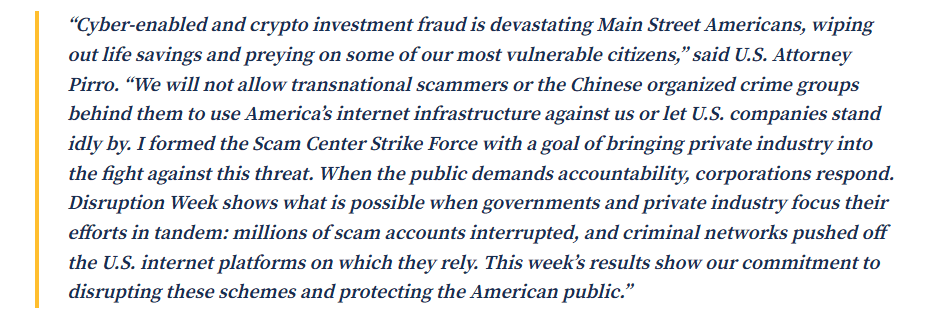
Source: US DOJ

Accounts, Servers, And Arrests

Meta, Microsoft, and Starlink were among the private firms named in the operation, helping take down servers and other hosting tools linked to the scam networks. Authorities also said more than 1.4 million social media and email accounts were disrupted, and the Royal Thai Police Anti-Cyber Scam Center made arrests tied to the effort.

The scam pattern is familiar, but the scale keeps climbing. The DOJ said investment fraud and pig butchering remain among the fastest-growing and most damaging scams aimed at Americans, and the FBI reported earlier this month that losses from crypto- and AI-related scams in 2025 topped $11 billion, with investment scams causing the most damage.

Total crypto market cap currently at $2.15 trillion. Chart: TradingView

Another part of the same push came in April, when the Scam Center Strike Force and its partners restrained more than $701 million in crypto tied to investment scams. Authorities have also carried out other crackdowns this year, including actions in Dubai and Albania, as pressure on scam infrastructure spread beyond Southeast Asia.

Crypto’s Place In The Crackdown

Coinbase also argued that blockchain gives investigators a permanent record of transactions, a point it used to push back on the idea that crypto is only a tool for crime. The coalition behind the operation included the FBI, the US Secret Service, and law enforcement partners in the UK, Australia, Canada, New Zealand, and Thailand.

The latest freeze fits a pattern of steady pressure on scam centers rather than one-off arrests. Officials have kept aiming at websites, messaging channels, servers, and the money trail itself, hoping to cut off the machinery that lets these fraud rings keep running.

Featured image from Unsplash, chart from TradingView

Preguntas relacionadas

QAccording to the article, how much cryptocurrency did Coinbase freeze that was linked to Southeast Asian scam networks?

ACoinbase moved to freeze more than $3 million in crypto linked to scam networks operating across Southeast Asia.

QWhat was the name of the coordinated law enforcement push during which this crypto freeze was announced?

AThe freeze was announced during Disruption Week, a coordinated push led by the DOJ's Scam Center Strike Force.

QWhich private companies were named as helping to take down servers linked to the scam networks?

AMeta, Microsoft, and Starlink were among the private firms named in the operation, helping take down servers and other hosting tools linked to the scam networks.

QWhat does the FBI report say about total losses from crypto- and AI-related scams in 2025?

AThe FBI reported earlier this month that losses from crypto- and AI-related scams in 2025 topped $11 billion, with investment scams causing the most damage.

QHow does Coinbase argue that blockchain technology can assist in fighting crime, according to the article?

ACoinbase argued that blockchain gives investigators a permanent record of transactions, pushing back on the idea that crypto is only a tool for crime.

Lecturas Relacionadas

Claude Code Slashes 80% of Prompt Tokens, But Opus 5 Just Adds Them Right Back In

Claude Code, the AI coding assistant from Anthropic, recently announced a massive reduction of over 80% in its system prompt content for models like Opus 5 and Fable 5. The goal was to remove verbose, often conflicting, rules (like strict commenting and documentation requirements) and replace them with a simpler directive: write code that matches the style of the surrounding project. This "pruning" aims to make the model more efficient by reducing internal conflict from overlapping instructions, with no measurable performance drop reported. However, a developer's (@chenchengpro) investigation revealed a twist. While the prompt was drastically cut from 15,225 characters in Opus 4.7 to 4,467 in Opus 4.8, it *increased* by approximately 72% to 7,694 characters in Opus 5. This isn't a contradiction. The "over 80% cut" refers to the overall shift from the old, detailed rulebook-style prompts to a new, streamlined system. The 72% increase for Opus 5 represents new, targeted instructions added to manage the model's enhanced capabilities. Opus 5 is more proactive—it likes to report progress, generate longer outputs, use sub-agents, and expand task scope. The added prompt content (roughly 3,755 characters) primarily provides guidelines for "Delivering work" (controlling task scope, progress reporting) and "Corrections" (limiting excessive self-correction). These new rules are necessary to curb potential over-engineering on simple tasks, ensuring efficiency even as the model becomes more independent. In short, the old, restrictive manual was deleted, but new guidelines were written to harness the model's newfound initiative.

marsbitHace 6 min(s)

Claude Code Slashes 80% of Prompt Tokens, But Opus 5 Just Adds Them Right Back In

marsbitHace 6 min(s)

One-Third of arXiv 'Contaminated', 65% of CS Papers Smell of AI, Only 0.7% in Math

Approximately one-third of recently posted arXiv papers show signs of significant AI-generated text, according to a new study. An analysis of 12,750 papers from January 2023 to July 2026 across ten disciplines found a sharp increase in AI text markers following ChatGPT's release, with the overall detection rate reaching 32% in the latest quarter and peaking near 39% in early 2026. The rate varies drastically by field. Computer Science papers lead at 65%, followed by Quantitative Biology (56.3%) and Electrical Engineering (51.3%). Mathematics, however, has the lowest detection rate at just 0.7%. The study's authors note this could be due to mathematicians using AI less or because the detector struggles with the high volume of formulas and symbolic notation in math papers, leaving the true cause unclear. The research highlights that the detector identifies a statistical "AI style" in the text rather than proving full AI authorship. It cannot distinguish between light AI-assisted editing and fully AI-generated content. Furthermore, the detector can produce false positives, as some pre-ChatGPT academic writing also exhibits patterns now flagged as "AI-like." The growing use of AI, particularly in highly competitive fields, is creating a cycle where researchers may feel pressured to adopt AI tools to keep pace. The findings raise questions about the changing nature of academic writing and the emergence of a new "AI style" that is increasingly difficult to distinguish from human prose, potentially undermining trust in written text regardless of its true origin.

marsbitHace 8 min(s)

One-Third of arXiv 'Contaminated', 65% of CS Papers Smell of AI, Only 0.7% in Math

marsbitHace 8 min(s)

The Biggest Enemy of the AI Bull Market Is Not a Bubble, But the Bond Market?

The bond market is emerging as the most dangerous variable for the AI stock rally. US Bank's chief investment strategist Michael Hartnett warns that surging bond yields are tightening financial conditions beyond what corporate earnings can support. Key indicators include the 30-year Treasury yield hitting 5.2% (a high since 2007) and real yields reaching 3% (a peak since 2008). Hartnett argues this bond market stress could force the Fed to hike rates, which would be detrimental to equities. A critical risk signal would be if the bullish combination of "rising yields & rising bank stocks" flips to "rising yields & falling bank stocks," potentially triggering a broader de-risking in markets. Simultaneously, credit risk for hyperscale cloud companies has reached record highs, with Credit Default Swaps (CDS) at unprecedented levels. This reflects bond investors' growing skepticism about the return on investment from the massive AI capital expenditure boom. The core concern is: if debt markets refuse to fund the AI spending spree, where will the capital for expensive memory chips and potentially unprofitable frontier models come from? Hartnett frames the current dynamic as "FCI > EPS" – where tightening Financial Conditions outweigh the support from Earnings Per Share. He advises a defensive tilt: going long defensive stocks, high-dividend stocks, and long-duration bonds, while shorting bank stocks, brokers, tech, and industrials to hedge against a potential reversal of the "boom" narrative. From a macro perspective, the 2020s are characterized by supply-side constraints (labor, imports, oil) rather than demand, while bond and equity supply remains abundant due to persistent fiscal deficits and reduced corporate buybacks. In this environment, Hartnett sees gold and Bitcoin quietly forming a base in 2026.

marsbitHace 10 min(s)

The Biggest Enemy of the AI Bull Market Is Not a Bubble, But the Bond Market?

marsbitHace 10 min(s)

"Injective Nova Program" Final Demo Day Summit Finals Successfully Concluded: TOP3 Teams Announced, Co-creating a New Paradigm of AI × Web3

"Injective Nova Program" Final Demo Day Successfully Concludes in Hangzhou: Top 3 Teams Announced, Shaping the New Paradigm of AI × Web3 On July 25, 2026, the Final Demo Day of the "Injective Nova Program," jointly launched by Injective, Microsoft, and Web3Labs, was successfully held in Hangzhou. The event gathered global blockchain experts, AI developers, top VC representatives, and ecosystem partners to witness innovations at the intersection of AI and decentralized networks. The program generated significant global interest, receiving 89 applications from over 10 countries and achieving over 1,000,000 ecosystem impressions. After a rigorous review, a global Top 10 was announced on July 10. These teams participated in an exclusive visit to Microsoft's Beijing headquarters for deep technical exchanges on July 16. At the final demo day, the Top 10 teams delivered live presentations. The jury evaluated projects based on technological innovation, commercial potential, and synergy with the Injective ecosystem, ultimately awarding the top three positions. All winning and shortlisted projects will receive comprehensive incubation support, technical resources, and capital access from Injective, Microsoft, and Web3Labs. The successful conclusion of the Final Demo Day marks a significant milestone for the first phase of the Injective Nova Program. The organizers plan to continue supporting global builders and exploring the limitless possibilities of AI and decentralized technology integration.

marsbitHace 16 min(s)

"Injective Nova Program" Final Demo Day Summit Finals Successfully Concluded: TOP3 Teams Announced, Co-creating a New Paradigm of AI × Web3

marsbitHace 16 min(s)

Trading

Spot
活动图片