Another $75 Million Raised: Why Are Top VCs Betting on FOMO Again?

Foresight NewsPublicado a 2026-06-23Actualizado a 2026-06-23

Resumen

FOMO, a social crypto trading app, raises $75M in Series B led by Index Ventures, with participation from USV and follow-on from Benchmark. The round values the company at $550M. Launched in beta in mid-2025, FOMO simplifies on-chain trading by eliminating gas fees for users, supporting multiple blockchains (Bitcoin, Ethereum, Solana, Base, BNB Chain), and enabling direct crypto purchases via Apple Pay or debit cards. The app features social functions allowing users to follow traders and view their activity. Key metrics show rapid growth: over 625,000 users, $4B+ in cumulative trading volume, and more than 110M social interactions. Notably, over 68,000 users made their first crypto purchase through FOMO using Apple Pay. The platform recently expanded into perpetual contracts trading for stocks, pre-IPO assets, crypto, indices, and commodities. The founding team, with backgrounds from dYdX, Uniswap, and OpenSea, initially raised a $2M pre-seed round from 140+ angel investors across the crypto ecosystem before securing a $17M Series A from Benchmark in late 2025. FOMO's strategy focuses on removing technical friction to drive mainstream adoption, positioning itself as a potential gateway between crypto and traditional finance.


Original Title: 《The Gold Rush Manual: Why Benchmark and Other Top VCs Have Their Eyes on FOMO?》

Originally Published on November 14, 2025

Author: KarenZ, Foresight News


Updated on June 23, 2026:


The capital narrative for fomo has taken another step forward. On June 22, 2026, fomo announced the completion of a $75 million Series B funding round. The round was led by Index Ventures, with participation from Union Square Ventures (USV). Benchmark doubled down on its investment. Other investors include Zynga co-founder Mark Pincus, Discord CEO Humam Sakhnini, and Eventbrite co-founder Kevin Hartz. According to a report by Fortune, fomo's post-money valuation reached $550 million.


Index Ventures has previously bet on high-growth tech companies like Figma and Scale AI, and also invested in the stablecoin infrastructure Bridge, which was acquired by Stripe for $1.1 billion in 2025. USV is a long-term capital partner behind crypto and internet network projects like Coinbase, Polygon, and Matter Labs. The entry of these two traditional top-tier VCs places fomo, from a crypto-native trading application, under scrutiny within the broader narrative of consumer finance and on-chain asset gateways.


Data is rising in tandem. According to official disclosures from fomo, over 625,000 users have joined the platform since its launch one year ago. Cumulative trading volume has exceeded $4 billion, generating over 110 million unique social interactions. Additionally, more than 68,000 users purchased cryptocurrency for the first time on fomo via Apple Pay (totaling $25 million).


On the product front, fomo launched perpetual contract functionality in June, powered by Hyperliquid and TradeXYZ, covering perpetual contracts for stocks, Pre-IPO assets, crypto assets, indices, and commodities. In other words, fomo is expanding from an ultra-simple on-chain trading app into a broader global trading network.


Original Article:


In recent years, the crypto industry has made rapid strides at the infrastructure level. However, truly consumer-grade crypto applications for the masses have consistently failed to break through. Issues at the user experience layer—such as fragmented blockchain ecosystems, complex wallet operations, and gas fees—remain significant hurdles for ordinary users, acting as the final barrier to mass adoption.


Fomo, a social crypto trading app that emerged in 2025, is attempting to rewrite the rules of the game by "demolishing the technical barriers to crypto trading" with an extremely simple experience. It has not only attracted over 140 top industry angel investors but also secured a $17 million Series A lead investment from Benchmark, a top-tier VC historically cautious about the crypto space, making it one of the most talked-about dark horse applications in the crypto sector this year.


Team Background: Crypto Veterans 'Attacking from a Higher Dimension'


Fomo's core positioning is "the social crypto trading mobile app for everyone." Its product design revolves around two key pillars: "eliminating technical friction" and "enhancing user connections," aiming to break the status quo of poor user experience in the crypto industry.


Fomo co-founders Paul Erlanger and Se Yong Park previously worked together at the crypto derivatives trading platform dYdX. The team includes members from companies like dYdX, Uniswap, OpenSea, Square, and Two Sigma, covering fields such as DeFi, NFT ecosystems, and traditional fintech. This "cross-domain + strong collaboration" team DNA has been key to fomo's rapid breakthrough.


Funding Path


Fomo's funding path is unconventional yet precisely targets the core of capital and resources. Instead of following the traditional "seed round → Series A" sequence, fomo first built the most豪华 early supporter network in the crypto industry through an "Angel Investor List" strategy, which then attracted the "rare bet" from top-tier firm Benchmark.


In February 2025, fomo completed a $2 million angel Pre-Seed round with support from over 140 angel investors, covering three core groups within the crypto ecosystem: builders, operators, and traders. This list includes Solana co-founder Raj Gokal, Polygon CEO Marc Boiron, Balaji Srinivasan, LayerZero CEO Bryan Pellegrino, Berachain CEO Smokey Bera, Sei co-founder Jeffrey Feng, Wintermute CEO Evgeny Gaevoy, Privy CEO Henri Stern, Kaito CEO Yu Hu, Pantera managing partner Paul Veradittakit, Dragonfly general partner Rob Hadick, and others.


Among these angel investors are key forces from multi-chain ecosystems, providing crucial support for fomo's cross-chain technical integrations, as well as top traders who are not only early product users but also help fomo optimize trading experience and social feature design.


Fomo's founders previously revealed to TechCrunch that the team initially compiled a "dream investor list" of 200 people. Through referrals and direct communication, very few ultimately declined—a high conversion rate indicating investor recognition of the "simplifying crypto trading" vision.


In November 2025, fomo secured a $17 million Series A round led by Benchmark. Benchmark is a legendary venture capital firm whose portfolio includes world-changing consumer products like Uber, Snapchat, Instagram, and X. Benchmark has been extremely cautious about investing in consumer crypto applications—since 2018, the firm has made only a handful of investments in crypto startups, deploying capital in just a few projects in the Web3 space like Chainalysis, Toncoin, and the Web3 social protocol Towns.


Benchmark general partner Chetan Puttagunta told TechCrunch he was drawn by fomo's "clear vision" and "truly exceptional growth." He noted that three separate people proactively introduced him to fomo. After learning about fomo's growth and clear vision, Chetan Puttagunta also joined fomo's board of directors.


Other participants in this Series A round included angel investors such as Pudgy Penguins CEO Luca Netz, Moonpay CEO Ivan Soto-Wright, and Zora CEO Jacob Horne.


Product Highlights: The Crypto Super-App of "Cross-Chain + Social"


Fomo's operation process is designed to be extremely simple. Features include using a single balance across chains, one-click purchases of any asset, no need for new wallets, no need for cross-chain bridging, and no gas fees. Even users with zero crypto experience can complete trades quickly.


  • Multi-Chain Asset Coverage: Currently supports mainstream blockchains like Bitcoin, Ethereum, Solana, Base, and BNB Chain, offering trading for millions of assets from major coins (like BTC, ETH) to meme coins and altcoins. The founders promise to achieve "coverage of almost all blockchain assets" within the next 6 months, eliminating the need for users to switch between multiple wallets and exchanges.
  • Support for Buying Crypto Directly with Apple Pay: Users can register after downloading the app using their Google or Apple ID, without creating complex seed phrases. Top-up methods include direct crypto transfers, Apple Pay, or debit cards.
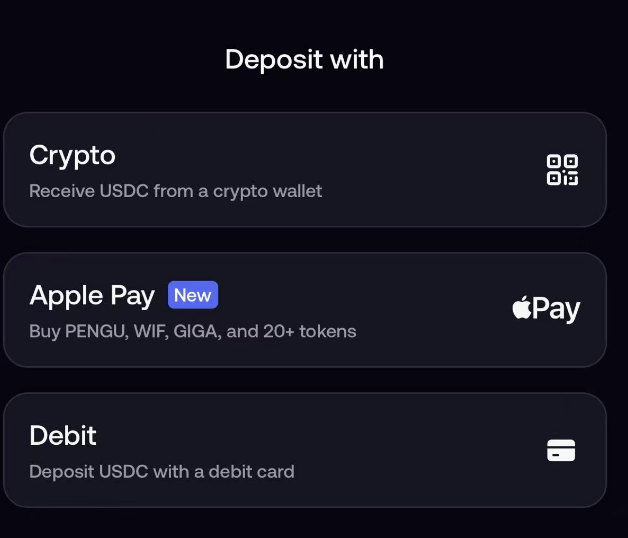


  • No Gas: Zero gas fees on the user side.
  • Fee Structure: A unified trading fee of 0.50%. A minimum fee of $0.95 is set only for the Solana network, with no minimum fee on lower-cost chains like Base and BNB Chain.
  • Social Discovery: Fomo also features built-in social functions. Users can follow KOLs, traders, or friends to view their real-time trading records (such as buying/selling assets, portfolio changes). They can also explore "Popular Assets," "Trending Trades," and "Top Trader Rankings" to quickly capture market opportunities.
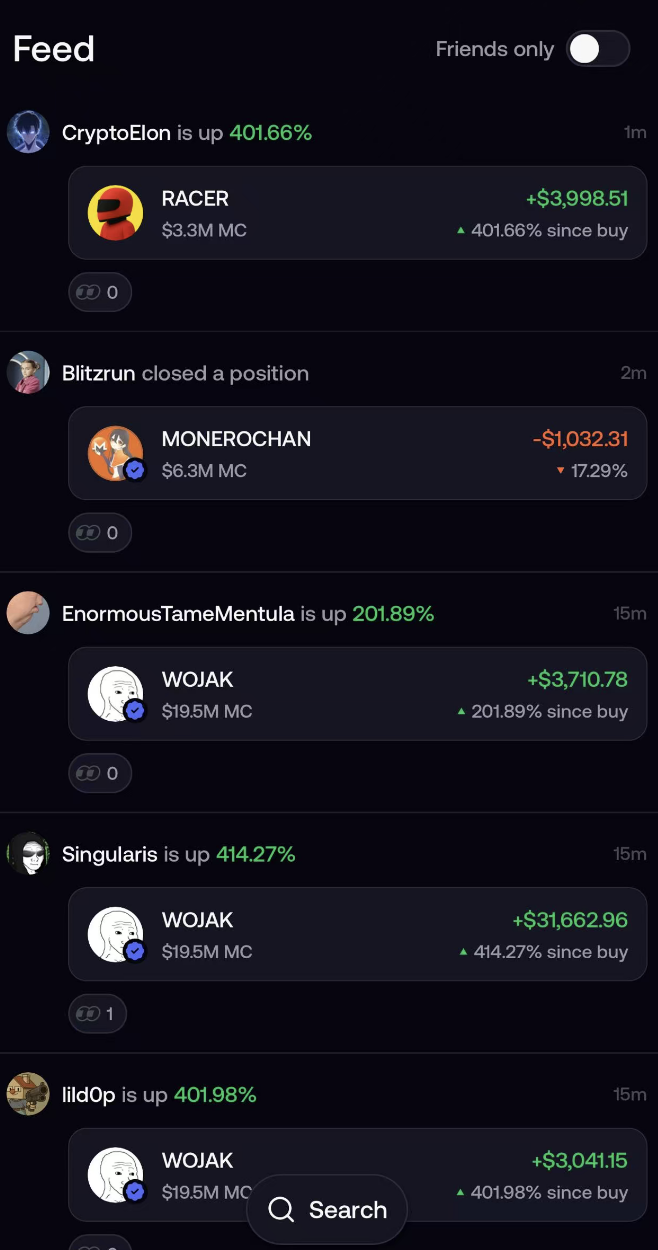


Fomo's ultimate goal is not limited to cryptocurrencies. Fomo founder Paul Erlanger told TechCrunch that the platform will gradually expand asset classes to cover traditional securities like prediction markets and bonds.


How Has Fomo Performed Data-Wise?


Since the beta version launched in May 2025, fomo's user and trading data have shown "exponential growth," validating its product model:
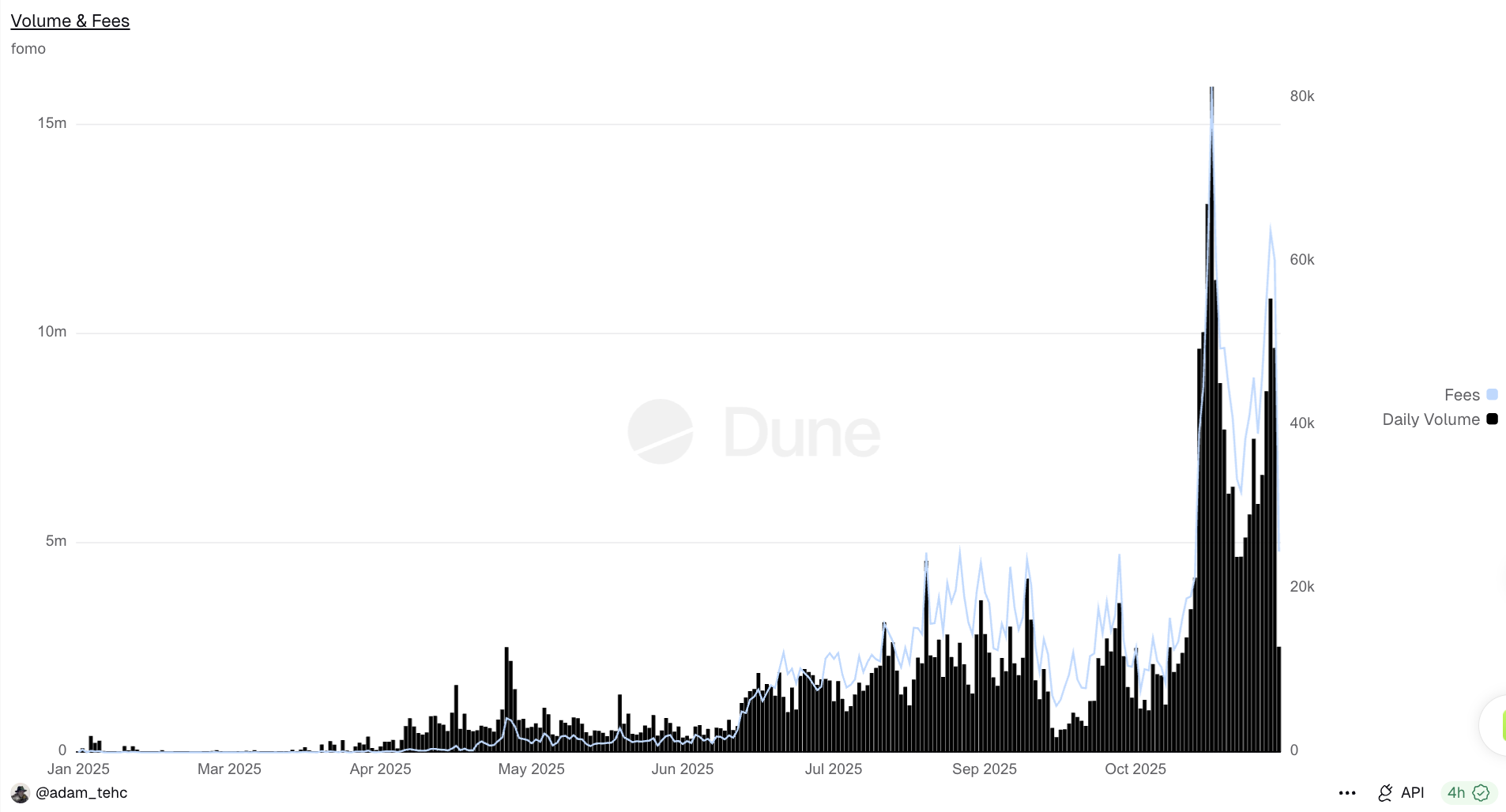
Source: Dune


Trading Volume: According to Dune data, as of the time of writing, fomo's cumulative trading volume is close to $850 million, generating $2.47 million in fees.

User Scale: When announcing its Series A funding, fomo stated its user base continued to grow nearly 10% week-over-week. Fomo has attracted over 120,000 users and 35,000 traders. Among them, nearly 15,000 users were first-time crypto buyers (topping up via Apple Pay). Dune data shows over 30,000 users on the fomo platform have executed more than one trade.


From an industry comparison perspective, within the Solana Bot赛道 over the past two months, fomo's transaction volume market share reached 5.5%, ranking sixth.
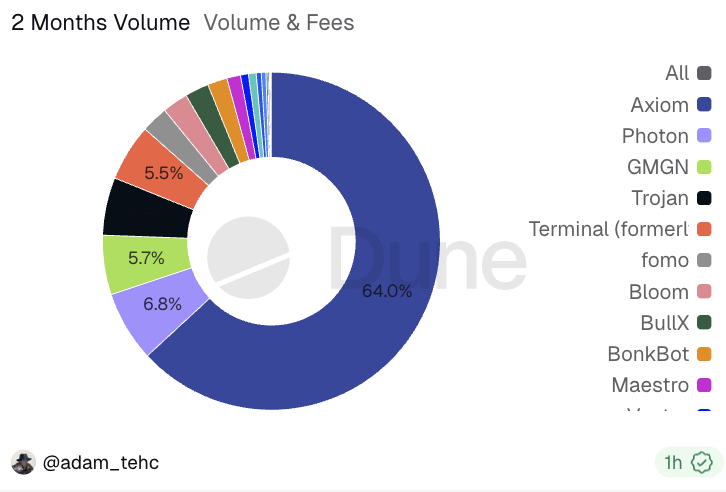

Source: Dune


What Are the Engagement Methods?


The core of fomo's interaction strategy is trading. It's unclear whether referrals count towards rankings, but inviting others grants a 25% fee reward from the referred user's fees.


Currently, fomo has launched a leaderboard feature within its mobile app. After attempting two small asset trades, the author's ranking entered the top 12,000.


Summary


When crypto infrastructure matures sufficiently, whoever can lower the user threshold will capture the next wave of growth.


Fomo's core value lies precisely in solving crypto's "last mile" problem—focusing on user experience optimization—which aligns perfectly with the core need for mass adoption of consumer-grade crypto applications.


Simultaneously, the angel investor lineup of over a hundred individuals and Benchmark's involvement signal that industry consensus and institutional capital are beginning to re-evaluate the long-term value of consumer crypto applications.


From a product perspective, fomo is redefining the standards for a "good trading app": not by piling on features, but by achieving extreme simplicity; not as an isolated trading tool, but as a socialized financial network.


According to official plans, fomo aims to support all assets on almost all mainstream blockchains within six months and eventually expand into prediction markets and traditional securities. Whether fomo has the potential to become a bridge connecting the crypto world with traditional finance is worth ongoing observation.


Preguntas relacionadas

QHow much did fomo raise in its Series B funding round and who were the key investors?

Afomo raised $75 million in its Series B funding round. The round was led by Index Ventures, with participation from Union Square Ventures (USV). Benchmark, an existing investor, also increased its stake. Notable angel investors included Zynga co-founder Mark Pincus, Discord CEO Humam Sakhnini, and Eventbrite co-founder Kevin Hartz.

QWhat is fomo's core value proposition and main target users?

Afomo's core value proposition is to simplify the crypto trading experience by eliminating technical friction and enhancing user connection. It aims to be a social crypto trading mobile app built 'for everyone,' targeting not just experienced crypto users but also newcomers who find traditional crypto wallets and exchanges complex.

QWhat key product features does fomo offer to simplify crypto trading?

Afomo offers several key features: multi-chain asset support (Bitcoin, Ethereum, Solana, Base, BNB Chain), direct purchases via Apple Pay or debit cards, zero Gas fees for users, a unified trading fee of 0.50%, and built-in social features for following traders and discovering market trends.

QWhat significant growth data did fomo disclose following its Series B announcement?

AFollowing its Series B announcement, fomo disclosed that it had attracted over 625,000 users, with a cumulative trading volume exceeding $4 billion. The platform facilitated over 110 million unique social interactions. Additionally, more than 68,000 users purchased cryptocurrency for the first time via Apple Pay on fomo, totaling $25 million.

QWhy was Benchmark's investment in fomo's Series A round considered notable?

ABenchmark's investment in fomo's $17 million Series A round was notable because the venture capital firm is historically very cautious about investing in consumer crypto applications. Its portfolio includes iconic consumer products like Uber and Instagram, but it had made only a handful of crypto investments since 2018, making its lead investment in fomo a significant endorsement of the app's vision and growth potential.

Lecturas Relacionadas

A 60-Day Window Depresses Oil Prices, So Why Is the Market Falling Instead?

International oil prices continued to decline on June 23, extending significant losses from the previous session. The market shifted focus from Middle East military risks to actual supply changes following a temporary U.S.-Iran arrangement. The immediate trigger was the resumption of traffic through the Strait of Hormuz, a critical oil shipping chokepoint, with two tankers passing through, signaling eased near-term supply disruption fears. Prices retreated as the "worst-case scenario" was temporarily averted. A reported 60-day window in a U.S.-Iran understanding allows Iran to sell oil during this period, further dampening supply concerns. However, this arrangement is temporary, linked to nuclear talks, and does not guarantee a long-term solution. Market sentiment remains cautious because the deal could still unravel, potentially reinstating sanctions or disrupting shipping. While these developments have lowered immediate risk premiums, prices have not fully returned to pre-conflict levels. Geopolitical news, particularly regarding the stability of the Strait of Hormuz or the progress of negotiations, could quickly reverse the price drop. Additionally, low U.S. strategic petroleum reserves limit the emergency buffer available if supply shocks reemerge. Therefore, the current price decline reflects a reduction in near-term panic, not a complete elimination of Middle East supply risks.

marsbitHace 6 min(s)

A 60-Day Window Depresses Oil Prices, So Why Is the Market Falling Instead?

marsbitHace 6 min(s)

SK Hynix Market Cap Exceeds Samsung for First Time in 26 Years, Korean Broker Calls for 50% More Upside

SK Hynix's market capitalization surpassed Samsung Electronics for the first time in 26 years on June 22, reaching 208.1 trillion won. The shift reflects a market trend where companies directly benefiting from AI infrastructure, like SK Hynix, are receiving higher valuation premiums than diversified giants. The surge is driven by AI-driven demand for High Bandwidth Memory (HBM), where SK Hynix holds a dominant 70-80% market share. Its Q1 2026 revenue exceeded 50 trillion won for the first time, with an operating profit margin of 72%. Hanwha Investment & Securities significantly raised its price target for SK Hynix to 430,000 won, the highest among Korean brokerages. The key rationale is that Long-Term Supply Agreements (LTAs) and robust HBM demand have fundamentally reduced the company's historical profit volatility. Several other brokers have also raised targets, arguing the valuation framework for memory semiconductors is being rewritten, moving away from a cyclical model. Despite the bullish outlook, the stock experienced a pullback of over 5% in regular trading on June 23 after briefly surpassing 3 million won pre-market, amid broader tech sector weakness. Some analysts caution that the市值 overtaking Samsung, whose profit scale and growth forecasts remain higher, could signal short-term overheating. However, high-return investors viewed the dip as a buying opportunity.

marsbitHace 24 min(s)

SK Hynix Market Cap Exceeds Samsung for First Time in 26 Years, Korean Broker Calls for 50% More Upside

marsbitHace 24 min(s)

GPU Rental Prices Drop 30% in Three Weeks: AI Value Chain Migrating from Nvidia to Memory Chips

GPU rental prices for Nvidia's flagship B200 chip have fallen by approximately 30% over three weeks, dropping from a high of $6.11/hour to $4.22/hour. This decline signals a potential easing of the "compute scarcity" narrative that has long supported AI hardware valuations. Concurrently, the semiconductor market is witnessing a significant divergence: while the VanEck Semiconductor ETF (SMH) has risen 15% in the past month, with memory giants Micron and SanDisk each surging nearly 60%, Nvidia's stock has declined about 3% over the same period. Analysts suggest this shift indicates that the AI value chain's bottleneck and profits are migrating from compute (GPUs) to memory. Demand for high-bandwidth memory (HBM) remains intensely strong, with contract prices soaring over 100% in H1 2026, granting memory manufacturers significant pricing power. In contrast, increased B200 supply from improved manufacturing yields and competitive pressure from new cloud providers are softening GPU rental rates. While long-term contracts, like SpaceX's $30 billion deal with Google, show sustained large-scale demand for Nvidia hardware, the softening spot prices pressure the margins of cloud providers and could eventually impact Nvidia's order flow if chip prices don't adjust. The key takeaway for investors is not a weakening AI thesis, but a recalibration within the sector: pricing power appears to be strengthening for memory chipmakers while showing signs of strain for leading GPU suppliers.

marsbitHace 33 min(s)

GPU Rental Prices Drop 30% in Three Weeks: AI Value Chain Migrating from Nvidia to Memory Chips

marsbitHace 33 min(s)

From Corning to Ciena: The 10X Stock Opportunities in the AI Optical Communication Chain

From Copper to Light: The AI-Driven Optical Communication Supply Chain and Investment Opportunities The exponential data demands of AI are pushing data centers beyond the physical limits of copper cables, forcing a critical transition to optical communication. This shift from electrical to photonic signals over distances greater than ~3 feet solves heat, power, and bandwidth constraints. The real investment opportunity lies not just in headline chipmakers, but across the entire essential photonics supply chain. **Key Investment Layers & Companies:** * **Glass & Fiber:** **Corning** is a dominant, irreplaceable supplier of advanced fiber to all major cloud/AI players (Meta, Amazon, Google, MSFT, OpenAI, NVIDIA), with multi-billion-dollar, multi-year contracts locked in years ahead of delivery. Its profit growth (93%) far outpaces revenue growth (36%), showing pricing power. * **Interconnects:** **Amphenol**, a consolidating giant in high-speed connectors (both copper and optical), shows robust growth (>80% in AI data centers) and expanding margins post-acquisition. **Credo Technology** bridges old and new worlds, extending copper's life in racks while moving into optics. It has hyper-growth but carries high customer concentration risk. * **Systems:** **Ciena** is a leader in coherent optics, enabling massive data capacity upgrades on existing fiber. It has a massive, growing order backlog ($~7B) and strong ties with cloud providers. * **Upstream & Enablers:** **AXT** produces mission-critical indium phosphide wafers for lasers, creating a supply bottleneck, but faces significant geopolitical/export license risk from its China-based manufacturing. **VEO Solutions** is the essential "picks and shovels" play, providing test equipment needed by every component in the optical chain, regardless of the eventual winner. A new pure-play photonics ETF (**FOTO**) offers a consolidated investment vehicle for this theme, though it is new and small. The core thesis is clear: the move from copper to light is inevitable and accelerating, with wealth creation spreading across this critical, multi-layered supply chain.

marsbitHace 53 min(s)

From Corning to Ciena: The 10X Stock Opportunities in the AI Optical Communication Chain

marsbitHace 53 min(s)

A Chip Company Releases AIDC Energy Storage Certification Standards. Why NVIDIA? Computing Power Reshapes Power Supply Logic. Who's in the Lead and Who's Left Out?

NVIDIA has released a "Battery Energy Storage System Self-Certification Guide," setting strict technical standards for energy storage systems specifically for AI data centers (AIDC). The guide focuses solely on certifying the Power Conversion System (PCS), not the batteries, with 10 mandatory performance metrics and 12 validation tests requiring real-world and simulation comparisons. Key requirements include rapid dynamic response to AI workloads, high-frequency system telemetry, and detailed electromagnetic transient models. The move is driven by the extreme and fluctuating power demands of next-generation AI hardware. Modern AIDCs require energy storage systems to act as intelligent, controllable grid assets, not just passive backup, to manage instantaneous, massive power load shifts that traditional UPS systems cannot handle. This redefines the competitive landscape for energy storage providers, shifting focus from capacity and cost to advanced control capabilities and system integration. While the market potential is significant—with forecasts of hundreds of GWh in new demand by 2030—the certification creates a high barrier to entry. It requires proven PCS delivery volumes and credible plans for rapid capacity scaling, favoring established, well-resourced players. Early movers like Fluence (partnering with Siemens) and several Chinese companies have secured projects ahead of the standard, but new entrants must now navigate this rigorous, costly, and time-intensive certification process to compete in the AIDC energy storage market.

marsbitHace 1 hora(s)

A Chip Company Releases AIDC Energy Storage Certification Standards. Why NVIDIA? Computing Power Reshapes Power Supply Logic. Who's in the Lead and Who's Left Out?

marsbitHace 1 hora(s)

Trading

Spot
Futuros
活动图片