Coinbase Posts $394 Million Loss In Q1 2026 — And The Worst May Not Be Over

bitcoinistPublicado a 2026-05-08Actualizado a 2026-05-08

Resumen

Coinbase reported a net loss of $394 million for Q1 2026, a sharp reversal from a $65.6 million profit a year ago. This missed analyst expectations as total revenue fell 30.5% to $1.41 billion, largely driven by a 23% decline in transaction revenue due to lower crypto trading volumes and prices. A significant factor was $482 million in unrealized losses on crypto holdings, primarily linked to Bitcoin's price drop. Excluding that, the adjusted net loss was $46 million. While subscription and services revenue remained strong at $584 million and adjusted EBITDA was positive, the results highlight the exchange's continued sensitivity to crypto market cycles. This follows recent workforce reductions and shows operating margin collapsing to -1.5%. The quarter underscores that despite its institutional standing, Coinbase's path to durable profitability remains tied to volatile crypto market conditions.

Coinbase reported a net loss of $394 million for the first quarter of 2026, swinging from a $65.6 million profit in the same period last year and missing Wall Street expectations on both revenue and earnings per share — as a sharp pullback in crypto prices and trading volumes hit the exchange’s core business harder than analysts had anticipated.

The results, reported by Bloomberg after market close on May 7, showed total revenue of $1.41 billion — a 30.5% year-over-year decline and a miss against the analyst consensus of approximately $1.51 billion. On a per-share basis, Coinbase posted a GAAP loss of $1.49 against expectations of a $0.29 profit — a significant miss that sent shares down roughly 4% in after-hours trading.
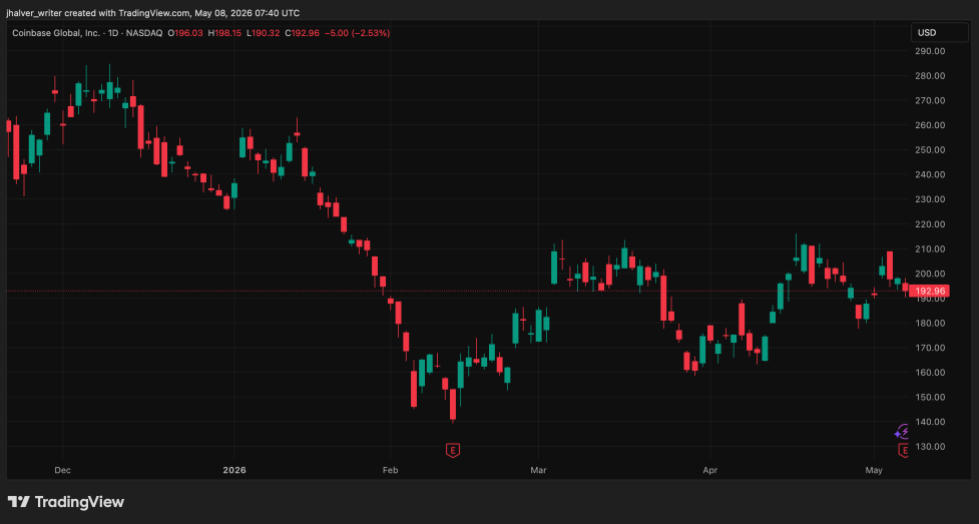
COIN's price records a modest loss following their Q1 earnings report, as seen on the daily chart. Source: COINUSD on Tradingview

What Drove Coinbase To A Loss

The single largest drag on the quarter was $482 million in unrealized losses on crypto assets held for investment, tied primarily to Bitcoin’s roughly 23% decline during Q1, a separate report from TheStreet crypto claims. Strip out that mark-to-market impact and the adjusted net loss narrows to $46 million — a meaningful distinction, but one that still reflects a materially weaker operating environment than the prior year.

Transaction revenue, the exchange’s primary revenue engine, came in at $755.8 million — down 23% quarter-over-quarter and below the $805.2 million analysts had projected. The main driver was straightforward: total crypto market capitalization and spot trading volumes declined more than 20% quarter-over-quarter, per Investing.com, pulling Coinbase’s most volatile revenue line with it.

Not everything was negative. Subscription and services revenue reached $584 million — representing 44% of net revenue — while stablecoin revenue hit $305 million on record average USDC holdings of $19 billion in Coinbase products. Adjusted EBITDA came in at $303 million, marking the company’s 13th consecutive positive quarter on that metric, per CFO Alesia Haas on the earnings call.

A Quarter That Confirms The Pattern

The Q1 loss arrives just days after Coinbase announced a 14% reduction in its workforce — approximately 700 roles — citing the need to restructure around AI-driven operations. Taken together, the layoffs and the earnings miss paint the picture of an exchange managing through a difficult cycle rather than riding one.

Operating margin collapsed to -1.5% from 34.7% in the year-ago quarter, underlining how quickly Coinbase’s profitability profile can shift when crypto markets pull back. The company closed the quarter with over $10 billion in cash and equivalents, per the earnings call transcript, which provides a substantial buffer — but does little to address the structural revenue sensitivity that has defined every down cycle in the exchange’s short public history.

For the nascent sector, Coinbase’s Q1 results serve as a reminder that even the most institutionally established crypto exchange remains tightly tethered to market conditions — and that the road to durable profitability runs directly through the unpredictable terrain of crypto price cycles.

Cover image from Grok, COINUSD chart from Tradingview

Preguntas relacionadas

QWhat were Coinbase's reported Q1 2026 financial results in terms of net loss and revenue?

ACoinbase reported a net loss of $394 million for Q1 2026, swinging from a $65.6 million profit in Q1 2025. Total revenue was $1.41 billion, a 30.5% year-over-year decline.

QWhat was the largest single factor contributing to Coinbase's Q1 2026 loss according to the article?

AThe single largest drag was $482 million in unrealized losses on crypto assets held for investment, primarily tied to Bitcoin's roughly 23% decline during the quarter.

QHow did Coinbase's transaction revenue perform in Q1 2026 compared to analyst expectations?

ATransaction revenue came in at $755.8 million, which was down 23% quarter-over-quarter and below the $805.2 million analysts had projected.

QDespite the overall loss, which areas of Coinbase's business showed positive performance in Q1 2026?

ASubscription and services revenue reached $584 million, representing 44% of net revenue. Stablecoin revenue hit $305 million on record average USDC holdings. Adjusted EBITDA was $303 million, marking the 13th consecutive positive quarter on that metric.

QWhat recent operational decision by Coinbase, mentioned alongside the earnings, highlights its response to a difficult cycle?

AJust days before the earnings report, Coinbase announced a 14% reduction in its workforce (approximately 700 roles), citing a restructuring around AI-driven operations.

Lecturas Relacionadas

‘TACO’ Is Outdated, Wall Street Embraces ‘NACHO’ Trading

The Wall Street trading meme "TACO" (Trump Always Chickens Out) is being replaced by "NACHO" (Not A Chance Hormuz Opens), signaling a major shift in market expectations. TACO bets anticipated de-escalation from political figures, but this pattern broke on March 23rd when a Trump social media post claiming progress with Iran was denied by Tehran, causing a sharp but temporary market reversal. Since then, markets have adopted a NACHO mindset, betting the Strait of Hormuz will remain closed for an extended period. This view is reflected in three key markets. First, war risk insurance premiums for vessels transiting the strait have skyrocketed. Second, the oil futures curve shows a steep backwardation, with near-term prices far exceeding long-dated contracts, indicating expectations for a prolonged but not permanent supply crunch. Third, Federal Reserve rate cut expectations for 2026 have been priced out to zero due to persistent oil-price inflation. While the S&P 500 continues hitting record highs, the market internally reflects NACHO's impact. The energy sector ETF (XLE) has vastly outperformed the transportation sector ETF (IYT), as high oil prices directly benefit producers but squeeze transport and logistics companies' margins. The NACHO trade has a concrete deadline. Analysts warn global commercial oil inventories could reach critical "operational pressure" levels by early June. If the strait remains closed into September, OECD stocks may fall below the operational floor. Prediction markets currently assign a very low probability to the strait reopening before June. The market has shifted from reacting to political headlines to pricing in the physical realities of oil supply and inventory clocks.

marsbitHace 5 min(s)

‘TACO’ Is Outdated, Wall Street Embraces ‘NACHO’ Trading

marsbitHace 5 min(s)

Peace Talks Hit an Impasse Again, U.S. Stocks Retreat from Highs, Can Bitcoin Hold the $80,000 Level?

Peace Talks Stalemate Sinks Stocks, Tests Bitcoin's $80K Support Optimism over a potential U.S.-Iran peace deal, which briefly propelled the S&P 500 and Nasdaq to record highs, evaporated within 24 hours. Iran dismissed key U.S. proposals regarding uranium enrichment and Strait of Hormuz access, reversing market sentiment. U.S. stocks fell, led by semiconductors and small caps, while oil prices whipsawed violently. The core narrative is a binary market bet on war or peace, creating extreme volatility. The probability of a deal by mid-May dropped to 20%. Oil (Brent) briefly crashed 12% before recovering to around $100, but a shift in its market structure hinted at ample physical supply despite geopolitical risk. Bitcoin fell roughly 1.56%, finding support near $80,000. The pullback was considered structurally healthy, backed by strong institutional inflows into U.S. ETFs and rising long-term holder conviction. Ethereum gained on positive U.S. crypto regulation hopes. In equities, major indices declined with the Russell 2000 hit hardest. The "Magnificent Seven" tech stocks were a rare bright spot, but the semiconductor sector sold off sharply. Notably, high-beta momentum stocks suffered dramatically worse losses than the broader market. Upcoming U.S. non-farm payrolls data is the next key catalyst. Treasury yields rose with oil, the dollar was steady, and gold/silver gained on a mix of inflation and safe-haven demand. European markets also fell. The situation in the Strait of Hormuz remains unresolved, keeping markets on edge.

marsbitHace 38 min(s)

Peace Talks Hit an Impasse Again, U.S. Stocks Retreat from Highs, Can Bitcoin Hold the $80,000 Level?

marsbitHace 38 min(s)

Trading

Spot
Futuros
活动图片