Strategy's Preferred Stock STRC Unpegs by 11%, Can Its Perpetual Motion Machine Keep Spinning?

marsbitPublicado a 2026-06-20Actualizado a 2026-06-20

Resumen

The preferred stock STRC issued by Strategy (MicroStrategy) has depegged over 11% from its $100 target par value, raising questions about the sustainability of the company's capital flywheel strategy. STRC, a perpetual preferred stock designed to trade around $100, serves as a key engine for Strategy's expansion, allowing it to raise fiat currency via at-the-market offerings to buy Bitcoin without diluting common shareholder equity. Its depegging, despite dividend rate hikes, suggests market concerns extend beyond yield to the core stability of Strategy's model. Analysts point to potential leveraged unwinding and, more critically, worries about Strategy's liquidity. While the company cites its massive Bitcoin holdings as covering decades of dividends, a recent small BTC sale—a first—has shaken confidence in its "never sell" narrative. If STRC remains discounted, impairing Strategy's fundraising ability, fears may grow that the company could be forced to sell Bitcoin to meet obligations, potentially turning a major market buyer into a seller and exerting significant downward pressure on Bitcoin's price.

Author | Azuma, Odaily Planet Daily

Strategy's preferred stock, STRC, is experiencing sustained "unpegging."

U.S. stock market data shows that since May 15th, STRC has gradually deviated from its target par value of $100. Recently, the discount has intensified significantly, hitting a low of $83.26 during Thursday's session and closing at $88.59, representing an unpegging of over 11% from the target par value.

For an ordinary stock, an 11% decline might not be a big deal. But for STRC, its persistent deviation from the $100 target par value signals a severe challenge to the product's core design objective.

This is because, in Strategy's original design, STRC was created as an income-oriented security intended to trade around a $100 par value, not a highly volatile speculative asset. The widening gap between market price and target par value is leading more investors to re-examine the logic behind this product.

More importantly, as Strategy continues to expand its Bitcoin reserves, STRC has gradually grown into the company's most crucial financing channel. In a sense, the market pricing of STRC reflects not only investor sentiment towards a preferred stock but also market confidence in Strategy's entire capital operation model.

STRC: The Engine of Strategy's Capital Flywheel

To understand the severity of this unpegging, we must first clarify STRC's product structure and its unique anchoring mechanism.

STRC is an innovative financial derivative instrument launched by Strategy in 2025. Unlike Strategy's common stock, MSTR, STRC is positioned as a perpetual preferred stock with a fixed target par value ($100) and relatively stable dividend income, resembling a fixed-income security.

  • Odaily Note: Strategy founder Michael Saylor recently revealed that STRC was designed with the assistance of AI.

Within Strategy's balance sheet expansion cycle, STRC is not just an ordinary financing tool but the most powerful engine of its current capital flywheel.

Before STRC, Strategy primarily relied on issuing convertible notes and direct common stock offerings to raise funds for Bitcoin purchases. However, both models had limitations—convertible notes were constrained by maturity dates and debt leverage caps, while frequent common stock offerings diluted existing shareholders' equity.

STRC's emergence perfectly addressed this pain point. Its core utility in Strategy's strategy is primarily manifested in two dimensions:

  • Unlimited "At-the-Market" (ATM) Offering Program: As long as STRC's market price remains at or above $100, Strategy can continuously issue new STRC shares in the secondary market through the ATM mechanism, raising fiat currency.
  • Purchasing Power with Zero Equity Dilution: As a perpetual preferred stock, STRC has no legal maturity or principal repayment pressure and lacks the voting rights and residual asset claims of common stock. This means Strategy can create billions in fiat purchasing power out of thin air, channeling it entirely into Bitcoin accumulation, without diluting MSTR shareholder equity or increasing rigid debt interest expenses.

Through the "issue more STRC ➡️ raise fiat ➡️ buy BTC ➡️ increase company net assets ➡️ boost STRC trust" loop, Strategy successfully constructed what seemed like an infinitely cycleable capital flywheel.

However, a key prerequisite for this flywheel's smooth operation is that STRC must trade near its $100 par value. Once the market price falls significantly below $100, based on ATM fundraising terms and market arbitrage logic, Strategy will effectively be unable to absorb funds from the market through the discounted preferred shares, and its entire capital magic trick will factually grind to a halt.

At the design stage, to ensure STRC's secondary market price would consistently adhere to the $100 target par value, Strategy introduced a "monthly dynamic dividend rate adjustment" mechanism. Simply put, when STRC's market price is below $100, Strategy can increase the dividend rate to enhance the product's attractiveness; when the price is above $100, it can lower the dividend rate — in theory, through continuous dividend rate adjustments, STRC should be able to trade long-term around $100.

But now, even though Strategy has raised the dividend to a high of 11.5% and switched the payout frequency from monthly to bi-weekly, STRC's "unpegged" state hasn't been effectively corrected... Why is that?

Unpegging Reasons: Confidence, Confidence, and Still Confidence

The ineffectiveness of dividend corrections means the market is pricing in risks that go beyond STRC's yield itself. From current market discussions, risk concerns are primarily focused on two levels.

First, surface-level technical factors. Some market participants believe the recent decline largely stems from concentrated stampeding due to arbitrage capital deleveraging.

Over the past year, STRC traded consistently around $100, attracting significant yield-seeking arbitrage capital. Such funds often use leverage to amplify returns, capturing both dividend income and price convergence arbitrage. However, as STRC broke below $100 and continued to weaken, some leveraged accounts hit risk control limits, forcing them to sell holdings; price declines then triggered more leveraged capital to unwind, creating a chain reaction. In this process, selling pressure intensified, causing STRC's decline to far exceed what normal supply-demand changes would warrant.

Yet, explaining the current market performance solely through leverage-driven stampeding seems insufficient. For many investors, a deeper concern lies in Strategy's liquidity reserve situation.

Earlier this month, J.P. Morgan released a research report pointing out that Strategy has an annual dividend obligation of approximately $1.7 billion. Based on current cash reserve levels, its cash on hand is only sufficient to cover about 6.3 months of preferred stock dividend payments. This sparked market worries about Strategy's promised future liquidity coverage capability.

In response, Strategy offered a starkly different explanation. The company officially posted on X, emphasizing that if its massive Bitcoin reserves are taken into account, they are sufficient to cover 32 years of dividend payments.
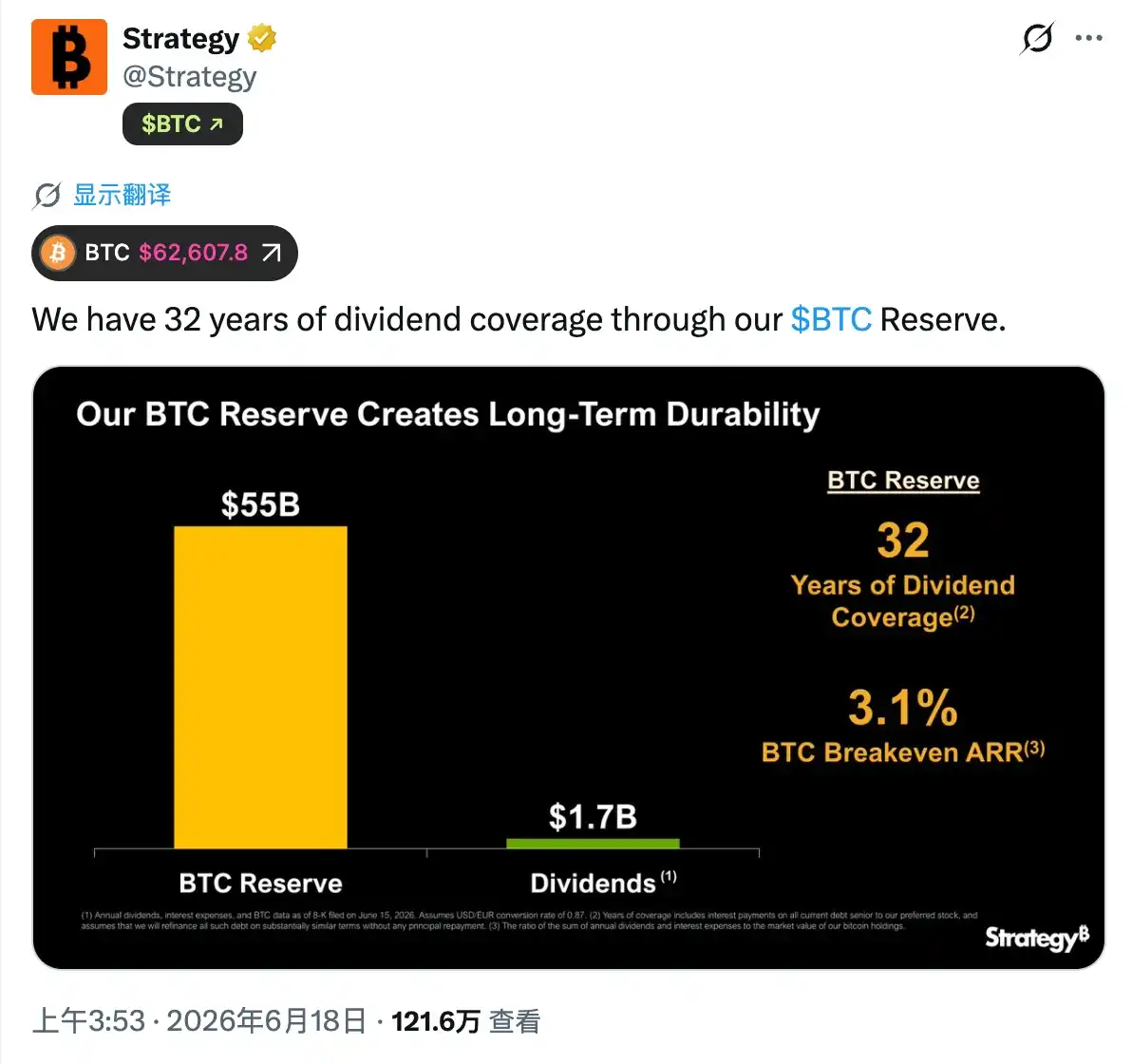
The issue, however, is that these two statements are based on different premises. J.P. Morgan focuses on Strategy's cash position, while Strategy's calculation implies a crucial assumption—if necessary, the company can obtain funds by selling Bitcoin.

This touches on the market's most sensitive nerve. Early this month, Strategy sold a portion of its Bitcoin holdings for the first time. Although the sale involved only 32 Bitcoins and was packaged by the company as "active market desensitization testing," with mention of "buying back more later," it still caused significant market shock. The reason is that over the past few years, Strategy and its founder Michael Saylor have consistently promoted a core narrative to the market—Bitcoin is a long-term strategic reserve asset, and the company will source operational funds through capital market financing, not by selling Bitcoin.

Therefore, when the market witnessed Strategy selling Bitcoin for the first time, it inevitably raised greater concerns—if financing conditions tighten in the future, will Strategy need to rely further on selling Bitcoin to meet dividend obligations? If the answer is not an absolute no, then investors must reassess the risk profile of related securities.

From this perspective, the persistent "unpegging" of STRC reflects the market re-evaluating the robustness of Strategy's entire capital structure.

Strategy's Buying Power Could Turn into Selling Pressure

For Strategy, the biggest impact of STRC's sustained unpegging is the weakening of its financing function.

Over the past few years, Strategy's ability to continuously expand its Bitcoin reserves hinged on a core logic: raising funds from capital markets by issuing stocks, convertible notes, and preferred shares, then using those funds to increase Bitcoin holdings. STRC is precisely Strategy's most important financing tool. When it trades persistently below its $100 target par value, it means the market is demanding higher risk compensation, and Strategy's financing ability consequently faces a temporary shutdown.

Going forward, STRC's re-pegging status may become a crucial indicator for the market to observe Strategy's risk profile. If STRC remains discounted for an extended period, leading to persistently constrained financing ability, while Strategy's cash reserves continue to deplete, market fears about Strategy potentially needing to sell more Bitcoin to meet dividend payments will inevitably intensify.

Once this expectation strengthens, its impact will extend beyond STRC itself. As one of the most significant marginal buyers in the Bitcoin market over recent years, Strategy's financing ability and accumulation pace have profoundly influenced market supply-demand expectations. If Strategy's buying power turns into selling pressure, it could exert unimaginable downward pressure on Bitcoin.


Criptos en tendencia

Preguntas relacionadas

QWhat is the core issue with Strategy's preferred stock STRC, and why is it significant?

AStrategy's preferred stock STRC has experienced a significant 'de-pegging' from its target par value of $100, with its price falling more than 11% below this level. This is significant because STRC is not meant to be a high-volatility speculative asset but a yield-oriented security designed to trade around $100. Its sustained discount threatens the core mechanism of Strategy's capital model, as it undermines the company's primary ability to raise funds through at-the-market (ATM) offerings of STRC, which are only viable when the stock trades at or above $100.

QHow did STRC function as the 'engine' of Strategy's capital flywheel, and what was the critical prerequisite for its operation?

ASTRC functioned as the engine by enabling Strategy to raise fiat currency through continuous at-the-market (ATM) share offerings without diluting the equity of common shareholders (MSTR holders) or incurring fixed debt obligations. The capital flywheel worked as follows: issue more STRC -> raise fiat -> buy Bitcoin -> increase the company's net assets -> boost confidence in STRC. The critical prerequisite for this flywheel to operate smoothly was that STRC's market price had to remain stable around its $100 target par value to facilitate new ATM issuances.

QAccording to the article, what are the two main reasons given for STRC's continued de-pegging despite high dividend adjustments?

AThe two main reasons are: 1) Technical factors involving a deleveraging cascade, where leveraged arbitrage funds were forced to sell their STRC holdings as the price fell below $100, creating a self-reinforcing cycle of selling pressure. 2) A deeper, fundamental loss of market confidence related to concerns about Strategy's liquidity. Investors are worried that if financing becomes tight, Strategy might need to sell its Bitcoin reserves to cover dividend payments, contradicting its long-standing 'hodl' narrative and increasing the perceived risk of STRC.

QWhat was the discrepancy between JPMorgan's analysis and Strategy's own statement regarding the company's ability to cover its dividend obligations?

AJPMorgan's analysis focused on Strategy's cash reserves, concluding they were only sufficient to cover about 6.3 months of preferred stock dividend payments. In contrast, Strategy's official statement argued that if its massive Bitcoin reserves were factored in, the company had enough assets to cover 32 years of dividend payments. The core discrepancy lies in the underlying assumption: JPMorgan considered immediate cash liquidity, while Strategy's calculation assumed the company could and would sell Bitcoin if necessary to generate funds for dividends.

QWhat broader market implication does the article suggest if STRC remains de-pegged and Strategy's financing ability weakens?

AThe article suggests that if STRC remains de-pegged, weakening Strategy's ability to raise new capital, market concerns will intensify that Strategy may be forced to sell portions of its Bitcoin holdings to meet its cash obligations (like dividend payments). As Strategy has been one of the most significant marginal buyers in the Bitcoin market, a shift from being a consistent buyer to a potential seller could create substantial downward pressure on the price of Bitcoin itself, impacting the broader market.

Lecturas Relacionadas

The "Impossible Triad" Is Fundamentally a Pseudo-Problem

The article argues that blockchain's fundamental limitation is not the scalability trilemma (decentralization, scalability, security), which has been largely solved, but the lack of **privacy** and, until recently, clear **legitimacy**. Blockchain is described as a slow, expensive, globally shared computer whose core value is censorship resistance and verifiability. While ideal for native digital assets like money (e.g., stablecoins), its default transparency acts as a **tax**, exposing all transactions and enabling MEV extraction, which deters serious institutional capital. Simultaneously, its permissionless nature created regulatory ambiguity. The piece contends that **privacy** is the missing critical feature. It rejects the false choice between total transparency and complete anonymity. Modern cryptography (like zero-knowledge proofs) enables **compliant privacy**: users can prove facts (solvency, KYC status, compliance) without revealing the underlying sensitive data (specific holdings, identities). This preserves auditability for regulators and eliminates the leak of financial information. With recent regulatory progress (e.g., the GENIUS Act) addressing legitimacy, adding default, provably compliant privacy becomes a pure upgrade. It transforms blockchain from a costly, public ledger into a confidential settlement layer, finally bridging the gap to mainstream institutional and individual adoption of on-chain finance.

链捕手Hace 2 hora(s)

The "Impossible Triad" Is Fundamentally a Pseudo-Problem

链捕手Hace 2 hora(s)

Optical Chips: Collective Capacity Expansion

The global optical chip industry is experiencing a massive wave of expansion driven by surging AI data center demand. Major players across the US, Japan, Europe, and China are aggressively investing to ramp up production capacity. In the US, Coherent is expanding its 6-inch Indium Phosphide (InP) semiconductor fab in Texas, supported by CHIPS Act funding and a $2 billion strategic investment from NVIDIA. Lumentum is building a new factory for InP optical devices, and Nokia is scaling its advanced photonic chip packaging and testing capabilities. NVIDIA's investments aim to secure future supply of critical lasers and optical interconnect products for AI infrastructure. Japan's JX Advanced Metals, a leading InP substrate supplier, plans a multi-billion yen investment to increase its capacity 7-10 times, strengthening its grip on the crucial upstream materials market. In Europe, IQE and Tower Semiconductor settled a patent dispute and signed a multi-year InP epitaxial wafer supply agreement, highlighting that next-generation silicon photonics platforms will integrate high-performance InP components. STMicroelectronics and Sivers Semiconductors are also expanding silicon photonics production and partnerships. China is rapidly building out its domestic supply chain. Dongshan Precision's subsidiary, Source Photonics, announced a $12 billion project to expand optical chip and module production. Companies like Sanan Optoelectronics and Yunnan Germanium are scaling up InP chip manufacturing and substrate production, moving towards vertical integration from materials to modules. While debate continues around the exact future architecture—whether CPO (Co-Packaged Optics), NPO, or pluggables will dominate—analysts like Morgan Stanley argue the underlying driver is unchangeable: the explosive growth in bandwidth demand. This will inevitably increase the volume of optical engines, lasers, and related content per GPU, regardless of the final technical path. The competition for "more light" in the AI era has intensified into a global, full-chain capacity race.

marsbitHace 5 hora(s)

Optical Chips: Collective Capacity Expansion

marsbitHace 5 hora(s)

Stablecoins Finally Find Real Yield: An In-Depth Look at On-Chain Reinsurance Re | A Conversation with Re Founder Karan Saroya

Stablecoin Real Yield Found: A Deep Dive into On-Chain Reinsurance with Re's Karan Saroya As stablecoin supply exceeds $170 billion, the search for sustainable, non-speculative yield intensifies. Re, an on-chain reinsurance platform, provides an answer: connecting stablecoin capital to the trillion-dollar traditional reinsurance market. Re operates as a regulated reinsurer, accepting stablecoin deposits as collateral to back US insurance companies. These insurers pay premiums, generating yield that flows back to on-chain depositors. Currently supporting 35 insurers and underwriting $500 million, Re projects scaling to over $1 billion soon. Key insights from a Bankless podcast with founder Karan Saroya and investor Avichal of Electric Capital: 1. **Uncorrelated, Real-World Yield:** Re offers stablecoin holders access to reinsurance returns (targeting 12-14%+), an asset class entirely separate from crypto or equity markets. 2. **Operational Efficiency via Smart Contracts:** Re replaces traditional, labor-intensive capital fundraising with smart contracts, allowing a ~12-person team to compete with industry giants. 3. **Regulatory Leverage:** For every $1 of collateral, regulations allow backing $5-7 in written premiums. This leverage amplifies returns from the underlying risk-free rate. 4. **DeFi Integration:** Depositors receive receipt tokens, which can be used in protocols like Morpho for "looping," potentially pushing yields to 18-20%+. 5. **The "DeFi Mullet" Model:** A compliant front-end (regulated reinsurer) paired with a decentralized back-end (smart contracts, DeFi capital markets). 6. **RE Governance Token:** Modeled on Lloyd's of London, the token governs the central capital pool's allocation, counterparty acceptance, and parameters. 7. **Real Economic Impact:** Capital funds real-world productivity (factories, clinics, businesses) via insurance, moving beyond crypto's internal loops. The discussion highlights a pivotal moment: DeFi's supply-side infrastructure is now met by real demand for productive yield, potentially kickstarting a flywheel where vast on-chain stablecoin capital seeks these real-world returns.

链捕手Hace 6 hora(s)

Stablecoins Finally Find Real Yield: An In-Depth Look at On-Chain Reinsurance Re | A Conversation with Re Founder Karan Saroya

链捕手Hace 6 hora(s)

1996 or 1999? Walsh's First Test is 'How to View AI'

"1996 or 1999? Wall's First Big Test Is 'How to View AI'" Federal Reserve Chairman Wall's initial challenge is not whether to raise or cut rates, but a more fundamental judgment: what kind of boom is the current AI boom? This will determine the Fed's policy path and define his legacy. Economics is split between two opposing views, according to reporter Nick Timiraos. One sees imminent productivity gains that will increase supply and cool inflation, allowing the Fed to hold steady. The other argues that while productivity benefits are distant, demand shocks are here now, and waiting for data confirmation risks missing the intervention window, forcing sharper rate hikes later. Wall has signaled a leaning toward the first view, echoing 1996-era Alan Greenspan, who embraced strong, productivity-driven growth without fear of inflation. However, Wall faces a different macro environment than Greenspan did, with tariff pressures, expanding fiscal deficits, and diminishing globalization benefits, which could force more significant inflation pressures even if AI benefits materialize. Wall's logic, expressed before taking office, is that AI-driven productivity gains won't show in official data for years. If the Fed waits for confirmation, it might mistakenly tighten policy and choke off the very growth that could suppress inflation. This argues for using forward-looking narratives over lagging data. Chicago Fed President Austan Goolsbee presents a key counter-argument. He distinguishes between expected and unexpected productivity booms. A widely anticipated boom, like the current AI wave, can cause people to spend future wealth gains in advance, overheating the economy before productivity actually rises, thus requiring preemptive rate hikes. He cites rising costs for AI data centers as evidence of such overheating. Fed Governor Christopher Waller offers a rebuttal to Goolsbee, noting the "expected spending" mechanism only works if people can borrow against future income, which many households cannot do due to borrowing constraints. Wall also faces a paradox related to his desire to reduce the Fed's use of "forward guidance" (pre-announcing policy moves). This practice was established in 1999 when Greenspan began signaling hikes to avoid market shocks. If the economy follows a less optimistic path, Wall may be forced to choose between using the guidance he wants to abolish or risking market volatility by staying silent. The ultimate question defining Wall's first major test remains: Is this 1996 or 1999?

marsbitHace 7 hora(s)

1996 or 1999? Walsh's First Test is 'How to View AI'

marsbitHace 7 hora(s)

Trading

Spot
Futuros

Artículos destacados

Qué es $S$

Entendiendo SPERO: Una Visión General Completa Introducción a SPERO A medida que el panorama de la innovación continúa evolucionando, la aparición de tecnologías web3 y proyectos de criptomonedas juega un papel fundamental en la configuración del futuro digital. Un proyecto que ha atraído la atención en este campo dinámico es SPERO, denotado como SPERO,$$s$. Este artículo tiene como objetivo reunir y presentar información detallada sobre SPERO, para ayudar a entusiastas e inversores a comprender sus fundamentos, objetivos e innovaciones dentro de los dominios web3 y cripto. ¿Qué es SPERO,$$s$? SPERO,$$s$ es un proyecto único dentro del espacio cripto que busca aprovechar los principios de descentralización y tecnología blockchain para crear un ecosistema que promueva la participación, la utilidad y la inclusión financiera. El proyecto está diseñado para facilitar interacciones de igual a igual de nuevas maneras, proporcionando a los usuarios soluciones y servicios financieros innovadores. En su esencia, SPERO,$$s$ tiene como objetivo empoderar a los individuos al proporcionar herramientas y plataformas que mejoren la experiencia del usuario en el espacio de las criptomonedas. Esto incluye habilitar métodos de transacción más flexibles, fomentar iniciativas impulsadas por la comunidad y crear caminos para oportunidades financieras a través de aplicaciones descentralizadas (dApps). La visión subyacente de SPERO,$$s$ gira en torno a la inclusividad, buscando cerrar brechas dentro de las finanzas tradicionales mientras aprovecha los beneficios de la tecnología blockchain. ¿Quién es el Creador de SPERO,$$s$? La identidad del creador de SPERO,$$s$ sigue siendo algo oscura, ya que hay recursos públicos limitados que proporcionan información de fondo detallada sobre su(s) fundador(es). Esta falta de transparencia puede derivarse del compromiso del proyecto con la descentralización, una ética que muchos proyectos web3 comparten, priorizando las contribuciones colectivas sobre el reconocimiento individual. Al centrar las discusiones en torno a la comunidad y sus objetivos colectivos, SPERO,$$s$ encarna la esencia del empoderamiento sin señalar a individuos específicos. Como tal, comprender la ética y la misión de SPERO sigue siendo más importante que identificar a un creador singular. ¿Quiénes son los Inversores de SPERO,$$s$? SPERO,$$s$ cuenta con el apoyo de una diversa gama de inversores que van desde capitalistas de riesgo hasta inversores ángeles dedicados a fomentar la innovación en el sector cripto. El enfoque de estos inversores generalmente se alinea con la misión de SPERO, priorizando proyectos que prometen avances tecnológicos sociales, inclusión financiera y gobernanza descentralizada. Estas fundaciones de inversores suelen estar interesadas en proyectos que no solo ofrecen productos innovadores, sino que también contribuyen positivamente a la comunidad blockchain y sus ecosistemas. El respaldo de estos inversores refuerza a SPERO,$$s$ como un contendiente notable en el dominio de proyectos cripto que evoluciona rápidamente. ¿Cómo Funciona SPERO,$$s$? SPERO,$$s$ emplea un marco multifacético que lo distingue de los proyectos de criptomonedas convencionales. Aquí hay algunas de las características clave que subrayan su singularidad e innovación: Gobernanza Descentralizada: SPERO,$$s$ integra modelos de gobernanza descentralizada, empoderando a los usuarios para participar activamente en los procesos de toma de decisiones sobre el futuro del proyecto. Este enfoque fomenta un sentido de propiedad y responsabilidad entre los miembros de la comunidad. Utilidad del Token: SPERO,$$s$ utiliza su propio token de criptomoneda, diseñado para servir diversas funciones dentro del ecosistema. Estos tokens permiten transacciones, recompensas y la facilitación de servicios ofrecidos en la plataforma, mejorando la participación y la utilidad general. Arquitectura en Capas: La arquitectura técnica de SPERO,$$s$ apoya la modularidad y escalabilidad, permitiendo la integración fluida de características y aplicaciones adicionales a medida que el proyecto evoluciona. Esta adaptabilidad es fundamental para mantener la relevancia en el cambiante paisaje cripto. Participación de la Comunidad: El proyecto enfatiza iniciativas impulsadas por la comunidad, empleando mecanismos que incentivan la colaboración y la retroalimentación. Al nutrir una comunidad sólida, SPERO,$$s$ puede abordar mejor las necesidades de los usuarios y adaptarse a las tendencias del mercado. Enfoque en la Inclusión: Al ofrecer tarifas de transacción bajas e interfaces amigables para el usuario, SPERO,$$s$ busca atraer a una base de usuarios diversa, incluyendo a individuos que anteriormente pueden no haber participado en el espacio cripto. Este compromiso con la inclusión se alinea con su misión general de empoderamiento a través de la accesibilidad. Cronología de SPERO,$$s$ Entender la historia de un proyecto proporciona información crucial sobre su trayectoria de desarrollo y hitos. A continuación se presenta una cronología sugerida que mapea eventos significativos en la evolución de SPERO,$$s$: Fase de Conceptualización e Ideación: Las ideas iniciales que forman la base de SPERO,$$s$ fueron concebidas, alineándose estrechamente con los principios de descentralización y enfoque comunitario dentro de la industria blockchain. Lanzamiento del Whitepaper del Proyecto: Tras la fase conceptual, se lanzó un whitepaper completo que detalla la visión, los objetivos y la infraestructura tecnológica de SPERO,$$s$ para generar interés y retroalimentación de la comunidad. Construcción de Comunidad y Primeras Interacciones: Se realizaron esfuerzos de divulgación activa para construir una comunidad de primeros adoptantes y posibles inversores, facilitando discusiones en torno a los objetivos del proyecto y obteniendo apoyo. Evento de Generación de Tokens: SPERO,$$s$ llevó a cabo un evento de generación de tokens (TGE) para distribuir sus tokens nativos a los primeros seguidores y establecer liquidez inicial dentro del ecosistema. Lanzamiento de la dApp Inicial: La primera aplicación descentralizada (dApp) asociada con SPERO,$$s$ se puso en marcha, permitiendo a los usuarios interactuar con las funcionalidades centrales de la plataforma. Desarrollo Continuo y Alianzas: Actualizaciones y mejoras continuas a las ofertas del proyecto, incluyendo alianzas estratégicas con otros actores en el espacio blockchain, han moldeado a SPERO,$$s$ en un jugador competitivo y en evolución en el mercado cripto. Conclusión SPERO,$$s$ se erige como un testimonio del potencial de web3 y las criptomonedas para revolucionar los sistemas financieros y empoderar a los individuos. Con un compromiso con la gobernanza descentralizada, la participación comunitaria y funcionalidades diseñadas de manera innovadora, allana el camino hacia un paisaje financiero más inclusivo. Como con cualquier inversión en el espacio cripto que evoluciona rápidamente, se anima a los posibles inversores y usuarios a investigar a fondo y participar de manera reflexiva con los desarrollos en curso dentro de SPERO,$$s$. El proyecto muestra el espíritu innovador de la industria cripto, invitando a una mayor exploración de sus innumerables posibilidades. Mientras el viaje de SPERO,$$s$ aún se desarrolla, sus principios fundamentales pueden, de hecho, influir en el futuro de cómo interactuamos con la tecnología, las finanzas y entre nosotros en ecosistemas digitales interconectados.

85 Vistas totalesPublicado en 2024.12.17Actualizado en 2024.12.17

Qué es $S$

Qué es AGENT S

Agent S: El Futuro de la Interacción Autónoma en Web3 Introducción En el paisaje en constante evolución de Web3 y las criptomonedas, las innovaciones están redefiniendo constantemente cómo los individuos interactúan con las plataformas digitales. Uno de estos proyectos pioneros, Agent S, promete revolucionar la interacción humano-computadora a través de su marco agente abierto. Al allanar el camino para interacciones autónomas, Agent S busca simplificar tareas complejas, ofreciendo aplicaciones transformadoras en inteligencia artificial (IA). Esta exploración detallada profundizará en las complejidades del proyecto, sus características únicas y las implicaciones para el dominio de las criptomonedas. ¿Qué es Agent S? Agent S se presenta como un marco agente abierto innovador, diseñado específicamente para abordar tres desafíos fundamentales en la automatización de tareas informáticas: Adquisición de Conocimiento Específico del Dominio: El marco aprende inteligentemente de diversas fuentes de conocimiento externas y experiencias internas. Este enfoque dual le permite construir un rico repositorio de conocimiento específico del dominio, mejorando su rendimiento en la ejecución de tareas. Planificación a Largo Plazo de Tareas: Agent S emplea planificación jerárquica aumentada por la experiencia, un enfoque estratégico que facilita la descomposición y ejecución eficiente de tareas complejas. Esta característica mejora significativamente su capacidad para gestionar múltiples subtareas de manera eficiente y efectiva. Manejo de Interfaces Dinámicas y No Uniformes: El proyecto introduce la Interfaz Agente-Computadora (ACI), una solución innovadora que mejora la interacción entre agentes y usuarios. Utilizando Modelos de Lenguaje Multimodal de Gran Escala (MLLMs), Agent S puede navegar y manipular diversas interfaces gráficas de usuario sin problemas. A través de estas características pioneras, Agent S proporciona un marco robusto que aborda las complejidades involucradas en la automatización de la interacción humana con las máquinas, preparando el terreno para una multitud de aplicaciones en IA y más allá. ¿Quién es el Creador de Agent S? Si bien el concepto de Agent S es fundamentalmente innovador, la información específica sobre su creador sigue siendo elusiva. El creador es actualmente desconocido, lo que resalta ya sea la etapa incipiente del proyecto o la elección estratégica de mantener a los miembros fundadores en el anonimato. Independientemente de la anonimidad, el enfoque sigue siendo en las capacidades y el potencial del marco. ¿Quiénes son los Inversores de Agent S? Dado que Agent S es relativamente nuevo en el ecosistema criptográfico, la información detallada sobre sus inversores y patrocinadores financieros no está documentada explícitamente. La falta de información disponible públicamente sobre las bases de inversión u organizaciones que apoyan el proyecto plantea preguntas sobre su estructura de financiamiento y hoja de ruta de desarrollo. Comprender el respaldo es crucial para evaluar la sostenibilidad del proyecto y su posible impacto en el mercado. ¿Cómo Funciona Agent S? En el núcleo de Agent S se encuentra una tecnología de vanguardia que le permite funcionar de manera efectiva en diversos entornos. Su modelo operativo se basa en varias características clave: Interacción Humano-Computadora Similar a la Humana: El marco ofrece planificación avanzada de IA, esforzándose por hacer que las interacciones con las computadoras sean más intuitivas. Al imitar el comportamiento humano en la ejecución de tareas, promete elevar las experiencias de los usuarios. Memoria Narrativa: Empleada para aprovechar experiencias de alto nivel, Agent S utiliza memoria narrativa para hacer un seguimiento de las historias de tareas, mejorando así sus procesos de toma de decisiones. Memoria Episódica: Esta característica proporciona a los usuarios una guía paso a paso, permitiendo que el marco ofrezca apoyo contextual a medida que se desarrollan las tareas. Soporte para OpenACI: Con la capacidad de ejecutarse localmente, Agent S permite a los usuarios mantener el control sobre sus interacciones y flujos de trabajo, alineándose con la ética descentralizada de Web3. Fácil Integración con APIs Externas: Su versatilidad y compatibilidad con varias plataformas de IA aseguran que Agent S pueda encajar sin problemas en ecosistemas tecnológicos existentes, convirtiéndolo en una opción atractiva para desarrolladores y organizaciones. Estas funcionalidades contribuyen colectivamente a la posición única de Agent S dentro del espacio cripto, ya que automatiza tareas complejas y de múltiples pasos con una intervención humana mínima. A medida que el proyecto evoluciona, sus posibles aplicaciones en Web3 podrían redefinir cómo se desarrollan las interacciones digitales. Cronología de Agent S El desarrollo y los hitos de Agent S pueden encapsularse en una cronología que resalta sus eventos significativos: 27 de septiembre de 2024: El concepto de Agent S fue lanzado en un documento de investigación integral titulado “Un Marco Agente Abierto que Usa Computadoras Como un Humano”, mostrando las bases del proyecto. 10 de octubre de 2024: El documento de investigación fue puesto a disposición del público en arXiv, ofreciendo una exploración profunda del marco y su evaluación de rendimiento basada en el benchmark OSWorld. 12 de octubre de 2024: Se lanzó una presentación en video, proporcionando una visión visual de las capacidades y características de Agent S, involucrando aún más a posibles usuarios e inversores. Estos marcadores en la cronología no solo ilustran el progreso de Agent S, sino que también indican su compromiso con la transparencia y la participación comunitaria. Puntos Clave Sobre Agent S A medida que el marco Agent S continúa evolucionando, varios atributos clave destacan, subrayando su naturaleza innovadora y potencial: Marco Innovador: Diseñado para proporcionar un uso intuitivo de las computadoras similar a la interacción humana, Agent S aporta un enfoque novedoso a la automatización de tareas. Interacción Autónoma: La capacidad de interactuar de manera autónoma con las computadoras a través de GUI significa un salto hacia soluciones informáticas más inteligentes y eficientes. Automatización de Tareas Complejas: Con su metodología robusta, puede automatizar tareas complejas y de múltiples pasos, haciendo que los procesos sean más rápidos y menos propensos a errores. Mejora Continua: Los mecanismos de aprendizaje permiten a Agent S mejorar a partir de experiencias pasadas, mejorando continuamente su rendimiento y eficacia. Versatilidad: Su adaptabilidad en diferentes entornos operativos como OSWorld y WindowsAgentArena asegura que pueda servir a una amplia gama de aplicaciones. A medida que Agent S se posiciona en el paisaje de Web3 y criptomonedas, su potencial para mejorar las capacidades de interacción y automatizar procesos significa un avance significativo en las tecnologías de IA. A través de su marco innovador, Agent S ejemplifica el futuro de las interacciones digitales, prometiendo una experiencia más fluida y eficiente para los usuarios en diversas industrias. Conclusión Agent S representa un audaz avance en la unión de la IA y Web3, con la capacidad de redefinir cómo interactuamos con la tecnología. Aunque aún se encuentra en sus primeras etapas, las posibilidades para su aplicación son vastas y atractivas. A través de su marco integral que aborda desafíos críticos, Agent S busca llevar las interacciones autónomas al primer plano de la experiencia digital. A medida que nos adentramos más en los reinos de las criptomonedas y la descentralización, proyectos como Agent S sin duda desempeñarán un papel crucial en la configuración del futuro de la tecnología y la colaboración humano-computadora.

495 Vistas totalesPublicado en 2025.01.14Actualizado en 2025.01.14

Qué es AGENT S

Cómo comprar S

¡Bienvenido a HTX.com! Hemos hecho que comprar Sonic (S) sea simple y conveniente. Sigue nuestra guía paso a paso para iniciar tu viaje de criptos.Paso 1: crea tu cuenta HTXUtiliza tu correo electrónico o número de teléfono para registrarte y obtener una cuenta gratuita en HTX. Experimenta un proceso de registro sin complicaciones y desbloquea todas las funciones.Obtener mi cuentaPaso 2: ve a Comprar cripto y elige tu método de pagoTarjeta de crédito/débito: usa tu Visa o Mastercard para comprar Sonic (S) al instante.Saldo: utiliza fondos del saldo de tu cuenta HTX para tradear sin problemas.Terceros: hemos agregado métodos de pago populares como Google Pay y Apple Pay para mejorar la comodidad.P2P: tradear directamente con otros usuarios en HTX.Over-the-Counter (OTC): ofrecemos servicios personalizados y tipos de cambio competitivos para los traders.Paso 3: guarda tu Sonic (S)Después de comprar tu Sonic (S), guárdalo en tu cuenta HTX. Alternativamente, puedes enviarlo a otro lugar mediante transferencia blockchain o utilizarlo para tradear otras criptomonedas.Paso 4: tradear Sonic (S)Tradear fácilmente con Sonic (S) en HTX's mercado spot. Simplemente accede a tu cuenta, selecciona tu par de trading, ejecuta tus trades y monitorea en tiempo real. Ofrecemos una experiencia fácil de usar tanto para principiantes como para traders experimentados.

1.0k Vistas totalesPublicado en 2025.01.15Actualizado en 2026.06.02

Cómo comprar S

Discusiones

Bienvenido a la comunidad de HTX. Aquí puedes mantenerte informado sobre los últimos desarrollos de la plataforma y acceder a análisis profesionales del mercado. A continuación se presentan las opiniones de los usuarios sobre el precio de S (S).

活动图片