From ZEC's Surge to Vitalik's Support: Will the Privacy Narrative Resurface?

marsbitPublicado a 2026-05-27Actualizado a 2026-05-27

Resumen

From ZEC's surge to Vitalik's endorsement, is privacy making a comeback? The recent rally in ZEC has refocused attention on the crypto privacy sector. This resurgence stems from a growing market realization: while blockchain transparency builds trust, full exposure of user balances, trading strategies, and risk positions can become a vulnerability, especially for large traders and institutions on platforms like Hyperliquid. The privacy landscape has evolved beyond classic anonymity coins like ZEC, XMR, and DASH. It now encompasses privacy infrastructure projects such as Railgun (bringing privacy to DeFi) and Aztec (a privacy-focused L2), as well as newer entrants like Genius Terminal, SilentSwap, and 0xBow that emphasize transaction privacy while attempting to balance compliance. Industry trends confirm privacy is becoming integrated, not a niche feature. Perp DEX Aster has introduced a "Shield Mode," and Vitalik has discussed the need for native privacy at the Ethereum protocol level, including proposals like EIP-8182 for standardized private transfers. In conclusion, this revival is more than a simple sector rotation. It reflects a critical reassessment of transparency's limits. As on-chain finance matures, the challenge is finding a sustainable balance between necessary transparency for trust and essential privacy for protecting assets and strategies, making privacy a potential cornerstone of next-generation infrastructure.

Author: Changan I Biteye Content Team

A strong rally in ZEC has brought the long-dormant privacy sector back to the center of market attention.

Beyond the price increase, more importantly, it has reignited market discussion about the privacy narrative: In today's world of increasingly transparent on-chain data and easily traceable transactions, is privacy still a niche demand?

In the past, privacy was often understood as the anonymity needs of a few users. But as more funds, transactions, and strategies move on-chain, privacy is becoming a more realistic problem: If all behaviors are visible, will on-chain finance truly be safer?

Starting from ZEC's current price action, let's examine what the market is actually discussing behind the renewed focus on the privacy sector.

I. Full On-Chain Transparency: From Cornerstone of Trust to a Targeted Weakness

The open-book risk brought by on-chain transparency first appeared in lending liquidation scenarios.

As early as the last cycle, when institutions or large holders engaged in on-chain lending, their collateral, debt size, health factor, and liquidation prices were almost all publicly visible. By monitoring these addresses, one could clearly see their risk positions.

When a large holder's liquidation price is visible to everyone, other traders might trade around that liquidation line. The price could be pushed into the liquidation range, triggering a margin call, followed by a quick rebound.

Such cases made many realize for the first time that completely public on-chain data also means being targetable.

This issue has become even more pronounced in the current cycle.

With the popularity of on-chain derivatives platforms like Hyperliquid, more whales are opening positions on-chain. Large positions, trade direction, margin changes, and liquidation prices could all be monitored by the market.

  • For ordinary users, transparency might just mean information disclosure.

  • But for large-scale traders, transparency sometimes means exposing their trading intentions and risk positions to all counterparties.

Therefore, the renewed focus on the privacy sector is not just due to the rise of certain tokens, nor is it merely a rotation among legacy privacy coins.

The deeper issue is: Can a fully transparent on-chain environment continue to support larger-scale, more professional on-chain financial activities?

Users need transparency to build trust, but they also need privacy to protect assets, strategies, and trading security.

II. Overview of the Three Core Segments in the Privacy Sector

Judging from this cycle's market action, the privacy sector is no longer just about legacy anonymous coins. It can be roughly divided into three categories: one includes legacy privacy assets like ZEC and XMR; another includes privacy infrastructure represented by Railgun and Aztec; and a third includes projects like Genius, SilentSwap, and 0xBow, which emphasize transaction privacy and compliance.
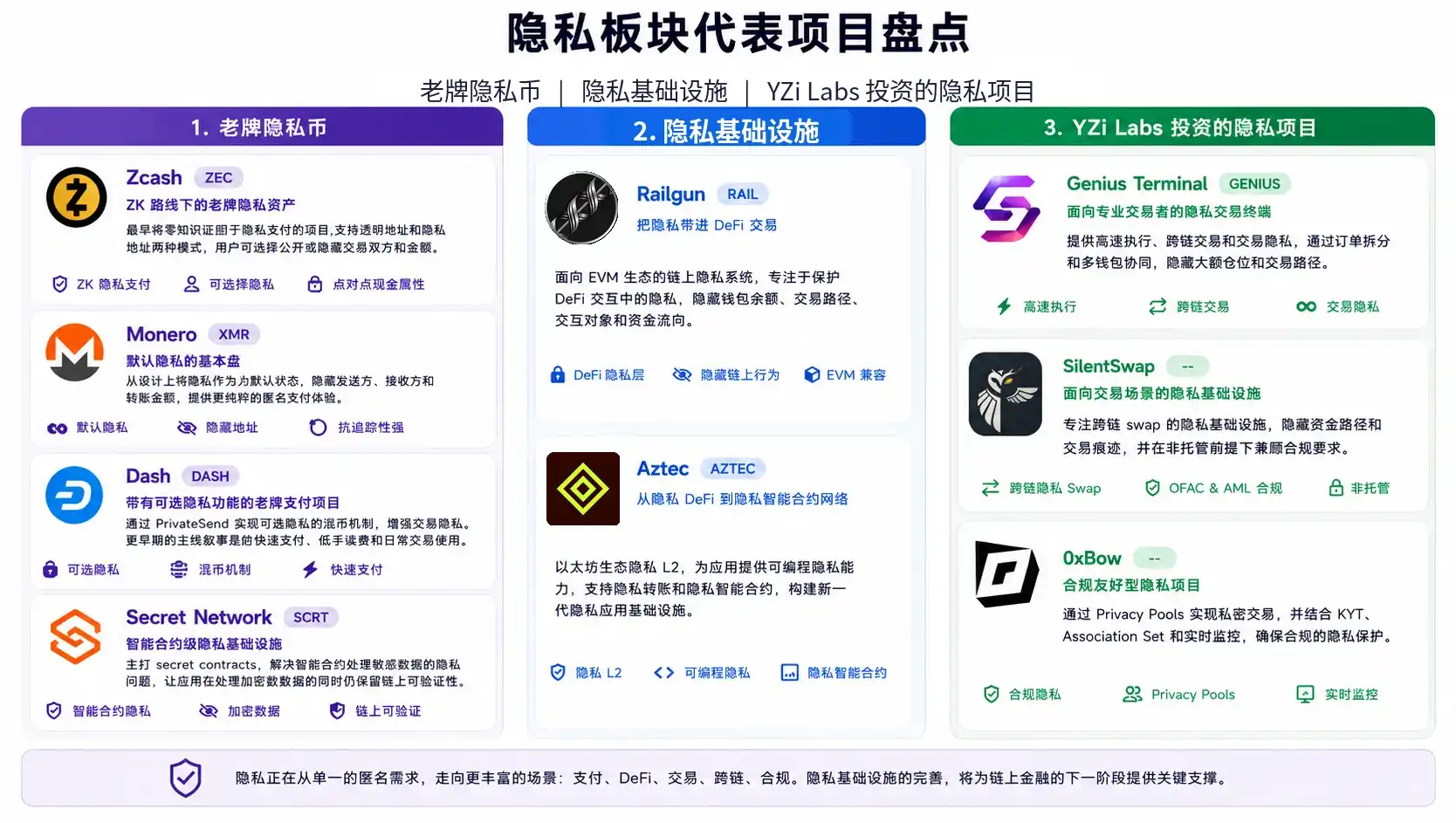
1. Legacy Privacy Coins: Asset and Payment Properties

Zcash (ZEC): Legacy Privacy Asset on the ZK Path

X: @zcash | XHunt Ranking: 13364

Zcash is a representative legacy privacy coin and one of the earliest crypto projects to use zero-knowledge proofs for private payments. Unlike regular public chains where all transactions are publicly viewable, Zcash supports both transparent and shielded (private) addresses.

Users can make public transfers like they would with Bitcoin, or they can hide the sender, receiver, and amount through shielded transactions.

Zcash's official definition is "encrypted electronic cash," emphasizing its properties for private peer-to-peer payments.

💰 Token Performance:

Naval Ravikant once stated on X: If Bitcoin is insurance against fiat currency risk, then Zcash is insurance against Bitcoin's transparency risk.

In terms of price performance, ZEC has been one of the most prominent primary assets in this cycle's privacy sector, rising from around $200 in March to $620.

Monero (XMR): The Default Privacy Baseline

X:@monero|XHunt Ranking: 4812

Monero is another highly representative project among legacy privacy coins, with its core positioning being default-private payments.

Unlike Zcash's optional privacy, Monero is designed with privacy as the default state from the ground up; transactions hide the sender, receiver, and amount.

Default privacy makes it more purist in the direction of anonymous payments, but it also subjects it to long-term higher regulatory pressure and exchange liquidity pressure.

💰 Token Performance:

However, judging from this cycle's market action, XMR's price performance hasn't been particularly outstanding. Although the broader market environment itself isn't strong, compared to ZEC, XMR clearly lacks elasticity.

Dash (DASH): Legacy Payment Project with Optional Privacy Features

X:@Dashpay|XHunt Ranking: 11376

Dash is an early entrant into the market, a legacy crypto project focused on payments. Dash's privacy features are optional, primarily implemented through PrivateSend.

The core idea of PrivateSend is to enhance transaction privacy through a coin mixing mechanism, allowing users to hide fund sources and transaction paths when needed. However, in terms of positioning, Dash is not a pure privacy coin; its earlier main narratives were actually fast payments, low fees, and everyday transactional use.

💰 Token Performance:

From this cycle's action, DASH has seen periodic rebounds, but its overall performance is not as prominent as ZEC's. Its current price is around 43 USDT. While it still carries the labels of a legacy payment project and optional privacy, the market's pricing of it seems more driven by sector rotation rather than a re-pricing of a primary privacy asset.

Secret Network (SCRT): Smart Contract-Level Privacy Infrastructure

X:@SecretNetwork|XHunt Ranking: 3677

Secret Network is an early public chain project focused on smart contract-level privacy, with its core feature being secret contracts. Unlike traditional privacy coins that focus on transfer privacy, it aims to solve data privacy problems at the application layer: Can smart contracts process sensitive data during execution without exposing everything on the public chain?

Secret Network's advantage lies in bringing privacy capabilities to the application layer. For applications like DeFi, NFTs, gaming, identity, and data markets, many scenarios are not suitable for completely public user data. The significance of secret contracts is enabling applications to process encrypted data while retaining on-chain verifiability.

💰 Token Performance:

In terms of price performance, SCRT hasn't clearly benefited from this round of privacy narrative resurgence. Its current price is around $0.08, still in a long-term low range.

2. New-Generation Privacy Infrastructure: Empowering the Application Layer

Railgun (RAIL): Bringing Privacy into DeFi Trading

X:@RAILGUN_Project|XHunt Ranking: 4099

Railgun is an on-chain privacy system for the EVM ecosystem, primarily serving DeFi scenarios. It doesn't aim to create a new privacy payment asset; rather, it hopes to bring privacy features into DeFi trading.

On public chains, users' wallet balances, transaction paths, counterparties, and fund flows can all be traced.

  • For ordinary users, this means asset exposure.

  • For traders, it means strategies could be copied or even targeted.

This is the problem Railgun aims to solve: allowing users to hide their on-chain behavior while participating in DeFi.

It's worth noting that Vitalik recently discussed the underlying problems faced by privacy protocols when talking about the Ethereum Foundation's future direction. He believes that protocols like smart contract wallets and Railgun still need intermediaries to submit transactions to the chain, which itself is a vulnerability.

💰 Token Performance:

RAIL has also clearly benefited from the recent warming of the privacy sector. The RAIL token's market cap has risen from 60M in April to 240M currently.

Compared to high-market-cap primary assets like ZEC, RAIL resembles more of a high-beta play within the privacy sector—easier to rally quickly when the narrative heats up, but with more pronounced liquidity and volatility.

Aztec (AZTEC): From Private DeFi to Private Smart Contract Network

X:@aztecnetwork|XHunt Ranking: 760

Aztec is a privacy L2 in the Ethereum ecosystem, positioned to provide programmable privacy for applications.

It's not a new project. Aztec initially launched zk.money and Aztec Connect, providing Ethereum users with private transfers and private DeFi entry points. However, in 2023, the team chose to shut down Aztec Connect and shift focus to a new private smart contract network.

In late 2025, AZTEC held a public token sale using a Continuous Clearing Auction mechanism, with the public sale price around $0.047.

💰 Token Performance:

From its secondary market performance, AZTEC's overall performance since listing hasn't been particularly strong. Its current price is around $0.025, still below the public sale cost. However, with the resurgence of the privacy sector, AZTEC has also seen a noticeable rebound recently.

3. YZi Labs' Investment Portfolio: Focusing on the Balance Between Transaction Privacy and Compliance

Genius Terminal (GENIUS): Privacy Trading Terminal for Professional Traders

X:@GeniusTerminal|XHunt Ranking: 7845

Genius Terminal is an on-chain trading terminal for professional DeFi users, emphasizing high-speed execution, cross-chain trading, and transaction privacy.

Genius can help users hide large positions and trading paths through order splitting and multi-wallet coordination. Users can complete cross-chain trades within one terminal without frequently switching wallets, bridges, and DEXs.

In January 2026, YZi Labs announced an investment in Genius, calling it a "private high-velocity on-chain trading terminal."

YZi Labs mentioned that Genius's goal is to provide an experience close to that of centralized exchanges in terms of speed, liquidity, and privacy, without sacrificing user ownership and decentralization.

💰 Token Performance:

In terms of secondary market performance, GENIUS has shown obvious short-term elasticity recently. Its current price is around $0.73.

SilentSwap: Privacy Infrastructure for Trading Scenarios

X:@SilentSwap|XHunt Ranking: 78144

SilentSwap is a privacy infrastructure for cross-chain trading scenarios, focusing on private cross-chain swaps. It aims to allow users to hide their fund paths and transaction traces when performing cross-chain swaps, transfers, and bridging assets.

On public chains, cross-chain transactions often expose a lot of information: which chain a user came from, what assets were swapped, the final destination of funds, and whether different addresses are associated. SilentSwap aims to solve this type of privacy leakage in cross-chain transactions.

Another feature of SilentSwap is that it doesn't just emphasize privacy; it also puts compliance among its product selling points. Its website explicitly lists "OFAC & AML Compliant" and states that it holds two legal opinions in the US. This sets it apart from traditional privacy projects that "only emphasize anonymity": it attempts to find a balance between non-custodial, cross-chain privacy, and compliance.

0xBow: Compliance-Friendly Privacy Project

X:@0xbowio|XHunt Ranking: 9376

0xBow is an infrastructure project for on-chain privacy and compliance scenarios, with its core direction being compliant onchain privacy.

Unlike traditional privacy projects emphasizing "untraceability," 0xBow is more concerned with: Can users prove their funds are not mixed with illicit activities while protecting their transaction privacy?

Its core product is Privacy Pools. Privacy Pools support peer-to-peer private transactions while avoiding users' funds mixing with illegal funds. 0xBow monitors deposits entering Privacy Pools and filters them through a Know Your Transaction mechanism. Only funds meeting the criteria enter the Association Set.

Behind this lies 0xBow's Association Set Provider (ASP). ASPs continuously monitor transactions within Privacy Pools, identify suspicious patterns, and support Proof of Association, real-time transaction monitoring, programmable compliance, and modular deployment.

In other words, 0xBow isn't simply creating an anonymous pool; it attempts to make private transactions operate within a compliance framework.

III. Industry Consensus: Privacy is No Longer an "Isolated Narrative"

Aster: Perp DEXs Also Begin Introducing Transaction Privacy

Aster itself is a Perp DEX, but its Shield Mode has already integrated privacy into the derivatives trading experience.

This indicates that privacy needs no longer exist only in transfer scenarios. For on-chain traders, what is truly sensitive is often trade direction, position size, transaction paths, and fund intentions.

Especially in Perp DEXs, if large trades and position changes are exposed in a public environment, they are prone to being copied, targeted, or even front-run.

Therefore, Aster's Shield Mode is essentially not a traditional privacy coin feature; it embeds transaction privacy into the Perp DEX product itself. It reflects a more specific trend: If on-chain derivatives want to continue attracting more professional trading demand, they may need to address not just liquidity and fees but also the issue of exposed trading intent.

Vitalik: Ethereum Also Needs Native Privacy

It's not just the application layer that is starting to value privacy; the Ethereum core roadmap is also beginning to revisit this issue.

Recently, Vitalik also mentioned Ethereum's lack of native privacy capabilities and proposed a set of short-term privacy improvement directions, including Account Abstraction, FOCIL, keyed nonces, and access-layer privacy work like Kohaku. These correspond to censorship resistance, transaction unlinkability, and privacy protection in wallets and chain-reading processes, respectively.

This shows that privacy is no longer just an add-on feature for external applications; it is also being discussed within wallet designs, transaction structures, access layers, and protocol design.

EIP-8182: Ethereum Also Discusses Native Private Transfers

EIP-8182 proposes introducing a standardized private transfer system for Ethereum. Through a shared shielded pool, system contracts, and ZK verification precompiles, it aims to give ETH and ERC-20 transfers native privacy capabilities.

Simply put, it asks: Can private transfers no longer rely on fragmented third-party applications but instead become shared infrastructure at the Ethereum protocol layer?

In the past, privacy on Ethereum was often fragmented. Different protocols had different privacy pools, different entry points, and different anonymity sets, resulting in a non-uniform user experience and diluted privacy effects.

EIP-8182 attempts to push this issue toward the protocol layer: If ETH and ERC-20s can share a common private transfer infrastructure, wallets, applications, and users can all more easily access privacy capabilities.

This also illustrates that privacy is no longer just the narrative of a few specific privacy projects. Whether it's Aster embedding privacy into its Perp DEX or EIP-8182 pushing private transfers toward the Ethereum protocol layer, they essentially point to the same thing:

The more mature the on-chain world becomes, the less privacy resembles a niche feature and the more it resembles part of the next stage of infrastructure.

IV. Conclusion: Finding the Balance Between Transparency and Protection

The privacy sector's return to the market spotlight this cycle appears, on the surface, to be a sector rotation play. However, if we only interpret it as "privacy coins are hot again," we might underestimate the significance of this change. What has truly changed is that the market is beginning to re-examine the boundaries of on-chain transparency.

In the past, the crypto industry often equated transparency with trust, believing that as long as all information is public, the system is more trustworthy. But transparency does not mean all financial behavior should be exposed without reservation. Users' asset balances, transaction paths, position changes, liquidation prices, and strategic intentions are essentially sensitive information. When this information is completely public, transparency can transform from a trust mechanism into a new source of risk.

Therefore, privacy is not the opposite of transparency; it is answering a more practical question: For on-chain finance to continue expanding, what information should be public, and what information should be protected? What will truly matter in the future may not be who can achieve the most complete anonymity, but who can find the balance between transparency, privacy, compliance, and usability.

When on-chain finance was still in the small-scale experimental stage, complete transparency might have sufficed. But if it is to carry larger funds, more complex trades, and more professional participants, privacy ceases to be merely a niche demand and becomes part of the infrastructure for the next stage.


Preguntas relacionadas

QWhat is the main reason behind the renewed interest in the privacy sector, beyond the rise in ZEC's price?

AThe deeper reason is market concern over whether a fully transparent on-chain environment can continue to support larger-scale, more professional on-chain financial activities. Users need transparency for trust but also need privacy to protect assets, strategies, and trading safety from risks like front-running and targeted attacks.

QAccording to the article, how is the modern privacy sector categorized?

AThe modern privacy sector is categorized into three main groups: 1) Legacy privacy assets like ZEC and XMR, focusing on private payments. 2) Next-generation privacy infrastructure like Railgun and Aztec, focusing on application-layer privacy (e.g., for DeFi). 3) Projects focusing on a balance between transaction privacy and compliance, like Genius, SilentSwap, and 0xBow, which are associated with YZi Labs' investments.

QWhat is the key difference between Zcash (ZEC) and Monero (XMR) regarding privacy?

AZcash offers optional privacy, allowing users to choose between transparent (public) addresses and shielded (private) addresses for transactions. Monero, in contrast, has privacy as its default state, where all transactions automatically hide the sender, receiver, and transaction amount by design.

QWhat point did Vitalik Buterin make about the current state of privacy protocols on Ethereum?

AVitalik pointed out that current privacy protocols, like those using smart contract wallets or Railgun, still have a vulnerability: they require an intermediary to submit transactions to the chain. He also discussed Ethereum's need for native privacy improvements, mentioning directions like Account Abstraction, FOCIL, and keyed nonces to address censorship resistance and transaction unlinkability.

QWhat is the core idea behind EIP-8182 for Ethereum?

AEIP-8182 proposes introducing a standardized private transfer system at the protocol level for Ethereum. It aims to enable native privacy for ETH and ERC-20 transfers by creating shared infrastructure like a shielded pool, system contracts, and ZK verification precompiles, moving away from fragmented, application-specific privacy solutions.

Lecturas Relacionadas

Retail Investors' 'Lead Brother' Serenity vs. Newly Minted Stock God Leopold: How Are the Two Top Hunters Mining AI's 'Physical Limits'?

The article profiles two prominent figures, Serenity and Leopold Aschenbrenner, who are gaining attention for their unconventional investment strategies focused on the physical constraints of the AI boom, moving beyond mainstream software narratives. Serenity, an anonymous online trader, advocates a "shiso leaf" theory. He targets small-cap companies with monopolies on critical, overlooked components in the AI hardware supply chain, such as specific semiconductor materials. His deep, technical analysis of bottlenecks in areas like co-packaged optics (CPO) has reportedly yielded massive returns, though his anonymity and focus on illiquid micro-cap stocks pose significant risks for followers. Leopold Aschenbrenner, a former OpenAI researcher, founded a multi-billion dollar hedge fund. His macro thesis argues that physical infrastructure—power grids, land, data centers—is the true bottleneck for AI growth, lagging far behind chip production. Consequently, his fund employs an infrastructure arbitrage strategy: heavily investing in storage and compute infrastructure companies while placing massive bearish bets (put options) against major semiconductor stocks, betting their valuations will correct as physical constraints become apparent. While their methods differ—Serenity drills into microscopic supply chain details, while Leopold takes a macroscopic, infrastructure-focused view—both share a core belief: the real power and investment alpha in the AI era lie in controlling scarce physical resources, not just software. The article concludes by noting the inherent risks in both approaches, such as liquidity issues for micro-caps and timing risks for macro bets, but suggests they signal a broader market re-evaluation of AI's foundational assets.

marsbitHace 2 hora(s)

Retail Investors' 'Lead Brother' Serenity vs. Newly Minted Stock God Leopold: How Are the Two Top Hunters Mining AI's 'Physical Limits'?

marsbitHace 2 hora(s)

Who Will Make Money in the Age of Agents?

In the Agents era of blockchain, traditional value capture theories face challenges. The "Fat Protocol" theory, dominant since 2016, suggested protocols capture most value as their tokens are essential for network use. However, the proliferation of interchangeable L1s, L2s, and modular layers has eroded protocol scarcity and pricing power. Conversely, the "Fat App" theory posits that applications capturing user relationships (like wallets and exchanges) become the primary value layer by controlling distribution and transaction flows. This aligns with the current "Great Repricing" cycle. Agents disrupt this logic. As software users, they lack brand loyalty, prioritize cost and efficiency, and switch between platforms seamlessly. This undermines the front-end UX moats that "Fat Apps" rely on. The article explores several potential futures: 1. **Headless Applications:** Current leading apps could strip their front-ends and become backend API infrastructure for Agents, preserving their role. 2. **Protocol Resurgence:** If integration becomes trivial, Agents might bypass aggregators and interact directly with protocols, reviving "Fat Protocol" dynamics. 3. **Pricing Power Collapse:** Agents' rational, frictionless routing could commoditize the entire stack, compressing margins toward cost and leaving little profit for intermediaries. 4. **Unprecedented Activity:** Agents may enable new, high-frequency, machine-to-machine economic activities, expanding the total value pie even if margins are thin. 5. **A New, Unnamed Model:** Historically, major tech shifts (like the internet's attention economy) create unforeseen business models. The Agents era may spawn entirely new ways to capture value. The most likely outcome is a coexistence where "Fat Apps" continue to serve human users valuing UX, while a separate, Agent-driven economy emerges governed by different rules—where loyalty is based on factors like liquidity, latency, and settlement guarantees rather than brand.

marsbitHace 3 hora(s)

Who Will Make Money in the Age of Agents?

marsbitHace 3 hora(s)

Trading

Spot
Futuros

Artículos destacados

Qué es $S$

Entendiendo SPERO: Una Visión General Completa Introducción a SPERO A medida que el panorama de la innovación continúa evolucionando, la aparición de tecnologías web3 y proyectos de criptomonedas juega un papel fundamental en la configuración del futuro digital. Un proyecto que ha atraído la atención en este campo dinámico es SPERO, denotado como SPERO,$$s$. Este artículo tiene como objetivo reunir y presentar información detallada sobre SPERO, para ayudar a entusiastas e inversores a comprender sus fundamentos, objetivos e innovaciones dentro de los dominios web3 y cripto. ¿Qué es SPERO,$$s$? SPERO,$$s$ es un proyecto único dentro del espacio cripto que busca aprovechar los principios de descentralización y tecnología blockchain para crear un ecosistema que promueva la participación, la utilidad y la inclusión financiera. El proyecto está diseñado para facilitar interacciones de igual a igual de nuevas maneras, proporcionando a los usuarios soluciones y servicios financieros innovadores. En su esencia, SPERO,$$s$ tiene como objetivo empoderar a los individuos al proporcionar herramientas y plataformas que mejoren la experiencia del usuario en el espacio de las criptomonedas. Esto incluye habilitar métodos de transacción más flexibles, fomentar iniciativas impulsadas por la comunidad y crear caminos para oportunidades financieras a través de aplicaciones descentralizadas (dApps). La visión subyacente de SPERO,$$s$ gira en torno a la inclusividad, buscando cerrar brechas dentro de las finanzas tradicionales mientras aprovecha los beneficios de la tecnología blockchain. ¿Quién es el Creador de SPERO,$$s$? La identidad del creador de SPERO,$$s$ sigue siendo algo oscura, ya que hay recursos públicos limitados que proporcionan información de fondo detallada sobre su(s) fundador(es). Esta falta de transparencia puede derivarse del compromiso del proyecto con la descentralización, una ética que muchos proyectos web3 comparten, priorizando las contribuciones colectivas sobre el reconocimiento individual. Al centrar las discusiones en torno a la comunidad y sus objetivos colectivos, SPERO,$$s$ encarna la esencia del empoderamiento sin señalar a individuos específicos. Como tal, comprender la ética y la misión de SPERO sigue siendo más importante que identificar a un creador singular. ¿Quiénes son los Inversores de SPERO,$$s$? SPERO,$$s$ cuenta con el apoyo de una diversa gama de inversores que van desde capitalistas de riesgo hasta inversores ángeles dedicados a fomentar la innovación en el sector cripto. El enfoque de estos inversores generalmente se alinea con la misión de SPERO, priorizando proyectos que prometen avances tecnológicos sociales, inclusión financiera y gobernanza descentralizada. Estas fundaciones de inversores suelen estar interesadas en proyectos que no solo ofrecen productos innovadores, sino que también contribuyen positivamente a la comunidad blockchain y sus ecosistemas. El respaldo de estos inversores refuerza a SPERO,$$s$ como un contendiente notable en el dominio de proyectos cripto que evoluciona rápidamente. ¿Cómo Funciona SPERO,$$s$? SPERO,$$s$ emplea un marco multifacético que lo distingue de los proyectos de criptomonedas convencionales. Aquí hay algunas de las características clave que subrayan su singularidad e innovación: Gobernanza Descentralizada: SPERO,$$s$ integra modelos de gobernanza descentralizada, empoderando a los usuarios para participar activamente en los procesos de toma de decisiones sobre el futuro del proyecto. Este enfoque fomenta un sentido de propiedad y responsabilidad entre los miembros de la comunidad. Utilidad del Token: SPERO,$$s$ utiliza su propio token de criptomoneda, diseñado para servir diversas funciones dentro del ecosistema. Estos tokens permiten transacciones, recompensas y la facilitación de servicios ofrecidos en la plataforma, mejorando la participación y la utilidad general. Arquitectura en Capas: La arquitectura técnica de SPERO,$$s$ apoya la modularidad y escalabilidad, permitiendo la integración fluida de características y aplicaciones adicionales a medida que el proyecto evoluciona. Esta adaptabilidad es fundamental para mantener la relevancia en el cambiante paisaje cripto. Participación de la Comunidad: El proyecto enfatiza iniciativas impulsadas por la comunidad, empleando mecanismos que incentivan la colaboración y la retroalimentación. Al nutrir una comunidad sólida, SPERO,$$s$ puede abordar mejor las necesidades de los usuarios y adaptarse a las tendencias del mercado. Enfoque en la Inclusión: Al ofrecer tarifas de transacción bajas e interfaces amigables para el usuario, SPERO,$$s$ busca atraer a una base de usuarios diversa, incluyendo a individuos que anteriormente pueden no haber participado en el espacio cripto. Este compromiso con la inclusión se alinea con su misión general de empoderamiento a través de la accesibilidad. Cronología de SPERO,$$s$ Entender la historia de un proyecto proporciona información crucial sobre su trayectoria de desarrollo y hitos. A continuación se presenta una cronología sugerida que mapea eventos significativos en la evolución de SPERO,$$s$: Fase de Conceptualización e Ideación: Las ideas iniciales que forman la base de SPERO,$$s$ fueron concebidas, alineándose estrechamente con los principios de descentralización y enfoque comunitario dentro de la industria blockchain. Lanzamiento del Whitepaper del Proyecto: Tras la fase conceptual, se lanzó un whitepaper completo que detalla la visión, los objetivos y la infraestructura tecnológica de SPERO,$$s$ para generar interés y retroalimentación de la comunidad. Construcción de Comunidad y Primeras Interacciones: Se realizaron esfuerzos de divulgación activa para construir una comunidad de primeros adoptantes y posibles inversores, facilitando discusiones en torno a los objetivos del proyecto y obteniendo apoyo. Evento de Generación de Tokens: SPERO,$$s$ llevó a cabo un evento de generación de tokens (TGE) para distribuir sus tokens nativos a los primeros seguidores y establecer liquidez inicial dentro del ecosistema. Lanzamiento de la dApp Inicial: La primera aplicación descentralizada (dApp) asociada con SPERO,$$s$ se puso en marcha, permitiendo a los usuarios interactuar con las funcionalidades centrales de la plataforma. Desarrollo Continuo y Alianzas: Actualizaciones y mejoras continuas a las ofertas del proyecto, incluyendo alianzas estratégicas con otros actores en el espacio blockchain, han moldeado a SPERO,$$s$ en un jugador competitivo y en evolución en el mercado cripto. Conclusión SPERO,$$s$ se erige como un testimonio del potencial de web3 y las criptomonedas para revolucionar los sistemas financieros y empoderar a los individuos. Con un compromiso con la gobernanza descentralizada, la participación comunitaria y funcionalidades diseñadas de manera innovadora, allana el camino hacia un paisaje financiero más inclusivo. Como con cualquier inversión en el espacio cripto que evoluciona rápidamente, se anima a los posibles inversores y usuarios a investigar a fondo y participar de manera reflexiva con los desarrollos en curso dentro de SPERO,$$s$. El proyecto muestra el espíritu innovador de la industria cripto, invitando a una mayor exploración de sus innumerables posibilidades. Mientras el viaje de SPERO,$$s$ aún se desarrolla, sus principios fundamentales pueden, de hecho, influir en el futuro de cómo interactuamos con la tecnología, las finanzas y entre nosotros en ecosistemas digitales interconectados.

72 Vistas totalesPublicado en 2024.12.17Actualizado en 2024.12.17

Qué es $S$

Qué es AGENT S

Agent S: El Futuro de la Interacción Autónoma en Web3 Introducción En el paisaje en constante evolución de Web3 y las criptomonedas, las innovaciones están redefiniendo constantemente cómo los individuos interactúan con las plataformas digitales. Uno de estos proyectos pioneros, Agent S, promete revolucionar la interacción humano-computadora a través de su marco agente abierto. Al allanar el camino para interacciones autónomas, Agent S busca simplificar tareas complejas, ofreciendo aplicaciones transformadoras en inteligencia artificial (IA). Esta exploración detallada profundizará en las complejidades del proyecto, sus características únicas y las implicaciones para el dominio de las criptomonedas. ¿Qué es Agent S? Agent S se presenta como un marco agente abierto innovador, diseñado específicamente para abordar tres desafíos fundamentales en la automatización de tareas informáticas: Adquisición de Conocimiento Específico del Dominio: El marco aprende inteligentemente de diversas fuentes de conocimiento externas y experiencias internas. Este enfoque dual le permite construir un rico repositorio de conocimiento específico del dominio, mejorando su rendimiento en la ejecución de tareas. Planificación a Largo Plazo de Tareas: Agent S emplea planificación jerárquica aumentada por la experiencia, un enfoque estratégico que facilita la descomposición y ejecución eficiente de tareas complejas. Esta característica mejora significativamente su capacidad para gestionar múltiples subtareas de manera eficiente y efectiva. Manejo de Interfaces Dinámicas y No Uniformes: El proyecto introduce la Interfaz Agente-Computadora (ACI), una solución innovadora que mejora la interacción entre agentes y usuarios. Utilizando Modelos de Lenguaje Multimodal de Gran Escala (MLLMs), Agent S puede navegar y manipular diversas interfaces gráficas de usuario sin problemas. A través de estas características pioneras, Agent S proporciona un marco robusto que aborda las complejidades involucradas en la automatización de la interacción humana con las máquinas, preparando el terreno para una multitud de aplicaciones en IA y más allá. ¿Quién es el Creador de Agent S? Si bien el concepto de Agent S es fundamentalmente innovador, la información específica sobre su creador sigue siendo elusiva. El creador es actualmente desconocido, lo que resalta ya sea la etapa incipiente del proyecto o la elección estratégica de mantener a los miembros fundadores en el anonimato. Independientemente de la anonimidad, el enfoque sigue siendo en las capacidades y el potencial del marco. ¿Quiénes son los Inversores de Agent S? Dado que Agent S es relativamente nuevo en el ecosistema criptográfico, la información detallada sobre sus inversores y patrocinadores financieros no está documentada explícitamente. La falta de información disponible públicamente sobre las bases de inversión u organizaciones que apoyan el proyecto plantea preguntas sobre su estructura de financiamiento y hoja de ruta de desarrollo. Comprender el respaldo es crucial para evaluar la sostenibilidad del proyecto y su posible impacto en el mercado. ¿Cómo Funciona Agent S? En el núcleo de Agent S se encuentra una tecnología de vanguardia que le permite funcionar de manera efectiva en diversos entornos. Su modelo operativo se basa en varias características clave: Interacción Humano-Computadora Similar a la Humana: El marco ofrece planificación avanzada de IA, esforzándose por hacer que las interacciones con las computadoras sean más intuitivas. Al imitar el comportamiento humano en la ejecución de tareas, promete elevar las experiencias de los usuarios. Memoria Narrativa: Empleada para aprovechar experiencias de alto nivel, Agent S utiliza memoria narrativa para hacer un seguimiento de las historias de tareas, mejorando así sus procesos de toma de decisiones. Memoria Episódica: Esta característica proporciona a los usuarios una guía paso a paso, permitiendo que el marco ofrezca apoyo contextual a medida que se desarrollan las tareas. Soporte para OpenACI: Con la capacidad de ejecutarse localmente, Agent S permite a los usuarios mantener el control sobre sus interacciones y flujos de trabajo, alineándose con la ética descentralizada de Web3. Fácil Integración con APIs Externas: Su versatilidad y compatibilidad con varias plataformas de IA aseguran que Agent S pueda encajar sin problemas en ecosistemas tecnológicos existentes, convirtiéndolo en una opción atractiva para desarrolladores y organizaciones. Estas funcionalidades contribuyen colectivamente a la posición única de Agent S dentro del espacio cripto, ya que automatiza tareas complejas y de múltiples pasos con una intervención humana mínima. A medida que el proyecto evoluciona, sus posibles aplicaciones en Web3 podrían redefinir cómo se desarrollan las interacciones digitales. Cronología de Agent S El desarrollo y los hitos de Agent S pueden encapsularse en una cronología que resalta sus eventos significativos: 27 de septiembre de 2024: El concepto de Agent S fue lanzado en un documento de investigación integral titulado “Un Marco Agente Abierto que Usa Computadoras Como un Humano”, mostrando las bases del proyecto. 10 de octubre de 2024: El documento de investigación fue puesto a disposición del público en arXiv, ofreciendo una exploración profunda del marco y su evaluación de rendimiento basada en el benchmark OSWorld. 12 de octubre de 2024: Se lanzó una presentación en video, proporcionando una visión visual de las capacidades y características de Agent S, involucrando aún más a posibles usuarios e inversores. Estos marcadores en la cronología no solo ilustran el progreso de Agent S, sino que también indican su compromiso con la transparencia y la participación comunitaria. Puntos Clave Sobre Agent S A medida que el marco Agent S continúa evolucionando, varios atributos clave destacan, subrayando su naturaleza innovadora y potencial: Marco Innovador: Diseñado para proporcionar un uso intuitivo de las computadoras similar a la interacción humana, Agent S aporta un enfoque novedoso a la automatización de tareas. Interacción Autónoma: La capacidad de interactuar de manera autónoma con las computadoras a través de GUI significa un salto hacia soluciones informáticas más inteligentes y eficientes. Automatización de Tareas Complejas: Con su metodología robusta, puede automatizar tareas complejas y de múltiples pasos, haciendo que los procesos sean más rápidos y menos propensos a errores. Mejora Continua: Los mecanismos de aprendizaje permiten a Agent S mejorar a partir de experiencias pasadas, mejorando continuamente su rendimiento y eficacia. Versatilidad: Su adaptabilidad en diferentes entornos operativos como OSWorld y WindowsAgentArena asegura que pueda servir a una amplia gama de aplicaciones. A medida que Agent S se posiciona en el paisaje de Web3 y criptomonedas, su potencial para mejorar las capacidades de interacción y automatizar procesos significa un avance significativo en las tecnologías de IA. A través de su marco innovador, Agent S ejemplifica el futuro de las interacciones digitales, prometiendo una experiencia más fluida y eficiente para los usuarios en diversas industrias. Conclusión Agent S representa un audaz avance en la unión de la IA y Web3, con la capacidad de redefinir cómo interactuamos con la tecnología. Aunque aún se encuentra en sus primeras etapas, las posibilidades para su aplicación son vastas y atractivas. A través de su marco integral que aborda desafíos críticos, Agent S busca llevar las interacciones autónomas al primer plano de la experiencia digital. A medida que nos adentramos más en los reinos de las criptomonedas y la descentralización, proyectos como Agent S sin duda desempeñarán un papel crucial en la configuración del futuro de la tecnología y la colaboración humano-computadora.

458 Vistas totalesPublicado en 2025.01.14Actualizado en 2025.01.14

Qué es AGENT S

Cómo comprar S

¡Bienvenido a HTX.com! Hemos hecho que comprar Sonic (S) sea simple y conveniente. Sigue nuestra guía paso a paso para iniciar tu viaje de criptos.Paso 1: crea tu cuenta HTXUtiliza tu correo electrónico o número de teléfono para registrarte y obtener una cuenta gratuita en HTX. Experimenta un proceso de registro sin complicaciones y desbloquea todas las funciones.Obtener mi cuentaPaso 2: ve a Comprar cripto y elige tu método de pagoTarjeta de crédito/débito: usa tu Visa o Mastercard para comprar Sonic (S) al instante.Saldo: utiliza fondos del saldo de tu cuenta HTX para tradear sin problemas.Terceros: hemos agregado métodos de pago populares como Google Pay y Apple Pay para mejorar la comodidad.P2P: tradear directamente con otros usuarios en HTX.Over-the-Counter (OTC): ofrecemos servicios personalizados y tipos de cambio competitivos para los traders.Paso 3: guarda tu Sonic (S)Después de comprar tu Sonic (S), guárdalo en tu cuenta HTX. Alternativamente, puedes enviarlo a otro lugar mediante transferencia blockchain o utilizarlo para tradear otras criptomonedas.Paso 4: tradear Sonic (S)Tradear fácilmente con Sonic (S) en HTX's mercado spot. Simplemente accede a tu cuenta, selecciona tu par de trading, ejecuta tus trades y monitorea en tiempo real. Ofrecemos una experiencia fácil de usar tanto para principiantes como para traders experimentados.

873 Vistas totalesPublicado en 2025.01.15Actualizado en 2025.03.21

Cómo comprar S

Discusiones

Bienvenido a la comunidad de HTX. Aquí puedes mantenerte informado sobre los últimos desarrollos de la plataforma y acceder a análisis profesionales del mercado. A continuación se presentan las opiniones de los usuarios sobre el precio de S (S).

活动图片