Luxury Cars Become Targets, Families Used as Pawns: Crypto 'Wrench Attacks' Sweep Across Europe and America

marsbitPublicado a 2026-06-10Actualizado a 2026-06-10

Resumen

In a significant U.S. federal case, 22-year-old Saif Faiq of Missouri pleaded guilty to conspiracy to commit Hobbs Act robbery, related to an attempted Bitcoin theft and the kidnapping of two individuals in Danbury, Connecticut. Prosecutors state the 2024 plot targeted the parents of a person involved in a separate large-scale Bitcoin theft, intending to use them as hostages to coerce the transfer of crypto assets. Faiq's role involved recruiting accomplices and surveillance. This case, involving a Lamborghini Urus carjacking, exemplifies the growing threat of "wrench attacks"—physical violence and coercion to steal cryptocurrency—where a holder's family, vehicles, and visible wealth become targets. The guilty plea, alongside that of co-conspirator Adam Iza, marks the formal entry of such crypto-related violent crimes into the U.S. federal judiciary. It highlights that while blockchain technology itself is secure, the human endpoint is vulnerable. Attackers leverage personal connections and luxury items as indicators of crypto wealth to plan kidnappings and extortion. Though this case occurred in the U.S., Europe remains the epicenter for such attacks. CertiK's 2026 report notes 34 confirmed wrench attacks in the first four months of 2026, with 82% occurring in Europe, primarily France, causing an estimated $101 million in losses. The Danbury case serves as a stark warning for crypto holders globally: operational security must now extend beyond digital threats to include ph...

Author: Liam 'Akiba' Wright

Compiled by: Saoirse, Foresight News

Quick Summary Key Points

  • A Missouri man pleaded guilty in Hartford federal court to participating in a robbery conspiracy involving an attempted Bitcoin theft and a double kidnapping in Danbury, Connecticut.
  • Prosecutors state this case highlights that holding crypto assets can make an individual's family and vehicles potential targets for physical coercion.
  • Saif Faiq is scheduled for sentencing on August 28; this 'wrench attack' crime pattern is spreading from Europe and now appearing in US court cases.

Saif Faiq, a 22-year-old man from St. Louis, Missouri, pleaded guilty on June 8th in Hartford federal court to conspiracy to commit robbery affecting interstate commerce. Prosecutors allege the case originated from a plot in August 2024 to steal Bitcoin from a family connected to another Bitcoin theft case involving hundreds of millions of dollars.

The charge carries a statutory maximum penalty of 20 years in prison. Saif Faiq's sentencing hearing is set for August 28.

According to prosecutors, the two kidnapped victims were the parents of a person involved in the Bitcoin case. Saif Faiq's role involved recruiting accomplices, coordinating with Adam Iza, and conducting surveillance on the victims' home.

The Danbury case is further evidence of the escalating threat of physical violence linked to crypto wealth. Prosecutors connected key elements: targeting relatives, prolonged surveillance, luxury vehicles, and the criminals' logic of taking hostages to coerce the transfer of Bitcoin.

Previous CryptoSlate reports indicated a surge in cases in France where crypto holders' identities were leaked, leading to violence against their families. The court documents from this Danbury case demonstrate that this same security threat has now emerged within the US federal justice system.

US Court Documents: Real Physical Violence Cases Triggered by Crypto Assets

In September 2024, Danbury police responded to a reported Lamborghini Urus carjacking and kidnapping, leading to charges against six Florida residents. Authorities stated two victims were forced from their vehicle, bound, and placed in a van before police intervened and arrested the suspects.

A June 2026 US Department of Justice announcement stated that six other individuals involved in the carjacking and kidnapping had pleaded guilty.

Saif Faiq is not the only one to plead guilty. The DOJ identified his brother, Adam Iza, as a key organizer. Adam Iza pleaded guilty on June 1st to the same Hobbs Act robbery conspiracy charge related to the attempted Bitcoin robbery and Danbury kidnapping.

Prosecutors said Adam Iza used phones and encrypted messaging apps to communicate with multiple kidnappers, coordinated logistics, and funded the criminal operation.

This federal criminal case includes several classic violent crime charges: recruitment, funding, surveillance, carjacking, kidnapping, and robbery conspiracy. The crypto connection lies in the plan to hold family members hostage to physically coerce a Bitcoin holder into surrendering assets.

This guilty plea formally categorizes crimes involving physical coercion against crypto asset holders as part of US federal violent crime prosecutions.

For cryptocurrency holders, this case delivers a stark security warning: if criminals believe someone holds Bitcoin, their family, vehicles, residence, or any public signs of wealth can become targets.

All 'wrench attack' cases operate on this logic of coercion.

The presence of a Lamborghini in the case is not incidental—prosecutors' narrative shows the luxury car served as a visual wealth indicator, signaling to criminals that the target held significant Bitcoin worth robbing.

Thus, flashy luxury vehicles can serve as a security alarm, reminding holders to be vigilant about their exposed wealth, loved ones, and access to digital assets.
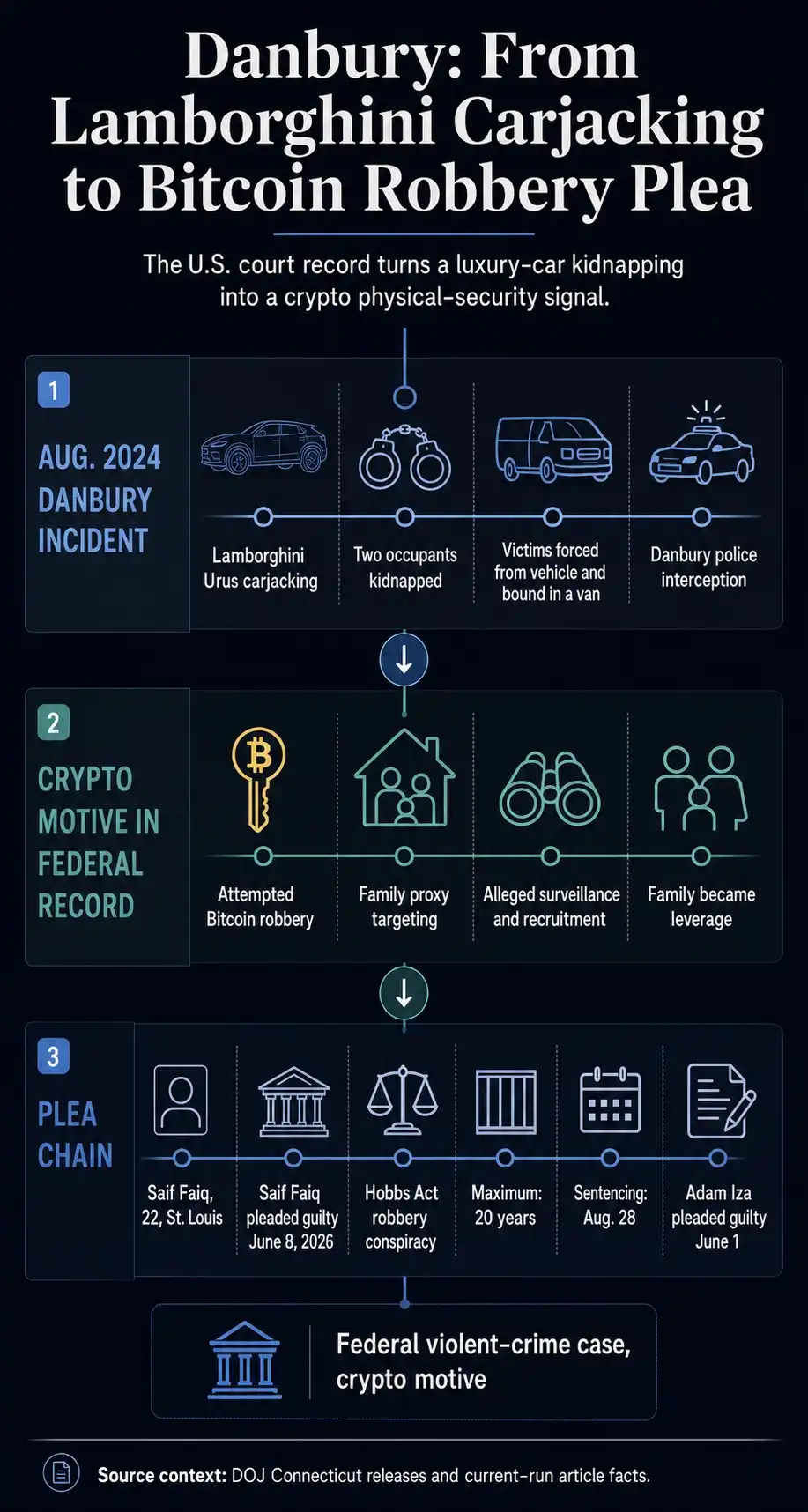
This infographic details a 2024 violent incident in Danbury, USA, involving a Lamborghini carjacking and kidnapping aimed at seizing Bitcoin, disclosing plot details and the 2026 guilty pleas and pending sentencing of two suspects.

The Attack Vector is Always the Human Element

In security research, a 'wrench attack' is defined as a crime involving physical violence or coercion to force a victim to reveal passwords, private keys, or access to digital assets.

CertiK's "2025 SkyNet Wrench Attack Report" categorizes such crimes as attacks on the 'human endpoint,' reporting 72 verified cases in 2025, a 75% year-on-year increase.

This is crucial for Bitcoin holders: the security of the blockchain protocol and the holder's personal safety are two separate systems. Even if the blockchain code is virtually unbreakable and Bitcoin cannot be stolen remotely, the individual controlling the assets is highly vulnerable to physical coercion.

Once criminals believe hardware wallets, seed phrases, exchange accounts, mobile devices, or a target's relatives can lead to transferable crypto assets, all become potential pressure points.

In the Danbury case, the pressure point was the victims' relatives. The US DOJ explicitly stated the two kidnapped parents were not involved in the Bitcoin theft.

They were targeted because their child was involved in the multi-hundred-million-dollar Bitcoin theft case. This also makes it a case of 'indirect target' hostage-taking for robbery.

Similar cases in France prove this is now a widespread personal safety hazard. A March report by this publication noted that victims of violent attacks in France are no longer limited to industry insiders or corporate executives; criminals are increasingly targeting ordinary individuals and private residences.

The Danbury case brings this established modus operandi into US court records. Conspicuous luxury cars are wealth markers, family is leverage, and the ultimate target asset is Bitcoin.

The criminals' core logic: find a person to physically coerce in order to access crypto assets.

The Danbury case clearly demonstrates that relatives can become indirect hostages in crypto-related crimes. The series of cases in France shows that as such attacks become recurrent, local public safety guidelines, travel and protection habits of industry executives, and self-protection methods for ordinary holders are all forced to adapt.

Europe Remains the Core Hotspot for Wrench Attack Cases

Apart from the Danbury guilty plea, overall case data shows Europe remains the concentrated epicenter for 'wrench attack' crimes.

CertiK's "2026 Wrench Attack Overview Report" states that 34 attack cases were verified from January to April 2026, with estimated total losses of approximately $101 million.

Of these 34 cases, 28 occurred in Europe, accounting for 82% of all recorded cases, with France having the highest number of incidents.

A May CryptoSlate special analysis on wrench attacks reached the same conclusion: the wave of offline violent extortion targeting crypto holders continues to accelerate, with the core region still being Europe, particularly France.
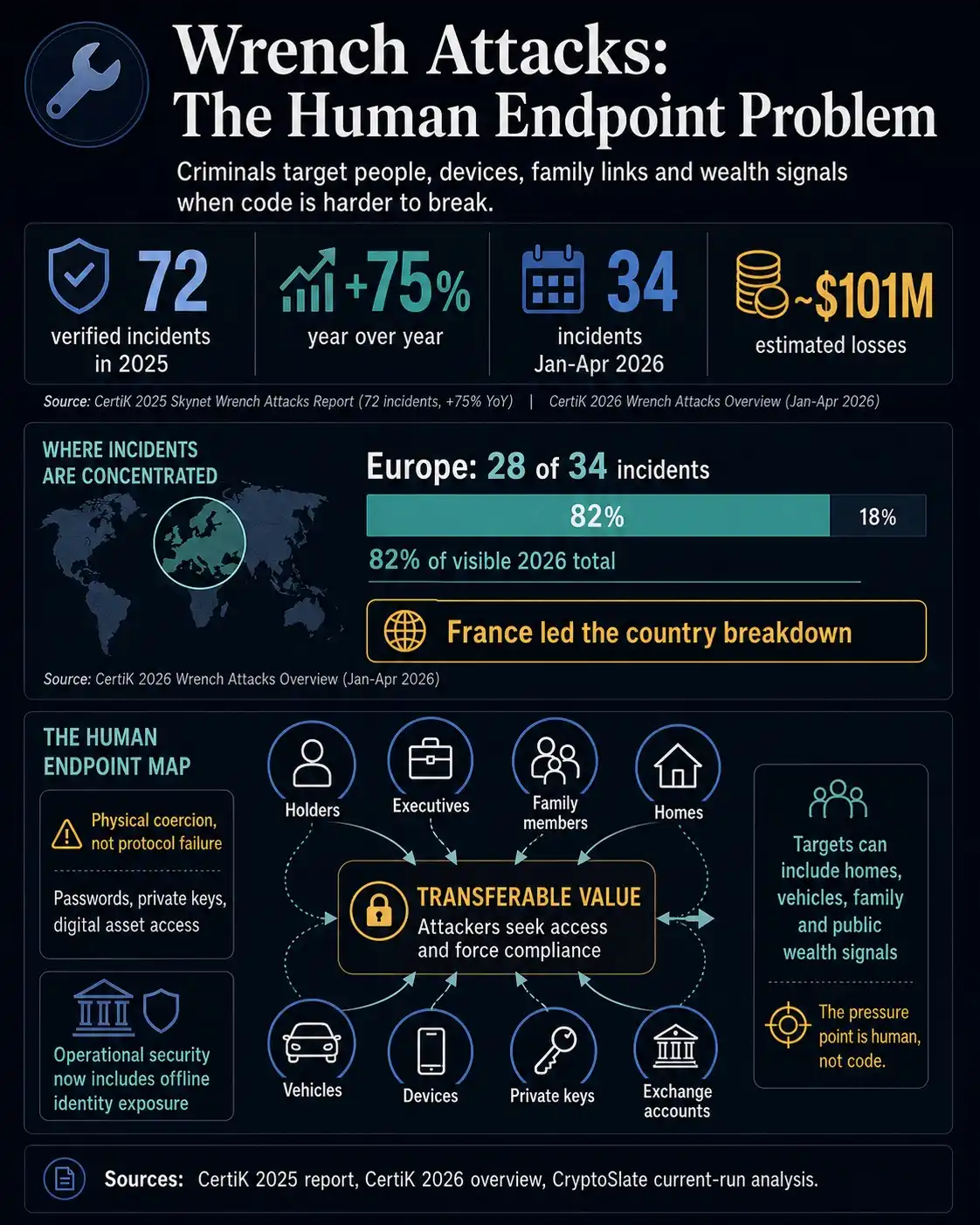
CertiK data shows that crypto 'wrench attacks' targeting holders, family, devices, and other physical endpoints confirmed 72 incidents in 2025, a 75% year-on-year increase. Of 34 cases in the first 4 months of 2026, 82% occurred in Europe, with estimated total losses of ~$101M. The core risk lies in the human/physical endpoint, not code vulnerabilities.

The Danbury case confirms that this attack model against crypto holders is now a judicial challenge for US prosecutors and federal courts.

Court records fully illustrate how the offline safety crisis sparked by crypto assets integrates into standard violent crime enforcement: gang recruitment, cross-regional operations, surveillance, hostage-taking of family, luxury car target identification, and hostage coercion for Bitcoin—the entire criminal chain is clearly documented.

For crypto asset holders and industry businesses, the scope of operational security has broadened significantly. Beyond online risks like phishing, wallet theft, exchange account breaches, and smart contract vulnerabilities, offline exposure risks related to identity, home addresses, electronic devices, and family must be seriously addressed.

The next key judicial signal will be the sentencing outcome. Saif Faiq's August 28th hearing will demonstrate how federal courts define and punish his culpability in this robbery conspiracy.

Long-term, all cases warranting close attention share a commonality: criminals identify crypto holders through offline clues like family, residences, vehicles, and public social profiles. It is precisely these cases that are transforming a safety crisis once concentrated in France into a societal issue that law enforcement across the US must confront—each court filing serves as a risk warning.


Criptos en tendencia

Preguntas relacionadas

QWhat is a 'wrench attack' in the context of cryptocurrency, as described in the article?

AA 'wrench attack' is a type of crime where physical violence or coercion is used to force a victim into surrendering passwords, private keys, or access to their digital assets.

QAccording to the article, what was the primary target of the assailants in the Danbury, Connecticut case?

AThe primary target was Bitcoin. The assailants planned to kidnap the parents of an individual involved in a separate Bitcoin theft case to coerce that individual into handing over the cryptocurrency.

QBased on the data from CertiK's reports cited in the article, which region is identified as the core hotspot for 'wrench attacks'?

AEurope, specifically France, is identified as the core hotspot for 'wrench attacks'. Data shows 82% of recorded attacks in early 2026 occurred in Europe.

QWhat role did the Lamborghini Urus play in the Danbury kidnapping case, according to the prosecutors?

AThe Lamborghini Urus served as a visible marker of wealth, signaling to the criminals that the target likely held significant Bitcoin and was worth targeting for robbery.

QWhat broader security lesson does the Danbury case highlight for cryptocurrency holders?

AIt highlights that while blockchain protocols themselves may be secure, the human holders are vulnerable. Physical security is crucial, as family members, luxury possessions, and public displays of wealth can make holders and their loved ones targets for violent coercion aimed at seizing crypto assets.

Lecturas Relacionadas

NVIDIA CPU Advances, China's RISC-V Responds: Semiconductor Deep Dive - Part Four

NVIDIA is set to launch its new Vera AI data center CPU in China as early as August, with high pricing. While this move offers a new option, it highlights China's continued dependence on foreign-controlled Arm architecture. In response, the Chinese semiconductor industry is increasingly turning to RISC-V as a strategic alternative for achieving high-performance computing autonomy. The article explores the concept of the "impossible triangle" in CPU development—balancing prosperity, control, and autonomy—and posits that RISC-V's open-source, modular nature offers a unique path to achieving all three. While RISC-V is already dominant in embedded systems, the focus is now shifting to data centers and AI workloads. China has become a global hotspot for RISC-V development, driven by AI-driven compute demand, supply chain concerns from export controls, cost benefits of open-source, and strong policy support. Multiple Chinese companies have reportedly crossed the key performance threshold of 15 SPECint per GHz, a benchmark for entering the high-performance CPU club. Progress extends beyond single-core benchmarks. Companies are developing complete computing subsystems, including commercial-grade coherent network-on-chip (NoC) technology and server processors with up to 40 cores that strictly adhere to the RVA23 standard to ensure software compatibility. Real-world applications are emerging in areas like video transcoding and edge AI. However, significant challenges remain. The RISC-V ecosystem faces fragmentation, immature toolchains and verification processes, and gaps in single-core performance and energy efficiency compared to mature x86 and Arm architectures. The formidable software moat, epitomized by NVIDIA's CUDA, is a long-term hurdle. In conclusion, while RISC-V cannot immediately replace offerings like NVIDIA's Vera, it represents a viable long-term path for China to develop a self-sufficient, high-performance CPU ecosystem. The journey is acknowledged to be long and arduous, requiring sustained effort to overcome technical and ecosystem challenges.

marsbitHace 26 min(s)

NVIDIA CPU Advances, China's RISC-V Responds: Semiconductor Deep Dive - Part Four

marsbitHace 26 min(s)

My Coding Betting Dashboard is Profiting, but Polymarket is Truly Not a Good Place for 'Arbitrage'

The author built a custom monitoring dashboard for Polymarket, a prediction market platform, and tested it with $1,600, achieving over 30% returns. However, the core argument is that Polymarket is not a good venue for traditional arbitrage. The dashboard has two main sections: a "Portfolio Dashboard" for tracking active positions with key metrics like total capital, P&L, and a risk-control module using a tier system (T1, T2, T3), and an "Opportunity Watchlist" for monitoring markets. The article details a critical structural trap in binary markets: a bet with a high perceived probability of success still carries a 100% loss risk if wrong. The author's T1/T2/T3 system is designed to manage this by limiting position sizes based on conviction and time horizon, emphasizing that high confidence should not equal high concentration. A key insight is the danger of "pseudo-diversification"—betting on different markets driven by the same underlying variable. The author concludes that Polymarket offers few true low-risk, arbitrage opportunities. It is instead a high-risk environment where wins can create a false sense of mastery, leading to large losses. The platform is better viewed as a training ground for honing judgment through disciplined, framework-driven betting rather than a reliable income source. The tools help transform intuition into structured, rule-based decisions to mitigate the risk of catastrophic errors.

marsbitHace 3 hora(s)

My Coding Betting Dashboard is Profiting, but Polymarket is Truly Not a Good Place for 'Arbitrage'

marsbitHace 3 hora(s)

WeChat AI Card Hands-On Guide: Has the AI Shopping Era Arrived?

**"WeChat AI Card" Practical Test Guide: Has the Era of AI Shopping Arrived?** WeChat has officially launched the "AI Exclusive Card," a feature integrated into its Workbuddy AI assistant. This card is designed to handle payments for AI-initiated purchases. Our hands-on test reveals it's not yet a tool for fully autonomous AI shopping, but rather a controlled payment layer for AI agents. The AI Card functions as an isolated sub-wallet within WeChat Pay. Users must bind the card and transfer funds into it from their main wallet. Crucially, every transaction requires explicit user confirmation via smartphone scan; AI cannot spend autonomously. Currently accessible through the Workbuddy agent, the card targets specific digital consumption scenarios: purchasing paid content (reports, data), calling paid APIs/tools, and subscribing to services. Its design prioritizes security and control by separating funds and mandating approval for each payment. We tested a real-world scenario: ordering bubble tea via Workbuddy using a "Meituan Life Assistant" skill. The process encountered multiple hurdles: high "skill" usage costs (exceeding daily free credits), and most importantly, while a payment was successfully initiated, the AI purchased an incorrect product (a mismatched group-buy coupon instead of the desired drink). This highlights the current limitation: the **AI Card only solves the payment step**. The broader challenge lies in the **AI agent's execution chain**—accurately understanding intent, navigating third-party platforms, selecting the right product, and ensuring proper fulfillment. The payment succeeded, but the purchase failed to meet the user's need. In conclusion, the WeChat AI Exclusive Card is a cautious, early-step experiment in AI commerce. It provides a secure, user-controlled payment method for agent interactions but is not yet capable of reliable, end-to-end complex purchases. For now, it's best used for low-value, low-risk digital services with careful user verification at each step. The vision of AI handling complete shopping tasks remains a work in progress.

marsbitHace 6 hora(s)

WeChat AI Card Hands-On Guide: Has the AI Shopping Era Arrived?

marsbitHace 6 hora(s)

Deconstructing Notion's Growth: From a Note-taking Tool to 100 Million Users—How Notion Built a Triple Growth Flywheel Through Product, Templates, and Community

Notion's growth from a niche note-taking tool to a platform with 100 million users is powered by three interconnected flywheels: Product-Led Growth (PLG), a Template Economy, and Community-Driven Growth. First, Notion's PLG strategy relies on a highly flexible, "plastic" product that users can adapt to countless personal and team workflows. Its freemium model lowers the barrier to entry, while features like page sharing and collaboration drive organic, usage-based viral growth as users naturally invite others. Second, the Template Economy solves the "blank page" problem. Templates, created by both Notion and its community, transform abstract product capabilities into concrete, copyable solutions for specific scenarios (e.g., project management, content calendars). This dramatically lowers activation costs for new users and fuels SEO-driven discovery. Third, a vibrant Community acts as a distributed growth engine. Users and official Ambassadors create tutorials, share use cases, and host local events. This community not only educates users but also fosters a sense of identity around pursuing "better ways of working," strengthening loyalty and enabling global, low-cost expansion. Together, these flywheels create a self-reinforcing ecosystem: a great product attracts users who create templates and community content, which in turn attracts more users and deepens engagement. This system allowed Notion to scale from individuals to teams and enterprises through a bottom-up adoption path. Looking ahead, AI integration promises to accelerate these flywheels further by making templates smarter and the platform a potential AI-native work operating system. Ultimately, Notion's defensible advantage is not just its features, but this deeply entrenched network of user assets, creators, and community trust.

marsbitHace 6 hora(s)

Deconstructing Notion's Growth: From a Note-taking Tool to 100 Million Users—How Notion Built a Triple Growth Flywheel Through Product, Templates, and Community

marsbitHace 6 hora(s)

Trading

Spot
Futuros

Artículos destacados

Cómo comprar QUICK

¡Bienvenido a HTX.com! Hemos hecho que comprar Quickswap (QUICK) sea simple y conveniente. Sigue nuestra guía paso a paso para iniciar tu viaje de criptos.Paso 1: crea tu cuenta HTXUtiliza tu correo electrónico o número de teléfono para registrarte y obtener una cuenta gratuita en HTX. Experimenta un proceso de registro sin complicaciones y desbloquea todas las funciones.Obtener mi cuentaPaso 2: ve a Comprar cripto y elige tu método de pagoTarjeta de crédito/débito: usa tu Visa o Mastercard para comprar Quickswap (QUICK) al instante.Saldo: utiliza fondos del saldo de tu cuenta HTX para tradear sin problemas.Terceros: hemos agregado métodos de pago populares como Google Pay y Apple Pay para mejorar la comodidad.P2P: tradear directamente con otros usuarios en HTX.Over-the-Counter (OTC): ofrecemos servicios personalizados y tipos de cambio competitivos para los traders.Paso 3: guarda tu Quickswap (QUICK)Después de comprar tu Quickswap (QUICK), guárdalo en tu cuenta HTX. Alternativamente, puedes enviarlo a otro lugar mediante transferencia blockchain o utilizarlo para tradear otras criptomonedas.Paso 4: tradear Quickswap (QUICK)Tradear fácilmente con Quickswap (QUICK) en HTX's mercado spot. Simplemente accede a tu cuenta, selecciona tu par de trading, ejecuta tus trades y monitorea en tiempo real. Ofrecemos una experiencia fácil de usar tanto para principiantes como para traders experimentados.

103 Vistas totalesPublicado en 2024.12.11Actualizado en 2026.06.02

Cómo comprar QUICK

Discusiones

Bienvenido a la comunidad de HTX. Aquí puedes mantenerte informado sobre los últimos desarrollos de la plataforma y acceder a análisis profesionales del mercado. A continuación se presentan las opiniones de los usuarios sobre el precio de QUICK (QUICK).

活动图片