Bezos' Third Startup Still Can't Avoid Musk

marsbitPublicado a 2026-06-17Actualizado a 2026-06-17

Resumen

Jeff Bezos Returns as CEO for Third Venture, Still Can't Avoid Musk After stepping down as Amazon CEO in 2021, Jeff Bezos has returned to the front lines as co-CEO of Prometheus, an AI startup he founded. In a recent CNBC interview, Bezos described the experience as "Type 2 fun"—exhausting but ultimately rewarding. Founded less than a year ago, Prometheus has already raised over $18 billion in two funding rounds, achieving a staggering $41 billion valuation. Prometheus aims to develop a "General Engineer AI" to accelerate the entire "invention loop"—design, simulation, testing, and manufacturing—for complex physical products like jet engines, spacecraft, and medical devices. This positions the company at the intersection of Bezos's past experiences: Amazon's platform-building scale and Blue Origin's rigorous physical engineering. This marks Bezos's third major venture, following Amazon and Blue Origin. His co-CEO is Vik Bajaj, bringing expertise from life sciences and hard tech. Bezos now dedicates most of his time to Prometheus, signaling his belief in its transformative potential. The move also comes as Bezos's space company, Blue Origin, faces challenges, including a recent test explosion delaying its New Glenn rocket. Meanwhile, Elon Musk's SpaceX achieved a record-breaking IPO, surpassing Amazon's market cap. While Musk focuses on AI for executing physical tasks (like Tesla's robots and SpaceX's engineering), Bezos is betting on AI to *invent* in the physical world. ...

By | 字母AI

Seven months after announcing his return to an executive role and founding the AI startup Prometheus, Jeff Bezos rarely discusses how he feels about sitting back in the CEO chair.

In a recent CNBC interview, Bezos admitted that he hadn't planned to be CEO again.

After stepping down as Amazon's CEO in 2021, Bezos handed daily management to Andy Jassy, taking on more of a role as founder, chairman, and investor.

He remained behind Amazon, Blue Origin, and The Washington Post, just no longer personally managing the day-to-day operations of a company as its CEO.

But for Prometheus, he returned to the front lines, resuming the life of a startup. Bezos described this state as "Type 2 fun"—the process is exhausting, but looking back, it feels worth it.

Prometheus has been in existence for less than a year with only about 150 employees, but its valuation has already reached a staggering $41 billion.

This is Bezos's first hands-on venture into a completely new future since leaving Amazon.

Although, this future still revolves around his old rival, Musk.

Prometheus

In Greek mythology, Prometheus is the Titan who brought fire to humanity. He is not only associated with "fire" but is often interpreted as a symbol of craftsmanship, creation, civilization, and foresight.

On June 11, Axios reported that Prometheus had completed a $12 billion Series B funding round, valuing the company at $41 billion. The investor lineup almost encompasses Wall Street and top global venture capital firms, including JPMorgan Chase, BlackRock, Goldman Sachs, internet investment giant DST Global, and life sciences and hard tech investment firm Arch Venture Partners. Bezos himself also participated in the investment.
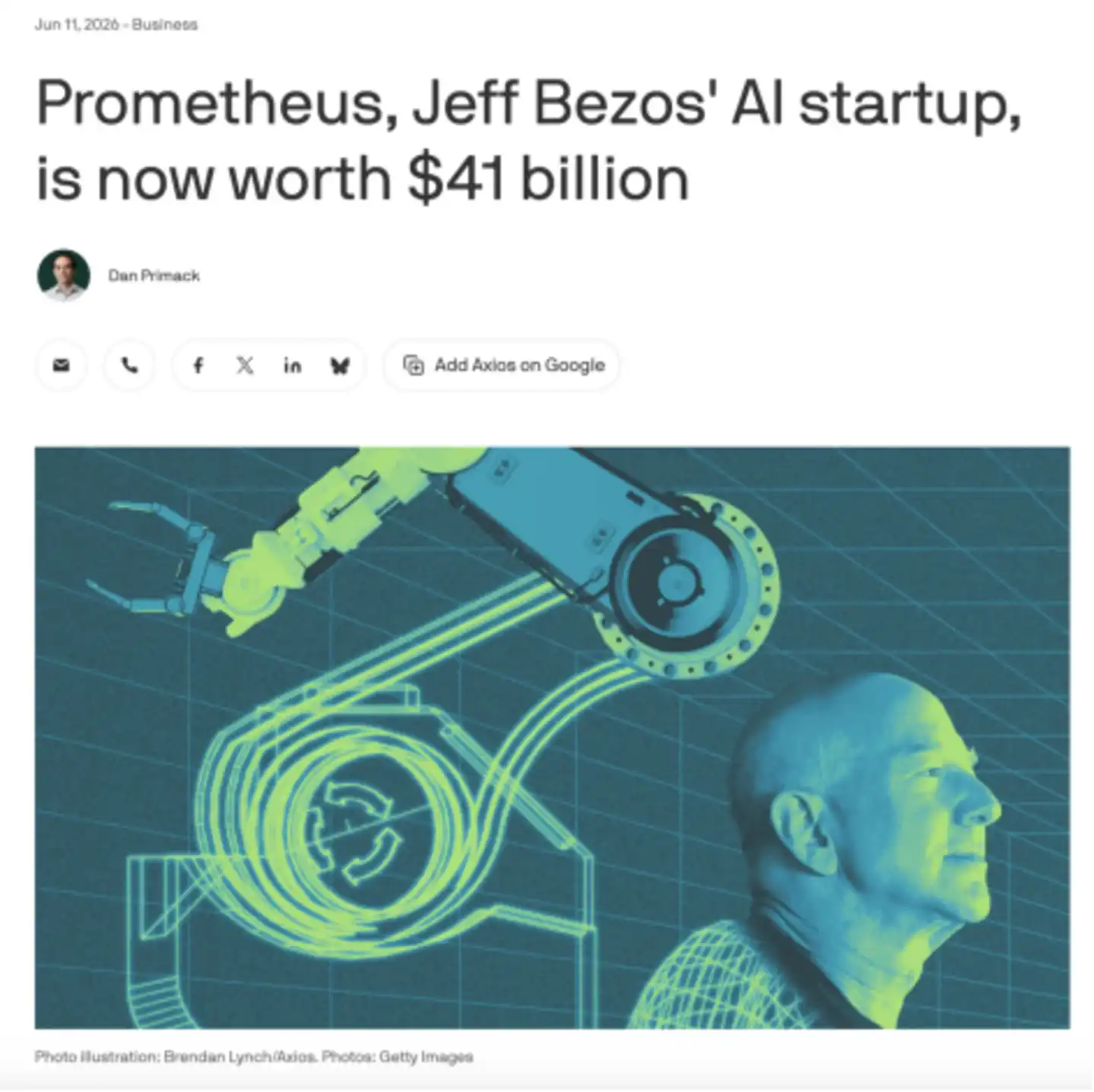
Last November, the company raised $6.2 billion in Series A funding upon its launch; just seven months later, it completed a $12 billion Series B, with the single-round funding amount almost doubling, and cumulative funding exceeding $18 billion across the two rounds.

In other words, it stepped onto the valuation peak of physical world AI as soon as it went public.

Humanoid robot company Figure AI announced over $1 billion in Series C funding in September 2025, with a post-money valuation of $39 billion;

Robot "brain" company Skild AI announced $1.4 billion in Series C funding this January, with a valuation exceeding $14 billion;

Another robot general intelligence company, Physical Intelligence, has a confirmed valuation of $5.6 billion, with reports suggesting its new funding round valuation may exceed $11 billion.

But Prometheus, in less than a year, has surpassed the valuations of these embodied AI star companies.

According to Bezos, Prometheus is not building robots but a kind of Artificial General Engineer AI.

Simply put, Prometheus aims to have AI participate in the design, simulation, testing, and manufacturing of complex real-world products.

Jet engines, spacecraft, chips, cars, medical devices, pharmaceuticals, consumer electronics, robots... The R&D cycles for these products often take years. A design goes through repeated simulation, prototyping, testing, failure, modification, and starting over.

What Prometheus wants to compress is this process—it aims to accelerate not a single task, but the entire "invention cycle": from design to simulation, from testing to manufacturing, and back to the next round of design.

More importantly, industrial AI remains a largely unexplored ocean, a blue ocean full of potential.

This direction is not without players. Robot companies are working on embodied intelligence, engineering software companies on simulation and design optimization, NVIDIA is pushing its physical AI platform, and manufacturing giants are also integrating AI into their production processes.

But it hasn't yet produced a truly benchmark product.

This relates to the complexity of industrial AI itself. It deals not with text and code on a screen, but with real-world materials, structures, temperature, energy consumption, cost, supply chains, and safety margins.

Here, AI can't just give an answer that looks plausible.

It must withstand simulation, pass testing, and ultimately be manufactured in reality.

Prometheus's $41 billion valuation is not buying a proven, mature company. It's buying an as-yet-unverified but potentially enormous possibility.

Prometheus stole fire, giving humanity the tools to change the world.

Bezos's Prometheus wants to hand the fire of AI to engineers in the real world.

Bezos's Third Hands-On Venture

If we exclude asset-type investments like acquiring The Washington Post, Prometheus counts as Bezos's third truly hands-on venture.

The first was Amazon.

In 1994, he left Wall Street and founded Amazon in Seattle. It started as just an online bookstore. Later, the company grew into one of the world's largest e-commerce platforms. In 2024, Amazon's annual revenue exceeded $630 billion; its AWS also became one of the most important players in the global cloud computing market.

Bezos built a set of infrastructure supporting modern commerce: warehousing, logistics, cloud computing, advertising, membership systems, and the operational machinery built around these systems.

The second was Blue Origin.

In 2000, Bezos founded Blue Origin. If Amazon belonged to the digital world, then Blue Origin faces the physical world. There is no "fail fast" here, only repeated design, manufacturing, testing, and launching.

Blue Origin isn't a paper-based space dream either. New Shepard has completed multiple suborbital flights and sent tourists to space; the BE-4 engine became the main engine for ULA's new Vulcan rocket; New Glenn is Blue Origin's core product for entering the heavy-lift orbital launch market.

Rockets aren't pure software products. They must ignite, undergo test fires, launch, and be tested for physical stability and manufacturing precision in the real world.

Amazon gave Bezos the experience of "turning complex systems into platforms," Blue Origin gave him the experience of "doing complex engineering in the physical world." With Prometheus, these two lines of experience converge.

Bezos mentioned in the CNBC interview that he was initially just a founding investor. Later, seeing the project's progress, he realized "I couldn't sit on the sidelines" and took on the co-CEO role himself.

Because Prometheus isn't a business suitable for remote betting. It's not building a lightweight application, but a complex system for the real industrial world. It requires both AI capabilities and engineering understanding; it needs to understand both models and manufacturing; it needs software speed but also respect for the constraints of the physical world.

And this falls precisely at the intersection of Bezos's experience over the past three decades.

Prometheus has Amazon-style platform ambitions and Blue Origin-style engineering difficulty. Bezos's return to the CEO role isn't just because he saw a new AI trend; it's more like he saw a familiar problem finally having a new solution.

Moreover, this time Bezos isn't diving in alone.

Prometheus's other co-CEO, Vik Bajaj, was an early core figure in Google's life sciences business, co-founding Google Life Sciences, later Verily; he later served as Chief Scientific Officer at cancer early detection company Grail.

In other words, Bajaj's past work has always been at the intersection of science, engineering, data, and real industry.

This co-CEO duo is interesting: Bezos brings Amazon-style platform capabilities and Blue Origin-style engineering experience; Bajaj brings experience in life sciences, hard tech, and complex R&D systems.

Two people, one better at turning complex systems into large-scale platforms, the other more familiar with pushing scientific problems into real industry.

Bezos said in the CNBC interview that Prometheus now occupies most of his time, followed by Blue Origin, and then AI-related work within Amazon.

In a sense, this is somewhat abnormal—over the past year, many well-known CEOs have chosen to step back, citing precisely that the AI era has arrived and the company needs someone more suited to lead the transformation.

But Bezos went in the opposite direction, and not to manage a mature giant like Amazon, but to invest most of his time in an AI startup less than a year old.

For a 61-year-old billionaire to return to the office, there must be a special reason. Perhaps he has already seen that the next opportunity to change the world is right there.

From "Blue Sky" to "Blue Ocean"

Blue Origin still exists. But it must be admitted that the "blue sky" of commercial space has been captured by SpaceX.

Last week, SpaceX completed its IPO, initially raising $75 billion. Subsequently, underwriters exercised the over-allotment option, increasing total fundraising to $85.7 billion, making it the largest IPO in global history. On its first trading day, SpaceX's stock rose about 19%, with its market cap breaking $2 trillion, pushing Musk to the position of "the world's first trillionaire."

SpaceX captured not just the launch market, but also the sexiest story in commercial space: reusable rockets, satellite internet, the Mars vision, massive valuation, employee wealth creation, and an IPO record-breaking enough to rewrite capital markets.

In contrast, while Blue Origin has New Shepard, BE-4, and New Glenn, these achievements aren't enough to change the seating at the table. The definition of commercial space has already fallen to SpaceX.

Moreover, Blue Origin was recently sharply reminded by the physical world.

On May 28, the New Glenn rocket exploded during a static fire engine test at Cape Canaveral, Florida, damaging the launch pad and potentially delaying subsequent launch plans by months.
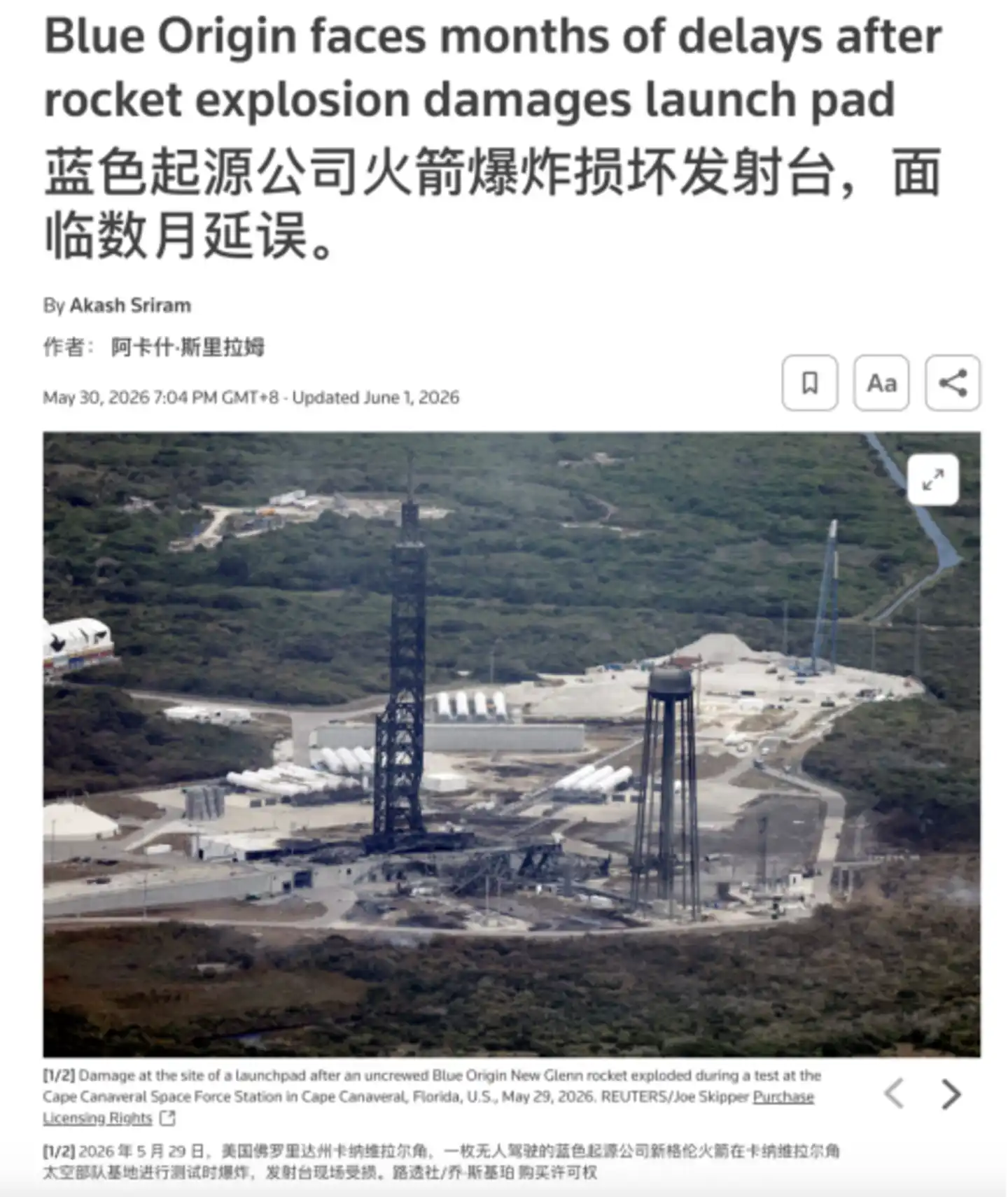
Space is harsh. Even if a company has money, patience, vision, and a founder like Bezos, rockets won't fly on schedule just because of that.

Reuters' latest report on June 16 shows SpaceX's stock continued to rise, closing at $201.80, with a market cap reaching approximately $2.655 trillion, already surpassing Amazon and briefly exceeding Microsoft. In other words, Musk not only won the definition in commercial space but also let SpaceX step on Amazon, the company Bezos built, in the capital markets.

This gives Bezos a somewhat "being overshadowed everywhere, might as well forge a new path" vibe.

Unfortunately, Musk seems to be "capable of everything from heaven to earth," making it hard to avoid him even after switching battlefields, as if the old rivals are just opening a new game.

Tesla works on autonomous driving, the humanoid robot Optimus; SpaceX works on highly engineered rocket manufacturing; xAI tries to integrate model capabilities into Musk's own company ecosystem... It can be said that Musk's AI path was never just about staying on the screen from the start. He wants AI to enter cars, robots, factories, and rockets, ultimately taking over more physical labor in the real world.

But there is a difference. If Musk is betting on "how AI executes tasks in the real world," then Bezos is betting on "how AI participates in real-world invention."

The industrial AI track is not short of players. OpenAI is supplementing robotic capabilities, Anthropic is entering industrial scenes, NVIDIA is building the Physical AI foundation—it's truly a time of fierce competition. But who will become the gateway to the industrial AI era remains unknown.

Prometheus wants to seize this position. It's not treating industrial AI as just a business direction, but as the entire company's proposition. What it wants to compete for is the human engineering of the AI era.

This time, Bezos doesn't want to chase behind Musk again.

Preguntas relacionadas

QWhat is Prometheus, and what is its unique focus in the AI landscape?

APrometheus is an AI startup founded by Jeff Bezos and Vik Bajaj. Unlike many AI companies focusing on digital tasks or specific robotic applications, Prometheus aims to develop an Artificial General Engineer (AGE). Its unique focus is on using AI to accelerate the entire invention cycle for complex physical products—such as jet engines, spacecraft, chips, and medical devices—by participating in their design, simulation, testing, and manufacturing processes.

QWhy did Jeff Bezos decide to return to a CEO role for Prometheus?

ABezos stated he initially didn't plan to be a CEO again after stepping down from Amazon. However, as he saw the progress of Prometheus, he realized he couldn't remain on the sidelines. He was drawn back because the company's mission sits at the intersection of his two major prior experiences: building Amazon's scalable digital platforms and managing Blue Origin's complex physical engineering challenges. Prometheus combines both, requiring deep understanding of both AI and real-world industrial constraints.

QHow does Prometheus's funding and valuation compare to other major AI companies in the physical world?

APrometheus has achieved a remarkably high valuation very quickly. After a $6.2 billion Series A in November and a $12 billion Series B in June, its valuation reached $41 billion within less than a year. This surpasses other well-funded physical AI companies: Figure AI (valued at $39B), Skild AI (valued at over $14B), and Physical Intelligence (reportedly heading for a >$11B valuation). This indicates immense investor confidence in its potential to dominate the industrial AI space.

QHow is Jeff Bezos's new venture, Prometheus, still connected to his rivalry with Elon Musk?

AAlthough Prometheus represents a new direction in industrial AI design, it still intersects with Elon Musk's domains. Musk's companies (Tesla with Optimus robots and self-driving, SpaceX with rocket engineering, xAI) are also focused on deploying AI in the physical world to perform and execute tasks. While Musk focuses on 'how AI executes tasks,' Bezos's Prometheus focuses on 'how AI participates in invention.' Their competition has essentially shifted from commercial space (Blue Origin vs. SpaceX) to defining the future of AI's role in engineering and the physical economy.

QWhat challenges does the field of Industrial AI present that Prometheus must overcome?

AIndustrial AI faces significant complexity because it must operate within the constraints of the real physical world, not just digital environments. Key challenges include: AI outputs must be rigorously verifiable through simulation and real-world testing; designs must account for materials, thermodynamics, structural integrity, cost, supply chains, and safety; and the technology must integrate into existing, often slow, multi-year engineering and manufacturing cycles. Prometheus's goal is to reliably compress this entire 'invention loop,' a task that requires a deep fusion of AI capability and practical engineering knowledge.

Lecturas Relacionadas

Gate Research Institute: Analysis of Chart Patterns and Breakout Trading Strategies

Gate Research Institute: Chart Pattern Analysis and Breakout Trading Strategies Chart patterns are crucial tools in technical analysis for observing market supply and demand shifts, trend continuations, and reversals. This analysis involves a comprehensive evaluation of trend, volume, support/resistance, time cycles, and breakout validity, not just rote pattern recognition. Patterns are broadly categorized into reversal patterns (e.g., Double Tops/Bottoms, Head and Shoulders) and continuation patterns (e.g., Flags, Triangles, Rectangles). An effective breakout, key for trading, requires clear support/resistance, prolonged consolidation, a prevailing trend backdrop, and volume confirmation. However, breakouts are not guaranteed, as false breakouts are common. Risk must be managed through position sizing, stop-loss orders, pullback confirmations, and profit-taking in stages. Key pattern types discussed include: * **Rectangle Patterns:** Indicate market indecision within parallel support and resistance, with breakouts projecting a move equal to the pattern's width. * **Flag & Pennant Patterns:** Short-term continuation patterns following sharp price moves ("flagpoles"). * **Triangle Patterns:** Symmetrical, Ascending (bullish bias), and Descending (bearish bias) triangles, representing consolidation before a directional move. * **Head and Shoulders Patterns:** Major reversal patterns signaling trend exhaustion. The article details breakout trading strategies, defining valid breakouts by price closing beyond a key level with increased volume and minimal immediate re-entry into the prior range. It contrasts range trading with breakout trading and outlines entry methods (immediate entry, pullback entry, scaling in), stop-loss placement (based on pattern failure), and profit-taking techniques (target-based, structure-based, trend-following). It further classifies breakout outcomes: 1. **Valid Breakouts:** Strong, sustained moves in the breakout direction. 2. **Pullback Breakouts:** Price breaks out, retests the breakout level as support/resistance, then resumes the trend—offering a lower-risk entry. 3. **False Breakouts:** Price briefly breaches a level but quickly reverses back into the prior range, a common risk managed by strict stop-losses. Key validation tools for breakouts include volume analysis, the principle of support/resistance role reversal, and momentum indicators like ATR, Moving Averages, Bollinger Bands, and RSI. In conclusion, while chart patterns and breakout analysis provide a structured framework, their effectiveness relies on multiple confirming factors—trend context, volume, and proper risk management. They should be integrated into a broader trading system rather than used as standalone signals.

marsbitHace 18 min(s)

Gate Research Institute: Analysis of Chart Patterns and Breakout Trading Strategies

marsbitHace 18 min(s)

Joseph Chalom: Ethereum is Becoming the "Settlement Layer of Trust" for Global Finance

In a speech titled "The Industrialization of Trust," Sharplink CEO Joseph Chalom (former BlackRock digital assets head) discussed the future transformation of global finance. Drawing from 20 years at BlackRock, where he led the launch of Bitcoin/ETH ETFs and tokenized funds, Chalom highlighted the immense hidden costs of establishing trust in traditional finance—estimated at over $9.3 trillion annually in the US alone due to fragmented systems, multi-day settlements, and countless reconciliations. He argued that Ethereum is emerging as the global financial "settlement layer for trust," with its robust, decentralized infrastructure securing over $300 billion in on-chain assets and most stablecoins and tokenized assets. The future, he stated, will be driven by three accelerating pillars: stablecoins (evolving beyond crypto gateways to become efficient cross-border payment rails), tokenized assets (enabling 24/7 trading and reshaping capital markets), and DeFi (providing automated, accessible financial services). A potential game-changer, Chalom added, is the fourth pillar: "Agentic Finance," where AI agents autonomously execute programmable financial transactions via smart contracts and stablecoins. He envisions individuals soon having AI-powered "CFOs in their pockets" to optimize idle capital and manage tokenized portfolios. This shift, facilitated by Ethereum's trustless settlement, could multiply on-chain transaction volume 1000x within a year, moving finance toward a seamless, digitized future.

marsbitHace 19 min(s)

Joseph Chalom: Ethereum is Becoming the "Settlement Layer of Trust" for Global Finance

marsbitHace 19 min(s)

STRC Severely Unpegged, What Risks Is the Market Pricing In?

The article analyzes the recent significant de-pegging of Strategy's perpetual preferred stock, STRC, whose price fell to approximately $89, far below its $100 face value. This discount has pushed its simple yield to around 12.9%, creating a paradox. The stock was designed as a high-yield instrument trading near par, and Strategy maintains an 11.5% annual dividend, even recently switching to semi-monthly payments to support the price. The author explores several reasons why the high yield hasn't attracted enough buying pressure to restore the par value. A key factor is potential reverse deleveraging from carry trades, where leveraged investors may be forced to sell due to margin calls as the price falls, creating a self-reinforcing downward spiral. Additionally, the tokenization and integration of STRC into DeFi protocols (like Apyx, Saturn, Pendle) have introduced faster, more transparent, and potentially more volatile price adjustment mechanisms through leverage and yield-splitting products. The emergence of a competing product, Strive's SATA, offering a 13% yield with daily dividends, has also changed the yield benchmark, challenging STRC's unique high-yield narrative. Furthermore, the market is questioning the distinction between Strategy's substantial Bitcoin reserves, which provide long-term balance sheet coverage, and the certainty of stable near-term cash flow for dividends. Ultimately, the price dip represents a stress test for this type of BTC-backed, high-yield financing tool. The future path of STRC depends on whether Strategy acts to reinforce the $100 peg (e.g., by adjusting dividends), whether DeFi-related leverage unwinds further, and how investors ultimately price the risks of leverage, competition, and cash flow uncertainty against the offered yield.

marsbitHace 30 min(s)

STRC Severely Unpegged, What Risks Is the Market Pricing In?

marsbitHace 30 min(s)

LIT Token Hits Six-Month High: How Long Can the Buyback Flywheel Keep Burning Fuel?

The LIT token of decentralized perpetual exchange Lighter surged to a six-month high above $1.90 on June 18th, with a market cap of $425 million. After a price correction earlier this year, the recent rebound is attributed to its core "buyback flywheel" mechanism. All protocol fee revenue is used for programmatic, hourly market buybacks of LIT. Since its TGE in December 2025, approximately 15 million LIT (6% of circulating supply) has been repurchased for around $21 million. Additional price support comes from the LLP (Lighter Liquidity Pool), where providers must stake LIT worth 10% of their deposited USDC, locking significant token supply. However, challenges persist. Trading volume has declined amidst a sluggish market, with total volume at $1.68 trillion, significantly lower than leading competitor Hyperliquid's $4.37 trillion. While Lighter focuses on perpetual contracts, RWA, and Pre-IPO markets, Hyperliquid has expanded into prediction markets and boasts a U.S. spot ETF, attracting institutional investment and influencer endorsements like from Arthur Hayes. In contrast, LIT currently lacks similar high-profile backing. With 75% of LIT's total 1 billion supply still locked (team and investor tokens begin a 3-year linear unlock in December 2026), there is no immediate unlock selling pressure. The token's future performance hinges on sustaining trading volume growth, successful product iteration, and executing its transparent buyback strategy against a dominant competitor.

Foresight NewsHace 49 min(s)

LIT Token Hits Six-Month High: How Long Can the Buyback Flywheel Keep Burning Fuel?

Foresight NewsHace 49 min(s)

Trading

Spot
Futuros
活动图片