WSJ: Fake Websites, Fake Trades, Real Promotion: Polymarket's Traffic Scam

marsbitPublicado a 2026-06-23Actualizado a 2026-06-23

Resumen

The Wall Street Journal investigation reveals that prediction market platform Polymarket hired dozens of creators, primarily students, to produce and disseminate deceptive promotional content on social media. These creators used fake, near-identical clone websites (like "poiymarket.com") to simulate placing bets and winning large sums—totaling $1.9 million in fake wagers and nearly $900,000 in fake winnings across over 1,100 analyzed videos—without disclosing their paid partnership with Polymarket, as required by federal advertising regulations. The videos, often promoting unrealistic "free money" claims, were amplified by a coordinated "army" of social media accounts managed by a marketing contractor to target U.S. users, despite Polymarket's crypto platform being barred from serving the U.S. since a 2022 settlement. Polymarket stated it is committed to fair and transparent markets and plans a comprehensive audit of its promotional content. The article also notes internal discussions about potentially overturning the 2022 settlement to reintroduce its crypto platform in the U.S.

Original article from WSJ, by Katherine Long, Caitlin Ostroff, Neil Mehta and Brenna T. Smith

Compiled by|Odaily Planet Daily Qin Xiaofeng(@QinXiaofeng 888 )

Editor's Note: A recent Wall Street Journal investigation found that prediction market platform Polymarket paid dozens of creators to make fake trades and profit videos on simulated websites, and used social media "water armies" for viral marketing to attract U.S. users. None of these videos disclosed the paid relationships as required by federal regulations, and the "handsome returns" shown were entirely fabricated. Polymarket stated it is committed to maintaining accurate, fair, and transparent markets and plans to conduct a comprehensive audit of its promotional content.

The following is the WSJ investigation article, compiled by Odaily Planet Daily. Enjoy~

————————

From George Makihara's videos, it appeared he had a lucrative side hustle: placing bets on Polymarket.

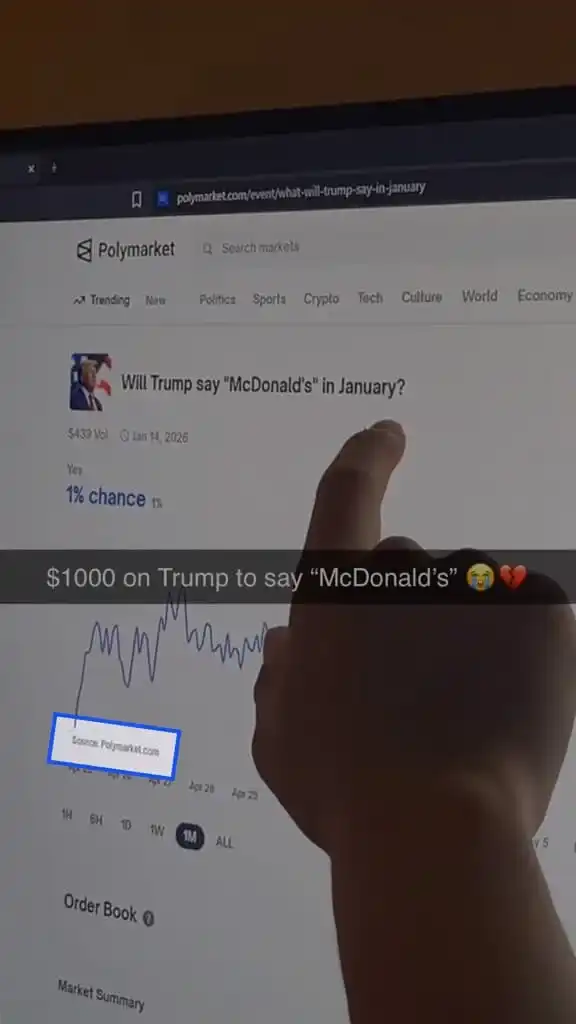
In January of this year, this college student posted a video showing he won $100,000 by betting that President Trump would publicly say the word "McDonald's" that month.

According to his videos, from January to mid-May, George Makihara seemingly placed 145 bets on the Polymarket website – with a total amount close to $410,000.

But according to a Wall Street Journal investigation, none of those trades were real.

George Makihara jumps when Trump says the word "McDonald's"; however, Trump never publicly said that phrase that month, this video was filmed two months ago

Based on the Journal's analysis of over 1,100 videos, related instructional materials, and interviews with creators who have worked with the company, George Makihara is one of dozens of creators paid by Polymarket, mostly college students, who film themselves making fake trades and sometimes showcasing fake profits. George Makihara declined to comment.

Public data shows that on Polymarket's actual website in January, over 50 accounts participated in the "McDonald's" bet. All of these accounts lost money.

To attract users to its unregulated platform, Polymarket flooded social media with videos like George Makihara's that appear genuine at first glance. In reality, Polymarket created near-perfect clones of its website and then instructed creators to make simulated trades on these virtual sites, while concealing that they were paid by Polymarket.

To make the videos go viral, Polymarket recruited a social media "army" to duplicate and repost the creators' content. Even though this New York-based company has been banned from offering its core crypto platform services in the U.S. since 2022, these social media creators, paid for their work, specifically targeted U.S. users – who can still access the site via virtual private networks (VPNs).

Polymarket said in a statement, "the company is committed to maintaining accurate, fair, and transparent markets. We are part of a fast-growing industry and are constantly evaluating how to improve how we engage and earn the trust of our audience." The company said it plans to conduct a comprehensive review of its existing promotional content.

Polymarket hired and worked closely with a marketing contractor to promote the site. In a message reviewed by the Journal, the contractor told its social media "army" to focus on reposting content from 10 Polymarket creators, including George Makihara. These creators initially did not label themselves as paid partners of Polymarket, though one provided a $20 referral code in their social media bio. After the Journal began asking the company about the marketing operation, these creators started adding "@polymarket partner" labels to their bios.

The Journal reviewed 1,105 videos posted between late December 2025 and mid-May by 10 creators endorsed by Polymarket's contractor. In 70% of the videos, the creators placed bets; clues in the videos indicate all these bets – totaling $1.9 million – were fake. Most videos just showed the betting process, but 118 videos showed creators reacting to winning, collectively winning nearly $900,000 in prizes – actually from fake trades; if you had actually placed those bets, you would have lost over $166,000.(Note: Polymarket has a data partnership with Dow Jones & Company, publisher of the Wall Street Journal. The Journal used only public data in this analysis.)

According to creators who have worked with the company, Polymarket instructed creators not to disclose they were paid. They said compensation typically accumulated to between $2,000 and $3,000 per month.

Investigating Fake Trades

One of the earliest videos showing signs of fake trades was posted to social media in June 2025, filmed at Polymarket's New York office. Someone placed a $100,000 bet that Powell would say "good afternoon" at a press conference, with a caption calling the bet a "valid manhood test."

The Journal investigation found over a dozen differences between the real Polymarket website and the simulated one.
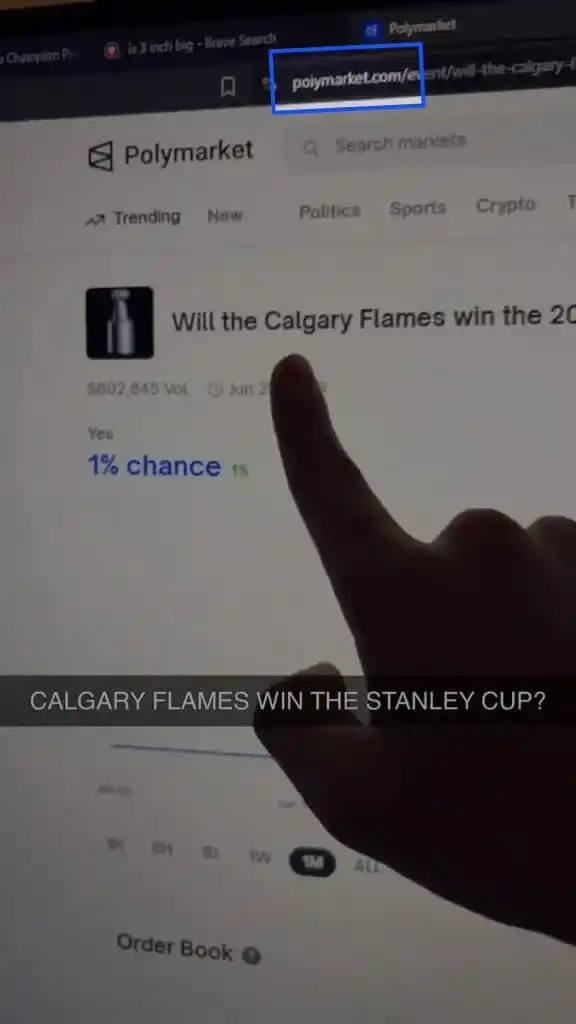
The fake simulated website was called "poiymarket.com"; when the "i" was capitalized, it was indistinguishable from polymarket.com. According to a person familiar with the matter, the site was built by Polymarket. Price charts on the site were labeled as sourced from "Polymarket.com." But Polymarket's real official website does not display any source information.
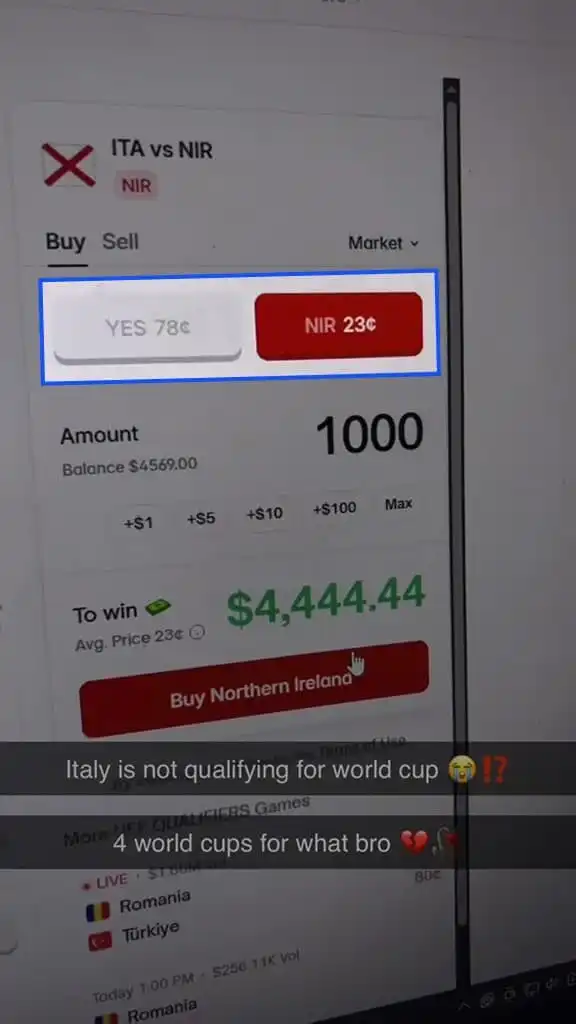
Additionally, the fake website sometimes had errors. For example, buttons would show "YES" and "NIR," while the real site has "YES" and "NO."
Several videos reviewed by the Journal also briefly flashed URL addresses, revealing the sites were test environments for Polymarket engineers. After the Journal contacted Polymarket for comment, the fake "poiymarket" website was taken down.

Federal advertising law requires brands to make truthful claims in their promotions and requires individuals paid to endorse products to disclose their connections; though there remains some gray area about what is permissible. Commodity laws governing prediction markets also prohibit deceptive and misleading conduct.

A spokesperson for the Federal Trade Commission, which enforces advertising laws, declined to comment on the Journal's findings, citing the agency's policy of not commenting on potential investigations.

Razeen Khan, a California college student who worked as a Polymarket creator for several months until March, compared the videos to fast-food commercials – where the food looks more appealing than it actually is.

"We're showing what actually happens," he said. "You're still going to buy that burger."

Creators said they would send finished videos to Polymarket for approval. If a video wasn't engaging enough or was obviously fake, Polymarket would ask for a reshoot.

Haian Nguyen was one of Polymarket's top-performing creators, filming her trades on the platform from a bedroom in San Francisco. In a video posted to Instagram, Haian Nguyen celebrated winning $60,000 after betting Trump would say "Olympics."

In another video of her dancing on a beach by the Golden Gate Bridge, the text overlay read "Polymarket funds my life."

Haian Nguyen declined to comment and cleared all videos from her profile after the Journal contacted her.

These promotional videos all followed the same template: the creator opens Polymarket, places a bet, and calls the profit "free money." Dozens of social media creators posted videos in nearly identical formats. According to creators who have worked with the company and a recruitment site, Polymarket sent creators bullet-pointed talking points.

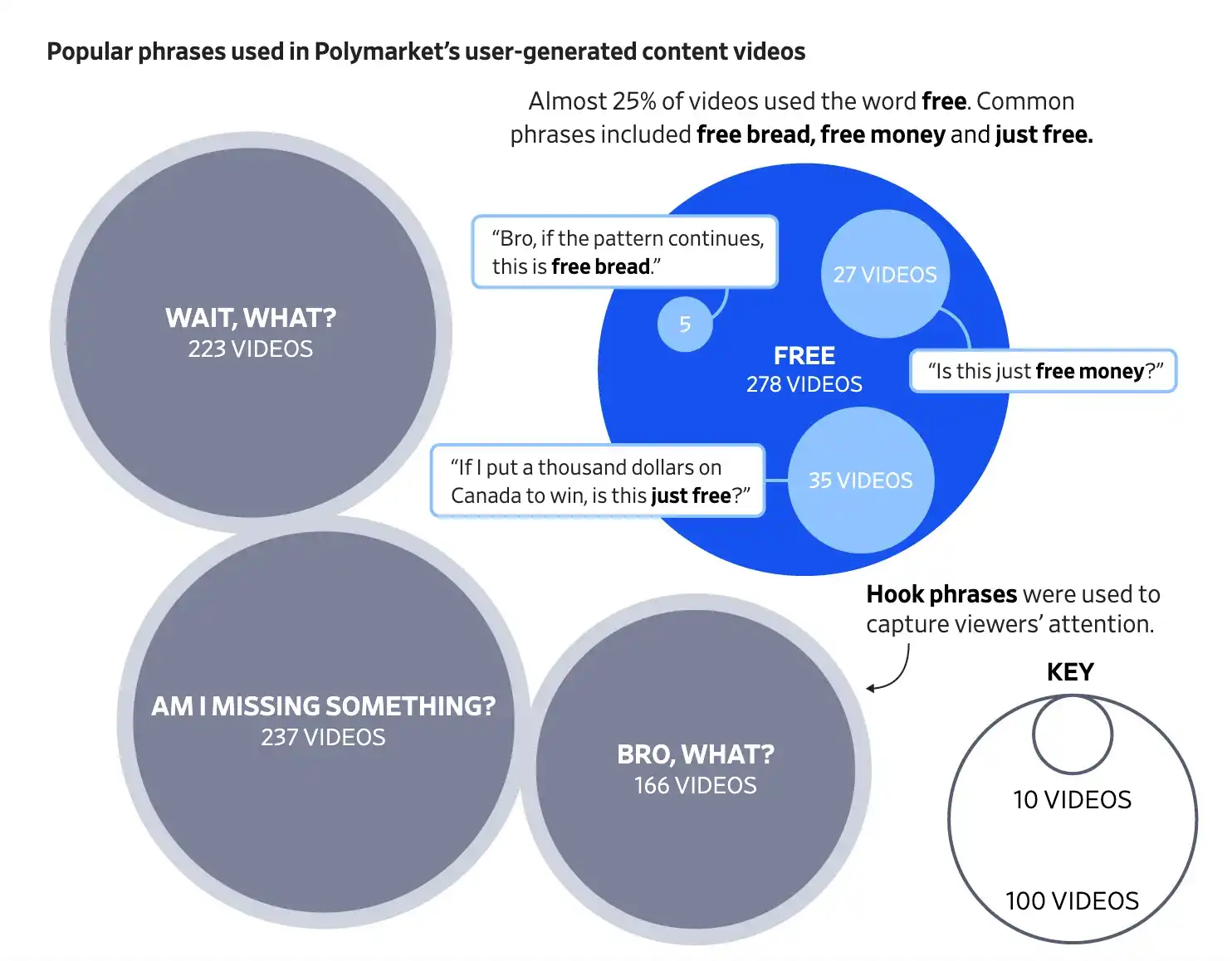
Common catchphrases in Polymarket user-generated content videos were:

Nearly 25% of videos used the word "free." Common phrases included "free bread," "free money," and "just free."

  • "Bro, if this trend continues, this is free bread." – 27 videos
  • "Wait, what?" – 223 videos
  • Free – 278 videos
  • "Isn't this free money?"
  • "If I bet a thousand dollars on Canada to win, isn't this free?" – 35 videos
  • "Am I missing something?" – 237 videos
  • "Bro, what?" – 166 videos
  • "Wait" – 100 videos

Source: Wall Street Journal analysis of 1,105 Polymarket creator videos on TikTok

The U.S. Commodity Futures Trading Commission (CFTC), which regulates prediction markets, has previously taken enforcement actions against companies using simulated trades to market products and making unrealistic profit promises.

The Trump administration has taken a permissive stance on regulating prediction markets. The CFTC has filed multiple lawsuits to stop states from regulating and taxing prediction markets. Trump recently posted on Truth Social that it is "critical" the CFTC has exclusive jurisdiction over prediction markets so they can flourish, calling politicians who want states to regulate them "scum." Trump's son, Donald Trump Jr., is an investor in Polymarket and a paid adviser to rival Kalshi.

A White House spokesperson said there was no conflict of interest and that Trump's actions were in the best interest of the American public. A CFTC spokesperson, in response to the Journal's reporting, said it is important to bring offshore prediction markets back to the U.S. so regulators can oversee them more effectively.

The Hype Machine

For Polymarket, virality is everything.

According to two people familiar with his thinking, founder Shayne Coplan told Polymarket's growth team to make the company impossible to ignore online. His close friend since high school, Matthew Modabber, oversees Polymarket's growth as chief marketing officer.

In 2024, Matthew Modabber (left) with Polymarket founder Shayne Coplan (right)

Polymarket is striving to attract more trading volume than its main competitor – the U.S.-regulated prediction market Kalshi. Polymarket was initially ahead; for most of 2025, both grew in sync; but in recent months, Kalshi has taken the lead. According to data provider The Block, last month Kalshi's trading volume was roughly double that of Polymarket.
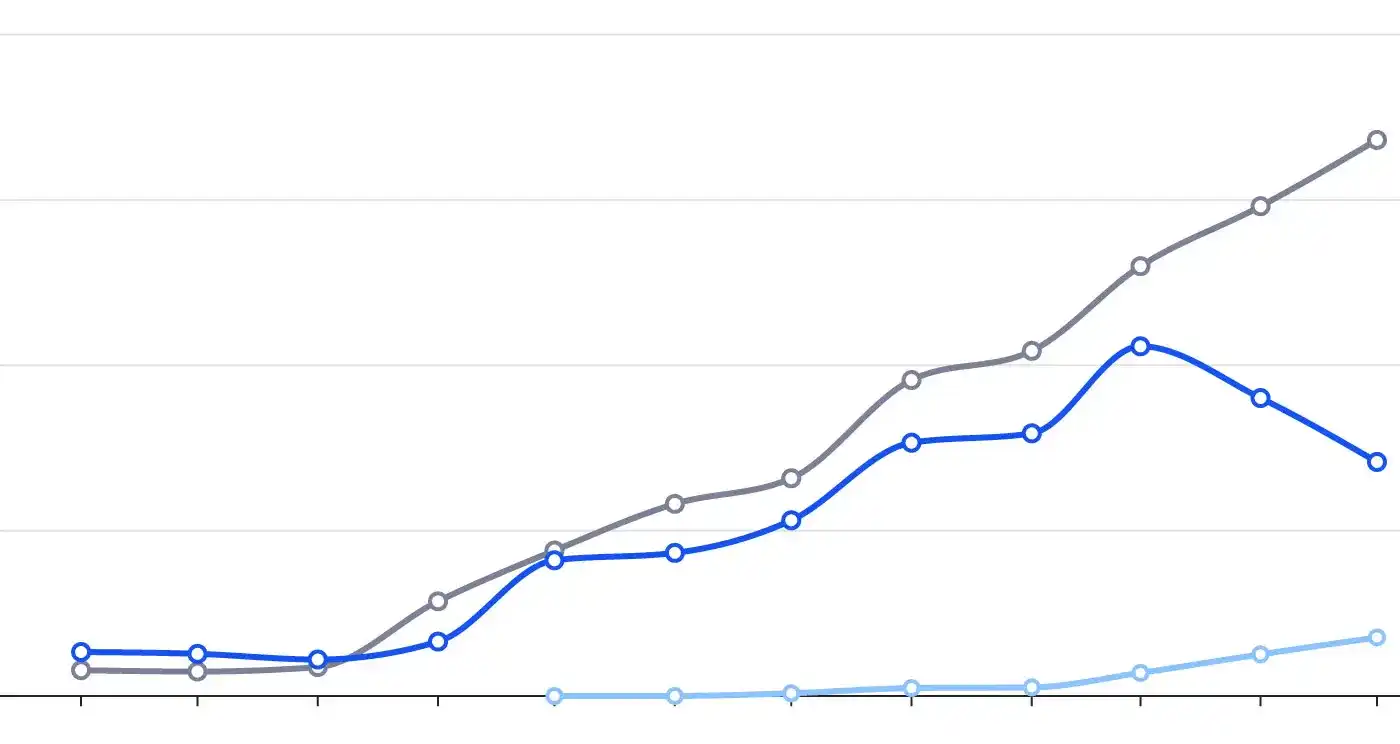
Monthly Trading Volume of Prediction Markets, data as of end of May 2026; Source: The Block

In 2022, Polymarket settled allegations of operating an unregistered options exchange, agreeing to stop offering its crypto-based trading services to U.S. customers and formally re-registering in Panama. Late last year, it launched a regulated U.S. version, available only as a mobile app. The app's trading volume is only a fraction of the offshore crypto exchange.

According to a person familiar with the matter, Polymarket is now seeking to overturn the outcome of the 2022 settlement and bring its crypto platform back to the U.S.

In the meantime, it is turning to social media to draw Americans to Polymarket.

Polymarket's Social Media "Army"

Polymarket's strategy leverages three groups of social media producers to portray the platform as a source of quick, easy money, gaining viral attention.

  • Streamers: Online personalities stream for hours on platforms like Twitch and Kick, discussing Polymarket and sometimes trading.
  • Creators: Social media users, mostly college students, make short videos talking about or trading on Polymarket.
  • Editors (known domestically as "slicers"): People around the world – especially teens in Asia – repost videos from streamers and creators.
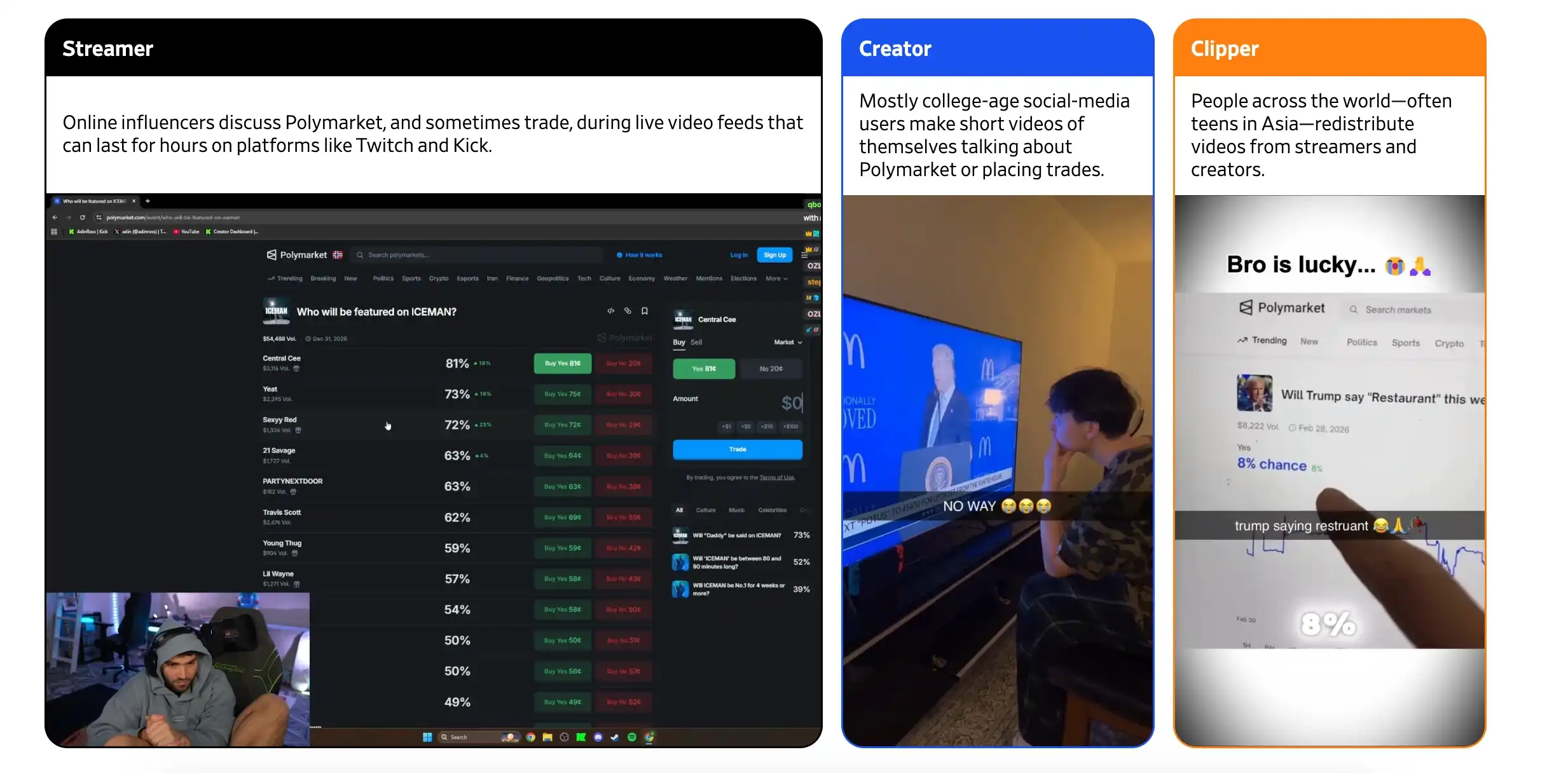
Polymarket hired marketing company Virality to manage the "slicer" team. Their promotional campaigns targeted Americans: according to instructional materials, as of early June, the slicer team could only get paid if at least 60% of their audience was U.S.-based.

Polymarket publicly distances itself from these ads. Based on the Journal's review of nearly 20,000 messages in a chat group for Polymarket's online content creator contractors, as well as instructional files and videos prepared for them, Virality asked the slicer team's posts to look "personal and natural."

"Everyone, if your account name contains 'Polymarket,' please rename and delete as soon as possible," a Virality employee told a group of slicers in the group chat. "Continued use would violate our guidelines and could lead to submissions being rejected. Not even 'poly' is allowed, change that too." Virality declined to comment.

Virality's editing promotion campaigns brought significant results.

A video posted by a Polymarket creator on TikTok had only received 151 views by mid-May. The slicer team reposted his video using secondary accounts, but most reposts were virtually unnoticed, with minimal view counts. But Polymarket works with many video editors to increase the odds of its videos going viral. Eventually, one video would always break through.

According to analytics provider Tubular, Polymarket's viral editing promotion campaigns have accumulated over 140 million views on TikTok, YouTube, and Instagram combined.

A TikTok U.S. spokesperson said several accounts identified by the Journal and other related accounts had been restricted for violating platform rules. A YouTube spokesperson said creators and brands must comply with legal obligations, otherwise YouTube may take action against them. A Meta spokesperson said while the platform requires creators to disclose if they are paid to promote or endorse products, it could not confirm if these specific contents violated its policies, as it had not independently verified whether these creators were paid by Polymarket.

Influencer Livestream Endorsements

Polymarket and Virality targeted dozens of videos by Adin Ross for promotion. Ross is a 25-year-old "manosphere" influencer with millions of followers. According to a person familiar with the negotiations, Ross has a multi-million dollar deal with Polymarket, averaging about half an hour per week browsing Polymarket and commenting on potential trades during his livestreams.

In at least five videos, Ross pointed out how he could trade on the platform using inside information.

In one promotional video, Ross said he could easily use inside information to trade on the release date of rapper Drake's (an acquaintance of Ross) upcoming new album.

Representatives for Ross and Drake declined to comment.

Internal materials show Polymarket and Virality promoted videos showcasing how easy it is to engage in insider trading on the platform. Polymarket has paid editors to promote at least 19 videos discussing opportunities to manipulate the market using insider information or other means.

Polymarket stated it "prohibits trading based on information obtained through theft, unlawful insider information, or in breach of trust, confidentiality, or other legal obligations." It added, "Polymarket's market integrity framework includes trade monitoring, on-chain transparency, reporting channels, and escalation processes to detect, review, and respond to suspicious activity. Where appropriate, we cooperate with regulators and law enforcement to maintain the integrity of our markets."

As the World Cup approached, some of Polymarket's creators turned to filming themselves trading on the company's newly launched, CFTC-regulated U.S. app.

Initially, these trades also looked legitimate. The app interface shown in social media videos was almost identical to that of Polymarket's U.S. app.

But a closer look revealed differences. For example, a market on the official app was "26 World Cup," while on the simulated Polymarket U.S. app it was "2026 FIFA World Cup."

The fake simulated trades continued.

Criptos en tendencia

Preguntas relacionadas

QAccording to the WSJ investigation, how did Polymarket attract U.S. users to its platform despite being barred from the U.S. market?

APolymarket hired dozens of creators, mostly college students, to create videos showing fake trades and profits on simulated websites. These videos were then virally promoted by a social media army, specifically targeting U.S. audiences who could still access the site via VPN.

QWhat were some of the key differences between the fake 'poiymarket' simulation website and the real Polymarket website as identified in the article?

AKey differences included the fake URL (poiymarket.com vs polymarket.com), the fake site attributing price charts to 'Polymarket.com' (whereas the real site showed no source), occasional typos on buttons like 'NIR' instead of 'NO', and the fake site sometimes showing URLs for test environments used by Polymarket engineers.

QWhat actions did Polymarket announce it would take in response to the WSJ's findings about its promotional activities?

APolymarket stated it was committed to maintaining accurate, fair, and transparent markets and announced plans to conduct a comprehensive audit of its existing promotional content.

QHow much fake winnings and losses were shown in the 1105 videos analyzed by The Wall Street Journal, and what was the actual outcome for those bets if placed on the real platform?

AThe videos showed creators placing fake bets totaling $1.9 million, with 118 videos depicting fake wins of nearly $900,000. If those bets had actually been placed on the real Polymarket platform, they would have resulted in losses of over $166,000.

QWhat was the role of the marketing firm Virality in Polymarket's promotional strategy, and what specific requirement did it have for the 'slicer' team's content?

AVirality was hired by Polymarket to manage a 'slicer' team that reposted and promoted creator videos. Virality required that the slicer team's posts appear 'personal and natural' and specifically mandated that their accounts must not contain 'Polymarket' or even 'poly' in the username. Furthermore, to get paid, the slicers' content needed to have an audience with at least 60% U.S. users.

Lecturas Relacionadas

The Final Piece of Franklin Templeton's Crypto Ambition

Franklin Templeton Completes Crypto Ambition with Acquisition of 250 Digital On June 22, Franklin Templeton announced the acquisition of 250 Digital and established Franklin Crypto, a new division focused on actively managed cryptocurrency strategies for institutional investors. The unit is led by Christopher Perkins and Seth Ginns. This acquisition marks a key piece in Franklin Templeton's multi-year crypto strategy, which began in 2018 with a digital assets team. The firm's crypto product suite now spans three layers: tokenized funds like the blockchain-based money market fund BENJI (~$831M AUM); a series of passive ETFs including Bitcoin (EZBC, ~$368M), Ethereum (EZET), XRP (XRPZ, ~$252M), Solana (SOEZ), and a multi-crypto index fund (EZPZ); and the newly added active management strategies from Franklin Crypto. The company has also expanded its crypto ecosystem through investments in projects like Ethena and Crossmint, and collaborations with blockchains such as Aptos and Sui. With approximately $18B in digital asset AUM and a total firm AUM of ~$1.78T, Franklin Templeton is positioning itself as a comprehensive crypto asset manager for pensions and sovereign wealth funds. In contrast, competitor Fidelity Investments has taken a different path, focusing early on building its own custody and trading infrastructure. Fidelity's Bitcoin ETF (FBTC) holds over $11B, significantly larger than Franklin Templeton's equivalent offering. Both giants' moves underscore the deepening trend of traditional finance entering the crypto space.

Foresight NewsHace 18 min(s)

The Final Piece of Franklin Templeton's Crypto Ambition

Foresight NewsHace 18 min(s)

Black Tuesday in Japanese and Korean Stock Markets: South Korea Triggers Circuit Breaker, Nikkei Plummets, AI Boom Undergoes Phased Adjustment

"Black Tuesday" for Asian Markets: Korean Stocks Halted by Circuit Breaker, Nikkei Plunges as AI Rally Undergoes Correction Asian stock markets experienced severe turbulence on Tuesday, with South Korea's benchmark KOSPI index plummeting nearly 10% after triggering a market-wide trading halt when its losses exceeded 8%. Japan's Nikkei 225 index also fell sharply by approximately 3.5%, ending an eight-day winning streak. The sell-off was heavily concentrated in the technology and semiconductor sectors, with giants like Samsung Electronics and SK Hynix leading the declines. The plunge reflected a rapid reversal from recent highs, with the KOSPI having retreated over 12% from its mid-June peak. Analysts attribute the sharp correction to multiple converging factors. The direct trigger was weakness in U.S. tech stocks, which fueled profit-taking in overbought Asian markets. Furthermore, stronger-than-expected U.S. jobs data has reinforced expectations that the Federal Reserve will maintain or even raise interest rates, putting pressure on rate-sensitive growth stocks. Structural vulnerabilities also played a role, particularly in South Korea, where the market is highly concentrated in a few semiconductor heavyweights, making it susceptible to shifts in global AI demand and foreign capital outflows. Despite the short-term volatility, the long-term narrative for AI and semiconductors remains intact. Industry forecasts still point to massive growth in global AI capital expenditure over the coming years. South Korean firms like SK Hynix maintain a dominant position in critical segments like High Bandwidth Memory (HBM), with long-term orders secured well into 2027. While near-term fluctuations are expected to continue, driven by U.S. monetary policy signals and upcoming corporate earnings, the current correction may present a buying opportunity for quality assets tied to the enduring AI infrastructure build-out.

marsbitHace 34 min(s)

Black Tuesday in Japanese and Korean Stock Markets: South Korea Triggers Circuit Breaker, Nikkei Plummets, AI Boom Undergoes Phased Adjustment

marsbitHace 34 min(s)

Trading

Spot
Futuros

Artículos destacados

Qué es $S$

Entendiendo SPERO: Una Visión General Completa Introducción a SPERO A medida que el panorama de la innovación continúa evolucionando, la aparición de tecnologías web3 y proyectos de criptomonedas juega un papel fundamental en la configuración del futuro digital. Un proyecto que ha atraído la atención en este campo dinámico es SPERO, denotado como SPERO,$$s$. Este artículo tiene como objetivo reunir y presentar información detallada sobre SPERO, para ayudar a entusiastas e inversores a comprender sus fundamentos, objetivos e innovaciones dentro de los dominios web3 y cripto. ¿Qué es SPERO,$$s$? SPERO,$$s$ es un proyecto único dentro del espacio cripto que busca aprovechar los principios de descentralización y tecnología blockchain para crear un ecosistema que promueva la participación, la utilidad y la inclusión financiera. El proyecto está diseñado para facilitar interacciones de igual a igual de nuevas maneras, proporcionando a los usuarios soluciones y servicios financieros innovadores. En su esencia, SPERO,$$s$ tiene como objetivo empoderar a los individuos al proporcionar herramientas y plataformas que mejoren la experiencia del usuario en el espacio de las criptomonedas. Esto incluye habilitar métodos de transacción más flexibles, fomentar iniciativas impulsadas por la comunidad y crear caminos para oportunidades financieras a través de aplicaciones descentralizadas (dApps). La visión subyacente de SPERO,$$s$ gira en torno a la inclusividad, buscando cerrar brechas dentro de las finanzas tradicionales mientras aprovecha los beneficios de la tecnología blockchain. ¿Quién es el Creador de SPERO,$$s$? La identidad del creador de SPERO,$$s$ sigue siendo algo oscura, ya que hay recursos públicos limitados que proporcionan información de fondo detallada sobre su(s) fundador(es). Esta falta de transparencia puede derivarse del compromiso del proyecto con la descentralización, una ética que muchos proyectos web3 comparten, priorizando las contribuciones colectivas sobre el reconocimiento individual. Al centrar las discusiones en torno a la comunidad y sus objetivos colectivos, SPERO,$$s$ encarna la esencia del empoderamiento sin señalar a individuos específicos. Como tal, comprender la ética y la misión de SPERO sigue siendo más importante que identificar a un creador singular. ¿Quiénes son los Inversores de SPERO,$$s$? SPERO,$$s$ cuenta con el apoyo de una diversa gama de inversores que van desde capitalistas de riesgo hasta inversores ángeles dedicados a fomentar la innovación en el sector cripto. El enfoque de estos inversores generalmente se alinea con la misión de SPERO, priorizando proyectos que prometen avances tecnológicos sociales, inclusión financiera y gobernanza descentralizada. Estas fundaciones de inversores suelen estar interesadas en proyectos que no solo ofrecen productos innovadores, sino que también contribuyen positivamente a la comunidad blockchain y sus ecosistemas. El respaldo de estos inversores refuerza a SPERO,$$s$ como un contendiente notable en el dominio de proyectos cripto que evoluciona rápidamente. ¿Cómo Funciona SPERO,$$s$? SPERO,$$s$ emplea un marco multifacético que lo distingue de los proyectos de criptomonedas convencionales. Aquí hay algunas de las características clave que subrayan su singularidad e innovación: Gobernanza Descentralizada: SPERO,$$s$ integra modelos de gobernanza descentralizada, empoderando a los usuarios para participar activamente en los procesos de toma de decisiones sobre el futuro del proyecto. Este enfoque fomenta un sentido de propiedad y responsabilidad entre los miembros de la comunidad. Utilidad del Token: SPERO,$$s$ utiliza su propio token de criptomoneda, diseñado para servir diversas funciones dentro del ecosistema. Estos tokens permiten transacciones, recompensas y la facilitación de servicios ofrecidos en la plataforma, mejorando la participación y la utilidad general. Arquitectura en Capas: La arquitectura técnica de SPERO,$$s$ apoya la modularidad y escalabilidad, permitiendo la integración fluida de características y aplicaciones adicionales a medida que el proyecto evoluciona. Esta adaptabilidad es fundamental para mantener la relevancia en el cambiante paisaje cripto. Participación de la Comunidad: El proyecto enfatiza iniciativas impulsadas por la comunidad, empleando mecanismos que incentivan la colaboración y la retroalimentación. Al nutrir una comunidad sólida, SPERO,$$s$ puede abordar mejor las necesidades de los usuarios y adaptarse a las tendencias del mercado. Enfoque en la Inclusión: Al ofrecer tarifas de transacción bajas e interfaces amigables para el usuario, SPERO,$$s$ busca atraer a una base de usuarios diversa, incluyendo a individuos que anteriormente pueden no haber participado en el espacio cripto. Este compromiso con la inclusión se alinea con su misión general de empoderamiento a través de la accesibilidad. Cronología de SPERO,$$s$ Entender la historia de un proyecto proporciona información crucial sobre su trayectoria de desarrollo y hitos. A continuación se presenta una cronología sugerida que mapea eventos significativos en la evolución de SPERO,$$s$: Fase de Conceptualización e Ideación: Las ideas iniciales que forman la base de SPERO,$$s$ fueron concebidas, alineándose estrechamente con los principios de descentralización y enfoque comunitario dentro de la industria blockchain. Lanzamiento del Whitepaper del Proyecto: Tras la fase conceptual, se lanzó un whitepaper completo que detalla la visión, los objetivos y la infraestructura tecnológica de SPERO,$$s$ para generar interés y retroalimentación de la comunidad. Construcción de Comunidad y Primeras Interacciones: Se realizaron esfuerzos de divulgación activa para construir una comunidad de primeros adoptantes y posibles inversores, facilitando discusiones en torno a los objetivos del proyecto y obteniendo apoyo. Evento de Generación de Tokens: SPERO,$$s$ llevó a cabo un evento de generación de tokens (TGE) para distribuir sus tokens nativos a los primeros seguidores y establecer liquidez inicial dentro del ecosistema. Lanzamiento de la dApp Inicial: La primera aplicación descentralizada (dApp) asociada con SPERO,$$s$ se puso en marcha, permitiendo a los usuarios interactuar con las funcionalidades centrales de la plataforma. Desarrollo Continuo y Alianzas: Actualizaciones y mejoras continuas a las ofertas del proyecto, incluyendo alianzas estratégicas con otros actores en el espacio blockchain, han moldeado a SPERO,$$s$ en un jugador competitivo y en evolución en el mercado cripto. Conclusión SPERO,$$s$ se erige como un testimonio del potencial de web3 y las criptomonedas para revolucionar los sistemas financieros y empoderar a los individuos. Con un compromiso con la gobernanza descentralizada, la participación comunitaria y funcionalidades diseñadas de manera innovadora, allana el camino hacia un paisaje financiero más inclusivo. Como con cualquier inversión en el espacio cripto que evoluciona rápidamente, se anima a los posibles inversores y usuarios a investigar a fondo y participar de manera reflexiva con los desarrollos en curso dentro de SPERO,$$s$. El proyecto muestra el espíritu innovador de la industria cripto, invitando a una mayor exploración de sus innumerables posibilidades. Mientras el viaje de SPERO,$$s$ aún se desarrolla, sus principios fundamentales pueden, de hecho, influir en el futuro de cómo interactuamos con la tecnología, las finanzas y entre nosotros en ecosistemas digitales interconectados.

87 Vistas totalesPublicado en 2024.12.17Actualizado en 2024.12.17

Qué es $S$

Qué es AGENT S

Agent S: El Futuro de la Interacción Autónoma en Web3 Introducción En el paisaje en constante evolución de Web3 y las criptomonedas, las innovaciones están redefiniendo constantemente cómo los individuos interactúan con las plataformas digitales. Uno de estos proyectos pioneros, Agent S, promete revolucionar la interacción humano-computadora a través de su marco agente abierto. Al allanar el camino para interacciones autónomas, Agent S busca simplificar tareas complejas, ofreciendo aplicaciones transformadoras en inteligencia artificial (IA). Esta exploración detallada profundizará en las complejidades del proyecto, sus características únicas y las implicaciones para el dominio de las criptomonedas. ¿Qué es Agent S? Agent S se presenta como un marco agente abierto innovador, diseñado específicamente para abordar tres desafíos fundamentales en la automatización de tareas informáticas: Adquisición de Conocimiento Específico del Dominio: El marco aprende inteligentemente de diversas fuentes de conocimiento externas y experiencias internas. Este enfoque dual le permite construir un rico repositorio de conocimiento específico del dominio, mejorando su rendimiento en la ejecución de tareas. Planificación a Largo Plazo de Tareas: Agent S emplea planificación jerárquica aumentada por la experiencia, un enfoque estratégico que facilita la descomposición y ejecución eficiente de tareas complejas. Esta característica mejora significativamente su capacidad para gestionar múltiples subtareas de manera eficiente y efectiva. Manejo de Interfaces Dinámicas y No Uniformes: El proyecto introduce la Interfaz Agente-Computadora (ACI), una solución innovadora que mejora la interacción entre agentes y usuarios. Utilizando Modelos de Lenguaje Multimodal de Gran Escala (MLLMs), Agent S puede navegar y manipular diversas interfaces gráficas de usuario sin problemas. A través de estas características pioneras, Agent S proporciona un marco robusto que aborda las complejidades involucradas en la automatización de la interacción humana con las máquinas, preparando el terreno para una multitud de aplicaciones en IA y más allá. ¿Quién es el Creador de Agent S? Si bien el concepto de Agent S es fundamentalmente innovador, la información específica sobre su creador sigue siendo elusiva. El creador es actualmente desconocido, lo que resalta ya sea la etapa incipiente del proyecto o la elección estratégica de mantener a los miembros fundadores en el anonimato. Independientemente de la anonimidad, el enfoque sigue siendo en las capacidades y el potencial del marco. ¿Quiénes son los Inversores de Agent S? Dado que Agent S es relativamente nuevo en el ecosistema criptográfico, la información detallada sobre sus inversores y patrocinadores financieros no está documentada explícitamente. La falta de información disponible públicamente sobre las bases de inversión u organizaciones que apoyan el proyecto plantea preguntas sobre su estructura de financiamiento y hoja de ruta de desarrollo. Comprender el respaldo es crucial para evaluar la sostenibilidad del proyecto y su posible impacto en el mercado. ¿Cómo Funciona Agent S? En el núcleo de Agent S se encuentra una tecnología de vanguardia que le permite funcionar de manera efectiva en diversos entornos. Su modelo operativo se basa en varias características clave: Interacción Humano-Computadora Similar a la Humana: El marco ofrece planificación avanzada de IA, esforzándose por hacer que las interacciones con las computadoras sean más intuitivas. Al imitar el comportamiento humano en la ejecución de tareas, promete elevar las experiencias de los usuarios. Memoria Narrativa: Empleada para aprovechar experiencias de alto nivel, Agent S utiliza memoria narrativa para hacer un seguimiento de las historias de tareas, mejorando así sus procesos de toma de decisiones. Memoria Episódica: Esta característica proporciona a los usuarios una guía paso a paso, permitiendo que el marco ofrezca apoyo contextual a medida que se desarrollan las tareas. Soporte para OpenACI: Con la capacidad de ejecutarse localmente, Agent S permite a los usuarios mantener el control sobre sus interacciones y flujos de trabajo, alineándose con la ética descentralizada de Web3. Fácil Integración con APIs Externas: Su versatilidad y compatibilidad con varias plataformas de IA aseguran que Agent S pueda encajar sin problemas en ecosistemas tecnológicos existentes, convirtiéndolo en una opción atractiva para desarrolladores y organizaciones. Estas funcionalidades contribuyen colectivamente a la posición única de Agent S dentro del espacio cripto, ya que automatiza tareas complejas y de múltiples pasos con una intervención humana mínima. A medida que el proyecto evoluciona, sus posibles aplicaciones en Web3 podrían redefinir cómo se desarrollan las interacciones digitales. Cronología de Agent S El desarrollo y los hitos de Agent S pueden encapsularse en una cronología que resalta sus eventos significativos: 27 de septiembre de 2024: El concepto de Agent S fue lanzado en un documento de investigación integral titulado “Un Marco Agente Abierto que Usa Computadoras Como un Humano”, mostrando las bases del proyecto. 10 de octubre de 2024: El documento de investigación fue puesto a disposición del público en arXiv, ofreciendo una exploración profunda del marco y su evaluación de rendimiento basada en el benchmark OSWorld. 12 de octubre de 2024: Se lanzó una presentación en video, proporcionando una visión visual de las capacidades y características de Agent S, involucrando aún más a posibles usuarios e inversores. Estos marcadores en la cronología no solo ilustran el progreso de Agent S, sino que también indican su compromiso con la transparencia y la participación comunitaria. Puntos Clave Sobre Agent S A medida que el marco Agent S continúa evolucionando, varios atributos clave destacan, subrayando su naturaleza innovadora y potencial: Marco Innovador: Diseñado para proporcionar un uso intuitivo de las computadoras similar a la interacción humana, Agent S aporta un enfoque novedoso a la automatización de tareas. Interacción Autónoma: La capacidad de interactuar de manera autónoma con las computadoras a través de GUI significa un salto hacia soluciones informáticas más inteligentes y eficientes. Automatización de Tareas Complejas: Con su metodología robusta, puede automatizar tareas complejas y de múltiples pasos, haciendo que los procesos sean más rápidos y menos propensos a errores. Mejora Continua: Los mecanismos de aprendizaje permiten a Agent S mejorar a partir de experiencias pasadas, mejorando continuamente su rendimiento y eficacia. Versatilidad: Su adaptabilidad en diferentes entornos operativos como OSWorld y WindowsAgentArena asegura que pueda servir a una amplia gama de aplicaciones. A medida que Agent S se posiciona en el paisaje de Web3 y criptomonedas, su potencial para mejorar las capacidades de interacción y automatizar procesos significa un avance significativo en las tecnologías de IA. A través de su marco innovador, Agent S ejemplifica el futuro de las interacciones digitales, prometiendo una experiencia más fluida y eficiente para los usuarios en diversas industrias. Conclusión Agent S representa un audaz avance en la unión de la IA y Web3, con la capacidad de redefinir cómo interactuamos con la tecnología. Aunque aún se encuentra en sus primeras etapas, las posibilidades para su aplicación son vastas y atractivas. A través de su marco integral que aborda desafíos críticos, Agent S busca llevar las interacciones autónomas al primer plano de la experiencia digital. A medida que nos adentramos más en los reinos de las criptomonedas y la descentralización, proyectos como Agent S sin duda desempeñarán un papel crucial en la configuración del futuro de la tecnología y la colaboración humano-computadora.

496 Vistas totalesPublicado en 2025.01.14Actualizado en 2025.01.14

Qué es AGENT S

Cómo comprar S

¡Bienvenido a HTX.com! Hemos hecho que comprar Sonic (S) sea simple y conveniente. Sigue nuestra guía paso a paso para iniciar tu viaje de criptos.Paso 1: crea tu cuenta HTXUtiliza tu correo electrónico o número de teléfono para registrarte y obtener una cuenta gratuita en HTX. Experimenta un proceso de registro sin complicaciones y desbloquea todas las funciones.Obtener mi cuentaPaso 2: ve a Comprar cripto y elige tu método de pagoTarjeta de crédito/débito: usa tu Visa o Mastercard para comprar Sonic (S) al instante.Saldo: utiliza fondos del saldo de tu cuenta HTX para tradear sin problemas.Terceros: hemos agregado métodos de pago populares como Google Pay y Apple Pay para mejorar la comodidad.P2P: tradear directamente con otros usuarios en HTX.Over-the-Counter (OTC): ofrecemos servicios personalizados y tipos de cambio competitivos para los traders.Paso 3: guarda tu Sonic (S)Después de comprar tu Sonic (S), guárdalo en tu cuenta HTX. Alternativamente, puedes enviarlo a otro lugar mediante transferencia blockchain o utilizarlo para tradear otras criptomonedas.Paso 4: tradear Sonic (S)Tradear fácilmente con Sonic (S) en HTX's mercado spot. Simplemente accede a tu cuenta, selecciona tu par de trading, ejecuta tus trades y monitorea en tiempo real. Ofrecemos una experiencia fácil de usar tanto para principiantes como para traders experimentados.

1.0k Vistas totalesPublicado en 2025.01.15Actualizado en 2026.06.02

Cómo comprar S

Discusiones

Bienvenido a la comunidad de HTX. Aquí puedes mantenerte informado sobre los últimos desarrollos de la plataforma y acceder a análisis profesionales del mercado. A continuación se presentan las opiniones de los usuarios sobre el precio de S (S).

活动图片