Soaring Over Tenfold Within the Year: The Frenzy Over SK Hynix Leveraged Products

marsbitPublicado a 2026-06-23Actualizado a 2026-06-23

Resumen

South China Morning Post The leveraged ETF tracking SK Hynix has surged over tenfold year-to-date, fueled by intense market speculation on the memory chip sector. By June 22, the value of the 'South Korea 2x Long SK Hynix ETF' listed in Hong Kong had skyrocketed by more than 1,061% since the start of the year, while its asset size exploded over twenty times from the end of last year. The rally is driven by AI-driven demand for high-bandwidth memory (HBM), with SK Hynix recently sampling its next-generation HBM4E product. However, industry professionals warn of significant risks. Leveraged ETFs magnify both gains and losses. During a recent market correction, while the underlying SK Hynix stock fell 19.1%, its double-leveraged ETF dropped nearly 38%. Korean regulators noted that such products could theoretically lose 60% in a single day. Additionally, these ETFs face risks like time decay in volatile markets, liquidity spirals during mass redemptions, and extreme price dislocations from market-making failures, as seen in early June when an ETF moved opposite to its underlying stock. The trading is predominantly driven by retail investors, with institutional capital largely absent due to the products' high volatility. Analysts caution that with the semiconductor sector at elevated valuations and facing geopolitical and supply chain uncertainties, leveraged ETFs pose a substantial threat of amplified losses for uninformed investors.

Source:Shanghai Securities News

Fueled by intense market capital interest in memory chips, as of June 22, the South China Double Long SK Hynix ETF has seen its year-to-date gains break through tenfold. Concurrently, the ETF's asset scale has skyrocketed by over twenty times compared to the end of last year.

However, industry insiders caution that against the backdrop of semiconductor sector valuations being at historical highs and growing divergence between bullish and bearish sentiments, the risks of leveraged products magnifying losses in both directions are accelerating. Retail investors need to maintain a sufficiently prudent attitude towards such instruments.

South China Double Long SK Hynix ETF Surges Over Tenfold Year-to-Date

Since 2026, the global semiconductor rally has continued its furious pace. In the A-share market, core storage stocks like GigaDevice, Deming Li, and Jiangbolong have persistently climbed; overseas market fervor remains unabated, with South Korean memory giant SK Hynix's stock price continuing its ascent. On June 22, SK Hynix briefly surpassed Samsung Electronics in market capitalization during trading hours, touching the top spot in the South Korean stock market. Its closing price rose 5.61% on the day.

Previously, SK Hynix announced it had delivered samples of its 12-layer HBM4E to key customers. This product is a new-generation high-performance DRAM designed for AI scenarios.

According to industry observers, compared to HBM4, HBM4E achieves dual upgrades in performance and energy efficiency, with a maximum pin speed reaching 16 Gbps and energy efficiency improving by over 20%. Leveraging a new interface and architecture design, it can reduce transmission latency and maintain stable operation under high-bandwidth conditions, thereby enhancing both the data processing capabilities for AI training and inference and the overall computational efficiency of next-generation AI data centers and large-scale computing systems.

Zhou Jingxiang, Fund Manager of Noah Research Select Fund, told the Shanghai Securities News reporter that the core driver of this memory upcycle stems from the explosive demand for SSD storage driven by AI inference computing power, and industry prosperity may trend upward throughout the year.

Leveraged ETFs linked to core chip leaders like SK Hynix and Samsung Electronics have also experienced epic-level market performance.

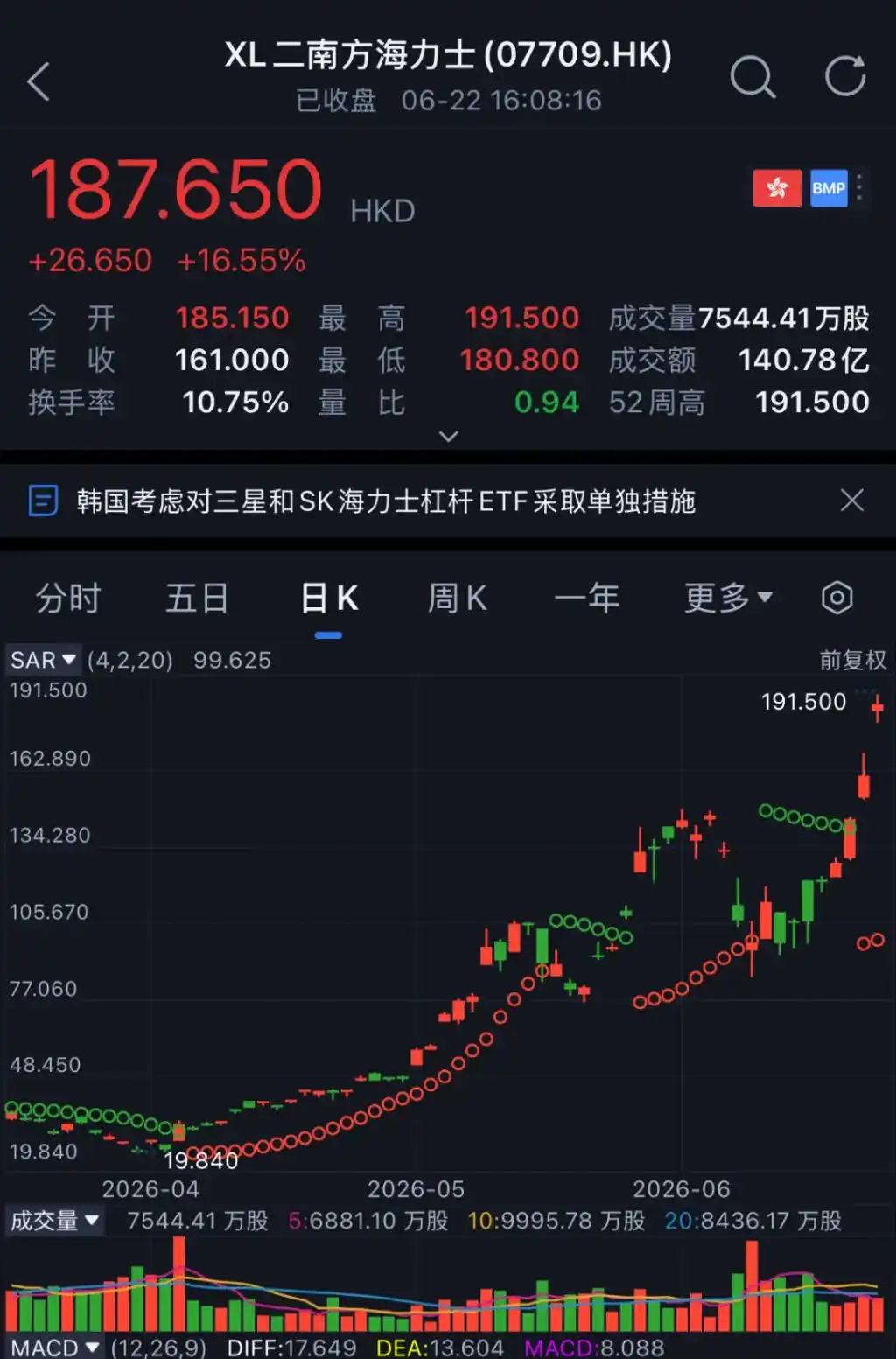
As of the close on June 22, the South China Double Long SK Hynix ETF listed in the Hong Kong market surged 16.55% in a single day, with year-to-date cumulative gains reaching a staggering 1061.92%. The product officially debuted on the Hong Kong Stock Exchange on October 16, 2025, with an initial size of approximately HK$24 million. However, as the storage rally intensified, the product's scale experienced explosive growth – reaching $14.418 billion as of June 18, a meteoric rise of 21.7 times from $636 million at the end of last year.
The South China Double Long Samsung Electronics ETF has also seen substantial capital inflows. Data shows that as of June 18, its size reached $4.4 billion. Following a 215.96% surge in scale in May, its size has grown by over 50% again since June.

However, dissecting the capital structure reveals that the leveraged ETF trading market currently exhibits a highly distinct feature of retail investor dominance, with institutional capital largely absent.

"The vast majority of institutions do not allocate to leveraged ETFs; only a small number of hedge funds use them as tools for short-term swing trading," a senior foreign fund manager candidly told this newspaper. Long-term allocation funds like pensions seek stable, long-term returns, which are completely mismatched with the high-volatility, high-risk return profile of leveraged products. Individual investors constitute the core purchasing group for such products.

Beware of Potential Volatility Risks

From an industry perspective, leveraged ETFs are typical "double-edged swords" that amplify both returns and risks. They can multiply investment returns during upward market phases; however, when the market turns downward, the magnitude of losses is similarly magnified. With growing divergence in global semiconductor sector outlooks and multiple uncertainties intertwining across geopolitics, industry dynamics, and valuations, the hidden risks within leveraged ETFs are continuously being exposed. Investors need to remain highly vigilant.

Recent severe market volatility has vividly demonstrated the destructive power of leveraged product losses. The South Korean Financial Supervisory Service's monitoring report released on June 18 showed that during the period from May 27 to June 12, while the underlying Samsung Electronics stock experienced a maximum drawdown of 18.0%, the corresponding two-times leveraged long ETF suffered a maximum drawdown of 35.9%, with losses nearly doubling. The SK Hynix stock drawdown was 19.1%, but its two-times leveraged ETF drawdown expanded further to 38%. Regulatory authorities have repeatedly warned that with South Korean individual stocks having a daily price limit of ±30%, two-times leveraged products theoretically face maximum single-day losses of up to 60%. Under extreme market conditions, principal capital can be severely depleted.

Beyond the routine amplification of volatility risk, leveraged ETFs have also experienced extreme abnormal scenarios where their price action completely diverges from the underlying stock, inflicting massive losses on retail investors chasing highs in the short term. In early June this year, a two-times leveraged ETF tracking SK Hynix exhibited divergent performance for two consecutive trading days: On June 8, while the underlying SK Hynix stock fell nearly 8%, the ETF surged nearly 50% against the trend; the next day, when the underlying stock rose sharply over 13%, the ETF plummeted by 40% intraday.

Addressing this abnormal volatility, the product issuer, Korea Investment Management, explained that the root cause was insufficient market maker liquidity. During the closing auction period, market makers are not obligated to provide mandatory quotes. A large volume of market buy orders pushed the fund price higher, creating a significant premium. When market liquidity recovered the following day, prices rapidly converged to fair value, causing substantial drawdowns for investors who entered at the previous day's elevated prices.

A fund analyst in Shanghai systematically dissected multiple potential risks of leveraged ETFs, both long-term and short-term: Firstly, due to the derivative structure employing daily leverage resetting, high market volatility environments can lead to time decay. Even if the underlying stock price returns to its previous high, the fund's net asset value may still suffer permanent losses. Secondly, leverage amplifies both gains and losses. With the overall semiconductor sector valuation currently at historical highs, any collective pullback would trigger drawdown impacts far exceeding those of the underlying stocks. If concentrated redemptions occur after sustained product scale inflation, it could also trigger a liquidity spiral, further exacerbating price declines. Thirdly, the trading volume of leveraged products in the South Korean market is nearing that of leading chip stocks themselves. Massive retail capital concentrated in one-sided bets creates a positive feedback loop, continuously boosting buying pressure during rallies, while batch stop-loss selling accelerates declines during downturns, significantly elevating market fragility.

Uncertainties at the industry chain fundamental level can also amplify the volatility risks of leveraged products. Sheng Jin, Portfolio Director at Value Partners, told this newspaper reporter that the semiconductor industry chain is long and deeply intertwined with globalized specialization. The variables affecting valuations are complex and intertwined. Any single variable, such as a company's quarterly earnings falling short of expectations or adjustments in global industrial policies, can quickly disrupt existing valuation logic, triggering violent sector fluctuations, which high-leverage products will synchronously magnify in impact.


Preguntas relacionadas

QWhat is the year-to-date return of the Leverage Product linked to SK Hynix mentioned in the article as of June 22nd?

AThe article states that the year-to-date return of the Southern Leverage Product (ETF) that provides two times the daily return of SK Hynix has exceeded 1000%, specifically reaching 1061.92%.

QWhat are the main risks associated with leveraged ETFs like the one tracking SK Hynix, as highlighted in the article?

AThe article highlights several key risks: 1) Magnified losses during market downturns, as losses are amplified just like gains. 2) The potential for permanent value erosion due to 'volatility decay' inherent in the daily resetting leverage structure. 3) Liquidity risks, where a lack of market makers can lead to extreme price dislocations from the underlying asset, causing severe losses for investors. 4) Increased market fragility due to a high concentration of retail investors engaging in one-sided bets, which can amplify price swings.

QAccording to the article, what is the core driver of the current upcycle in the memory chip sector?

AAccording to Zhou Jingxiang, a fund manager cited in the article, the core driver of the current memory upcycle is the explosive demand for SSD storage brought about by AI inference computing power.

QWhat specific product advancement from SK Hynix is mentioned as contributing to its market performance?

AThe article mentions that SK Hynix announced it had sent samples of its next-generation high-performance DRAM, the 12-layer HBM4E, to key customers. This product is designed for AI scenarios and offers upgrades in both performance and energy efficiency compared to HBM4.

QWhat unusual price behavior did a leveraged ETF tracking SK Hynix exhibit in early June, and what was the cited reason?

AIn early June, a two-times leveraged ETF tracking SK Hynix exhibited a price dislocation from the underlying stock. On June 8th, the stock fell nearly 8%, but the ETF surged nearly 50%. The next day, the stock rose over 13%, but the ETF plunged 40% intraday. The product manager, Korea Investment Management Company, attributed this abnormal volatility to insufficient market maker liquidity during the closing auction period, which led to a large premium. When liquidity normalized, the price sharply corrected to its fair value.

Lecturas Relacionadas

With Labour Changing Leaders, Is the Long-Suppressed UK Crypto Market About to Turn Around?

Labour leader change: Hope for UK crypto market? With Keir Starmer's resignation as Prime Minister and Labour leader, a leadership contest has begun. Andy Burnham, the former Mayor of Greater Manchester and now the overwhelming favourite to succeed, has sparked cautious optimism within the UK cryptocurrency industry. Industry figures hope Burnham, seen as more receptive to digital assets than much of the Labour establishment, could shift the party's traditionally harder line. The leadership transition is expected to be swift, with prediction markets like Polymarket assigning a 97% probability to Burnham becoming the next Prime Minister. However, this political shift comes as a comprehensive regulatory framework for crypto, established by law earlier this year, is in its final implementation phase. The Financial Conduct Authority (FCA) is finalizing detailed rules covering trading, custody, stablecoins, and market abuse, with the full regime set to go live in October 2027. While a new Prime Minister can reshuffle ministers and adjust policy priorities, the core regulatory architecture is now law and unlikely to be fundamentally overturned without significant, deliberate government intervention. The main industry hope is that a Burnham government, focusing on economic growth, will ensure the FCA's implementation is pragmatic and growth-oriented. Industry advocates seek proportionate capital requirements, a streamlined licensing process, and clear rules for staking and stablecoins. They argue that embracing the crypto sector could attract investment and listings to London's struggling markets. Despite the optimism, concerns remain that regulatory implementation may still be influenced by more sceptical factions within the Labour party.

Foresight NewsHace 25 min(s)

With Labour Changing Leaders, Is the Long-Suppressed UK Crypto Market About to Turn Around?

Foresight NewsHace 25 min(s)

A 60-Day Window Depresses Oil Prices, So Why Is the Market Falling Instead?

International oil prices continued to decline on June 23, extending significant losses from the previous session. The market shifted focus from Middle East military risks to actual supply changes following a temporary U.S.-Iran arrangement. The immediate trigger was the resumption of traffic through the Strait of Hormuz, a critical oil shipping chokepoint, with two tankers passing through, signaling eased near-term supply disruption fears. Prices retreated as the "worst-case scenario" was temporarily averted. A reported 60-day window in a U.S.-Iran understanding allows Iran to sell oil during this period, further dampening supply concerns. However, this arrangement is temporary, linked to nuclear talks, and does not guarantee a long-term solution. Market sentiment remains cautious because the deal could still unravel, potentially reinstating sanctions or disrupting shipping. While these developments have lowered immediate risk premiums, prices have not fully returned to pre-conflict levels. Geopolitical news, particularly regarding the stability of the Strait of Hormuz or the progress of negotiations, could quickly reverse the price drop. Additionally, low U.S. strategic petroleum reserves limit the emergency buffer available if supply shocks reemerge. Therefore, the current price decline reflects a reduction in near-term panic, not a complete elimination of Middle East supply risks.

marsbitHace 41 min(s)

A 60-Day Window Depresses Oil Prices, So Why Is the Market Falling Instead?

marsbitHace 41 min(s)

SK Hynix Market Cap Exceeds Samsung for First Time in 26 Years, Korean Broker Calls for 50% More Upside

SK Hynix's market capitalization surpassed Samsung Electronics for the first time in 26 years on June 22, reaching 208.1 trillion won. The shift reflects a market trend where companies directly benefiting from AI infrastructure, like SK Hynix, are receiving higher valuation premiums than diversified giants. The surge is driven by AI-driven demand for High Bandwidth Memory (HBM), where SK Hynix holds a dominant 70-80% market share. Its Q1 2026 revenue exceeded 50 trillion won for the first time, with an operating profit margin of 72%. Hanwha Investment & Securities significantly raised its price target for SK Hynix to 430,000 won, the highest among Korean brokerages. The key rationale is that Long-Term Supply Agreements (LTAs) and robust HBM demand have fundamentally reduced the company's historical profit volatility. Several other brokers have also raised targets, arguing the valuation framework for memory semiconductors is being rewritten, moving away from a cyclical model. Despite the bullish outlook, the stock experienced a pullback of over 5% in regular trading on June 23 after briefly surpassing 3 million won pre-market, amid broader tech sector weakness. Some analysts caution that the市值 overtaking Samsung, whose profit scale and growth forecasts remain higher, could signal short-term overheating. However, high-return investors viewed the dip as a buying opportunity.

marsbitHace 59 min(s)

SK Hynix Market Cap Exceeds Samsung for First Time in 26 Years, Korean Broker Calls for 50% More Upside

marsbitHace 59 min(s)

GPU Rental Prices Drop 30% in Three Weeks: AI Value Chain Migrating from Nvidia to Memory Chips

GPU rental prices for Nvidia's flagship B200 chip have fallen by approximately 30% over three weeks, dropping from a high of $6.11/hour to $4.22/hour. This decline signals a potential easing of the "compute scarcity" narrative that has long supported AI hardware valuations. Concurrently, the semiconductor market is witnessing a significant divergence: while the VanEck Semiconductor ETF (SMH) has risen 15% in the past month, with memory giants Micron and SanDisk each surging nearly 60%, Nvidia's stock has declined about 3% over the same period. Analysts suggest this shift indicates that the AI value chain's bottleneck and profits are migrating from compute (GPUs) to memory. Demand for high-bandwidth memory (HBM) remains intensely strong, with contract prices soaring over 100% in H1 2026, granting memory manufacturers significant pricing power. In contrast, increased B200 supply from improved manufacturing yields and competitive pressure from new cloud providers are softening GPU rental rates. While long-term contracts, like SpaceX's $30 billion deal with Google, show sustained large-scale demand for Nvidia hardware, the softening spot prices pressure the margins of cloud providers and could eventually impact Nvidia's order flow if chip prices don't adjust. The key takeaway for investors is not a weakening AI thesis, but a recalibration within the sector: pricing power appears to be strengthening for memory chipmakers while showing signs of strain for leading GPU suppliers.

marsbitHace 1 hora(s)

GPU Rental Prices Drop 30% in Three Weeks: AI Value Chain Migrating from Nvidia to Memory Chips

marsbitHace 1 hora(s)

Trading

Spot
Futuros
活动图片