EDGE Price Plummets 77%: External Manipulation or Internal Script?

marsbitPublicado a 2026-06-02Actualizado a 2026-06-02

Resumen

On June 2, the native token EDGE of the edgeX protocol experienced a violent flash crash, plummeting over 77% from around $1.14 to a low of $0.32 before partially recovering to approximately $0.64. edgeX officially ruled out a hack or platform security flaw, attributing the event to suspected market manipulation by external actors. The incident reignited community concerns regarding the project's transparency and past controversies. Prominent on-chain investigator ZachXBT highlighted that EDGE supply has long been controlled by a small group, with low circulating liquidity. This structure traces back to a disputed airdrop in April 2026, where the majority of tokens were allocated to partner wallets instead of the community, leading to accusations of a "well-designed rug pull." Despite having notable backers like Circle Ventures and Amber Group, and generating substantial protocol fees, edgeX faces criticism for a recurring pattern of "low float, high control, and opaque market making." While the team investigates the crash and emphasizes its core contracts are operational, user sentiment remains severely damaged, with many expressing a lack of trust in the team's integrity. Meanwhile, prediction markets have already opened betting pools on EDGE's future price.

Original Author: Ma He, Foresight News

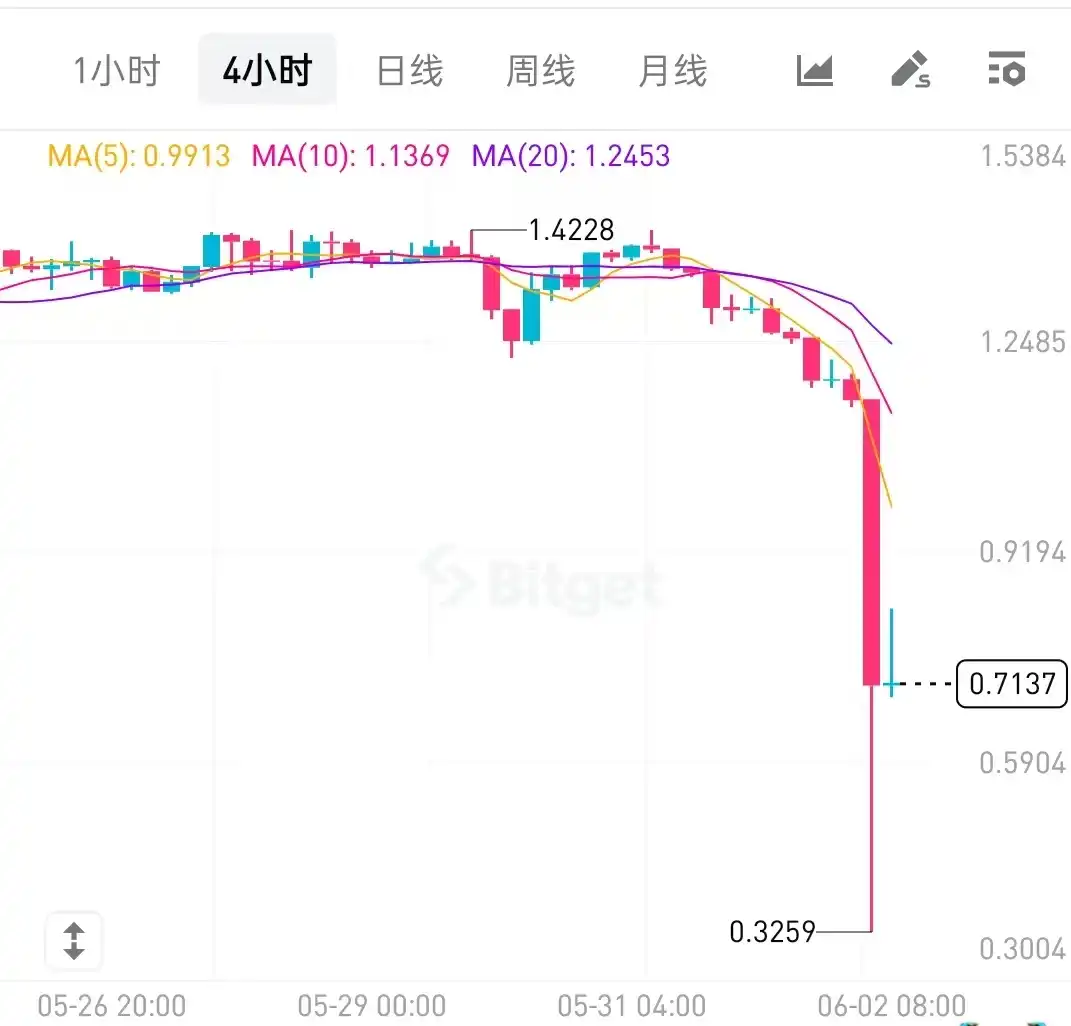
Around 4:00 AM on June 2, the native token EDGE of edgeX experienced severe and abnormal volatility. The price plummeted over 77% in a short period from around $1.14, hitting a low of $0.32, and has since rebounded to around $0.64, with a market cap of approximately $250 million.
edgeX responded immediately, explicitly ruling out hacking or platform security vulnerabilities, and pointed the finger at "intentional market manipulation by external specific entities."
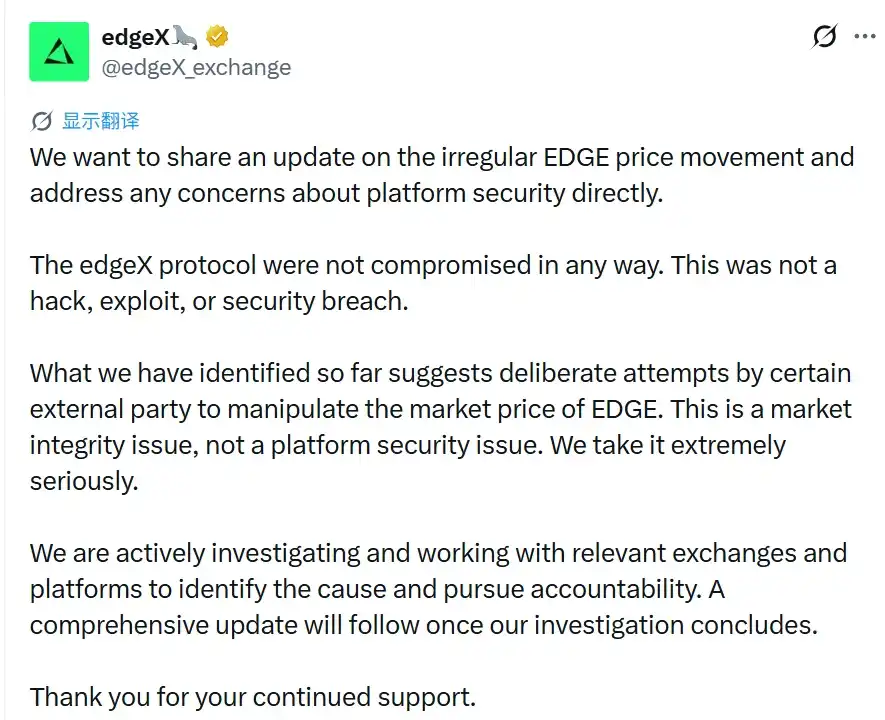
edgeX stated that its protocol was not breached, and there was no hacking or security vulnerability. This price anomaly is suspected to be market manipulation intentionally carried out by external specific entities, making it a market issue rather than a platform security issue. The team is actively investigating and cooperating with relevant exchanges and platforms to trace the responsible parties. Complete investigation results will be announced upon conclusion.

edgeX emphasized that core contracts like SpotVault are operating normally, with no suspicious activity detected, further focusing attention on external market behavior rather than the protocol itself.

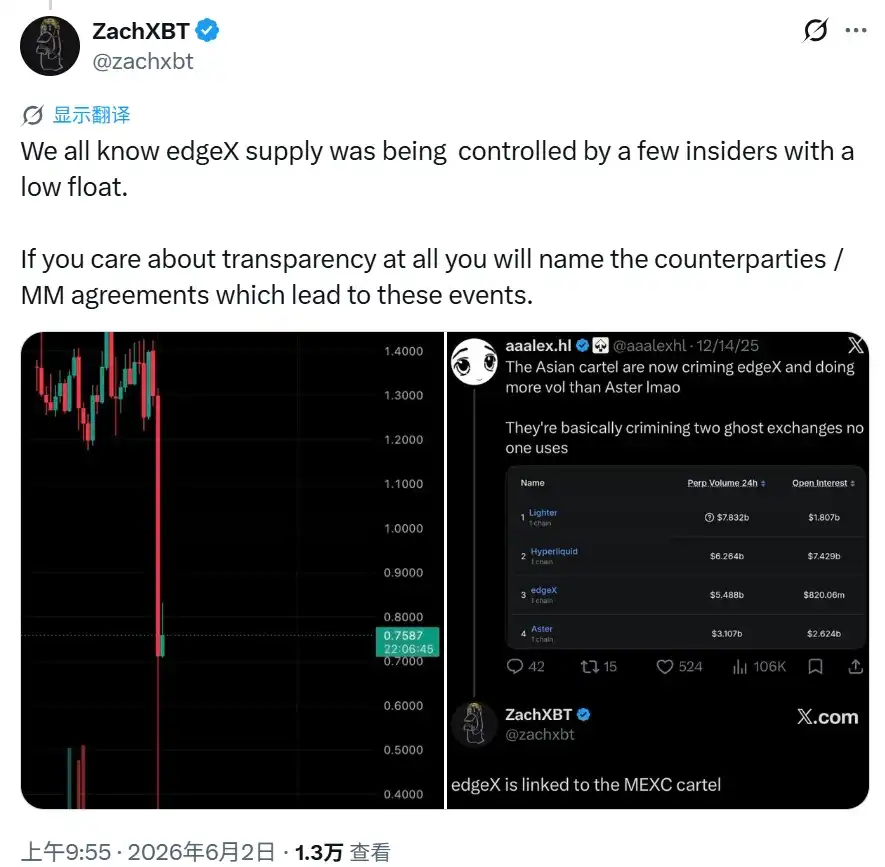
On-chain investigator ZachXBT commented after the incident, pointing out that edgeX supply has long been controlled by a few insiders, with low circulation. He called for the project to disclose market maker and counterparty information to improve transparency.
As the incident developed, many users linked this volatility directly to the project's past operations, expressing disappointment in the team's integrity. One community member bluntly stated: "No one is even discussing the EDGE crash anymore. This project team lacks integrity, goes back on their word, there's really little desire to bottom-fish."

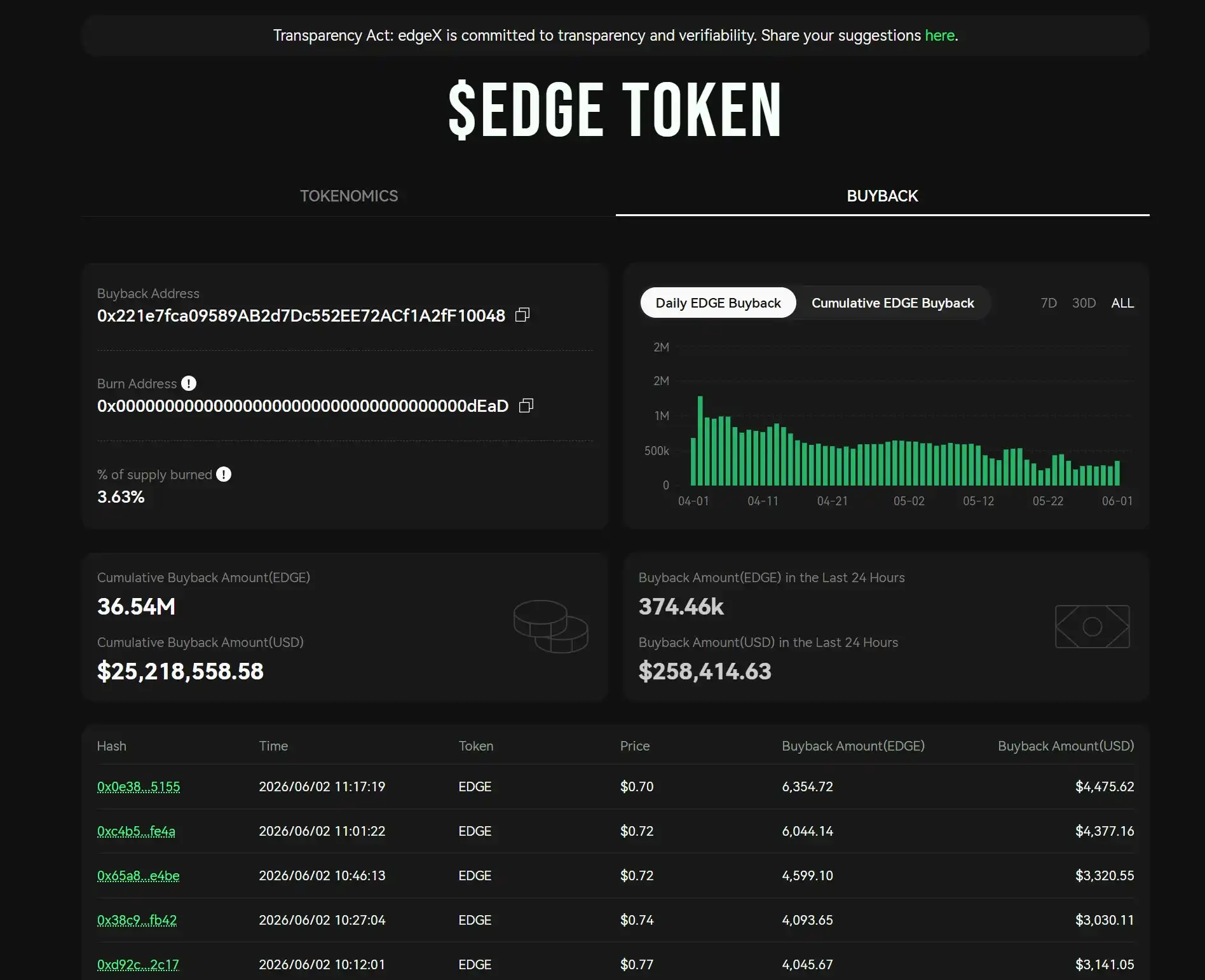
Since its TGE, the EDGE token price rose from $0.7 to $1.5, and subsequently fluctuated around $1.4. The official team also launched a dedicated token website to prove transparency. In late May this year, the protocol launched V2 and adjusted its tokenomics to allocate all profits to repurchasing EDGE. According to its website data, approximately 36.54 million tokens have been repurchased so far, with a total value of around $25 million.
Additionally, related information shows the protocol received investment from Circle Ventures and Amber Group, though specific amounts were not disclosed.

Past Airdrop Controversy Planted Seeds for Subsequent Crash

This incident cannot be separated from the context of edgeX's previous airdrop controversy. In April 2026, the author detailed the entire process of the TGE sparking community dissatisfaction in the article "The Complete Story of the edgeX Airdrop Debacle: An Elaborately Designed Scheme?". The project had promised the community would receive 25% of the token supply, but the actual proportion allocated to ordinary traders was only about 4%, while approximately 14% (valued at around $94.6 million at the time) flowed to partner wallets. Arkham's token flow chart showed at least 80 related addresses were created in 2025, exhibiting consistent behavioral patterns: small test deposits followed by large deposits, and concentrated outflows after TGE, involving about $90 million in token transfers, with some funds flowing to exchanges.

The more core controversy lay in the opaque points exchange mechanism. User feedback indicated huge discrepancies in exchange ratios despite identical trading volumes. Furthermore, the gap between estimated point value (pre-TGE market expectations of $30-40 per point or higher FDV) and actual received amount exceeded 80%. Early contributors and NFT holders also encountered cases of "lowest allocation across the network." Community members flooded the official Twitter account with angry comments, prompting the team to temporarily disable comments.

Afterward, edgeX announced it would lock the controversial 14% share for one year and initiate a buyback, but rejected the community's demand to burn the tokens on Ethereum.
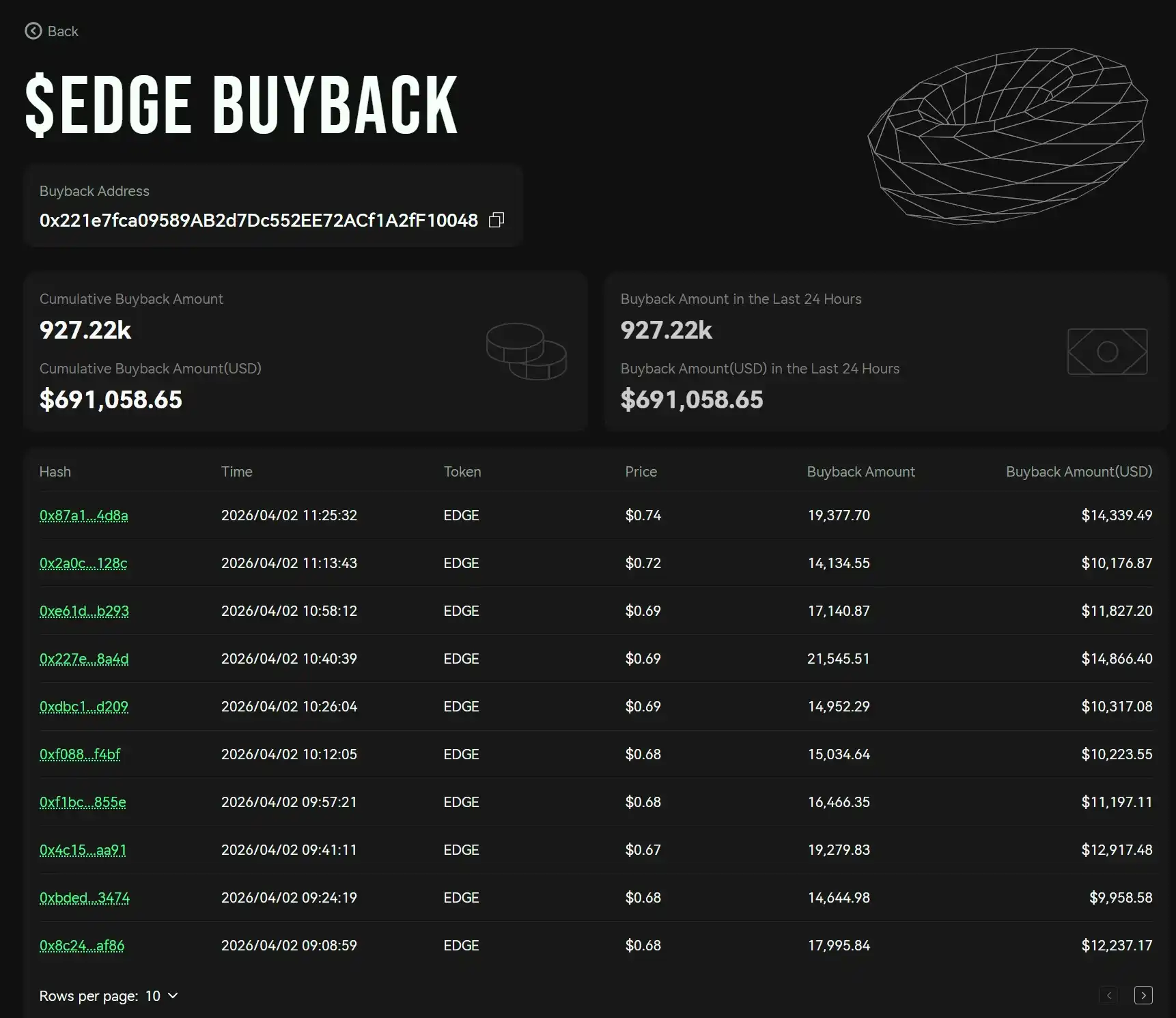
These unresolved issues directly planted the seeds for the current volatility: concentration of chips in a few addresses or related parties makes it easier for external entities to influence prices through large-scale operations. Low circulation is not accidental but an inevitable result of early allocation and lock-up arrangements. When abnormal selling pressure appears in the market, the lack of sufficient depth as a buffer easily triggers a chain reaction.

Structural Risks and Transparency Test

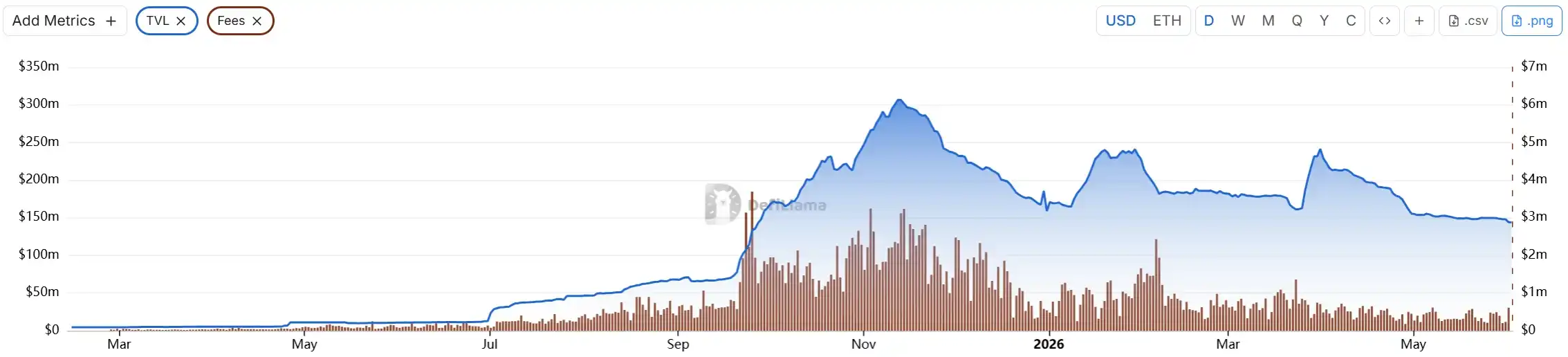
edgeX once carved a niche in the sector with its trading speed, low slippage, and perpetual contract innovation. After TGE, the project experienced a phase of price increase, and its trading volume and fee revenue repeatedly ranked high in DeFi. According to the latest data from DefiLlama, the protocol's total fee revenue over the past 30 days was $10.7 million, and the perpetual DEX's trading volume over the past 30 days reached $42.765 billion.
However, from the airdrop allocation controversy to this price anomaly, this model of 'low circulation + high control + opaque market making' has become a tried-and-true 'serial scam scheme' for new projects in recent years. Mouthing 'community first' while wallets honestly dump tokens to related parties is just a single-player game dressed in DeFi clothing.

The accusation of external manipulation is difficult to prove immediately, but the traceable abnormal on-chain transfers are enough to raise community alarm.

Ironically, just as it faces the whirlpool of plummeting token prices, a price prediction market for its EDGE token has quietly launched on Polymarket.
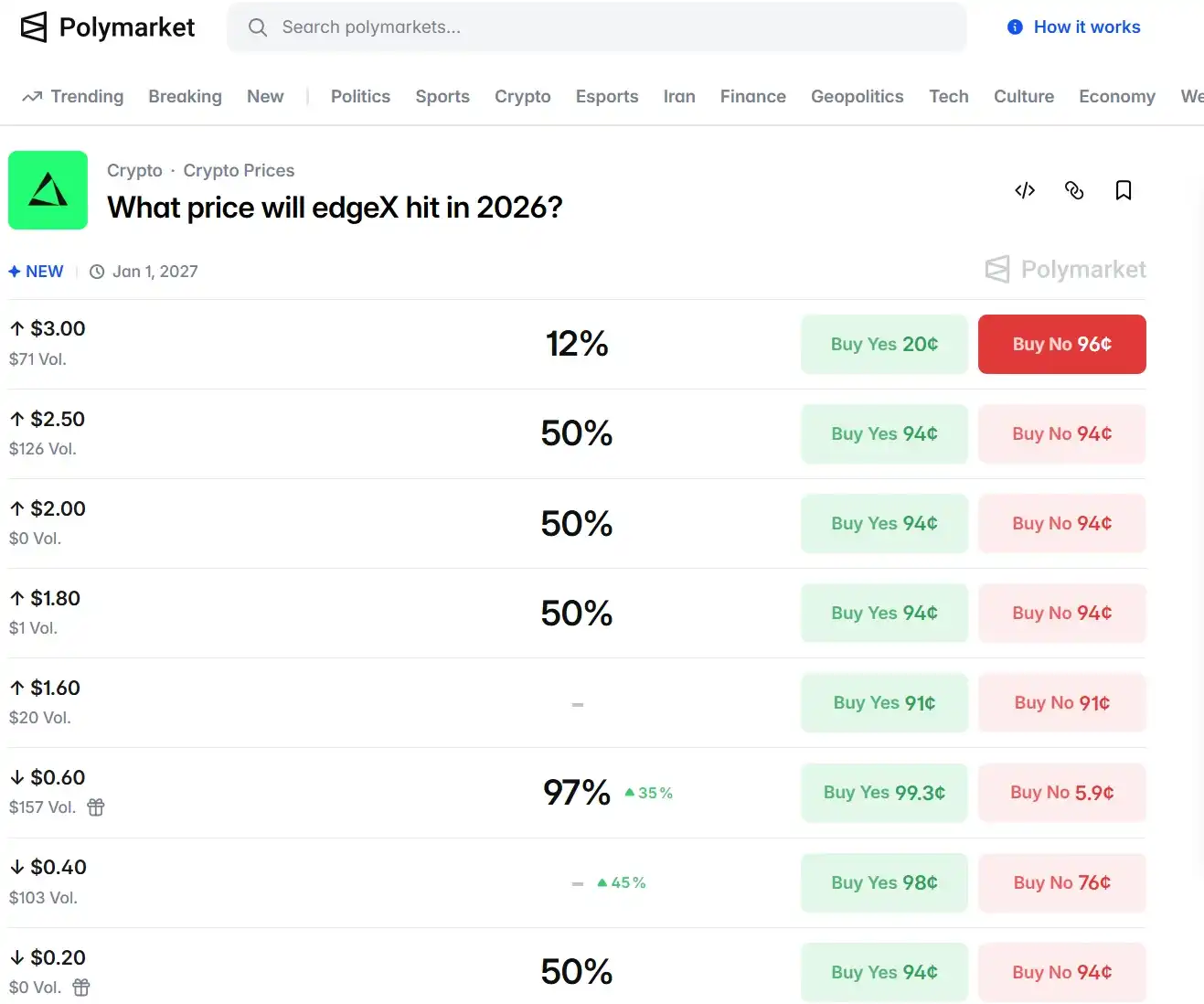
The project team is busy proving its innocence, trapped retail investors are angrily demanding justice. And on Polymarket, some players have already started betting on how much it will rise or fall by this year.


Preguntas relacionadas

QWhat caused the sharp 77% price drop in EDGE token according to the edgeX team?

AThe edgeX team explicitly ruled out a hack or platform security vulnerability. They attributed the price drop to 'market manipulation intentionally carried out by a specific external entity', framing it as a market problem rather than a security problem with their platform.

QWhat criticism did ZachXBT level against the edgeX project following the price crash?

AZachXBT criticized the project's lack of transparency. He pointed out that the EDGE supply has long been controlled by a small number of insiders with low circulation, and demanded that the project publicly disclose information about its market makers and counterparties.

QWhat past controversy is mentioned as setting the stage for this price volatility event?

AThe article mentions a significant airdrop controversy from April 2026. The project promised 25% of tokens to the community, but only allocated about 4% to regular traders, while about 14% (worth roughly $94.6 million at the time) went to partner wallets, causing major community discontent and distrust.

QWhat structural risk pattern does the article accuse edgeX and similar new projects of following?

AThe article accuses edgeX of following a pattern common in recent new projects: 'low circulation + high control by insiders + non-transparent market making'. It describes this as a 'serial harvesting scheme' that acts like a single-player game disguised as DeFi.

QHow did the edgeX protocol perform in terms of trading activity prior to this incident according to DefiLlama data?

AAccording to DefiLlama data cited in the article, the edgeX protocol had strong performance metrics. Its total fee revenue over the past 30 days was $10.7 million, and the trading volume for its perpetual DEX over the past 30 days reached $42.765 billion.

Lecturas Relacionadas

Can DeepSeek Save China One Trillion Dollars?

"DeepSeek and the $1 Trillion Infrastructure Question" The article examines whether DeepSeek's AI optimization breakthroughs could potentially save China $1 trillion in future AI infrastructure costs. The analysis begins with Nvidia's upcoming Vera Rubin AI platform, costing ~$7.8 million, where memory (HBM4/LPDDR5X) constitutes $2 million—a 435% cost increase in one year, highlighting how AI hardware spending is shifting toward expensive memory components. DeepSeek's approach works in the opposite direction. Through three key technical innovations showcased in DeepSeek V4, the company dramatically improves hardware efficiency: 1. **Memory Compression (MLA)**: Re-engineers the attention mechanism to compress long-context memory (KV Cache) by over 90%, drastically reducing expensive HBM usage. 2. **Selective Activation (MoE)**: Employs Mixture-of-Experts architecture where only a small fraction of parameters (e.g., 49B out of 1.6T in V4-Pro) are activated per token, allowing most parameters to reside in cheaper memory/SSD. 3. **Computation Caching**: Reuses previously computed results via cache hits, replacing expensive GPU computations with cheap memory reads. Combined, these optimizations allow the same hardware to produce approximately 4x more tokens, effectively reducing required hardware investment by 75%. DeepSeek's pricing reflects this: a 10-billion token workload costs ~$522 monthly versus ~$9,000-$10,000 for competitors. The $1 trillion savings projection stems from McKinsey's estimate that global AI infrastructure will require ~$5.2 trillion investment by 2030. As China's daily token consumption grows toward quadrillions, even marginal efficiency gains scale massively. With a conservative 4x throughput improvement, China could avoid building tens of thousands of AI data centers equivalent to ~7 trillion RMB ($1 trillion) in saved investment. Critically, this strategy shifts dependency from scarce, expensive GPU/HBM—where China lags—toward more accessible storage, caching, and systems engineering where domestic suppliers like CXMT are gaining strength. Rather than "replacing Nvidia," DeepSeek rebalances AI's value chain away from monolithic hardware dependency. Ultimately, DeepSeek's technical breakthroughs could lower the barrier to AI adoption across Chinese industries by making advanced capabilities affordable at scale—transforming who can access next-generation AI.

marsbitHace 32 min(s)

Can DeepSeek Save China One Trillion Dollars?

marsbitHace 32 min(s)

Overturning the Mainstream Approach to Hallucinations: Metacognition is the New Solution for Large Models to Break the Hallucination Barrier

This paper, "Hallucinations Undermine Trust; Metacognition is a Way Forward," proposes a paradigm shift in combating AI hallucination. It argues that the current mainstream approaches—striving for omniscience by scaling data/models or having AI abstain from uncertain answers—are fundamentally flawed. The former has inevitable knowledge gaps, while the latter imposes a crippling "utility tax," requiring the rejection of many correct answers to achieve high accuracy, due to models' poor "discrimination" (the ability to distinguish correct from incorrect answers internally). The core contribution is redefining hallucination not as "being wrong," but as "expressing false information with unwarranted certainty." The proposed solution is **Faithful Uncertainty** or **Metacognition**: enabling AI to accurately perceive its internal uncertainty and honestly express it in its language (e.g., using hedging phrases when unsure). This creates a more reliable assistant that provides useful information while signaling its confidence, minimizing harm from errors. The paper emphasizes that metacognition is critical for the era of AI Agents. Without it, Agents cannot intelligently decide when to use tools like search engines, leading to inefficiency and misuse. Key implementation challenges are highlighted: the "bootstrapping paradox" of training with static uncertainty data, the "alignment distortion signal" where human preference training suppresses internal uncertainty cues, and the difficulty of causally evaluating true metacognition vs. its superficial imitation. The paper concludes that the goal should not be an infallible AI, but one that is honest about the limits of its knowledge, thereby building user trust through transparent communication of its certainty.

marsbitHace 36 min(s)

Overturning the Mainstream Approach to Hallucinations: Metacognition is the New Solution for Large Models to Break the Hallucination Barrier

marsbitHace 36 min(s)

Hedge by Buying Gold and Oil, Chase Soaring Returns with AI. ‘Dated’ Bitcoin Enters a Bear Market

Bitcoin has recently declined, hitting a two-month low near $66,123, while Ethereum fell to a three-month low around $1,837. Analysts suggest the drop is not merely due to factors like ETF outflows or MicroStrategy's selling but reflects a deeper issue: Bitcoin is losing a broader asset competition. In a near-zero interest rate environment, Bitcoin previously thrived as an outlet for investor dissatisfaction with inflation and limited options. However, the market landscape has shifted. Bitcoin now occupies an "awkward middle ground," facing competition on three fronts. For inflation hedging, investors prefer gold, energy stocks, and commodity producers—assets with tangible backing and clearer pricing power. For growth exposure, AI-related companies with actual revenues and profits are more attractive. Even within crypto, investors can choose stablecoins, exchanges, or infrastructure firms tied directly to adoption, offering clearer business models and leverage. Thus, Bitcoin is no longer the top choice for hedging, growth, or crypto exposure. This shift is evident in market reactions: despite recent warnings about persistent inflation from a Fed official, Bitcoin did not rally as it might have in the past. Instead, capital flowed to assets with direct commodity or energy exposure. The recent ETF outflows and MicroStrategy sales are symptoms, not causes, of this new reality. Investors are becoming more selective, demanding clearer value propositions beyond mere scarcity. The emerging bear case for Bitcoin is not about it being a bubble or failed technology, but that scarcity alone is no longer sufficient.

华尔街日报Hace 39 min(s)

Hedge by Buying Gold and Oil, Chase Soaring Returns with AI. ‘Dated’ Bitcoin Enters a Bear Market

华尔街日报Hace 39 min(s)

Trading

Spot
Futuros

Artículos destacados

Cómo comprar EDGE

¡Bienvenido a HTX.com! Hemos hecho que comprar edgeX (EDGE) sea simple y conveniente. Sigue nuestra guía paso a paso para iniciar tu viaje de criptos.Paso 1: crea tu cuenta HTXUtiliza tu correo electrónico o número de teléfono para registrarte y obtener una cuenta gratuita en HTX. Experimenta un proceso de registro sin complicaciones y desbloquea todas las funciones.Obtener mi cuentaPaso 2: ve a Comprar cripto y elige tu método de pagoTarjeta de crédito/débito: usa tu Visa o Mastercard para comprar edgeX (EDGE) al instante.Saldo: utiliza fondos del saldo de tu cuenta HTX para tradear sin problemas.Terceros: hemos agregado métodos de pago populares como Google Pay y Apple Pay para mejorar la comodidad.P2P: tradear directamente con otros usuarios en HTX.Over-the-Counter (OTC): ofrecemos servicios personalizados y tipos de cambio competitivos para los traders.Paso 3: guarda tu edgeX (EDGE)Después de comprar tu edgeX (EDGE), guárdalo en tu cuenta HTX. Alternativamente, puedes enviarlo a otro lugar mediante transferencia blockchain o utilizarlo para tradear otras criptomonedas.Paso 4: tradear edgeX (EDGE)Tradear fácilmente con edgeX (EDGE) en HTX's mercado spot. Simplemente accede a tu cuenta, selecciona tu par de trading, ejecuta tus trades y monitorea en tiempo real. Ofrecemos una experiencia fácil de usar tanto para principiantes como para traders experimentados.

450 Vistas totalesPublicado en 2026.03.31Actualizado en 2026.06.02

Cómo comprar EDGE

Discusiones

Bienvenido a la comunidad de HTX. Aquí puedes mantenerte informado sobre los últimos desarrollos de la plataforma y acceder a análisis profesionales del mercado. A continuación se presentan las opiniones de los usuarios sobre el precio de EDGE (EDGE).

活动图片