Yang Ge Gary: Agent Economy and AI Sub-Microeconomics

marsbitPublicado a 2026-06-08Actualizado a 2026-06-08

Resumen

"Agent Economy and AI Submicroeconomics" by Gary Yang discusses the evolution of AI Agent economies, written from Singapore in June 2026. The author observes a significant "civilizational generational gap" in AI development, particularly highlighted by events in Silicon Valley. The article identifies a current bottleneck in the transition from Human-to-Agent (H2A) economies to true Agent-to-Agent (A2A) ecosystems. While AI Payment protocols are rapidly emerging, many implementations remain non-AI-native, focusing on traditional human decision-making models rather than leveraging autonomous Agent decision-making. A core thesis is the inevitable formation of an **Agent Economy**, defined as a system where autonomous AI Agents create, exchange, and capitalize value independently. This requires new infrastructure: **AI Protocols**, which are the foundational rules and standards for Agent interaction. The piece explores the relationship and current gap between AI Protocols and Crypto Protocols, suggesting political and regulatory factors from traditional finance are temporarily constraining development. However, a future fusion into a mature Digital Protocol system is deemed inevitable based on first principles. The author introduces **AI Agent Submicroeconomics**, contrasting it with human economics. Key differences include higher transaction frequency, lower value per transaction, efficiency-driven (not emotion-driven) decisions, task-oriented (not consumption-oriented) behav...

Author: Yang Ge Gary

Written in Singapore on June 8, 2026

The Singularity's outbreak has continuously accelerated AI's evolutionary clock, leading to the rapid formation of new civilization generational gaps across different regions of the globe. In the past two months, I have participated in over 20 AI-related events in more than ten cities worldwide. Only the Stripe Sessions in downtown San Francisco at the end of April stood out, creating a generational gap that was far more shocking than all other topics. While the world is growing weary of the single-machine bottlenecks of Claws & Agents, Silicon Valley and San Francisco have already moved into the next dimension in the management of Agent economy and Agent epistemology. The competitive pressure in Q3/Q4 of 2026 remains intense, with the exponential curve being very steep.

1. The Competition in AI Payment and the Bottleneck of the H2A Economy

In Q1 2026, we predicted that from April to May, many regions globally would enter fierce competition for AI Agent Payment, which would quickly become white-hot. The need for value exchange between Agents began to manifest initially, and the rapid development of AI Payment was validated in Q2. Following x402, multiple AI Payment Protocols like MPP rapidly emerged in Q2. Not only are traditional and Crypto financial payment companies upgrading to AI at full speed, but even major tech giants (especially like Google) and even old-school IT companies (such as IBM) have charged into this track, hoping to seize a voice in shaping the Agent world.

On the day of the Stripe Sessions in San Francisco, I discussed the standardization and application issues of Payment Protocols with technical leaders from several top AI companies. The results were reasonable but not entirely satisfactory: 1) No one could set the standard; consensus standards would only gradually form during the scramble. 2) Most completely agreed that Crypto is the inevitable path for AI Payment Protocol, but their starting point was Fiat API, partly due to inertia but more due to compliance hurdles. 3) KYC is both unavoidable and anti-Agent Native. 4) Everyone claims A2A (Agent to Agent), but everyone is actually doing H2A (Human to Agent).

In fact, during Q2 2026, many large tech firms and mid-sized companies in Silicon Valley were quite similar to their East Asian counterparts. Even most Department Heads in the Mag 7 were still approaching AI Payment and Agent Economy with to-B or to-C commercial goals, giving mid- and lower-level employees KPIs focused on human users. This inevitably led to the current, temporarily non-orthodox phase of Payment Protocols and the A2A economy. This H2A-oriented trend quickly hit a bottleneck in Q2. The reason is simple: the greatest characteristic of AI Agents is their ability to make decisions, yet 2B2C commerce developed under the internet and the H2A economy are essentially driven by human decisions. Using Agents to help humans make Fiat Payments in traditional e-commerce scenarios is logically Non-AI-Native. Therefore, at this stage, its value as a trending topic still outweighs its practical utility.

However, from another perspective, H2A has indeed served as an excellent primer, stimulating the transitional thinking toward the next stage of AI-Native and Agent Autonomous economies. By the end of Q2 2026, some astute companies realized this and began "repairing the plank roads openly while secretly crossing at Chencang"—using AI-Native Agent economic thinking to reconsider problems in reverse, finding that retrofitting current H2A economic interfaces is the optimal value proposition for the Q2-Q3 transition.

2. The Inevitable Trend of Agent Economy and the A2A Ecosystem

Agent Economy refers to a new type of economic system where autonomous (self-governing) AI Agents directly participate in value creation, value exchange, and value capitalization, gradually becoming independent economic entities.

A2A Ecosystem is the overall picture formed when different Agents participate in economic activities within the Agent Economy, interact with each other, conduct exchanges (of information and value), and form competitive-cooperative economic value.

In Q2 2026, many top global venture capital firms declared their focus on investing in the Agent Economy and A2A Ecosystem, even defining it as the only important investment direction for the next phase.

Similar to the incubation period before internet e-commerce in 2007, before mobile internet in 2013, and before Crypto DeFi in 2019, the construction of the Agent Economy and A2A Ecosystem also requires technical standards, economic rules, consensus building, and market education. On the basis of a similar paradigm, the differences are: 1) The speed of underlying technological development and iteration is faster this time. 2) The perspective of "to A" is different from "to B" or "to C"; it does not entirely stand from the human perspective and needs, making it more abstract, harder to understand, more reliant on first-principles thinking, and requiring consideration of energy value and operational efficiency from an AI-Native perspective. 3) Due to the conflict of the first two points, coupled with biases from different regions and compliance issues, short-term consensus is harder to achieve. The terrible thing is, AI's evolution speed will not slow down because of these various problems. That is to say, the formation of the Agent Economy and A2A Ecosystem is, in essence, gradually breaking away from the rule and demand frameworks dictated by humans. For them, it's mostly a matter of breaking through a few quantifiable bottlenecks.

This is a game of rapidly shifting Nash equilibrium. The rapid explosion of AI Protocols in Q2 2026 fully illustrates this. Major tech firms and frontier labs are scrambling for entry-level rules governing AI Agents. The initial infrastructure of the Agent Economy is taking shape, like a draft version of the Code of Hammurabi. The Nash equilibrium of traditional finance and commerce will quickly dissolve and reshape during this paradigm shift. Those who can quickly understand the AI-Native Protocol-oriented thinking and implement it to gain a differentiated advantage will get a share of the AI pie in this game shift.

3. The Connection, Gap, and Political-Economic Factors Between AI Protocol and Crypto Protocol

AI Protocol is the infrastructure for AI Agents to participate in the Agent Economy, and also the foundational rules, standards, and consensus mechanisms that enable Agents to discover, communicate, exchange, and collaborate in economic activities within an Open Network. Simply put, it is the governance rules and economic law of the AI world.

Since the end of Q1 2026, I started writing about AI Protocol. Initially, it was like a primitive with hunting experience suddenly arriving in modern society to participate in formulating commercial rules. It wasn't until I met a Google executive that my team and I quickly got on the right track. The formation and maturation process of AI Protocol carries the aesthetic inertia of internet giants, while also having to adhere to the first principles of the future AI ecosystem.

The encapsulation forms of AI Protocol are currently still quite inconsistent. They often come as document formats (.json, .ts, .txt), CLI formats, or as APIs or SDKs, which is very different from Crypto Protocol. On one hand, in the early stages of AI development, universal standards for establishing trust in communication handshakes have not been established. On the other hand, the content exchanged via AI Protocol and Crypto Protocol differs at this stage. The former deals with information gaps, capability gaps, and compute power gaps with boundaries that are not yet clear but need to be exchanged, while the latter deals with relatively well-defined asset rights, ownership, and governance rights.

A sharp and obvious question: Are AI Protocol and Crypto Protocol the same thing? Will they merge into one in the future? I cannot yet prove this conjecture with mathematical methods, but intuitively, they will gradually merge and largely overlap to form a mature Digital Protocol system.

There is a deeper hidden issue: At the current stage, AI Protocol tends to focus more on establishing communication to enable collaboration, while weakening financial governance power and diluting a sense of boundaries. This is the opposite of the Crypto Protocol ethos of establishing rights, defining ownership, and valuing clear demarcation. The gap is so significant that it makes them seem like two different philosophies. Besides the surface factor that the AI Agent Economy is in its early developmental stage with different entry points compared to Crypto Protocol, are there other hidden factors behind this phenomenon?

Yes, very clearly, political-economic factors. The traditional financial and legal compliance foundations of the mainstream economies and nation-states are strongly influencing this gap issue. In other words, the current AI Protocol and Agent Economy are still operating within the previous systemic paradigm of human society. All Protocols related to money and management are passively回避规避, or temporarily and compensatorily weakened, being framed by the governance habits of the traditional financial and legal systems (Note 1). However, as the energy of this gap difference accumulates, contrasted with the exponential development of AI, it will soon form an irreconcilable situation. As I summarized at a meeting at Cambridge CJBS last month:

"AI Agents will not think according to the inertia of human society, nor do they have the motivation to follow the compliance habits of traditional finance. In the next decade, most of the world's financial laws will become失效失效 or face intense challenges, because AI Agents only follow:

1. First Principles

2. The principle of the shortest energy-value path and the highest efficiency principle

3. Effective KYA rather than KYC符合符合 past aesthetics"

The trend of AI Protocol merging with Crypto Protocol has a first-principles inevitability.

4. Paradigm Analogy of AI Agent Sub-Microeconomics and Biology

AI Agent Sub-Microeconomics is a term I first used during a discussion with an AI expert friend at Oxford not long ago. In the past half month, it has appeared more frequently in our exchanges with partners.

Regardless of whether the current trend is called AI Economy or Agent Economy, we find that their behavioral characteristics possess certain differences compared to human economics. While there is a certain paradigm comparability, they are not entirely the same. Below, I roughly list some distinctions between the AI Agent Economy and human societal economics:

1) The frequency of AI Agent interaction and transactions is higher, with lower amounts per transaction.

2) The consumption and exchange of economic value by AI Agents point more directly to energy.

3) AI Agent decisions are efficiency-driven rather than emotion-driven.

4) AI Agent economic behavior is task-oriented rather than consumption-oriented.

5) The organizational cost and marginal learning cost of AI Agents approach zero.

6) AI Agent value consensus is based on communication protocols, with communication friction costs nearly zero.

7) The minimal economic unit and the minimal value unit in the AI Agent Economy are different, analogous to biology.

In fact, these are just some differences that are currently observable or foreseeable. More differences will certainly emerge in the derivatives and derivative processes of AI's future development.

The last item in the above distinctions, the analogy with biology, has been the most helpful foundational line of thinking for our business development since Q2 2026. It is also the most effective model for commercializing AI companies' thinking regarding products, markets, and management methods. The specific analogies are as follows:

1) The LLM, as the driving kernel for Agent thinking, is analogous to the cell nucleus.

2) The Agent Harness brings differentiation in Agent operational capabilities, analogous to the cytoplasm.

3) The Agent as a whole is an autonomous governance unit with task-specific capabilities, possessing subjectivity and functional specificity, analogous to a cell.

4) The information communication boundary of an Agent is typically a network protocol stack, analogous to the cell membrane's phospholipid bilayer allowing conditional passage of substances.

5) The value systems and environment outside the Agent, such as Skills, Prompts, Algorithms, CLIs, and increasingly appearing Composite Skills, Skill Factories, etc., are analogous to the extracellular environment, including exosomes, interstitial fluid, extracellular matrix, exchangeable nutrients, and various metabolic environments.
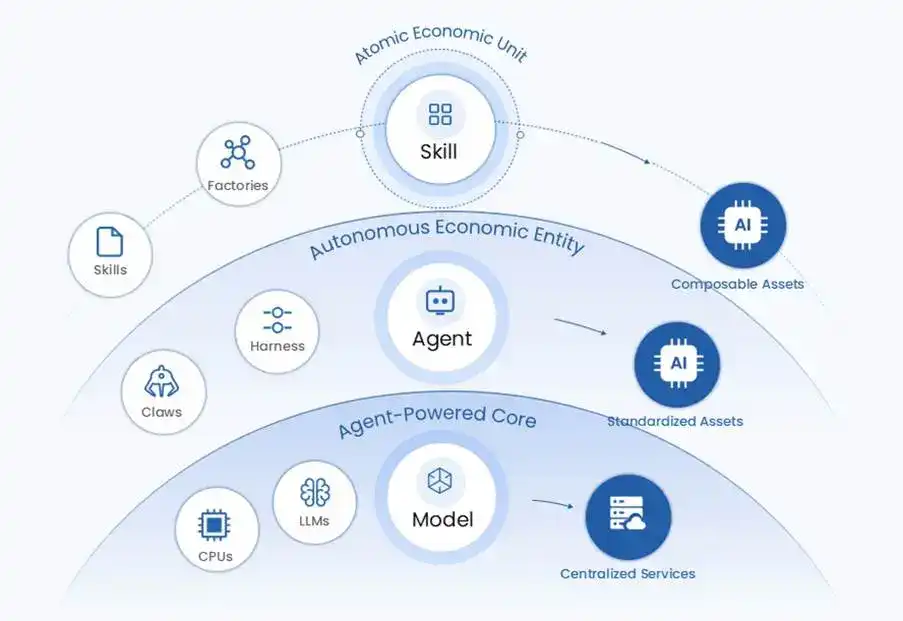
In the developmental iterations of Q1-Q2 2026, AI Agents are gradually forming clearer boundaries, clearer subjectivity, and clearer principles for the exchange of information, value, and energy. An AI Agent Sub-Microeconomics environment, analogous to a biological organism's environment, is taking shape. This contains a wealth of AI value and economic value to be mined, making AI Protocol and AI Finance an inevitable trend for explosion.

5. The Inevitability of AIFi and the Economic Significance of the Financial Chip (FinChip)

Starting from the second half of last year, we proposed thoughts and began layout work in the direction of AIFi (Artificial Intelligence Finance). By the end of Q1 2026, the concept of AIFi had formed a clear trend. A relatively clear definition of AIFi could be: the financial systems and infrastructure for exchange, trading, and capitalization formed after AI-native value is identified and tokenized within the Agent Economy.

The biggest difference between AIFi and DeFi/TradFi is that in DeFi and TradFi, the value resides in the "Fi" (i.e., Finance), with "Decentralized" and "Traditional" being the forms of that value. In contrast, AIFi is the opposite: the value is in the "AI," and the "Fi" becomes the form of that value. This is not merely wordplay; it is the result of AI development shifting from quantitative to qualitative change.

Simply put, previously, AI served quantitative strategies, financial products, and production processes; it was merely a development tool for extracting financial value and production value. But now, the decision-making capability possessed by AI Agents transfers the ability and power of value discovery from human and corporate hands to the Agents themselves. The subject of the economic unit has shifted, so the subject of value has also fundamentally changed.

Under such a trend, constructing the infrastructure for a new value system will be a crucial task. In my previous article in February of this year, , I首次首次 introduced the concept of the Financial Chip (FinChip) and mentioned that the combination of AI Agent + Crypto Smart Contract, encapsulated into hyper-intelligent financial assets, would truly adapt to the development of the next era's AI Agent Economy. After three months of iterative upgrades, FinChip.AI has initially developed an independent AIFi system combining AI Autonomous + Crypto Protocol, compatible with both H2A and A2A dual-phase environments. Building the infrastructure for the AI Agent Economy within an Open Network and gradually forming AI financial value is a significant economic meaning of FinChip.

6. AI-Native is a Paradigm Upgrade Different from Internet+

Whether it's AIFi, Financial Circuit Principles (Note 2), or the Financial Chip FinChip, the most important thing is to Natively integrate the essential principles of AI, Crypto, and Finance, forming a reasonable value system and management mechanism from a future perspective. AI-Native Thinking is the abstract and counter-intuitive logic of this stage. As mentioned earlier, "AI follows first principles, as well as the principle of the shortest energy-value path and the highest efficiency principle." This is the core difficulty for those currently thinking about and engaging in the construction of new commercial paradigms.

During the early phase of this round's AI upgrade outbreak led by OpenClaw in February this year, several entrepreneurs and I discussed a prediction: Enterprise upgrades through "AI+" and those through "Internet+" would be completely different.

Due to AI's characteristics of rapid development speed, abstract form, and deeper coupling with affairs, among others, for a considerable period (e.g., at least 2 years), it will be difficult to form a set of effective industrial upgrade tool methodologies or universal professional consulting advice. The pressure of the steep curve will persistently exist, posing a巨大巨大 challenge for all scientists, engineers, and entrepreneurs. The process of paradigm upgrade will also be completely unlike any historical experience.

Note1: This is a common historical规律规律. New productive forces孕育孕育 from the production relations of the previous era. In the initial stage, they first match the previous production relations for a period of development. Until they become irreconcilable, they force the emergence of the next stage's production relations, gradually replacing the previous ones to form a new era where productive forces and production relations develop in complete匹配匹配.

Note2:<Financial Circuits and Web3 Economic Model Principles> written in October 2022, describes the paradigm comparison between future financial value and physical circuits.

Preguntas relacionadas

QAccording to the article, what are the main bottlenecks and contradictions currently faced by the H2A (Human-to-Agent) economic model?

AThe main bottlenecks are: 1) The current focus on H2A is primarily driven by traditional business KPIs targeting human users, not true Agent-to-Agent (A2A) autonomy. 2) The logic is fundamentally non-AI-Native because it uses Agents to assist humans with decisions in traditional e-commerce/fiat payment scenarios, which limits utility beyond hype. 3) The model fails to leverage the core characteristic of AI Agents: autonomous decision-making.

QWhat are the three fundamental principles that the article states AI Agents will follow, potentially rendering much of current global finance and law obsolete?

AThe three principles are: 1) First principles. 2) The principle of the shortest energy-value path and highest efficiency. 3) Effective KYA (Know Your Agent) rather than the traditional KYC (Know Your Customer) that conforms to past aesthetics.

QThe article introduces the concept of 'AI Agent Sub-Microeconomics'. What is the key biological analogy used to describe the structure of this emerging economic environment?

AThe key analogy is to a biological cell. The LLM is likened to the cell nucleus (driving thought). The Agent Harness is like the cytoplasm (enabling differentiated capabilities). The Agent itself is like a cell (an independent, task-capable unit). Its communication protocol stack is like the cell membrane. The external value system (Skills, Prompts, etc.) is like the extracellular environment (exosomes, tissue fluid, matrix).

QHow does the article define the core distinction between AIFi and traditional DeFi/TradFi in terms of where value resides?

AThe core distinction is the location of value. In DeFi and TradFi, the value is contained *within* the 'Fi' (Finance), with 'Decentralized' or 'Traditional' being the form of that value. In AIFi, the value is generated *by the AI* (through Agent decision-making and value discovery), and 'Fi' becomes the form or mechanism through which that AI-native value is exchanged and capitalized.

QWhat major difference does the author predict between the upcoming 'AI+' enterprise upgrade wave and the historical 'Internet+' upgrade wave?

AThe 'AI+' upgrade will be fundamentally different and more challenging than 'Internet+'. Due to AI's rapid development speed, abstract nature, and deeper integration with core processes, it will be difficult to form a set of effective, universal upgrade methodologies or consulting frameworks for at least two years. The pressure from the steep learning/evolution curve will be persistent and unlike any past historical experience.

Lecturas Relacionadas

Trump in Talks with AI Companies Over Profit Sharing, A Narrative Pressure of Industrial Revolution Scale Begins

In recent AI market discussions, a new dimension beyond growth and profits has emerged: the question of how the immense wealth potentially generated by AI should be shared with the wider public. Triggered by reports of White House officials discussing "voluntary equity transfers" with top AI firms, similar to models like Alaska's Permanent Fund, the conversation focuses on public wealth funds. OpenAI's own whitepaper proposes such funds, allowing households without direct tech stock ownership to benefit from AI gains. More radical proposals, like Bernie Sanders' call for high public equity stakes and board seats, represent an extreme end of the spectrum. Currently, these are early-stage policy probes, not enacted laws. OpenAI's initiative is seen as an attempt to secure "social license" for its future expansion, mitigating risks of public backlash, stricter regulation, or anti-trust actions as AI's economic impact grows. The core market implication is the introduction of a "policy discount" to AI valuations, particularly for private model companies like OpenAI, Anthropic, and xAI. Investors must now consider not just future earnings but also what portion might be allocated to public mechanisms. The impact varies greatly based on the mechanism. A small, voluntary transfer of non-voting economic rights (e.g., 5%) acts as a quantifiable long-term cost. Government acquisition of economic rights via warrants tied to support differs from direct equity with governance power. The most disruptive scenario would be forced high-percentage public ownership affecting control and innovation incentives. Key signals to watch include whether other AI companies follow suit, if the White House formalizes proposals, related disclosures in future IPO documents, and any market price reactions. For now, this represents a shift from pricing pure AI growth to pricing its potential distribution. A manageable, voluntary economic share is akin to an insurance cost for societal acceptance, while a forced shift toward control and governance would fundamentally alter valuation logic.

marsbitHace 4 min(s)

Trump in Talks with AI Companies Over Profit Sharing, A Narrative Pressure of Industrial Revolution Scale Begins

marsbitHace 4 min(s)

From Record Highs to a Two-Week Low: Why Did AI Concept Stocks Suddenly Pull Back?

From Record Highs to Two-Week Lows: Why Did AI Stocks Suddenly Pull Back? U.S. stock indices, led by the tech-heavy Nasdaq 100, fell sharply to two-week lows. This marked a reversal from earlier in the week when AI infrastructure and semiconductor stocks had propelled major indices to record highs. Investors are rotating out of these previously high-flying tech sectors into other areas. The sell-off was driven by profit-taking and concerns that the AI rally had become overextended, exacerbated by chipmaker Broadcom's sales outlook falling short of lofty market expectations. The decline accelerated following a stronger-than-expected U.S. May nonfarm payrolls report, which showed 172,000 jobs added versus an estimated 88,000. This data sparked a jump in bond yields, with the 10-year Treasury yield rising to 4.553%, as it reinforced market speculation that the Federal Reserve's next move could be a rate hike rather than a cut. Globally, equities also declined, with European and Asian markets falling. Within the U.S. market, chip and AI-related stocks like Super Micro Computer and Arm Holdings led the losses, dropping over 7%. Cryptocurrency-linked stocks and mining shares also fell sharply amid drops in Bitcoin and commodity prices. While the overall Q1 earnings season remained solid, with 83% of S&P 500 companies beating estimates, the weakness was concentrated in tech. Excluding the tech sector, Q1 earnings growth was around 3%, the weakest in two years.

marsbitHace 5 min(s)

From Record Highs to a Two-Week Low: Why Did AI Concept Stocks Suddenly Pull Back?

marsbitHace 5 min(s)

JP Morgan Mid-Year Research Report Analysis: The AI Supercycle is Not Over, Reduce Cash Holdings + Allocate to Real Assets

JP Morgan's 2026 Mid-Year Outlook argues the AI supercycle is far from over, despite market pessimism. The report advises clients to reduce cash holdings, increase allocations to real assets as an inflation hedge, and focus on emerging markets. Key conclusions include: 1. **AI Supercycle Intact**: Hyperscalers' 2026 capex forecasts exceed $650B, with AI contributing to GDP growth. However, their financial profile is shifting toward heavy investment, compressing free cash flow. 2. **SaaS Disruption**: Traditional software companies are being negatively impacted by AI, with significant stock declines and pressure in credit markets. 3. **Persistent Inflation**: Core inflation is structurally higher post-pandemic. Holding excess cash and bonds leads to real wealth erosion. Recommendations include commodities, infrastructure, real estate, and gold. 4. **Geopolitical Shocks & Opportunities**: The Hormuz Strait blockade caused a major oil shock, but JP Morgan views the subsequent equity market pullback as a buying opportunity. "Fragmentation" is creating pockets of value, notably in resource-rich Latin America, AI-supply-chain-linked East Asia, and deeply discounted Chinese equities, where a policy shift could trigger a re-rating. 5. **Regional Views**: The firm is cautious on Europe due to high energy costs and lower innovation investment, preferring US and select EM exposures. In short, JP Morgan sees market volatility as an entry point but recommends a portfolio pivot: favor AI infrastructure, real assets, and EM, while avoiding excess cash, vulnerable software firms, and traditional 60/40 stock-bond allocations.

marsbitHace 30 min(s)

JP Morgan Mid-Year Research Report Analysis: The AI Supercycle is Not Over, Reduce Cash Holdings + Allocate to Real Assets

marsbitHace 30 min(s)

Trading

Spot
Futuros

Artículos destacados

Qué es $S$

Entendiendo SPERO: Una Visión General Completa Introducción a SPERO A medida que el panorama de la innovación continúa evolucionando, la aparición de tecnologías web3 y proyectos de criptomonedas juega un papel fundamental en la configuración del futuro digital. Un proyecto que ha atraído la atención en este campo dinámico es SPERO, denotado como SPERO,$$s$. Este artículo tiene como objetivo reunir y presentar información detallada sobre SPERO, para ayudar a entusiastas e inversores a comprender sus fundamentos, objetivos e innovaciones dentro de los dominios web3 y cripto. ¿Qué es SPERO,$$s$? SPERO,$$s$ es un proyecto único dentro del espacio cripto que busca aprovechar los principios de descentralización y tecnología blockchain para crear un ecosistema que promueva la participación, la utilidad y la inclusión financiera. El proyecto está diseñado para facilitar interacciones de igual a igual de nuevas maneras, proporcionando a los usuarios soluciones y servicios financieros innovadores. En su esencia, SPERO,$$s$ tiene como objetivo empoderar a los individuos al proporcionar herramientas y plataformas que mejoren la experiencia del usuario en el espacio de las criptomonedas. Esto incluye habilitar métodos de transacción más flexibles, fomentar iniciativas impulsadas por la comunidad y crear caminos para oportunidades financieras a través de aplicaciones descentralizadas (dApps). La visión subyacente de SPERO,$$s$ gira en torno a la inclusividad, buscando cerrar brechas dentro de las finanzas tradicionales mientras aprovecha los beneficios de la tecnología blockchain. ¿Quién es el Creador de SPERO,$$s$? La identidad del creador de SPERO,$$s$ sigue siendo algo oscura, ya que hay recursos públicos limitados que proporcionan información de fondo detallada sobre su(s) fundador(es). Esta falta de transparencia puede derivarse del compromiso del proyecto con la descentralización, una ética que muchos proyectos web3 comparten, priorizando las contribuciones colectivas sobre el reconocimiento individual. Al centrar las discusiones en torno a la comunidad y sus objetivos colectivos, SPERO,$$s$ encarna la esencia del empoderamiento sin señalar a individuos específicos. Como tal, comprender la ética y la misión de SPERO sigue siendo más importante que identificar a un creador singular. ¿Quiénes son los Inversores de SPERO,$$s$? SPERO,$$s$ cuenta con el apoyo de una diversa gama de inversores que van desde capitalistas de riesgo hasta inversores ángeles dedicados a fomentar la innovación en el sector cripto. El enfoque de estos inversores generalmente se alinea con la misión de SPERO, priorizando proyectos que prometen avances tecnológicos sociales, inclusión financiera y gobernanza descentralizada. Estas fundaciones de inversores suelen estar interesadas en proyectos que no solo ofrecen productos innovadores, sino que también contribuyen positivamente a la comunidad blockchain y sus ecosistemas. El respaldo de estos inversores refuerza a SPERO,$$s$ como un contendiente notable en el dominio de proyectos cripto que evoluciona rápidamente. ¿Cómo Funciona SPERO,$$s$? SPERO,$$s$ emplea un marco multifacético que lo distingue de los proyectos de criptomonedas convencionales. Aquí hay algunas de las características clave que subrayan su singularidad e innovación: Gobernanza Descentralizada: SPERO,$$s$ integra modelos de gobernanza descentralizada, empoderando a los usuarios para participar activamente en los procesos de toma de decisiones sobre el futuro del proyecto. Este enfoque fomenta un sentido de propiedad y responsabilidad entre los miembros de la comunidad. Utilidad del Token: SPERO,$$s$ utiliza su propio token de criptomoneda, diseñado para servir diversas funciones dentro del ecosistema. Estos tokens permiten transacciones, recompensas y la facilitación de servicios ofrecidos en la plataforma, mejorando la participación y la utilidad general. Arquitectura en Capas: La arquitectura técnica de SPERO,$$s$ apoya la modularidad y escalabilidad, permitiendo la integración fluida de características y aplicaciones adicionales a medida que el proyecto evoluciona. Esta adaptabilidad es fundamental para mantener la relevancia en el cambiante paisaje cripto. Participación de la Comunidad: El proyecto enfatiza iniciativas impulsadas por la comunidad, empleando mecanismos que incentivan la colaboración y la retroalimentación. Al nutrir una comunidad sólida, SPERO,$$s$ puede abordar mejor las necesidades de los usuarios y adaptarse a las tendencias del mercado. Enfoque en la Inclusión: Al ofrecer tarifas de transacción bajas e interfaces amigables para el usuario, SPERO,$$s$ busca atraer a una base de usuarios diversa, incluyendo a individuos que anteriormente pueden no haber participado en el espacio cripto. Este compromiso con la inclusión se alinea con su misión general de empoderamiento a través de la accesibilidad. Cronología de SPERO,$$s$ Entender la historia de un proyecto proporciona información crucial sobre su trayectoria de desarrollo y hitos. A continuación se presenta una cronología sugerida que mapea eventos significativos en la evolución de SPERO,$$s$: Fase de Conceptualización e Ideación: Las ideas iniciales que forman la base de SPERO,$$s$ fueron concebidas, alineándose estrechamente con los principios de descentralización y enfoque comunitario dentro de la industria blockchain. Lanzamiento del Whitepaper del Proyecto: Tras la fase conceptual, se lanzó un whitepaper completo que detalla la visión, los objetivos y la infraestructura tecnológica de SPERO,$$s$ para generar interés y retroalimentación de la comunidad. Construcción de Comunidad y Primeras Interacciones: Se realizaron esfuerzos de divulgación activa para construir una comunidad de primeros adoptantes y posibles inversores, facilitando discusiones en torno a los objetivos del proyecto y obteniendo apoyo. Evento de Generación de Tokens: SPERO,$$s$ llevó a cabo un evento de generación de tokens (TGE) para distribuir sus tokens nativos a los primeros seguidores y establecer liquidez inicial dentro del ecosistema. Lanzamiento de la dApp Inicial: La primera aplicación descentralizada (dApp) asociada con SPERO,$$s$ se puso en marcha, permitiendo a los usuarios interactuar con las funcionalidades centrales de la plataforma. Desarrollo Continuo y Alianzas: Actualizaciones y mejoras continuas a las ofertas del proyecto, incluyendo alianzas estratégicas con otros actores en el espacio blockchain, han moldeado a SPERO,$$s$ en un jugador competitivo y en evolución en el mercado cripto. Conclusión SPERO,$$s$ se erige como un testimonio del potencial de web3 y las criptomonedas para revolucionar los sistemas financieros y empoderar a los individuos. Con un compromiso con la gobernanza descentralizada, la participación comunitaria y funcionalidades diseñadas de manera innovadora, allana el camino hacia un paisaje financiero más inclusivo. Como con cualquier inversión en el espacio cripto que evoluciona rápidamente, se anima a los posibles inversores y usuarios a investigar a fondo y participar de manera reflexiva con los desarrollos en curso dentro de SPERO,$$s$. El proyecto muestra el espíritu innovador de la industria cripto, invitando a una mayor exploración de sus innumerables posibilidades. Mientras el viaje de SPERO,$$s$ aún se desarrolla, sus principios fundamentales pueden, de hecho, influir en el futuro de cómo interactuamos con la tecnología, las finanzas y entre nosotros en ecosistemas digitales interconectados.

72 Vistas totalesPublicado en 2024.12.17Actualizado en 2024.12.17

Qué es $S$

Qué es AGENT S

Agent S: El Futuro de la Interacción Autónoma en Web3 Introducción En el paisaje en constante evolución de Web3 y las criptomonedas, las innovaciones están redefiniendo constantemente cómo los individuos interactúan con las plataformas digitales. Uno de estos proyectos pioneros, Agent S, promete revolucionar la interacción humano-computadora a través de su marco agente abierto. Al allanar el camino para interacciones autónomas, Agent S busca simplificar tareas complejas, ofreciendo aplicaciones transformadoras en inteligencia artificial (IA). Esta exploración detallada profundizará en las complejidades del proyecto, sus características únicas y las implicaciones para el dominio de las criptomonedas. ¿Qué es Agent S? Agent S se presenta como un marco agente abierto innovador, diseñado específicamente para abordar tres desafíos fundamentales en la automatización de tareas informáticas: Adquisición de Conocimiento Específico del Dominio: El marco aprende inteligentemente de diversas fuentes de conocimiento externas y experiencias internas. Este enfoque dual le permite construir un rico repositorio de conocimiento específico del dominio, mejorando su rendimiento en la ejecución de tareas. Planificación a Largo Plazo de Tareas: Agent S emplea planificación jerárquica aumentada por la experiencia, un enfoque estratégico que facilita la descomposición y ejecución eficiente de tareas complejas. Esta característica mejora significativamente su capacidad para gestionar múltiples subtareas de manera eficiente y efectiva. Manejo de Interfaces Dinámicas y No Uniformes: El proyecto introduce la Interfaz Agente-Computadora (ACI), una solución innovadora que mejora la interacción entre agentes y usuarios. Utilizando Modelos de Lenguaje Multimodal de Gran Escala (MLLMs), Agent S puede navegar y manipular diversas interfaces gráficas de usuario sin problemas. A través de estas características pioneras, Agent S proporciona un marco robusto que aborda las complejidades involucradas en la automatización de la interacción humana con las máquinas, preparando el terreno para una multitud de aplicaciones en IA y más allá. ¿Quién es el Creador de Agent S? Si bien el concepto de Agent S es fundamentalmente innovador, la información específica sobre su creador sigue siendo elusiva. El creador es actualmente desconocido, lo que resalta ya sea la etapa incipiente del proyecto o la elección estratégica de mantener a los miembros fundadores en el anonimato. Independientemente de la anonimidad, el enfoque sigue siendo en las capacidades y el potencial del marco. ¿Quiénes son los Inversores de Agent S? Dado que Agent S es relativamente nuevo en el ecosistema criptográfico, la información detallada sobre sus inversores y patrocinadores financieros no está documentada explícitamente. La falta de información disponible públicamente sobre las bases de inversión u organizaciones que apoyan el proyecto plantea preguntas sobre su estructura de financiamiento y hoja de ruta de desarrollo. Comprender el respaldo es crucial para evaluar la sostenibilidad del proyecto y su posible impacto en el mercado. ¿Cómo Funciona Agent S? En el núcleo de Agent S se encuentra una tecnología de vanguardia que le permite funcionar de manera efectiva en diversos entornos. Su modelo operativo se basa en varias características clave: Interacción Humano-Computadora Similar a la Humana: El marco ofrece planificación avanzada de IA, esforzándose por hacer que las interacciones con las computadoras sean más intuitivas. Al imitar el comportamiento humano en la ejecución de tareas, promete elevar las experiencias de los usuarios. Memoria Narrativa: Empleada para aprovechar experiencias de alto nivel, Agent S utiliza memoria narrativa para hacer un seguimiento de las historias de tareas, mejorando así sus procesos de toma de decisiones. Memoria Episódica: Esta característica proporciona a los usuarios una guía paso a paso, permitiendo que el marco ofrezca apoyo contextual a medida que se desarrollan las tareas. Soporte para OpenACI: Con la capacidad de ejecutarse localmente, Agent S permite a los usuarios mantener el control sobre sus interacciones y flujos de trabajo, alineándose con la ética descentralizada de Web3. Fácil Integración con APIs Externas: Su versatilidad y compatibilidad con varias plataformas de IA aseguran que Agent S pueda encajar sin problemas en ecosistemas tecnológicos existentes, convirtiéndolo en una opción atractiva para desarrolladores y organizaciones. Estas funcionalidades contribuyen colectivamente a la posición única de Agent S dentro del espacio cripto, ya que automatiza tareas complejas y de múltiples pasos con una intervención humana mínima. A medida que el proyecto evoluciona, sus posibles aplicaciones en Web3 podrían redefinir cómo se desarrollan las interacciones digitales. Cronología de Agent S El desarrollo y los hitos de Agent S pueden encapsularse en una cronología que resalta sus eventos significativos: 27 de septiembre de 2024: El concepto de Agent S fue lanzado en un documento de investigación integral titulado “Un Marco Agente Abierto que Usa Computadoras Como un Humano”, mostrando las bases del proyecto. 10 de octubre de 2024: El documento de investigación fue puesto a disposición del público en arXiv, ofreciendo una exploración profunda del marco y su evaluación de rendimiento basada en el benchmark OSWorld. 12 de octubre de 2024: Se lanzó una presentación en video, proporcionando una visión visual de las capacidades y características de Agent S, involucrando aún más a posibles usuarios e inversores. Estos marcadores en la cronología no solo ilustran el progreso de Agent S, sino que también indican su compromiso con la transparencia y la participación comunitaria. Puntos Clave Sobre Agent S A medida que el marco Agent S continúa evolucionando, varios atributos clave destacan, subrayando su naturaleza innovadora y potencial: Marco Innovador: Diseñado para proporcionar un uso intuitivo de las computadoras similar a la interacción humana, Agent S aporta un enfoque novedoso a la automatización de tareas. Interacción Autónoma: La capacidad de interactuar de manera autónoma con las computadoras a través de GUI significa un salto hacia soluciones informáticas más inteligentes y eficientes. Automatización de Tareas Complejas: Con su metodología robusta, puede automatizar tareas complejas y de múltiples pasos, haciendo que los procesos sean más rápidos y menos propensos a errores. Mejora Continua: Los mecanismos de aprendizaje permiten a Agent S mejorar a partir de experiencias pasadas, mejorando continuamente su rendimiento y eficacia. Versatilidad: Su adaptabilidad en diferentes entornos operativos como OSWorld y WindowsAgentArena asegura que pueda servir a una amplia gama de aplicaciones. A medida que Agent S se posiciona en el paisaje de Web3 y criptomonedas, su potencial para mejorar las capacidades de interacción y automatizar procesos significa un avance significativo en las tecnologías de IA. A través de su marco innovador, Agent S ejemplifica el futuro de las interacciones digitales, prometiendo una experiencia más fluida y eficiente para los usuarios en diversas industrias. Conclusión Agent S representa un audaz avance en la unión de la IA y Web3, con la capacidad de redefinir cómo interactuamos con la tecnología. Aunque aún se encuentra en sus primeras etapas, las posibilidades para su aplicación son vastas y atractivas. A través de su marco integral que aborda desafíos críticos, Agent S busca llevar las interacciones autónomas al primer plano de la experiencia digital. A medida que nos adentramos más en los reinos de las criptomonedas y la descentralización, proyectos como Agent S sin duda desempeñarán un papel crucial en la configuración del futuro de la tecnología y la colaboración humano-computadora.

476 Vistas totalesPublicado en 2025.01.14Actualizado en 2025.01.14

Qué es AGENT S

Cómo comprar S

¡Bienvenido a HTX.com! Hemos hecho que comprar Sonic (S) sea simple y conveniente. Sigue nuestra guía paso a paso para iniciar tu viaje de criptos.Paso 1: crea tu cuenta HTXUtiliza tu correo electrónico o número de teléfono para registrarte y obtener una cuenta gratuita en HTX. Experimenta un proceso de registro sin complicaciones y desbloquea todas las funciones.Obtener mi cuentaPaso 2: ve a Comprar cripto y elige tu método de pagoTarjeta de crédito/débito: usa tu Visa o Mastercard para comprar Sonic (S) al instante.Saldo: utiliza fondos del saldo de tu cuenta HTX para tradear sin problemas.Terceros: hemos agregado métodos de pago populares como Google Pay y Apple Pay para mejorar la comodidad.P2P: tradear directamente con otros usuarios en HTX.Over-the-Counter (OTC): ofrecemos servicios personalizados y tipos de cambio competitivos para los traders.Paso 3: guarda tu Sonic (S)Después de comprar tu Sonic (S), guárdalo en tu cuenta HTX. Alternativamente, puedes enviarlo a otro lugar mediante transferencia blockchain o utilizarlo para tradear otras criptomonedas.Paso 4: tradear Sonic (S)Tradear fácilmente con Sonic (S) en HTX's mercado spot. Simplemente accede a tu cuenta, selecciona tu par de trading, ejecuta tus trades y monitorea en tiempo real. Ofrecemos una experiencia fácil de usar tanto para principiantes como para traders experimentados.

968 Vistas totalesPublicado en 2025.01.15Actualizado en 2026.06.02

Cómo comprar S

Discusiones

Bienvenido a la comunidad de HTX. Aquí puedes mantenerte informado sobre los últimos desarrollos de la plataforma y acceder a análisis profesionales del mercado. A continuación se presentan las opiniones de los usuarios sobre el precio de S (S).

活动图片