Attention: Cryptocurrency Exchange Mistakenly Transfers User Information to Hackers

cryptonews.ruPublished on 2026-09-12Last updated on 2026-09-12

Abstract

Blockchain researcher ZachXBT reports that fintech company Revolut may have inadvertently disclosed user data to hackers by falling for a spoofed legal request. The incident began when Revolut received an information request that appeared to come from a legitimate government agency, using the agency's official email domain. The email was accepted as authentic because it contained valid domain verification information. Failing to detect the fraudulent nature of the request, Revolut potentially provided user information in response. Potentially compromised data includes user names, dates of birth, occupations, addresses, email addresses, phone numbers, copies of passports or driver's licenses, selfies from identity verification, account statements, IBAN information, withdrawal records, and extensive transaction history, including Bitcoin transactions. Revolut's security notice stated that facial biometric telemetry data was not affected. ZachXBT notes that while the incident appears limited so far, it may have specifically targeted high-net-worth users. Several Revolut users have reportedly received security notifications related to this event.

Blockchain researcher ZachXBT suggests that fintech company Revolut may have transferred personal data of some users to third parties, having mistaken a forged request from a government institution for a genuine one. According to information published on ZachXBT's personal channel, the incident began when Revolut received a request for client information that appeared to come from a legitimate government agency and used that agency's official email domain.

According to the investigation, the email in question was accepted by Revolut as authentic because it contained verifiable domain confirmation information. As a result of the company's failure to detect the fraudulent nature of the request, some user information may have been obtained or transferred in response to it.

The potentially affected data includes users' first and last names, dates of birth, occupations, addresses, email addresses and phone numbers, as well as copies of passports or driver's licenses, selfies taken during identity verification, account statements, IBAN information, withdrawal records, and extensive transaction history, including Bitcoin transactions. In its security notice to users, Revolut indicated that facial biometric telemetry data was not affected by the incident.

ZachXBT noted that although the incident currently appears to be limited in scope, it may have specifically targeted users with substantial assets. According to the statement, several Revolut users have recently received security notifications related to this incident.

*This is not investment advice.

end-content

Related Questions

QWhat was the suspected security incident involving fintech company Revolut, according to blockchain researcher ZachXBT?

AZachXBT suspects that Revolut may have mistakenly handed over some users' personal data to third parties after falling for a fake request that appeared to be from a legitimate government agency.

QHow did the fraudulent request manage to appear genuine to Revolut?

AThe fraudulent request used the official email domain of the legitimate government agency and contained authentic-looking information to verify the domain, which led Revolut to accept it as genuine.

QWhat types of user data were potentially compromised in this incident?

APotentially compromised data includes users' first and last names, dates of birth, occupations, addresses, email addresses, phone numbers, copies of passports or driver's licenses, selfies from identity verification, account statements, IBAN information, withdrawal records, and extensive transaction history, including Bitcoin transactions.

QWhat user group might have been specifically targeted in this attack, according to the report?

AThe report suggests that while the incident appears limited, it might have been specifically targeted against Revolut users with substantial assets.

QWhat assurance did Revolut reportedly give to users regarding biometric data in its security notification?

AIn its security notification to users, Revolut reportedly stated that facial biometric telemetry data was not affected by the incident.

Related Reads

230k-follower “Crypto God” exposed: 30 sock puppet accounts caught harvesting fans

Cupsey, a Solana meme coin trader with over 230,000 X followers, has been exposed by on-chain analytics firm Bubblemaps for allegedly running roughly 30 secret wallets to profit off his own followers. Since May 7, these linked addresses traded over 27,000 tokens and cashed out about $1.74 million on roughly 3,000 tokens using a repeated three-step scheme: four core wallets quietly accumulate a new token and spread holdings across 12 associated wallets; Cupsey's public wallet then buys the same token and he promotes it to followers; finally, the hidden wallets sell into the incoming buy orders. In some cases the secret wallets dumped tokens while Cupsey was still drafting his recommendation posts. Because new meme coins have thin liquidity, followers' buys push prices up briefly, letting the insider wallets exit while late buyers absorb the losses. The report also links Cupsey-associated wallets to a token-issuing address starting with "3z4vj," which launched over 400 tokens and earned an estimated $1.3 million. Beyond trading spreads, Cupsey reportedly received about $331,000 in Pump.fun promotion rewards. Bubblemaps has similarly exposed other top traders such as Anglio, 0xEthan, and Solstice for front-running their own recommendations, in some cases buying about 20 seconds before posting. The firm criticizes platforms for rewarding trading volume with millions in incentives while doing little to detect bundled holdings, insider wallets, or repeat offenders, turning followers into exit liquidity. Cupsey has not yet responded to the allegations.

marsbit1h ago

230k-follower “Crypto God” exposed: 30 sock puppet accounts caught harvesting fans

marsbit1h ago

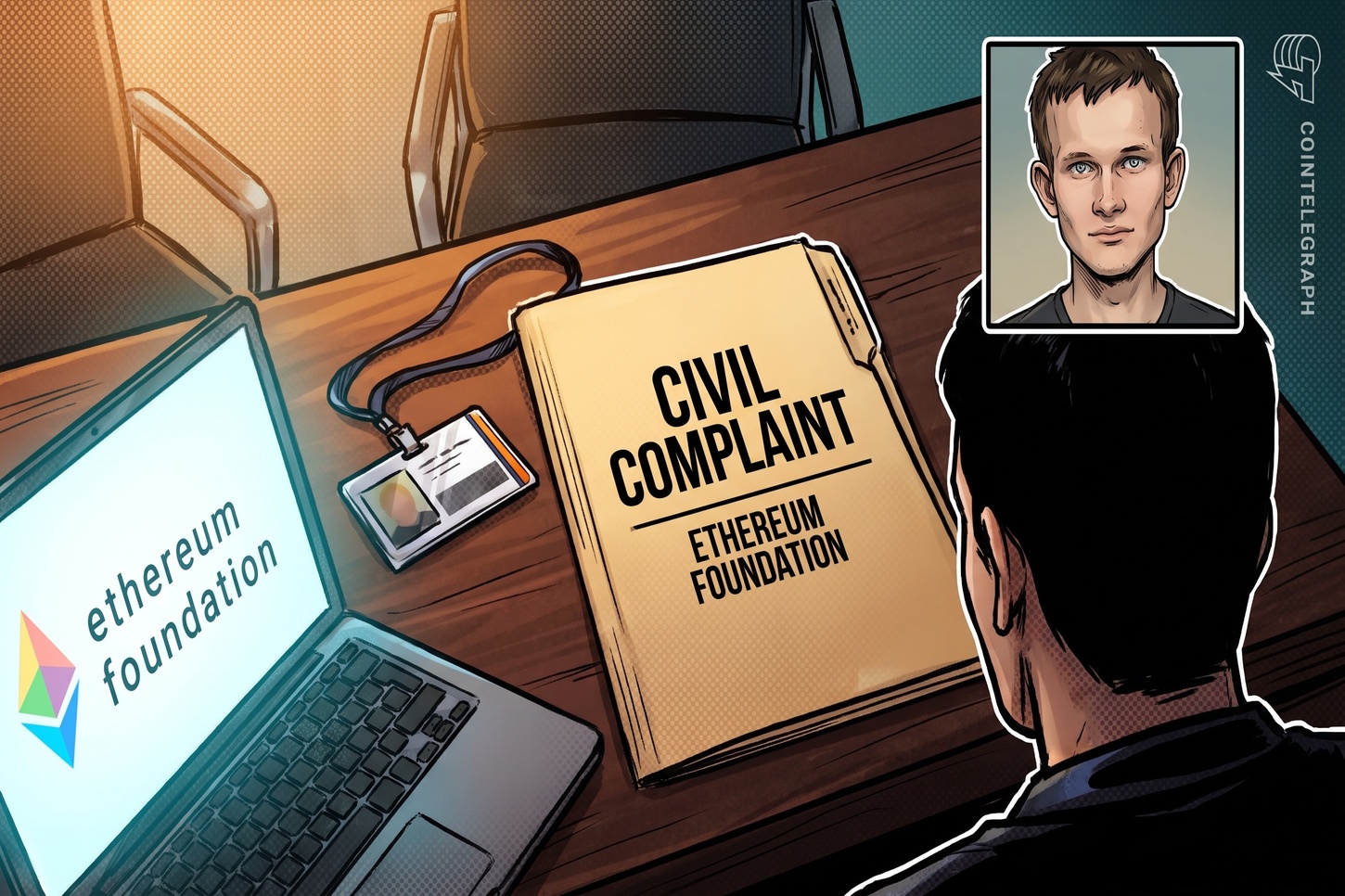
Ex-employee sues Ethereum Foundation and Vitalik Buterin over firing

A former Ethereum Foundation employee, Kayleen Fulton (known as “Nixo”), has sued the organization, co-founder Vitalik Buterin, and four others, alleging she was fired after disclosing a cancer diagnosis and organizing a staff letter challenging a directive tied to the foundation’s new mandate. Fulton, who led the protocol support team, filed the complaint on Nov. 4 in the U.S. District Court for the District of Colorado. She claims Bastian Aue, then a co-executive director, fired her on April 6, 13 days after her diagnosis disclosure, and that Buterin helped adopt and enforce the directive as a board member. Fulton and colleague Trent Van Epps organized a letter with 53 signers supporting the mandate’s goals but objecting to a requirement that employees affirm it to keep their jobs; she alleges she and Van Epps were fired 30 minutes apart days later. She alleges disability discrimination, retaliation, and interference with medical leave rights, seeking lost pay and damages. The complaint also notes some employees objected to a reference to ritual suicide in the mandate, quoting Aue saying the language was figurative. A lawyer for the foundation’s Singapore affiliate denied unlawful conduct or retaliation and said her separation agreement was binding. The foundation published its mandate in March, highlighting censorship resistance, open-source code, privacy and security, and a focus on protocol upgrades, research, and developer tools.

cointelegraph1h ago

Ex-employee sues Ethereum Foundation and Vitalik Buterin over firing

cointelegraph1h ago

Major Analog Chip Acquisition: The Account Behind Over 500 Part Numbers

On November 9, Awinic Electronics announced a trading halt to plan the acquisition of Yutai Semiconductor shares via share issuance and cash, plus supporting financing—a landmark integration in China's analog chip design sector. Both companies compete in analog chips but follow different product paths. Awinic's power management revenue reached 1.047 billion yuan in 2025 (about 37% of total), slightly down 0.03% year-on-year, deeply tied to consumer electronics like phones, AIoT, and wearables. Its real strength lies in high-performance mixed-signal chips (1.505 billion yuan, 53% of revenue), with audio power amplifiers as the core, now extending into edge AI audio for AI glasses, supplying Meta, Rokid, and RayNeo. However, consumer cyclicality and fierce 2026 price competition expose Awinic's limited coverage in industrial-grade medium/high-voltage power, telecom power, and smart meters. Yutai, founded by former Maxim designers with R&D centers in Shanghai, Silicon Valley, and Hanoi, offers over 500 product models covering DC-DC, AC-DC, LDO, battery management, and PMU. Its AC-DC line spans 5 categories and 130+ models, including PWM controllers, integrated GaN converters, synchronous rectification, and fast-charging protocols—targeting high-voltage, high-frequency, high-power-density applications like fast chargers, industrial power, and telecom equipment. Its DC-DC products, such as the ETA9121/9122 dual-phase buck converters and ETA5220 ultra-low-noise LDO (0.96μV RMS), are not commodity consumer parts. Yutai also partners with MediaTek, Intel, Spreadtrum, Rockchip, Ambarella, and NXP, covering smart meters, security, set-top boxes, and routers. The complementarity is clear: Awinic excels in low-voltage, consumer-grade, highly integrated power for phones and wearables; Yutai in medium/high-voltage, industrial-grade, full-category solutions. A merger could theoretically cover consumer to industrial communications, low to medium/high voltage, and single chips to system-level solutions. Yet product logic alone doesn't guarantee success: Saint-Gong holds 25.95% of Yutai as second-largest shareholder, potentially constraining R&D integration, customer sharing, and product roadmaps post-closing. The deal reflects China's analog chip industry moving from niche land-grabbing to platform-based consolidation. Awinic needs Yutai's industrial power lines and customer ecosystem to break consumer growth ceilings; Yutai needs Awinic's listing platform and consumer channels to offset capital and market shortcomings. But success won't be decided by synergy visions in announcements—it depends on whether the two R&D teams can work under one product definition framework after the halt ends, and how many of Yutai's 700+ part numbers truly enter Awinic's customer system and generate design wins. Products can be acquired; scenario capabilities must be digested.

marsbit1h ago

Major Analog Chip Acquisition: The Account Behind Over 500 Part Numbers

marsbit1h ago

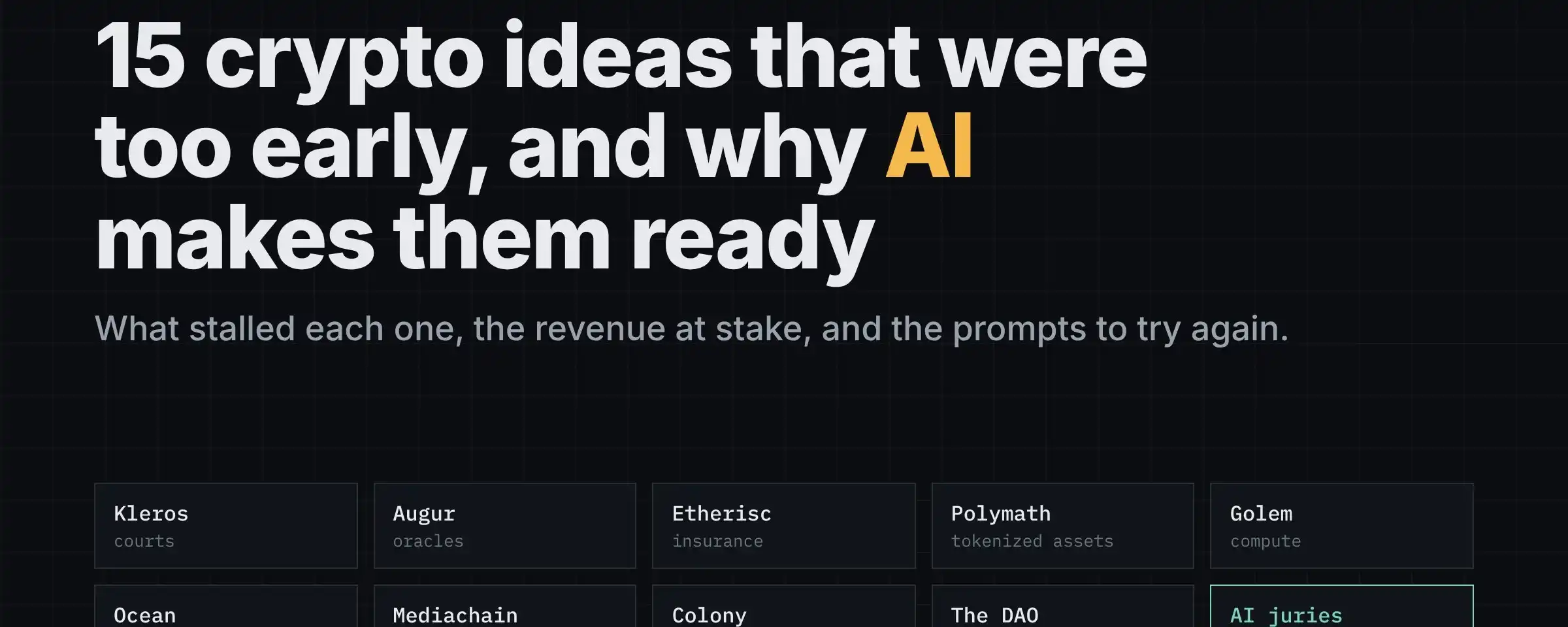
15 Crypto Ideas That Were 'Ahead of Their Time'—Why They're Worth Rebuilding in the AI Era

Between 2014 and 2019, crypto projects like Kleros, Augur, Etherisc, and Golem tried to bring commercial arbitration, prediction markets, mutual insurance, and decentralized compute on-chain, but failed because judgment of real-world outcomes depended on slow, bribe-prone human voting, governance tokens were volatile, and settlement was expensive. After 2023, three bottlenecks broke at once: multi-model AI juries cut the cost of real-world judgment to cents, AI agents became high-frequency on-chain transactors, and stablecoins (~$310B) plus sub-second chains like Solana made micro-settlement viable. The article ranks 15 ideas worth rebuilding by revenue potential and readiness: e-commerce arbitration courts, real-world prediction market oracles for questions lacking APIs, automatic-payout insurance without claims adjusters, escrowed task labor markets, data and media licensing, machine micropayments (x402), reputation-and-bond lending, proof of personhood, constitution-enforced DAOs, curated registries, content provenance, supply chain tracking, legally binding tokenized assets, compute and infrastructure markets, and IP with real legal contracts. Top candidates combine billion-dollar markets with components buildable in a quarter using existing AI models, stablecoins, and Solana. The article also provides a general validation prompt plus per-idea prompts, and warns of four risks: AI juries may share blind spots and err collectively, evidence can be forged, regulated sectors still require licenses, and real paid demand for micropayments and DePIN remains thin.

marsbit2h ago

15 Crypto Ideas That Were 'Ahead of Their Time'—Why They're Worth Rebuilding in the AI Era

marsbit2h ago

Trading

Spot
活动图片