Google's AI Chief is Actually the Secret Backer of Anthropic, Hassabis Quietly Controls the Global AI Ecosystem

marsbitPublicado a 2026-05-21Actualizado a 2026-05-21

Resumen

A bombshell report reveals that Demis Hassabis, the head of Google AI and DeepMind founder, was an early, secret investor in Anthropic, Google's arch-rival in the AI race. This discovery unveils a vast, interconnected empire—dubbed the "DeepMind Mafia"—where Hassabis's capital and influence extend through numerous top AI startups like Inflection AI and Ineffable Intelligence, which have collectively raised over $14 billion. Despite the public rivalry between Google's Gemini and Anthropic's Claude, Hassabis personally funded Anthropic at its inception, a stake now astronomically valuable given the company's reported $900 billion valuation. Furthermore, a close, mentor-like relationship exists between Hassabis and Anthropic CEO Dario Amodei. Concurrently, Hassabis has consolidated power within Google. Following the 2023 merger of Google Brain and DeepMind into Google DeepMind, his loyalists have assumed key leadership roles across Google's AI and cloud divisions. However, Hassabis continues to operate his power base from London, not Silicon Valley. The report paints a picture of Hassabis as a master strategist, quietly orchestrating the global AI ecosystem through a web of personal investments, former protégés, and internal corporate control, ensuring his influence prevails regardless of which public-facing company wins in the market.

Just now, a massive bombshell exploded in the global tech world—

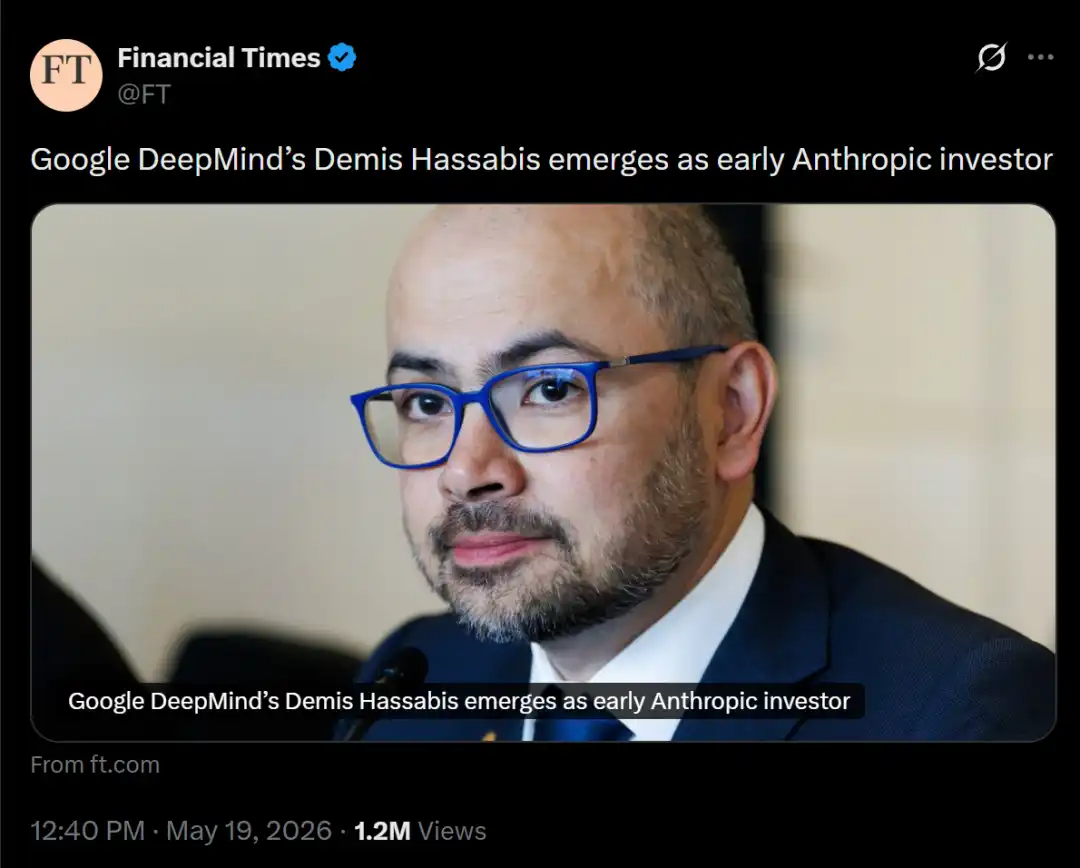
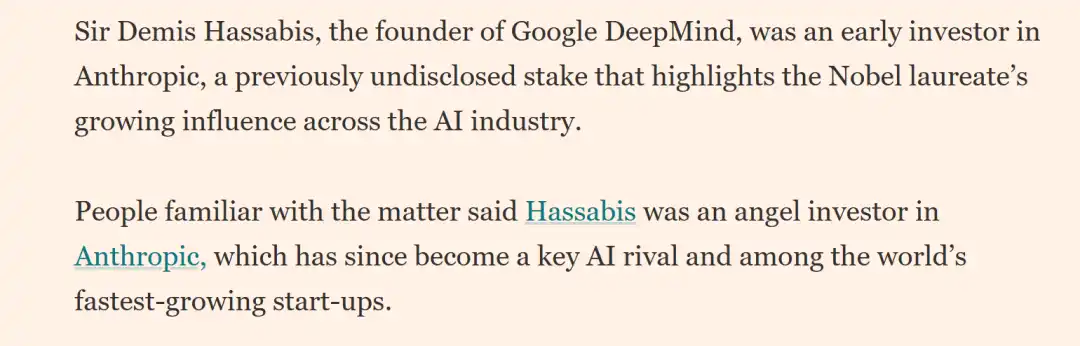
Demis Hassabis, Google AI's top leader, DeepMind founder, and Nobel laureate, was reportedly revealed to be an early, secret financial backer of its biggest rival, the super-unicorn Anthropic!
This meticulously planned infiltration is utterly shocking.

Even more unexpected is that following this clue has unearthed a vast 'DeepMind Mafia' empire, intricately woven and with deeply intertwined interests, personally orchestrated by Hassabis.

From Anthropic, valued at a staggering $900 billion, to Inflection AI which secured massive Microsoft investment, to Ineffable Intelligence which recently landed over $3 billion in funding... the leading figures or early backers behind the world's hottest, most cash-magnetizing AI startups are all him!

This is perhaps the most brilliant "Trojan Horse" in tech history—this "Godfather of AI" has quietly taken control of the discourse power in the global AI ecosystem right under our noses.
The Ultimate "Infiltration": Google AI Boss is a Major Shareholder in Its Rival?

In the current large model battlefield, Google's Gemini and Anthropic's Claude are locked in intense competition.

To outmaneuver their opponent, the two companies are engaged in a pixel-perfect arms race every day.

Yet, who would have thought that while Google employees work overtime to benchmark against Claude, their top boss had quietly bought shares in this "rival" company back when Anthropic was first founded.

According to the latest revelations by the Financial Times, Hassabis secretly invested in Anthropic as a personal angel investor during its early days.

This hidden ownership stake was previously unknown to the public.

The shock level is akin to discovering that during the fierce Cola Wars, the CEO of Coca-Cola was a founding shareholder of PepsiCo.
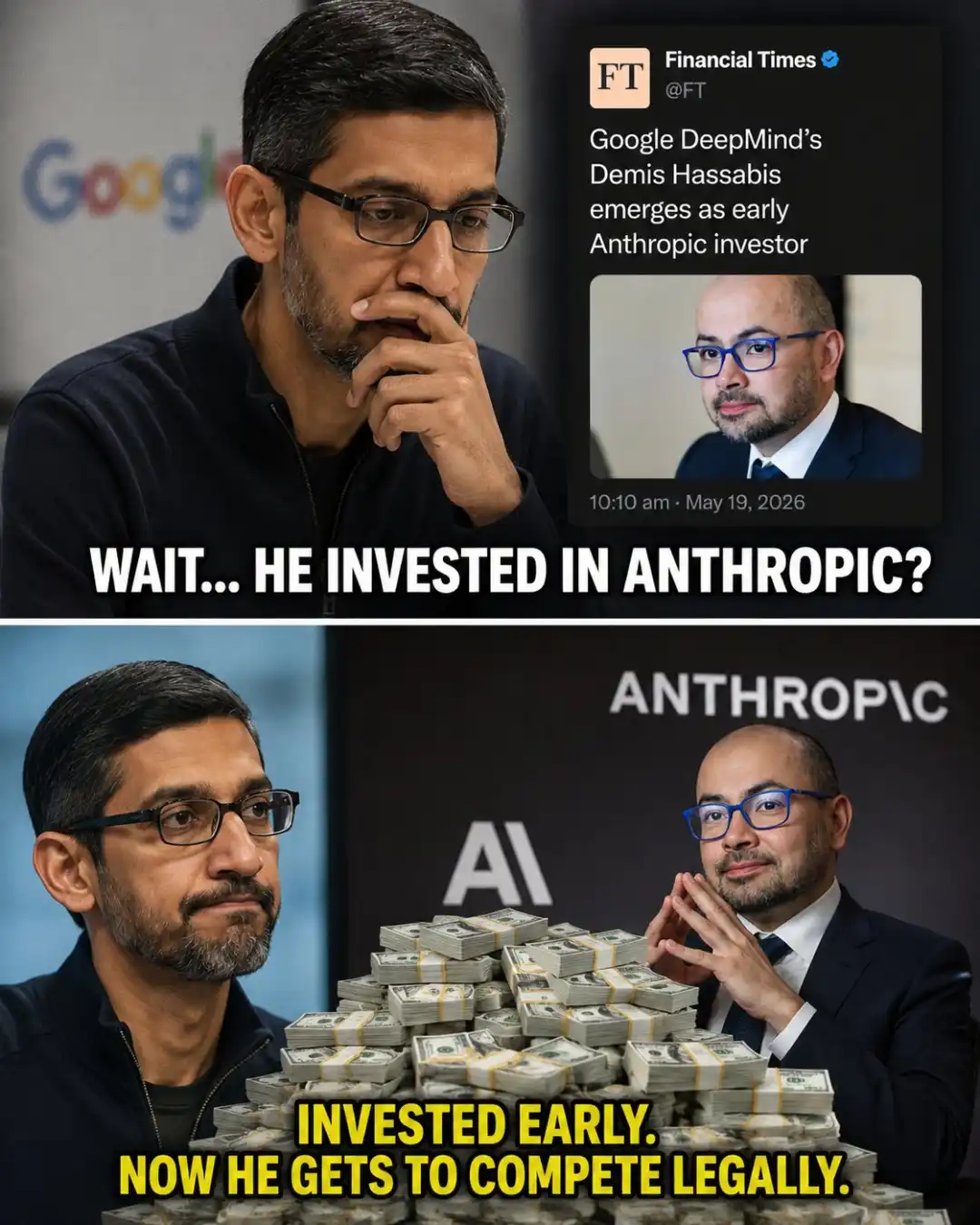
Looking at Anthropic's current monstrous size, you know Hassabis's investment paid off handsomely.

According to insiders, Anthropic's valuation has skyrocketed to an astonishing $900 billion in its latest funding round!

It has not only surpassed its arch-rival OpenAI but has ballooned into the fastest-growing "Leviathan" in global tech history.

Do the math, the assets in Hassabis's hands are now enormous enough to rival nations.

What's even more interesting is that Hassabis's "mothership," Google, later joined the game as well.

Google officially announced a multi-billion dollar investment in Anthropic earlier, establishing a deep cloud and AI partnership.
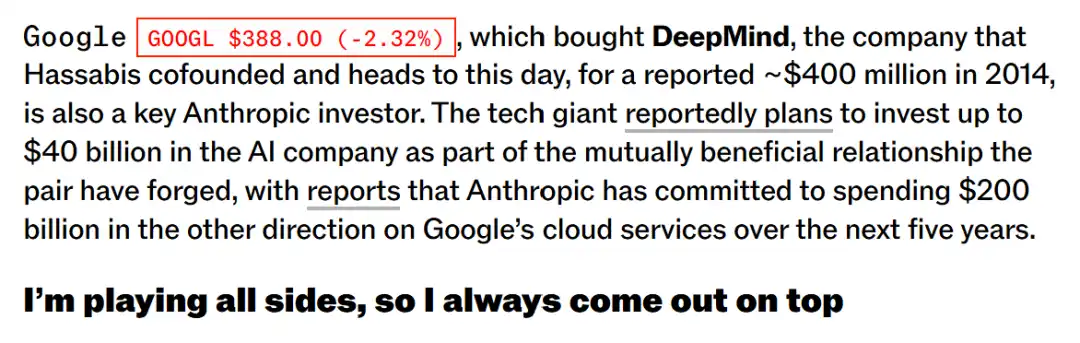
Rumored details of the deal suggest the scale of this "two-way street" is staggering—

Google reportedly plans to invest up to $40 billion in Anthropic; in return, as part of the agreement, Anthropic is said to have committed to spending a whopping $200 billion on Google Cloud services over the next five years!

In his left hand is the Google AI empire he commands; in his right hand is the $900 billion rival he incubated early on; and in between are tens of billions in cloud service contracts.

Hassabis's actions show us, "If I bet on both sides, the only winner in the end can be me."

Dario: He is My Mentor

Digging deeper, things get even more intriguing.

The relationship between the two men goes far beyond mere financial ties.

According to sources close to Anthropic's leadership, Dario Amodei, Anthropic's founder and CEO, privately regards Hassabis as his role model and mentor.

Even though Dario previously held a core executive position at OpenAI, in his heart, Hassabis's DeepMind represents the holy grail of modern AI engineering.

In Dario's widely circulated personal essay "Machines of Loving Grace," although he doesn't name names directly, the reverence and admiration for a certain "AI pioneer" between the lines is unmistakable to anyone reading.

Anyone with insight can tell—he's talking about Hassabis.

The "Couch Moment" at the World Economic Forum

This relationship of friendly rivalry and mutual admiration was immortalized in a famous moment at the 2025 World Economic Forum.

At the time, as leaders of two industry giants, Hassabis and Dario, during an interview, were squeezed onto a narrow two-seater sofa by event staff.

The two AI titans, worth billions and shaping humanity's future, sat shoulder to shoulder, pressed tightly together due to the cramped space.

According to eyewitnesses, the scene was described like this: "It was a textbook example of tech world bromance. Two public rivals, squeezed together on camera, their eyes holding not animosity, but instead a sense of mutual understanding and amusement shared by peers at the top."

This personal closeness, transcending corporate boundaries, not only softens the coldness of business warfare but also reveals that on the highest throne of AI, they are fellow travelers on the same path.

The "DeepMind Mafia" on a Rampage: Former Employees Raised $14 Billion in Four Years!

Hassabis's ambition is far from limited to just Anthropic.

In Silicon Valley, there was once the famous "PayPal Mafia." This entrepreneurial clique, consisting of Elon Musk, Peter Thiel, Reid Hoffman, and others, nearly dominated the early Web 2.0 era.

Today, a more massive and potentially more disruptive "DeepMind Mafia" is rapidly expanding, with dual centers in London and Silicon Valley.
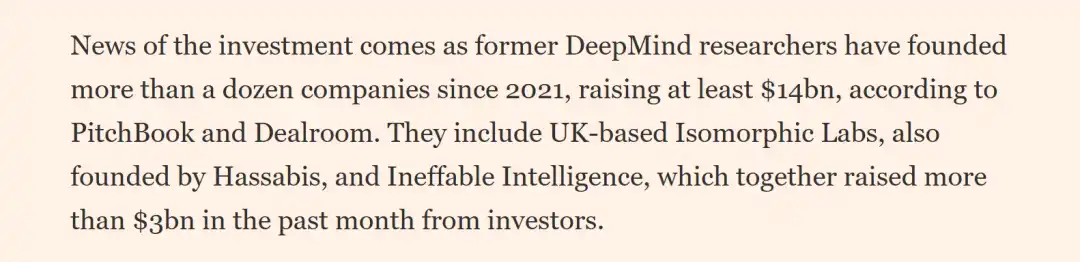
According to the latest statistics from the international authoritative startup databases PitchBook and Dealroom: Since 2021, core technical leads and executives who left DeepMind have gone on to found over 12 super AI startups.

Within just four years, this faction has cumulatively and frenziedly secured over $14 billion in funding from the market!

This scale is enough to make any venture capital firm tremble.

Let's look at this empire map composed of Hassabis and his disciples—

Core Members of the "DeepMind Mafia"
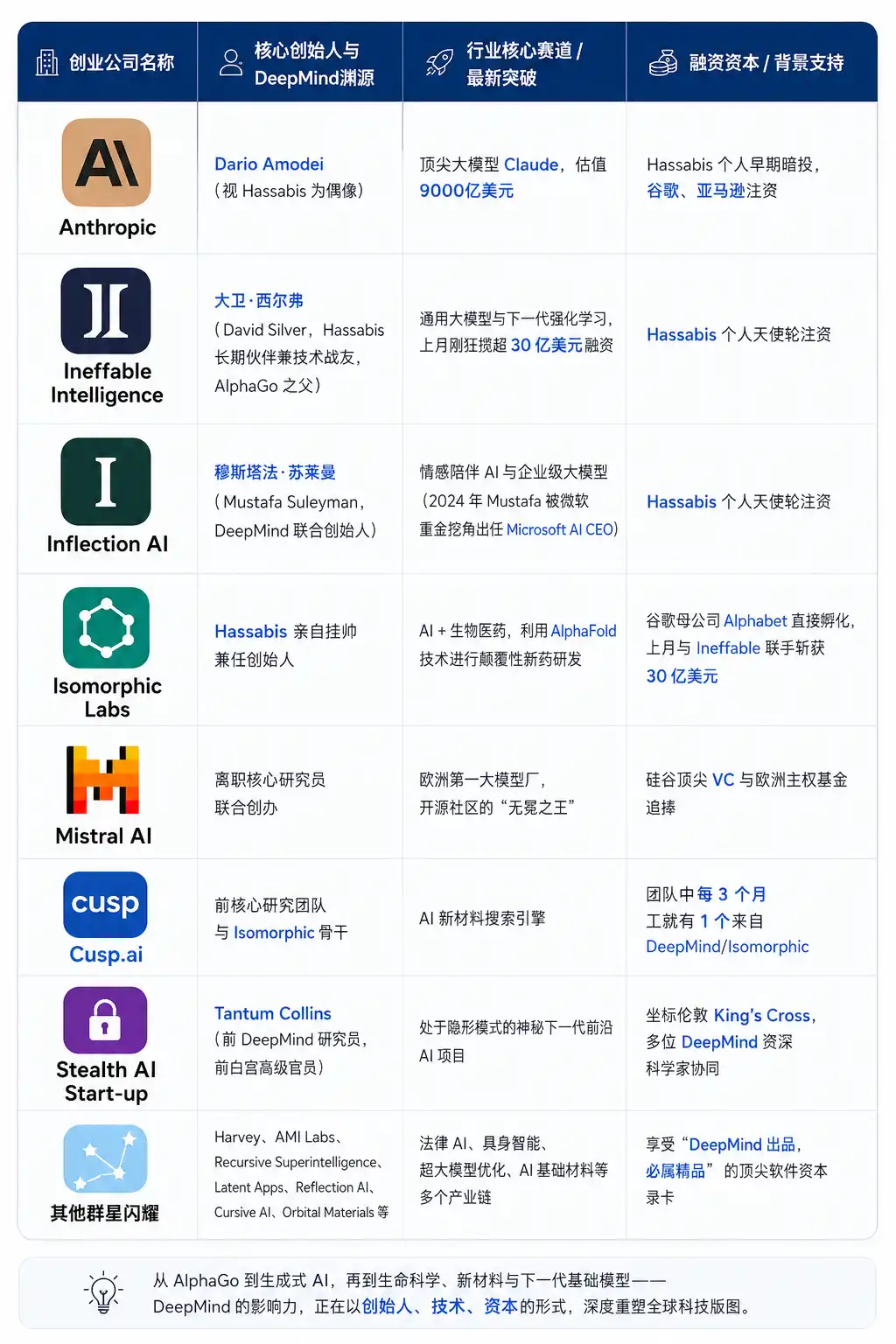
This list is still growing rapidly.

A seasoned Silicon Valley investor put it this way: "Nowadays, in the AI startup scene, if your resume says 'Former Senior Researcher at DeepMind,' you don't even need to finish your pitch deck—the checks are already on the table."

The Hidden Capital Web: Revealing the Harsh Truth Behind the Giants' 'Bloody War'

The most terrifying aspect of Hassabis's capital puzzle is its comprehensiveness and covertness.

As a billionaire who sold DeepMind to Google for £400 million in 2014, Hassabis holds vast cash reserves.

But instead of spending it on yachts or mansions like the typical wealthy, he turned this money into numerous precise capital tentacles, quietly reaching into the entrepreneurial ventures of former colleagues and subordinates.

David Silver wants to work on general AI, Hassabis invests.

Mustafa Suleyman leaves to start Inflection AI, Hassabis invests.

He is even a core angel investor in the famous startup incubator Entrepreneurs First (EF).

This kind of capital deployment completely tears open the harsh truth of modern tech giant competition—

Under the spotlight, the giants fight fiercely over market share, for financial reports and stock prices, engaging in bloody PR wars and patent battles.

But behind the curtain, the top AI elites are deeply bound together through a hidden network woven from personal capital, mentor-discipleship, and former colleague relationships.
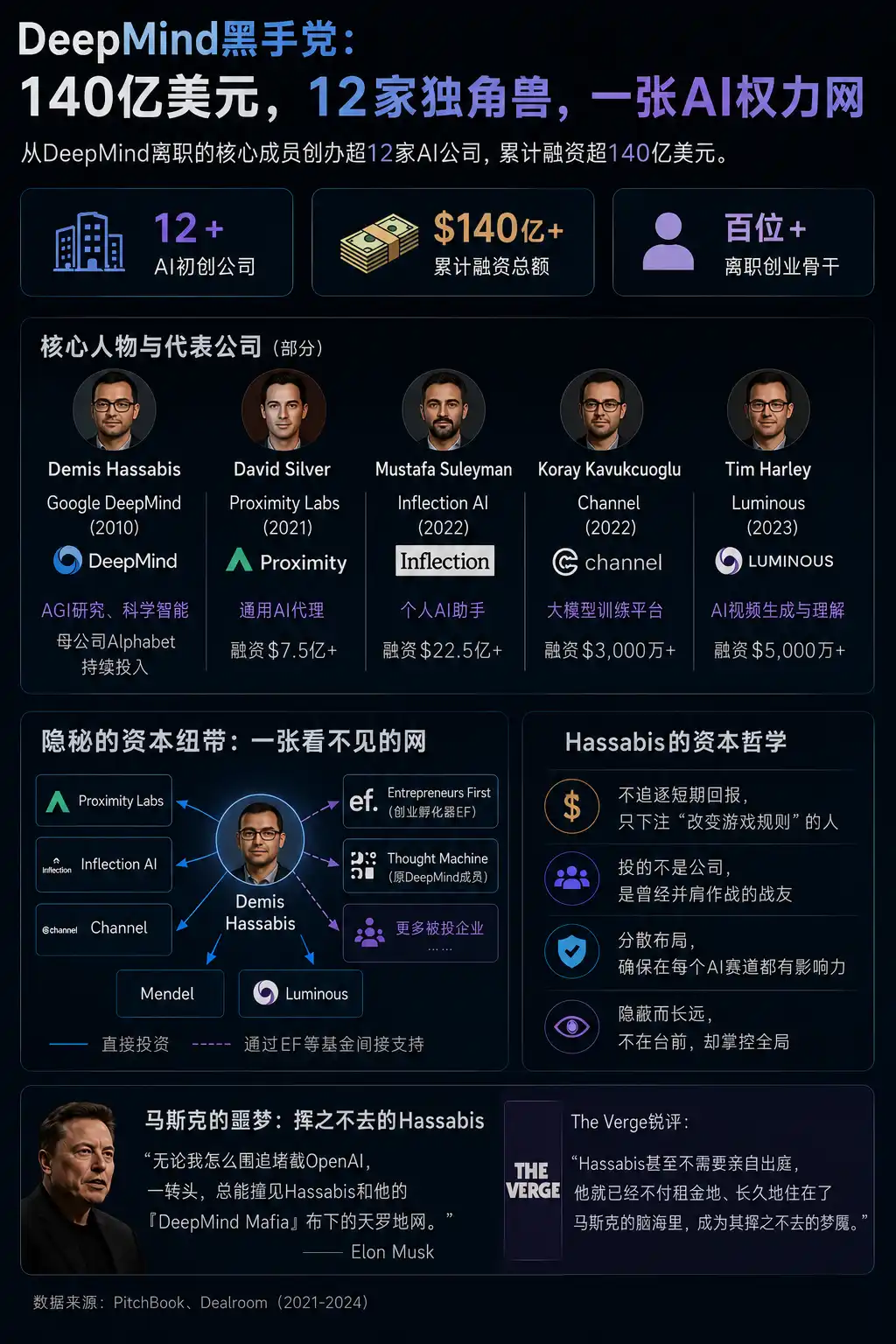
This phenomenon has even caused the maverick Elon Musk anxiety and anger.

In the high-profile, ongoing "Musk vs. Altman" lawsuit, court documents and testimonies show that Hassabis's name appears with high frequency in Musk's legal filings.

The Verge sharply commented: "Hassabis doesn't even need to show up in court; he already resides rent-free, permanently, in Musk's mind, becoming Musk's haunting nightmare.

Because Musk has discovered that no matter how he tries to corner OpenAI, whenever he turns around, he always runs into the intricate net laid by Hassabis and his 'DeepMind Mafia.'"

Pulling the Strings from Within: DeepMind Takes Over Google Completely

If aggressively deploying capital externally and nurturing external armies represents Hassabis's external strategy; then centralizing power and pulling strings from behind the scenes within Google is his internal mastery.

While exporting capital outward, DeepMind's senior executives are taking over the core power of the entire Google tech empire at an astonishing pace.

2023: The Unification of Google AI

Looking back to 2023, when OpenAI unleashed ChatGPT and caught Google off guard, causing its stock price to plummet, Alphabet made a historic decision: forcibly merging Google's once-proud Google Brain with DeepMind to form the new Google DeepMind, placed under Hassabis's unified command.

On the surface, this merger was a combination of strengths; in reality, it was a full-scale takeover of Google's core R&D force by DeepMind.

Hassabis declared at the time: "We need to simplify decision-making with greater speed, stronger collaboration, and execution to focus on achieving maximum impact."

Translation: I'm in charge of the AI business here.

Core Lieutenants, Ascending to Power

Within just two years, DeepMind's trusted inner circle has completely taken over and occupied the core decision-making layers of Google's AI and cloud services.

Koray Kavukcuoglu, DeepMind's former CTO, was officially promoted last year to Google's Chief AI Architect.

This means the underlying architecture of all future Google AI products bears the DeepMind stamp.

Pushmeet Kohli, who led the Nobel Prize-winning scientific marvel AlphaFold project, was formally appointed last month as Google Cloud's Chief Scientist. Thus, the technical brain behind Google's most profitable cloud business is also now a DeepMind confidant.

The "Power Behind the Throne" in London

Most remarkably, even though DeepMind has thoroughly completed its reverse takeover of Google's AI empire, Hassabis, wielding immense power, stubbornly keeps his headquarters in London's King's Cross district, refusing to relocate to Silicon Valley's Mountain View.

To accommodate this true power, Google even spent $1 billion building a grand new headquarters building in London's King's Cross.

"Demis possesses terrifying, incalculable soft power both within Google and across the entire tech industry," remarked Matt Clifford, a long-time friend of Hassabis and co-founder of EF.

"He was a pioneer long before anyone else figured out what AI was. A large part of the reason the younger generation of founders can raise such massive amounts of money is because they carry Demis's spiritual endorsement. Whether he's in Silicon Valley or London, his influence is growing exponentially."

The Ultimate Gambit of the "Godfather of AI"

As a former child prodigy in chess, now knighted by the British monarchy, Demis Hassabis clearly sees the entire global AI industry as a grand chess game.

In this game, Gemini is his public-facing chariot charging for Google; Anthropic is the hidden piece he placed secretly as a contingency; Ineffable, Inflection, Mistral, and other billion-dollar unicorns are the sharp pawns he has scattered across the board, ready to encircle the market at any moment.

And he himself sits calmly in his King's Cross office, watching capital, talent, and technology circulate perfectly within the web he has woven.

This recent exposure by the media punctures the harshest truth in the tech circle: the so-called great war among giants is nothing but a capital game played by the top elites, moving pieces from left hand to right.

No matter where the tide of technology flows, it never escapes the grasp of those who bought into the wave early.


Preguntas relacionadas

QWhat was the shocking revelation about Google's AI chief Demis Hassabis reported in the article?

ADemis Hassabis, Google's AI chief and DeepMind founder, was revealed to be an early secret financial backer of Anthropic, Google's major rival in AI.

QAccording to the article, what is the term used to describe the network of former DeepMind employees and their influence in the AI startup scene?

AThe term used is the 'DeepMind Mafia,' referring to the extensive network of former DeepMind employees who have founded and led major AI startups, collectively raising over $14 billion in funding.

QWhat significant corporate restructuring did Google undertake in 2023 in response to competitive pressure, as mentioned in the article?

AIn 2023, Google merged its Google Brain AI research unit with DeepMind to form Google DeepMind, placing it under the unified leadership of Demis Hassabis to streamline AI efforts.

QHow does the article characterize the relationship between Demis Hassabis and Anthropic CEO Dario Amodei?

AThe article characterizes their relationship as one of mutual respect and mentorship, with Dario Amodei privately viewing Hassabis as a role model and spiritual guide, despite their companies being public rivals.

QWhat is the article's perspective on the nature of competition among major AI companies?

AThe article suggests that while AI giants compete fiercely in public, the competition is underpinned by a hidden network of personal capital, mentorship, and former colleague ties among top AI elites, implying a more interconnected and less adversarial reality at the highest levels.

Lecturas Relacionadas

Detained for 37 Days: The First Wave of People Who Got Rich from 'AI Gateways' Are Starting to Go to Jail

A prominent AI proxy service operator was reportedly detained for 37 days and is now on bail pending trial, highlighting the legal risks in China's booming but unregulated AI intermediary market. These services act as "AI scalpers," providing domestic users with access to restricted overseas models (like OpenAI, Claude) by bundling APIs, handling payments, and bypassing network blocks, all for a fee. Their controversial profitability stems from practices like bulk-registering accounts to resell free credits, exploiting refund policies, overcharging for tokens, substituting cheaper models, and illegally selling user conversation data. Major figures, including cryptocurrency entrepreneurs, are now entering this space. Legally, these operations face severe risks. Their core model often involves unauthorized API access and operating without required telecom licenses, potentially constituting illegal business operations. They fail to meet data security obligations for the vast amounts of user data they process, risking charges for failing to fulfill network security duties. Crucially, the unauthorized collection and sale of user data, which can include personal and commercial secrets, easily meets the threshold for the crime of infringing on personal information. The case underscores a critical juncture for the AI industry. While proxies lower access barriers, they expose user data to unsecured middlemen and undermine the business models of AI developers, forcing them to divert resources to security and distorting market value perceptions. The article argues that the industry's sustainable future depends on building trust, protecting data, and fostering compliant competition, moving away from its current "wild growth" phase.

marsbitHace 3 min(s)

Detained for 37 Days: The First Wave of People Who Got Rich from 'AI Gateways' Are Starting to Go to Jail

marsbitHace 3 min(s)

Putting Markets On-Chain: Canton Network Quietly Becomes the New Backbone of Institutional Finance

**Title: Letting the Market Itself Go On-Chain: Canton Network Quietly Becomes the New Backbone for Institutional Finance** **Summary:** The Canton Network, a blockchain platform designed for institutional finance, is gaining significant traction. A key sign of its maturity was Visa's recent entry as a super-validator, a proposal approved in just three days—highlighting prior, extensive collaboration between traditional finance and crypto. Unlike public chains like Ethereum that prioritize transparency and asset onboarding, Canton focuses on enabling confidential, compliant business operations for regulated institutions. Its core design features built-in **data visibility control**, meaning transaction details are only shared between direct counterparties. This privacy is fundamental, allowing competing institutions (like banks Goldman Sachs, JPMorgan, and BNP Paribas, all validators) to interact on the same network without exposing sensitive positions or strategies. Developed by Wall Street veterans at Digital Asset, Canton has taken a slow, deliberate approach to onboard real financial activity. It now handles over **$9 trillion monthly** in transaction volume, primarily from real-world institutional use cases like **tokenized repo agreements**, Treasury settlements, and collateral mobility. Major live applications include **JPM Coin** for institutional payments and **DTCC's tokenized U.S. Treasuries** project. Canton's native token, **CC**, is framed as a "network utility asset" with zero pre-mine or VC allocations. Its value is intended to be driven by the volume of real financial activity on the network. Looking ahead, Canton aims to become the invisible foundational layer for global finance—enabling atomic settlement (where payment and asset delivery occur simultaneously), 24/7 capital flows, and the native issuance and settlement of various asset classes, from corporate bonds to potentially equities. The main challenges are no longer technical but involve navigating fragmented global regulations and integrating with legacy financial systems.

marsbitHace 23 min(s)

Putting Markets On-Chain: Canton Network Quietly Becomes the New Backbone of Institutional Finance

marsbitHace 23 min(s)

It's Bankless That Needs Ethereum, Not Ethereum That Needs Bankless

Titled "Bankless Needs Ethereum, Not the Other Way Around," this article analyzes the significant recent news involving Bankless, a prominent crypto media outlet. Bankless co-founder David Hoffman announced the sale of all his ETH holdings, while the company also reportedly underwent major layoffs, with its founders parting ways. The news, likened to a high-profile defection, initially sent shockwaves through the Ethereum community, given Bankless's historical role as a key evangelist and "semi-official" narrative builder for Ethereum. For years, through its podcasts and writings, Bankless championed core Ethereum ideas like "ultrasound money" and the blockchain's role as a new financial settlement layer, acting as a crucial community hub and belief system during its growth phase. However, the article argues this development is not necessarily negative for Ethereum. It suggests Bankless's "first mission"—serving as Ethereum's passionate, inward-facing "propaganda department"—has largely been completed. As Ethereum matures and moves towards mainstream, institutional adoption, the narrative baton has shifted. Today, the value propositions of ETH are increasingly communicated to traditional finance by asset managers like BlackRock and VanEck, public companies adding ETH to their treasuries, and established financial figures. This represents a natural evolution towards a more decentralized, professional, and institutionally-focused narrative network. Therefore, while Bankless's retreat marks the end of an era, it signifies Ethereum's growing resilience and its reduced reliance on any single entity for belief, as its story is now carried forward by a broader and more mature ecosystem of advocates.

链捕手Hace 45 min(s)

It's Bankless That Needs Ethereum, Not Ethereum That Needs Bankless

链捕手Hace 45 min(s)

Google Officially Declares War

Google Declares War with AI-First I/O 2026 At its 2026 I/O developer conference, Google launched an aggressive, multi-pronged offensive, embedding AI across its ecosystem and challenging rivals on performance and price. The event showcased three major releases: Gemini 3.5 Flash, the video-centric Gemini Omni Flash, and the system-level AI assistant Spark. Gemini 3.5 Flash, despite being a smaller "Flash" model, outperforms its Pro counterpart in key benchmarks like mathematical reasoning (GSM8K) and coding (SWE-bench). Google attributes this to "extreme knowledge distillation" from a larger teacher model and a novel, highly granular MoE (Mixture of Experts) architecture with 256 experts, achieving sub-65ms response times. The native multi-modal model, Gemini Omni Flash, offers real-time video understanding with 120ms latency, enabling applications like preventing a cup from overfilling. The new Spark assistant gains deep Android system integration, allowing it to automate complex multi-app workflows based on voice commands. Complementing these, Google unveiled lightweight AI glasses featuring Micro-OLED displays and on-device Gemini chips for instant, offline translation and scene analysis. CEO Sundar Pichai announced Gemini has reached 900 million monthly active users, leveraged through integration into Chrome, Android, and Workspace. Google also slashed prices dramatically: the Gemini 3.5 Flash API is priced at a fraction of competitor rates. This price war is enabled by Google's vertically integrated TPU infrastructure. The strategy signals a shift: standalone AI models are becoming commoditized. Google's advantage lies in its "device + cloud + ecosystem + hardware" integration, aiming to reshape internet traffic from user-initiated searches to AI-driven service distribution. This move pressures pure-play AI firms like OpenAI and Anthropic on business models, and challenges Apple to respond in the next-generation, screen-less device race.

链捕手Hace 1 hora(s)

Google Officially Declares War

链捕手Hace 1 hora(s)

Trading

Spot
Futuros

Artículos destacados

Qué es $S$

Entendiendo SPERO: Una Visión General Completa Introducción a SPERO A medida que el panorama de la innovación continúa evolucionando, la aparición de tecnologías web3 y proyectos de criptomonedas juega un papel fundamental en la configuración del futuro digital. Un proyecto que ha atraído la atención en este campo dinámico es SPERO, denotado como SPERO,$$s$. Este artículo tiene como objetivo reunir y presentar información detallada sobre SPERO, para ayudar a entusiastas e inversores a comprender sus fundamentos, objetivos e innovaciones dentro de los dominios web3 y cripto. ¿Qué es SPERO,$$s$? SPERO,$$s$ es un proyecto único dentro del espacio cripto que busca aprovechar los principios de descentralización y tecnología blockchain para crear un ecosistema que promueva la participación, la utilidad y la inclusión financiera. El proyecto está diseñado para facilitar interacciones de igual a igual de nuevas maneras, proporcionando a los usuarios soluciones y servicios financieros innovadores. En su esencia, SPERO,$$s$ tiene como objetivo empoderar a los individuos al proporcionar herramientas y plataformas que mejoren la experiencia del usuario en el espacio de las criptomonedas. Esto incluye habilitar métodos de transacción más flexibles, fomentar iniciativas impulsadas por la comunidad y crear caminos para oportunidades financieras a través de aplicaciones descentralizadas (dApps). La visión subyacente de SPERO,$$s$ gira en torno a la inclusividad, buscando cerrar brechas dentro de las finanzas tradicionales mientras aprovecha los beneficios de la tecnología blockchain. ¿Quién es el Creador de SPERO,$$s$? La identidad del creador de SPERO,$$s$ sigue siendo algo oscura, ya que hay recursos públicos limitados que proporcionan información de fondo detallada sobre su(s) fundador(es). Esta falta de transparencia puede derivarse del compromiso del proyecto con la descentralización, una ética que muchos proyectos web3 comparten, priorizando las contribuciones colectivas sobre el reconocimiento individual. Al centrar las discusiones en torno a la comunidad y sus objetivos colectivos, SPERO,$$s$ encarna la esencia del empoderamiento sin señalar a individuos específicos. Como tal, comprender la ética y la misión de SPERO sigue siendo más importante que identificar a un creador singular. ¿Quiénes son los Inversores de SPERO,$$s$? SPERO,$$s$ cuenta con el apoyo de una diversa gama de inversores que van desde capitalistas de riesgo hasta inversores ángeles dedicados a fomentar la innovación en el sector cripto. El enfoque de estos inversores generalmente se alinea con la misión de SPERO, priorizando proyectos que prometen avances tecnológicos sociales, inclusión financiera y gobernanza descentralizada. Estas fundaciones de inversores suelen estar interesadas en proyectos que no solo ofrecen productos innovadores, sino que también contribuyen positivamente a la comunidad blockchain y sus ecosistemas. El respaldo de estos inversores refuerza a SPERO,$$s$ como un contendiente notable en el dominio de proyectos cripto que evoluciona rápidamente. ¿Cómo Funciona SPERO,$$s$? SPERO,$$s$ emplea un marco multifacético que lo distingue de los proyectos de criptomonedas convencionales. Aquí hay algunas de las características clave que subrayan su singularidad e innovación: Gobernanza Descentralizada: SPERO,$$s$ integra modelos de gobernanza descentralizada, empoderando a los usuarios para participar activamente en los procesos de toma de decisiones sobre el futuro del proyecto. Este enfoque fomenta un sentido de propiedad y responsabilidad entre los miembros de la comunidad. Utilidad del Token: SPERO,$$s$ utiliza su propio token de criptomoneda, diseñado para servir diversas funciones dentro del ecosistema. Estos tokens permiten transacciones, recompensas y la facilitación de servicios ofrecidos en la plataforma, mejorando la participación y la utilidad general. Arquitectura en Capas: La arquitectura técnica de SPERO,$$s$ apoya la modularidad y escalabilidad, permitiendo la integración fluida de características y aplicaciones adicionales a medida que el proyecto evoluciona. Esta adaptabilidad es fundamental para mantener la relevancia en el cambiante paisaje cripto. Participación de la Comunidad: El proyecto enfatiza iniciativas impulsadas por la comunidad, empleando mecanismos que incentivan la colaboración y la retroalimentación. Al nutrir una comunidad sólida, SPERO,$$s$ puede abordar mejor las necesidades de los usuarios y adaptarse a las tendencias del mercado. Enfoque en la Inclusión: Al ofrecer tarifas de transacción bajas e interfaces amigables para el usuario, SPERO,$$s$ busca atraer a una base de usuarios diversa, incluyendo a individuos que anteriormente pueden no haber participado en el espacio cripto. Este compromiso con la inclusión se alinea con su misión general de empoderamiento a través de la accesibilidad. Cronología de SPERO,$$s$ Entender la historia de un proyecto proporciona información crucial sobre su trayectoria de desarrollo y hitos. A continuación se presenta una cronología sugerida que mapea eventos significativos en la evolución de SPERO,$$s$: Fase de Conceptualización e Ideación: Las ideas iniciales que forman la base de SPERO,$$s$ fueron concebidas, alineándose estrechamente con los principios de descentralización y enfoque comunitario dentro de la industria blockchain. Lanzamiento del Whitepaper del Proyecto: Tras la fase conceptual, se lanzó un whitepaper completo que detalla la visión, los objetivos y la infraestructura tecnológica de SPERO,$$s$ para generar interés y retroalimentación de la comunidad. Construcción de Comunidad y Primeras Interacciones: Se realizaron esfuerzos de divulgación activa para construir una comunidad de primeros adoptantes y posibles inversores, facilitando discusiones en torno a los objetivos del proyecto y obteniendo apoyo. Evento de Generación de Tokens: SPERO,$$s$ llevó a cabo un evento de generación de tokens (TGE) para distribuir sus tokens nativos a los primeros seguidores y establecer liquidez inicial dentro del ecosistema. Lanzamiento de la dApp Inicial: La primera aplicación descentralizada (dApp) asociada con SPERO,$$s$ se puso en marcha, permitiendo a los usuarios interactuar con las funcionalidades centrales de la plataforma. Desarrollo Continuo y Alianzas: Actualizaciones y mejoras continuas a las ofertas del proyecto, incluyendo alianzas estratégicas con otros actores en el espacio blockchain, han moldeado a SPERO,$$s$ en un jugador competitivo y en evolución en el mercado cripto. Conclusión SPERO,$$s$ se erige como un testimonio del potencial de web3 y las criptomonedas para revolucionar los sistemas financieros y empoderar a los individuos. Con un compromiso con la gobernanza descentralizada, la participación comunitaria y funcionalidades diseñadas de manera innovadora, allana el camino hacia un paisaje financiero más inclusivo. Como con cualquier inversión en el espacio cripto que evoluciona rápidamente, se anima a los posibles inversores y usuarios a investigar a fondo y participar de manera reflexiva con los desarrollos en curso dentro de SPERO,$$s$. El proyecto muestra el espíritu innovador de la industria cripto, invitando a una mayor exploración de sus innumerables posibilidades. Mientras el viaje de SPERO,$$s$ aún se desarrolla, sus principios fundamentales pueden, de hecho, influir en el futuro de cómo interactuamos con la tecnología, las finanzas y entre nosotros en ecosistemas digitales interconectados.

72 Vistas totalesPublicado en 2024.12.17Actualizado en 2024.12.17

Qué es $S$

Qué es AGENT S

Agent S: El Futuro de la Interacción Autónoma en Web3 Introducción En el paisaje en constante evolución de Web3 y las criptomonedas, las innovaciones están redefiniendo constantemente cómo los individuos interactúan con las plataformas digitales. Uno de estos proyectos pioneros, Agent S, promete revolucionar la interacción humano-computadora a través de su marco agente abierto. Al allanar el camino para interacciones autónomas, Agent S busca simplificar tareas complejas, ofreciendo aplicaciones transformadoras en inteligencia artificial (IA). Esta exploración detallada profundizará en las complejidades del proyecto, sus características únicas y las implicaciones para el dominio de las criptomonedas. ¿Qué es Agent S? Agent S se presenta como un marco agente abierto innovador, diseñado específicamente para abordar tres desafíos fundamentales en la automatización de tareas informáticas: Adquisición de Conocimiento Específico del Dominio: El marco aprende inteligentemente de diversas fuentes de conocimiento externas y experiencias internas. Este enfoque dual le permite construir un rico repositorio de conocimiento específico del dominio, mejorando su rendimiento en la ejecución de tareas. Planificación a Largo Plazo de Tareas: Agent S emplea planificación jerárquica aumentada por la experiencia, un enfoque estratégico que facilita la descomposición y ejecución eficiente de tareas complejas. Esta característica mejora significativamente su capacidad para gestionar múltiples subtareas de manera eficiente y efectiva. Manejo de Interfaces Dinámicas y No Uniformes: El proyecto introduce la Interfaz Agente-Computadora (ACI), una solución innovadora que mejora la interacción entre agentes y usuarios. Utilizando Modelos de Lenguaje Multimodal de Gran Escala (MLLMs), Agent S puede navegar y manipular diversas interfaces gráficas de usuario sin problemas. A través de estas características pioneras, Agent S proporciona un marco robusto que aborda las complejidades involucradas en la automatización de la interacción humana con las máquinas, preparando el terreno para una multitud de aplicaciones en IA y más allá. ¿Quién es el Creador de Agent S? Si bien el concepto de Agent S es fundamentalmente innovador, la información específica sobre su creador sigue siendo elusiva. El creador es actualmente desconocido, lo que resalta ya sea la etapa incipiente del proyecto o la elección estratégica de mantener a los miembros fundadores en el anonimato. Independientemente de la anonimidad, el enfoque sigue siendo en las capacidades y el potencial del marco. ¿Quiénes son los Inversores de Agent S? Dado que Agent S es relativamente nuevo en el ecosistema criptográfico, la información detallada sobre sus inversores y patrocinadores financieros no está documentada explícitamente. La falta de información disponible públicamente sobre las bases de inversión u organizaciones que apoyan el proyecto plantea preguntas sobre su estructura de financiamiento y hoja de ruta de desarrollo. Comprender el respaldo es crucial para evaluar la sostenibilidad del proyecto y su posible impacto en el mercado. ¿Cómo Funciona Agent S? En el núcleo de Agent S se encuentra una tecnología de vanguardia que le permite funcionar de manera efectiva en diversos entornos. Su modelo operativo se basa en varias características clave: Interacción Humano-Computadora Similar a la Humana: El marco ofrece planificación avanzada de IA, esforzándose por hacer que las interacciones con las computadoras sean más intuitivas. Al imitar el comportamiento humano en la ejecución de tareas, promete elevar las experiencias de los usuarios. Memoria Narrativa: Empleada para aprovechar experiencias de alto nivel, Agent S utiliza memoria narrativa para hacer un seguimiento de las historias de tareas, mejorando así sus procesos de toma de decisiones. Memoria Episódica: Esta característica proporciona a los usuarios una guía paso a paso, permitiendo que el marco ofrezca apoyo contextual a medida que se desarrollan las tareas. Soporte para OpenACI: Con la capacidad de ejecutarse localmente, Agent S permite a los usuarios mantener el control sobre sus interacciones y flujos de trabajo, alineándose con la ética descentralizada de Web3. Fácil Integración con APIs Externas: Su versatilidad y compatibilidad con varias plataformas de IA aseguran que Agent S pueda encajar sin problemas en ecosistemas tecnológicos existentes, convirtiéndolo en una opción atractiva para desarrolladores y organizaciones. Estas funcionalidades contribuyen colectivamente a la posición única de Agent S dentro del espacio cripto, ya que automatiza tareas complejas y de múltiples pasos con una intervención humana mínima. A medida que el proyecto evoluciona, sus posibles aplicaciones en Web3 podrían redefinir cómo se desarrollan las interacciones digitales. Cronología de Agent S El desarrollo y los hitos de Agent S pueden encapsularse en una cronología que resalta sus eventos significativos: 27 de septiembre de 2024: El concepto de Agent S fue lanzado en un documento de investigación integral titulado “Un Marco Agente Abierto que Usa Computadoras Como un Humano”, mostrando las bases del proyecto. 10 de octubre de 2024: El documento de investigación fue puesto a disposición del público en arXiv, ofreciendo una exploración profunda del marco y su evaluación de rendimiento basada en el benchmark OSWorld. 12 de octubre de 2024: Se lanzó una presentación en video, proporcionando una visión visual de las capacidades y características de Agent S, involucrando aún más a posibles usuarios e inversores. Estos marcadores en la cronología no solo ilustran el progreso de Agent S, sino que también indican su compromiso con la transparencia y la participación comunitaria. Puntos Clave Sobre Agent S A medida que el marco Agent S continúa evolucionando, varios atributos clave destacan, subrayando su naturaleza innovadora y potencial: Marco Innovador: Diseñado para proporcionar un uso intuitivo de las computadoras similar a la interacción humana, Agent S aporta un enfoque novedoso a la automatización de tareas. Interacción Autónoma: La capacidad de interactuar de manera autónoma con las computadoras a través de GUI significa un salto hacia soluciones informáticas más inteligentes y eficientes. Automatización de Tareas Complejas: Con su metodología robusta, puede automatizar tareas complejas y de múltiples pasos, haciendo que los procesos sean más rápidos y menos propensos a errores. Mejora Continua: Los mecanismos de aprendizaje permiten a Agent S mejorar a partir de experiencias pasadas, mejorando continuamente su rendimiento y eficacia. Versatilidad: Su adaptabilidad en diferentes entornos operativos como OSWorld y WindowsAgentArena asegura que pueda servir a una amplia gama de aplicaciones. A medida que Agent S se posiciona en el paisaje de Web3 y criptomonedas, su potencial para mejorar las capacidades de interacción y automatizar procesos significa un avance significativo en las tecnologías de IA. A través de su marco innovador, Agent S ejemplifica el futuro de las interacciones digitales, prometiendo una experiencia más fluida y eficiente para los usuarios en diversas industrias. Conclusión Agent S representa un audaz avance en la unión de la IA y Web3, con la capacidad de redefinir cómo interactuamos con la tecnología. Aunque aún se encuentra en sus primeras etapas, las posibilidades para su aplicación son vastas y atractivas. A través de su marco integral que aborda desafíos críticos, Agent S busca llevar las interacciones autónomas al primer plano de la experiencia digital. A medida que nos adentramos más en los reinos de las criptomonedas y la descentralización, proyectos como Agent S sin duda desempeñarán un papel crucial en la configuración del futuro de la tecnología y la colaboración humano-computadora.

449 Vistas totalesPublicado en 2025.01.14Actualizado en 2025.01.14

Qué es AGENT S

Cómo comprar S

¡Bienvenido a HTX.com! Hemos hecho que comprar Sonic (S) sea simple y conveniente. Sigue nuestra guía paso a paso para iniciar tu viaje de criptos.Paso 1: crea tu cuenta HTXUtiliza tu correo electrónico o número de teléfono para registrarte y obtener una cuenta gratuita en HTX. Experimenta un proceso de registro sin complicaciones y desbloquea todas las funciones.Obtener mi cuentaPaso 2: ve a Comprar cripto y elige tu método de pagoTarjeta de crédito/débito: usa tu Visa o Mastercard para comprar Sonic (S) al instante.Saldo: utiliza fondos del saldo de tu cuenta HTX para tradear sin problemas.Terceros: hemos agregado métodos de pago populares como Google Pay y Apple Pay para mejorar la comodidad.P2P: tradear directamente con otros usuarios en HTX.Over-the-Counter (OTC): ofrecemos servicios personalizados y tipos de cambio competitivos para los traders.Paso 3: guarda tu Sonic (S)Después de comprar tu Sonic (S), guárdalo en tu cuenta HTX. Alternativamente, puedes enviarlo a otro lugar mediante transferencia blockchain o utilizarlo para tradear otras criptomonedas.Paso 4: tradear Sonic (S)Tradear fácilmente con Sonic (S) en HTX's mercado spot. Simplemente accede a tu cuenta, selecciona tu par de trading, ejecuta tus trades y monitorea en tiempo real. Ofrecemos una experiencia fácil de usar tanto para principiantes como para traders experimentados.

868 Vistas totalesPublicado en 2025.01.15Actualizado en 2025.03.21

Cómo comprar S

Discusiones

Bienvenido a la comunidad de HTX. Aquí puedes mantenerte informado sobre los últimos desarrollos de la plataforma y acceder a análisis profesionales del mercado. A continuación se presentan las opiniones de los usuarios sobre el precio de S (S).

活动图片