The Largest Upgrade Since The Merge? How Glamsterdam Will Affect Ethereum and Regular Users?

marsbitPublicado a 2026-07-01Actualizado a 2026-07-01

Resumen

The upcoming Glamsterdam upgrade, scheduled for late 2026, is considered Ethereum's most significant change since The Merge. It focuses on fundamentally restructuring Ethereum's block production, transaction execution, and gas pricing to enable major scalability improvements while preserving decentralization. The upgrade centers on three key innovations: * **Enshrined PBS (ePBS)**: Moves the Proposer-Builder Separation mechanism into the protocol's core, eliminating reliance on external relays. This reorganizes the block pipeline, extending the time window for processing execution payloads, which is crucial for safely increasing block capacity. * **Block-Level Access Lists (BALs)**: Attaches a "map" to each block, declaring in advance which state data its transactions will access. This enables potential parallel transaction processing and faster node synchronization, breaking a key performance bottleneck. * **Gas Repricing**: Introduces a more accurate resource pricing model by separating computation costs from state storage costs. This discourages uncontrolled state growth by making operations that create permanent data (like new accounts) more accurately reflect their long-term network burden. Together, these changes aim to solve the core challenges of increasing Ethereum's throughput (e.g., raising the Gas Limit) without overburdening node hardware or increasing centralization risks. They prepare the infrastructure for higher capacity, targeting a credible post-up...

Author: imToken

Ethereum's next major upgrade has entered its final sprint.

According to the current official Ethereum roadmap, the Glamsterdam upgrade is planned to officially launch on the mainnet in the second half of 2026. As of the end of June, it has also entered the final testing phase on the developer network. Testing is continuously underway on the multi-client development network, focusing on core features such as enshrined PBS, block-level access lists, and Gas repricing. However, the specific activation time has not been finalized.

Meanwhile, on major social media platforms, the most talked-about aspect is undoubtedly the performance narrative of "mainnet reaching 10,000 TPS" after the upgrade. But beyond that, this upgrade fundamentally reconstructs Ethereum's block production pipeline and execution engine. Its depth of changes and wide-reaching impact have led the developer community to widely acclaim it as "the largest-scale upgrade since The Merge."
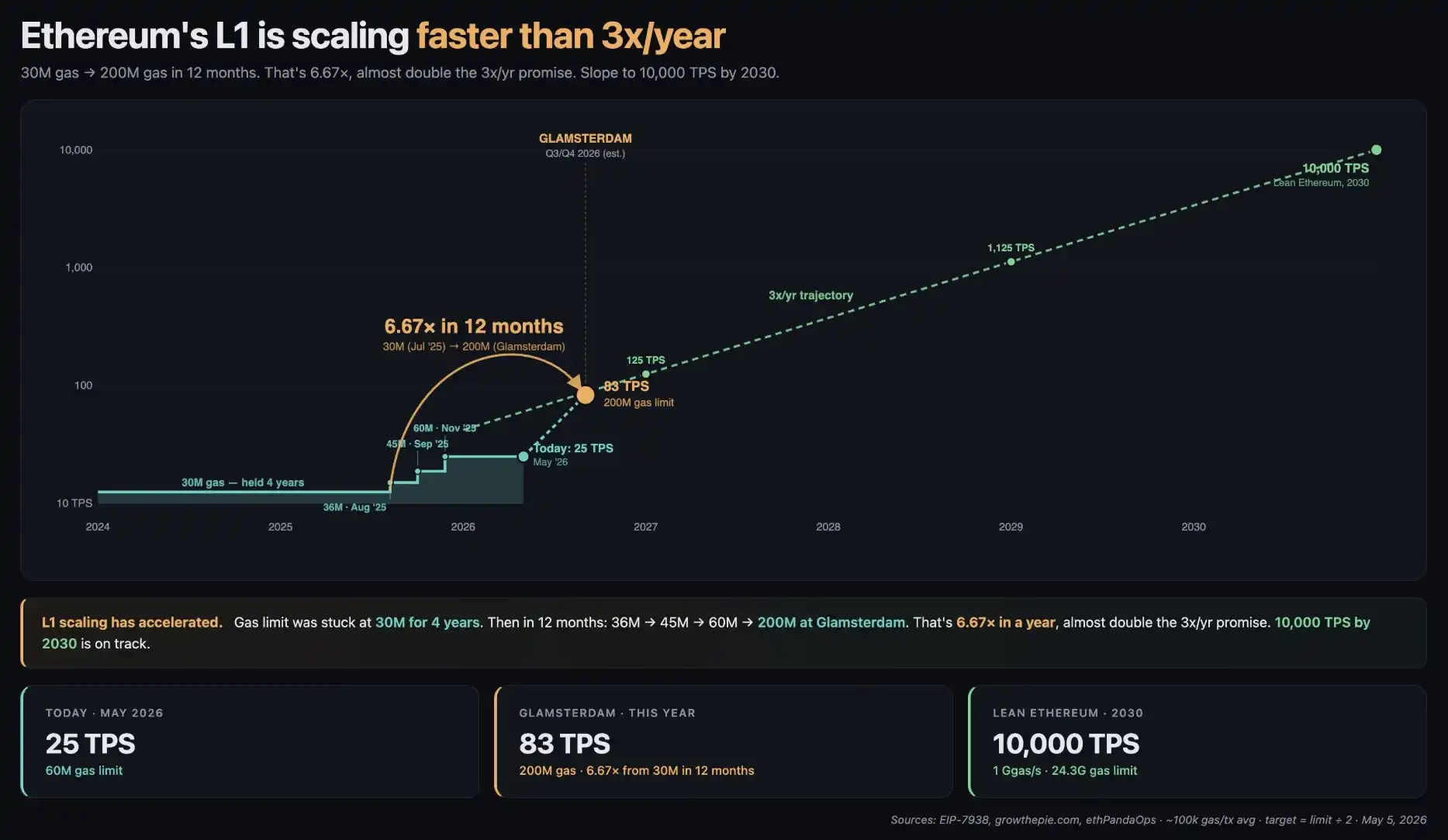
So, what exactly does this cool-sounding "Glamsterdam" (a combination of the consensus layer upgrade Gloas and the execution layer upgrade Amsterdam) change? How will it address past pain points, and what disruptive changes will it bring to our daily on-chain experience?

I. Why is it the "Largest-Scale Upgrade Since The Merge"?

If previous upgrades like Dencun and Fusaka primarily paved the way for L2 data availability (Blob), then Glamsterdam shifts the focus back to L1, initiating a major overhaul of L1 performance and architecture.

This is also the underlying reality of Ethereum's current "make L1 great again" ethos: how to allow L1 to handle more transactions without simultaneously increasing the cost of running nodes and the risk of network centralization.

However, for ordinary users, Ethereum upgrades are often simplified into one most intuitive question: Will Gas become cheaper? Will throughput increase? To be honest, the upcoming Glamsterdam is difficult to summarize simply with "fee reduction" or "scaling."

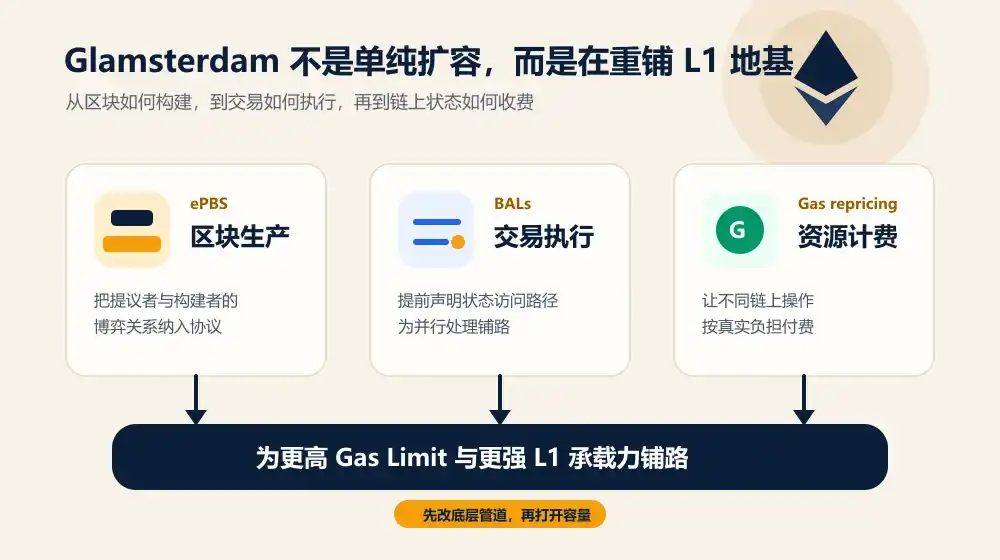
Overall, this upgrade involves multiple key aspects of Ethereum's underlying layer, including who builds blocks, how transactions are executed, how nodes read and synchronize state, and how much Gas different on-chain operations should pay. It essentially aims to redesign the fundamental paradigm for how Ethereum produces and processes blocks. According to the currently disclosed technical details, the most noteworthy core changes are mainly in three areas:

  • Enshrined PBS (ePBS): Restructures the relationship between block proposers and builders, eliminating reliance on external relays;
  • Block-Level Access Lists (BALs): Maps out transaction execution paths in advance, paving the way for parallel processing and faster node synchronization;
  • Gas Repricing: Introduces a more precise resource pricing model to control state bloat in high-throughput environments;
First, to understand enshrined PBS, one needs to know that blocks on Ethereum are not necessarily submitted by the Proposer themselves. Especially under the current MEV-Boost architecture, most Proposers outsource the work of collecting transactions, ordering them, and seeking MEV opportunities to professional Block Builders. The Proposer is primarily responsible for choosing the highest-bidding candidate block from several options and submitting it to the network.

This division of labor, where "Builder assembles, Proposer submits," is PBS (Proposer-Builder Separation).

The problem, however, is that this mechanism is not fully encoded into Ethereum's underlying protocol—Proposers and Builders must rely on off-protocol third-party software and MEV-Boost Relay services to complete block bidding, content delivery, and payment.

This means Relays must ensure Builders ultimately disclose the full block while also preventing Proposers from "stealing" block content in advance and refusing payment. Therefore, Relays act as fragile and centralized "trusted middlemen."

The ePBS (Enshrined PBS) proposed by EIP-7732 aims to solve this pain point by incorporating this博弈关系 directly into Ethereum's consensus protocol itself. It eliminates third-party relays, making Builders protocol-native participants. Builders first submit a block commitment and bid, the protocol automatically locks the corresponding payment, and a dedicated "Payload Timeliness Committee" judges whether the Builder timely disclosed the execution payload.

This decouples part of the processing of the consensus block and the execution payload, extending the propagation and processing window for the execution payload from about 2 seconds to approximately 9 seconds. These few extra seconds, while seemingly small, are crucial for Ethereum scaling—it means nodes have more time to receive and process larger blocks and more Blob data, thereby creating room for further increasing the Gas Limit.

Secondly, another core breakthrough of Glamsterdam on the execution layer is the Block-Level Access Lists (BALs) proposed by EIP-7928.

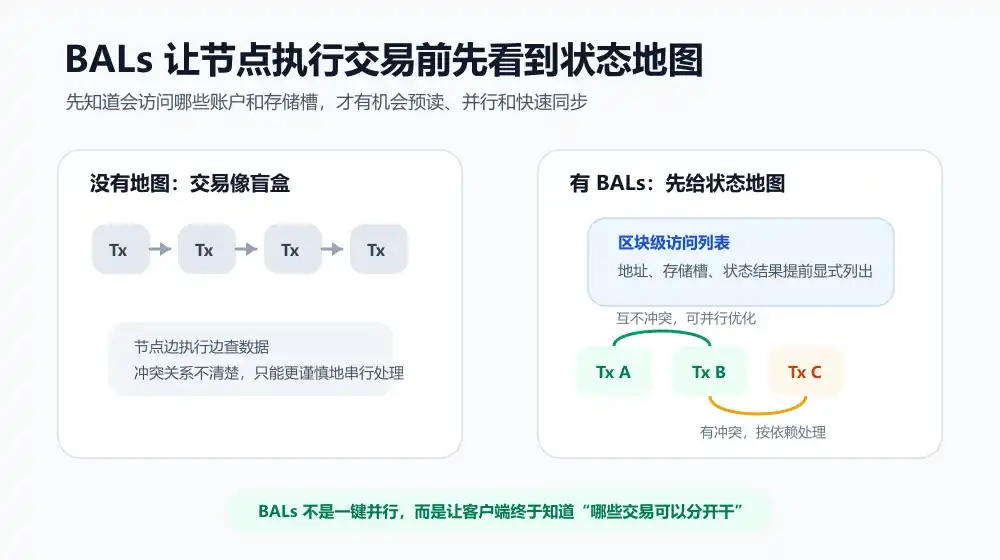
As is well known, currently, Ethereum nodes cannot directly learn from a block which accounts each transaction will read, which contract storage it will access, or which states it will modify before receiving it. Instead, they typically discover these data dependencies gradually during transaction execution.

This is like entering a large warehouse to pick goods without a complete inventory list. Workers must search and process simultaneously, so to avoid two people modifying the same batch of inventory, much of the work must be done strictly in a fixed order (single-threaded serial execution).

Block-Level Access Lists (BALs) act as a complete "state access map" attached to each block. They declare in the block header in advance which addresses and Storage Slots the set of transactions within that block will touch, as well as the state results after transaction execution. With this map, nodes can judge at a glance which transactions will access the same data and which are independent before execution:

For the independent parts, nodes can pre-fetch relevant state data from the hard drive and process transaction validation and state root calculation in parallel for some transactions, instead of cramming all work into a strictly serial queue. Additionally, since BALs also record state changes after transaction completion, some nodes can use these results for state reconstruction during network synchronization and catch-up, without having to execute every single transaction in the block from scratch in all scenarios (the author's personal understanding leans towards a sharding-like concept), potentially moving Ethereum towards a more parallel execution blockchain.

Therefore, in the long run, this is also a key underlying element for Ethereum's mainnet to break through its performance ceiling.
Finally, there is Gas repricing, which fundamentally recalibrates the Gas pricing for various on-chain operations through economic levers.

The reason is that the current Gas cost on Ethereum does not fully match the actual resource consumption borne by nodes. For example, a purely complex computation typically doesn't leave a long-term burden on nodes after execution. However, creating a new account, deploying a smart contract, or writing to a new storage slot generates data that needs to be permanently stored by all full nodes globally.

In the past, the fees for these state-creating actions did not fully reflect the permanent storage costs they incur (state explosion). If Ethereum maintained its original pricing after increasing the Gas Limit, more block space could rapidly transform into uncontrollable state data, eventually overwhelming node hardware.

EIP-8037, which has been confirmed for inclusion in Glamsterdam, aims to completely restructure these rules. This includes separating computation and state accounting, recalculating costs based on the volume of new state data added, distinguishing between general computation Gas and state Gas. It also controls state explosion, meaning operations that create many new accounts, deploy large redundant contracts, or frequently write new state may see increased costs. Conversely, applications primarily consuming immediate computational resources without persistently increasing state will have a more attractive fee structure.

Ultimately, the Gas reform in Glamsterdam cannot be simplistically understood as a "comprehensive fee reduction." Instead, it clarifies how much immediate computational resource a transaction consumes and what long-term storage burden it leaves on the network, then makes different operations pay in a way closer to their true physical cost.

Overall, these three parts, while seemingly independent, jointly point toward the same ultimate goal: to renovate the underlying core infrastructure in advance for Ethereum's mainnet to further and significantly increase Gas Limit and processing capacity.

II. Why Not Just Make Blocks Bigger?

Many might wonder: since it's slow and expensive, why not just increase the Gas Limit and double the block capacity directly?

This is a frequently asked question. In theory, the most direct way to increase mainnet capacity is indeed to raise the maximum Gas allowed per block. A higher Gas Limit means more transactions and computations can fit into one block.

However, the Gas Limit is not a number that can be increased indefinitely. Blindly enlarging blocks triggers a domino effect: nodes need to receive more data, execute more transactions, and calculate new state within the same timeframe. If processing speed can't keep up, nodes with weaker configurations are more likely to fall behind, block propagation and validation may experience delays, ultimately increasing the risk of network forks and centralization.

Meanwhile, more transactions also mean more accounts, contracts, and storage data permanently written into Ethereum's database. This data doesn't automatically disappear after transactions end but accumulates in Ethereum's state database, leading to faster state bloat.

Therefore, Ethereum scaling is not a simple math problem; it needs to solve three problems simultaneously:

  • First, how to give nodes more time to propagate and process larger blocks;
  • Second, how to reduce performance bottlenecks caused by sequential transaction execution;
  • Finally, how to prevent more block space from rapidly transforming into uncontrollable state bloat;

This is the core logic of Glamsterdam. Instead of blindly scaling first and forcing nodes to bear the brunt, it first restructures the methods of block production, transaction execution, and resource pricing, clearing the underlying pipeline, then naturally opens the door for increasing mainnet capacity.

Specifically, ePBS reorganizes the block processing flow within a slot, giving nodes more time to propagate and validate larger blocks; BALs improve client efficiency in reading, executing, and synchronizing by explicitly providing state access relationships; Gas repricing is responsible for limiting unsustainable state growth.

During the collaborative Glamsterdam test in April 2026, core developers conducted focused stress tests around multi-client implementations and explicitly set the technical goal of a credible capacity lower bound of 200 million Gas after the upgrade. Supporting this target is the combined underlying foundation provided by ePBS, BALs, and state Gas repricing.

Of course, 200 million Gas is closer to the system's carrying capacity post-upgrade and the direction for future evolution. It does not mean the mainnet will immediately jump its Gas Limit to this level on the day Glamsterdam activates.

What's truly important is that Ethereum is shifting from past "cautious, tentative scaling" toward "preparing in advance for more substantial mainnet scaling through underlying structural reconstruction."

III. How Will Ordinary Users and the Ethereum Ecosystem Be Affected?

From an ordinary user's perspective, the most relevant question regarding the Glamsterdam upgrade is still whether transaction fees will decrease.

Overall, the answer leans more towards likely decreasing and becoming more stable, rather than all transactions instantly becoming cheaper.

Since ePBS and block-level access lists create conditions for a higher Gas Limit, it's foreseeable that the number of transactions each block can accommodate will definitely increase. If on-chain demand remains constant, the increased supply of block space naturally helps alleviate congestion and reduces the probability of sudden Base Fee spikes.

However, for individual transactions, the impact may vary depending on the operation. For example, simple ETH transfers may benefit from base Gas optimizations; and since BALs provide state paths in advance, wallet accuracy in estimating Gas fees will significantly improve. The糟糕体验 of past failed transactions due to inaccurate wallet Gas estimates during market volatility—yet still paying fees—will become history.

On the other hand, operations like deploying contracts, batch-creating accounts, or writing large amounts of new state may see increased costs due to state repricing. Therefore, Glamsterdam is more likely to result in decreased costs for simple transactions, more stable fees during congested periods, while state-intensive applications start paying a more accurate price for the long-term network resources they occupy.
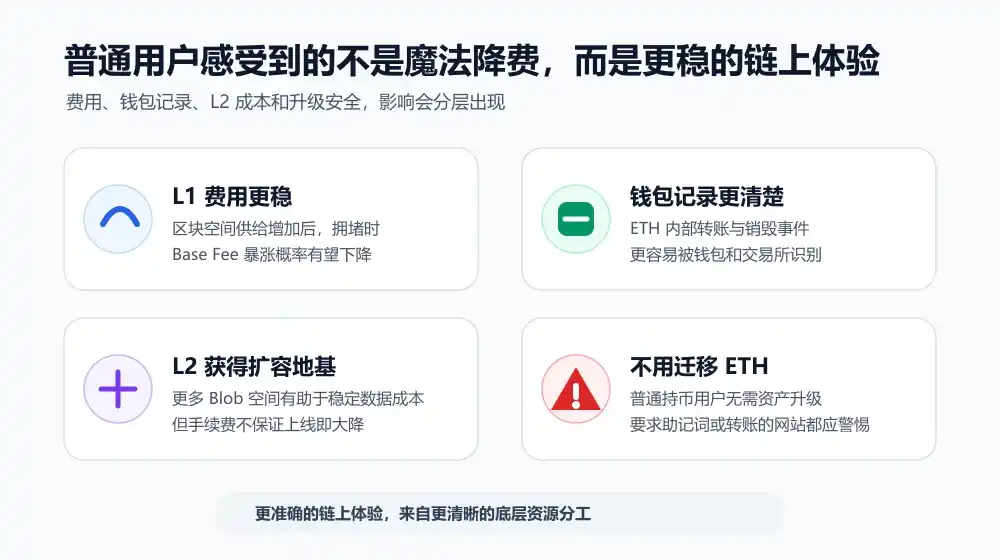
For users primarily using L2s, this upgrade is not irrelevant. By extending the data propagation window for execution payloads from about 2 seconds to about 9 seconds, ePBS can not only support larger mainnet blocks but also leaves more room for Ethereum to handle more Blob data. After Blob capacity continues to expand, Rollups will have more space to submit transaction data, which in the long run helps stabilize L2 data costs.

Furthermore, for wallets, exchanges, and cross-chain bridges, a more user-perceivable change might come from EIP-7708. Currently, ERC-20 token transfers typically generate standardized Transfer logs. However, some native ETH transfers between smart contracts do not leave equally clear event logs. Wallets and trading platforms often need to rely on additional internal transaction tracing tools to identify these ETH flows.

EIP-7708 requires non-zero ETH transfers and ETH destruction operations to generate standard logs, allowing wallets, exchanges, and cross-chain bridges to more reliably identify deposits, withdrawals, and internal ETH movements within contracts. In the future, users' ETH asset records may become more complete, and some internal transfers that previously required complex transaction tracing to display might be more easily recognized directly by wallets.

For node operators and stakers, the impact is more direct. Glamsterdam changes both execution and consensus layer block processing methods, so nodes and validators need to upgrade to client versions supporting Glamsterdam before mainnet activation. Ordinary token holders do not need to migrate ETH or perform any so-called "asset upgrades" or "token swaps."

Looking further ahead, what Glamsterdam truly affects is how Ethereum rebalances scaling and decentralization. After all, once block capacity increases, if the hardware cost required to run a node rises significantly in tandem, while mainnet throughput increases, the network may become increasingly reliant on large institutions.

The combination of ePBS, block-level access lists, and state Gas repricing attempts to form another scaling path: not simply demanding nodes handle more work in the same timeframe, but reorganizing the block production flow, providing transaction dependency information in advance, and charging different resources according to their actual burden.

This is also the most fundamental difference between Glamsterdam and a simple Gas Limit increase. It does not attempt to solve all of Ethereum's problems with a single EIP but simultaneously reforms three interrelated mechanisms: block production, transaction execution, and state growth.

In Conclusion

In the long term, what Glamsterdam profoundly influences is the narrative direction of how Ethereum rebalances between "high-performance scaling" and "absolute decentralization."

This is also the初心 or inertia of Ethereum that we are becoming increasingly familiar with—facing the步步紧逼 of high-performance monolithic blockchains, it chooses not to take the简单粗暴 route of raising hardware requirements. Instead, it selects a path that strives to maintain its decentralized底色, offering greater underlying resilience. Just like this time, through the combination拳 of rewriting the block pipeline (ePBS), explicitly providing transaction dependencies in advance (BALs), and making different resources pay precisely according to their physical burden (Gas repricing), it is still to carve out greater mainnet capacity while ensuring ordinary people can run nodes and participate in validation.

From this perspective, every划算 Gas fee we pay in the future, the more accurate and clear internal ETH statements in our wallets, and the broader space for fee reductions on L2s may all deeply benefit from the foundation that Glamsterdam lays for Ethereum in the second half of 2026.

Criptos en tendencia

Preguntas relacionadas

QWhat is Glamsterdam and why is it considered the largest Ethereum upgrade since The Merge?

AGlamsterdam is a major upcoming upgrade for Ethereum, combining the consensus layer upgrade 'Gloss' and the execution layer upgrade 'Amsterdam'. It is considered the largest since The Merge because it fundamentally restructures Ethereum's block production pipeline and execution engine. It introduces core changes like enshrined PBS (ePBS), block-level access lists (BALs), and gas repricing, which together aim to significantly enhance L1 performance and capacity while managing decentralization risks.

QHow does Enshrined PBS (ePBS) aim to improve Ethereum's scalability?

AEnshrined PBS (ePBS, introduced via EIP-7732) integrates the proposer-builder separation directly into Ethereum's consensus protocol, removing the need for external, centralized relay services. It decouples the consensus block from the execution payload, extending the processing window for execution payloads from about 2 seconds to roughly 9 seconds. This gives nodes more time to receive and process larger blocks and more blob data, which is a critical step for safely increasing the gas limit and overall network capacity.

QWhat problem do Block-Level Access Lists (BALs) solve, and what benefits do they provide?

ABlock-Level Access Lists (BALs, proposed in EIP-7928) solve the problem of nodes not knowing which accounts or storage slots a transaction will access until it is executed. BALs provide a pre-declared 'map' of all state accesses and results for the transactions in a block. This allows nodes to identify non-conflicting transactions beforehand, enabling some parallel processing and faster state synchronization. In the long term, this is a foundational step towards breaking Ethereum's performance ceiling by moving towards more parallel execution.

QWill the Glamsterdam upgrade make all Ethereum transactions cheaper for users?

ANot necessarily. While the upgrade's components (ePBS and BALs) create conditions for a higher gas limit, which could reduce congestion and base fees during peak times, the gas repricing (EIP-8037) introduces a more accurate cost model. Simple transfers may become cheaper, but operations that create significant new permanent state data (like deploying large contracts) will likely see increased costs. The overall effect is expected to be more stable fees and a pricing structure that better reflects the real resource cost of different transactions.

QWhat is the primary long-term goal of the Glamsterdam upgrade?

AThe primary long-term goal of Glamsterdam is to enable a substantial increase in Ethereum's mainnet capacity and throughput (e.g., targeting a credible capacity of 200M gas) without compromising its decentralization. It achieves this not by simply raising the gas limit, but by simultaneously redesigning core mechanisms: ePBS restructures block production timing, BALs optimizes transaction execution, and gas repricing controls unsustainable state growth. This combined approach aims to find a new balance between high performance and maintaining a decentralized network where individuals can still run nodes.

Lecturas Relacionadas

Circle CEO Responds to the OUSD Challenge: Stablecoin is a Winner-Takes-All Business, and We Won't Slow Down

In response to questions about the OUSD stablecoin initiative, Circle CEO Jeremy Allaire argues that the stablecoin market is a "winner-take-most" platform business driven by powerful network effects, and Circle has no plans to slow down. He outlines three key drivers behind USDC's dominant position: 1. **Protocol/Software Layer Network Effects**: The value of a stablecoin network grows as more developers and services integrate it, creating compounding utility and user preference. Circle has spent nearly a decade building this ecosystem with USDC, now accelerated by mainstream adoption and enhanced by software stacks like CCTP and Gateway for interoperability. 2. **Liquidity Network Effects**: Liquidity begets more liquidity. USDC has achieved top-tier global liquidity—ranking among the top three digital assets alongside BTC and USDT—through nearly a decade of building deep primary and secondary market access across regions and venues. 3. **Regulatory and Policy Integration**: Establishing a global stablecoin requires deep regulatory engagement, licensing, and compliance across key markets—a significant, long-term investment where Circle is a leader. Allaire cites Artemis data showing USDC facilitated 80% of all dollar stablecoin on-chain transaction volume in Q1 2026, with USDT at 20% and all others negligible. He addresses OUSD's purported advantages: "free" minting/burning is often not sustainable in practice; redistributing all revenue can starve essential infrastructure investment; and large consortium models historically struggle with inefficiency and slow execution, unlike focused strategic partnerships. He reaffirms Circle's strong ongoing partnership with Coinbase on USDC and notes Circle collaborates with dozens of other stablecoin issuers through its expanding platform (Arc, CCTP, CPN, etc.). While welcoming OUSD to the ecosystem, Allaire asserts that Circle's vast, trusted network and continued investment make USDC the foundational digital dollar infrastructure for the world.

链捕手Hace 3 hora(s)

Circle CEO Responds to the OUSD Challenge: Stablecoin is a Winner-Takes-All Business, and We Won't Slow Down

链捕手Hace 3 hora(s)

Trading

Spot

Artículos destacados

Qué es ETH 2.0

ETH 2.0: Una Nueva Era para Ethereum Introducción ETH 2.0, conocido ampliamente como Ethereum 2.0, marca una actualización monumental para la blockchain de Ethereum. Esta transición no es solo una mejora superficial; busca mejorar fundamentalmente la escalabilidad, seguridad y sostenibilidad de la red. Con un cambio del mecanismo de consenso intensivo en energía Prueba de Trabajo (PoW) a una Prueba de Participación (PoS) más eficiente, ETH 2.0 promete un enfoque transformador para el ecosistema blockchain. ¿Qué es ETH 2.0? ETH 2.0 es un conjunto de actualizaciones interconectadas y distintivas centradas en optimizar las capacidades y el rendimiento de Ethereum. La reestructuración está diseñada para abordar desafíos críticos que el mecanismo actual de Ethereum ha enfrentado, particularmente en lo que respecta a la velocidad de transacción y la congestión de la red. Objetivos de ETH 2.0 Los objetivos principales de ETH 2.0 giran en torno a mejorar tres aspectos clave: Escalabilidad: Con el objetivo de aumentar significativamente el número de transacciones que la red puede manejar por segundo, ETH 2.0 busca superar la limitación actual de aproximadamente 15 transacciones por segundo, potencialmente alcanzando miles. Seguridad: Las medidas de seguridad mejoradas son fundamentales para ETH 2.0, particularmente a través de una mejor resistencia contra ciberataques y la preservación del ethos descentralizado de Ethereum. Sostenibilidad: El nuevo mecanismo PoS está diseñado no solo para mejorar la eficiencia, sino también para reducir drásticamente el consumo de energía, alineando el marco operativo de Ethereum con consideraciones ambientales. ¿Quién es el Creador de ETH 2.0? La creación de ETH 2.0 se puede atribuir a la Fundación Ethereum. Esta organización sin fines de lucro, que desempeña un papel crucial en el apoyo al desarrollo de Ethereum, es liderada por el notable cofundador Vitalik Buterin. Su visión de un Ethereum más escalable y sostenible ha sido la fuerza motriz detrás de esta actualización, involucrando contribuciones de una comunidad global de desarrolladores y entusiastas dedicados a mejorar el protocolo. ¿Quiénes son los Inversores de ETH 2.0? Si bien los detalles sobre los inversores de ETH 2.0 no se han hecho públicos, se sabe que la Fundación Ethereum recibe apoyo de varias organizaciones e individuos en el ámbito de blockchain y tecnología. Estos socios incluyen firmas de capital de riesgo, compañías tecnológicas y organizaciones filantrópicas que comparten un interés mutuo en apoyar el desarrollo de tecnologías descentralizadas e infraestructura blockchain. ¿Cómo Funciona ETH 2.0? ETH 2.0 se distingue por introducir una serie de características clave que lo diferencian de su predecesor. Prueba de Participación (PoS) La transición a un mecanismo de consenso PoS es uno de los cambios más destacados de ETH 2.0. A diferencia de PoW, que se basa en la minería intensiva en energía para la verificación de transacciones, PoS permite a los usuarios validar transacciones y crear nuevos bloques de acuerdo con la cantidad de ETH que apuestan en la red. Esto conduce a una mayor eficiencia energética, reduciendo el consumo en aproximadamente un 99.95%, convirtiendo a Ethereum 2.0 en una alternativa considerablemente más verde. Cadenas Shard Las cadenas shard son otra innovación crítica de ETH 2.0. Estas cadenas más pequeñas operan en paralelo con la cadena principal de Ethereum, lo que permite que múltiples transacciones sean procesadas simultáneamente. Este enfoque mejora la capacidad general de la red, abordando las preocupaciones de escalabilidad que han afectado a Ethereum. Cadena Beacon En el núcleo de ETH 2.0 se encuentra la Cadena Beacon, que coordina la red y gestiona el protocolo PoS. Funciona como un organizador de cierta manera: supervisa a los validadores, asegura que los shards permanezcan conectados a la red y monitorea la salud general del ecosistema blockchain. Cronología de ETH 2.0 El viaje de ETH 2.0 ha estado marcado por varios hitos clave que trazan la evolución de esta importante actualización: Diciembre 2020: El lanzamiento de la Cadena Beacon marcó la introducción de PoS, preparándose para la migración hacia ETH 2.0. Septiembre 2022: La finalización de “La Fusión” representa un momento crucial en el que la red Ethereum se trasladó exitosamente de un marco PoW a uno PoS, anunciando una nueva era para Ethereum. 2023: El lanzamiento esperado de cadenas shard tiene como objetivo mejorar aún más la escalabilidad de la red Ethereum, consolidando a ETH 2.0 como una plataforma robusta para aplicaciones y servicios descentralizados. Características Clave y Beneficios Escalabilidad Mejorada Una de las ventajas más significativas de ETH 2.0 es su escalabilidad mejorada. La combinación de PoS y cadenas shard permite que la red expanda su capacidad, permitiendo acomodar un volumen mucho mayor de transacciones en comparación con el sistema heredado. Eficiencia Energética La implementación de PoS representa un gran paso hacia la eficiencia energética en la tecnología blockchain. Al reducir drásticamente el consumo de energía, ETH 2.0 no solo disminuye los costos operativos, sino que también se alinea más estrechamente con los objetivos de sostenibilidad global. Seguridad Mejorada Los mecanismos actualizados de ETH 2.0 contribuyen a mejorar la seguridad en toda la red. El despliegue de PoS, junto con las medidas de control innovadoras establecidas a través de cadenas shard y la Cadena Beacon, asegura un mayor grado de protección contra posibles amenazas. Costos Más Bajos para los Usuarios A medida que la escalabilidad mejora, los efectos sobre los costos de transacción también serán evidentes. Se espera que una mayor capacidad y una menor congestión se traduzcan en tarifas más bajas para los usuarios, haciendo que Ethereum sea más accesible para transacciones cotidianas. Conclusión ETH 2.0 marca una evolución significativa en el ecosistema blockchain de Ethereum. A medida que aborda problemas fundamentales como la escalabilidad, el consumo de energía, la eficiencia en las transacciones y la seguridad general, la importancia de esta actualización no puede ser subestimada. La transición a la Prueba de Participación, la introducción de cadenas shard y el trabajo fundamental de la Cadena Beacon son indicativos de un futuro donde Ethereum puede satisfacer las crecientes demandas del mercado descentralizado. En una industria impulsada por la innovación y el progreso, ETH 2.0 se erige como un testimonio de las capacidades de la tecnología blockchain para allanar el camino hacia una economía digital más sostenible y eficiente.

179 Vistas totalesPublicado en 2024.04.04Actualizado en 2024.12.03

Qué es ETH 2.0

Qué es ETH 3.0

ETH3.0 y $eth 3.0: Un Examen Profundo del Futuro de Ethereum Introducción En el paisaje en rápida evolución de las criptomonedas y la tecnología blockchain, ETH3.0, a menudo denotado como $eth 3.0, ha surgido como un tema de considerable interés y especulación. El término abarca dos conceptos principales que merecen aclaración: Ethereum 3.0: Esto representa una posible actualización futura destinada a aumentar las capacidades de la blockchain existente de Ethereum, enfocándose particularmente en mejorar la escalabilidad y el rendimiento. ETH3.0 Meme Token: Este proyecto de criptomoneda distinto busca aprovechar la blockchain de Ethereum para crear un ecosistema centrado en memes, promoviendo la participación dentro de la comunidad de criptomonedas. Comprender estos aspectos de ETH3.0 es esencial no solo para los entusiastas de las criptomonedas, sino también para aquellos que observan tendencias tecnológicas más amplias en el espacio digital. ¿Qué es ETH3.0? Ethereum 3.0 Ethereum 3.0 se presenta como una actualización propuesta para la red de Ethereum ya establecida, que ha sido la columna vertebral de muchas aplicaciones descentralizadas (dApps) y contratos inteligentes desde su inicio. Las mejoras previstas se concentran principalmente en la escalabilidad, integrando tecnologías avanzadas como sharding y pruebas de conocimiento cero (zk-proofs). Estas innovaciones tecnológicas tienen como objetivo facilitar un número sin precedentes de transacciones por segundo (TPS), potencialmente alcanzando millones, abordando así una de las limitaciones más significativas que enfrenta la tecnología blockchain actual. La mejora no es meramente técnica, sino también estratégica; está destinada a preparar la red de Ethereum para su adopción generalizada y utilidad en un futuro marcado por una mayor demanda de soluciones descentralizadas. ETH3.0 Meme Token En contraste con Ethereum 3.0, el ETH3.0 Meme Token se aventura en un ámbito más ligero y juguetón al combinar la cultura de memes de internet con la dinámica de las criptomonedas. Este proyecto permite a los usuarios comprar, vender e intercambiar memes en la blockchain de Ethereum, proporcionando una plataforma que fomenta la participación comunitaria a través de la creatividad y los intereses compartidos. El ETH3.0 Meme Token tiene como objetivo demostrar cómo la tecnología blockchain puede intersectarse con la cultura digital, creando casos de uso que son tanto entretenidos como financieramente viables. ¿Quién es el Creador de ETH3.0? Ethereum 3.0 La iniciativa hacia Ethereum 3.0 es impulsada principalmente por un consorcio de desarrolladores e investigadores dentro de la comunidad de Ethereum, incluyendo notablemente a Justin Drake. Conocido por sus ideas y contribuciones a la evolución de Ethereum, Drake ha sido una figura prominente en las discusiones sobre la transición de Ethereum a una nueva capa de consenso, denominada “Beam Chain.” Este enfoque colaborativo para el desarrollo significa que Ethereum 3.0 no es el producto de un creador singular, sino más bien una manifestación de ingenio colectivo centrado en avanzar la tecnología blockchain. ETH3.0 Meme Token Los detalles sobre el creador del ETH3.0 Meme Token son actualmente inidentificables. La naturaleza de los tokens de memes a menudo conduce a una estructura más descentralizada y dirigida por la comunidad, lo que podría explicar la falta de atribución específica. Esto se alinea con la ética de la comunidad cripto más amplia, donde la innovación a menudo surge de esfuerzos colaborativos en lugar de individuales. ¿Quiénes son los Inversores de ETH3.0? Ethereum 3.0 El apoyo a Ethereum 3.0 proviene principalmente de la Fundación Ethereum junto con una entusiasta comunidad de desarrolladores e inversores. Esta asociación fundamental proporciona un grado significativo de legitimidad y mejora la perspectiva de una implementación exitosa, ya que aprovecha la confianza y credibilidad construidas a lo largo de años de operaciones en la red. En el clima cambiando rápidamente de las criptomonedas, el apoyo de la comunidad juega un papel crucial en impulsar el desarrollo y la adopción, posicionando a Ethereum 3.0 como un contendiente serio para futuros avances en blockchain. ETH3.0 Meme Token Si bien las fuentes actualmente disponibles no proporcionan información explícita sobre las fundaciones o organizaciones de inversión que respaldan el ETH3.0 Meme Token, es indicativo del modelo de financiamiento típico para tokens de memes, que a menudo depende del apoyo de base y la participación comunitaria. Los inversores en tales proyectos suelen consistir en individuos motivados por el potencial de innovación impulsada por la comunidad y el espíritu de cooperación que se encuentra dentro de la comunidad cripto. ¿Cómo Funciona ETH3.0? Ethereum 3.0 Las características distintivas de Ethereum 3.0 radican en su implementación propuesta de sharding y tecnología zk-proof. Sharding es un método de particionamiento de la blockchain en piezas más pequeñas y manejables o “shards,” que pueden procesar transacciones de manera concurrente en lugar de secuencial. Esta descentralización del procesamiento ayuda a prevenir la congestión y asegura que la red permanezca receptiva incluso bajo una carga pesada. La tecnología de prueba de conocimiento cero (zk-proof) contribuye con otra capa de sofisticación al permitir la validación de transacciones sin revelar los datos subyacentes involucrados. Este aspecto no solo mejora la privacidad, sino que también aumenta la eficiencia general de la red. También se habla de incorporar una Máquina Virtual de Ethereum de conocimiento cero (zkEVM) en esta actualización, amplificando aún más las capacidades y utilidad de la red. ETH3.0 Meme Token El ETH3.0 Meme Token se distingue al capitalizar la popularidad de la cultura de memes. Establece un mercado para que los usuarios participen en el comercio de memes, no solo por entretenimiento sino también por el posible beneficio económico. Al integrar características como staking, provisión de liquidez y mecanismos de gobernanza, el proyecto fomenta un entorno que incentiva la interacción y participación de la comunidad. Al ofrecer una mezcla única de entretenimiento y oportunidad económica, el ETH3.0 Meme Token tiene como objetivo atraer a una audiencia diversa, que abarca desde entusiastas de las criptomonedas hasta conocedores casuales de memes. Línea de Tiempo de ETH3.0 Ethereum 3.0 11 de noviembre de 2024: Justin Drake insinúa la próxima actualización de ETH 3.0, centrada en mejoras de escalabilidad. Este anuncio significa el comienzo de las discusiones formales sobre la futura arquitectura de Ethereum. 12 de noviembre de 2024: Se espera que la propuesta anticipada para Ethereum 3.0 se desvele en Devcon en Bangkok, preparando el escenario para una mayor retroalimentación de la comunidad y posibles próximos pasos en el desarrollo. ETH3.0 Meme Token 21 de marzo de 2024: El ETH3.0 Meme Token se lista oficialmente en CoinMarketCap, marcando su incursión en el dominio público de las criptomonedas y mejorando la visibilidad de su ecosistema basado en memes. Puntos Clave En conclusión, Ethereum 3.0 representa una evolución significativa dentro de la red de Ethereum, enfocándose en superar las limitaciones en términos de escalabilidad y rendimiento a través de tecnologías avanzadas. Sus actualizaciones propuestas reflejan un enfoque proactivo hacia las demandas y la usabilidad futura. Por otro lado, el ETH3.0 Meme Token encapsula la esencia de la cultura impulsada por la comunidad en el espacio de las criptomonedas, aprovechando la cultura de memes para crear plataformas atractivas que fomentan la creatividad y participación del usuario. Comprender los distintos propósitos y funcionalidades de ETH3.0 y $eth 3.0 es fundamental para cualquiera interesado en los desarrollos en curso dentro del espacio cripto. Con ambas iniciativas abriendo caminos únicos, subrayan colectivamente la naturaleza dinámica y multifacética de la innovación en blockchain.

199 Vistas totalesPublicado en 2024.04.04Actualizado en 2024.12.03

Qué es ETH 3.0

Cómo comprar ETH

¡Bienvenido a HTX.com! Hemos hecho que comprar Ethereum (ETH) sea simple y conveniente. Sigue nuestra guía paso a paso para iniciar tu viaje de criptos.Paso 1: crea tu cuenta HTXUtiliza tu correo electrónico o número de teléfono para registrarte y obtener una cuenta gratuita en HTX. Experimenta un proceso de registro sin complicaciones y desbloquea todas las funciones.Obtener mi cuentaPaso 2: ve a Comprar cripto y elige tu método de pagoTarjeta de crédito/débito: usa tu Visa o Mastercard para comprar Ethereum (ETH) al instante.Saldo: utiliza fondos del saldo de tu cuenta HTX para tradear sin problemas.Terceros: hemos agregado métodos de pago populares como Google Pay y Apple Pay para mejorar la comodidad.P2P: tradear directamente con otros usuarios en HTX.Over-the-Counter (OTC): ofrecemos servicios personalizados y tipos de cambio competitivos para los traders.Paso 3: guarda tu Ethereum (ETH)Después de comprar tu Ethereum (ETH), guárdalo en tu cuenta HTX. Alternativamente, puedes enviarlo a otro lugar mediante transferencia blockchain o utilizarlo para tradear otras criptomonedas.Paso 4: tradear Ethereum (ETH)Tradear fácilmente con Ethereum (ETH) en HTX's mercado spot. Simplemente accede a tu cuenta, selecciona tu par de trading, ejecuta tus trades y monitorea en tiempo real. Ofrecemos una experiencia fácil de usar tanto para principiantes como para traders experimentados.

4.2k Vistas totalesPublicado en 2024.12.10Actualizado en 2026.06.02

Cómo comprar ETH

Discusiones

Bienvenido a la comunidad de HTX. Aquí puedes mantenerte informado sobre los últimos desarrollos de la plataforma y acceder a análisis profesionales del mercado. A continuación se presentan las opiniones de los usuarios sobre el precio de ETH (ETH).

活动图片