Open Systems Will Ultimately Prevail: Why Ethereum Is the Next Linux?

Foresight NewsPublicado a 2026-06-22Actualizado a 2026-06-22

Resumen

The article "Open Systems Will Ultimately Prevail: Why Ethereum Is the Next Linux?" argues that Ethereum, like Linux before it, will triumph over closed, proprietary systems in finance due to its open, permissionless, and credibly neutral nature. It draws a historical parallel: just as the open internet defeated corporate private networks and Linux outcompeted proprietary Unix systems, open financial infrastructure like Ethereum will surpass private blockchains. The core advantage lies in the "bazaar" development model (as described in Eric Raymond's "The Cathedral and the Bazaar"), where decentralized, permissionless innovation by a global community of developers outpaces the controlled "cathedral" approach of centralized entities. This model fosters rapid innovation, as seen with Ethereum standards like ERC-20 and applications like Uniswap, which were built without needing permission. Ethereum's key, irreplicable strength is its credible neutrality: transparent, equally applicable, immutable rules that allow anyone to participate. This ensures sovereign independence, meaning no single entity (company, government) can control or change its core rules—a critical feature for global financial infrastructure. In contrast, private blockchains and consortium chains (like SWIFT or various bank-led projects) suffer from platform risk, central control, and an inability to attract broad developer ecosystems, leading to frequent failures. The article notes that major institutions (e...


Author: Etherealize

Compiled by: Luffy, Foresight News


History Repeats: The Cathedral Eventually Loses to the Open Bazaar


In 1995, the vast majority of tech industry authorities were convinced that the open internet would ultimately lose out to proprietary private enterprise networks. History proved them wrong, and today's skeptics of Ethereum are likely to be mistaken again for the same reasons. The most prominent figure at the time was Bill Gates, who argued in his book "The Road Ahead" that the future of digital commerce lay not with the open internet, but with private, proprietary networks controlled by companies like Microsoft and Oracle. This was the mainstream consensus in the industry. Ben Horowitz, co-founder of a16z, wrote: "Almost no one thought the internet would move beyond academia, let alone compete with the major tech giants, who at the time were all busy building their own private networks to fight against it."


Linux followed an identical path. In the late 1990s, Sun Microsystems dominated the high-end Unix server market. But by the early 2000s, cheap, generic hardware running the open-source Linux system rapidly ate away the vast majority of its business.
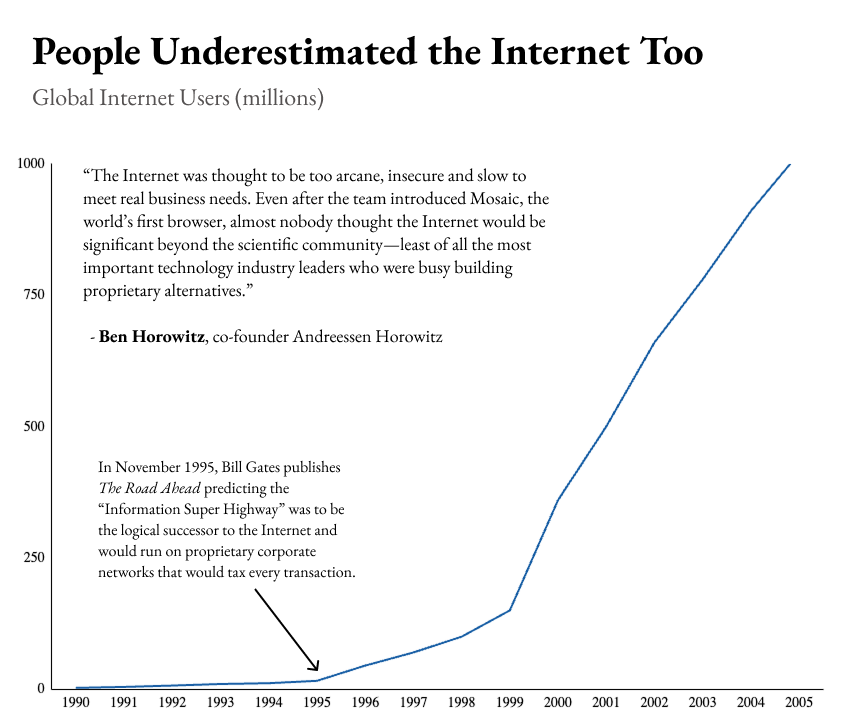


Today, the same historical script is playing out in the realm of financial infrastructure. Sensing both opportunity and threat, major corporations are racing to build private blockchains. In the short term, private chains appear to have the upper hand: faster transaction speeds, better user experience, and large business development teams pushing for adoption. But over time, open, credibly neutral alternatives will slowly erode their market share for two key reasons: 1) No single company can permanently keep up with the pace of innovation in a permissionless system. 2) No legitimate institution wants to build on infrastructure controlled by a competitor.


In 1997, Eric Raymond, a core Linux contributor, explained the underlying logic for the long-term victory of open, permissionless infrastructure in his essay "The Cathedral and the Bazaar." The previously accepted classic theory came from Fred Brooks's "The Mythical Man-Month": software must be developed by a single architect overseeing a small, tightly-knit team, otherwise communication costs would skyrocket exponentially. But Raymond observed that thousands of developers who had never met could simultaneously work on different modules of the Linux kernel, ultimately producing a product that dwarfed those from multi-billion dollar commercial companies. Traditional software was like a finely crafted "cathedral"; the "bazaar" was Fred's term for Linux's distributed development model: public, decentralized, and full of the chaotic, free-flowing energy of iteration. When Linus Torvalds open-sourced the kernel and accepted patches from anyone, he inadvertently pioneered this development paradigm. As Raymond put it: "Release early, release often. Delegate everything you can. Be open to the point of promiscuity." The operating system built using this model powered most internet services by the early 2000s.


Raymond explained that the bazaar model circumvented the problem of exponentially rising communication costs: developers don't need to coordinate directly with each other; everyone simply works synchronously around the code repository, interacting through patches and version updates. The project maintainer integrates all submissions to form a unified standard, which all other developers then use as a baseline. He wrote: "Brooks's law isn't repealed... but given a large enough beta-tester and co-developer base, almost every problem will be characterized quickly and the fix obvious to someone." He added that the negative effects predicted by the law were "overcome by other, nonlinear growth effects."


Raymond also pointed out that the bazaar model breaks down the barrier between users and developers. In the cathedral model, users are merely customers who report bugs to a support ticket system. In the bazaar model, users are co-builders who, upon finding a problem, either submit a fix directly or provide detailed technical descriptions for others to follow up. In the open-source community, "given enough eyeballs, all bugs are shallow." The collective effort of massive participation ultimately leads to overall efficiency surpassing any centralized competitor: "The Linux community... in many ways resembles a free market or an ecology. Many agents pursue their own self-interest, yet the combined result is a self-correcting, resilient system of astonishing complexity and efficiency, far beyond what any centralized planning could achieve."


The Ethereum ecosystem perfectly embodies this pattern. Fabian Vogelsteller, while developing a wallet, found the chaos in various token interface standards and wrote the now-ubiquitous ERC-20 standard. The NFT standard ERC-721 was born from the CryptoKitties development team. Uniswap, now the world's largest decentralized exchange, started as an idea in a Vitalik Buterin blog post, built by Hayden Adams, a mechanical engineer with no financial industry background. These individuals advanced network upgrades without needing anyone's permission. As Sun Microsystems co-founder Bill Joy famously said: "No matter who you are, most of the smartest people work for someone else." A permissionless system allows innovation to spring from anywhere.


The core distinction between the bazaar and the cathedral lies in this: the bazaar's integration layer is lightweight, completely public, and operates on credibility, not top-down authority. Core leaders like Linus Torvalds or Vitalik Buterin gain influence through the voluntary following of developers. Developers follow because core decisions are fully transparent, subject to public critique, and the community can always fork the project if necessary. The internet uses lightweight centralized coordination layers like the IETF and IANA. Wikipedia has a structured editorial review process. All projects that thrive on permissionless innovation manage to be truly open to contributions while having structured integration mechanisms to avoid the feared chaos. And the coordination layer must be maintained by credibility, not coercive control, or the system will quickly collapse.


The bazaar model also requires that the underlying infrastructure cannot be monopolized by a single entity. If Torvalds had tried to privatize the Linux kernel, developers worldwide would have immediately forked the project and continued iterating independently. Raymond refined this theory in "Homesteading the Noosphere." Open-source systems evolved rules similar to Lockean property rights: the developer who writes the initial code first gains founder ownership; continued contribution maintains that ownership; ownership is transferred through formal community succession. Open-source licenses are the formal guarantee of these rules, with community consensus as the soft constraint. If either is missing, developers will migrate to other open-source projects that won't appropriate their labor.


Ethereum's Unreplicable Core Moat


In the Ethereum community, Vitalik has summarized these underlying requirements as "credible neutrality." A coordination mechanism is credibly neutral if it possesses four characteristics simultaneously: the rules are completely transparent, apply equally to all participants, are difficult to arbitrarily change, and anyone can freely participate by following them. These four traits are distilled from mature systems like the internet, Linux, and Wikipedia that attract massive collaboration. Private networks, closed ecosystems, and enterprise blockchains all fail to meet these four points simultaneously.


Over a long enough timeline, credibly neutral systems tend to prevail: the open web replaced corporate private networks, Linux replaced proprietary Unix, Wikipedia replaced Encyclopædia Britannica. In each iteration, the private alternatives held tangible advantages: focused product positioning, strong financial backing, dedicated customer support, professional marketing, and business development teams. But as the open ecosystem matures, these advantages erode, and network effects completely reverse. Once an open system accumulates enough developer tools, applications, and credibility, establishing a perception of stable, unchanging rules, closed systems can no longer compete.


This development pattern is now permeating every layer of financial infrastructure. SWIFT, Visa, Mastercard, and the consortium chains being promoted to institutions today vary in product form and history, but share the same underlying logic: controlled by a centralized entity, harboring platform risk.


For forty years, SWIFT has been owned by member banks and should have remained neutral. But in 2012, under US pressure, it cut off Iranian banks, and in 2022, it was pressured to block several Russian financial institutions. Despite being registered in Belgium and governed by banks, SWIFT ultimately succumbed to US influence, a weakness observed globally. Subsequently, China accelerated its Cross-Border Interbank Payment System (CIPS), Russia built its own System for Transfer of Financial Messages (SPFS), India expanded its Unified Payments Interface (UPI), and Brazil's Pix became a core component of BRICS payment systems. Visa and Mastercard also started as bank cooperatives but have become toll collectors, charging merchants 1.5% to 3.5% fees. Current consortium chains (Canton, Tempo, Arc, etc.) share the same fatal flaw: the interests of the platform operator can always conflict with those of developers building on top.


"The original idea of consortium chains—multiple banks, large companies building their own blockchain together—has largely failed," Vitalik explained. "Such systems combine the worst of both centralized and decentralized worlds." He noted that while the first few participating banks might seem like equal co-builders, the twentieth institution joining is essentially plugging into a system controlled by its competitors. Companies bear all the development costs of a distributed system without gaining the core value blockchains were born to provide: open composability and credible neutrality. Past failures confirm this. From 2017 to 2019, multiple bank consortia tried to rebuild trade finance on blockchain: We.trade, backed by over a dozen institutions including HSBC and Deutsche Bank, went bankrupt in 2022; Marco Polo, with over thirty banks, entered liquidation the next year; Contour followed shortly after, shutting down. The Australian Securities Exchange spent six years and roughly A$250 million building a permissioned ledger with Digital Asset (now developer of Canton), ultimately scrapping the project in 2022. In contrast, Ethereum, owned by no one, has never experienced a full network outage in over a decade, with its ecosystem continually expanding.


This is also the fundamental reason developers choose Ethereum. According to Electric Capital, over 1 million developers have participated in the Ethereum ecosystem since its inception, with 232,000 active developers in the past year alone—no other public chain comes close. Some growth comes from the standard virtuous cycle: Ethereum's concentration of development tools, industry standards, and job opportunities naturally attracts newcomers to learn and build there, which in turn attracts more tools and jobs. But developers and institutions actively choose Ethereum precisely for its extreme decentralization and credible neutrality. For example, last year Robinhood chose to build its Layer 2 on Ethereum rather than develop its own base layer. Johann Kerbrat, head of crypto at the company, stated: "Today, many companies are building their own L1 chains. We also desired the control of our own system, but building a truly secure, decentralized base layer is extremely difficult. Ethereum inherently provides this security base for free. Many new L1s aren't truly decentralized, their security is questionable, and they're essentially just slower, improved databases. We saw no core value."


Erik Voorhees, founder of the privacy-focused AI inference platform Venice AI, expressed a similar view a few days ago. The platform has over 3 million users and generates tens of millions in annual revenue. When asked why they chose to build on Base, Coinbase's Ethereum Layer 2, he said: "We didn't hesitate at all. Among all smart contract platforms, the Ethereum ecosystem is the purest, most resilient, and most mature."


The most fundamental trait of a blockchain is sovereignty. Bitcoin's revolutionary nature lies in being the world's first sovereign computing platform. Before Bitcoin, all computer systems belonged to individuals, companies, or governments and had to obey their owner's will and local laws. A sovereign system follows only its own predetermined rules; no single entity can forcibly change Bitcoin's rules. In the past, sovereignty belonged to monarchs and nations; now, for the first time, a computing platform has achieved sovereignty. This is also why decentralization is so valued in crypto: it's the only path to sovereignty. A chain with only ten validating nodes has its rules dictated by those ten entities. Ethereum, with hundreds of thousands of independent validators spread across global jurisdictions, multiple independent client implementations, and a foundation that explicitly renounces governance power, has long crossed the sovereignty threshold. No single party can claim exclusive ownership of the network. The core value of sovereignty is this: the global financial system can build applications on Ethereum, and all participants need not worry about other institutions, governments, or foundations arbitrarily changing rules to their detriment.


Global Institutions Bet on Ethereum's Open Ecosystem


Ethereum's lead in sovereignty and credible neutrality stems from a historical path dependency that other chains cannot replicate. Ethereum launched in 2015 with Proof of Work, ran for seven years, and only transitioned to Proof of Stake in 2022. Network ownership was sufficiently decentralized through a public crowd sale in 2014 and mining accessible with consumer-grade GPUs, ensuring no single entity holds a large enough token stake to control the network (a key prerequisite for sovereignty in a Proof of Stake system). Most consortium chains today are venture-backed, with tokens concentrated among founding teams, giving a few entities absolute say over consensus. Competitors can copy the technical architecture but not Ethereum's development history.


Since then, Ethereum's lead has compounded: sovereignty and credible neutrality attract developers; an influx of developers brings better libraries, tools, and job markets, further lowering the barrier to entry and attracting more practitioners; applications deposit liquidity and tokenized assets, driving institutional participation. Each layer of the ecosystem reinforces the others. Competitors must build a complete industrial chain simultaneously, while Ethereum's scale advantage continues to grow with compound interest.
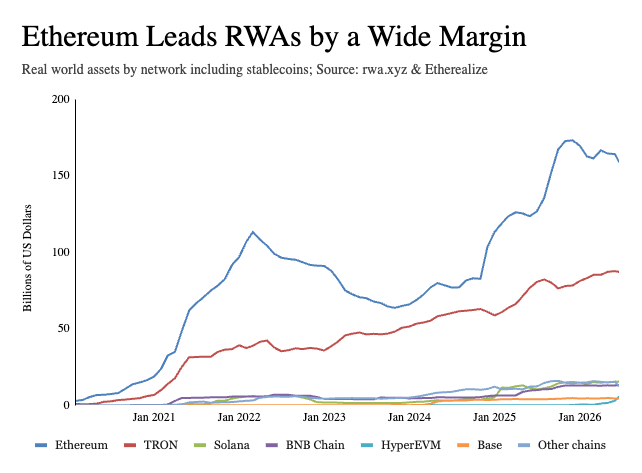


The industry's most sophisticated players are already betting on Ethereum: Coinbase and Robinhood built their Layer 2s on Ethereum; BlackRock and JPMorgan launched tokenized money market funds BUIDL and MONY, both on Ethereum; leading DeFi protocols like Aave, Maker/Sky, Maple, and Uniswap are primarily on Ethereum; the world's top stablecoin issuers settle on Ethereum. Data from Token Terminal's "Q1 2026 Ethereum Industry Report" shows: among the top five public chains, Ethereum hosts 79% of active DeFi lending, 62% of stablecoin issuance, 73% of tokenized funds, and 84% of tokenized commodity assets.


Ethereum's applications are also permissionless, further amplifying its advantages. For example, Uniswap's permissionless listing mechanism gives pricing and liquidity to thousands of long-tail assets, a service centralized exchanges would never provide. Aave's open and highly composable lending markets have spawned an entire ecosystem of specialized pools and risk management tools, far exceeding what the core team alone could develop. Closed systems require platform operators to anticipate all use cases in advance; open systems do not.


The most potent counter-argument to the thesis that "permissionless systems will ultimately win" is not technical but relates to the specific nature of finance: privately controlled networks might be an advantage, not a defect, for the financial industry. When payments fail or funds flow abnormally, regulators need a clear responsible entity; "no one in charge" sounds more like a huge risk than an advantage in a legal context. But this criticism confuses two completely separate layers: accountability mechanisms are built at the application layer; the settlement layer does not need to bear this function. For instance, the ERC-3643 token standard directly embeds KYC verification and cross-border transfer restrictions into smart contracts; issuers can set wallet whitelists, restrict asset transfers, freeze, or recover tokens. Privacy technologies work similarly; zero-knowledge proofs allow institutions to settle on a public chain while hiding transaction details. In contrast, on consortium chains, transaction data is visible only to the company itself and its competitors.


In the early days of the internet, it was widely believed its security was insufficient for commercial transactions. After the HTTPS protocol enhanced security capabilities, most commercial activity migrated to the open web, and such skepticism vanished. The skeptics back then weren't wrong about the internet's early flaws, but they underestimated the self-evolving potential of open networks.


Today, banks and fintech companies building private chains are repeating the mistakes of AOL and Microsoft: trying to replicate an open system but building a walled garden, extracting rent through platform control. This model is doomed to fail. The walls built to exert control also block out external innovation.


Netscape is the model for success. Netscape never tried to monopolize the internet; it built a browser to guide global users onto the open network. Riding the explosive growth of the internet, Netscape became a defining company of its era. Ethereum, with its almost unreplicable credible neutrality, already possesses the potential to become the global settlement layer for finance. The optimal industry strategy is to build applications on top of permissionless infrastructure, not to compete with it head-on.

Criptos en tendencia

Preguntas relacionadas

QAccording to the article, what is the 'Cathedral vs. Bazaar' analogy, and how does it relate to Ethereum's development?

AThe 'Cathedral vs. Bazaar' analogy, from Eric Raymond's essay, contrasts traditional, centralized 'cathedral' software development with the open, decentralized 'bazaar' model of Linux. The article argues that Ethereum perfectly embodies this 'bazaar' model, where innovation is permissionless and contributions come from a global, decentralized network of developers, leading to superior long-term evolution and resilience compared to closed, corporate-controlled systems.

QWhat are the four key characteristics of 'credible neutrality' as defined by Vitalik Buterin in the context of Ethereum?

AAccording to the article, Vitalik Buterin defines a credibly neutral coordination mechanism as one that possesses four key characteristics: 1) The rules are completely transparent. 2) The rules apply equally to all participants. 3) The rules are difficult to change arbitrarily. 4) Anyone who follows the rules can participate freely. Ethereum is presented as a system that embodies these traits.

QWhy does the author argue that private or consortium blockchains (like Canton, Tempo) are fundamentally flawed for financial infrastructure?

AThe author argues that private or consortium blockchains suffer from a fatal flaw: they reintroduce platform risk controlled by a centralized entity or a consortium of competitors. This structure fails to provide the core value of blockchains—open composability and credible neutrality. Institutions are reluctant to build on infrastructure controlled by rivals, and these systems cannot match the innovation speed of permissionless networks. Historical failures like We.trade and the Australian Stock Exchange's project are cited as evidence.

QWhat historical examples does the article use to support the thesis that open, permissionless systems ultimately triumph over closed ones?

AThe article supports its thesis with several historical examples: the open Internet defeating corporate proprietary networks (like those envisioned by Bill Gates), the Linux operating system displacing proprietary Unix systems (like Sun Microsystems), and Wikipedia replacing the Encyclopaedia Britannica. Each case shows closed systems initially having advantages but ultimately being overtaken by open ecosystems due to network effects and innovation.

QWhat is described as Ethereum's 'unreplicable core moat' or competitive advantage, and how was it established?

AEtheream's 'unreplicable core moat' is its sovereign independence and credible neutrality, achieved through a unique historical path dependence. This was established by launching with Proof-of-Work in 2015, which allowed for highly decentralized ownership via GPU mining, and conducting a public crowd sale with no single entity holding a controlling stake. This history, combined with its subsequent network effects in developers, tools, and applications, creates a competitive advantage that new chains backed by venture capital and centralized token allocations cannot easily replicate.

Lecturas Relacionadas

Two Giants' Credit Expansion: Loan Balances of $9.9 Billion vs. $14.6 Billion, Brazil Emerges as the Main Battlefield

Title: Two Giants "Credit" Surge: Loan Balances of 99 Billion vs. 146 Billion USD, Brazil Emerges as Main Battlefield Summary: The article compares the rapid expansion of credit businesses by two major e-commerce and fintech players, Sea (via Monee) and Mercado Libre (via Mercado Pago), in overseas markets like Southeast Asia and Latin America, contrasting with a slowing domestic Chinese credit market. Using Q1 2026 financial data, it highlights their significant growth. Sea's Monee reached a loan balance of $99 billion, up 71% year-over-year (YoY), contributing 17.5% to Sea's total revenue. Mercado Pago's loan balance hit $146 billion, up 87% YoY, contributing 45% to its parent company's revenue. Both maintained stable risk metrics (e.g., Monee's 90+ day NPL at 1.1%) despite rapid scaling. Brazil is identified as a key and accelerating growth market for both. Sea's Brazilian operations saw loan volumes exceed $10 billion, growing 250% YoY, with SPayLater GMV penetration still low (~10%) indicating high potential. Sea also secured a key Brazilian financial credit license (SCFI). Mercado Libre's Brazil segment contributed over half (54%) of total group revenue, with its credit business there generating $11.24 billion in revenue, up 89% YoY and accounting for 12.7% of global revenue. Mercado Pago's credit portfolio, especially credit cards (46% of loans, +105% YoY), is a strategic focus, described as crucial as building logistics was a decade ago. Its net interest margin after loss (NIMAL) remains high at 17.8%. The article concludes that while Brazil presents immense opportunities, the success is largely driven by these integrated "e-commerce + fintech" giants with proprietary transaction data and ecosystems, making it challenging for standalone fintech players to compete effectively.

链捕手Hace 15 min(s)

Two Giants' Credit Expansion: Loan Balances of $9.9 Billion vs. $14.6 Billion, Brazil Emerges as the Main Battlefield

链捕手Hace 15 min(s)

Research Report Analysis: Is Intel Making a Comeback with Apple? Bernstein's Calculations Show the Right Direction, but the Price Is Already Overvalued

Bernstein analyst Stacy A. Rasgon published a report on June 18 regarding Intel, assessing the potential impact of recent political support for a US-based PC chip design and manufacturing collaboration between Apple and Intel. The report views this as a significant signal for the foundry landscape shift but concludes the initial financial contribution would be minimal. Key conclusions: 1) An Apple deal is seen as a small-scale "proof of concept." Even if Intel wins 40% of Apple's premium notebook chip orders (~5 million units/year), Bernstein estimates it would generate only about $500M in annual revenue and ~$0.03 EPS, negligible against Intel's ~$55B revenue. 2) Political encouragement is not equivalent to enforceable mandates. Winning orders ultimately depends on Intel demonstrating competitive technology (like its 18A node), cost, and reliable supply. 3) The path from validation to large-scale production involves significant challenges, capital investment, and time. Due to these uncertainties, Bernstein maintains a Market-Perform (Hold) rating with a $100 price target, implying potential downside from the ~$121.10 price at the report date. The analysis highlights the tension between near-term validation value—serving as a crucial trust signal for Intel's foundry ambitions and US supply chain resilience—and the long-term opportunity to attract larger cloud and AI chip customers. The investment thesis hinges on successful 18A execution and sustained policy support, not on immediate financial gains from Apple.

marsbitHace 40 min(s)

Research Report Analysis: Is Intel Making a Comeback with Apple? Bernstein's Calculations Show the Right Direction, but the Price Is Already Overvalued

marsbitHace 40 min(s)

27-Year Reign Ends: SK Hynix Market Cap Surpasses Samsung for First Time, an AI-Driven Reshuffle of Korean Chip Power

On June 22, 2026, SK Hynix made history by surpassing Samsung Electronics in market capitalization, ending Samsung's 27-year reign as South Korea's most valuable company. This dramatic reversal is powered by the AI boom and SK Hynix's dominant position in High Bandwidth Memory (HBM), a critical component for AI model training. Once a heavily indebted firm on the brink of bankruptcy, SK Hynix bet early on HBM, which has evolved from a niche product to essential AI infrastructure. It now commands a 59% share of the global HBM market. Its financial performance is staggering, with Q1 2026 net profit soaring nearly fourfold year-over-year to KRW 40.35 trillion, translating to over 2 billion RMB in daily net profit. HBM now drives roughly 40% of its revenue with exceptionally high margins. In contrast, Samsung, with its broad portfolio spanning memory chips, smartphones, and foundry services, has lagged in the HBM race while facing headwinds in other divisions. This shift signifies a deeper restructuring of South Korea's economy, moving from consumer electronics to AI-driven growth. However, the future remains competitive. With major capacity expansions planned industry-wide by 2028 and Samsung aiming to catch up in HBM technology, the new market leader cannot afford complacency. This event marks a pivotal moment in the global semiconductor industry's ongoing power realignment.

marsbitHace 51 min(s)

27-Year Reign Ends: SK Hynix Market Cap Surpasses Samsung for First Time, an AI-Driven Reshuffle of Korean Chip Power

marsbitHace 51 min(s)

Trading

Spot
Futuros

Artículos destacados

Qué es ETH 2.0

ETH 2.0: Una Nueva Era para Ethereum Introducción ETH 2.0, conocido ampliamente como Ethereum 2.0, marca una actualización monumental para la blockchain de Ethereum. Esta transición no es solo una mejora superficial; busca mejorar fundamentalmente la escalabilidad, seguridad y sostenibilidad de la red. Con un cambio del mecanismo de consenso intensivo en energía Prueba de Trabajo (PoW) a una Prueba de Participación (PoS) más eficiente, ETH 2.0 promete un enfoque transformador para el ecosistema blockchain. ¿Qué es ETH 2.0? ETH 2.0 es un conjunto de actualizaciones interconectadas y distintivas centradas en optimizar las capacidades y el rendimiento de Ethereum. La reestructuración está diseñada para abordar desafíos críticos que el mecanismo actual de Ethereum ha enfrentado, particularmente en lo que respecta a la velocidad de transacción y la congestión de la red. Objetivos de ETH 2.0 Los objetivos principales de ETH 2.0 giran en torno a mejorar tres aspectos clave: Escalabilidad: Con el objetivo de aumentar significativamente el número de transacciones que la red puede manejar por segundo, ETH 2.0 busca superar la limitación actual de aproximadamente 15 transacciones por segundo, potencialmente alcanzando miles. Seguridad: Las medidas de seguridad mejoradas son fundamentales para ETH 2.0, particularmente a través de una mejor resistencia contra ciberataques y la preservación del ethos descentralizado de Ethereum. Sostenibilidad: El nuevo mecanismo PoS está diseñado no solo para mejorar la eficiencia, sino también para reducir drásticamente el consumo de energía, alineando el marco operativo de Ethereum con consideraciones ambientales. ¿Quién es el Creador de ETH 2.0? La creación de ETH 2.0 se puede atribuir a la Fundación Ethereum. Esta organización sin fines de lucro, que desempeña un papel crucial en el apoyo al desarrollo de Ethereum, es liderada por el notable cofundador Vitalik Buterin. Su visión de un Ethereum más escalable y sostenible ha sido la fuerza motriz detrás de esta actualización, involucrando contribuciones de una comunidad global de desarrolladores y entusiastas dedicados a mejorar el protocolo. ¿Quiénes son los Inversores de ETH 2.0? Si bien los detalles sobre los inversores de ETH 2.0 no se han hecho públicos, se sabe que la Fundación Ethereum recibe apoyo de varias organizaciones e individuos en el ámbito de blockchain y tecnología. Estos socios incluyen firmas de capital de riesgo, compañías tecnológicas y organizaciones filantrópicas que comparten un interés mutuo en apoyar el desarrollo de tecnologías descentralizadas e infraestructura blockchain. ¿Cómo Funciona ETH 2.0? ETH 2.0 se distingue por introducir una serie de características clave que lo diferencian de su predecesor. Prueba de Participación (PoS) La transición a un mecanismo de consenso PoS es uno de los cambios más destacados de ETH 2.0. A diferencia de PoW, que se basa en la minería intensiva en energía para la verificación de transacciones, PoS permite a los usuarios validar transacciones y crear nuevos bloques de acuerdo con la cantidad de ETH que apuestan en la red. Esto conduce a una mayor eficiencia energética, reduciendo el consumo en aproximadamente un 99.95%, convirtiendo a Ethereum 2.0 en una alternativa considerablemente más verde. Cadenas Shard Las cadenas shard son otra innovación crítica de ETH 2.0. Estas cadenas más pequeñas operan en paralelo con la cadena principal de Ethereum, lo que permite que múltiples transacciones sean procesadas simultáneamente. Este enfoque mejora la capacidad general de la red, abordando las preocupaciones de escalabilidad que han afectado a Ethereum. Cadena Beacon En el núcleo de ETH 2.0 se encuentra la Cadena Beacon, que coordina la red y gestiona el protocolo PoS. Funciona como un organizador de cierta manera: supervisa a los validadores, asegura que los shards permanezcan conectados a la red y monitorea la salud general del ecosistema blockchain. Cronología de ETH 2.0 El viaje de ETH 2.0 ha estado marcado por varios hitos clave que trazan la evolución de esta importante actualización: Diciembre 2020: El lanzamiento de la Cadena Beacon marcó la introducción de PoS, preparándose para la migración hacia ETH 2.0. Septiembre 2022: La finalización de “La Fusión” representa un momento crucial en el que la red Ethereum se trasladó exitosamente de un marco PoW a uno PoS, anunciando una nueva era para Ethereum. 2023: El lanzamiento esperado de cadenas shard tiene como objetivo mejorar aún más la escalabilidad de la red Ethereum, consolidando a ETH 2.0 como una plataforma robusta para aplicaciones y servicios descentralizados. Características Clave y Beneficios Escalabilidad Mejorada Una de las ventajas más significativas de ETH 2.0 es su escalabilidad mejorada. La combinación de PoS y cadenas shard permite que la red expanda su capacidad, permitiendo acomodar un volumen mucho mayor de transacciones en comparación con el sistema heredado. Eficiencia Energética La implementación de PoS representa un gran paso hacia la eficiencia energética en la tecnología blockchain. Al reducir drásticamente el consumo de energía, ETH 2.0 no solo disminuye los costos operativos, sino que también se alinea más estrechamente con los objetivos de sostenibilidad global. Seguridad Mejorada Los mecanismos actualizados de ETH 2.0 contribuyen a mejorar la seguridad en toda la red. El despliegue de PoS, junto con las medidas de control innovadoras establecidas a través de cadenas shard y la Cadena Beacon, asegura un mayor grado de protección contra posibles amenazas. Costos Más Bajos para los Usuarios A medida que la escalabilidad mejora, los efectos sobre los costos de transacción también serán evidentes. Se espera que una mayor capacidad y una menor congestión se traduzcan en tarifas más bajas para los usuarios, haciendo que Ethereum sea más accesible para transacciones cotidianas. Conclusión ETH 2.0 marca una evolución significativa en el ecosistema blockchain de Ethereum. A medida que aborda problemas fundamentales como la escalabilidad, el consumo de energía, la eficiencia en las transacciones y la seguridad general, la importancia de esta actualización no puede ser subestimada. La transición a la Prueba de Participación, la introducción de cadenas shard y el trabajo fundamental de la Cadena Beacon son indicativos de un futuro donde Ethereum puede satisfacer las crecientes demandas del mercado descentralizado. En una industria impulsada por la innovación y el progreso, ETH 2.0 se erige como un testimonio de las capacidades de la tecnología blockchain para allanar el camino hacia una economía digital más sostenible y eficiente.

172 Vistas totalesPublicado en 2024.04.04Actualizado en 2024.12.03

Qué es ETH 2.0

Qué es ETH 3.0

ETH3.0 y $eth 3.0: Un Examen Profundo del Futuro de Ethereum Introducción En el paisaje en rápida evolución de las criptomonedas y la tecnología blockchain, ETH3.0, a menudo denotado como $eth 3.0, ha surgido como un tema de considerable interés y especulación. El término abarca dos conceptos principales que merecen aclaración: Ethereum 3.0: Esto representa una posible actualización futura destinada a aumentar las capacidades de la blockchain existente de Ethereum, enfocándose particularmente en mejorar la escalabilidad y el rendimiento. ETH3.0 Meme Token: Este proyecto de criptomoneda distinto busca aprovechar la blockchain de Ethereum para crear un ecosistema centrado en memes, promoviendo la participación dentro de la comunidad de criptomonedas. Comprender estos aspectos de ETH3.0 es esencial no solo para los entusiastas de las criptomonedas, sino también para aquellos que observan tendencias tecnológicas más amplias en el espacio digital. ¿Qué es ETH3.0? Ethereum 3.0 Ethereum 3.0 se presenta como una actualización propuesta para la red de Ethereum ya establecida, que ha sido la columna vertebral de muchas aplicaciones descentralizadas (dApps) y contratos inteligentes desde su inicio. Las mejoras previstas se concentran principalmente en la escalabilidad, integrando tecnologías avanzadas como sharding y pruebas de conocimiento cero (zk-proofs). Estas innovaciones tecnológicas tienen como objetivo facilitar un número sin precedentes de transacciones por segundo (TPS), potencialmente alcanzando millones, abordando así una de las limitaciones más significativas que enfrenta la tecnología blockchain actual. La mejora no es meramente técnica, sino también estratégica; está destinada a preparar la red de Ethereum para su adopción generalizada y utilidad en un futuro marcado por una mayor demanda de soluciones descentralizadas. ETH3.0 Meme Token En contraste con Ethereum 3.0, el ETH3.0 Meme Token se aventura en un ámbito más ligero y juguetón al combinar la cultura de memes de internet con la dinámica de las criptomonedas. Este proyecto permite a los usuarios comprar, vender e intercambiar memes en la blockchain de Ethereum, proporcionando una plataforma que fomenta la participación comunitaria a través de la creatividad y los intereses compartidos. El ETH3.0 Meme Token tiene como objetivo demostrar cómo la tecnología blockchain puede intersectarse con la cultura digital, creando casos de uso que son tanto entretenidos como financieramente viables. ¿Quién es el Creador de ETH3.0? Ethereum 3.0 La iniciativa hacia Ethereum 3.0 es impulsada principalmente por un consorcio de desarrolladores e investigadores dentro de la comunidad de Ethereum, incluyendo notablemente a Justin Drake. Conocido por sus ideas y contribuciones a la evolución de Ethereum, Drake ha sido una figura prominente en las discusiones sobre la transición de Ethereum a una nueva capa de consenso, denominada “Beam Chain.” Este enfoque colaborativo para el desarrollo significa que Ethereum 3.0 no es el producto de un creador singular, sino más bien una manifestación de ingenio colectivo centrado en avanzar la tecnología blockchain. ETH3.0 Meme Token Los detalles sobre el creador del ETH3.0 Meme Token son actualmente inidentificables. La naturaleza de los tokens de memes a menudo conduce a una estructura más descentralizada y dirigida por la comunidad, lo que podría explicar la falta de atribución específica. Esto se alinea con la ética de la comunidad cripto más amplia, donde la innovación a menudo surge de esfuerzos colaborativos en lugar de individuales. ¿Quiénes son los Inversores de ETH3.0? Ethereum 3.0 El apoyo a Ethereum 3.0 proviene principalmente de la Fundación Ethereum junto con una entusiasta comunidad de desarrolladores e inversores. Esta asociación fundamental proporciona un grado significativo de legitimidad y mejora la perspectiva de una implementación exitosa, ya que aprovecha la confianza y credibilidad construidas a lo largo de años de operaciones en la red. En el clima cambiando rápidamente de las criptomonedas, el apoyo de la comunidad juega un papel crucial en impulsar el desarrollo y la adopción, posicionando a Ethereum 3.0 como un contendiente serio para futuros avances en blockchain. ETH3.0 Meme Token Si bien las fuentes actualmente disponibles no proporcionan información explícita sobre las fundaciones o organizaciones de inversión que respaldan el ETH3.0 Meme Token, es indicativo del modelo de financiamiento típico para tokens de memes, que a menudo depende del apoyo de base y la participación comunitaria. Los inversores en tales proyectos suelen consistir en individuos motivados por el potencial de innovación impulsada por la comunidad y el espíritu de cooperación que se encuentra dentro de la comunidad cripto. ¿Cómo Funciona ETH3.0? Ethereum 3.0 Las características distintivas de Ethereum 3.0 radican en su implementación propuesta de sharding y tecnología zk-proof. Sharding es un método de particionamiento de la blockchain en piezas más pequeñas y manejables o “shards,” que pueden procesar transacciones de manera concurrente en lugar de secuencial. Esta descentralización del procesamiento ayuda a prevenir la congestión y asegura que la red permanezca receptiva incluso bajo una carga pesada. La tecnología de prueba de conocimiento cero (zk-proof) contribuye con otra capa de sofisticación al permitir la validación de transacciones sin revelar los datos subyacentes involucrados. Este aspecto no solo mejora la privacidad, sino que también aumenta la eficiencia general de la red. También se habla de incorporar una Máquina Virtual de Ethereum de conocimiento cero (zkEVM) en esta actualización, amplificando aún más las capacidades y utilidad de la red. ETH3.0 Meme Token El ETH3.0 Meme Token se distingue al capitalizar la popularidad de la cultura de memes. Establece un mercado para que los usuarios participen en el comercio de memes, no solo por entretenimiento sino también por el posible beneficio económico. Al integrar características como staking, provisión de liquidez y mecanismos de gobernanza, el proyecto fomenta un entorno que incentiva la interacción y participación de la comunidad. Al ofrecer una mezcla única de entretenimiento y oportunidad económica, el ETH3.0 Meme Token tiene como objetivo atraer a una audiencia diversa, que abarca desde entusiastas de las criptomonedas hasta conocedores casuales de memes. Línea de Tiempo de ETH3.0 Ethereum 3.0 11 de noviembre de 2024: Justin Drake insinúa la próxima actualización de ETH 3.0, centrada en mejoras de escalabilidad. Este anuncio significa el comienzo de las discusiones formales sobre la futura arquitectura de Ethereum. 12 de noviembre de 2024: Se espera que la propuesta anticipada para Ethereum 3.0 se desvele en Devcon en Bangkok, preparando el escenario para una mayor retroalimentación de la comunidad y posibles próximos pasos en el desarrollo. ETH3.0 Meme Token 21 de marzo de 2024: El ETH3.0 Meme Token se lista oficialmente en CoinMarketCap, marcando su incursión en el dominio público de las criptomonedas y mejorando la visibilidad de su ecosistema basado en memes. Puntos Clave En conclusión, Ethereum 3.0 representa una evolución significativa dentro de la red de Ethereum, enfocándose en superar las limitaciones en términos de escalabilidad y rendimiento a través de tecnologías avanzadas. Sus actualizaciones propuestas reflejan un enfoque proactivo hacia las demandas y la usabilidad futura. Por otro lado, el ETH3.0 Meme Token encapsula la esencia de la cultura impulsada por la comunidad en el espacio de las criptomonedas, aprovechando la cultura de memes para crear plataformas atractivas que fomentan la creatividad y participación del usuario. Comprender los distintos propósitos y funcionalidades de ETH3.0 y $eth 3.0 es fundamental para cualquiera interesado en los desarrollos en curso dentro del espacio cripto. Con ambas iniciativas abriendo caminos únicos, subrayan colectivamente la naturaleza dinámica y multifacética de la innovación en blockchain.

190 Vistas totalesPublicado en 2024.04.04Actualizado en 2024.12.03

Qué es ETH 3.0

Cómo comprar ETH

¡Bienvenido a HTX.com! Hemos hecho que comprar Ethereum (ETH) sea simple y conveniente. Sigue nuestra guía paso a paso para iniciar tu viaje de criptos.Paso 1: crea tu cuenta HTXUtiliza tu correo electrónico o número de teléfono para registrarte y obtener una cuenta gratuita en HTX. Experimenta un proceso de registro sin complicaciones y desbloquea todas las funciones.Obtener mi cuentaPaso 2: ve a Comprar cripto y elige tu método de pagoTarjeta de crédito/débito: usa tu Visa o Mastercard para comprar Ethereum (ETH) al instante.Saldo: utiliza fondos del saldo de tu cuenta HTX para tradear sin problemas.Terceros: hemos agregado métodos de pago populares como Google Pay y Apple Pay para mejorar la comodidad.P2P: tradear directamente con otros usuarios en HTX.Over-the-Counter (OTC): ofrecemos servicios personalizados y tipos de cambio competitivos para los traders.Paso 3: guarda tu Ethereum (ETH)Después de comprar tu Ethereum (ETH), guárdalo en tu cuenta HTX. Alternativamente, puedes enviarlo a otro lugar mediante transferencia blockchain o utilizarlo para tradear otras criptomonedas.Paso 4: tradear Ethereum (ETH)Tradear fácilmente con Ethereum (ETH) en HTX's mercado spot. Simplemente accede a tu cuenta, selecciona tu par de trading, ejecuta tus trades y monitorea en tiempo real. Ofrecemos una experiencia fácil de usar tanto para principiantes como para traders experimentados.

4.2k Vistas totalesPublicado en 2024.12.10Actualizado en 2026.06.02

Cómo comprar ETH

Discusiones

Bienvenido a la comunidad de HTX. Aquí puedes mantenerte informado sobre los últimos desarrollos de la plataforma y acceder a análisis profesionales del mercado. A continuación se presentan las opiniones de los usuarios sobre el precio de ETH (ETH).

活动图片