Author: Xiaobai
This article is an original submission from the author. The views expressed are solely the author's personal understanding. ETHPanda has edited and organized the content.
Blockchain has always emphasized "being your own bank," but few have seriously addressed another question: If users fundamentally cannot understand what they are signing, how real is that control? From blind signing to Clear Signing, Ethereum is finally working on a fundamental, albeit overdue, piece of the puzzle, aiming to make transaction signatures slowly transition from being understandable by programmers to something comprehensible by ordinary users.
Blind Signing Isn't User Carelessness
I've had a lingering question ever since I started using a crypto wallet.
Why does the wallet confirmation screen always show a string of hexadecimal code every time I go to sign?
I'm clearly clicking Swap, Mint, Claim, or Approve on a website, but at the final confirmation step, the screen suddenly switches to a bunch of 0x-prefixed gibberish. Countless educational videos repeatedly warn people not to sign randomly, as many phishing sites steal assets this way.
This creates a major contradiction.
On one hand, telling regular users that signing is dangerous and they must be careful. On the other hand, presenting the very thing they need to see in a format utterly incomprehensible to the average person.
This isn't user carelessness; it's an inherently anti-human interaction design.
I later learned this situation has a name: blind signing. When you click confirm, cryptographically you are authorizing a transaction, but from a human understanding perspective, you are essentially signing a document you cannot read.
The problem isn't that users don't understand security is important; it's that they lack sufficient information to judge whether something is safe or not.
The Ethereum Foundation recently announced that Clear Signing is now live, with a straightforward goal: to make human-readable transaction signing the default experience. The Clear Signing website puts it even more plainly: See what you sign. Let you truly see what you are signing.
It's not just a simple wallet UI optimization; it's building a foundational piece that Ethereum has been missing for ordinary users.
Wallet security in the past mostly focused on warning you before something went wrong. For example, some browser extensions would check if a site is a phishing risk and flash red warnings. Wallets like Rabby also added many transaction previews and risk warnings, showing you roughly how your asset balance would change after signing.
These are very useful.
But they are more like adding security guards next to the transaction, rather than solving the problem at the root of the signature itself. You still have to trust the extension, trust the wallet simulation, trust its ability to identify the risks of that website and that transaction.
Clear Signing Aims to Translate Transactions into Plain Language
What Clear Signing wants to do is more fundamental.
It doesn't just tell you "this site might be dangerous." It enables protocol developers to write the transaction semantics in a standard format, allowing wallets to reliably translate calldata into human-understandable actions.
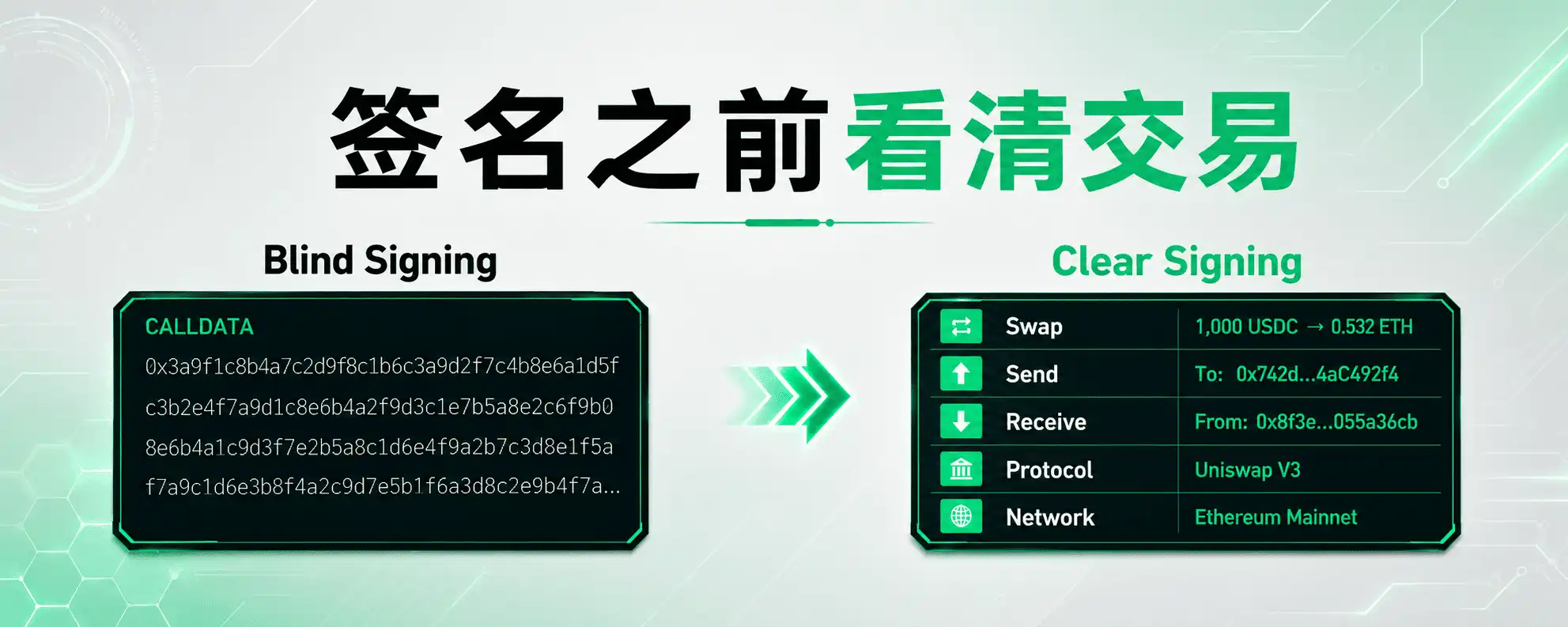
For example, what you used to see was a long string of hex.
Ideally in the future, what you should see is: Swap, sending 1,000 USDC, minimum to receive 0.42 WETH, protocol is Uniswap V3, network is Ethereum.
This is what the signature confirmation page should look like for humans.
Here we can reference Ray's explanation. In his post, he said something I think is very insightful: "Structured code is still code."
This statement actually highlights the difference between EIP-712 and ERC-7730. EIP-712 turns chaotic signature data into structured data, but structured doesn't equal human-readable. What ordinary users truly need is not rows of neater variable names and parameters, but action language they can understand at a glance.
Ray also described Clear Signing as **"adding a layer of translation between code and the ordinary user."** That's an excellent analogy.
How ERC-7730 and the Registry Work
The core standard behind Clear Signing is ERC-7730.
It defines a JSON metadata format.
In simple terms, it allows protocol developers to create a "translation dictionary" for their contract functions. They specify, in advance and in a standard way, how a particular contract function, a particular parameter, or an amount field should be displayed to the user. This description is then submitted to a public registry. Before signing, the wallet consults this dictionary to translate the underlying calldata into a confirmation page the user can understand.
An ABI can tell a wallet, "Here is a uint256 amount."
But an ABI can't necessarily tell the user that this amount is for USDC with 6 decimals, or for ETH with 18 decimals. Nor can it necessarily tell the user if this operation is a Swap, Stake, Approve, or Claim.
ERC-7730 fills in this semantic layer.
The registry then plays the role of a public directory. The clear-signing-erc7730-registry repository maintains the metadata files within the registry directory. Protocol developers submit their description files, and wallets and tools read them, finally enabling the translation of transactions into clearer human language.
According to the snapshot from the Clear Signing website on May 7, 2026, the registry already covers 44 protocols and has published 346 descriptors. Projects like 1inch, Aave, Circle, Lido, Uniswap, Safe, WalletConnect, and WETH can already be seen in the list.
It's Not a Magic Switch, But the Direction is Right
The numbers look promising, but Clear Signing has only just begun.
Blind signing problems haven't suddenly disappeared just because the EF made an announcement. In reality, a vast number of contracts have not registered according to ERC-7730, and wallet integration won't happen overnight either. The official website currently clearly states Ledger is live, Trezor is in development. Other wallets, tools, and protocols will need time to integrate.
So the practical issue Cos raises is crucial. Protocols need to complete registration according to the ERC-7730 standard for wallets and tools supporting ERC-7730 to parse and display information properly. At the same time, the existing parsing, simulation, and risk-warning capabilities on the wallet side must remain and cannot be discarded.
I really agree with this point.
Clear Signing addresses what a transaction *claims* it will do. Transaction simulations like Rabby's address what *might* happen after execution. One looks at intent, the other at outcome. A truly good wallet security experience should have both layers.
Because attackers won't stop evolving.
If users start trusting clear signatures in the future, attackers might try submitting misleading metadata, or use long-tail contracts, unregistered contracts, or complex batch transactions to bypass proper display. The official documentation also specifically mentions that wallets need to decide for themselves which registries, review signals, and attestations to trust.
Therefore, Clear Signing is not a magic switch; it's more like a new industry discipline.
Protocols need to clearly define transaction semantics.
The registry needs to have review and trust signals.
Wallets need to decide which metadata can be displayed.
Users finally don't have to be forced to face indecipherable gibberish.
I think this is especially significant for the Chinese-speaking community.
It's not that many people don't want to enter the on-chain ecosystem; the barrier is genuinely too high. Most users aren't programmers, and even programmers might not understand Solidity, calldata, ABI, selector, permit, delegatecall, and so on.
The on-chain experience of the past often defaulted to the assumption that users should bear the cost of understanding themselves.
If you can't understand it, you're not professional enough.
If you get scammed, you weren't careful enough.
If you're afraid to use it, you haven't learned enough yet.
But this isn't the posture a mass-market application should have.
If a financial-grade system requires ordinary users to understand hexadecimal code before signing, that's not a failure of user education; it's a sign the product and infrastructure haven't matured yet.
I had a similar idea earlier during the Web3 Winter Internship Program by LXDAO and ETHPanda. At the time, I submitted a PR to add security courses in Headbook. My thought was simple: I wanted to help educate users on how wallets parse the first four hexadecimal digits of a signature (the function selector) to understand its meaning. I didn't have a complete solution back then, just a simple belief that users shouldn't have to guess their fate based on hex.
Looking back now, ERC-7730 is systematically answering this question.
It's not just about parsing the first four selector digits; it's about enabling protocols to write verifiable, reusable, wallet-consumable structured metadata for functions, fields, amounts, addresses, and context.
This is more important than simply looking up a function name.
Because function names can be deceptive too. A malicious function could be named `claimRewards` or `deposit`. The truly valuable display isn't just telling you what the function is called, but telling you the action, asset, amount, protocol, network, and risk boundaries associated with that signature.
This is informed consent.
In its early days, Ethereum sacrificed a lot of human readability to get smart contracts running fast. Historically, this is understandable. Without that rapid experimentation then, there might not be the DeFi, NFT, DAO, and the entire EVM ecosystem we have today.
But technical debt doesn't disappear; it only returns to collect payment later, in the form of phishing, accidental signatures, malicious approvals, and cold wallet thefts, as the user base grows.
Future Outlook
Now with the emergence of Clear Signing, it at least shows the Ethereum ecosystem is seriously starting to pay back this debt.
I don't think it will change everyone's wallet experience in a matter of months. A more realistic assessment is that over the next few years, as mainstream protocols submit metadata, mainstream wallets gradually add support, and auditing and attestation mechanisms improve, clear signing will slowly become the default experience.
But the direction is right.
Blockchain shouldn't remain forever in the stage of "only those who understand code dare to use it." True mass adoption isn't about making everyone learn to read calldata; it's about enabling everyone to understand, in their own language, what they are authorizing before they sign.
The world has suffered from blind signing for far too long.
This is the significance of Clear Signing: It's not about making wallets look prettier; it's about gradually returning the right to informed consent for transaction signatures back to the users.