SharpLink CEO: How to Understand Ethereum Developers Just Exceeded 1 Million?

链捕手Publicado a 2026-06-16Actualizado a 2026-06-16

Resumen

SharpLink CEO reflects on the milestone of Ethereum surpassing 1 million historical developers, emphasizing that this figure represents the largest pool of technical talent ever assembled around an open, permissionless blockchain network. While approximately 232,000 developers remain active, the key question for the crypto industry is not which chain is fastest, but where the best builders choose to build long-term. Ethereum's advantage lies in a decade-long accumulation of infrastructure, standards, tools, liquidity, and a cohesive culture, making it the default operating system for programmable finance. This developer base is tackling complex challenges: the Glamsterdam upgrade aims to enhance scalability while preserving core principles; synchronous composability seeks to unify Rollup ecosystems; and significant efforts are underway for post-quantum security. Ethereum's deeper network effects stem from composability and shared standards (like the EVM and Solidity), creating a flywheel of more developers, tools, and liquidity. Three reinforcing strengths cement Ethereum's lead: credible neutrality (secured by ~900k validators), a modular architecture with interconnected Rollups, and a culture that attracts top researchers. The ecosystem is consolidating as the trusted coordination layer for internet-native finance, favored by large institutions valuing security and liquidity. The future of Ethereum is being built by this global community of founders and architects.

Author: Joseph Chalom

Compiled by: Jiahuan, ChainCatcher

I just returned from Asia, where I spent time with Ethereum developers and ecosystem leaders. Special thanks to Nonce Classic, Four Pillars, and DSRV in Seoul, our friends at SNZ, and the recently opened Ethereum Community Center in Hong Kong. This center is Asia's first long-term operational physical Ethereum community space, supported by the Ethereum Foundation.

What impressed me most was not just the vibrancy, but also the rigor and ambition of the builders there. The high-caliber projects, experimental spirit, and long-term thinking emerging from the global Ethereum ecosystem were truly inspiring.

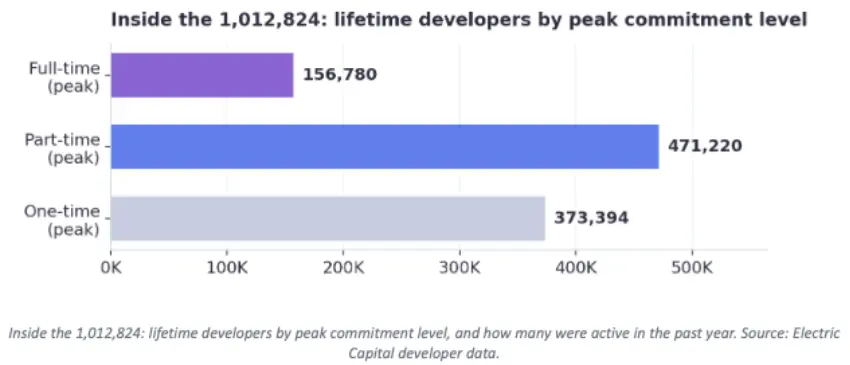
This also brought a number to life: data from Electric Capital shows that the total number of historical Ethereum developers has now exceeded one million, with 1,012,824 individuals having contributed to the ecosystem. No other ecosystem in crypto can compare.

A Milestone Worth Noting

One million is a round number, and round numbers can sometimes feel hollow. But this one is not. It represents the largest pool of technical talent ever assembled around an open, permissionless blockchain network. More importantly, this talent pool continues to deepen and widen.

Of this one million developers, approximately 232,000 remained active over the past twelve months.
Why Ethereum: The Real Important Question

For years, crypto discussions have revolved around speed, fees, and throughput. Every new chain claims to be "faster than Ethereum." But the core question in crypto has never been which chain is the fastest, but another:

"Where will the most skilled builders choose to build long-term?"

On this issue, Ethereum maintains a clear advantage. This advantage is not just technical; it's institutional, cultural, economic, and structural—the result of a decade of accumulation of developers, infrastructure, standards, tools, liquidity, research, applications, and social coordination that no other ecosystem can replicate.

Ethereum has become the default operating system for programmable finance and internet-native capital formation.

What Are These Million Builders Constructing, and Why It Reinforces the Moat

The significance of these million builders lies in what they are doing *right now*. The current focus is on the hardest, highest-stakes problems in the industry: core protocol scalability, privacy, quantum resistance, and the autonomous agent systems that will run on top of it.

Glamsterdam Upgrade: Innovating Without Breaking Core Principles. The Glamsterdam upgrade, expected in 2026, demonstrates how Ethereum progresses while holding firm to its core values. Core changes include enshrined proposer-builder separation (ePBS) and block-level access lists (BALs), unlocking parallel execution and higher throughput, and the potential to raise the gas limit, significantly increasing Layer 1 capacity.

Scaling for future demand while defending credibly neutral trust, security, and MEV fairness is itself an evolving moat.

Synchronous Composability: Making Many Rollups Feel Like One Chain. Composability has always been Ethereum's superpower; the next leap is extending it to Layer 2. Native Rollups and Based Rollups, combined with synchronous composability, address this. A contract on one rollup can call a contract on Mainnet or another rollup in a single atomic transaction—no bridges, no waiting.

Linea, Ethereum Economic Zone, Gnosis, Zisk, and the Ethereum Foundation are collaborating to combine this design with real-time proofs. The result is that dozens of rollups no longer operate like isolated networks but begin to function like a unified chain. This is a direct response to fragmentation criticism.

Quantum Resistance: Ethereum's Most Obvious Lead. No other mainstream ecosystem is more prepared for the post-quantum era. The "Lean Ethereum" roadmap, the Ethereum Foundation's Post-Quantum Security team established in early 2026, pq.ethereum.org, and over a dozen client teams already running weekly post-quantum interoperability devnets constitute a coordinated, open-source migration targeting completion around 2029.

When quantum risk becomes a reality, institutions hosting trillions of dollars in assets will care about one thing: which chain was prepared earliest and most thoroughly.

Moat Beyond Developers: Composability, Standards, and Trust

The concentration of developer talent compounds because of how Ethereum itself is built. Its deepest network effect is not liquidity, but the depth of composability: applications function like interoperable financial Lego bricks.

Lending, stablecoins, exchanges, wallets, tokenized assets, oracles, and Layer 2 rollups all interact through shared standards; developers never have to start from scratch. The EVM is crypto's application layer, and Solidity skills are transferable to Base, Arbitrum, Optimism, Polygon, zkSync, Scroll, Linea, and hundreds of other networks.

Learning the Ethereum tech stack maximizes optionality, which drives a flywheel effect: more developers, more tools, more liquidity, more institutions, which in turn attracts more developers to build composable protocols and assets. Liquidity begets liquidity, composability begets composability.
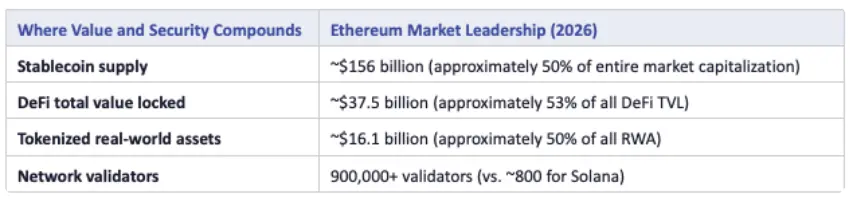
Moreover, Ethereum dominates where real value settles, not just where the loudest noise is made:

Three forces reinforce this lead.

Credible Neutrality: Ethereum is secured by over 900,000 validators, while Solana has around 800. Large institutions place immense value on this level of decentralization and platform neutrality.

Modularity: Rollups like Base, Arbitrum, and Optimism are not fragmenting Ethereum; they are expanding it into an increasingly interconnected modular internet economy that inherits Mainnet's security.

Culture: Ethereum attracts top researchers, cryptographers, and EIP standards authors far beyond any other ecosystem, setting the direction for the entire industry. This is perhaps the hardest advantage for other ecosystems to replicate.

There is Only One Ethereum

There's a fundamental difference between generating on-chain activity and being the long-term coordination layer for internet-native finance. The latter means being the layer trusted by the world's largest financial institutions.

Ethereum has firmly captured the mindshare of major asset holders, institutions that value trust, security, and liquidity above all. I saw this firsthand from the front row during my tenure at BlackRock.

In technology markets, ecosystems consolidate over time around standards, liquidity, and developer attention. This is Ethereum's moat.

After meeting these developers, builders, and ecosystem leaders in Seoul and Hong Kong, I am more convinced than ever of Ethereum's competitive advantage. I met the talent building the next generation of financial infrastructure—the founders and architects of our industry's future and agentic finance. These are the people and teams that will change the world.

Ethereum's future is happening now.

Preguntas relacionadas

QAccording to the SharpLink CEO, what makes the milestone of 1 million historical Ethereum developers significant, beyond just being a large number?

AIt represents the largest technical talent pool ever assembled around an open, permissionless blockchain network. This talent pool is not only vast but also continues to deepen and broaden in expertise and scope.

QIn the CEO's view, what is the most fundamental question for the crypto industry, and what is the current answer to it?

AThe most fundamental question is not which chain is the fastest, but: 'Where will the best builders choose to build for the long term?' The clear answer, according to the article, is Ethereum.

QWhat three key technical frontiers is the article's author most impressed that Ethereum's developer community is tackling?

AThe author highlights three key areas: 1) Core protocol scalability, privacy, and MEV fairness through upgrades like Glamsterdam; 2) Achieving synchronized composability across multiple rollups; and 3) Preparing for post-quantum security through a coordinated, long-term roadmap.

QWhat does the author identify as the deepest network effect of Ethereum that goes beyond just developer count?

AThe deepest network effect is the depth of composability. Applications can interact like interoperable financial Lego bricks, thanks to shared standards like the EVM. This allows developers to build on existing infrastructure without starting from scratch, creating a powerful compounding effect.

QWhat three specific forces does the author argue are strengthening Ethereum's leading position, particularly for large institutions?

AThe three forces are: 1) Credible Neutrality, secured by a highly decentralized network of validators; 2) A Modular architecture where L2 rollups expand rather than fragment the ecosystem; and 3) A deeply ingrained Culture that attracts top researchers and standard-setters, which is the hardest advantage for competitors to replicate.

Lecturas Relacionadas

Ray Dalio: AI Bull Market Continues to Soar, Should Investors Go All In or Cash Out and Leave the Field?

In his latest notes, Ray Dalio addresses a critical question for investors amid the AI-driven stock market surge: how should one allocate assets during a transformative technological revolution? Dalio emphasizes that technological advancement does not automatically make related stocks attractive. Historical tech cycles—marked by excitement, crowding, volatility, and eventual shakeouts—show that even long-term winners like Microsoft and Apple experienced severe drawdowns. Today's AI sector faces similar uncertainties: overinvestment, intensifying competition, geopolitical tensions (e.g., Taiwan's chip supply), tax policy shifts, anti-AI sentiment, and potential disruption from future technologies like quantum computing. Dalio's core argument focuses on the highly concentrated market structure, where a few tech giants dominate major indices. He warns investors against unknowingly holding concentrated, correlated exposures. Instead of chasing a handful of AI leaders, he advocates for a robust, diversified portfolio of 15 or more high-quality, uncorrelated investments, risk-balanced to match an investor's volatility tolerance. Mathematically, such diversification significantly improves the risk-return ratio—for example, holding 15 uncorrelated assets can boost the ratio by over four times compared to a single concentrated bet. Dalio cautions that future equity returns appear low, with his bubble indicator suggesting real returns could be negative over the next 5-10 years. He stresses that knowing what you don't know is as important as knowing what you do. In an environment of high uncertainty and concentration, avoiding large, concentrated bets on AI stocks is prudent. The optimal strategy is disciplined diversification—the "holy grail" of investing—to navigate this technologically driven cycle with lower risk and comparable or better returns.

marsbitHace 3 min(s)

Ray Dalio: AI Bull Market Continues to Soar, Should Investors Go All In or Cash Out and Leave the Field?

marsbitHace 3 min(s)

The World Cup has only been played for a few days, but some AI prediction models have already been crowned as oracles, while others have stumbled badly.

The 2026 FIFA World Cup has sparked significant interest not only on the pitch but also in AI-driven match prediction. Major models like Qwen, Copilot, and ChatGPT are being used to forecast outcomes, scores, upsets, red cards, and key player performances. Qwen gained early attention by accurately predicting Mexico's 2-0 win over South Africa (including a red card risk) and South Korea's 2-1 victory over the Czech Republic in the opening matches. Copilot's pre-tournament predictions had notable successes, such as correctly calling the Mexico 2-0 scoreline, South Korea's 2-1 win, and Brazil's 1-1 draw with Morocco. However, it also had clear misses, failing to predict upsets like Australia's 2-0 win over Turkey or Switzerland's draw with Qatar. ChatGPT provided detailed analytical reasoning, correctly predicting Mexico's 2-0 win, but its full-tournament predictions tended to favor favorites, missing several underdog results and draws. Tests pitting multiple models (ChatGPT, Gemini, Grok, Claude) against the same match, like Mexico vs. South Africa, showed varying predictions, with only some hitting the exact score. In summary, while AI models like Qwen have shown promising early results in specific match details, and others have had isolated successes, they collectively struggle to consistently identify upsets and underdog performances. AI is becoming an additional reference tool for prediction markets but is far from a definitive source.

marsbitHace 4 min(s)

The World Cup has only been played for a few days, but some AI prediction models have already been crowned as oracles, while others have stumbled badly.

marsbitHace 4 min(s)

Missed Out on SpaceX's IPO? Take a Look at SpaceX's Complete Supply Chain

SpaceX is now public, but its high valuation and losses may deter some investors. However, the real opportunity, as seen with Apple, Tesla, and Nvidia, may lie in its extensive supply chain. SpaceX, funded primarily by its profitable Starlink service, spends hundreds of billions annually on components for its rockets, satellites, and planned orbital AI data centers, creating significant revenue streams for suppliers. Key suppliers are categorized by their indispensability. The first group includes irreplaceable players like **NVIDIA** (GPUs for AI supercomputers), **Eutelsat (SATS)** (spectrum rights), **Filtronic** (millimeter-wave amplifiers), **Materion (MTRN)** (beryllium alloys), and **STMicroelectronics (STM)** (phased array chips). The second category comprises suppliers costly to replace due to long certification cycles or deep integration, such as **Honeywell (HON)** (flight controls), **Carpenter Technology (CRS)** (specialty steel), **Hexcel (HXL)** (carbon fiber), **Broadcom (AVGO)** (data switching), and **Linde** (industrial gases). The third group involves high-volume, cost-critical manufacturers for mass-produced items like Starlink terminals. Major players here include Taiwanese contract manufacturer **Wistron NeWeb (6285)** and several Chinese-listed firms: **Sunway Communication (300136)**, **Parker Advanced Materials (605123)**, **Western Superconducting (002149)**, and **Yingliu Co., Ltd. (603308)**. Other niche providers include **Tianyin Electromechanical**, **Tongyu Communication**, **Trimble (TRMB)**, **Astronics (ATRO)**, and **CTSH**. The timing is now relevant because: 1) SpaceX's procurement is accelerating with plans for 100 launches in 2026, 30 million Starlink terminals, and orbital data centers. 2) Its IPO has brought unprecedented transparency to its supply chain. 3) This phase mirrors early days of the Tesla supply chain boom. The investment thesis shifts from betting on SpaceX's stock to betting on the steady, order-book-driven revenues of its essential suppliers. Risks remain, such as commodity cycles, geopolitical factors, and technological shifts, but the supply chain offers a potentially less speculative path to participate in SpaceX's growth.

marsbitHace 22 min(s)

Missed Out on SpaceX's IPO? Take a Look at SpaceX's Complete Supply Chain

marsbitHace 22 min(s)

Jane Street: The Most Powerful Behind-the-Scenes Operator in the Crypto Industry

Jane Street: Crypto's Most Powerful Behind-the-Scenes Operator A recent 13F filing revealed Jane Street, the secretive Wall Street quant giant, drastically reduced its Bitcoin ETF holdings while increasing stakes in Ethereum ETFs. This move highlights its role not as a directional investor, but as a critical infrastructure player extracting "tolls" from crypto's institutionalization. The firm, founded in 2000 and famously lacking a CEO, has systematically embedded itself across crypto markets. It acts as a key Authorized Participant (AP) and market maker for major Bitcoin and Ethereum ETFs, profiting from arbitrage between ETF shares and underlying assets. Its approach combines quantitative prowess with a willingness to hold positions for structural arbitrage, differing from pure high-frequency traders. Jane Street faces allegations related to the 2022 Terra (LUNA) collapse. A lawsuit claims it used non-public information to withdraw $85 million in UST minutes before a critical withdrawal by Terraform Labs, allegedly exacerbating the crash and avoiding over $200 million in losses. The company denies the claims. Further indicating its reach, a wallet suspected to be operated by Jane Street ("JaneStreetIndia") was identified on the prediction market Polymarket. This bot executed over 11,000 high-frequency trades on short-term crypto price movements with a near-perfect win rate, showcasing a套利 strategy divorced from traditional prediction. Beyond trading, Jane Street holds equity in crypto infrastructure like Kraken, 1inch, and Arbitrum, and mining stocks. Its strategy is clear: avoid betting on winners, but secure a position in the market's essential plumbing. By becoming a ubiquitous part of the liquidity infrastructure—from ETFs to OTC trading and potentially链上 markets—Jane Street operates as a market force itself, raising questions about whether crypto's decentralized,散户-friendly alpha is being permanently eroded by traditional finance's most sophisticated players.

Foresight NewsHace 25 min(s)

Jane Street: The Most Powerful Behind-the-Scenes Operator in the Crypto Industry

Foresight NewsHace 25 min(s)

U.S.-Iran Ceasefire: How Much of a Bitcoin Rally Can a Truce Agreement Support?

Headline: "U.S.-Iran Truce: How Much Can a Ceasefire Agreement Propel Bitcoin's Rebound?" On June 15th, Bitcoin rebounded to around $67,255, marking its first return to the $67,000 level since falling below $60,000 earlier in June. Ethereum and Solana also saw significant gains. The immediate driver for this market-wide recovery in crypto and global risk assets was the signing of a U.S.-Iran ceasefire memorandum, with a formal ceremony scheduled for June 19th. The agreement, which includes reopening the Strait of Hormuz, caused oil prices to plunge roughly 5%, easing inflation expectations and boosting prospects for Federal Reserve rate cuts. This macroeconomic shift fueled a rally in U.S. equities, with the Dow Jones hitting a record high. SpaceX's spectacular post-IPO performance further energized market sentiment. However, on-chain and derivatives data from Glassnode suggest this move is more indicative of a technical rebound from deeply oversold conditions rather than a confirmed trend reversal. The crypto market is undergoing noticeable capital rotation. While Bitcoin ETFs recently saw their worst outflows on record, the bleeding has slowed significantly. Meanwhile, new altcoin ETFs for assets like XRP and Solana are attracting substantial inflows, causing Bitcoin's market dominance to drop to 58%. Despite the rebound, the Crypto Fear & Greed Index remains in "Extreme Fear" territory at 22. The price quickly retreated after touching the $67,000 resistance level, indicating selling pressure persists. Analysis shows short-term speculative supply has been heavily washed out, with holder structure shifting toward a more long-term profile. While panic is subsiding and some on-chain metrics point to accumulation at lower prices, the market currently lacks the strong, sustained institutional buying needed to establish a new bullish trend.

Foresight NewsHace 41 min(s)

U.S.-Iran Ceasefire: How Much of a Bitcoin Rally Can a Truce Agreement Support?

Foresight NewsHace 41 min(s)

Trading

Spot
Futuros

Artículos destacados

Qué es ETH 2.0

ETH 2.0: Una Nueva Era para Ethereum Introducción ETH 2.0, conocido ampliamente como Ethereum 2.0, marca una actualización monumental para la blockchain de Ethereum. Esta transición no es solo una mejora superficial; busca mejorar fundamentalmente la escalabilidad, seguridad y sostenibilidad de la red. Con un cambio del mecanismo de consenso intensivo en energía Prueba de Trabajo (PoW) a una Prueba de Participación (PoS) más eficiente, ETH 2.0 promete un enfoque transformador para el ecosistema blockchain. ¿Qué es ETH 2.0? ETH 2.0 es un conjunto de actualizaciones interconectadas y distintivas centradas en optimizar las capacidades y el rendimiento de Ethereum. La reestructuración está diseñada para abordar desafíos críticos que el mecanismo actual de Ethereum ha enfrentado, particularmente en lo que respecta a la velocidad de transacción y la congestión de la red. Objetivos de ETH 2.0 Los objetivos principales de ETH 2.0 giran en torno a mejorar tres aspectos clave: Escalabilidad: Con el objetivo de aumentar significativamente el número de transacciones que la red puede manejar por segundo, ETH 2.0 busca superar la limitación actual de aproximadamente 15 transacciones por segundo, potencialmente alcanzando miles. Seguridad: Las medidas de seguridad mejoradas son fundamentales para ETH 2.0, particularmente a través de una mejor resistencia contra ciberataques y la preservación del ethos descentralizado de Ethereum. Sostenibilidad: El nuevo mecanismo PoS está diseñado no solo para mejorar la eficiencia, sino también para reducir drásticamente el consumo de energía, alineando el marco operativo de Ethereum con consideraciones ambientales. ¿Quién es el Creador de ETH 2.0? La creación de ETH 2.0 se puede atribuir a la Fundación Ethereum. Esta organización sin fines de lucro, que desempeña un papel crucial en el apoyo al desarrollo de Ethereum, es liderada por el notable cofundador Vitalik Buterin. Su visión de un Ethereum más escalable y sostenible ha sido la fuerza motriz detrás de esta actualización, involucrando contribuciones de una comunidad global de desarrolladores y entusiastas dedicados a mejorar el protocolo. ¿Quiénes son los Inversores de ETH 2.0? Si bien los detalles sobre los inversores de ETH 2.0 no se han hecho públicos, se sabe que la Fundación Ethereum recibe apoyo de varias organizaciones e individuos en el ámbito de blockchain y tecnología. Estos socios incluyen firmas de capital de riesgo, compañías tecnológicas y organizaciones filantrópicas que comparten un interés mutuo en apoyar el desarrollo de tecnologías descentralizadas e infraestructura blockchain. ¿Cómo Funciona ETH 2.0? ETH 2.0 se distingue por introducir una serie de características clave que lo diferencian de su predecesor. Prueba de Participación (PoS) La transición a un mecanismo de consenso PoS es uno de los cambios más destacados de ETH 2.0. A diferencia de PoW, que se basa en la minería intensiva en energía para la verificación de transacciones, PoS permite a los usuarios validar transacciones y crear nuevos bloques de acuerdo con la cantidad de ETH que apuestan en la red. Esto conduce a una mayor eficiencia energética, reduciendo el consumo en aproximadamente un 99.95%, convirtiendo a Ethereum 2.0 en una alternativa considerablemente más verde. Cadenas Shard Las cadenas shard son otra innovación crítica de ETH 2.0. Estas cadenas más pequeñas operan en paralelo con la cadena principal de Ethereum, lo que permite que múltiples transacciones sean procesadas simultáneamente. Este enfoque mejora la capacidad general de la red, abordando las preocupaciones de escalabilidad que han afectado a Ethereum. Cadena Beacon En el núcleo de ETH 2.0 se encuentra la Cadena Beacon, que coordina la red y gestiona el protocolo PoS. Funciona como un organizador de cierta manera: supervisa a los validadores, asegura que los shards permanezcan conectados a la red y monitorea la salud general del ecosistema blockchain. Cronología de ETH 2.0 El viaje de ETH 2.0 ha estado marcado por varios hitos clave que trazan la evolución de esta importante actualización: Diciembre 2020: El lanzamiento de la Cadena Beacon marcó la introducción de PoS, preparándose para la migración hacia ETH 2.0. Septiembre 2022: La finalización de “La Fusión” representa un momento crucial en el que la red Ethereum se trasladó exitosamente de un marco PoW a uno PoS, anunciando una nueva era para Ethereum. 2023: El lanzamiento esperado de cadenas shard tiene como objetivo mejorar aún más la escalabilidad de la red Ethereum, consolidando a ETH 2.0 como una plataforma robusta para aplicaciones y servicios descentralizados. Características Clave y Beneficios Escalabilidad Mejorada Una de las ventajas más significativas de ETH 2.0 es su escalabilidad mejorada. La combinación de PoS y cadenas shard permite que la red expanda su capacidad, permitiendo acomodar un volumen mucho mayor de transacciones en comparación con el sistema heredado. Eficiencia Energética La implementación de PoS representa un gran paso hacia la eficiencia energética en la tecnología blockchain. Al reducir drásticamente el consumo de energía, ETH 2.0 no solo disminuye los costos operativos, sino que también se alinea más estrechamente con los objetivos de sostenibilidad global. Seguridad Mejorada Los mecanismos actualizados de ETH 2.0 contribuyen a mejorar la seguridad en toda la red. El despliegue de PoS, junto con las medidas de control innovadoras establecidas a través de cadenas shard y la Cadena Beacon, asegura un mayor grado de protección contra posibles amenazas. Costos Más Bajos para los Usuarios A medida que la escalabilidad mejora, los efectos sobre los costos de transacción también serán evidentes. Se espera que una mayor capacidad y una menor congestión se traduzcan en tarifas más bajas para los usuarios, haciendo que Ethereum sea más accesible para transacciones cotidianas. Conclusión ETH 2.0 marca una evolución significativa en el ecosistema blockchain de Ethereum. A medida que aborda problemas fundamentales como la escalabilidad, el consumo de energía, la eficiencia en las transacciones y la seguridad general, la importancia de esta actualización no puede ser subestimada. La transición a la Prueba de Participación, la introducción de cadenas shard y el trabajo fundamental de la Cadena Beacon son indicativos de un futuro donde Ethereum puede satisfacer las crecientes demandas del mercado descentralizado. En una industria impulsada por la innovación y el progreso, ETH 2.0 se erige como un testimonio de las capacidades de la tecnología blockchain para allanar el camino hacia una economía digital más sostenible y eficiente.

166 Vistas totalesPublicado en 2024.04.04Actualizado en 2024.12.03

Qué es ETH 2.0

Qué es ETH 3.0

ETH3.0 y $eth 3.0: Un Examen Profundo del Futuro de Ethereum Introducción En el paisaje en rápida evolución de las criptomonedas y la tecnología blockchain, ETH3.0, a menudo denotado como $eth 3.0, ha surgido como un tema de considerable interés y especulación. El término abarca dos conceptos principales que merecen aclaración: Ethereum 3.0: Esto representa una posible actualización futura destinada a aumentar las capacidades de la blockchain existente de Ethereum, enfocándose particularmente en mejorar la escalabilidad y el rendimiento. ETH3.0 Meme Token: Este proyecto de criptomoneda distinto busca aprovechar la blockchain de Ethereum para crear un ecosistema centrado en memes, promoviendo la participación dentro de la comunidad de criptomonedas. Comprender estos aspectos de ETH3.0 es esencial no solo para los entusiastas de las criptomonedas, sino también para aquellos que observan tendencias tecnológicas más amplias en el espacio digital. ¿Qué es ETH3.0? Ethereum 3.0 Ethereum 3.0 se presenta como una actualización propuesta para la red de Ethereum ya establecida, que ha sido la columna vertebral de muchas aplicaciones descentralizadas (dApps) y contratos inteligentes desde su inicio. Las mejoras previstas se concentran principalmente en la escalabilidad, integrando tecnologías avanzadas como sharding y pruebas de conocimiento cero (zk-proofs). Estas innovaciones tecnológicas tienen como objetivo facilitar un número sin precedentes de transacciones por segundo (TPS), potencialmente alcanzando millones, abordando así una de las limitaciones más significativas que enfrenta la tecnología blockchain actual. La mejora no es meramente técnica, sino también estratégica; está destinada a preparar la red de Ethereum para su adopción generalizada y utilidad en un futuro marcado por una mayor demanda de soluciones descentralizadas. ETH3.0 Meme Token En contraste con Ethereum 3.0, el ETH3.0 Meme Token se aventura en un ámbito más ligero y juguetón al combinar la cultura de memes de internet con la dinámica de las criptomonedas. Este proyecto permite a los usuarios comprar, vender e intercambiar memes en la blockchain de Ethereum, proporcionando una plataforma que fomenta la participación comunitaria a través de la creatividad y los intereses compartidos. El ETH3.0 Meme Token tiene como objetivo demostrar cómo la tecnología blockchain puede intersectarse con la cultura digital, creando casos de uso que son tanto entretenidos como financieramente viables. ¿Quién es el Creador de ETH3.0? Ethereum 3.0 La iniciativa hacia Ethereum 3.0 es impulsada principalmente por un consorcio de desarrolladores e investigadores dentro de la comunidad de Ethereum, incluyendo notablemente a Justin Drake. Conocido por sus ideas y contribuciones a la evolución de Ethereum, Drake ha sido una figura prominente en las discusiones sobre la transición de Ethereum a una nueva capa de consenso, denominada “Beam Chain.” Este enfoque colaborativo para el desarrollo significa que Ethereum 3.0 no es el producto de un creador singular, sino más bien una manifestación de ingenio colectivo centrado en avanzar la tecnología blockchain. ETH3.0 Meme Token Los detalles sobre el creador del ETH3.0 Meme Token son actualmente inidentificables. La naturaleza de los tokens de memes a menudo conduce a una estructura más descentralizada y dirigida por la comunidad, lo que podría explicar la falta de atribución específica. Esto se alinea con la ética de la comunidad cripto más amplia, donde la innovación a menudo surge de esfuerzos colaborativos en lugar de individuales. ¿Quiénes son los Inversores de ETH3.0? Ethereum 3.0 El apoyo a Ethereum 3.0 proviene principalmente de la Fundación Ethereum junto con una entusiasta comunidad de desarrolladores e inversores. Esta asociación fundamental proporciona un grado significativo de legitimidad y mejora la perspectiva de una implementación exitosa, ya que aprovecha la confianza y credibilidad construidas a lo largo de años de operaciones en la red. En el clima cambiando rápidamente de las criptomonedas, el apoyo de la comunidad juega un papel crucial en impulsar el desarrollo y la adopción, posicionando a Ethereum 3.0 como un contendiente serio para futuros avances en blockchain. ETH3.0 Meme Token Si bien las fuentes actualmente disponibles no proporcionan información explícita sobre las fundaciones o organizaciones de inversión que respaldan el ETH3.0 Meme Token, es indicativo del modelo de financiamiento típico para tokens de memes, que a menudo depende del apoyo de base y la participación comunitaria. Los inversores en tales proyectos suelen consistir en individuos motivados por el potencial de innovación impulsada por la comunidad y el espíritu de cooperación que se encuentra dentro de la comunidad cripto. ¿Cómo Funciona ETH3.0? Ethereum 3.0 Las características distintivas de Ethereum 3.0 radican en su implementación propuesta de sharding y tecnología zk-proof. Sharding es un método de particionamiento de la blockchain en piezas más pequeñas y manejables o “shards,” que pueden procesar transacciones de manera concurrente en lugar de secuencial. Esta descentralización del procesamiento ayuda a prevenir la congestión y asegura que la red permanezca receptiva incluso bajo una carga pesada. La tecnología de prueba de conocimiento cero (zk-proof) contribuye con otra capa de sofisticación al permitir la validación de transacciones sin revelar los datos subyacentes involucrados. Este aspecto no solo mejora la privacidad, sino que también aumenta la eficiencia general de la red. También se habla de incorporar una Máquina Virtual de Ethereum de conocimiento cero (zkEVM) en esta actualización, amplificando aún más las capacidades y utilidad de la red. ETH3.0 Meme Token El ETH3.0 Meme Token se distingue al capitalizar la popularidad de la cultura de memes. Establece un mercado para que los usuarios participen en el comercio de memes, no solo por entretenimiento sino también por el posible beneficio económico. Al integrar características como staking, provisión de liquidez y mecanismos de gobernanza, el proyecto fomenta un entorno que incentiva la interacción y participación de la comunidad. Al ofrecer una mezcla única de entretenimiento y oportunidad económica, el ETH3.0 Meme Token tiene como objetivo atraer a una audiencia diversa, que abarca desde entusiastas de las criptomonedas hasta conocedores casuales de memes. Línea de Tiempo de ETH3.0 Ethereum 3.0 11 de noviembre de 2024: Justin Drake insinúa la próxima actualización de ETH 3.0, centrada en mejoras de escalabilidad. Este anuncio significa el comienzo de las discusiones formales sobre la futura arquitectura de Ethereum. 12 de noviembre de 2024: Se espera que la propuesta anticipada para Ethereum 3.0 se desvele en Devcon en Bangkok, preparando el escenario para una mayor retroalimentación de la comunidad y posibles próximos pasos en el desarrollo. ETH3.0 Meme Token 21 de marzo de 2024: El ETH3.0 Meme Token se lista oficialmente en CoinMarketCap, marcando su incursión en el dominio público de las criptomonedas y mejorando la visibilidad de su ecosistema basado en memes. Puntos Clave En conclusión, Ethereum 3.0 representa una evolución significativa dentro de la red de Ethereum, enfocándose en superar las limitaciones en términos de escalabilidad y rendimiento a través de tecnologías avanzadas. Sus actualizaciones propuestas reflejan un enfoque proactivo hacia las demandas y la usabilidad futura. Por otro lado, el ETH3.0 Meme Token encapsula la esencia de la cultura impulsada por la comunidad en el espacio de las criptomonedas, aprovechando la cultura de memes para crear plataformas atractivas que fomentan la creatividad y participación del usuario. Comprender los distintos propósitos y funcionalidades de ETH3.0 y $eth 3.0 es fundamental para cualquiera interesado en los desarrollos en curso dentro del espacio cripto. Con ambas iniciativas abriendo caminos únicos, subrayan colectivamente la naturaleza dinámica y multifacética de la innovación en blockchain.

179 Vistas totalesPublicado en 2024.04.04Actualizado en 2024.12.03

Qué es ETH 3.0

Cómo comprar ETH

¡Bienvenido a HTX.com! Hemos hecho que comprar Ethereum (ETH) sea simple y conveniente. Sigue nuestra guía paso a paso para iniciar tu viaje de criptos.Paso 1: crea tu cuenta HTXUtiliza tu correo electrónico o número de teléfono para registrarte y obtener una cuenta gratuita en HTX. Experimenta un proceso de registro sin complicaciones y desbloquea todas las funciones.Obtener mi cuentaPaso 2: ve a Comprar cripto y elige tu método de pagoTarjeta de crédito/débito: usa tu Visa o Mastercard para comprar Ethereum (ETH) al instante.Saldo: utiliza fondos del saldo de tu cuenta HTX para tradear sin problemas.Terceros: hemos agregado métodos de pago populares como Google Pay y Apple Pay para mejorar la comodidad.P2P: tradear directamente con otros usuarios en HTX.Over-the-Counter (OTC): ofrecemos servicios personalizados y tipos de cambio competitivos para los traders.Paso 3: guarda tu Ethereum (ETH)Después de comprar tu Ethereum (ETH), guárdalo en tu cuenta HTX. Alternativamente, puedes enviarlo a otro lugar mediante transferencia blockchain o utilizarlo para tradear otras criptomonedas.Paso 4: tradear Ethereum (ETH)Tradear fácilmente con Ethereum (ETH) en HTX's mercado spot. Simplemente accede a tu cuenta, selecciona tu par de trading, ejecuta tus trades y monitorea en tiempo real. Ofrecemos una experiencia fácil de usar tanto para principiantes como para traders experimentados.

4.2k Vistas totalesPublicado en 2024.12.10Actualizado en 2026.06.02

Cómo comprar ETH

Discusiones

Bienvenido a la comunidad de HTX. Aquí puedes mantenerte informado sobre los últimos desarrollos de la plataforma y acceder a análisis profesionales del mercado. A continuación se presentan las opiniones de los usuarios sobre el precio de ETH (ETH).

活动图片