Ethereum 2026 Q1 Review: On-Chain Activity Hits Record Highs, Tokenized Assets Lead the Industry

marsbitPublicado a 2026-06-18Actualizado a 2026-06-18

Resumen

Ethereum Q1 2026 Review: Record On-Chain Activity, Tokenized Assets Lead the Industry. Despite a price correction impacting USD-denominated metrics, Ethereum's on-chain usage hit all-time highs in Q1 2026. Monthly active addresses surged 85.9% year-over-year to 13.2 million, while L1 transactions and throughput also set new records. This growth occurred alongside a significant 47.9% quarterly drop in L1 transaction fees, demonstrating the impact of network scaling via upgrades like the Blob Parameter Fork. The ecosystem maintained its dominance in decentralized finance (DeFi), holding 71% of the total value locked among top chains and 79.2% of active borrowing. Ethereum solidified its position as the primary platform for tokenized real-world assets (RWAs), with a total market cap of $203.4B. It holds leading shares in stablecoins (61.8%), tokenized funds (73%), and tokenized commodities (84%) across major chains. Key developments included the ERC-8004 standard for AI agents and heightened institutional engagement at forums. Major financial institutions like BlackRock, JPMorgan, and a European banking consortium announced new tokenized products on Ethereum throughout the period. The report draws parallels to the early internet, suggesting Ethereum is sacrificing short-term fee revenue for long-term network expansion and adoption. Its strategy focuses on becoming a neutral, open settlement layer for global finance, with scaling roadmaps aiming for tens of thousands of TPS b...

Author: Token Terminal

Compiled by: Saoirse, Foresight News

Ethereum serves as the core underlying settlement network for on-chain assets, relying on ETH for gas fees and staking to maintain network security. Traditional finance suffers from issues like slow settlement, multiple intermediaries, and high counterparty risk, while tokenized assets and stablecoins provide on-chain solutions. From 2025 to 2026, relevant regulations gradually matured, providing the necessary conditions for institutional on-chain business deployment.

Various stablecoins, tokenized funds, commodities, and on-chain stocks are issued and settled on Ethereum. Layer 2 networks offload transactions, which are ultimately confirmed on Layer 1, allowing ETH to continuously accumulate value. By market capitalization, Ethereum remains the world's largest platform for hosting tokenized assets, operated jointly by the Ethereum Foundation and the developer community. Teams like Etherealize specialize in connecting with traditional financial institutions, driving institutional capital inflows. In Q1 2026, the Ethereum ecosystem exhibited a divergent performance, which will be analyzed in detail below using complete data from Token Terminal.

The Q1 2026 market presented a stark dual dynamic: on-chain usage scale hit record highs—monthly active users, total transaction volume, and throughput all reached new peaks. However, asset valuations and fee metrics denominated in USD contracted simultaneously, with fully diluted market cap, total value locked (TVL), trading volume, and two types of fee data all declining sequentially. Key events this quarter profoundly shaped this unique market situation:

In January, only the second Blob parameter fork (BPO#2) of the Fusaka upgrade cycle was implemented, significantly increasing data storage capacity.

In February, the ERC-8004 standard launched on the mainnet, becoming the universal standard for AI agent identity and credit ratings.

The Ethereum Foundation defined three core protocol goals for 2026: scaling, improving user experience, and strengthening Layer 1 foundational security.

The Institutional Ethereum Forum was held in March, with significantly increased participation from traditional financial institutions.

Key Q1 2026 Metrics Overview

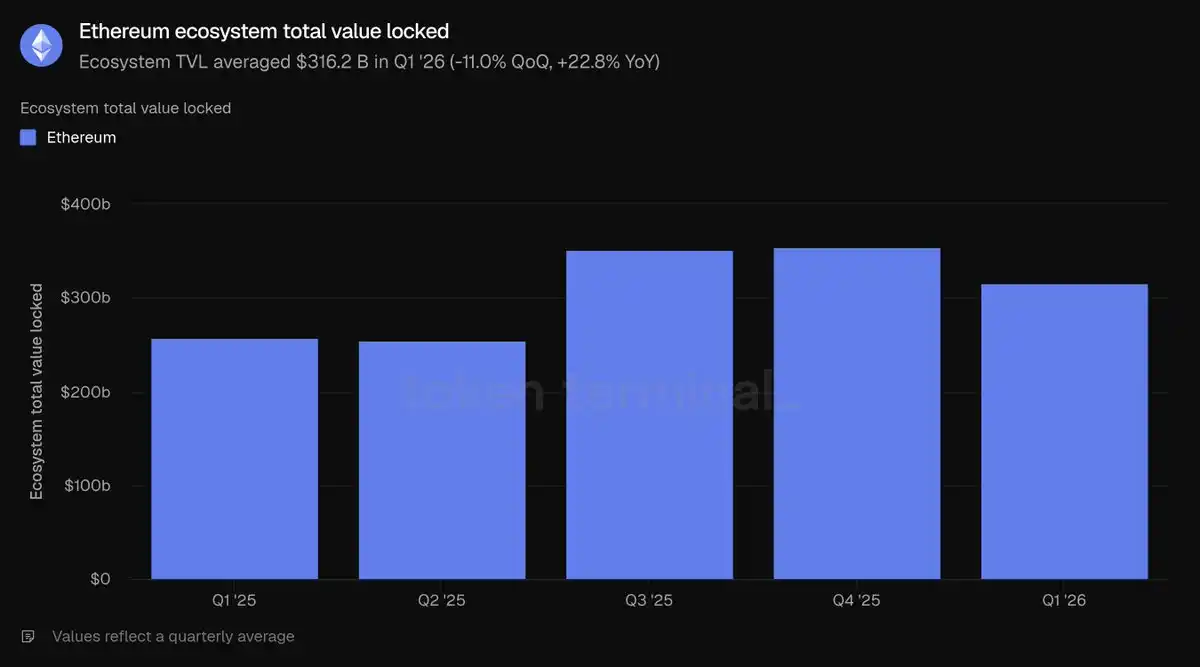
Ecosystem Total Value Locked (TVL): $316.2 billion (QoQ -11.0%, YoY +22.8%)

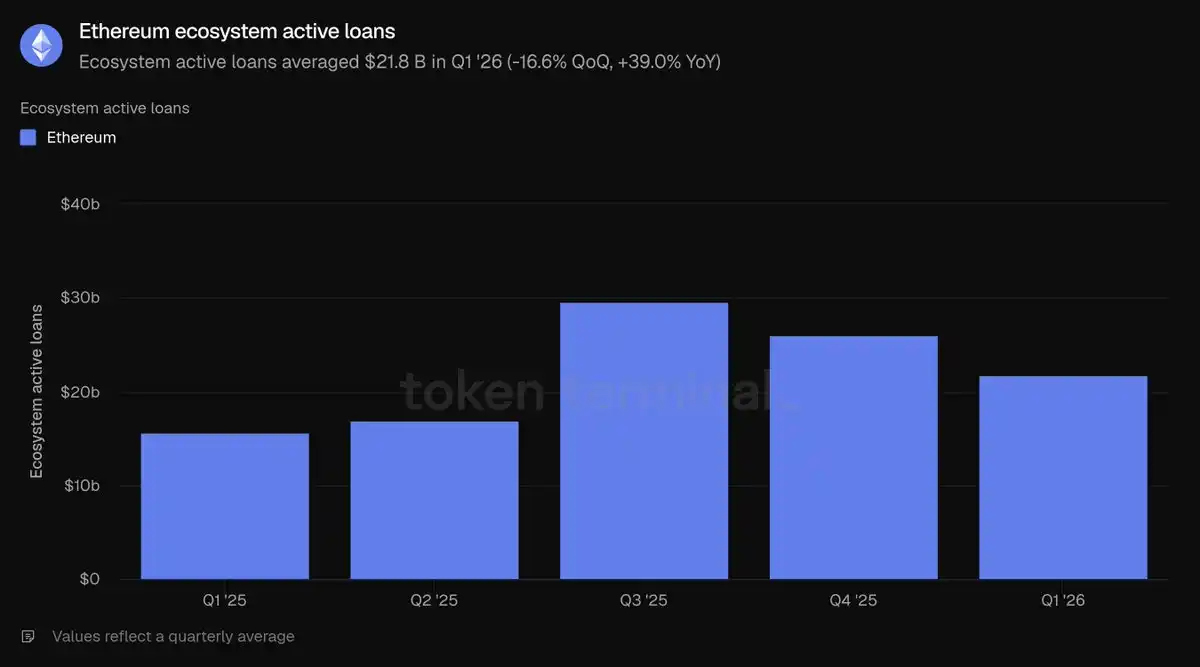
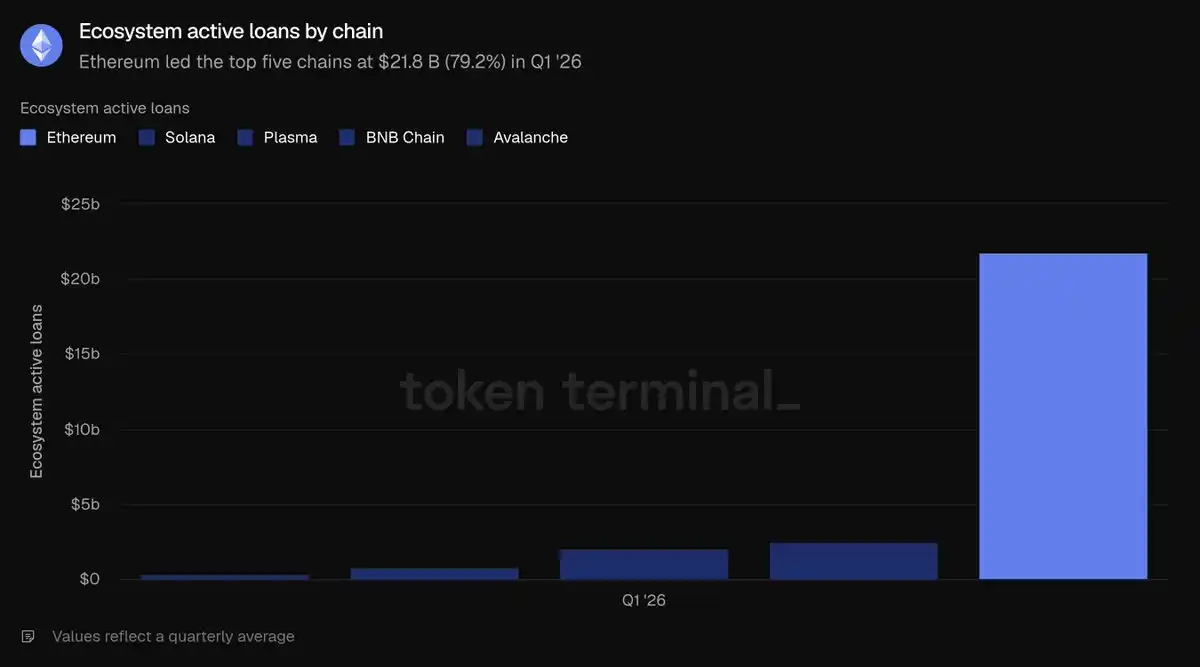
Ecosystem Active Outstanding Loans: $21.8 billion (QoQ -16.6%, YoY +39.0%)

Ecosystem Total Decentralized Exchange Volume: $134.5 billion (QoQ -24.0%, YoY -31.2%)

Total Application Fee Revenue for the Ecosystem: $2.0 billion (QoQ -16.9%, YoY -7.8%)

On-Chain Tokenized Asset Total Market Cap: $203.4 billion (QoQ -0.7%, YoY +42.9%)

Stablecoins: $178.9 billion (QoQ -2.3%, YoY +37.6%)

Tokenized Funds: $19.4 billion (QoQ +4.9%, YoY +73.1%)

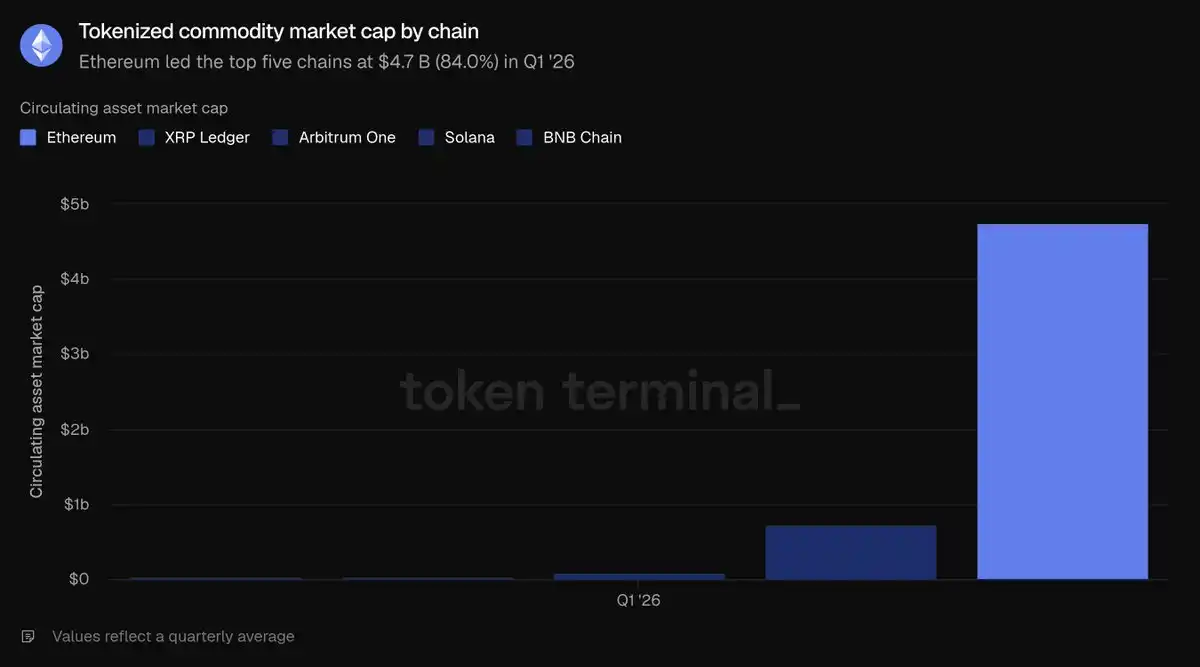
Tokenized Commodities: $4.7 billion (QoQ +60.0%, YoY +325.9%)

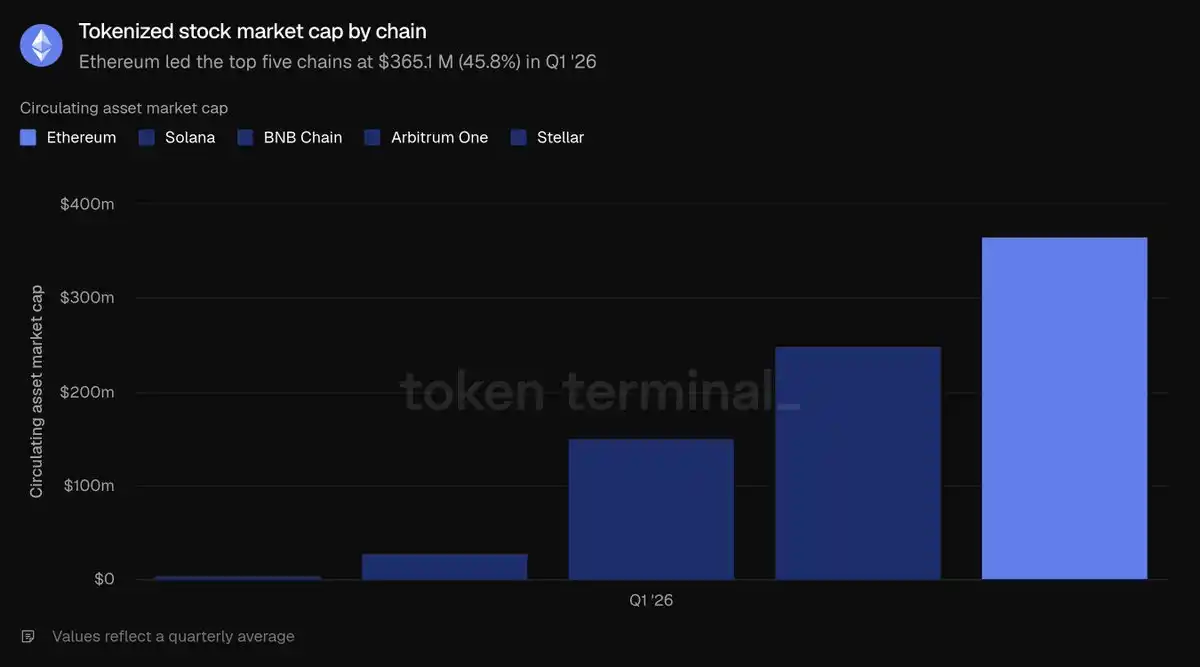
Tokenized Equities: $365.1 million (QoQ +16.5%)

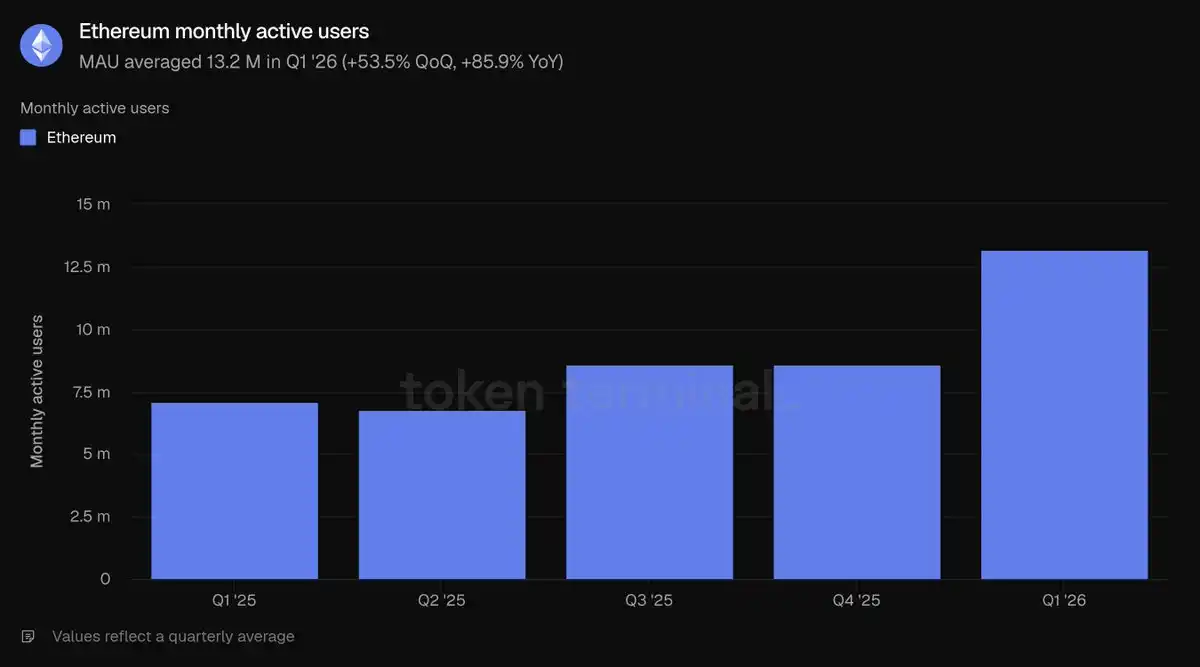
Monthly Active User Addresses: 13.2 million (QoQ +53.5%, YoY +85.9%)

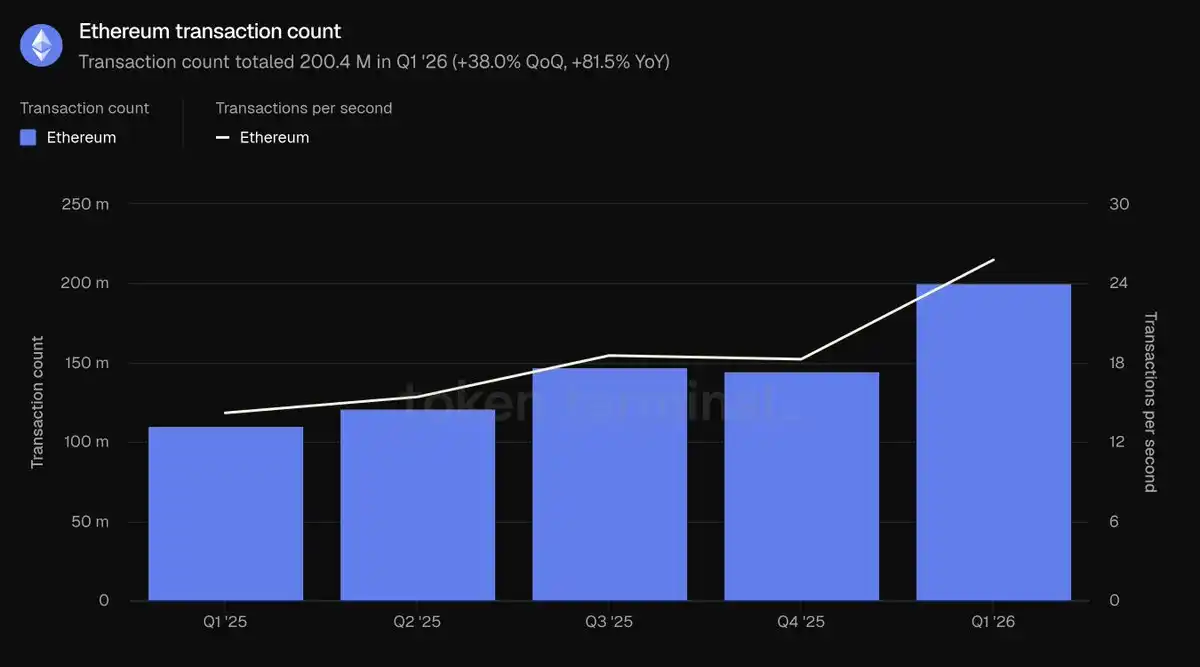
Layer 1 Total Transaction Count: 200.4 million (QoQ +38.0%, YoY +81.5%)

Average Transactions Processed Per Second (TPS): 25.78 (QoQ +41.2%, YoY +81.7%)

Layer 1 Mainnet Transaction Fee Revenue: $39.9 million (QoQ -47.9%, YoY -81.9%)

ETH Fully Diluted Market Cap: $290.0 billion (QoQ -30.3%, YoY -9.9%)

ETH Staking Ratio: 0.31 (QoQ and YoY both increased by 0.03)

Total ETH Holding Addresses: 292.8 million (QoQ +8.1%, YoY +24.9%)

Note: This report's statistical scope is limited to the Ethereum Layer 1 mainnet. Layer 2 networks are considered independent blockchains, and their data is not included in the Ethereum statistics.

Overall Ecosystem Development

Total Value Locked refers to the total USD value of assets deposited into various on-chain applications. It is a leading indicator for revenue-generating businesses like lending, trading, and staking. This statistic measures on-chain deposited funds that users can withdraw at any time within the entire Ethereum ecosystem. In Q1 2026, the average TVL for the Ethereum ecosystem reached $316.2 billion, down 11.0% QoQ but up 22.8% YoY. The sequential decline was due to a general pullback in crypto asset prices, while the significant YoY growth demonstrates substantial expansion of the ecosystem scale compared to the same period last year.
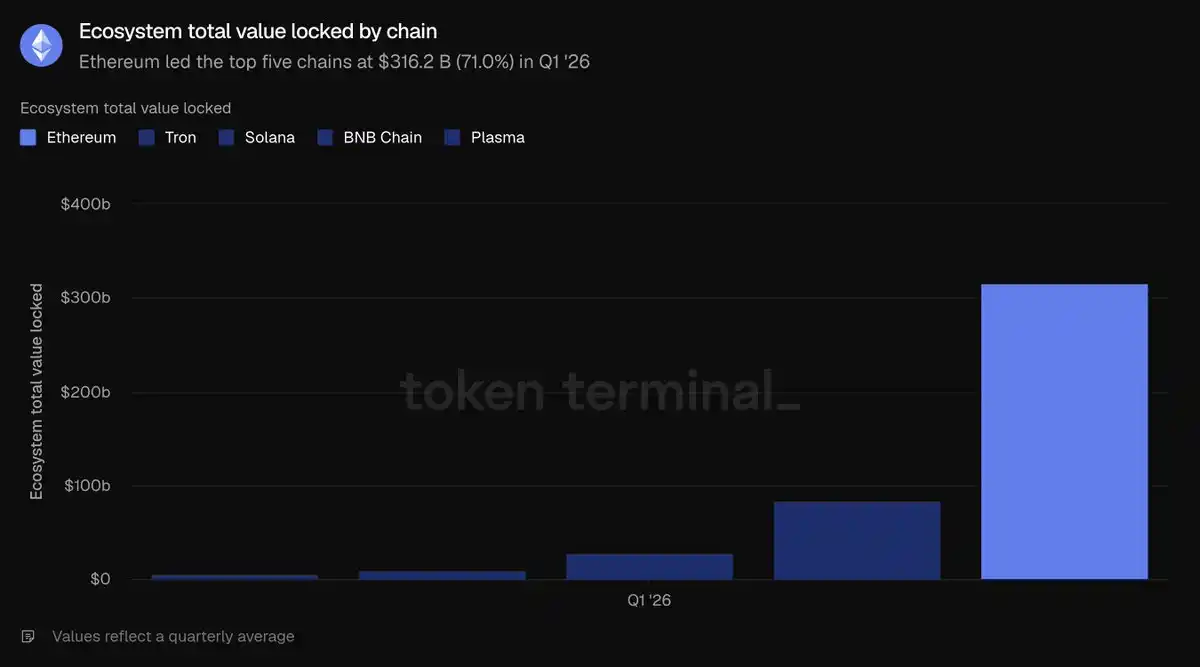
Among the top five blockchains, Ethereum's TVL leads by a wide margin: $316.2 billion far exceeds the combined TVL of Tron ($84.5B), Solana ($28.8B), BNB Chain ($10.3B), and Plasma ($5.7B), accounting for 71% of the total TVL across these five chains. Capital is primarily concentrated in two major sectors: the liquid staking sector led by Lido and the lending sector centered around Aave. Restaking protocols like EigenLayer and ether.fi, as well as synthetic dollar stablecoin platforms like Ethena and Sky, also hold significant capital. High capital concentration is Ethereum's most prominent structural advantage.
Active lending represents the deposit scale that users have borrowed out and that generates interest income, directly reflecting lending business revenue. This statistic measures the total outstanding loan amount across all Ethereum lending applications. In Q1, the ecosystem's average active lending volume was $21.8 billion, down 16.6% QoQ but up 39.0% YoY. The decline in outstanding loans accompanied the contraction in TVL, indicating a general cooling of market risk appetite, but the scale remains significantly higher than the same period last year.
Ethereum's lending market is concentrated in a few liquidity pools, with Aave dominating: its active lending volume was approximately $13.5 billion at quarter-end, accounting for the vast majority of the ecosystem share. It was followed by Morpho (~$1.9B), Spark under Sky (~$1.0B), and Maple (~$0.84B). The contraction in lending scale this quarter was primarily driven by Aave, as the decline in crypto asset prices led to cooling borrowing demand, with its total loans shrinking by approximately 24%. Comparing across the top five chains, Ethereum's $21.8B in active lending significantly leads Solana ($2.5B), Plasma ($2.1B), BNB Chain ($0.761B), and Avalanche ($0.392B), capturing 79.2% of the total lending volume across these five chains. This is the sector where Ethereum holds the highest percentage among these five chains.
Decentralized exchange volume refers to the total transaction amount completed on on-chain spot exchanges. Traders pay fees when transacting, so trading volume is highly correlated with platform revenue. This data aggregates trading across all Ethereum DEXs. Total ecosystem volume in Q1 was $134.5 billion, down 24% QoQ and 31.2% YoY. The decline in trading volume exceeded the contraction in TVL, confirming a significant reduction in market risk appetite during this quarter's asset price downturn.
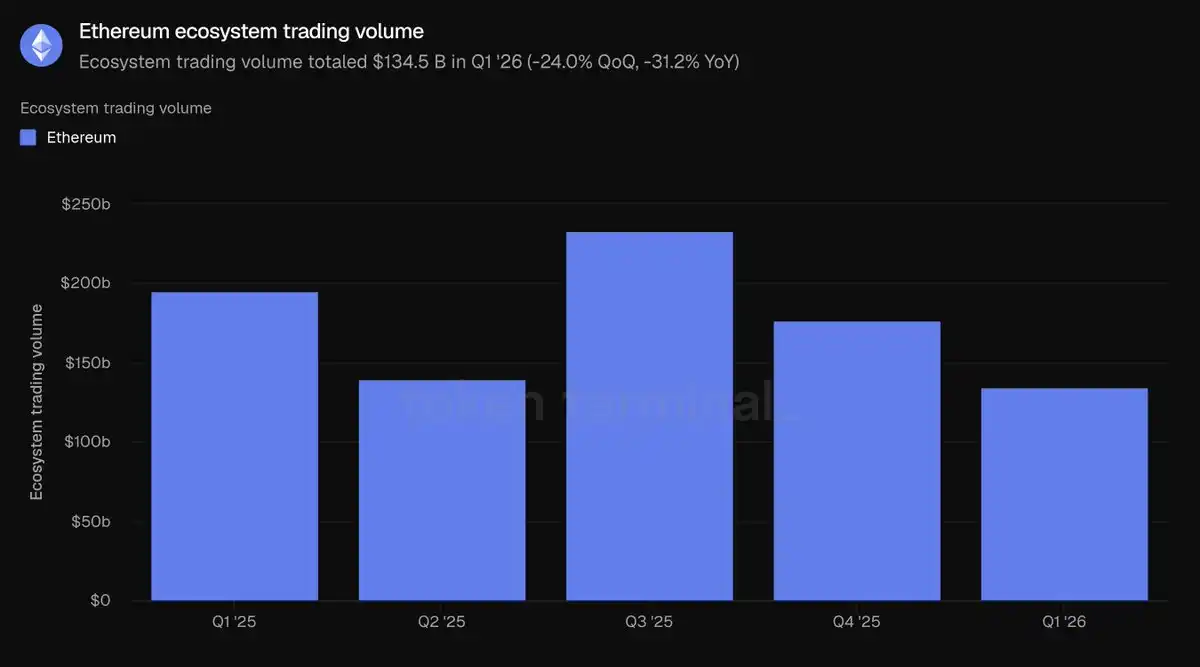
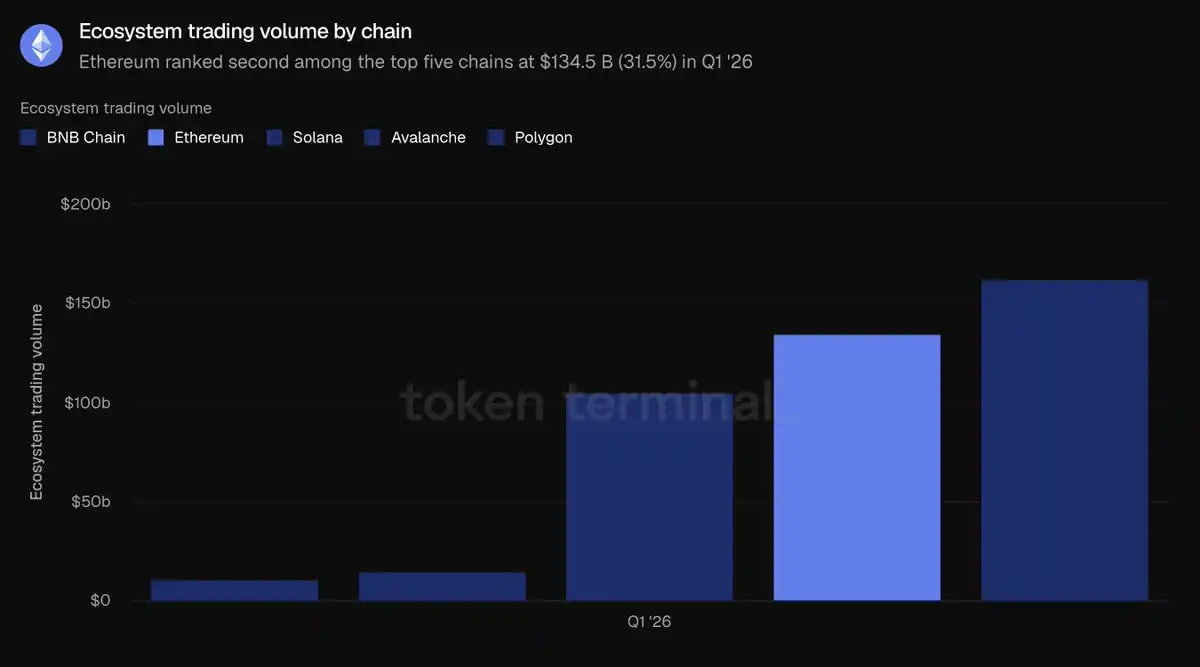
Ethereum DEX transaction flow is highly concentrated among leading platforms: Uniswap's Q1 volume was approximately $85.5 billion, accounting for two-thirds of the ecosystem total. It was followed by Curve (~$22.1B) and CoW Swap (~$12.4B). Trading volume is the only metric where Ethereum did not top the five major chains: BNB Chain's total volume of $162.5B was higher than Ethereum's $134.5B, followed by Solana ($104.9B), with Avalanche ($14.5B) and Polygon ($10.7B) trailing. Ethereum's volume accounted for 31.5% of the total across these five chains, second to BNB Chain's 38%.
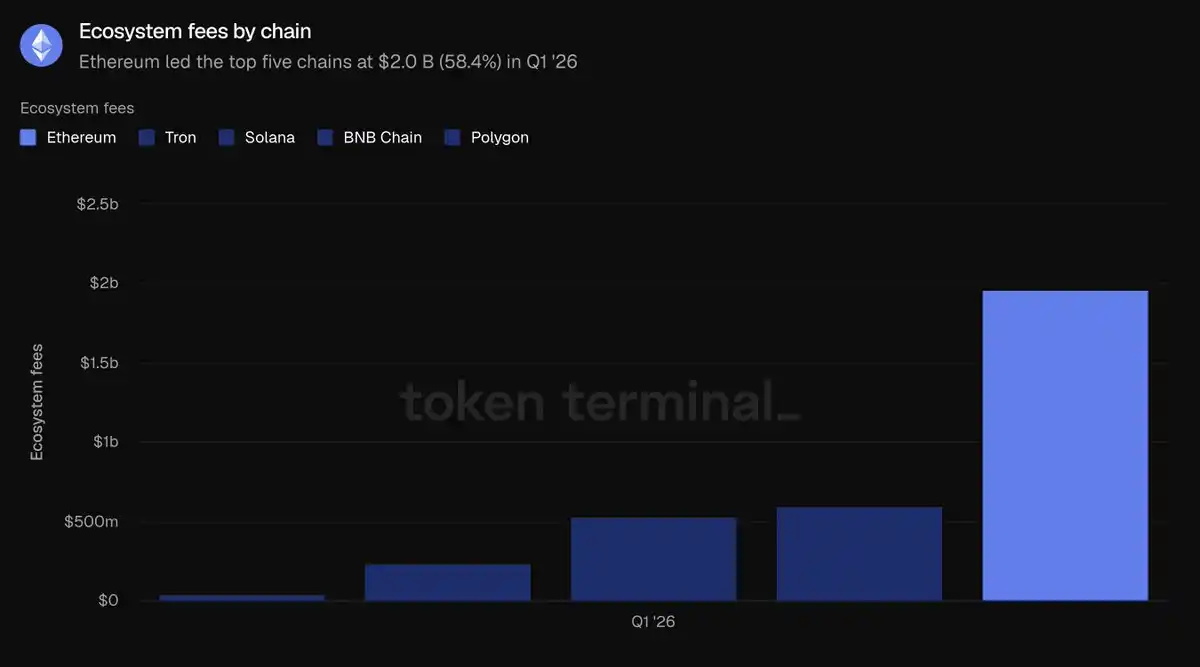
Ecosystem fees refer to all fees generated by users using various applications, including borrower interest and trader transaction fees, directly reflecting the economic value created by the ecosystem. This aggregates total fees from all Ethereum applications. Total ecosystem fees in Q1 amounted to $2.0 billion, down 16.9% QoQ and 7.8% YoY, declining in sync with reduced trading and lending activity.
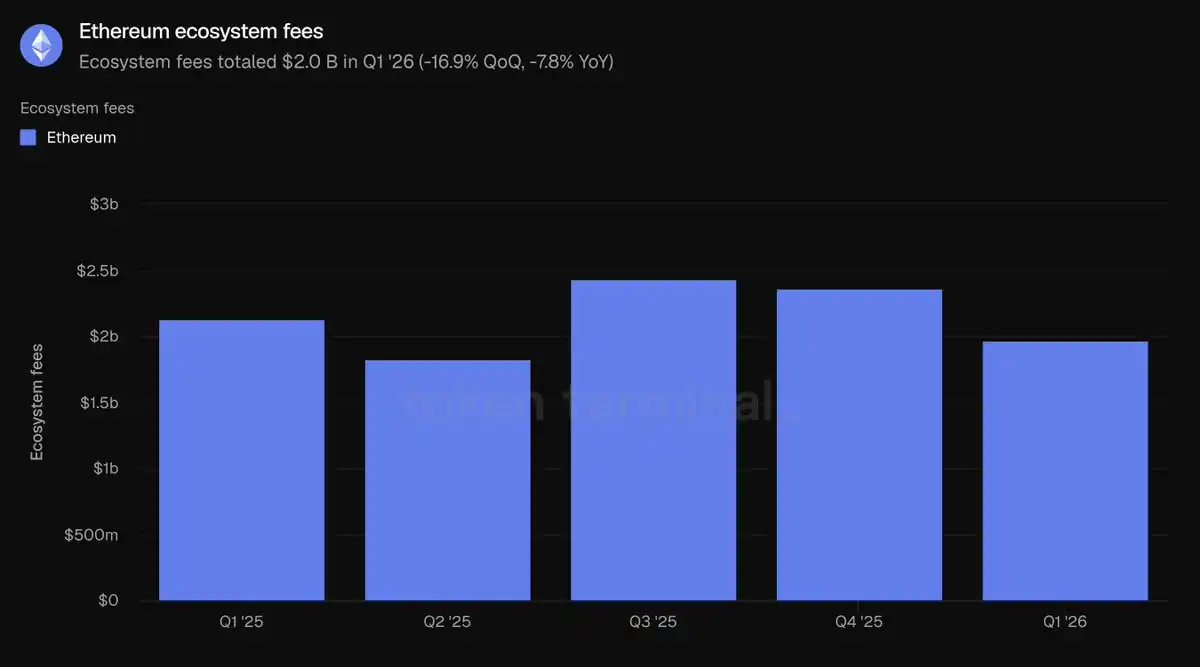
Ethereum's $2.0 billion in ecosystem fees far exceeds Tron ($0.599B), Solana ($0.533B), BNB Chain ($0.232B), and Polygon ($0.0388B), capturing 58.4% of the total fees across these five top chains. Even with the sequential decline, Ethereum remains the number one source of application fees in the industry. Summarizing all indicators in this section: Ethereum leads the industry in TVL, lending volume, and ecosystem fees, trailing only in DEX trading volume compared to BNB Chain.
Tokenized Asset Sector

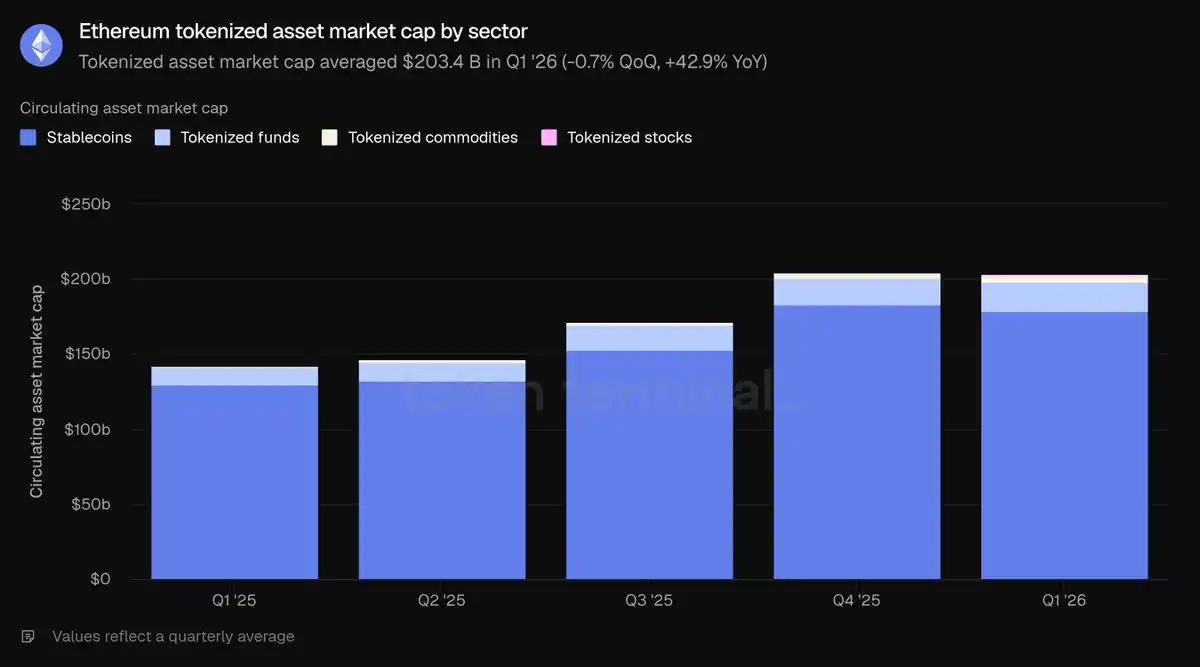
Circulating asset market cap refers to the total value of on-chain tokenized assets, calculated as circulating supply multiplied by the closing price. For stablecoins, it is the total circulating issuance; for tokenized funds, it is the on-chain assets under management (AUM); for tokenized equities, it is the total value of on-chain issued shares. This section only counts assets issued on Ethereum.

In Q1, the average total market cap for Ethereum tokenized assets was $203.4 billion, roughly flat QoQ (down only 0.7%) but up significantly by 42.9% YoY. Stablecoins account for 87.9% of the total, with the remaining share divided among tokenized funds, commodities, and equities.
Stablecoins

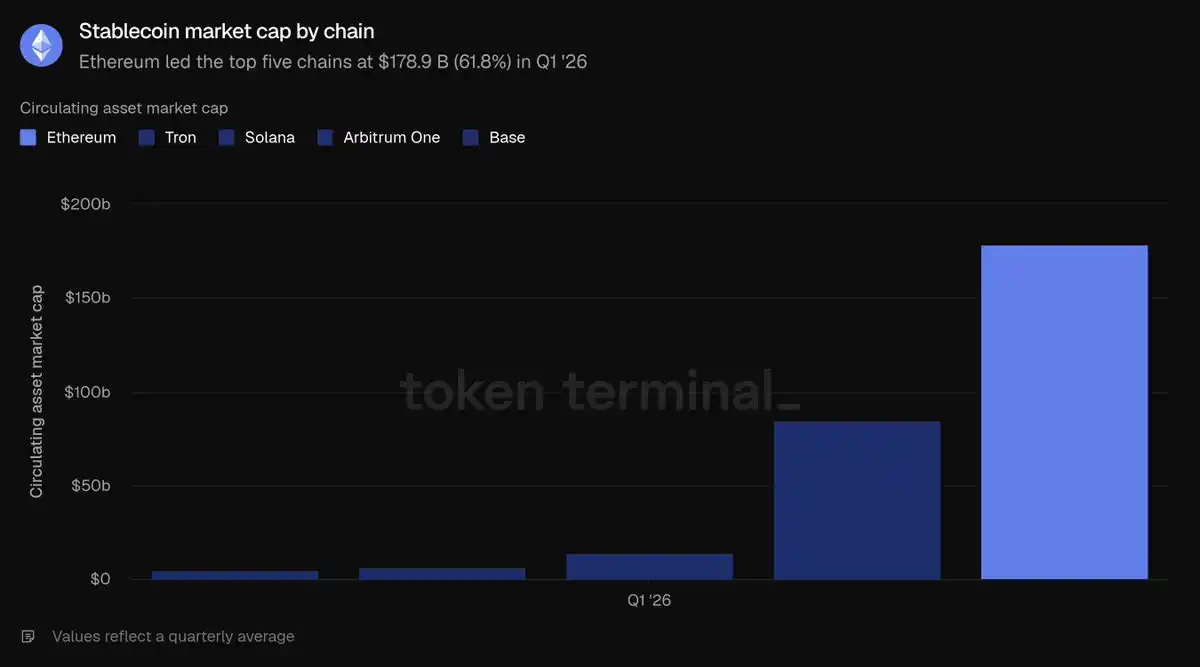
The average scale of Ethereum stablecoins in Q1 was $178.9 billion, down slightly by 2.3% QoQ but up 37.6% YoY, making it the only tokenized sub-sector that contracted sequentially. The market is dominated by two major issuers: at quarter-end, Tether's USDT ($94.1B) and Circle's USDC ($54.5B) combined held the vast majority of Ethereum's stablecoin market cap. Other leading products include Sky's USDS ($12.4B), Ethena's USDe ($5.9B), and PayPal's PYUSD ($2.9B). New compliant stablecoins like Ripple's RLUSD ($1.1B) have also launched. Comparing across the top five chains, Ethereum's $178.9B stablecoin scale leads Tron ($84.5B), Solana ($14.5B), Arbitrum One ($6.8B), and Base ($4.7B), accounting for 61.8% of the total stablecoin supply across these five chains.
Tokenized Funds

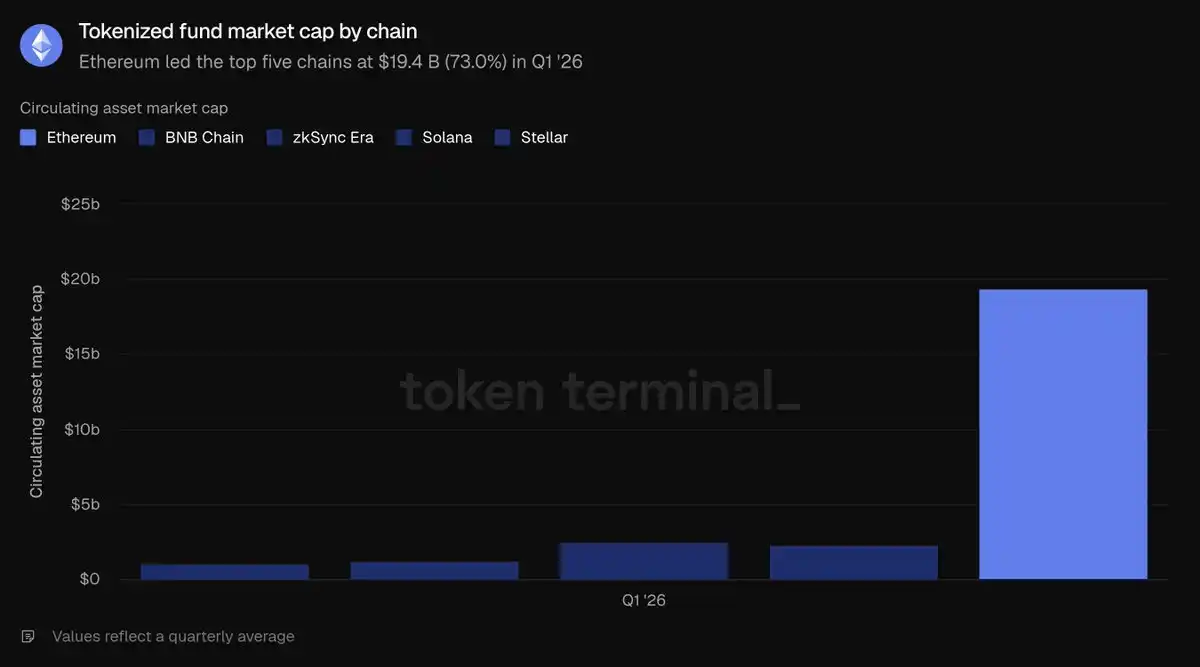
The average scale of Ethereum tokenized funds in Q1 was $19.4 billion, up 4.9% QoQ and surging 73.1% YoY. This sector is divided into two main types:

Yield-bearing on-chain dollar products (largest by scale): Sky's sUSDS (~$6.4B), Ethena's sUSDe (~$3.5B).

Traditional finance compliant funds (core vehicles for the institutional narrative): BlackRock's BUIDL (issued via Securitize, ~$1.0B), WisdomTree's government money fund (~$0.815B), Superstate's USTB (~$0.62B), with Ondo's OUSG (~$0.32B) following closely. Comparing across the top five chains, Ethereum's $19.4B in tokenized funds significantly leads ZKsync Era ($2.5B), BNB Chain ($2.3B), Solana ($1.3B), and Stellar ($1.1B), capturing 73% of the total. This is Ethereum's second most dominant tokenized asset sector.
Tokenized Commodities

The average scale of Ethereum tokenized commodities in Q1 was $4.7 billion, up 60% QoQ and surging 325.9% YoY, making it the fastest-growing tokenized category. This sector consists almost entirely of on-chain gold: Tether's gold XAUT (~$2.6B) and Paxos' gold PAXG (~$2.4B) together hold nearly the entire sector share. Comparing across the five relevant public chains, Ethereum's $4.7B scale far exceeds Ripple ($0.737B), Arbitrum One ($0.0959B), BNB Chain ($0.0384B), and Solana ($0.0298B), accounting for 84% of the total. This is the most dominant sub-sector for Ethereum.
Tokenized Equities

Tokenized equities are the smallest sub-sector by scale. In Q1, Ethereum's average scale was $365.1 million, virtually zero a year ago, representing a 16.5% increase QoQ. This sector is almost exclusively dominated by Ondo Finance, which issues S&P 500, NASDAQ-100 broad index, and dozens of individual stock on-chain assets, constituting the vast majority of Ethereum's tokenized equity market cap. Comparing across the five major chains, Ethereum's $365.1M slightly leads Solana ($249M), BNB Chain ($150.5M), Arbitrum One ($29M), and Stellar ($4.2M), capturing only 45.8% of the total tokenized equity supply across these five chains. This is the only tokenized asset sector where Ethereum does not hold an absolute majority share.
Summarizing the tokenized asset sector: Stablecoin balances slightly retreated in Q1, but Ethereum's dominant positions in tokenized funds and commodities continue to solidify.

On-Chain Usage Activity

Monthly active users are defined as unique addresses that generate revenue-generating on-chain transactions each month. This metric only counts addresses interacting with the Ethereum Layer 1 mainnet. The average MAU in Q1 was 13.2 million, surging 53.5% QoQ and up 85.9% YoY, hitting a record high and ending the slow growth trend of previous quarters, with user growth accelerating significantly.
Total transaction count refers to the number of transactions written to and confirmed on the blockchain, reflecting the heat of user on-chain interaction. Transactions per second (TPS) is the average confirmation rate within a period, measuring the network's real-time capacity. Both metrics only count the Ethereum Layer 1 mainnet. In Q1, Layer 1 processed 200.4 million transactions, up 38% QoQ and 81.5% YoY. Average TPS increased to 25.78, up 41.2% QoQ. Both figures hit new record highs, proving that user growth has effectively translated into real on-chain business volume.
Here, 'fees' specifically refer to the base network cost users pay for initiating transactions on Ethereum Layer 1, distinguished from the total ecosystem application fees in Part 2. Total Layer 1 transaction fees in Q1 were $39.9 million, plummeting 47.9% QoQ and 81.9% YoY. The core data contrast this quarter is heightened activity alongside a sharp drop in fees: transaction volume increased 38%, but total fees contracted by nearly half. The primary reason is that the Blob scaling upgrade significantly increased block storage capacity. With ample block space supply, the cost per transaction has notably decreased.

The key conclusion of this section is the realization of scaling benefits: user and transaction counts simultaneously hit new highs while overall network usage costs declined. When network throughput expansion outpaces the growth rate of market transaction demand, the characteristics of 'increased activity and decreased fees' emerge.

Native Token ETH Fundamentals

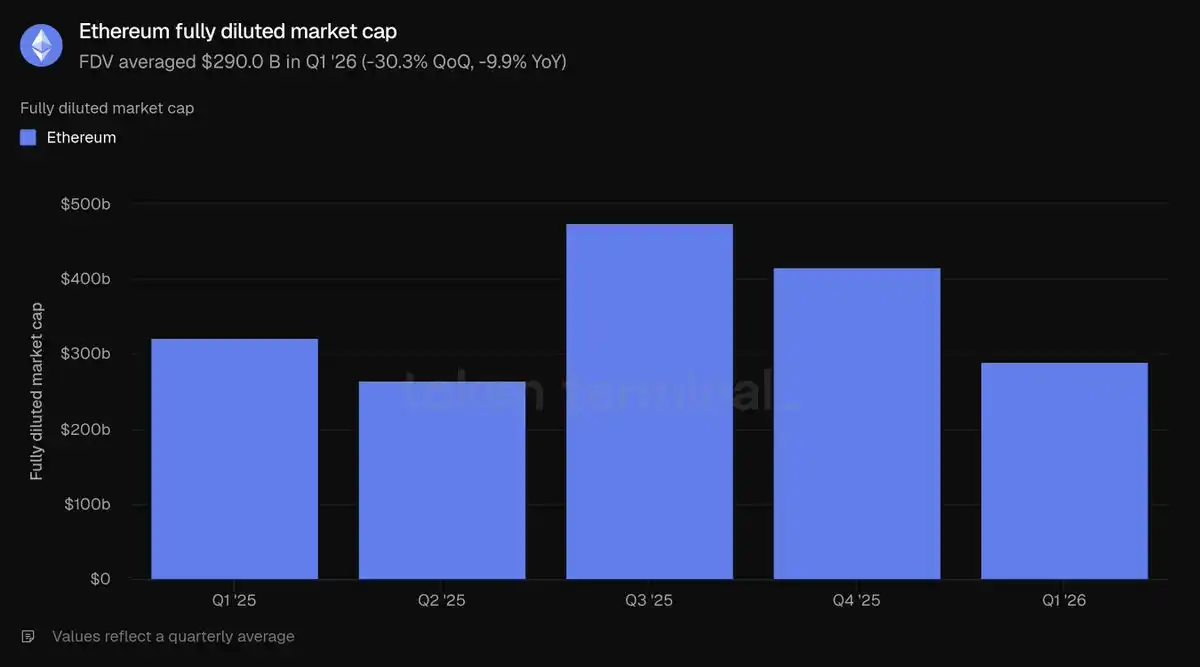
Fully Diluted Market Cap calculation logic: ETH token price × total supply under the current tokenomics model (including circulating, locked, unlocked, and yet-to-be-issued tokens). The average ETH FDMC in Q1 was $290.0 billion, down sharply by 30.3% QoQ and 9.9% YoY, marking the largest sequential decline among all valuation metrics in the report and the core factor driving the decline in USD-denominated asset scale across the ecosystem.
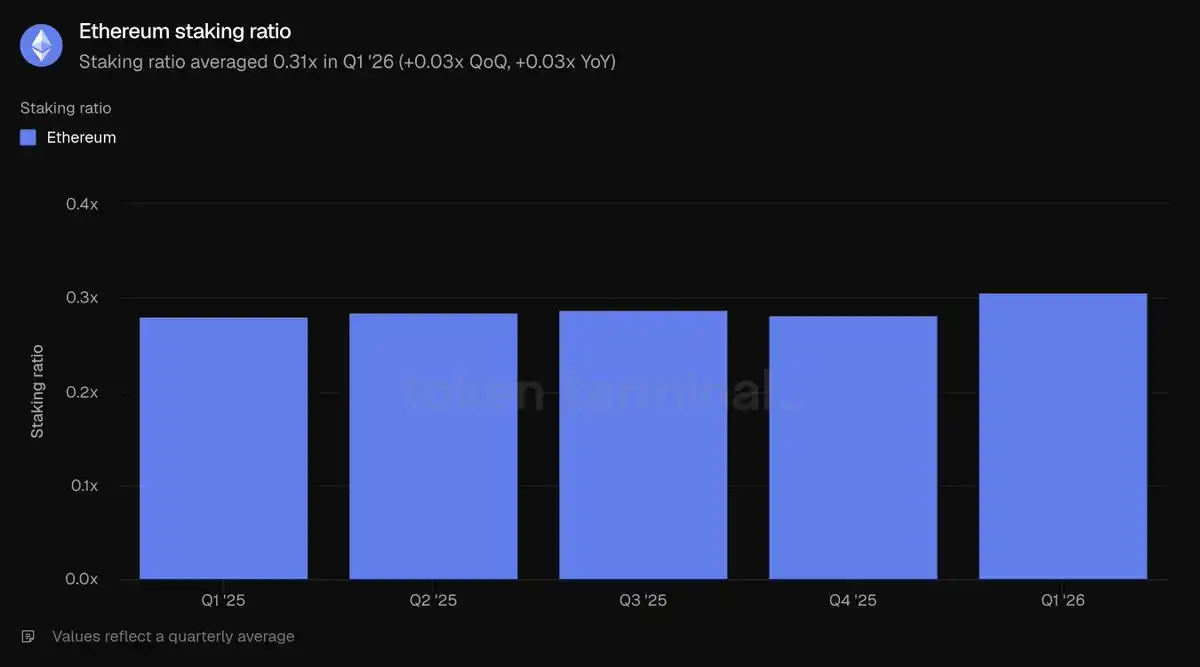
Staking Ratio: The ratio of the total value of ETH staked to secure the Proof-of-Stake network to the overall ETH market cap; 0.31 indicates that approximately 31% of ETH's market cap is participating in staking. The average staking ratio in Q1 was 0.31, higher than the 0.28 of the previous quarter and the same period last year. Even as ETH's overall market cap corrected significantly, the proportion of tokens participating in network security staking continued to rise, indicating stable long-term staking willingness among users during the price downturn.
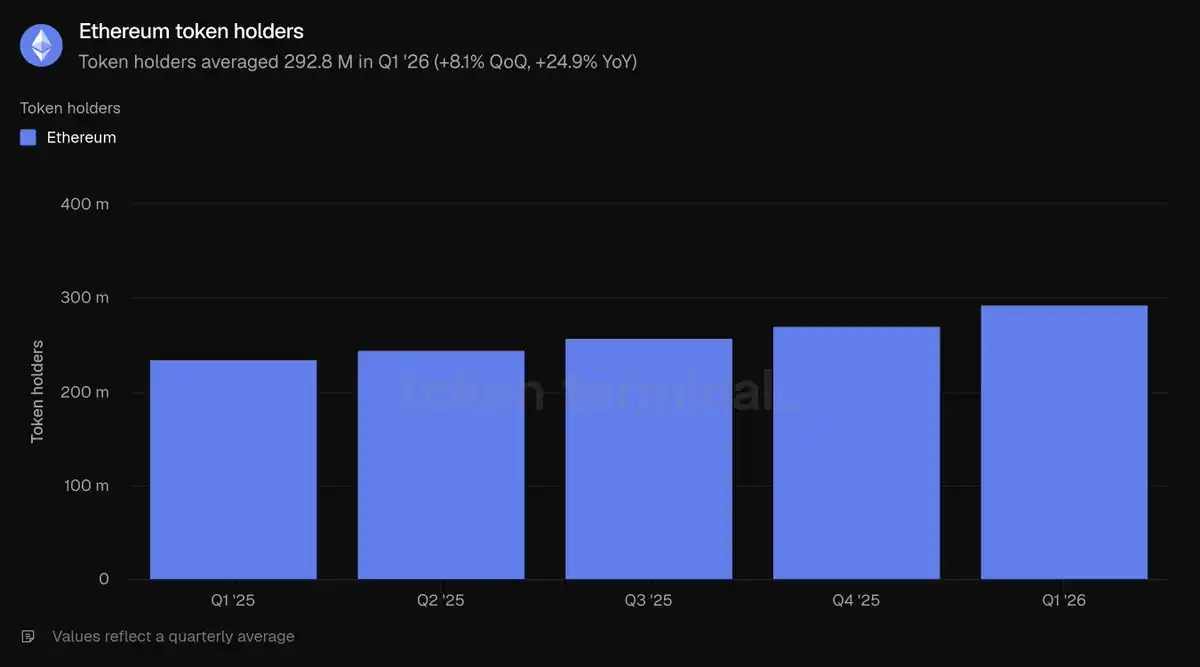
Token Holder Metric: The total number of unique wallet addresses holding ETH. The average number of ETH holding addresses in Q1 was 292.8 million, up 8.1% QoQ and 24.9% YoY, increasing steadily for five consecutive quarters. Against the backdrop of a continuously declining FDMC, the expansion of holding addresses represents a further dispersion of the ETH holder base, indicating that ordinary users' willingness to position themselves has not cooled with short-term market conditions.
Etherealize Team Commentary and Analysis

The most critical contradiction this quarter: Ethereum Layer 1 mainnet on-chain usage scale hit record highs, while network transaction fees simultaneously declined. Ethereum proactively pursued network scaling, sacrificing short-term fee revenue with the long-term logic being: cheaper block space will unlock vast potential market demand, ultimately driving long-term network revenue growth.

Data from Token Terminal's "Ethereum Q1 2026 Report" proves this long-term logic is being realized: on a YoY basis, MAU grew 85.9%, transaction volume increased 81.5%, and network throughput rose 81.7%. This is a classic manifestation of the Jevons Paradox. The team predicts that the long-term incremental demand for network-wide transactions will fully offset the short-term revenue loss from lower per-transaction fees. Drawing an analogy to the semiconductor industry: when Gordon Moore proposed Moore's Law in 1975, industry revenue was limited; today, industry revenue has grown by several orders of magnitude. Scaling benefits are not yet fully realized: the Q3 Glamsterdam upgrade plans to increase the Gas limit by more than threefold. Ethereum's long-term roadmap envisions achieving tens of thousands of TPS by 2029, building a high-speed Layer 1 chain with second-level finality.

The team agrees with BlackRock CEO Larry Fink's view from last December: the current stage of the tokenization industry is equivalent to that of the internet in 1996—when Amazon's online book sales were only $16 million. At the time, the market generally believed Amazon was just an online bookstore surviving on the internet bubble and sustained losses. But Jeff Bezos predicted the internet would completely reshape retail, forgoing short-term profits to build network effects and scale advantages. Ethereum is now making a similar trade-off to solidify its position as the global financial settlement layer.

Internet development offers another crucial lesson: open, permissionless networks will ultimately defeat closed, proprietary networks. In his 1995 book "The Road Ahead," Bill Gates predicted that digital commerce would rely on corporate proprietary private networks—"information superhighways"—rather than the open internet. At the time, Microsoft's MSN, America Online, CompuServe, and Prodigy operated closed walled gardens with millions of paying users. France's Minitel terminal system had more users than the global internet until late 1996. But all these closed systems ultimately failed. No established large enterprise wants to build its business on a network controlled by a competitor. More critically, no single company can perpetually keep up with the innovation speed of a permissionless, open ecosystem. History repeatedly confirms this pattern: Linux surpassing proprietary Unix systems, the open web replacing corporate intranets, Wikipedia replacing Encyclopaedia Britannica. At the start of each shift, proprietary products often gain first-mover advantages with more precise features, ample marketing, and business resources. But when the open ecosystem accumulates sufficient development tools, developers, and neutral, trustworthy attributes, first-mover advantages rapidly dissolve.

This industry dynamic is now replaying in the financial infrastructure domain. All data in this report serves as evidence that Ethereum has crossed the critical ecosystem threshold: it holds commanding market share across all core sectors. Institutions choosing Ethereum for tokenized finance deployment is not due to ideological preference but because ecosystem liquidity, composability, and mature institutional use cases have concentrated here. Report data shows: Ethereum captures 79.2% of DeFi active lending, 61.8% of stablecoins, 73% of tokenized funds, and 84% of tokenized commodities market share across the top five chains. Each new type of tokenized asset further thickens ecosystem liquidity, continuously attracting more institutions. A neutral, unbiased base layer is the only stable equilibrium solution for the industry—major financial institutions will never unanimously choose a competitor's private chain for asset settlement. Furthermore, institutions are gradually realizing that private interactions, access restrictions, KYC compliance, and asset transfer controls can be implemented via privacy-preserving computation environments and permissioned token standards atop Ethereum while fully accessing the network's public liquidity. Conversely, closed private chains cannot tap into the vast liquidity and diverse applications of the open ecosystem.

Following the quarter, institutional deployment has accelerated. In May alone, several significant developments occurred: In asset management: BlackRock filed for two new tokenized funds; JPMorgan launched its second Ethereum on-chain money market fund, JLTXX; Fidelity International launched Moody's AAA-rated US dollar liquidity fund FILQ as an ERC-20 token. In stablecoins: Japan's Blockchain Foundation's yen stablecoin EJPY is set to deploy on Ethereum; a consortium of 12 major European banks (including BNP Paribas, ING, UniCredit, BBVA, etc.) is preparing a compliant euro stablecoin.

The internet seemed distant in 1990 but became a societal necessity by 2005. If Fink's assessment of the tokenization industry's stage is accurate, the coming years may be the most opportune phase in Ethereum's development history. The team's previous "Efficient Money" report proposed a core thesis: Network fees build an intrinsic value floor for ETH. The long-term optimistic logic is that, relying on more robust monetary properties, ETH has the potential to capture the monetary storage value premium of gold and Bitcoin, totaling over $30 trillion. Ethereum can establish its leading industry position without relying on high transaction fees.

Criptos en tendencia

Preguntas relacionadas

QAccording to the article, what was the core contradiction observed in the Ethereum ecosystem during Q1 2026?

AThe core contradiction was that while on-chain usage metrics like monthly active users and transaction volume reached all-time highs, the total transaction fees paid on the Layer 1 network declined sharply.

QWhich data point from the report best demonstrates Ethereum's dominant position in the tokenized fund sector compared to other major blockchains?

AEthereum's tokenized fund size of $19.4 billion accounted for 73% of the total across the five major blockchains analyzed (ZKsync Era, BNB Chain, Solana, Stellar), making it the sector where Ethereum holds its second-strongest advantage among tokenized assets.

QWhat is the primary reason given for the significant decrease in Layer 1 transaction fees despite increased network activity?

AThe primary reason was the successful implementation of the Blob Parameter Only fork (BPO#2) in January, which significantly increased data storage capacity. This expansion of block space supply reduced the cost per transaction, leading to lower total fees even as transaction volume grew.

QWhat key strategic choice does the article compare Ethereum's current approach to, citing a historical parallel from the technology industry?

AThe article compares Ethereum's choice to prioritize network expansion (scaling) and lower transaction costs over short-term fee revenue to Amazon's strategy in 1996. Like Amazon, which sacrificed short-term profits to build network effects and scale in online retail, Ethereum is making a similar trade-off to solidify its position as a global financial settlement layer.

QBesides stablecoins, which two tokenized asset categories on Ethereum showed the strongest quarterly and yearly growth rates?

ATokenized commodities showed the strongest growth, with a 60.0% quarterly increase and a 325.9% yearly increase. Tokenized funds also showed strong yearly growth of 73.1%, with a quarterly increase of 4.9%.

Lecturas Relacionadas

NVIDIA CPU Advances, China's RISC-V Responds: Semiconductor Deep Dive - Part Four

NVIDIA is set to launch its new Vera AI data center CPU in China as early as August, with high pricing. While this move offers a new option, it highlights China's continued dependence on foreign-controlled Arm architecture. In response, the Chinese semiconductor industry is increasingly turning to RISC-V as a strategic alternative for achieving high-performance computing autonomy. The article explores the concept of the "impossible triangle" in CPU development—balancing prosperity, control, and autonomy—and posits that RISC-V's open-source, modular nature offers a unique path to achieving all three. While RISC-V is already dominant in embedded systems, the focus is now shifting to data centers and AI workloads. China has become a global hotspot for RISC-V development, driven by AI-driven compute demand, supply chain concerns from export controls, cost benefits of open-source, and strong policy support. Multiple Chinese companies have reportedly crossed the key performance threshold of 15 SPECint per GHz, a benchmark for entering the high-performance CPU club. Progress extends beyond single-core benchmarks. Companies are developing complete computing subsystems, including commercial-grade coherent network-on-chip (NoC) technology and server processors with up to 40 cores that strictly adhere to the RVA23 standard to ensure software compatibility. Real-world applications are emerging in areas like video transcoding and edge AI. However, significant challenges remain. The RISC-V ecosystem faces fragmentation, immature toolchains and verification processes, and gaps in single-core performance and energy efficiency compared to mature x86 and Arm architectures. The formidable software moat, epitomized by NVIDIA's CUDA, is a long-term hurdle. In conclusion, while RISC-V cannot immediately replace offerings like NVIDIA's Vera, it represents a viable long-term path for China to develop a self-sufficient, high-performance CPU ecosystem. The journey is acknowledged to be long and arduous, requiring sustained effort to overcome technical and ecosystem challenges.

marsbitHace 2 hora(s)

NVIDIA CPU Advances, China's RISC-V Responds: Semiconductor Deep Dive - Part Four

marsbitHace 2 hora(s)

My Coding Betting Dashboard is Profiting, but Polymarket is Truly Not a Good Place for 'Arbitrage'

The author built a custom monitoring dashboard for Polymarket, a prediction market platform, and tested it with $1,600, achieving over 30% returns. However, the core argument is that Polymarket is not a good venue for traditional arbitrage. The dashboard has two main sections: a "Portfolio Dashboard" for tracking active positions with key metrics like total capital, P&L, and a risk-control module using a tier system (T1, T2, T3), and an "Opportunity Watchlist" for monitoring markets. The article details a critical structural trap in binary markets: a bet with a high perceived probability of success still carries a 100% loss risk if wrong. The author's T1/T2/T3 system is designed to manage this by limiting position sizes based on conviction and time horizon, emphasizing that high confidence should not equal high concentration. A key insight is the danger of "pseudo-diversification"—betting on different markets driven by the same underlying variable. The author concludes that Polymarket offers few true low-risk, arbitrage opportunities. It is instead a high-risk environment where wins can create a false sense of mastery, leading to large losses. The platform is better viewed as a training ground for honing judgment through disciplined, framework-driven betting rather than a reliable income source. The tools help transform intuition into structured, rule-based decisions to mitigate the risk of catastrophic errors.

marsbitHace 5 hora(s)

My Coding Betting Dashboard is Profiting, but Polymarket is Truly Not a Good Place for 'Arbitrage'

marsbitHace 5 hora(s)

WeChat AI Card Hands-On Guide: Has the AI Shopping Era Arrived?

**"WeChat AI Card" Practical Test Guide: Has the Era of AI Shopping Arrived?** WeChat has officially launched the "AI Exclusive Card," a feature integrated into its Workbuddy AI assistant. This card is designed to handle payments for AI-initiated purchases. Our hands-on test reveals it's not yet a tool for fully autonomous AI shopping, but rather a controlled payment layer for AI agents. The AI Card functions as an isolated sub-wallet within WeChat Pay. Users must bind the card and transfer funds into it from their main wallet. Crucially, every transaction requires explicit user confirmation via smartphone scan; AI cannot spend autonomously. Currently accessible through the Workbuddy agent, the card targets specific digital consumption scenarios: purchasing paid content (reports, data), calling paid APIs/tools, and subscribing to services. Its design prioritizes security and control by separating funds and mandating approval for each payment. We tested a real-world scenario: ordering bubble tea via Workbuddy using a "Meituan Life Assistant" skill. The process encountered multiple hurdles: high "skill" usage costs (exceeding daily free credits), and most importantly, while a payment was successfully initiated, the AI purchased an incorrect product (a mismatched group-buy coupon instead of the desired drink). This highlights the current limitation: the **AI Card only solves the payment step**. The broader challenge lies in the **AI agent's execution chain**—accurately understanding intent, navigating third-party platforms, selecting the right product, and ensuring proper fulfillment. The payment succeeded, but the purchase failed to meet the user's need. In conclusion, the WeChat AI Exclusive Card is a cautious, early-step experiment in AI commerce. It provides a secure, user-controlled payment method for agent interactions but is not yet capable of reliable, end-to-end complex purchases. For now, it's best used for low-value, low-risk digital services with careful user verification at each step. The vision of AI handling complete shopping tasks remains a work in progress.

marsbitHace 8 hora(s)

WeChat AI Card Hands-On Guide: Has the AI Shopping Era Arrived?

marsbitHace 8 hora(s)

Trading

Spot
Futuros

Artículos destacados

Qué es ETH 2.0

ETH 2.0: Una Nueva Era para Ethereum Introducción ETH 2.0, conocido ampliamente como Ethereum 2.0, marca una actualización monumental para la blockchain de Ethereum. Esta transición no es solo una mejora superficial; busca mejorar fundamentalmente la escalabilidad, seguridad y sostenibilidad de la red. Con un cambio del mecanismo de consenso intensivo en energía Prueba de Trabajo (PoW) a una Prueba de Participación (PoS) más eficiente, ETH 2.0 promete un enfoque transformador para el ecosistema blockchain. ¿Qué es ETH 2.0? ETH 2.0 es un conjunto de actualizaciones interconectadas y distintivas centradas en optimizar las capacidades y el rendimiento de Ethereum. La reestructuración está diseñada para abordar desafíos críticos que el mecanismo actual de Ethereum ha enfrentado, particularmente en lo que respecta a la velocidad de transacción y la congestión de la red. Objetivos de ETH 2.0 Los objetivos principales de ETH 2.0 giran en torno a mejorar tres aspectos clave: Escalabilidad: Con el objetivo de aumentar significativamente el número de transacciones que la red puede manejar por segundo, ETH 2.0 busca superar la limitación actual de aproximadamente 15 transacciones por segundo, potencialmente alcanzando miles. Seguridad: Las medidas de seguridad mejoradas son fundamentales para ETH 2.0, particularmente a través de una mejor resistencia contra ciberataques y la preservación del ethos descentralizado de Ethereum. Sostenibilidad: El nuevo mecanismo PoS está diseñado no solo para mejorar la eficiencia, sino también para reducir drásticamente el consumo de energía, alineando el marco operativo de Ethereum con consideraciones ambientales. ¿Quién es el Creador de ETH 2.0? La creación de ETH 2.0 se puede atribuir a la Fundación Ethereum. Esta organización sin fines de lucro, que desempeña un papel crucial en el apoyo al desarrollo de Ethereum, es liderada por el notable cofundador Vitalik Buterin. Su visión de un Ethereum más escalable y sostenible ha sido la fuerza motriz detrás de esta actualización, involucrando contribuciones de una comunidad global de desarrolladores y entusiastas dedicados a mejorar el protocolo. ¿Quiénes son los Inversores de ETH 2.0? Si bien los detalles sobre los inversores de ETH 2.0 no se han hecho públicos, se sabe que la Fundación Ethereum recibe apoyo de varias organizaciones e individuos en el ámbito de blockchain y tecnología. Estos socios incluyen firmas de capital de riesgo, compañías tecnológicas y organizaciones filantrópicas que comparten un interés mutuo en apoyar el desarrollo de tecnologías descentralizadas e infraestructura blockchain. ¿Cómo Funciona ETH 2.0? ETH 2.0 se distingue por introducir una serie de características clave que lo diferencian de su predecesor. Prueba de Participación (PoS) La transición a un mecanismo de consenso PoS es uno de los cambios más destacados de ETH 2.0. A diferencia de PoW, que se basa en la minería intensiva en energía para la verificación de transacciones, PoS permite a los usuarios validar transacciones y crear nuevos bloques de acuerdo con la cantidad de ETH que apuestan en la red. Esto conduce a una mayor eficiencia energética, reduciendo el consumo en aproximadamente un 99.95%, convirtiendo a Ethereum 2.0 en una alternativa considerablemente más verde. Cadenas Shard Las cadenas shard son otra innovación crítica de ETH 2.0. Estas cadenas más pequeñas operan en paralelo con la cadena principal de Ethereum, lo que permite que múltiples transacciones sean procesadas simultáneamente. Este enfoque mejora la capacidad general de la red, abordando las preocupaciones de escalabilidad que han afectado a Ethereum. Cadena Beacon En el núcleo de ETH 2.0 se encuentra la Cadena Beacon, que coordina la red y gestiona el protocolo PoS. Funciona como un organizador de cierta manera: supervisa a los validadores, asegura que los shards permanezcan conectados a la red y monitorea la salud general del ecosistema blockchain. Cronología de ETH 2.0 El viaje de ETH 2.0 ha estado marcado por varios hitos clave que trazan la evolución de esta importante actualización: Diciembre 2020: El lanzamiento de la Cadena Beacon marcó la introducción de PoS, preparándose para la migración hacia ETH 2.0. Septiembre 2022: La finalización de “La Fusión” representa un momento crucial en el que la red Ethereum se trasladó exitosamente de un marco PoW a uno PoS, anunciando una nueva era para Ethereum. 2023: El lanzamiento esperado de cadenas shard tiene como objetivo mejorar aún más la escalabilidad de la red Ethereum, consolidando a ETH 2.0 como una plataforma robusta para aplicaciones y servicios descentralizados. Características Clave y Beneficios Escalabilidad Mejorada Una de las ventajas más significativas de ETH 2.0 es su escalabilidad mejorada. La combinación de PoS y cadenas shard permite que la red expanda su capacidad, permitiendo acomodar un volumen mucho mayor de transacciones en comparación con el sistema heredado. Eficiencia Energética La implementación de PoS representa un gran paso hacia la eficiencia energética en la tecnología blockchain. Al reducir drásticamente el consumo de energía, ETH 2.0 no solo disminuye los costos operativos, sino que también se alinea más estrechamente con los objetivos de sostenibilidad global. Seguridad Mejorada Los mecanismos actualizados de ETH 2.0 contribuyen a mejorar la seguridad en toda la red. El despliegue de PoS, junto con las medidas de control innovadoras establecidas a través de cadenas shard y la Cadena Beacon, asegura un mayor grado de protección contra posibles amenazas. Costos Más Bajos para los Usuarios A medida que la escalabilidad mejora, los efectos sobre los costos de transacción también serán evidentes. Se espera que una mayor capacidad y una menor congestión se traduzcan en tarifas más bajas para los usuarios, haciendo que Ethereum sea más accesible para transacciones cotidianas. Conclusión ETH 2.0 marca una evolución significativa en el ecosistema blockchain de Ethereum. A medida que aborda problemas fundamentales como la escalabilidad, el consumo de energía, la eficiencia en las transacciones y la seguridad general, la importancia de esta actualización no puede ser subestimada. La transición a la Prueba de Participación, la introducción de cadenas shard y el trabajo fundamental de la Cadena Beacon son indicativos de un futuro donde Ethereum puede satisfacer las crecientes demandas del mercado descentralizado. En una industria impulsada por la innovación y el progreso, ETH 2.0 se erige como un testimonio de las capacidades de la tecnología blockchain para allanar el camino hacia una economía digital más sostenible y eficiente.

171 Vistas totalesPublicado en 2024.04.04Actualizado en 2024.12.03

Qué es ETH 2.0

Qué es ETH 3.0

ETH3.0 y $eth 3.0: Un Examen Profundo del Futuro de Ethereum Introducción En el paisaje en rápida evolución de las criptomonedas y la tecnología blockchain, ETH3.0, a menudo denotado como $eth 3.0, ha surgido como un tema de considerable interés y especulación. El término abarca dos conceptos principales que merecen aclaración: Ethereum 3.0: Esto representa una posible actualización futura destinada a aumentar las capacidades de la blockchain existente de Ethereum, enfocándose particularmente en mejorar la escalabilidad y el rendimiento. ETH3.0 Meme Token: Este proyecto de criptomoneda distinto busca aprovechar la blockchain de Ethereum para crear un ecosistema centrado en memes, promoviendo la participación dentro de la comunidad de criptomonedas. Comprender estos aspectos de ETH3.0 es esencial no solo para los entusiastas de las criptomonedas, sino también para aquellos que observan tendencias tecnológicas más amplias en el espacio digital. ¿Qué es ETH3.0? Ethereum 3.0 Ethereum 3.0 se presenta como una actualización propuesta para la red de Ethereum ya establecida, que ha sido la columna vertebral de muchas aplicaciones descentralizadas (dApps) y contratos inteligentes desde su inicio. Las mejoras previstas se concentran principalmente en la escalabilidad, integrando tecnologías avanzadas como sharding y pruebas de conocimiento cero (zk-proofs). Estas innovaciones tecnológicas tienen como objetivo facilitar un número sin precedentes de transacciones por segundo (TPS), potencialmente alcanzando millones, abordando así una de las limitaciones más significativas que enfrenta la tecnología blockchain actual. La mejora no es meramente técnica, sino también estratégica; está destinada a preparar la red de Ethereum para su adopción generalizada y utilidad en un futuro marcado por una mayor demanda de soluciones descentralizadas. ETH3.0 Meme Token En contraste con Ethereum 3.0, el ETH3.0 Meme Token se aventura en un ámbito más ligero y juguetón al combinar la cultura de memes de internet con la dinámica de las criptomonedas. Este proyecto permite a los usuarios comprar, vender e intercambiar memes en la blockchain de Ethereum, proporcionando una plataforma que fomenta la participación comunitaria a través de la creatividad y los intereses compartidos. El ETH3.0 Meme Token tiene como objetivo demostrar cómo la tecnología blockchain puede intersectarse con la cultura digital, creando casos de uso que son tanto entretenidos como financieramente viables. ¿Quién es el Creador de ETH3.0? Ethereum 3.0 La iniciativa hacia Ethereum 3.0 es impulsada principalmente por un consorcio de desarrolladores e investigadores dentro de la comunidad de Ethereum, incluyendo notablemente a Justin Drake. Conocido por sus ideas y contribuciones a la evolución de Ethereum, Drake ha sido una figura prominente en las discusiones sobre la transición de Ethereum a una nueva capa de consenso, denominada “Beam Chain.” Este enfoque colaborativo para el desarrollo significa que Ethereum 3.0 no es el producto de un creador singular, sino más bien una manifestación de ingenio colectivo centrado en avanzar la tecnología blockchain. ETH3.0 Meme Token Los detalles sobre el creador del ETH3.0 Meme Token son actualmente inidentificables. La naturaleza de los tokens de memes a menudo conduce a una estructura más descentralizada y dirigida por la comunidad, lo que podría explicar la falta de atribución específica. Esto se alinea con la ética de la comunidad cripto más amplia, donde la innovación a menudo surge de esfuerzos colaborativos en lugar de individuales. ¿Quiénes son los Inversores de ETH3.0? Ethereum 3.0 El apoyo a Ethereum 3.0 proviene principalmente de la Fundación Ethereum junto con una entusiasta comunidad de desarrolladores e inversores. Esta asociación fundamental proporciona un grado significativo de legitimidad y mejora la perspectiva de una implementación exitosa, ya que aprovecha la confianza y credibilidad construidas a lo largo de años de operaciones en la red. En el clima cambiando rápidamente de las criptomonedas, el apoyo de la comunidad juega un papel crucial en impulsar el desarrollo y la adopción, posicionando a Ethereum 3.0 como un contendiente serio para futuros avances en blockchain. ETH3.0 Meme Token Si bien las fuentes actualmente disponibles no proporcionan información explícita sobre las fundaciones o organizaciones de inversión que respaldan el ETH3.0 Meme Token, es indicativo del modelo de financiamiento típico para tokens de memes, que a menudo depende del apoyo de base y la participación comunitaria. Los inversores en tales proyectos suelen consistir en individuos motivados por el potencial de innovación impulsada por la comunidad y el espíritu de cooperación que se encuentra dentro de la comunidad cripto. ¿Cómo Funciona ETH3.0? Ethereum 3.0 Las características distintivas de Ethereum 3.0 radican en su implementación propuesta de sharding y tecnología zk-proof. Sharding es un método de particionamiento de la blockchain en piezas más pequeñas y manejables o “shards,” que pueden procesar transacciones de manera concurrente en lugar de secuencial. Esta descentralización del procesamiento ayuda a prevenir la congestión y asegura que la red permanezca receptiva incluso bajo una carga pesada. La tecnología de prueba de conocimiento cero (zk-proof) contribuye con otra capa de sofisticación al permitir la validación de transacciones sin revelar los datos subyacentes involucrados. Este aspecto no solo mejora la privacidad, sino que también aumenta la eficiencia general de la red. También se habla de incorporar una Máquina Virtual de Ethereum de conocimiento cero (zkEVM) en esta actualización, amplificando aún más las capacidades y utilidad de la red. ETH3.0 Meme Token El ETH3.0 Meme Token se distingue al capitalizar la popularidad de la cultura de memes. Establece un mercado para que los usuarios participen en el comercio de memes, no solo por entretenimiento sino también por el posible beneficio económico. Al integrar características como staking, provisión de liquidez y mecanismos de gobernanza, el proyecto fomenta un entorno que incentiva la interacción y participación de la comunidad. Al ofrecer una mezcla única de entretenimiento y oportunidad económica, el ETH3.0 Meme Token tiene como objetivo atraer a una audiencia diversa, que abarca desde entusiastas de las criptomonedas hasta conocedores casuales de memes. Línea de Tiempo de ETH3.0 Ethereum 3.0 11 de noviembre de 2024: Justin Drake insinúa la próxima actualización de ETH 3.0, centrada en mejoras de escalabilidad. Este anuncio significa el comienzo de las discusiones formales sobre la futura arquitectura de Ethereum. 12 de noviembre de 2024: Se espera que la propuesta anticipada para Ethereum 3.0 se desvele en Devcon en Bangkok, preparando el escenario para una mayor retroalimentación de la comunidad y posibles próximos pasos en el desarrollo. ETH3.0 Meme Token 21 de marzo de 2024: El ETH3.0 Meme Token se lista oficialmente en CoinMarketCap, marcando su incursión en el dominio público de las criptomonedas y mejorando la visibilidad de su ecosistema basado en memes. Puntos Clave En conclusión, Ethereum 3.0 representa una evolución significativa dentro de la red de Ethereum, enfocándose en superar las limitaciones en términos de escalabilidad y rendimiento a través de tecnologías avanzadas. Sus actualizaciones propuestas reflejan un enfoque proactivo hacia las demandas y la usabilidad futura. Por otro lado, el ETH3.0 Meme Token encapsula la esencia de la cultura impulsada por la comunidad en el espacio de las criptomonedas, aprovechando la cultura de memes para crear plataformas atractivas que fomentan la creatividad y participación del usuario. Comprender los distintos propósitos y funcionalidades de ETH3.0 y $eth 3.0 es fundamental para cualquiera interesado en los desarrollos en curso dentro del espacio cripto. Con ambas iniciativas abriendo caminos únicos, subrayan colectivamente la naturaleza dinámica y multifacética de la innovación en blockchain.

184 Vistas totalesPublicado en 2024.04.04Actualizado en 2024.12.03

Qué es ETH 3.0

Cómo comprar ETH

¡Bienvenido a HTX.com! Hemos hecho que comprar Ethereum (ETH) sea simple y conveniente. Sigue nuestra guía paso a paso para iniciar tu viaje de criptos.Paso 1: crea tu cuenta HTXUtiliza tu correo electrónico o número de teléfono para registrarte y obtener una cuenta gratuita en HTX. Experimenta un proceso de registro sin complicaciones y desbloquea todas las funciones.Obtener mi cuentaPaso 2: ve a Comprar cripto y elige tu método de pagoTarjeta de crédito/débito: usa tu Visa o Mastercard para comprar Ethereum (ETH) al instante.Saldo: utiliza fondos del saldo de tu cuenta HTX para tradear sin problemas.Terceros: hemos agregado métodos de pago populares como Google Pay y Apple Pay para mejorar la comodidad.P2P: tradear directamente con otros usuarios en HTX.Over-the-Counter (OTC): ofrecemos servicios personalizados y tipos de cambio competitivos para los traders.Paso 3: guarda tu Ethereum (ETH)Después de comprar tu Ethereum (ETH), guárdalo en tu cuenta HTX. Alternativamente, puedes enviarlo a otro lugar mediante transferencia blockchain o utilizarlo para tradear otras criptomonedas.Paso 4: tradear Ethereum (ETH)Tradear fácilmente con Ethereum (ETH) en HTX's mercado spot. Simplemente accede a tu cuenta, selecciona tu par de trading, ejecuta tus trades y monitorea en tiempo real. Ofrecemos una experiencia fácil de usar tanto para principiantes como para traders experimentados.

4.2k Vistas totalesPublicado en 2024.12.10Actualizado en 2026.06.02

Cómo comprar ETH

Discusiones

Bienvenido a la comunidad de HTX. Aquí puedes mantenerte informado sobre los últimos desarrollos de la plataforma y acceder a análisis profesionales del mercado. A continuación se presentan las opiniones de los usuarios sobre el precio de ETH (ETH).

活动图片