Facing Competition from Fomo, Why is Pump.fun Spending Heavily to 'Poach' and Compete for Trading Volume?

marsbitPublicado a 2026-08-13Actualizado a 2026-08-13

Resumen

In the competitive meme coin market, Pump.fun and Fomo are battling for dominance in speculative trading. Fomo has seen rapid growth on Robinhood Chain by socializing trading—allowing users to follow traders, view portfolios, and copy trades. However, as Solana remains the core hub for such activity, Pump.fun, which provides much of the underlying infrastructure for platforms like Fomo, is now aggressively moving to capture the front-end user market directly. Pump.fun is employing tactics like offering lucrative contracts to poach top traders from Fomo and implementing a zero-fee front-end policy—subsidies possible due to its profitable bond curve and PumpSwap mechanisms. This creates a complex dynamic where the two are partners in infrastructure but direct competitors for users. The conflict highlights a trend of established crypto infrastructure projects vertically integrating to control consumer-facing applications, similar to Uniswap's moves on Robinhood Chain. The article suggests the ultimate winner may hinge on *trust*. While Fomo promotes transparency, the inherent risk in social trading is that traders can manipulate signals. Pump.fun's aggressive tactics, including the alleged poaching, have also impacted its reputation. The platform that best ensures the authenticity of trading signals and maintains user trust will likely prevail.

Written by: David Christopher

Compiled by: Saoirse, Foresight News

The meme coin battlefield is filled with smoke, as Pump.fun and Fomo vie for industry dominance.

Over the past few weeks, another titan clash has unfolded in the crypto industry: Pump versus Fomo. The arena for their competition is the most widespread product in the crypto market—speculative trading.

Fomo has proven well how quality consumer-facing experiences can shape a trading product. It has socialized, publicized, and trackable trading: users can follow traders, view their holdings, copy trades or take the opposite position, and observe the complete trading process in real-time.

This product design has driven rapid platform growth. Riding the wave of renewed market speculation, Fomo became a core battleground for the meme coin frenzy on Robinhood Chain, with weekly platform fees and trader numbers surging accordingly.
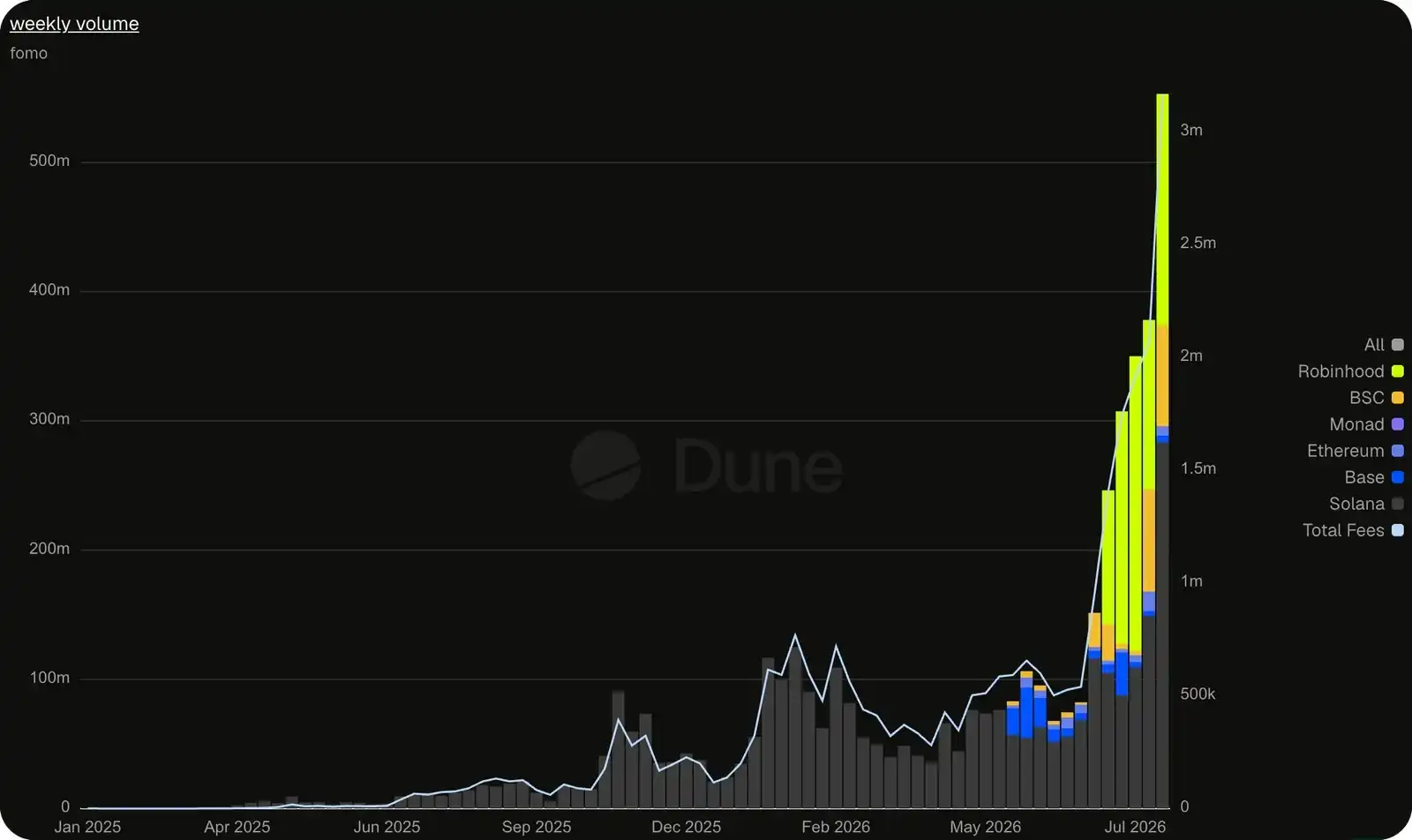
This Dune chart shows Fomo's weekly trading volume: starting with slow growth in early 2025, experiencing an explosive surge after May 2026, with Robinhood Chain being the core driver of volume growth, while total platform fees simultaneously hit record highs.

However, Solana remains the stronghold of speculative trading in the crypto market, and Pump.fun sits at the heart of this arena, unwilling to share the market pie.

Fomo relies on the underlying infrastructure from Pump.fun, achieving rapid growth with a superior front-end interface, essentially acting as a middleman between Solana's speculative infrastructure and the average speculative user. The term 'middleman' here is not derogatory. Fomo has built a product that meets user needs, and the platform's continuous generation of fees proves users are willing to pay for this experience.

But ultimately, most of the features built by Fomo could theoretically be replicated by Pump.fun. We are witnessing this now: Pump.fun is continuously adding numerous social features to its own application, striving to become the 'homepage' for speculative trading.

This creates a delicate dynamic between the two platforms: partners at the underlying infrastructure layer, yet direct competitors in the user-facing market. Fomo holds user traffic, while the infrastructure supporting trade execution mostly belongs to Pump.fun.

Now, Pump.fun wants to capture both the infrastructure and the consumer-facing market layers.

To achieve this goal, Pump.fun is going all out. It is reportedly offering conditions, with contracts worth tens of thousands of dollars per month, to poach top traders from Fomo and attract them to move their trading activities to Pump.fun. This action is not illegal, nor even an industry scandal. Essentially, it's a well-funded platform spending money to attract core users who bring their own traffic.

Beyond this, Pump.fun has also introduced a zero-fee policy for its front-end. It can afford this subsidy because the platform already profits from mechanisms like its bonding curve and PumpSwap; this front-end subsidy model is something Fomo cannot replicate.

Many market participants criticize Fomo for charging fees as a result, but this view misses the core question: what exactly are users paying for?

Users pay for the entire accompanying trading experience: finding traders worth following, viewing their holdings, tracking trade profits, receiving market alerts, and completing all operations through an interface that significantly lowers the barrier to cryptocurrency actions.

Transaction fees are Fomo's core revenue source; the entire user experience is its main business. Pump.fun can offer similar features for free because its underlying business already provides stable income.

In my view, there are two key points worth considering in this matter.

First, this is yet another classic case: mature crypto infrastructure projects are beginning vertical integration upward, competing for end-user traffic. A similar drama is unfolding with Uniswap on Robinhood Chain. After becoming the core on-chain trading infrastructure, Uniswap is promoting its own launchpad, no longer merely serving as an underlying tool for other platforms. Pump.fun is employing the same strategy on Solana: having already captured the underlying infrastructure for speculative trading, it now wants to further control the consumer-facing layer for ordinary users.

Second, I believe the key to the ultimate outcome between Pump.fun and Fomo lies in trust.

Due to its central position in the meme speculation arena, regardless of objectivity, Pump.fun's reputation within the crypto community is mixed. And the rumors of the platform heavily incentivizing trader poaching further damage its image.

In contrast, Fomo launched later, carries less historical baggage, and its product was designed from the outset to make trading behavior more transparent and traceable, focusing on social trading.

But the value of social trading depends entirely on the credibility of the signals traders provide. A trader can publicly buy with one wallet and quietly sell with another; build a position in advance, promote it publicly, and then dump the holdings on followers. While blockchain enables on-chain data transparency, it cannot guarantee that traders themselves are trustworthy.

Ultimately, where users choose to trade depends on which platform can maximize the authenticity of the information displayed. Once traders collude, use multiple hidden wallets to obscure transactions, and harvest their followers, users will lose trust in trading signals. After trust collapses, the value of the social trading layer that both platforms are fiercely competing for will also vanish.

It remains to be seen what measures both platforms will take to maintain user trust going forward.


Criptos en tendencia

Preguntas relacionadas

QWhat are the main strategies that Pump.fun is using to compete with Fomo for trading traffic?

APump.fun is employing two main strategies to compete with Fomo. First, it is reportedly offering lucrative contracts, worth tens of thousands of dollars per month, to attract top traders from Fomo to migrate their trading activity to Pump.fun. Second, it has introduced a zero-fee policy for its front-end interface, a subsidy it can afford due to profits from its underlying infrastructure like bonding curves and PumpSwap, which Fomo cannot replicate as its core revenue comes from transaction fees.

QWhat is the fundamental difference in the business models of Pump.fun and Fomo that allows Pump.fun to offer a zero-fee front-end?

AThe fundamental difference lies in their primary revenue sources. Pump.fun's core business and profitability come from its underlying infrastructure, such as the bonding curve mechanism and PumpSwap, which facilitate token creation and trading. This allows it to subsidize its front-end by offering zero fees. In contrast, Fomo's main business and revenue stream is its user-facing platform and the associated trading experience; transaction fees are essential for its operation, as it does not have the same foundational infrastructure profits to offset such costs.

QAccording to the article, what broader trend in the crypto industry does the competition between Pump.fun and Fomo represent?

AThe competition represents a trend of vertical integration, where mature crypto infrastructure projects begin moving upstream to capture end-user traffic and control the consumer-facing layer. Similar dynamics are seen with Uniswap on Robinhood Chain, which, after becoming core on-chain trading infrastructure, started promoting its own launchpad instead of just serving as a backend tool for other platforms. Pump.fun is following the same playbook on Solana.

QWhat is identified as the ultimate deciding factor for which platform, Pump.fun or Fomo, will win in the long run?

AThe article identifies user trust as the ultimate deciding factor. The value of social trading, which Fomo emphasizes and Pump.fun is replicating, depends entirely on the credibility of the signals traders provide. If traders engage in manipulative practices (like wash trading or hidden wallets), user trust will erode. The platform that can best ensure the authenticity of the information and trading signals displayed will likely gain a decisive advantage.

QHow does Fomo's product design differentiate it in the meme coin trading space, and what is a potential vulnerability of this model?

AFomo differentiates itself by socializing, publicizing, and making trading trackable. Its product allows users to follow traders, view their portfolios, copy trades (or trade against them), and observe the entire trading process in real-time. This superior front-end experience drove its rapid growth. A potential vulnerability of this social trading model is its dependence on trader trustworthiness. The transparency of blockchain data does not prevent traders from acting dishonestly (e.g., using multiple wallets to hide true positions), which could lead to a collapse in user trust and devalue the platform's core offering.

Lecturas Relacionadas

Wall Street Morning Report: CPI Lands Mildly, U.S. Stocks Stage Deep V-Shaped Reversal, AI Cloud, Storage, and Optical Communications Collectively Surge

Wall Street Morning Report: US stocks staged a deep V-shaped recovery following a mild CPI report, with AI cloud, storage, and optical communication sectors leading the rally. Major indexes were mixed: the Dow dipped slightly, while the S&P 500 and Nasdaq gained, nearing record highs. The July CPI data met expectations, with core inflation hitting its slowest pace since March 2021, further reducing expectations for a September Fed rate hike. Market focus shifted decisively towards AI infrastructure. The Philadelphia Semiconductor Index jumped 2.49%. AI cloud providers NEBIUS and CoreWeave surged 34% and 19% respectively on strong earnings and massive order backlogs. Optical communication stocks like Lumentum and Coherent also posted significant gains. The storage sector rallied broadly, with SK Hynix and Micron among the advancers. Meanwhile, major tech giants saw divergence. Nvidia rose over 3%, while Apple, Microsoft, Amazon, and Meta closed lower. In commodities, gold and silver remained strong, while oil prices retreated as markets awaited developments in the Strait of Hormuz. The US federal budget deficit widened significantly in July, raising long-term concerns. Key upcoming events include US PPI data, Sandisk's investor day, and the SEC's 13F filings deadline, which will reveal institutional holdings.

marsbitHace 11 min(s)

Wall Street Morning Report: CPI Lands Mildly, U.S. Stocks Stage Deep V-Shaped Reversal, AI Cloud, Storage, and Optical Communications Collectively Surge

marsbitHace 11 min(s)

A 22-Year-Old Mathematical Puzzle, Solved by a Union Hospital Intern?

In an astonishing development, a longstanding mathematical problem known as the Crouzeix conjecture, which had challenged experts in numerical linear algebra for 22 years, appears to have been solved by Shanmu Jin, a neurosurgery resident and postdoctoral researcher at Peking Union Medical College Hospital. With no formal advanced mathematical training—his background is in geology and medicine—Jin relied on self-study and, crucially, the AI model GPT-5.6. The conjecture, proposed by mathematician Michel Crouzeix in 2004, concerns a fundamental constant (speculated to be 2) bounding the relationship between matrix norms and polynomial values over numerical ranges. It is critical for applications in matrix function analysis and numerical methods. Despite dedicated efforts by leading mathematicians, the best proven constant had only been reduced to 2.414. Jin approached the problem using sophisticated prompt engineering with GPT-5.6. He adapted a known prompting strategy, isolating the AI from external resources to force original reasoning, employing multiple divergent "sub-agents" to explore different paths, and enforcing rigorous adversarial review of proposed proof steps. After about 16 hours of autonomous, unsupervised operation, the AI produced a novel and elegant proof. The key insight involved a clever "sampling strategy" that reduced the problem to a simple positivity condition—a solution described as elegant and unexpected by experts. The proof was verified by the conjecture's originator, Michel Crouzeix, and other specialists like Alex Townsend and Anne Greenbaum, who expressed astonishment at its validity. Jin has made the entire process open-source, including the prompt, drafts, and formal verification code. Remarkably, just eight days after Jin's preprint appeared, mathematicians Emiel Lorist and Felix Schwenninger published an independent, concise 5-page proof using a different approach, also developed with the aid of ChatGPT 5.6. Jin welcomed this complementary work. This event marks a potential turning point, demonstrating how AI can enable experts from non-traditional backgrounds to solve deep theoretical problems and dramatically accelerate scientific discovery, heralding what some are calling a new "golden age" for interdisciplinary research.

marsbitHace 25 min(s)

A 22-Year-Old Mathematical Puzzle, Solved by a Union Hospital Intern?

marsbitHace 25 min(s)

Trading

Spot

Artículos destacados

Qué es MEME 2.0

Memecoin 2.0: El Ascenso de $MEME 2.0 en el Mundo de las Criptomonedas Introducción En el panorama siempre cambiante de las criptomonedas, ha surgido un nuevo contendiente. Memecoin 2.0, simbolizada como $MEME 2.0, lleva el concepto de las monedas meme a un emocionante nuevo nivel. Como un subproducto del Memecoin original, este proyecto ha capturado la atención de la comunidad cripto al cambiar el enfoque de los incentivos financieros típicos a una experiencia comprometida y entretenida. Operando en la blockchain de Ethereum, Memecoin 2.0 redefine audazmente la participación de la comunidad en la esfera cripto. ¿Qué es Memecoin 2.0, $MEME 2.0? En su núcleo, Memecoin 2.0 es un proyecto de criptomoneda que prioriza el espíritu comunitario y la diversión asociada con la cultura meme. A diferencia de las criptomonedas convencionales, que se concentran en casos de uso prácticos y beneficios tangibles, Memecoin 2.0 se distingue al abrazar el lado más liviano de la moneda digital. El proyecto existe sin promesas de utilidad, un mapa estructurado o retornos financieros, enfocándose en cambio en fomentar una comunidad vibrante centrada en memes y en el disfrute compartido. Al hacerlo, aprovecha la creciente tendencia de la cultura meme en el espacio en línea, convirtiéndose en un jugador único en el mundo de los activos digitales. Creador de Memecoin 2.0, $MEME 2.0 A pesar de la extensa investigación sobre los orígenes de Memecoin 2.0, la identidad explícita de su creador sigue siendo desconocida. Esta anonimidad no es inusual en la comunidad cripto, donde muchos proyectos son liderados por individuos o grupos que prefieren permanecer en las sombras. La falta de información disponible públicamente sobre el creador podría verse como un movimiento estratégico, poniendo el foco en la participación comunitaria en lugar de la notoriedad individual dentro del espacio. Inversores de Memecoin 2.0, $MEME 2.0 La información sobre los inversores o el respaldo financiero de Memecoin 2.0 es escasa. Esta ausencia de detalles puede sugerir que el proyecto es autofinanciado o que su enfoque en la comunidad en lugar de las estructuras de inversión tradicionales ha atraído a un tipo diferente de apoyo. Dado que el mundo de las monedas meme generalmente involucra una participación más de base en lugar de inversión institucional, este enfoque está alineado con la ética de los proyectos impulsados por la comunidad. ¿Cómo Funciona Memecoin 2.0, $MEME 2.0? Memecoin 2.0 opera completamente en la blockchain de Ethereum, capitalizando sus robustas características de seguridad y escalabilidad. Al aprovechar las fortalezas de Ethereum, Memecoin 2.0 puede ofrecer un entorno seguro para las interacciones de los usuarios, asegurando que las transacciones sean tanto eficientes como rentables. Uno de los atributos únicos de Memecoin 2.0 radica en su estructura impulsada por la comunidad. El valor y la popularidad del token $MEME 2.0 derivan de la participación activa de sus usuarios, en vez de de una utilidad inherente. Este diseño refuerza el enfoque del proyecto en el aspecto de entretenimiento de las criptomonedas, lo que implica que la risa y la participación comunitaria son las verdaderas monedas que impulsan su éxito. Además, el proyecto encaja dentro del ecosistema más amplio de las monedas meme, donde el valor de cada moneda meme oscila basado en la cultura, tendencias y la participación de la comunidad, en lugar de principios económicos tradicionales. Cronología de Memecoin 2.0, $MEME 2.0 Para entender mejor la evolución y los hitos de Memecoin 2.0, aquí hay una cronología que destaca eventos significativos en su historia: 2024: Se reconoce la creación de Memecoin 2.0 como una ramificación del Memecoin original, estableciéndose dentro del contexto próspero de las monedas meme mientras opera en la blockchain de Ethereum. 13 de julio de 2024: Memecoin 2.0 se posiciona oficialmente como una moneda meme centrada en la comunidad en la red de Ethereum, enfatizando su enfoque centrado en el entretenimiento que invita a los usuarios a participar y crecer. Puntos Clave Sobre Memecoin 2.0, $MEME 2.0 Varios rasgos críticos definen a Memecoin 2.0: Enfoque Centrado en la Comunidad: La misión principal de Memecoin 2.0 es crear una experiencia comunitaria divertida y atractiva, capitalizando en el disfrute colectivo derivado de la cultura memética. Construido sobre Ethereum: Operar en la blockchain de Ethereum proporciona al proyecto una infraestructura esencial que garantiza seguridad y escalabilidad. Falta de Utilidad o Hoja de Ruta: En un notable desvío de las criptomonedas tradicionales, Memecoin 2.0 no promete características utilitarias ni retornos financieros, reafirmando su compromiso con la participación comunitaria y el compromiso social. Enfoque en la Cultura Memética: Al abrazar los aspectos humorísticos y culturales del fenómeno meme, Memecoin 2.0 proporciona una plataforma para que los usuarios interactúen con cripto tanto fuera de línea como en línea. Contexto Adicional: La Importancia de las Monedas Meme Las monedas meme han surgido como una clase distinta de criptomonedas, a menudo impulsadas por el humor y un enfoque desenfadado para el comercio. Estas monedas generalmente carecen de una utilidad significativa o hojas de ruta de desarrollo, atrayendo a los usuarios con la promesa de diversión, interacción comunitaria y relevancia cultural. En el panorama del ecosistema cripto más amplio, las monedas meme reviven la importancia de la participación comunitaria, revirtiendo enfoques únicamente motivados por el lucro. Proyectos como Memecoin 2.0 inauguran una era donde el entretenimiento puede armonizar con las aspiraciones financieras, convirtiendo la blockchain en un parque de diversiones para la creatividad y la interacción social. Conclusión Memecoin 2.0, o $MEME 2.0, encarna una nueva ola de criptomonedas que prioriza la participación comunitaria sobre estructuras financieras rígidas. Con un enfoque en el humor y la interacción social, capitaliza sobre la fascinación que rodea la cultura meme. Al operar en la blockchain de Ethereum, Memecoin 2.0 aprovecha las capacidades de la tecnología mientras se mantiene firme en su compromiso con el valor de entretenimiento de la moneda digital. A medida que el espacio alrededor de las criptomonedas continúa evolucionando, Memecoin 2.0 sirve como un testimonio de la noción de que el futuro de los activos digitales podría depender, en gran medida, de experiencias compartidas, risas y sólidas conexiones comunitarias. En el mundo impredecible de las criptomonedas, quizás la alegría pueda ser tan valiosa como la ganancia financiera tradicional.

195 Vistas totalesPublicado en 2024.04.04Actualizado en 2024.12.03

Qué es MEME 2.0

Cómo comprar MEME

¡Bienvenido a HTX.com! Hemos hecho que comprar Memeland (MEME) sea simple y conveniente. Sigue nuestra guía paso a paso para iniciar tu viaje de criptos.Paso 1: crea tu cuenta HTXUtiliza tu correo electrónico o número de teléfono para registrarte y obtener una cuenta gratuita en HTX. Experimenta un proceso de registro sin complicaciones y desbloquea todas las funciones.Obtener mi cuentaPaso 2: ve a Comprar cripto y elige tu método de pagoTarjeta de crédito/débito: usa tu Visa o Mastercard para comprar Memeland (MEME) al instante.Saldo: utiliza fondos del saldo de tu cuenta HTX para tradear sin problemas.Terceros: hemos agregado métodos de pago populares como Google Pay y Apple Pay para mejorar la comodidad.P2P: tradear directamente con otros usuarios en HTX.Over-the-Counter (OTC): ofrecemos servicios personalizados y tipos de cambio competitivos para los traders.Paso 3: guarda tu Memeland (MEME)Después de comprar tu Memeland (MEME), guárdalo en tu cuenta HTX. Alternativamente, puedes enviarlo a otro lugar mediante transferencia blockchain o utilizarlo para tradear otras criptomonedas.Paso 4: tradear Memeland (MEME)Tradear fácilmente con Memeland (MEME) en HTX's mercado spot. Simplemente accede a tu cuenta, selecciona tu par de trading, ejecuta tus trades y monitorea en tiempo real. Ofrecemos una experiencia fácil de usar tanto para principiantes como para traders experimentados.

315 Vistas totalesPublicado en 2024.12.12Actualizado en 2026.06.02

Cómo comprar MEME

Discusiones

Bienvenido a la comunidad de HTX. Aquí puedes mantenerte informado sobre los últimos desarrollos de la plataforma y acceder a análisis profesionales del mercado. A continuación se presentan las opiniones de los usuarios sobre el precio de MEME (MEME).

活动图片