In Order to Buy Investigational Weight-Loss Drugs, a Group of Americans Learn to Use Bitcoin Payments

marsbitPublicado a 2026-07-22Actualizado a 2026-07-22

Resumen

To purchase the experimental weight-loss drug retatrutide, Americans like Zach are turning to Bitcoin despite initial skepticism. Retatrutide, an unapproved triple-agonist from Eli Lilly, offers significant weight loss but is inaccessible through U.S. channels. Buying from domestic resellers costs around $3,600 annually, whereas Zach found a Chinese seller offering a year’s supply for $240—with Bitcoin as the only payment option. This price disparity led him to learn cryptocurrency for the transaction. Online sellers of such “research chemicals” or peptides often use Bitcoin because traditional payment systems avoid the regulatory and legal risks. Chainalysis data shows crypto payments to grey-market peptide sellers reached $32 million in Q1 2026, suggesting an annualized volume exceeding $100 million, though this remains a fraction of the estimated $1-3 billion black market. The trend intersects with communities like DeSciNYC, where events on peptides draw crowds interested in biohacking and longevity, indicating shared interests between crypto and wellness circles. However, potential FDA moves to legalize certain peptides could shift demand away from the black market and reduce the need for crypto payments.

Original: Bloomberg

Compiled & Edited by: angelilu, Foresight News

A 49-year-old American marketing director, who previously considered Bitcoin to have "no underlying value," spent several days this year opening an account, buying cryptocurrency, and making a transfer. His goal was to purchase 20 bottles of an investigational weight-loss drug from a Chinese seller. A Bloomberg report on July 20 revealed that such transactions are forming a crypto payment market, with annual transaction volume projected to exceed $100 million at the current pace—and the buyers are mostly ordinary consumers who had never touched cryptocurrency before.

A Transfer to Save Money

The buyer interviewed by Bloomberg is named Zach (surname withheld for privacy), from the Pacific Northwest region of the US. He wanted retatrutide—an investigational weight-loss drug from Eli Lilly. It is a triple GIP, GLP-1, and glucagon receptor agonist; in simple terms, it targets one more point than current market drugs like semaglutide and tirzepatide. Eli Lilly released its phase 3 clinical data in March this year, showing weight loss of up to 28% at the highest dose over 80 weeks. However, this drug has not yet been approved by the US Food and Drug Administration (FDA) and is unavailable through regular channels.

Zach searched for months and finally found a Chinese seller willing to sell him 20 bottles of what they claimed to be that compound, roughly a year's supply, for a total of $240. In contrast, buying from secondary dealers in the US would cost him $300 a month, or $3,600 a year.

The only condition: Bitcoin only.

According to Bloomberg's description, Zach had previously categorized Bitcoin as a purely speculative asset. But the more than tenfold price difference changed his mind—"The spread is too vast; it felt like a risk worth taking." The seller gave him a webpage teaching him how to buy and transfer cryptocurrency. A few days later, he opened a Coinbase account, bought Bitcoin for the first time in his life, transferred it to the seller, and received the package a week later.

What Peptides Are, and Why They Need Crypto Payments

Peptides are short chains of amino acids that participate in regulating various physiological processes in the human body. They have entered the public spotlight over the past two years alongside the weight-loss drug craze—injectable drugs like semaglutide (Wegovy) and tirzepatide (Zepbound), which have undergone full clinical validation and approval, are themselves peptide drugs.

But beyond these approved drugs, a large number of similar products that have not undergone full human safety and efficacy verification circulate online, often sold under the label of "research chemicals," with packaging clearly stating they are not approved by the FDA and are not for human or animal use. They are shipped directly from overseas laboratories, requiring no prescription and bypassing insurance.

Due to the unproven health claims of these products and the high legal and regulatory risks, banks and credit card networks are often unwilling to provide services to such sellers. Locked out of the traditional payment system, more and more sellers accept only Bitcoin.

style="text-align: left;">It should be noted that crypto payments themselves are stratified: Data cited by Bloomberg shows that among sellers with an average transaction value exceeding $1,000, stablecoins have surpassed Bitcoin as the preferred choice; but on the end catering to small retail customers like Zach, Bitcoin remains mainstream.

Growing in Scale, but Still Small Overall

Data from blockchain analytics firm Chainalysis shows that in Q1 2026, gray-market peptide sellers received $32 million in cryptocurrency payments, a 700% year-on-year increase (a 159% increase from the previous quarter's $12 million). Projecting based on recent months' pace, the annualized scale now exceeds $100 million.
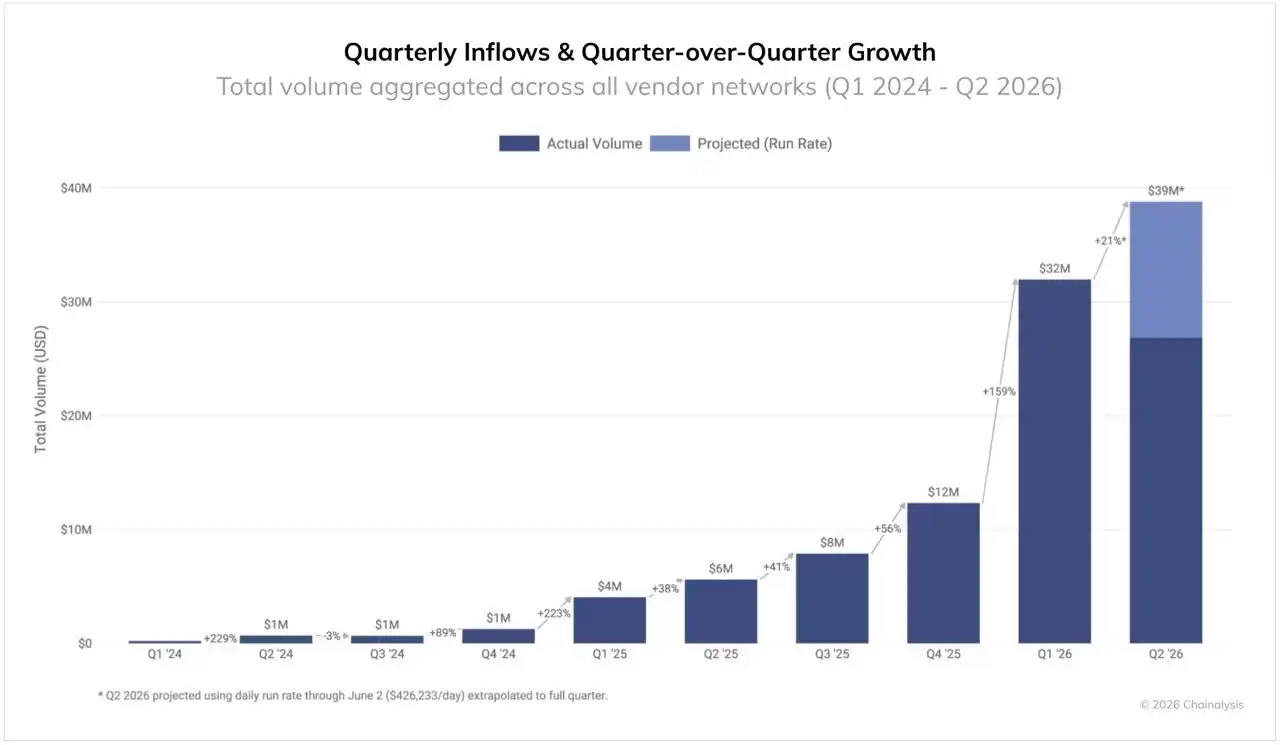
Security firm TRM Labs, using another method—combining on-chain analysis with public information investigations on drug precursor manufacturers—estimated crypto inflows into this sector at $41.4 million in 2025, a 20% year-on-year increase.

Ari Redbord, Global Head of Policy at TRM Labs, believes, "This market is huge and expanding. I'm not sure there's another pharmaceutical market in the world growing as fast as peptides."

This paints a somewhat dramatic scene: regular gym-goers, podcast listeners, middle-aged individuals wanting to lose weight—these demographics are being linked to gray-market buyers.

Despite the growth, industry investors estimate the overall size of the peptide black market to be between $1 billion and $3 billion. The volume using cryptocurrency as a payment method remains very small.

A Bar Adorned with Crypto Memorabilia

The most interesting scene in Bloomberg's report takes place in a corner of a bar in Manhattan—walls covered with crypto memorabilia, over a hundred people crammed into a stuffy room, listening to a lecture on peptides.

The organizer was DeSciNYC, a monthly in-person gathering for science enthusiasts, with the slogan "Science for everyone." Its past themes have included: longevity, CRISPR gene editing, AI & science, microbiome, bioelectricity, tardigrades, cellular metabolism, academic publishing fraud, prediction markets, etc.

This peptide-themed session was called "Peptides 101." The speaker was Julius Ritter, in his twenties, founder of the California Peptide Club, who also runs a longevity-themed meal delivery company and operates a hackathon house in San Francisco. He spent an hour covering peptide chemistry, potential uses, some risks, and several specific products, finally lifting his black T-shirt and injecting himself on the spot, earning a round of applause.

This scene illustrates something more direct than payment data: the connection between crypto and this market is not just a payment channel; it's the same crowd. The DeSci, longevity, biohacking, and fitness self-optimization circles are highly overlapping, with the crypto community being frequent visitors.

Regulation Is Moving, This Use Case Might Disappear

It's worth noting that the US is moving in the direction of "legalization."

The FDA is convening advisory committees to discuss whether to allow the legal domestic production of some popular peptides. US Secretary of Health and Human Services, Robert F. Kennedy Jr., has publicly supported this direction, arguing that legalization "helps shift demand away from the black market." Lee Rosebush, President of the American Peptide Medical Association, which advocates for regulation, used the term "Wild West" to describe the current market state. He believes stricter rules could actually squeeze out "for research only" manufacturers, making it easier for patients to obtain safe medication.

If this path succeeds, crypto payments' position in this market could become awkward—its current share largely occupies the space left by the absence of the traditional payment system.

Zach himself plans to exit. He says he has already reached his target weight.

Criptos en tendencia

Preguntas relacionadas

QAccording to the article, why is a market for unapproved weight-loss peptides using Bitcoin payments emerging in the United States?

AThe market is emerging because these unapproved peptide products, often sold as 'research chemicals,' face significant legal and regulatory risks. As a result, traditional payment networks like banks and credit cards are often unwilling to process transactions for these sellers. Bitcoin provides a workaround, allowing sellers to receive payments from buyers who cannot access these products through approved channels. Additionally, the large price difference compared to buying from domestic 'gray market' sources is a key driver for consumers to learn and use Bitcoin.

QWhat key difference in payment preference is highlighted between large-scale and small-scale buyers in the peptide crypto market?

AAccording to blockchain data cited in the article, stablecoins have surpassed Bitcoin as the preferred payment method for sellers dealing with large-scale transactions where the average order value exceeds $1,000. However, for small-scale retail buyers making smaller purchases, Bitcoin remains the dominant cryptocurrency used for payment.

QWhat does the scene at the DeSciNYC event in a Manhattan bar illustrate about the connection between the crypto community and the peptide market?

AThe scene illustrates that the connection goes beyond just a payment method. It shows that the communities for decentralized science (DeSci), biohacking, longevity, fitness optimization, and cryptocurrency are highly overlapping. The event, focused on peptide education and featuring a live injection demonstration, attracted a crowd in a crypto-themed bar, indicating shared interests and values between these groups.

QBased on the article, what potential regulatory change in the U.S. could threaten the use of cryptocurrencies in the peptide market?

AThe U.S. Food and Drug Administration (FDA) is considering allowing the legal domestic production of some popular peptide compounds. Key figures like Health and Human Services Secretary RFK Jr. support this move to shift demand away from the black market. If successful, this legalization would likely integrate peptide sales into the traditional financial and pharmaceutical systems, reducing the need for cryptocurrency as a workaround payment method and potentially causing its role in this specific market to diminish.

QWhat was the primary motivation for 'Zach', the 49-year-old marketing director, to use Bitcoin for the first time?

AZach's primary motivation was the massive cost savings. He found a Chinese seller offering a one-year supply (20 bottles) of the unapproved weight-loss drug retatrutide for $240 total. In contrast, purchasing a similar supply from U.S.-based secondary sellers would cost him $300 per month, or $3,600 per year. The enormous price disparity made him decide that the risk and effort of learning to use Bitcoin were 'worth taking.'

Lecturas Relacionadas

As Consensus Accelerates, What Are Young Investors Betting On?

Title: As Consensus Forms Faster, What Are Young Investors Betting On? In the rapid evolution of tech investment, a new generation of young investors is navigating a landscape where AI, robotics, commercial aerospace, and quantum computing are advancing simultaneously. Traditional investment logic based on financial models is giving way to a need for deep technical understanding and the ability to act before industry consensus forms. An analysis of trends from the "WAIC FUTURE TECH" list of young investment leaders reveals key shifts in focus. The first major trend is the movement of AI from the digital screen into the physical world. Investment is shifting from large language models and chatbots towards embodied AI, robotics, AI hardware, and edge computing. While demonstrations generate excitement, the real challenge lies in achieving scalable, reliable, and cost-effective delivery in complex real-world environments like factories and logistics. Success depends not just on algorithms but on the integration of sensors, actuators, and control systems. Second, the competitive focus for large models is moving beyond raw capability toward building an "intelligence flywheel." The goal is to create self-reinforcing systems where user interaction generates data, improving the model, which in turn enhances the user experience and attracts more engagement. Companies that successfully embed AI into workflows to create these closed-loop systems can build lasting value that isn't easily erased by the next model upgrade. Third, facing a potential bottleneck in high-quality human-generated data, investors are looking at new underlying technologies. Reinforcement learning and self-play, as demonstrated by AlphaGo Zero, offer paths for AI to generate its own experience. Scientific foundation models, which aim to build general AI capabilities for fields like life sciences and materials discovery, represent a non-consensus direction that could unlock new frontiers of knowledge and data. Finally, in deep-tech areas like quantum computing, commercial aerospace, and space-based infrastructure, patient capital is essential. These fields have long, uncertain development and validation cycles involving complex engineering, supply chains, and regulations. Investment here requires a long-term view, focusing on foundational team capabilities and the eventual emergence of market demand, even if commercial returns are distant. Collectively, these trends illustrate how young investors are adapting to a new era. They are learning to make earlier, technically-informed judgments, balance hype with real-world viability, and provide the patient capital needed to build the deep-tech foundations of the future.

marsbitHace 22 min(s)

As Consensus Accelerates, What Are Young Investors Betting On?

marsbitHace 22 min(s)

Can Japan Buy Growth with AI? Will the Bond Market Believe It?

Japan's cabinet has introduced the 2026 Basic Policy on Economic and Fiscal Management and Reform, shifting its primary fiscal target. The new framework moves away from the traditional annual primary balance goal and instead prioritizes a stable reduction of the debt-to-GDP ratio. This change is tied to a strategy of increased "responsible proactive fiscal" spending, aiming to boost long-term growth through investments in strategic sectors like AI, semiconductors, energy, and robotics. The government estimates total public and private investment in 62 key technologies could exceed 370 trillion yen by 2040. The market reaction has been mixed and cautious. While equity markets may respond to policy signals, bond markets are focused on fiscal credibility. Concerns center on whether the weakening of the clear primary balance anchor could lead to looser fiscal discipline. If investors doubt that these strategic investments will generate sufficient productivity gains, tax revenue, and nominal growth to outpace rising interest costs, they may demand higher yields on Japanese Government Bonds (JGBs). Recent volatility in the yen and JGB yields, with the 10-year yield briefly reaching 2.9%, reflects this skepticism. The success of this new framework hinges on two factors: whether Japan can achieve a nominal growth rate consistently higher than its long-term interest rates, and whether future budgets demonstrate disciplined control over bond issuance. The government's narrative is that strategic investment is essential to break Japan's cycle of low growth, aging, and labor shortages. However, the bond market will continuously assess the credibility of this plan, pricing the risk that it may represent fiscal expansion rather than a viable growth strategy.

marsbitHace 59 min(s)

Can Japan Buy Growth with AI? Will the Bond Market Believe It?

marsbitHace 59 min(s)

Misjudged A-Shares: Resilience, Expectations, and Confidence

China's A-share market recently faced selling pressure, especially in tech sectors, initially triggered by a global tech sell-off that began in South Korea. However, the article argues this is a case of "mistaken injury" and highlights the market's underlying resilience. This resilience stems from three main pillars: **1) Tech Sector Fundamentals:** Unlike Korea's market dominated by a few memory chip stocks, China's tech sector is diversified across computing, communications, electronics, and semiconductors, supported by dual narratives of global AI supply chains and domestic substitution. Core areas like optical modules and fiber optics continue to show strong earnings growth. **2) "National Team" Support:** State-backed institutions and large corporations have made significant market purchases and announced buybacks, providing liquidity and signaling confidence. This is seen as a stabilizing policy signal, often associated with market bottoms. **3) Broader Market Pillars:** Other major sectors are showing endogenous recovery momentum. Consumer stocks benefit from stabilizing CPI and signs of sector recovery (e.g., liquor price hikes). Cyclical sectors like aluminum have high earnings, potential price increases due to tight supply, and low valuations. The financial sector offers stable dividends and low valuations. The conclusion is that the sell-off was driven by external contagion, not a collapse in fundamentals. With strong policy support and recovering momentum across key sectors, the A-share market possesses the toughness to regain stability.

marsbitHace 1 hora(s)

Misjudged A-Shares: Resilience, Expectations, and Confidence

marsbitHace 1 hora(s)

Trading

Spot

Artículos destacados

Qué es BITCOIN

Entendiendo HarryPotterObamaSonic10Inu (ERC-20) y Su Posición en el Espacio Cripto En los últimos años, el mercado de criptomonedas ha sido testigo de un aumento en la popularidad de las monedas meme, capturando el interés no solo de los comerciantes, sino también de aquellos que buscan compromiso comunitario y valor de entretenimiento. Entre estos tokens únicos se encuentra HarryPotterObamaSonic10Inu (ERC-20), un proyecto intrigante que mezcla referencias culturales en el tejido de las criptomonedas. Este artículo profundiza en los aspectos clave de HarryPotterObamaSonic10Inu, explorando sus mecanismos, ethos impulsado por la comunidad y su relación con el paisaje cripto más amplio. ¿Qué es HarryPotterObamaSonic10Inu (ERC-20)? Como su nombre sugiere, HarryPotterObamaSonic10Inu es una moneda meme construida sobre la blockchain de Ethereum, clasificada bajo el estándar ERC-20. A diferencia de las criptomonedas tradicionales que pueden enfatizar la utilidad práctica o el potencial de inversión, este token prospera en el valor de entretenimiento y la fuerza de su comunidad. El proyecto tiene como objetivo fomentar un entorno donde los usuarios comprometidos puedan reunirse, compartir ideas y participar en actividades inspiradas por diversos fenómenos culturales. Una característica notable de HarryPotterObamaSonic10Inu es su cero impuestos en las transacciones. Este atractivo elemento tiene como objetivo incentivar el comercio y la participación comunitaria, sin cargos adicionales que puedan disuadir a los comerciantes de pequeña escala. El suministro total de la moneda está establecido en mil millones de tokens, una cifra que marca su intención de mantener una circulación sustancial dentro de la comunidad. Creador de HarryPotterObamaSonic10Inu (ERC-20) Los orígenes de HarryPotterObamaSonic10Inu están algo envueltos en misterio; los detalles sobre el creador siguen siendo desconocidos. El desarrollo de este token carece de un equipo identificable o de un plan explícito, lo cual no es inusual dentro del sector de monedas meme. En cambio, el proyecto ha surgido de manera orgánica, con su progreso muy dependiente del entusiasmo y la participación de su comunidad. Inversores de HarryPotterObamaSonic10Inu (ERC-20) En cuanto a inversiones externas y respaldo, HarryPotterObamaSonic10Inu también sigue siendo ambiguo. El token no lista ninguna fundación de inversión conocida o apoyo organizacional significativo. En cambio, la savia del proyecto es su comunidad de base, que informa su crecimiento y sostenibilidad a través de la acción colectiva y el compromiso en el espacio cripto. ¿Cómo Funciona HarryPotterObamaSonic10Inu (ERC-20)? Como una moneda meme, HarryPotterObamaSonic10Inu opera principalmente fuera de los marcos tradicionales que a menudo rigen el valor de los activos. Hay varios aspectos distintivos que definen cómo funciona el proyecto: Transacciones Sin Impuestos: Sin tarifas impositivas en las transacciones, los usuarios pueden comprar y vender el token libremente sin preocuparse por costos ocultos. Compromiso Comunitario: El proyecto prospera en la interacción comunitaria, aprovechando plataformas de redes sociales para crear entusiasmo y facilitar la participación. Las discusiones, el intercambio de contenido y el compromiso son elementos cruciales que ayudan a expandir su alcance y fomentar la lealtad entre los seguidores. Sin Utilidad Práctica: Cabe señalar que HarryPotterObamaSonic10Inu no ofrece utilidad concreta dentro del ecosistema financiero. Más bien, se clasifica como un token principalmente para actividades de entretenimiento y comunitarias. Referencia Cultural: El token incorpora astutamente elementos de la cultura popular para atraer interés, conectando con entusiastas de los memes y seguidores de las criptomonedas por igual. HarryPotterObamaSonic10Inu ejemplifica cómo las monedas meme operan de manera diferente a los proyectos de criptomonedas más tradicionales, ingresando al mercado como construcciones sociales innovadoras en lugar de activos utilitarios. Cronología de HarryPotterObamaSonic10Inu (ERC-20) La historia de HarryPotterObamaSonic10Inu está marcada por varios hitos notables: Creación: El token surgió de un meme viral, capturando la imaginación de muchos entusiastas de las criptomonedas. Las fechas específicas de creación no están disponibles, subrayando su ascenso orgánico. Listado en Exchanges: HarryPotterObamaSonic10Inu ha llegado a varios exchanges, permitiendo un acceso y comercio más fácil por parte de la comunidad. Iniciativas de Compromiso Comunitario: Actividades continuas destinadas a mejorar la interacción comunitaria, incluyendo concursos, campañas en redes sociales y generación de contenido por parte de fanáticos y defensores. Planes de Expansión Futuros: La hoja de ruta del proyecto incluye el lanzamiento de una colección de NFT, mercancía y un sitio de comercio electrónico relacionado con sus temas culturales, involucrando aún más a la comunidad e intentando añadir más dimensiones a su ecosistema. Puntos Clave Sobre HarryPotterObamaSonic10Inu (ERC-20) Naturaleza Impulsada por la Comunidad: El proyecto prioriza la participación colectiva y la creatividad, asegurando que la involucración de los usuarios esté a la vanguardia de su desarrollo. Clasificación como Moneda Meme: Representa la epítome de las criptomonedas basadas en el entretenimiento, diferenciándose de los vehículos de inversión tradicionales. Sin Afiliación Directa con Bitcoin: A pesar de la similitud en el nombre del ticker, HarryPotterObamaSonic10Inu es distinto y no tiene relación con Bitcoin u otras criptomonedas establecidas. Enfoque en la Colaboración: HarryPotterObamaSonic10Inu está diseñado para crear un espacio para la colaboración y el intercambio de historias entre sus poseedores, proporcionando una vía para la creatividad y el vínculo comunitario. Perspectivas Futuras: La ambición de expandirse más allá de su premisa inicial hacia NFTs y mercancías describe un camino para que el proyecto potencialmente ingrese a avenidas más tradicionales dentro de la cultura digital. A medida que las monedas meme continúan capturando la imaginación de la comunidad de criptomonedas, HarryPotterObamaSonic10Inu (ERC-20) se destaca debido a sus lazos culturales y su enfoque centrado en la comunidad. Si bien puede no encajar en el molde típico de un token impulsado por la utilidad, su esencia radica en la alegría y la camaradería fomentadas entre sus seguidores, destacando la naturaleza en evolución de las criptomonedas en una era cada vez más digital. A medida que el proyecto continúa desarrollándose, será importante observar cómo las dinámicas comunitarias influyen en su trayectoria en el cambiante paisaje de la tecnología blockchain.

2.0k Vistas totalesPublicado en 2024.04.01Actualizado en 2024.12.03

Qué es BITCOIN

Cómo comprar BTC

¡Bienvenido a HTX.com! Hemos hecho que comprar Bitcoin (BTC) sea simple y conveniente. Sigue nuestra guía paso a paso para iniciar tu viaje de criptos.Paso 1: crea tu cuenta HTXUtiliza tu correo electrónico o número de teléfono para registrarte y obtener una cuenta gratuita en HTX. Experimenta un proceso de registro sin complicaciones y desbloquea todas las funciones.Obtener mi cuentaPaso 2: ve a Comprar cripto y elige tu método de pagoTarjeta de crédito/débito: usa tu Visa o Mastercard para comprar Bitcoin (BTC) al instante.Saldo: utiliza fondos del saldo de tu cuenta HTX para tradear sin problemas.Terceros: hemos agregado métodos de pago populares como Google Pay y Apple Pay para mejorar la comodidad.P2P: tradear directamente con otros usuarios en HTX.Over-the-Counter (OTC): ofrecemos servicios personalizados y tipos de cambio competitivos para los traders.Paso 3: guarda tu Bitcoin (BTC)Después de comprar tu Bitcoin (BTC), guárdalo en tu cuenta HTX. Alternativamente, puedes enviarlo a otro lugar mediante transferencia blockchain o utilizarlo para tradear otras criptomonedas.Paso 4: tradear Bitcoin (BTC)Tradear fácilmente con Bitcoin (BTC) en HTX's mercado spot. Simplemente accede a tu cuenta, selecciona tu par de trading, ejecuta tus trades y monitorea en tiempo real. Ofrecemos una experiencia fácil de usar tanto para principiantes como para traders experimentados.

5.3k Vistas totalesPublicado en 2024.12.12Actualizado en 2026.06.02

Cómo comprar BTC

Qué es $BITCOIN

ORO DIGITAL ($BITCOIN): Un Análisis Integral Introducción al ORO DIGITAL ($BITCOIN) ORO DIGITAL ($BITCOIN) es un proyecto basado en blockchain que opera en la red Solana, cuyo objetivo es combinar las características de los metales preciosos tradicionales con la innovación de las tecnologías descentralizadas. Aunque comparte un nombre con Bitcoin, a menudo referido como “oro digital” debido a su percepción como un refugio de valor, ORO DIGITAL es un token separado diseñado para crear un ecosistema único dentro del paisaje Web3. Su meta es posicionarse como un activo digital alternativo viable, aunque los detalles sobre sus aplicaciones y funcionalidades aún están en desarrollo. ¿Qué es ORO DIGITAL ($BITCOIN)? ORO DIGITAL ($BITCOIN) es un token de criptomoneda diseñado explícitamente para su uso en la blockchain de Solana. A diferencia de Bitcoin, que proporciona un papel de almacenamiento de valor ampliamente reconocido, este token parece centrarse en aplicaciones y características más amplias. Aspectos notables incluyen: Infraestructura Blockchain: El token está construido sobre la blockchain de Solana, conocida por su capacidad para manejar transacciones de alta velocidad y bajo costo. Dinámicas de Suministro: ORO DIGITAL tiene un suministro máximo limitado a 100 cuatrillones de tokens (100P $BITCOIN), aunque los detalles sobre su suministro circulante no se han divulgado actualmente. Utilidad: Si bien las funcionalidades precisas no están delineadas explícitamente, hay indicios de que el token podría ser utilizado para diversas aplicaciones, potencialmente involucrando aplicaciones descentralizadas (dApps) o estrategias de tokenización de activos. ¿Quién es el Creador de ORO DIGITAL ($BITCOIN)? En la actualidad, la identidad de los creadores y el equipo de desarrollo detrás de ORO DIGITAL ($BITCOIN) sigue siendo desconocida. Esta situación es típica entre muchos proyectos innovadores dentro del espacio blockchain, particularmente aquellos alineados con las finanzas descentralizadas y fenómenos de monedas meme. Si bien tal anonimato puede fomentar una cultura impulsada por la comunidad, intensifica las preocupaciones sobre la gobernanza y la responsabilidad. ¿Quiénes son los Inversores de ORO DIGITAL ($BITCOIN)? La información disponible indica que ORO DIGITAL ($BITCOIN) no tiene patrocinadores institucionales conocidos ni inversiones destacadas de capital de riesgo. El proyecto parece operar en un modelo de peer-to-peer centrado en el apoyo y la adopción de la comunidad en lugar de rutas de financiamiento tradicionales. Su actividad y liquidez se sitúan principalmente en intercambios descentralizados (DEX), como PumpSwap, en lugar de plataformas de trading centralizadas establecidas, lo que resalta aún más su enfoque de base. Cómo Funciona ORO DIGITAL ($BITCOIN) Los mecanismos operativos de ORO DIGITAL ($BITCOIN) pueden elaborarse en función de su diseño blockchain y atributos de red: Mecanismo de Consenso: Al aprovechar el único proof-of-history (PoH) de Solana combinado con un modelo de proof-of-stake (PoS), el proyecto asegura una validación de transacciones eficiente que contribuye al alto rendimiento de la red. Tokenómica: Si bien los mecanismos deflacionarios específicos no se han detallado extensamente, el vasto suministro máximo de tokens implica que podría atender microtransacciones o casos de uso nicho que aún están por definirse. Interoperabilidad: Existe el potencial de integración con el ecosistema más amplio de Solana, incluyendo varias plataformas de finanzas descentralizadas (DeFi). Sin embargo, los detalles sobre integraciones específicas permanecen no especificados. Cronología de Eventos Clave Aquí hay una cronología que destaca hitos significativos relacionados con ORO DIGITAL ($BITCOIN): 2023: El despliegue inicial del token ocurre en la blockchain de Solana, marcado por su dirección de contrato. 2024: ORO DIGITAL gana visibilidad al estar disponible para trading en intercambios descentralizados como PumpSwap, permitiendo a los usuarios comerciar contra SOL. 2025: El proyecto presencia actividad de trading esporádica y potencial interés en compromisos liderados por la comunidad, aunque no se han documentado asociaciones notables o avances técnicos hasta el momento. Análisis Crítico Fortalezas Escalabilidad: La infraestructura subyacente de Solana soporta altos volúmenes de transacciones, lo que podría mejorar la utilidad de $BITCOIN en varios escenarios de transacción. Accesibilidad: El potencial bajo precio de trading por token podría atraer a inversores minoristas, facilitando una participación más amplia debido a oportunidades de propiedad fraccionada. Riesgos Falta de Transparencia: La ausencia de patrocinadores, desarrolladores o un proceso de auditoría conocidos públicamente puede generar escepticismo sobre la sostenibilidad y confiabilidad del proyecto. Volatilidad del Mercado: La actividad de trading depende en gran medida del comportamiento especulativo, lo que puede resultar en una volatilidad de precios significativa y en incertidumbre para los inversores. Conclusión ORO DIGITAL ($BITCOIN) surge como un proyecto intrigante pero ambiguo dentro del ecosistema de Solana en rápida evolución. Si bien intenta aprovechar la narrativa del “oro digital”, su alejamiento del papel establecido de Bitcoin como refugio de valor subraya la necesidad de una diferenciación más clara de su utilidad y estructura de gobernanza previstas. La aceptación y adopción futura dependerán probablemente de abordar la actual opacidad y de definir sus estrategias operativas y económicas de manera más explícita. Nota: Este informe abarca información sintetizada disponible hasta octubre de 2023, y pueden haber ocurrido desarrollos más allá del período de investigación.

181 Vistas totalesPublicado en 2025.05.13Actualizado en 2025.05.13

Qué es $BITCOIN

Discusiones

Bienvenido a la comunidad de HTX. Aquí puedes mantenerte informado sobre los últimos desarrollos de la plataforma y acceder a análisis profesionales del mercado. A continuación se presentan las opiniones de los usuarios sobre el precio de BTC (BTC).

活动图片














