Where Are the Sellers? Low Bitcoin Inflows Hint At Holder Conviction Amid Deepest Pullback of 2025

bitcoinistPublished on 2025-12-09Last updated on 2025-12-09

Abstract

Bitcoin is attempting to recover toward $92,000 after a significant 36% pullback, its deepest of 2025. Despite the sharp decline, a CryptoQuant report highlights an unusual trend: cryptocurrency inflows to Binance remain extremely low. Historically, large corrections trigger high exchange inflows as investors rush to sell, indicating fear or capitulation. This time, however, investors are holding rather than offloading assets, showing patience and lack of panic. The current inflow levels are five times lower than during past sell-offs, suggesting strong holder conviction and a resilient market structure. This restraint may signal underlying strength and support a potential bullish recovery once the correction ends.

Bitcoin is attempting to reclaim the $92,000 level as bullish momentum gradually returns after weeks of uncertainty. The market has spent nearly two months in a corrective phase, shedding roughly 36% from its highs, yet signs of stabilization are beginning to emerge. A new CryptoQuant report from analyst Darkfost highlights a striking deviation from typical mid-cycle correction behavior—one that may explain why sentiment is starting to shift.

According to the report, inflows of cryptocurrencies onto Binance remain unusually low, even as Bitcoin has experienced one of its deepest pullbacks of the cycle. Historically, during significant corrections, investors tend to send large amounts of BTC and other assets to exchanges, signaling growing willingness to sell and escalating market fear. This pattern appeared repeatedly in past downturns, often marking periods of capitulation.

But this time, the data suggests something different: investors are not rushing to offload their holdings. Instead, they appear more comfortable holding through volatility, showing patience rather than panic. Such low inflows contrast sharply with prior mid-cycle resets and hint at a more resilient market structure beneath the surface—one where holders may be preparing for the next phase rather than abandoning ship.

A Shift in Inflows Reveals Unusual Investor Behavior

Darkfost notes that today’s data shows a markedly different behavior from what Bitcoin typically displays during major corrections. Instead of focusing on BTC alone, the analysis aggregates total inflows of all cryptocurrencies sent to Binance, offering a broader view of market intent. The logic behind this metric is straightforward: rising inflows signal growing selling pressure, while shrinking inflows indicate that investors prefer to hold rather than exit their positions.
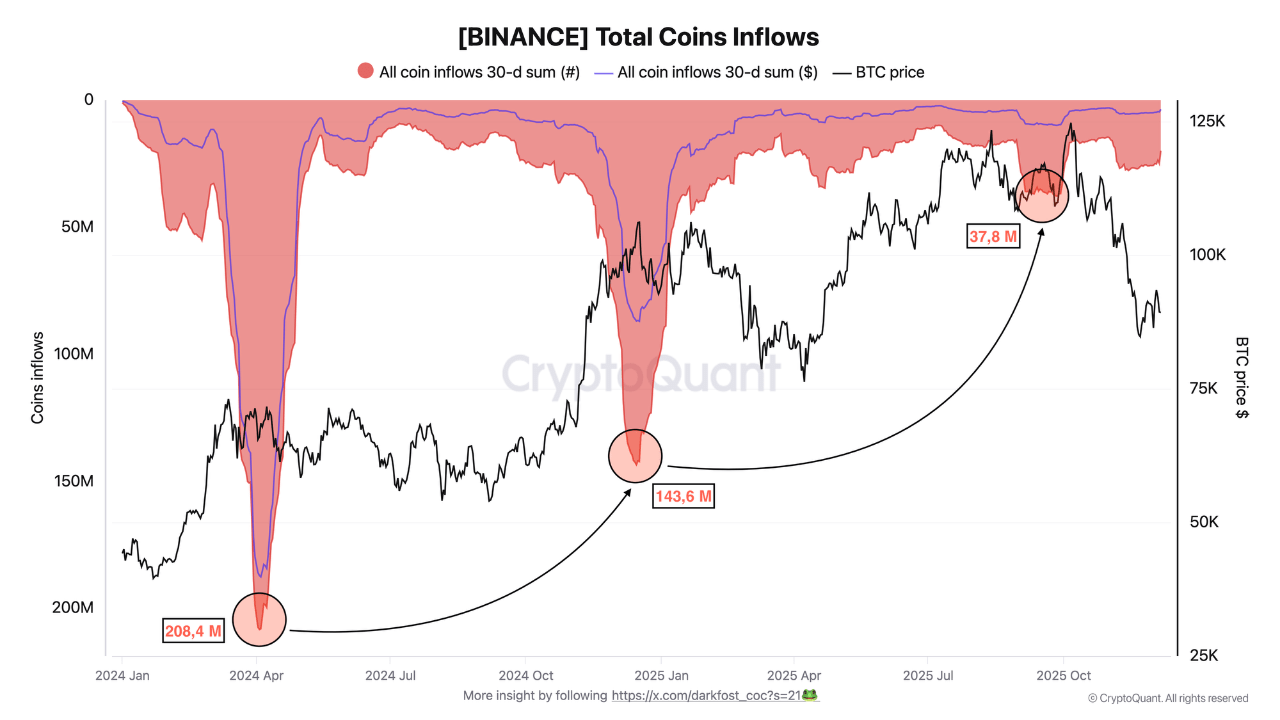
Binance Total Coins Inflows | Source: CryptoQuant

During previous downturns, inflows surged. In April 2024, right after Bitcoin hit a new all-time high at $73,800, total inflows exceeded 200 million coins, reflecting intense selling pressure. A similar spike appeared in December 2024, as BTC broke above $100,000, signaling that investors were preparing to lock in profits.

Today’s environment looks nothing like those periods. Despite experiencing a much deeper correction, inflows are five times lower—and notably stable. Investors are not sending coins to exchanges, which means they’re not eager to sell. Instead, they are sitting through the decline, showing patience rather than panic.

This unusual calm suggests a more confident market structure. If selling pressure continues to fade, this investor restraint could become one of the most constructive signals supporting a future bullish recovery once the correction runs its course.


Related Reads

Farcaster Is Not a Pivot, It's Evolution: The True Ambition from Social to Wallet

Recently, Farcaster co-founder Dan Romero announced a shift in the project’s focus from "social-first" to "wallet-first," sparking widespread discussion. While some interpreted this as Farcaster abandoning social features or even signaling the failure of Web3 social networks, the move is better understood as a strategic evolution rather than a pivot. Farcaster’s integration of a built-in wallet is not a replacement for social functionality but an upgrade to improve user experience. It enables seamless on-chain interactions, especially as Frames evolve into more powerful Mini Apps. This enhancement allows users to mint NFTs, execute trades, and engage with decentralized applications without leaving the app—reducing friction and supporting richer crypto-native experiences. The shift reflects a broader trend: social apps are integrating wallets, and wallet apps are adding social features. This convergence is becoming the natural direction for consumer crypto applications. By combining social graphs with built-in wallets and Mini Apps, Farcaster enables closed-loop scenarios for asset creation, discovery, trading, and community interaction—all within a unified experience. Other platforms like Telegram, Zapper, Base App, and Binance are also exploring similar integrations, highlighting the growing importance of blending social context with financial activity. Farcaster’s open and composable social protocol allows developers to build diverse clients and applications, further expanding its ecosystem. In summary, Farcaster is not moving away from social—it is enhancing it. The integration of wallet functionality aims to drive growth, improve utility, and solidify its unique value proposition in the crypto space.

marsbitHace 4 min(s)

Farcaster Is Not a Pivot, It's Evolution: The True Ambition from Social to Wallet

marsbitHace 4 min(s)

Central Bank Names Bitcoin the Most Loss-Making Asset in November When Invested in Rubles

The Central Bank of Russia, in its latest "Financial Market Risks Review," identified Bitcoin as the worst-performing asset in November for ruble-denominated investments. The regulator included Bitcoin in its comparative table of asset returns, as it has done routinely. The list includes instruments from the Russian market, as well as gold, US government bonds, and other assets. In contrast to previous months, Russian stocks demonstrated the highest total returns in November. Although Bitcoin reached a new all-time high exceeding $126,000 on October 6th, this peak was not achieved against several currencies, including the euro, Swiss franc, and the Russian ruble. Against the ruble, the price remained below its December 2024 peak. According to the regulator's calculations, Bitcoin showed the worst returns in ruble terms for November (-19.9%), since the start of 2025 (-25.7%), and over the past 12 months (-31.9%). Notably, in reports prior to and including September 2025, Bitcoin was consistently among the top performers. However, since the beginning of 2022, Bitcoin remains the second-best performing asset after gold, having gained over 100% and significantly outperforming other assets. The report also provided data on Russian crypto investment activity. The volume of open positions held by individuals in cryptocurrency futures on the Moscow Exchange reached 3.5 billion rubles by the end of November. The majority of investors hold small positions, but the largest share of the volume comes from major participants. Additionally, thousands of investors have allocated funds to crypto CFAs and copy-trading strategies linked to crypto assets. Over 500 people participate in OTC crypto derivatives. The report also noted an 18% decline in the volume of transactions by Russians on foreign crypto exchanges in Q2 and Q3 2025 compared to the previous two quarters, alongside a decrease in estimated ruble balances on crypto exchanges and traffic to crypto platforms from Russia.

RBK-cryptoHace 28 min(s)

Central Bank Names Bitcoin the Most Loss-Making Asset in November When Invested in Rubles

RBK-cryptoHace 28 min(s)

Trading

Spot
Futures
活动图片