Strategy Takes a Hard Line Against MSCI: The Ultimate Defense of DAT

深潮Publicado a 2025-12-11Actualizado a 2025-12-11

Resumen

In a significant industry clash, digital asset treasury company Strategy has issued a forceful 12-page public letter to MSCI opposing its proposal to exclude companies with over 50% digital asset holdings from its global investable market indices. Strategy argues the move is discriminatory, misleading, and threatens billions in capital flow, potentially causing up to $2.8 billion in passive outflows from its stock alone. The company defends its business model, asserting that digital asset treasuries (DATs) are operational companies—not passive funds—with active strategies like issuing digital debt instruments to fund Bitcoin acquisitions and generate shareholder returns. It compares its role to historic infrastructure builders like Standard Oil and AT&T, emphasizing Bitcoin’s transformative potential in finance. Strategy highlights four key objections: the proposal is arbitrarily discriminatory against digital assets; it violates index providers' neutrality principles; it is impractical due to Bitcoin's volatility and accounting disparities; and it contradicts the U.S. government’s pro-digital asset strategy. The firm demands MSCI withdraw the proposal or extend consultations. Backed by industry advocates and data showing over 200 public companies hold more than 5% of Bitcoin’s supply, Strategy urges MSCI to let markets—not biased rules—determine the value of digital asset companies. The decision, expected by January 2026, could redefine the role of crypto-native firms in ...

Author: KarenZ, Foresight News

The博弈 concerning the development of the Digital Asset Treasury (DAT) industry continues to intensify.

In October, global index provider MSCI put forward a proposal to exclude companies with digital asset holdings accounting for 50% or more of their total assets from its Global Investable Market Indexes. This move directly threatens the market position of companies like Strategy, representative of digital asset treasury companies, and could potentially redirect capital flows for the entire DAT sector.

According to statistics from Bitcoin for Corporations, 39 companies risk exclusion from the MSCI Global Investable Market Indexes. J.P. Morgan analysts previously warned that the exclusion of Strategy alone could lead to nearly $2.8 billion in passive fund outflows. If other index providers follow suit with similar rules, outflows could reach as high as $8.8 billion.
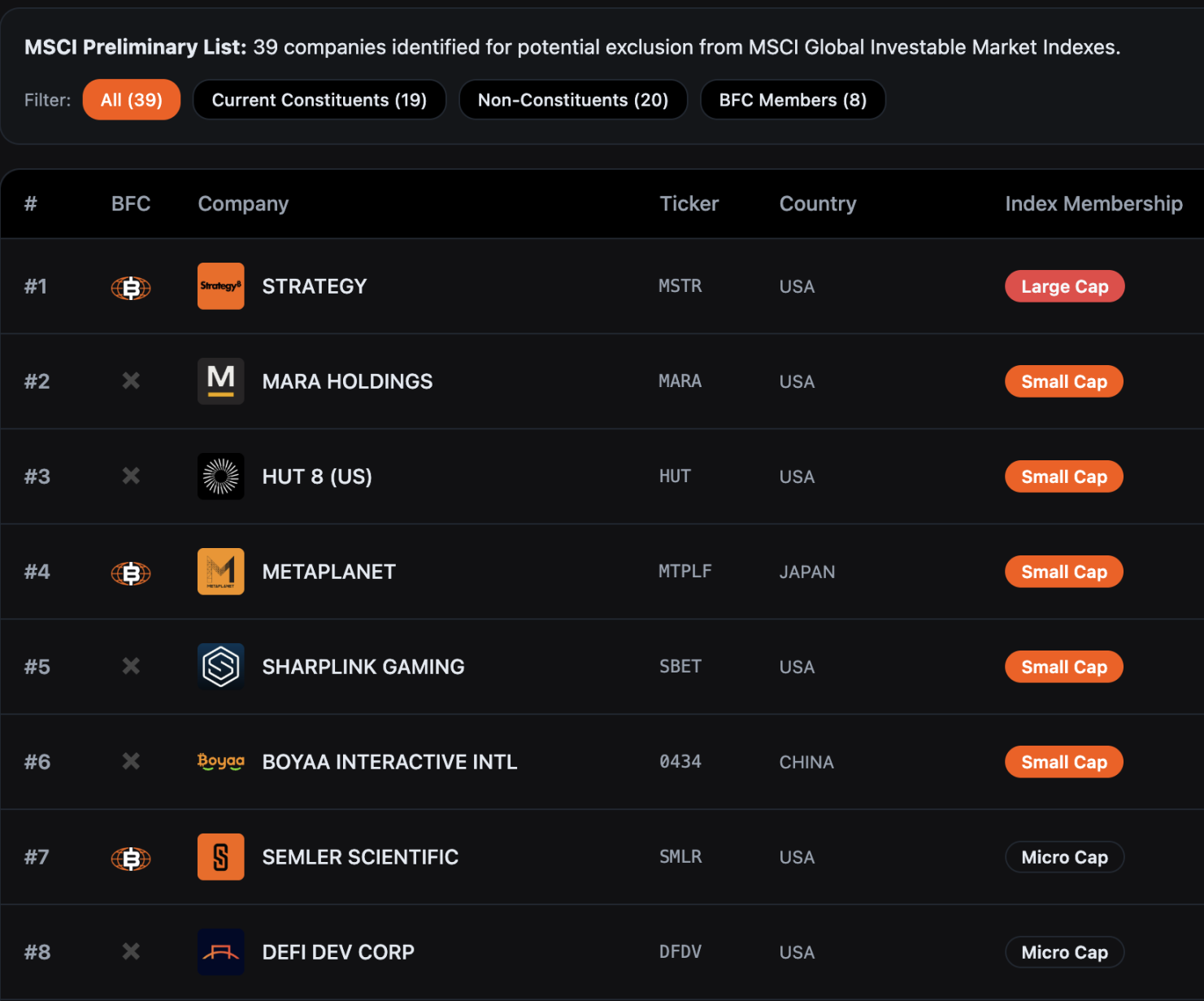
The consultation period for this MSCI proposal is currently open until December 31, 2025, with a final conclusion expected by January 15, 2026. Any adjustments would be formally implemented during the February 2026 index review.

Faced with this urgent situation, Strategy submitted a strongly worded 12-page public letter to the MSCI Equity Index Committee on December 10th. Signed jointly by Executive Chairman and Founder Michael Saylor and President & CEO Phong Le, the letter clearly expressed firm opposition to the proposal. It stated unequivocally: "This proposal is seriously misleading and will have far-reaching destructive consequences for the interests of global investors and the development of the digital asset industry. We strongly urge MSCI to completely withdraw this plan."

Strategy's Four Core Arguments

Digital Assets Are a Revolutionary Foundational Technology Reshaping the Financial System

Strategy believes MSCI's proposal underestimates the strategic value of Bitcoin and other digital assets. Since Satoshi Nakamoto introduced Bitcoin 16 years ago, this digital asset has gradually grown into a key component of the global economy, with a current total market value of approximately $1.85 trillion.

In Strategy's view, digital assets are far more than simple financial instruments; they represent a fundamental technological innovation capable of reshaping the global financial system — companies investing in Bitcoin-related infrastructure are building a new financial ecosystem, much like leading companies that deeply invested in single emerging technologies throughout history.

Just as Standard Oil focused on oil well extraction in the 19th century and AT&T全力 built telephone networks in the 20th century, these companies laid a solid foundation for subsequent economic transformations through前瞻性 investment in core infrastructure, ultimately becoming industry benchmarks. Strategy argues that companies focusing on digital assets today are following this path of "technology pioneers" and should not be simply dismissed by traditional index rules.

DATs Are Operating Companies, Not Passive Funds

This is the core of Strategy's argument — Digital Asset Treasury companies (DATs) are operating companies with complete business models, not merely investment funds passively holding Bitcoin. Although Strategy currently holds over 600,000 Bitcoin, its core value does not rely solely on Bitcoin's price fluctuations. Instead, it creates sustainable returns for shareholders by designing and offering unique "digital credit" instruments.

Specifically, Strategy issues "digital credit" instruments including various types of preferred stock with fixed dividend rates, floating dividend rates, different priority levels, and credit protection terms. It uses the funds raised from selling these instruments to acquire more Bitcoin. As long as the long-term investment return on Bitcoin exceeds Strategy's USD-denominated financing costs, it can generate stable returns for shareholders and clients. Strategy emphasizes that this model of "active operation + asset appreciation" is fundamentally different from the passive management logic of traditional investment funds or ETFs and should be regarded as a normal operating company.

Furthermore, Strategy questions in the letter: Why can oil giants, Real Estate Investment Trusts (REITs), timber companies, etc., concentrate holdings in a single asset class without being classified as investment funds and excluded from indexes? Imposing special restrictions only on digital asset companies clearly violates the principle of industry equity.

The 50% Digital Asset Threshold is Arbitrary, Discriminatory, and Impractical

Strategy points out that MSCI's proposal employs discriminatory standards. Many large companies in traditional industries also hold a highly concentrated single asset class in their portfolios, including oil and gas companies, REITs, timber companies, and power infrastructure firms. Yet, MSCI has set special exclusion criteria only for digital asset companies, constituting obvious unfair treatment.

From an implementation feasibility perspective, the proposal also has serious issues. Due to the high volatility of digital asset prices, the same company could frequently enter and exit MSCI indexes within days due to changes in asset value, causing market chaos. Additionally, differences between accounting standards (the treatment of digital assets differs under US GAAP and international IFRS standards) will lead to differential treatment for companies with the same business model based on their jurisdiction of incorporation.

Violates Index Neutrality Principle, Introduces Policy Bias

Strategy argues that MSCI's proposal is essentially a value judgment on a certain asset class, violating the fundamental principle that index providers should remain neutral. MSCI claims to markets and regulators that its indexes provide "exhaustive" coverage, aiming to reflect the "evolution of the underlying equity market," and should not "make judgments about the goodness or appropriateness of any market, company, strategy, or investment."

By selectively excluding digital asset companies, MSCI is effectively making a policy judgment on behalf of the market, which is precisely what index providers should avoid.

Contradicts US Digital Asset Strategy

Strategy specifically emphasizes that this proposal conflicts with the strategic goals of the Trump administration to advance US leadership in digital assets. The Trump administration signed an executive order in its first week to promote growth in digital financial technology and established a strategic Bitcoin reserve, aiming to make the US the global leader in digital assets.

However, if MSCI's proposal is implemented, it would directly prevent long-term US capital, such as pension funds and 401(k) plans, from investing in digital asset companies, leading to tens of billions of dollars flowing out of the sector. This would not only hinder the development of US digital asset innovation companies but could also weaken US competitiveness in this strategic field, running counter to the government's stated policy direction.

Citing analyst estimates, Strategy states that it alone could face up to $2.8 billion in passive stock liquidation due to MSCI's proposal. This harms not only Strategy itself but will also have a chilling effect on the entire digital asset ecosystem. For example, it might force Bitcoin mining companies to sell assets prematurely to adjust their asset structure, thereby distorting the normal supply and demand dynamics of the digital asset market.

Strategy's Ultimate Demands

Strategy puts forward two main demands in its public letter:

First, it hopes MSCI will completely withdraw the exclusion proposal, allowing the market to test the value of Digital Asset Treasury companies (DATs) through free competition, enabling indexes to neutrally and faithfully reflect the development trends of next-generation financial technology.

Second, if MSCI still insists on "special treatment" for digital asset companies, it must expand the scope of industry consultation, extend the consultation period, and provide more substantial logical support to explain the rationality of the rules.

Strategy Is Not Fighting Alone

Strategy is not fighting alone. According to data from BitcoinTreasuries.NET, as of December 11th, 208 publicly listed companies globally hold over 1.07 million Bitcoin, exceeding 5% of Bitcoin's total supply, currently worth approximately $100 billion.
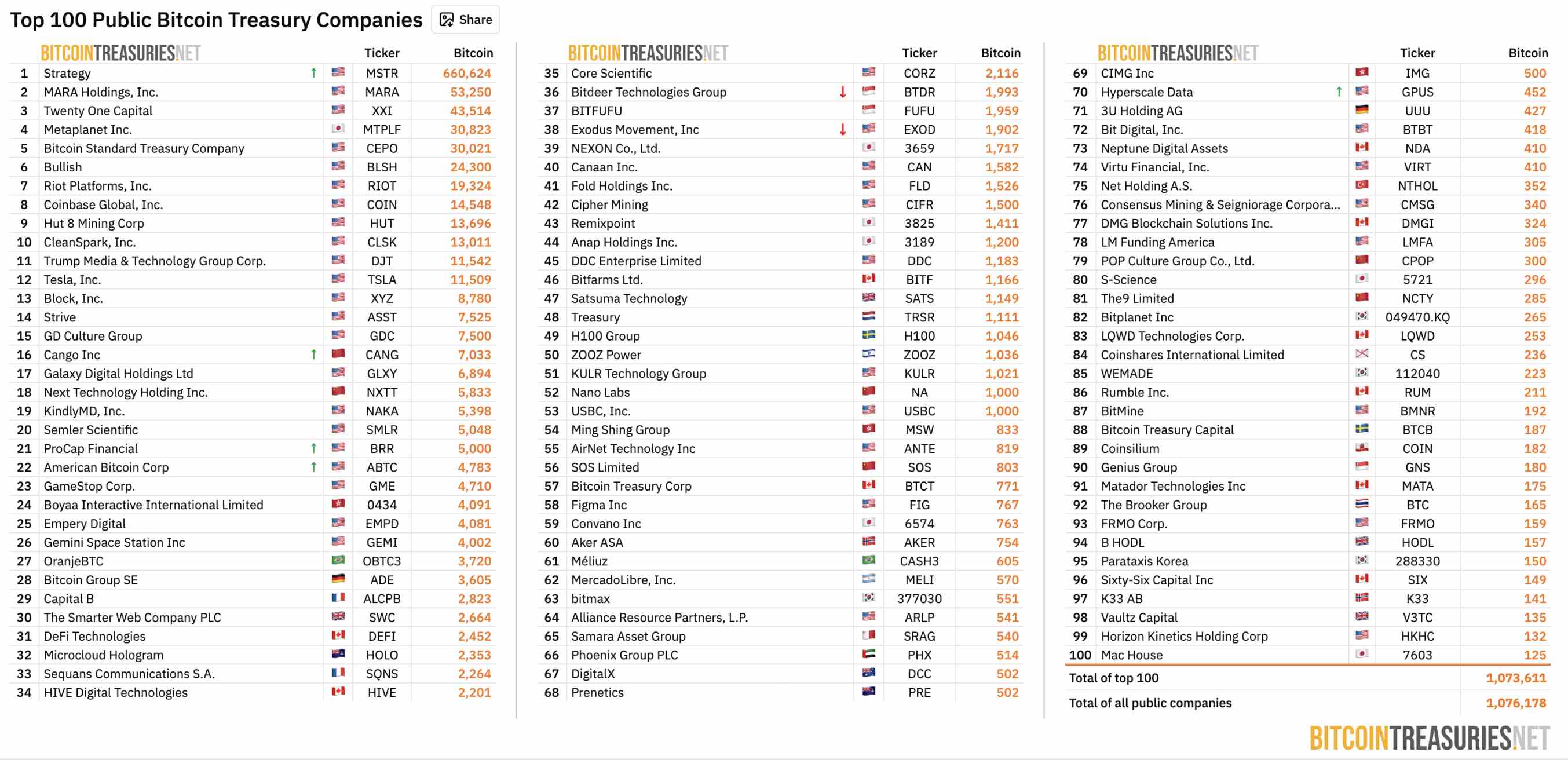
Source: BitcoinTreasuries.NET

These digital asset treasury companies have become important bridge for institutional adoption of cryptocurrency, providing compliant indirect exposure for traditional financial institutions like pension funds and endowments.

Previously, Strive, a Bitcoin-holding public company, suggested that MSCI should leave the "choice" regarding digital asset companies to the market. A simple and direct solution would be to create "ex-Digital Asset Treasury" versions of existing indexes, such as the MSCI USA ex Digital Asset Treasuries Index and the MSCI ACWI ex Digital Asset Treasuries Index. A transparent screening mechanism would allow investors to choose their tracking benchmark independently, preserving index integrity while meeting the needs of different investors.

Additionally, the industry organization Bitcoin for Corporations has initiated a joint petition calling on MSCI to withdraw the digital asset proposal. It advocates that classification should be based on a company's actual business model, financial performance, and operational characteristics, rather than simply drawing a line based on asset percentage. According to the organization's website, 309 companies or investors have currently signed the joint letter. Signatories, besides Strategy, include executives from industry-known firms like Strive, BitGo, Redwood Digital Group, 21MIL, Btc inc, DeFi Development Corp, as well as numerous individual developers and investors.

Summary

The standoff between Strategy and MSCI is essentially a fundamental debate about "how emerging financial innovations integrate into the traditional system." Digital Asset Treasury companies (DATs), as "cross-border" entities between traditional finance and the cryptocurrency world, are neither pure technology companies nor simple investment funds, but represent a new business model built upon digital assets.

MSCI's proposal attempts to use a "50% asset threshold" to classify these complex entities as "investment funds" and exclude them from indexes; Strategy insists that this simplified treatment is a serious misunderstanding of their business essence and a departure from the principle of index neutrality. As the January 15, 2026 decision date approaches, the outcome of this博弈 will not only determine the index "eligibility" of several Bitcoin-holding public companies but will also delineate a critical "survival boundary" for the future position of the digital asset industry within the global traditional financial system.


Preguntas relacionadas

QWhat is the core argument that Strategy uses to defend its classification as an operational company rather than a passive fund?

AStrategy argues that it is an operational company with a complete business model, not a passive investment fund. Its core value is not derived from Bitcoin's price fluctuations but from creating sustainable returns for shareholders through its unique 'digital credit' instruments, such as preferred shares with fixed or floating dividend rates, which it sells to raise capital for acquiring more Bitcoin. This active operational model is fundamentally different from the passive management of ETFs or funds.

QWhat potential financial impact does Strategy claim the MSCI proposal could have on it and the broader digital asset market?

AStrategy, citing analyst estimates, claims that its exclusion from the MSCI index alone could trigger nearly $2.8 billion in passive fund outflows. If other index providers adopt similar rules, the outflows could reach as high as $8.8 billion. This would not only harm Strategy but also create a chilling effect on the entire digital asset ecosystem, potentially forcing companies like Bitcoin miners to sell assets prematurely and distorting market supply and demand.

QHow does Strategy's public letter justify the strategic value of Bitcoin and digital assets?

AStrategy's letter argues that Bitcoin and digital assets represent a revolutionary foundational technology reshaping the financial system, not merely financial instruments. It compares companies investing in Bitcoin infrastructure to historical pioneers like Standard Oil and AT&T, which made foundational investments in oil and telephone networks. These companies laid the groundwork for economic transformation and became industry benchmarks, a path Strategy believes digital asset companies are now following.

QWhat alternative solution does the industry group Bitcoin for Corporations suggest to MSCI's proposal?

AThe industry group Bitcoin for Corporations, along with companies like Strive, suggests that MSCI should create new versions of its existing indices that explicitly exclude Digital Asset Treasury companies, such as 'MSCI USA ex Digital Asset Treasuries' and 'MSCI ACWI ex Digital Asset Treasuries'. This would give investors the transparent choice of which benchmark to follow, preserving the integrity of the main indices while catering to different investor preferences.

QWhat is Strategy's ultimate request to MSCI regarding the proposed rule change?

AStrategy's primary request is for MSCI to completely withdraw the proposal to exclude companies based on their digital asset holdings. It argues the market should freely compete to validate the value of Digital Asset Treasury companies (DATs) and that the index should neutrally reflect the evolution of next-generation fintech. If MSCI insists on special treatment for these companies, Strategy demands a broader industry consultation, an extended consultation period, and a more robust logical justification for the rule.

Lecturas Relacionadas

Deconstructing Anthropic: The Best AI Company Might Also Be an 'Organizational Invention'

Anthropic has emerged as one of the most compelling and fastest-growing AI companies. Its core strengths lie in strategic focus and unique organizational culture. Strategically, Anthropic concentrated early on coding as the critical path to AGI and commercial success, a focus driven by resource constraints and validated by market results. This contrasts with OpenAI's more expansive, multi-pronged approach. Co-founder Dario Amodei's technical conviction and low FOMO personality fostered this decisive focus. Organizationally, Anthropic has cultivated a distinctive culture characterized by: 1. **Deep Mission-Orientation:** A genuine, almost religious commitment to AI safety as the primary goal, even above corporate success. 2. **High Trust, Low Ego:** An environment where brilliant researchers collaborate effectively without internal politics or status battles. 3. **Strong Humanistic Values:** A bookish, idealistic ethos reflected in its hiring and model naming. This culture is maintained through rigorous cultural screening in hiring, extreme transparency and context-sharing from leadership (like Dario's frequent all-hands), a unique seven-cofounder equal-equity structure that disperses cultural influence, and a "one team" philosophy that minimizes silos. The culture stems partly from business necessity—excelling at the "dirty work" of data engineering for coding/agentic AI—and partly from Dario's negative experiences with political infighting at previous companies, motivating him to build Anthropic as an antithesis. While OpenAI remains a formidable competitor with greater resources and exploratory zeal, Anthropic demonstrates that success in the AI era can also come from focused bets, cohesive culture, and a steadfast mission, offering a distinct model of organizational invention.

marsbitHace 10 min(s)

Deconstructing Anthropic: The Best AI Company Might Also Be an 'Organizational Invention'

marsbitHace 10 min(s)

Moutai Moment: When Liquidity Dries Up, Everyone Huddles Around HYPE and ZEC

In May 2026, a notable sentiment shift is occurring in the crypto market, symbolized by prominent Ethereum advocate David Hoffman selling his remaining ETH. While major assets like ETH and SOL struggle—ETH is down over 50% from its 2025 high—two assets, HYPE and ZEC, are rallying strongly. This divergence mirrors the "core asset crowding" phenomenon seen in traditional markets during liquidity crunches, where capital concentrates in few perceived safe havens. The market faces liquidity pressure, partly due to Bitcoin ETF outflows and stalled narratives for major Layer 1s. In contrast, Hyperliquid (HYPE) attracts capital due to its strong fundamentals as a leading decentralized perp exchange with substantial protocol revenue and a share of USDC reserve yields. Its tokenomics, heavily favoring users, add to its appeal. Meanwhile, Zcash (ZEC) surges as a "privacy beta" play, driven by growing fears over AI-driven deanonymization and quantum computing threats. Endorsements from figures like Arthur Hayes and Multicoin Capital's Tushar Jain, alongside regulatory clarity and ETF expectations, fuel its rise. This crowding poses risks. Similar to the A股白酒 rally that ended when liquidity returned, the current crypto crowding could unravel if macro conditions improve or if positions become too concentrated, leading to a sharp correction. The article concludes by questioning whether investors hold assets out of conviction or inertia and prompts consideration of what the next crowded trade might be.

marsbitHace 44 min(s)

Moutai Moment: When Liquidity Dries Up, Everyone Huddles Around HYPE and ZEC

marsbitHace 44 min(s)

Trading

Spot
Futuros

Artículos destacados

Cómo comprar HPP

¡Bienvenido a HTX.com! Hemos hecho que comprar House Party Protocol (HPP) sea simple y conveniente. Sigue nuestra guía paso a paso para iniciar tu viaje de criptos.Paso 1: crea tu cuenta HTXUtiliza tu correo electrónico o número de teléfono para registrarte y obtener una cuenta gratuita en HTX. Experimenta un proceso de registro sin complicaciones y desbloquea todas las funciones.Obtener mi cuentaPaso 2: ve a Comprar cripto y elige tu método de pagoTarjeta de crédito/débito: usa tu Visa o Mastercard para comprar House Party Protocol (HPP) al instante.Saldo: utiliza fondos del saldo de tu cuenta HTX para tradear sin problemas.Terceros: hemos agregado métodos de pago populares como Google Pay y Apple Pay para mejorar la comodidad.P2P: tradear directamente con otros usuarios en HTX.Over-the-Counter (OTC): ofrecemos servicios personalizados y tipos de cambio competitivos para los traders.Paso 3: guarda tu House Party Protocol (HPP)Después de comprar tu House Party Protocol (HPP), guárdalo en tu cuenta HTX. Alternativamente, puedes enviarlo a otro lugar mediante transferencia blockchain o utilizarlo para tradear otras criptomonedas.Paso 4: tradear House Party Protocol (HPP)Tradear fácilmente con House Party Protocol (HPP) en HTX's mercado spot. Simplemente accede a tu cuenta, selecciona tu par de trading, ejecuta tus trades y monitorea en tiempo real. Ofrecemos una experiencia fácil de usar tanto para principiantes como para traders experimentados.

142 Vistas totalesPublicado en 2026.04.29Actualizado en 2026.04.29

Cómo comprar HPP

Qué es GENIUS

I. Introducción al Proyecto1. ¿Qué es Genius?Genius (GENIUS) se posiciona como el “terminal en cadena definitivo”, una plataforma de trading descentralizada enfocada en la privacidad y la velocidad. Al integrar tecnología de privacidad de primer nivel, busca construir una infraestructura de trading privado de próxima generación en redes como BNB Chain, permitiendo a los usuarios interactuar en cadena con una experiencia fluida comparable a los intercambios centralizados.2. ¿Cómo Funciona Genius?La arquitectura técnica central de Genius está estructurada de la siguiente manera:(1) Invisible en la cadena: Los usuarios no necesitan manejar manualmente aprobaciones de múltiples pasos para operaciones entre cadenas, envoltura de activos o gestión compleja de gas.(2) Trading sin firma: A través de integraciones como Turnkey, Genius permite el trading instantáneo sin confirmaciones emergentes o autorización por transacción.(3) Agregador de Agregadores: Genius está impulsado por una pila de agregación de clase mundial integrada con más de 150 DEXs, reclamando una eficiencia de cotización superior en comparación con productos competidores.(4) Gestión de Cuentas: La plataforma adopta una arquitectura no custodial y aprovecha Turnkey y Lit Protocol para la gestión de claves, permitiendo a los usuarios acceder de manera segura a sus cuentas a través de claves de acceso.3. ¿Quién Creó Genius?Según sus Términos de Servicio oficiales, Genius fue desarrollado por Shuttle Labs, Inc. Basado en la cuenta oficial de X del proyecto, Ryan Myher es uno de los contribuyentes clave que impulsa la iteración del producto, incluyendo desarrollos como el lanzamiento del protocolo Ghost, así como un mayor compromiso con la comunidad.El fundador de Binance, CZ, se ha unido oficialmente al proyecto como asesor, con el objetivo de ayudar al equipo a construir una experiencia de trading en cadena más rápida y que preserve la privacidad.Además, el proyecto ha recibido un fuerte respaldo de YZi Labs, que ha invertido en Genius y trabaja junto a la Fundación Genius, responsable de mantener el Protocolo Genius Bridge (GBP).4. Tokenómica de GeniusGENIUS es el token nativo del ecosistema Genius. Hasta ahora, el proyecto no ha publicado un documento completo de tokenómica.Según las últimas divulgaciones oficiales, Genius incorpora un mecanismo deflacionario, y el 4.6% del suministro total de tokens ya había sido quemado durante la fase de lanzamiento inicial.Sistema de Puntos Genius (GP):(1) Comercio para Ganar: La plataforma ha establecido un fondo de recompensas de 200 millones de Puntos Genius, y los usuarios ganan GP por cada comercio ejecutado a través del terminal.(2) Clasificación y Insignias: Genius cuenta con un sistema de insignias basado en progresión que va desde Inteligente hasta Dios, con niveles más altos desbloqueando beneficios y ventajas adicionales.(3) Rendimiento Nativo: Los usuarios que posean activos designados como usdGG en el panel pueden ganar rendimiento nativo directamente sin pasar por un staking complejo.(4) Incentivos por Referidos: Los referidores pueden ganar reembolsos de tarifas de más del 45% pagados en USDC, junto con GP adicionales.5. Cronograma & Hitos ClaveMarzo 2020: Se creó la cuenta oficial de X del proyecto, marcando el inicio de su fase de preparación temprana.13 de enero de 2026: Genius anunció una inversión de varios millones de dólares de YZi Labs y simultáneamente confirmó a CZ como asesor para acelerar la construcción de su infraestructura de trading privado.18 de abril de 2026: El proyecto anunció que el protocolo de privacidad Ghost se lanzaría pronto.29 de abril de 2026: El protocolo Ghost se abrió oficialmente a sus primeros 50 testers, marcando el comienzo de una nueva era para el trading privado en BNB Chain. Al mismo tiempo, el equipo confirmó que el 4.6% de los tokens han sido quemados.​II. Información del Token1) Información BásicaNombre del token: GENIUS (Genius)III. Enlaces RelacionadosSitio web:https://www.tradegenius.com/homeExploradores:https://bscscan.com/address/0x1f12b85aac097e43aa1555b2881e98a51090e9a6Redes Sociales:https://x.com/GeniusTerminalNota: La introducción del proyecto proviene de los materiales publicados o proporcionados por el equipo oficial del proyecto, que es solo para referencia y no constituye asesoramiento de inversión. HTX no se hace responsable de ninguna pérdida directa o indirecta resultante.

249 Vistas totalesPublicado en 2026.04.29Actualizado en 2026.05.12

Qué es GENIUS

Cómo comprar GENIUS

¡Bienvenido a HTX.com! Hemos hecho que comprar Genius (GENIUS) sea simple y conveniente. Sigue nuestra guía paso a paso para iniciar tu viaje de criptos.Paso 1: crea tu cuenta HTXUtiliza tu correo electrónico o número de teléfono para registrarte y obtener una cuenta gratuita en HTX. Experimenta un proceso de registro sin complicaciones y desbloquea todas las funciones.Obtener mi cuentaPaso 2: ve a Comprar cripto y elige tu método de pagoTarjeta de crédito/débito: usa tu Visa o Mastercard para comprar Genius (GENIUS) al instante.Saldo: utiliza fondos del saldo de tu cuenta HTX para tradear sin problemas.Terceros: hemos agregado métodos de pago populares como Google Pay y Apple Pay para mejorar la comodidad.P2P: tradear directamente con otros usuarios en HTX.Over-the-Counter (OTC): ofrecemos servicios personalizados y tipos de cambio competitivos para los traders.Paso 3: guarda tu Genius (GENIUS)Después de comprar tu Genius (GENIUS), guárdalo en tu cuenta HTX. Alternativamente, puedes enviarlo a otro lugar mediante transferencia blockchain o utilizarlo para tradear otras criptomonedas.Paso 4: tradear Genius (GENIUS)Tradear fácilmente con Genius (GENIUS) en HTX's mercado spot. Simplemente accede a tu cuenta, selecciona tu par de trading, ejecuta tus trades y monitorea en tiempo real. Ofrecemos una experiencia fácil de usar tanto para principiantes como para traders experimentados.

181 Vistas totalesPublicado en 2026.04.29Actualizado en 2026.05.12

Cómo comprar GENIUS

Discusiones

Bienvenido a la comunidad de HTX. Aquí puedes mantenerte informado sobre los últimos desarrollos de la plataforma y acceder a análisis profesionales del mercado. A continuación se presentan las opiniones de los usuarios sobre el precio de A (A).

活动图片