When Bitcoin Miners Take to Space

marsbitPublicado a 2026-04-01Actualizado a 2026-04-01

Resumen

SpaceX is reportedly preparing for a historic IPO with a target of $1.75 trillion, while simultaneously advancing plans to deploy AI data centers in orbit, leveraging space’s vacuum for cooling and solar energy for power. This has sparked interest in whether Bitcoin mining—also energy-intensive and dependent on computing hardware—could also move to space. The core idea involves placing mining ASICs on the back of solar panels in orbit, using abundant solar energy to power mining operations. Heat dissipation in vacuum, a key challenge, is manageable through thermal radiation, and communication with mining pools is feasible with low latency via low Earth orbit satellites. However, the economics remain prohibitive. Launch costs, currently around $2,720 per kilogram via Falcon 9, make mining payloads financially unviable. Estimates suggest that with current technology, the payback period would exceed 100 years. SpaceX’s Starship may eventually reduce launch costs below $200/kg, making space mining more feasible. Companies like Starcloud—backed by NVIDIA and top VCs—are already testing orbit-based computing, including AI and planned Bitcoin mining experiments. Others, like SpaceChain and Cryptosat, focus on secure blockchain nodes and cryptographic services in space rather than mining. While orbital mining is not yet economically competitive with terrestrial operations, it represents a long-term vision for radically reducing energy costs and expanding the infrastructure of dec...

According to multiple media reports, Musk's space exploration company SpaceX will soon submit an IPO prospectus to the U.S. Securities and Exchange Commission (SEC), targeting a valuation of $1.75 trillion and an expected financing scale exceeding $75 billion. If successful, this would be the largest IPO in human history, far surpassing the record of $29.4 billion set by Saudi Aramco in 2019, and it will also be the most watched IPO this year.

Interestingly, in February 2026, SpaceX suddenly acquired xAI, another AI company under Musk, and incorporated the "Orbital Data Center" into its core strategy: utilizing the vacuum of space for heat dissipation and continuous solar power supply to send AI computing power into low Earth orbit. Musk believes that, in the long run, space-based AI is the only way to achieve scalable development.

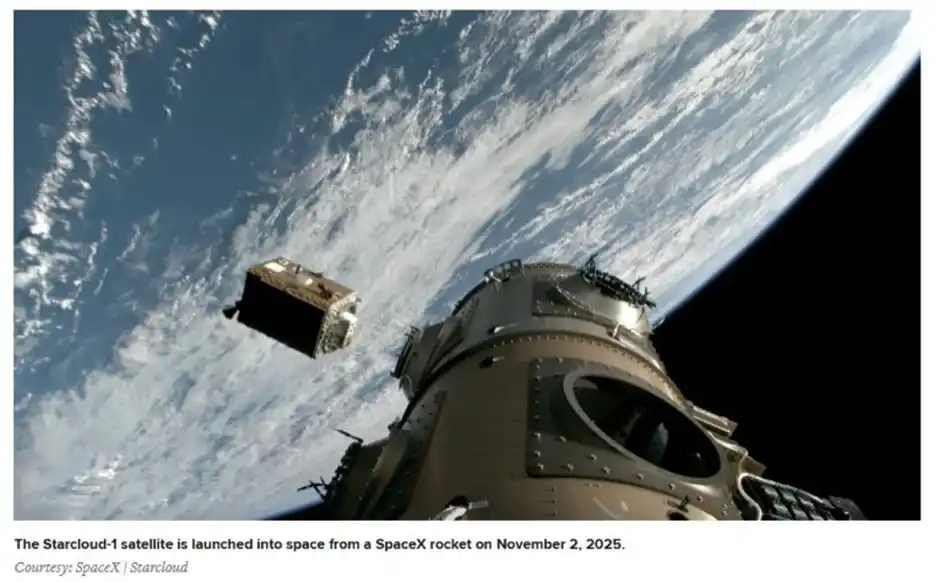
At the same time, NVIDIA is also actively exploring this direction. It has invested in the orbital data center startup Starcloud, which successfully sent an NVIDIA H100 GPU into orbit in November 2025, completing the first-ever training and inference of an AI large language model in space.
As SpaceX sends AI computing power into space, many are also beginning to wonder: since Bitcoin mining also relies on computing chips and can utilize solar power, could it also be moved to space? However, this issue is far more complex than most people imagine.

A Satellite, a Solar Panel, a Miner

Mining is a competitive mathematical calculation. Millions of miners worldwide operate simultaneously, competing to be the first to solve a specific hash value, with the successful one receiving the Bitcoin reward for the current block. This process is called Proof of Work, and its cost is a massive amount of electricity. The continuous power consumption of the global Bitcoin network is approximately 20 gigawatts, equivalent to the total industrial electricity consumption of a medium-sized country. Miners' profit margins are largely determined by electricity prices; once electricity prices rise, profit margins are compressed.

The endless sunlight in space directly addresses the core cost variable of Bitcoin mining: electricity.

In Earth's orbit, solar radiation intensity is about 1,380 watts per square meter, six times the average level on the ground, and is unaffected by clouds, day/night cycles, or seasons. In specific geosynchronous orbits, satellites can receive near-continuous sunlight and generate power persistently. Attaching a miner to the back of a solar panel and sending it into orbit to mine forever is the underlying logic of space mining.

Bitcoin core developer Peter Todd published a technical analysis in December 2024, pushing this idea from concept to an engineering blueprint. He proposed the concept of a "flat-panel miner": installing ASIC chips directly on the back of a solar panel, with the front facing the sun to generate power and the chips on the back consuming electricity to mine, with the entire structure radiating waste heat in both directions.
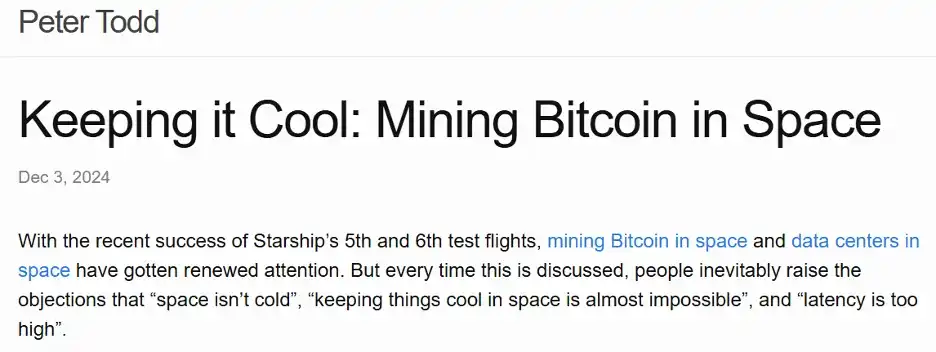
Space heat dissipation is a counterintuitive challenge. On Earth, chip heat can be carried away by air convection; but in the vacuum of space, with no air, heat can only be dissipated through radiation. Todd's calculations show that, without additional cooling devices, the thermal equilibrium temperature of this structure in orbit is about 59°C, well within the normal operating range of the chips. If the temperature is considered too high, simply tilting the entire panel slightly relative to the sun to reduce the illuminated area can further improve heat dissipation.

Communication is surprisingly simple as well. The communication between miners and mining pools essentially involves receiving new block headers and submitting computation results, generating about 10MB of data per day, less than the data consumed by streaming a single song. Communication latency in low Earth orbit (500 to 1,000 km above Earth) ranges from 4 to 30 milliseconds, resulting in a stale block rate (i.e., submitting outdated computation results) of less than 0.01%, on par with the vast majority of ground-based miners, with no substantial difference. In fact, Blockstream began using geosynchronous satellites to broadcast the entire Bitcoin blockchain globally as early as 2017, proving that the combination of satellites and blockchain has never been an unsolved problem.

So, if it's physically feasible and the engineering framework is viable, why isn't it widespread? The reason is the high cost of rocket transportation.

The Uneconomical Math

Using SpaceX's Falcon 9 rocket to send cargo to low Earth orbit currently costs about $2,720 per kilogram.

Peter Todd estimated that a complete 20-kilowatt space mining system, including solar panels, heat radiators, ASIC chip arrays, structural supports, and communication modules, weighs about 1,600 to 2,200 kilograms. At current prices, the launch cost alone would be as high as $4.3 million to $6 million.

How much computing power can this system contribute daily, and how many coins can it mine? Researcher Nick Moran provided the answer: daily revenue is about $92.7, equivalent to roughly $34,000 per year. The payback period exceeds 100 years.

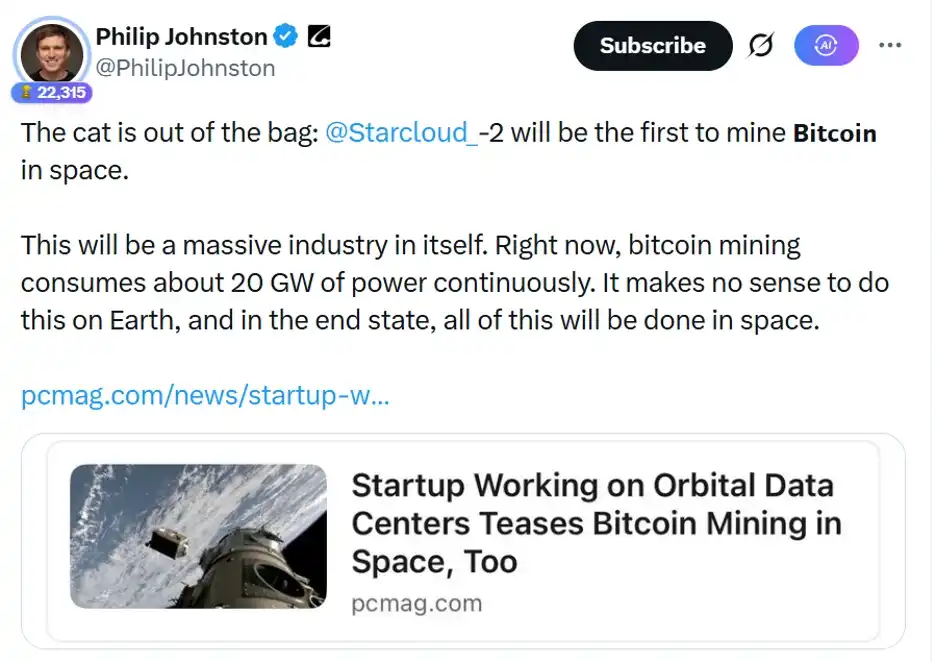
Starcloud's CEO Philip Johnston calculated that launch costs must drop below $200 per kilogram for space mining to have basic commercial logic. This means the cost needs to decrease by another 13.

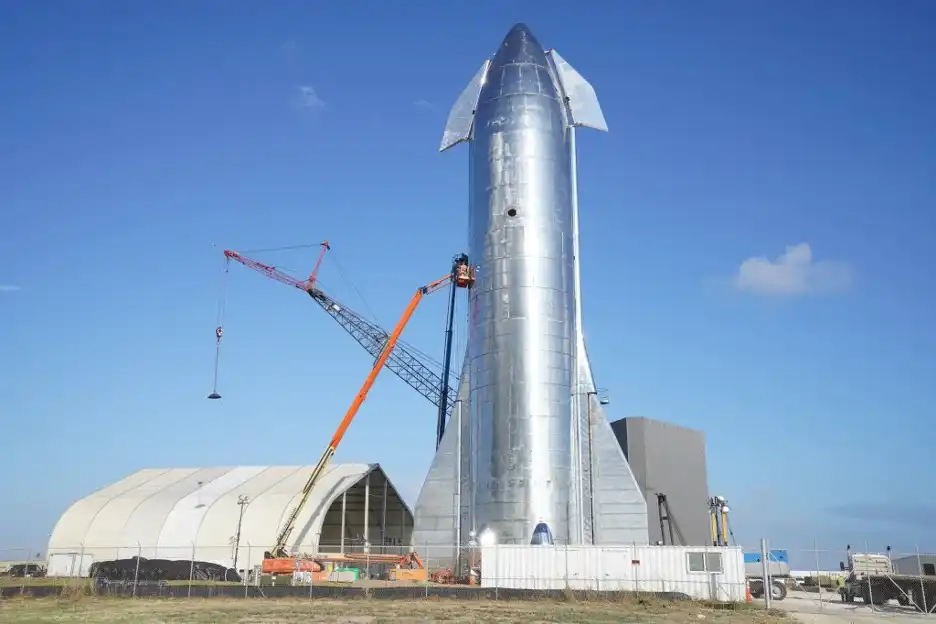
SpaceX's Starship is widely considered the key to achieving this leap. The fully reusable Starship could theoretically reduce the launch cost per kilogram to below $100 or even lower, which is one of the underlying assumptions for the viability of the orbital data center in SpaceX's current IPO vision. However, when this cost curve will materialize, and whether it will, remains an open variable.
Another challenge is the automatic adjustment of Bitcoin's network-wide mining difficulty. The Bitcoin protocol calculates the total network hash rate every two weeks and automatically adjusts the mining difficulty to maintain a block time of approximately 10 minutes. In other words, if a large number of space miners enter the market and the total network hash rate increases significantly, the mining difficulty will rise accordingly, synchronously compressing the profits of all miners, including those in orbit.

Some Are Always Busy Searching for Treasure

Despite this, a number of startups are actively pushing forward with this endeavor.

Starcloud, formerly Lumen Orbit, is currently the company closest to actual implementation and the most important case study in the entire field. Founded in 2024 and headquartered in Redmond, Washington, it is backed by NFX, Y Combinator, a16z's angel fund, Sequoia Capital's angel fund, and NVIDIA. Total funding is approximately $200 million. The company's CTO worked at Airbus Defense and Space for ten years, and the lead engineer previously worked on the Starlink project at SpaceX.

In November 2025, Starcloud successfully sent its first satellite, carrying an NVIDIA H100 GPU, into orbit, ran Google's Gemma language model in space, and sent the first-ever message generated by AI in orbit to Earth. In March 2026, Starcloud announced that its second satellite would carry both Bitcoin ASIC chips and NVIDIA's latest-generation Blackwell GPU, aiming to become the first organization to mine a Bitcoin in space. Additionally, the company has applied to the U.S. Federal Communications Commission (FCC) for a constellation plan deploying up to 88,000 satellites, with a long-term vision of building a total of 5 gigawatts of computing power infrastructure in orbit.
SpaceChain is an OG player in this field, co-founded by former Bitcoin core developer Jeff Garzik and Zheng Zhong. Since 2017, SpaceChain has launched at least seven blockchain payloads to satellites and the International Space Station. In June 2020, Garzik completed the first-ever Bitcoin transaction in space from an orbit 400 km above Earth, for an amount of 0.0099 BTC, using SpaceChain's multisignature wallet node installed on the space station. SpaceChain's core focus is on orbital secure nodes for blockchain transactions, not active mining: locking private keys in space where no hacker or government on Earth can physically access them.

Cryptosat, founded by two Stanford PhDs, currently operates three satellites in orbit, primarily providing tamper-resistant orbital cryptography services. In 2023, Cryptosat participated in the largest trusted setup ceremony in Ethereum's history (KZG Ceremony), generating partial random number parameters through orbital nodes, institutionally ensuring that these parameters could not be controlled by any single ground-based entity. It explores another possibility for space blockchain: not mining, but making the entire crypto-economic system more resistant to attack.

From Orbit to Market: What This Means for the Mining Industry

For currently operating Bitcoin mining companies, space mining does not pose an immediate competitive threat in the short term. However, the fact that numerous startups continue to attempt it indicates that the significant cost reduction potential it represents still holds great attraction and imaginative space for the industry. This also reflects, from a side perspective, the structural cost pressures facing the entire industry.

After the 2024 halving, the network-wide hash rate and difficulty continue to hit record highs, with energy costs accounting for 70% to 90% of total operating expenses. In this context, whoever can obtain clean electricity at the lowest cost and most stably has the deepest moat. Hydroelectric, wind, and associated natural gas resources in the United States, the Middle East, and Africa are becoming the core drivers of a new wave of mining mergers, acquisitions, and site selection.

The logic of space mining is an ultimate extrapolation of this trend: if cheap electricity on the ground will eventually narrow due to competitive demand, then go to where energy is most abundant—the cosmos.

Of course, if the Starcloud-2 satellite manages to mine the first Bitcoin in 2026, it would be equivalent to a grain of sand falling into the ocean compared to the global total hash rate of over 900 exahashes per second (EH/s). But symbolic significance itself has penetrating power. Just like that 0.0099 BTC space transaction in 2020, its value lies not in the amount but in proving that it can be done.

From SpaceX's IPO narrative to NVIDIA's orbital computing power布局, to Starcloud's ASIC satellite plan, an outline is emerging: the cosmos is becoming the competitive arena for the next generation of computing infrastructure. AI computing power led the way, and Bitcoin computing power is following closely behind.

On that day, the global digital network connecting every corner of the Earth, as described in Satoshi Nakamoto's whitepaper, could also break free from Earth and float in the universe, seeking new opportunities.

Preguntas relacionadas

QWhat is the core concept behind space-based Bitcoin mining as described in the article?

AThe core concept is to place Bitcoin mining hardware, specifically ASIC chips, on solar panels in Earth's orbit. This setup uses the abundant and constant solar energy in space for power, while the vacuum environment aids in radiating heat away from the mining equipment.

QWhat is the single biggest economic challenge preventing the widespread adoption of space-based Bitcoin mining?

AThe single biggest economic challenge is the extremely high cost of rocket launches to transport the mining equipment into orbit, currently around $2,720 per kilogram using a Falcon 9 rocket, making the payback period over 100 years.

QWhich company, backed by NVIDIA, is a key player in testing both AI and Bitcoin mining operations in space?

AStarcloud (formerly Lumen Orbit) is the company backed by NVIDIA. It successfully sent an NVIDIA H100 GPU into orbit in 2025 and announced plans for a second satellite to carry both Bitcoin ASIC chips and a Blackwell GPU.

QHow does the Bitcoin network's difficulty adjustment mechanism impact the potential profitability of space-based miners?

AThe Bitcoin protocol automatically adjusts the mining difficulty every two weeks based on the total network hashrate. If many space-based miners come online and significantly increase the total hashrate, the difficulty will rise, compressing profit margins for all miners, including those in space.

QBesides mining, what other two applications of blockchain technology in space are mentioned in the article?

AThe two other applications are: 1) Operating secure, tamper-proof orbital nodes for transactions and wallet storage (e.g., SpaceChain's multi-signature wallet on the ISS). 2) Providing trusted setup ceremonies and cryptographic services to enhance the security of crypto-economic systems (e.g., Cryptosat's role in Ethereum's KZG Ceremony).

Lecturas Relacionadas

Trading

Spot
Futuros

Artículos destacados

Qué es BITCOIN

Entendiendo HarryPotterObamaSonic10Inu (ERC-20) y Su Posición en el Espacio Cripto En los últimos años, el mercado de criptomonedas ha sido testigo de un aumento en la popularidad de las monedas meme, capturando el interés no solo de los comerciantes, sino también de aquellos que buscan compromiso comunitario y valor de entretenimiento. Entre estos tokens únicos se encuentra HarryPotterObamaSonic10Inu (ERC-20), un proyecto intrigante que mezcla referencias culturales en el tejido de las criptomonedas. Este artículo profundiza en los aspectos clave de HarryPotterObamaSonic10Inu, explorando sus mecanismos, ethos impulsado por la comunidad y su relación con el paisaje cripto más amplio. ¿Qué es HarryPotterObamaSonic10Inu (ERC-20)? Como su nombre sugiere, HarryPotterObamaSonic10Inu es una moneda meme construida sobre la blockchain de Ethereum, clasificada bajo el estándar ERC-20. A diferencia de las criptomonedas tradicionales que pueden enfatizar la utilidad práctica o el potencial de inversión, este token prospera en el valor de entretenimiento y la fuerza de su comunidad. El proyecto tiene como objetivo fomentar un entorno donde los usuarios comprometidos puedan reunirse, compartir ideas y participar en actividades inspiradas por diversos fenómenos culturales. Una característica notable de HarryPotterObamaSonic10Inu es su cero impuestos en las transacciones. Este atractivo elemento tiene como objetivo incentivar el comercio y la participación comunitaria, sin cargos adicionales que puedan disuadir a los comerciantes de pequeña escala. El suministro total de la moneda está establecido en mil millones de tokens, una cifra que marca su intención de mantener una circulación sustancial dentro de la comunidad. Creador de HarryPotterObamaSonic10Inu (ERC-20) Los orígenes de HarryPotterObamaSonic10Inu están algo envueltos en misterio; los detalles sobre el creador siguen siendo desconocidos. El desarrollo de este token carece de un equipo identificable o de un plan explícito, lo cual no es inusual dentro del sector de monedas meme. En cambio, el proyecto ha surgido de manera orgánica, con su progreso muy dependiente del entusiasmo y la participación de su comunidad. Inversores de HarryPotterObamaSonic10Inu (ERC-20) En cuanto a inversiones externas y respaldo, HarryPotterObamaSonic10Inu también sigue siendo ambiguo. El token no lista ninguna fundación de inversión conocida o apoyo organizacional significativo. En cambio, la savia del proyecto es su comunidad de base, que informa su crecimiento y sostenibilidad a través de la acción colectiva y el compromiso en el espacio cripto. ¿Cómo Funciona HarryPotterObamaSonic10Inu (ERC-20)? Como una moneda meme, HarryPotterObamaSonic10Inu opera principalmente fuera de los marcos tradicionales que a menudo rigen el valor de los activos. Hay varios aspectos distintivos que definen cómo funciona el proyecto: Transacciones Sin Impuestos: Sin tarifas impositivas en las transacciones, los usuarios pueden comprar y vender el token libremente sin preocuparse por costos ocultos. Compromiso Comunitario: El proyecto prospera en la interacción comunitaria, aprovechando plataformas de redes sociales para crear entusiasmo y facilitar la participación. Las discusiones, el intercambio de contenido y el compromiso son elementos cruciales que ayudan a expandir su alcance y fomentar la lealtad entre los seguidores. Sin Utilidad Práctica: Cabe señalar que HarryPotterObamaSonic10Inu no ofrece utilidad concreta dentro del ecosistema financiero. Más bien, se clasifica como un token principalmente para actividades de entretenimiento y comunitarias. Referencia Cultural: El token incorpora astutamente elementos de la cultura popular para atraer interés, conectando con entusiastas de los memes y seguidores de las criptomonedas por igual. HarryPotterObamaSonic10Inu ejemplifica cómo las monedas meme operan de manera diferente a los proyectos de criptomonedas más tradicionales, ingresando al mercado como construcciones sociales innovadoras en lugar de activos utilitarios. Cronología de HarryPotterObamaSonic10Inu (ERC-20) La historia de HarryPotterObamaSonic10Inu está marcada por varios hitos notables: Creación: El token surgió de un meme viral, capturando la imaginación de muchos entusiastas de las criptomonedas. Las fechas específicas de creación no están disponibles, subrayando su ascenso orgánico. Listado en Exchanges: HarryPotterObamaSonic10Inu ha llegado a varios exchanges, permitiendo un acceso y comercio más fácil por parte de la comunidad. Iniciativas de Compromiso Comunitario: Actividades continuas destinadas a mejorar la interacción comunitaria, incluyendo concursos, campañas en redes sociales y generación de contenido por parte de fanáticos y defensores. Planes de Expansión Futuros: La hoja de ruta del proyecto incluye el lanzamiento de una colección de NFT, mercancía y un sitio de comercio electrónico relacionado con sus temas culturales, involucrando aún más a la comunidad e intentando añadir más dimensiones a su ecosistema. Puntos Clave Sobre HarryPotterObamaSonic10Inu (ERC-20) Naturaleza Impulsada por la Comunidad: El proyecto prioriza la participación colectiva y la creatividad, asegurando que la involucración de los usuarios esté a la vanguardia de su desarrollo. Clasificación como Moneda Meme: Representa la epítome de las criptomonedas basadas en el entretenimiento, diferenciándose de los vehículos de inversión tradicionales. Sin Afiliación Directa con Bitcoin: A pesar de la similitud en el nombre del ticker, HarryPotterObamaSonic10Inu es distinto y no tiene relación con Bitcoin u otras criptomonedas establecidas. Enfoque en la Colaboración: HarryPotterObamaSonic10Inu está diseñado para crear un espacio para la colaboración y el intercambio de historias entre sus poseedores, proporcionando una vía para la creatividad y el vínculo comunitario. Perspectivas Futuras: La ambición de expandirse más allá de su premisa inicial hacia NFTs y mercancías describe un camino para que el proyecto potencialmente ingrese a avenidas más tradicionales dentro de la cultura digital. A medida que las monedas meme continúan capturando la imaginación de la comunidad de criptomonedas, HarryPotterObamaSonic10Inu (ERC-20) se destaca debido a sus lazos culturales y su enfoque centrado en la comunidad. Si bien puede no encajar en el molde típico de un token impulsado por la utilidad, su esencia radica en la alegría y la camaradería fomentadas entre sus seguidores, destacando la naturaleza en evolución de las criptomonedas en una era cada vez más digital. A medida que el proyecto continúa desarrollándose, será importante observar cómo las dinámicas comunitarias influyen en su trayectoria en el cambiante paisaje de la tecnología blockchain.

830 Vistas totalesPublicado en 2024.04.01Actualizado en 2024.12.03

Qué es BITCOIN

Cómo comprar BTC

¡Bienvenido a HTX.com! Hemos hecho que comprar Bitcoin (BTC) sea simple y conveniente. Sigue nuestra guía paso a paso para iniciar tu viaje de criptos.Paso 1: crea tu cuenta HTXUtiliza tu correo electrónico o número de teléfono para registrarte y obtener una cuenta gratuita en HTX. Experimenta un proceso de registro sin complicaciones y desbloquea todas las funciones.Obtener mi cuentaPaso 2: ve a Comprar cripto y elige tu método de pagoTarjeta de crédito/débito: usa tu Visa o Mastercard para comprar Bitcoin (BTC) al instante.Saldo: utiliza fondos del saldo de tu cuenta HTX para tradear sin problemas.Terceros: hemos agregado métodos de pago populares como Google Pay y Apple Pay para mejorar la comodidad.P2P: tradear directamente con otros usuarios en HTX.Over-the-Counter (OTC): ofrecemos servicios personalizados y tipos de cambio competitivos para los traders.Paso 3: guarda tu Bitcoin (BTC)Después de comprar tu Bitcoin (BTC), guárdalo en tu cuenta HTX. Alternativamente, puedes enviarlo a otro lugar mediante transferencia blockchain o utilizarlo para tradear otras criptomonedas.Paso 4: tradear Bitcoin (BTC)Tradear fácilmente con Bitcoin (BTC) en HTX's mercado spot. Simplemente accede a tu cuenta, selecciona tu par de trading, ejecuta tus trades y monitorea en tiempo real. Ofrecemos una experiencia fácil de usar tanto para principiantes como para traders experimentados.

4.2k Vistas totalesPublicado en 2024.12.12Actualizado en 2025.03.21

Cómo comprar BTC

Qué es $BITCOIN

ORO DIGITAL ($BITCOIN): Un Análisis Integral Introducción al ORO DIGITAL ($BITCOIN) ORO DIGITAL ($BITCOIN) es un proyecto basado en blockchain que opera en la red Solana, cuyo objetivo es combinar las características de los metales preciosos tradicionales con la innovación de las tecnologías descentralizadas. Aunque comparte un nombre con Bitcoin, a menudo referido como “oro digital” debido a su percepción como un refugio de valor, ORO DIGITAL es un token separado diseñado para crear un ecosistema único dentro del paisaje Web3. Su meta es posicionarse como un activo digital alternativo viable, aunque los detalles sobre sus aplicaciones y funcionalidades aún están en desarrollo. ¿Qué es ORO DIGITAL ($BITCOIN)? ORO DIGITAL ($BITCOIN) es un token de criptomoneda diseñado explícitamente para su uso en la blockchain de Solana. A diferencia de Bitcoin, que proporciona un papel de almacenamiento de valor ampliamente reconocido, este token parece centrarse en aplicaciones y características más amplias. Aspectos notables incluyen: Infraestructura Blockchain: El token está construido sobre la blockchain de Solana, conocida por su capacidad para manejar transacciones de alta velocidad y bajo costo. Dinámicas de Suministro: ORO DIGITAL tiene un suministro máximo limitado a 100 cuatrillones de tokens (100P $BITCOIN), aunque los detalles sobre su suministro circulante no se han divulgado actualmente. Utilidad: Si bien las funcionalidades precisas no están delineadas explícitamente, hay indicios de que el token podría ser utilizado para diversas aplicaciones, potencialmente involucrando aplicaciones descentralizadas (dApps) o estrategias de tokenización de activos. ¿Quién es el Creador de ORO DIGITAL ($BITCOIN)? En la actualidad, la identidad de los creadores y el equipo de desarrollo detrás de ORO DIGITAL ($BITCOIN) sigue siendo desconocida. Esta situación es típica entre muchos proyectos innovadores dentro del espacio blockchain, particularmente aquellos alineados con las finanzas descentralizadas y fenómenos de monedas meme. Si bien tal anonimato puede fomentar una cultura impulsada por la comunidad, intensifica las preocupaciones sobre la gobernanza y la responsabilidad. ¿Quiénes son los Inversores de ORO DIGITAL ($BITCOIN)? La información disponible indica que ORO DIGITAL ($BITCOIN) no tiene patrocinadores institucionales conocidos ni inversiones destacadas de capital de riesgo. El proyecto parece operar en un modelo de peer-to-peer centrado en el apoyo y la adopción de la comunidad en lugar de rutas de financiamiento tradicionales. Su actividad y liquidez se sitúan principalmente en intercambios descentralizados (DEX), como PumpSwap, en lugar de plataformas de trading centralizadas establecidas, lo que resalta aún más su enfoque de base. Cómo Funciona ORO DIGITAL ($BITCOIN) Los mecanismos operativos de ORO DIGITAL ($BITCOIN) pueden elaborarse en función de su diseño blockchain y atributos de red: Mecanismo de Consenso: Al aprovechar el único proof-of-history (PoH) de Solana combinado con un modelo de proof-of-stake (PoS), el proyecto asegura una validación de transacciones eficiente que contribuye al alto rendimiento de la red. Tokenómica: Si bien los mecanismos deflacionarios específicos no se han detallado extensamente, el vasto suministro máximo de tokens implica que podría atender microtransacciones o casos de uso nicho que aún están por definirse. Interoperabilidad: Existe el potencial de integración con el ecosistema más amplio de Solana, incluyendo varias plataformas de finanzas descentralizadas (DeFi). Sin embargo, los detalles sobre integraciones específicas permanecen no especificados. Cronología de Eventos Clave Aquí hay una cronología que destaca hitos significativos relacionados con ORO DIGITAL ($BITCOIN): 2023: El despliegue inicial del token ocurre en la blockchain de Solana, marcado por su dirección de contrato. 2024: ORO DIGITAL gana visibilidad al estar disponible para trading en intercambios descentralizados como PumpSwap, permitiendo a los usuarios comerciar contra SOL. 2025: El proyecto presencia actividad de trading esporádica y potencial interés en compromisos liderados por la comunidad, aunque no se han documentado asociaciones notables o avances técnicos hasta el momento. Análisis Crítico Fortalezas Escalabilidad: La infraestructura subyacente de Solana soporta altos volúmenes de transacciones, lo que podría mejorar la utilidad de $BITCOIN en varios escenarios de transacción. Accesibilidad: El potencial bajo precio de trading por token podría atraer a inversores minoristas, facilitando una participación más amplia debido a oportunidades de propiedad fraccionada. Riesgos Falta de Transparencia: La ausencia de patrocinadores, desarrolladores o un proceso de auditoría conocidos públicamente puede generar escepticismo sobre la sostenibilidad y confiabilidad del proyecto. Volatilidad del Mercado: La actividad de trading depende en gran medida del comportamiento especulativo, lo que puede resultar en una volatilidad de precios significativa y en incertidumbre para los inversores. Conclusión ORO DIGITAL ($BITCOIN) surge como un proyecto intrigante pero ambiguo dentro del ecosistema de Solana en rápida evolución. Si bien intenta aprovechar la narrativa del “oro digital”, su alejamiento del papel establecido de Bitcoin como refugio de valor subraya la necesidad de una diferenciación más clara de su utilidad y estructura de gobernanza previstas. La aceptación y adopción futura dependerán probablemente de abordar la actual opacidad y de definir sus estrategias operativas y económicas de manera más explícita. Nota: Este informe abarca información sintetizada disponible hasta octubre de 2023, y pueden haber ocurrido desarrollos más allá del período de investigación.

83 Vistas totalesPublicado en 2025.05.13Actualizado en 2025.05.13

Qué es $BITCOIN

Discusiones

Bienvenido a la comunidad de HTX. Aquí puedes mantenerte informado sobre los últimos desarrollos de la plataforma y acceder a análisis profesionales del mercado. A continuación se presentan las opiniones de los usuarios sobre el precio de BTC (BTC).

活动图片