Bitcoin’s 4-Year Moving Average Shows Where The Market Bottom Lies Here

bitcoinistPublicado a 2026-06-04Actualizado a 2026-06-04

Resumen

Crypto analyst Adam Livingston points to Bitcoin's 4-year moving average (MA), currently near $60,000, as a key indicator for a potential market bottom. He notes that BTC's price is historically cheap relative to this average, suggesting this zone has been a high-quality accumulation area. The analysis comes as Bitcoin faces significant selling pressure, dropping from highs near $71,000 to around $63,600, with increased exchange inflows and sustained ETF outflows. While Livingston views the $60,000 MA area as a likely bottom, other analysts like Bluntz predict a sweep down to $58,000, and Ali Martinez warns support could lie between $54,000 and $50,000 based on MVRV bands.

Crypto pundit Adam Livingston has pointed to Bitcoin’s 4-year moving average, which offers insights into where the leading crypto is likely to bottom in this bear market. This comes as BTC extends its decline and is now at risk of falling to the February 2026 low of $60,000.

Pundit Points To Bitcoin’s 4-Year Moving Average For Potential Bottom

In an X post, Livingston noted that Bitcoin’s 4-year moving average is right at $60,000 and that Bitcoin is only 22.75% above this moving average. He further remarked that historically, only about 18.5% of valid days had a lower deviation. He added that about 81.5% of days were more expensive relative to the 4-year MA.

Basically, the crypto pundit suggested that this 4-year moving average could mark the Bitcoin bottom in this cycle. Livingston noted that buying BTC when it was in the same cheap percentile band relative to the 4-year MA would have turned every $10,000 deployed into about $56,600, compared with about $40,200 from a daily DCA over the same window. He added that BTC at today’s 4-year MA percentile has historically been a high-quality accumulation zone.
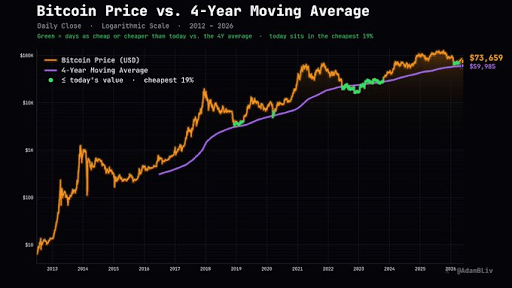
Source: Chart from Adam Livingston on X

As such, Livingston suggested that it may be a good bet to start accumulating Bitcoin in this range, with $60,000 likely to serve as the bottom. It is worth noting that his comment comes as BTC appears set to drop back to $60,000. The leading crypto has witnessed a massive sell-off since the start of the week, falling from as high as $71,000.

However, crypto analyst Bluntz predicted that Bitcoin would drop below $60,000 on this decline. He alluded to BTC’s daily close, indicating that there was no way that the leading crypto wouldn’t sweep $58,000.

BTC In A Vulnerable Position

In an X post, crypto analyst Ali Martinez stated that the breakdown below $72,000 has put Bitcoin in a vulnerable position and that, based on the MVRV pricing bands, the next major area of support sits between $54,000 and $50,000. As such, BTC still risks dropping to as low as $50,000 in this market cycle.

In another X post, Martinez pointed out how Bitcoin is facing significant selling pressure with 54,000 BTC moved to exchanges over the past week. He noted that this spike in available supply has increased the short-term selling pressure, which has driven the price to the lower $60,000. BTC is also facing selling pressure from the Bitcoin ETFs, which are currently on a 13-day streak of net outflows.

At the time of writing, the BTC price is trading at around $63,600, down over 5% in the last 24 hours, according to data from CoinMarketCap.

BTC trading at $63,618 on the 1D chart | Source: BTCUSDT on Tradingview.com

Preguntas relacionadas

QWhat indicator does crypto pundit Adam Livingston point to for identifying Bitcoin's potential market bottom?

AAdam Livingston points to Bitcoin's 4-year moving average (4-year MA) as an indicator for identifying the potential market bottom.

QAccording to the article, what specific price level is suggested as the potential bottom based on the 4-year moving average?

ABased on the 4-year moving average, the potential bottom suggested is around $60,000.

QWhat does analyst Ali Martinez cite as the next major area of support for Bitcoin after its breakdown below $72,000?

AAnalyst Ali Martinez cites the MVRV pricing bands, stating that the next major area of support for Bitcoin sits between $54,000 and $50,000.

QWhat recent market activity is mentioned as contributing to increased short-term selling pressure on Bitcoin?

ARecent market activity contributing to increased short-term selling pressure includes 54,000 BTC being moved to exchanges over the past week and Bitcoin ETFs being on a 13-day streak of net outflows.

QAt what price was Bitcoin trading at the time the article was written, and what was its 24-hour performance?

AAt the time the article was written, Bitcoin was trading at around $63,600, down over 5% in the last 24 hours.

Lecturas Relacionadas

Trump's 'Bitcoin Retirement Plan' Hits Roadblock: Democrats Claim It Endangers American Workers' Pensions?

Democratic Senators Bernie Sanders (I-VT) and Elizabeth Warren (D-MA), along with Rep. Bobby Scott (D-VA), are urging the Labor Department to repeal a proposed rule that would open U.S. retirement savings accounts, like 401(k) plans, to investments in Bitcoin and other cryptocurrencies. In a letter to Acting Labor Secretary Keith Sonderling, they argue the rule would endanger workers' financial futures and contradicts long-standing legal precedents under the Employee Retirement Income Security Act (ERISA). The rule, stemming from a Trump executive order, would shift the legal standard for plan fiduciaries. Instead of requiring them to prove they conducted due diligence on volatile assets, it would presume prudence if they followed a specified process. The lawmakers warn this exposes the $14.2 trillion in 401(k) savings to highly volatile and less-regulated assets, citing FINRA warnings on crypto's risks and FBI data on massive crypto scam losses. The letter also alleges a conflict of interest, noting that President Trump's adult children manage the family's crypto business, which has raised billions. They claim the rule could allow the Trump family to profit at the expense of workers and retirees. Consumer advocates echo concerns that it could turn retirement savings into a lifeline for a risky industry. The Trump administration defends the rule as expanding worker choice, with officials stating it ends the department "picking winners and losers" and requires fiduciaries to follow a prudent process.

foresightnews_apiHace 1 min(s)

Trump's 'Bitcoin Retirement Plan' Hits Roadblock: Democrats Claim It Endangers American Workers' Pensions?

foresightnews_apiHace 1 min(s)

Rules Change Mid-Game, Polymarket’s Billion-Dollar Bitcoin Prediction Market Mired in Settlement Controversy

A nearly $150 million prediction market contract on Polymarket is in turmoil after the platform refused to settle in favor of traders who correctly predicted that MicroStrategy (now Strategy) would sell Bitcoin. The core dispute revolves around a sale of 32 BTC, which occurred between May 26-31 but was officially disclosed in an SEC 8-K filing on June 1. The original contract stated it would resolve to "Yes" if Strategy sold any Bitcoin before May 31, 11:59 PM ET, using public disclosures and on-chain data as proof. After the filing on June 1, traders who saw the disclosure rushed to buy "Yes" contracts, believing it was conclusive evidence. However, Polymarket's operators later added a rule that the disclosure itself must occur by the deadline, not just the transaction, invalidating the filing as proof. This retroactive rule change has sparked accusations of market manipulation, leaving traders like "willo2," who invested $527,000, facing total losses. The controversy highlights a deeper structural flaw in Polymarket's decentralized settlement system, which relies on UMA's optimistic oracle. Disputed resolutions are ultimately decided by a vote among UMA token holders, a mechanism critics say is vulnerable to manipulation by large holders ("whales") who can vote in their own financial interest rather than on objective facts. Data suggests a high concentration of voting power and significant overlap between voters and Polymarket traders. The dispute emerges as prediction markets like Polymarket and Kalshi are experiencing massive growth and seeking mainstream financial legitimacy, having recently secured regulatory approval from the U.S. CFTC. However, the incident underscores the unresolved tension between decentralized, token-vote-based settlement and the need for transparent, rules-based outcomes in high-stakes financial contracts.

foresightnews_apiHace 4 min(s)

Rules Change Mid-Game, Polymarket’s Billion-Dollar Bitcoin Prediction Market Mired in Settlement Controversy

foresightnews_apiHace 4 min(s)

Ethereum Foundation Researcher: Quantum Day Is Approaching, Plans to Complete Quantum-Resistant Migration by 2029

Ethereum Foundation researcher Justin Drake discusses the implications of a recent quantum computing breakthrough by Google’s quantum AI team, which demonstrated a 10x efficiency improvement in Shor’s algorithm against the secp256k1 elliptic curve used in Bitcoin and Ethereum. Notably, Google kept key algorithmic details confidential, using zero-knowledge proofs to verify the result without disclosure—a first in academia. Shortly after, the core optimization was independently reproduced, and an open-source competition (ecdsa.fail) emerged, further improving the algorithm by 8.4%. Meanwhile, startup Oratomic published research suggesting that neutral-atom quantum architectures could break secp256k1 with only 10,000 physical qubits, accelerating the timeline for "Q-Day"—the day quantum computers can break widely used cryptography. Drake estimates a 50% probability of Q-Day by 2032 and a 10% chance by 2030, contrasting with the U.S. government’s more conservative 2035 forecast. He warns against panic but stresses timely migration to post-quantum cryptography. Ethereum plans to complete its migration by 2029, covering consensus, data, and execution layers with hash-based systems. The Foundation is also developing leanVM, a formally verifiable zkVM, and has launched two $1 million initiatives to advance SNARK-friendly cryptography.

foresightnews_apiHace 4 min(s)

Ethereum Foundation Researcher: Quantum Day Is Approaching, Plans to Complete Quantum-Resistant Migration by 2029

foresightnews_apiHace 4 min(s)

Trading

Spot
Futuros

Artículos destacados

Cómo comprar 4

¡Bienvenido a HTX.com! Hemos hecho que comprar 4 (4) sea simple y conveniente. Sigue nuestra guía paso a paso para iniciar tu viaje de criptos.Paso 1: crea tu cuenta HTXUtiliza tu correo electrónico o número de teléfono para registrarte y obtener una cuenta gratuita en HTX. Experimenta un proceso de registro sin complicaciones y desbloquea todas las funciones.Obtener mi cuentaPaso 2: ve a Comprar cripto y elige tu método de pagoTarjeta de crédito/débito: usa tu Visa o Mastercard para comprar 4 (4) al instante.Saldo: utiliza fondos del saldo de tu cuenta HTX para tradear sin problemas.Terceros: hemos agregado métodos de pago populares como Google Pay y Apple Pay para mejorar la comodidad.P2P: tradear directamente con otros usuarios en HTX.Over-the-Counter (OTC): ofrecemos servicios personalizados y tipos de cambio competitivos para los traders.Paso 3: guarda tu 4 (4)Después de comprar tu 4 (4), guárdalo en tu cuenta HTX. Alternativamente, puedes enviarlo a otro lugar mediante transferencia blockchain o utilizarlo para tradear otras criptomonedas.Paso 4: tradear 4 (4)Tradear fácilmente con 4 (4) en HTX's mercado spot. Simplemente accede a tu cuenta, selecciona tu par de trading, ejecuta tus trades y monitorea en tiempo real. Ofrecemos una experiencia fácil de usar tanto para principiantes como para traders experimentados.

742 Vistas totalesPublicado en 2025.10.20Actualizado en 2026.06.02

Cómo comprar 4

Discusiones

Bienvenido a la comunidad de HTX. Aquí puedes mantenerte informado sobre los últimos desarrollos de la plataforma y acceder a análisis profesionales del mercado. A continuación se presentan las opiniones de los usuarios sobre el precio de 4 (4).

活动图片