Blackrock Contributes to Bitcoin ETF Recovery of $32 Million After 4-Day Slump

cryptonews.ruPublicado a 2026-07-30Actualizado a 2026-07-30

Resumen

The cryptocurrency ETF market saw a reversal on July 29th. Bitcoin ETFs ended a four-day outflow streak, posting a net inflow of $32.11 million, largely driven by BlackRock's IBIT fund which attracted $89.83 million. This offset outflows from other major Bitcoin ETFs. Meanwhile, Solana ETFs rebounded with a $19.06 million inflow, primarily into Morgan Stanley's new staking-supported MSOL ETF, after significant outflows the previous day. Ethereum ETFs faced renewed pressure, however, with a net outflow of $18.65 million despite some inflows to new staking products. XRP ETFs saw a modest recovery. Conversely, $HYPE ETFs extended their losing streak to five days with further outflows. The data suggests a selective market: Bitcoin regaining support, Solana rebounding, and staking products attracting interest, while Ethereum and $HYPE faced continued selling pressure.

The cryptocurrency exchange-traded fund (ETF) market shifted direction again on Wednesday, July 29. Bitcoin found buyers after four consecutive sessions characterized by outflows, while Solana offset significant losses from the previous day with nearly equal inflows.

Ether funds were less fortunate. After two sessions of growth, they returned to outflows, and $HYPE ETF funds extended their losing streak to five days.

Blackrock Supported Bitcoin Amid Ether Fund Pullback

Blackrock's IBIT ETF became the driving force behind the Bitcoin ETF recovery, attracting an inflow of $89.83 million. This increase offset outflows of $43.08 million from Fidelity's FBTC and $14.64 million from ARK 21Shares' ARKB. As a result, the category ended the period with a net inflow of $32.11 million.

The total trading volume for Bitcoin ETFs reached $1.88 billion, and the aggregate net assets at the day's close stood at $77.46 billion.
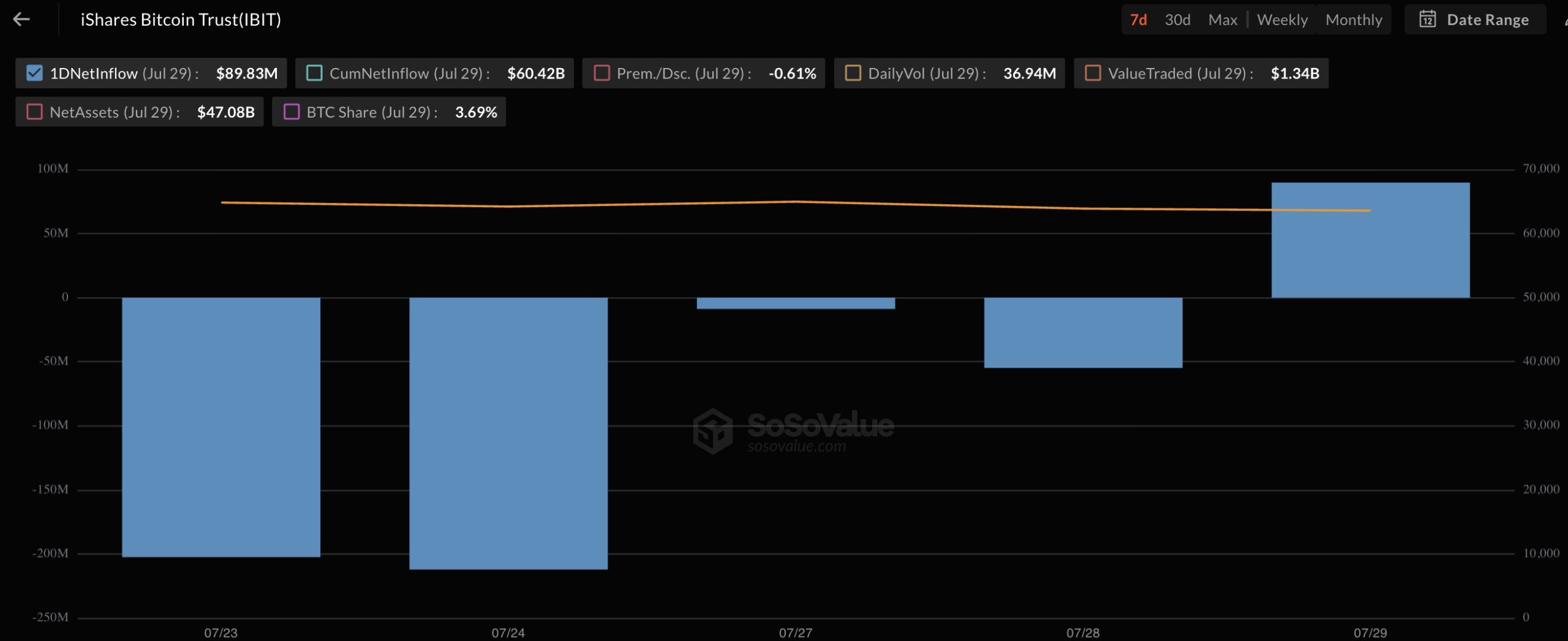
Bitcoin ETF fund flows appear to be largely dictated by Blackrock's IBIT fund, with Bitcoin ETFs' net gains/losses mirroring IBIT's flow dynamics. Source: Sosovalue

Ether ETFs displayed more mixed dynamics. The recently launched Morgan Stanley staking fund, MSSE, attracted $14.30 million, and Blackrock's ETHA ETF attracted $5.16 million.

These inflows were outweighed by outflows from five products. Fidelity's FETH fund lost $16.07 million. Grayscale's ETHE and Ether Mini Trust funds recorded outflows of $9.74 million and $8.09 million, respectively.

The 21Shares TETH fund lost $2.85 million, and Bitwise's ETHW lost $1.36 million. For the period, the net outflow for this category amounted to $18.65 million. Ether ETF trading volume was $563.79 million, with net assets at closing at $10.37 billion.

Solana Recovers Amid Accelerated Selling on Hype Wave

Solana ETFs attracted $19.06 million, offsetting the outflow of $18.07 million recorded during the previous session.

All new capital flowed into the recently launched Morgan Stanley MSOL ETF—a Solana ETF with staking support. The total trading volume reached $60.21 million, and net assets rose to $862.98 million.

Demand for new Morgan Stanley products related to staking was noticeable. The MSSE fund attracted $19.45 million over two days, and MSOL attracted $19 million on its first day of inflows, indicating that investors are responding positively to products that combine token investments with staking yield.

$XRP ETFs also returned to positive territory, though the growth was modest. Franklin Templeton's XRPZ attracted $584,710, bringing the total assets for the category to $988.70 million. Trading volume reached $10.35 million.

$HYPE ETF funds remained under pressure. Bitwise's BHYP fund recorded an outflow of $8.78 million, marking the fifth consecutive day of decline for this category. The trading volume for $HYPE ETF funds was $6.92 million, and net assets decreased to $252.38 million.

The latest fund flow data indicates that the market remains willing to take on cryptocurrency risk but is becoming increasingly selective. Bitcoin regained support, Solana bounced back, and staking products attracted interest. Ether and $HYPE, however, faced another wave of selling.

end-content


Criptos en tendencia

Preguntas relacionadas

QWhat was the main reason for the Bitcoin ETF market reversing its four-day outflow streak on July 29?

AThe main reason was a significant influx of $89.83 million into BlackRock's IBIT ETF, which offset outflows from other major Bitcoin ETFs, resulting in a net inflow of $32.11 million for the category.

QWhich newly launched product categories from Morgan Stanley attracted significant investor interest and capital?

AMorgan Stanley's newly launched staking-enabled ETFs attracted significant interest. The Ethereum staking fund (MSSE) attracted $14.30 million, and the Solana staking fund (MSOL) attracted $19.06 million, indicating positive investor reception for products combining token exposure with staking yield.

QHow did the performance of Ethereum ETFs compare to Bitcoin ETFs on the reported day?

AEthereum ETFs underperformed compared to Bitcoin ETFs. While Bitcoin ETFs saw a net inflow of $32.11 million, Ethereum ETFs experienced a net outflow of $18.65 million, with outflows from products like Fidelity's FETH and Grayscale's ETHE outweighing inflows.

QWhat happened to the $HYPE ETF funds during the reported period?

AThe $HYPE ETF funds continued to face selling pressure, with Bitwise's BHYP fund experiencing an $8.78 million outflow. This marked the fifth consecutive day of losses for the category, reducing its total net assets to $252.38 million.

QWhat does the latest fund flow data suggest about the overall sentiment in the cryptocurrency ETF market?

AThe data suggests the market is still willing to take on crypto risk but is becoming increasingly selective. Support returned for Bitcoin, Solana rebounded, and staking products attracted interest, while Ethereum and $HYPE faced continued selling pressure.

Lecturas Relacionadas

Global Market Share Survey: Japanese Firms Lead in Semiconductor Materials

Global Market Share Survey: Japanese Firms Lead in Semiconductor Materials According to the 2025 "Major Goods and Services Market Share Survey" by Nikkei, Japanese companies maintain strong positions in semiconductor-related materials. In silicon wafers, Shin-Etsu Chemical ranks first with a 26.3% share, followed by SUMCO at 17.8%. Together, they hold 44.1% of the market, widening their lead over competitors from Taiwan, Germany, and South Korea. In photoresists, Tokyo Ohka Kogyo, JSR, and Shin-Etsu Chemical occupy the top three spots, with a combined share of 60.5%. Despite their strength in materials, Japanese firms have a weaker presence in core semiconductor segments like DRAM and NAND flash memory, where South Korean and U.S. companies dominate. For instance, SK Hynix and Samsung lead in DRAM, while China’s CXMT doubled its share to 6% in 2025. The semiconductor market is projected to grow rapidly, with WSTS forecasting a 90% increase to $1.5112 trillion by 2026. Major players like Samsung, SK Hynix, and Micron are making massive investments to expand capacity. To maintain their edge in materials, Japanese companies must similarly commit to large-scale, risk-taking investments. In contrast, Japan’s automotive sector shows stagnation. Toyota remains the global leader but with only a slight share increase to 12.3%, while Japanese brands are absent from the top five in the EV market. In shipbuilding, Imabari Shipbuilding rose to third place globally with a 7.2% share, benefiting from large container ship deliveries. However, Chinese and South Korean firms dominate the sector, holding the top two positions. Japan aims to revitalize its shipbuilding industry through government and corporate efforts, targeting a near doubling of output by 2035. Addressing labor shortages and adopting advanced technologies like physical AI will be critical for competitiveness.

marsbitHace 5 min(s)

Global Market Share Survey: Japanese Firms Lead in Semiconductor Materials

marsbitHace 5 min(s)

STRC Major De-pegging's First Financial Report, How Will Strategy Repair Its Capital Flywheel?

Bitcoin treasury company Strategy released its Q2 2026 earnings report on July 31. Despite a 6.9% year-over-year revenue increase to $122 million, the company recorded a net loss of $8.22 billion, largely due to $8.32 billion in unrealized losses from Bitcoin price fluctuations. As of quarter-end, Strategy holds 843,775 BTC with an average cost of $75,000 per coin, and Bitcoin per share increased. The report highlights a critical shift in Strategy's capital model following the de-pegging of its key financing tool, STRC (Strategic Coin), which fell below its $100 target. Management's top priority is restoring STRC to its target value, aiming for a recovery by September 8. They rule out discounted STRC issuances and plan to maintain its dividend yield at 12%, instead focusing on bolstering its $3.75 billion cash reserve. Strategy has moved from a one-way "buy-and-hold" Bitcoin strategy to active capital management. This new approach, part of its "Digital Credit Capital Framework," involves flexibly managing its balance sheet across four elements: BTC, USD cash, common stock (MSTR), and digital credit securities like STRC. This allows for BTC monetization (having sold $218.4 million in BTC so far), strategic repurchases of discounted securities, and debt optimization, as seen with a $1.5 billion convertible bond buyback. The company's future hinges on two key tests: successfully re-pegging STRC to restore market confidence in its digital credit system, and a long-term recovery in Bitcoin's price to ultimately support its growth thesis.

marsbitHace 50 min(s)

STRC Major De-pegging's First Financial Report, How Will Strategy Repair Its Capital Flywheel?

marsbitHace 50 min(s)

STRC's First Financial Report Post-Depegging, How is Strategy Restoring the Capital Flywheel?

On July 31, 2026, Bitcoin treasury company Strategy released its Q2 financial report. Despite a 6.9% year-over-year increase in revenue to $122 million, the company recorded a substantial net loss of $8.22 billion, primarily due to $8.32 billion in unrealized losses from Bitcoin holdings. While Strategy's core Bitcoin strategy remains intact—its holdings grew 11% to 843,775 BTC—the company is undergoing a fundamental shift in its capital model. Following the de-pegging of its key financing tool, the STRCoin (STRC), from its $100 target in May, Strategy has pivoted from a one-directional "raise funds, buy Bitcoin" cycle to a more dynamic, multi-asset capital management approach. A key part of this new framework is the "Monetization Program," through which Strategy has sold approximately $218.4 million worth of BTC to bolster liquidity. The company's top priority is repairing STRC's peg, committing not to issue discounted shares until it returns to its target range. It has initiated a $1 billion buyback program for discounted digital credit securities, having repurchased $28.9 million face value of STRC so far. Management aims to restore the peg around September 8, 2026. Strategy now actively manages a matrix of assets: Bitcoin (for accumulation or strategic sales), USD cash reserves (now at $3.75 billion), common stock (MSTR), and digital credit securities like STRC. This allows for tactical moves like repurchasing discounted debt or equity to capture value. The future success of Strategy's "capital flywheel" hinges on two factors: the short-term ability to successfully re-peg STRC to restore market confidence in its digital credit system, and the long-term price trajectory of Bitcoin, upon which its entire investment thesis ultimately depends.

Odaily星球日报Hace 55 min(s)

STRC's First Financial Report Post-Depegging, How is Strategy Restoring the Capital Flywheel?

Odaily星球日报Hace 55 min(s)

Trading

Spot

Artículos destacados

Cómo comprar 4

¡Bienvenido a HTX.com! Hemos hecho que comprar 4 (4) sea simple y conveniente. Sigue nuestra guía paso a paso para iniciar tu viaje de criptos.Paso 1: crea tu cuenta HTXUtiliza tu correo electrónico o número de teléfono para registrarte y obtener una cuenta gratuita en HTX. Experimenta un proceso de registro sin complicaciones y desbloquea todas las funciones.Obtener mi cuentaPaso 2: ve a Comprar cripto y elige tu método de pagoTarjeta de crédito/débito: usa tu Visa o Mastercard para comprar 4 (4) al instante.Saldo: utiliza fondos del saldo de tu cuenta HTX para tradear sin problemas.Terceros: hemos agregado métodos de pago populares como Google Pay y Apple Pay para mejorar la comodidad.P2P: tradear directamente con otros usuarios en HTX.Over-the-Counter (OTC): ofrecemos servicios personalizados y tipos de cambio competitivos para los traders.Paso 3: guarda tu 4 (4)Después de comprar tu 4 (4), guárdalo en tu cuenta HTX. Alternativamente, puedes enviarlo a otro lugar mediante transferencia blockchain o utilizarlo para tradear otras criptomonedas.Paso 4: tradear 4 (4)Tradear fácilmente con 4 (4) en HTX's mercado spot. Simplemente accede a tu cuenta, selecciona tu par de trading, ejecuta tus trades y monitorea en tiempo real. Ofrecemos una experiencia fácil de usar tanto para principiantes como para traders experimentados.

832 Vistas totalesPublicado en 2025.10.20Actualizado en 2026.06.02

Cómo comprar 4

Discusiones

Bienvenido a la comunidad de HTX. Aquí puedes mantenerte informado sobre los últimos desarrollos de la plataforma y acceder a análisis profesionales del mercado. A continuación se presentan las opiniones de los usuarios sobre el precio de 4 (4).

活动图片