Bitcoin treasuries stall in Q4, but largest holders keep stacking sats

cointelegraphPublicado a 2025-12-11Actualizado a 2025-12-11

Resumen

The adoption of Bitcoin treasuries slowed sharply in Q4 2025, with only nine new companies adding BTC to their balance sheets compared to 53 in the previous quarter. While 117 companies adopted Bitcoin in 2025, most hold relatively small amounts. However, the largest corporate holders, such as Strategy, continued accumulating Bitcoin, with Strategy purchasing $962 million worth in a single day. Overall, public companies hold over 1 million BTC ($90.2B), representing 4.7% of the total supply, while spot Bitcoin ETFs hold an additional 1.49 million BTC. Some firms, like Metaplanet, paused purchases, and others, like Satsuma Technology, sold portions of their holdings. Ether treasury investments also declined, with cumulative ETH acquisitions falling 81% over three months.

Bitcoin treasury adoption slowed sharply in the fourth quarter of 2025, even as the biggest corporate holders continued to quietly add to their stacks while smaller players stepped back.

The number of new Bitcoin (BTC) treasury companies declined from its peak of 53 new companies in the third quarter to just nine companies adding Bitcoin to their balance sheet in the fourth quarter of 2025 so far, with a total of 117 new companies adopting Bitcoin this year, according to blockchain data platform CryptoQuant.

“Despite the growth in numbers during 2025, most Bitcoin Treasury companies hold relatively small amounts,” CryptoQuant wrote in a Thursday X post.

Still, the accumulation data shows that the most well-funded corporate treasuries continue to scoop up the Bitcoin supply despite a decline in buying by smaller companies and retail participants.
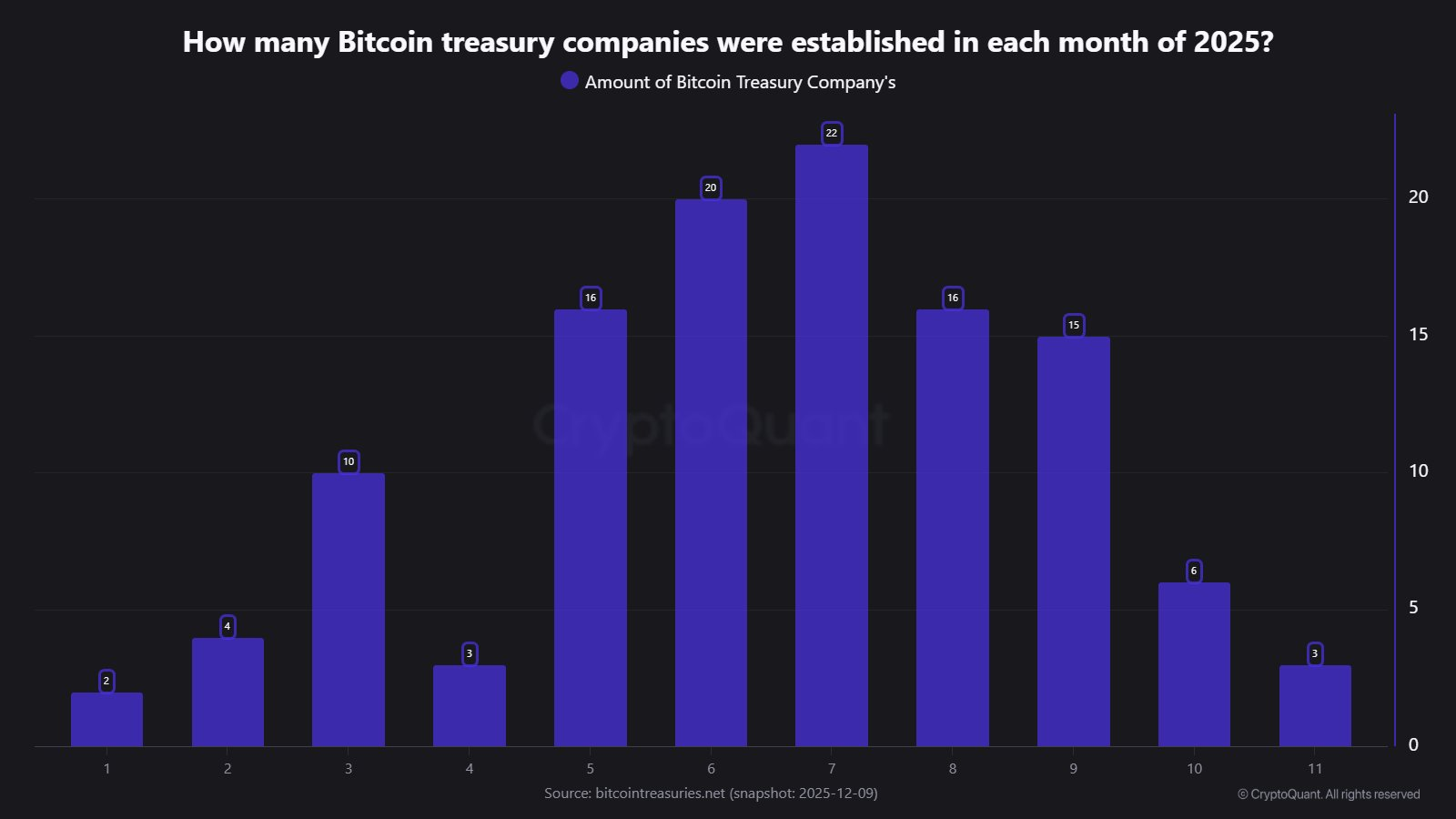
New Bitcoin treasury companies per month, 2025 year-to-date chart. Source: CryptoQuant

Some Bitcoin treasury firms have stopped accumulating this quarter. Japanese investment company Metaplanet, for instance, hasn’t purchased any Bitcoin in over two months.

Some companies are even selling their Bitcoin stacks. United Kingdom-based, Bitcoin-focused tech company Satsuma Technology sold 579 Bitcoin for around $53 million, leaving the company with 620 Bitcoin on its balance sheet, according to a Wednesday announcement.

Related: Bitcoin treads water at $90K as whales eat the Ethereum dip: Finance Redefined

Largest corporate holders continue their quiet Bitcoin accumulation

Despite the broader slowdown, some of the largest corporations continue to scoop up more of the Bitcoin supply.

Strategy, the largest corporate Bitcoin holder, purchased $962 million of BTC on Monday, in its biggest purchase since July. The company is now just $500 million shy of matching the $21.97 billion worth of Bitcoin it acquired in 2024, according to CryptoQuant.
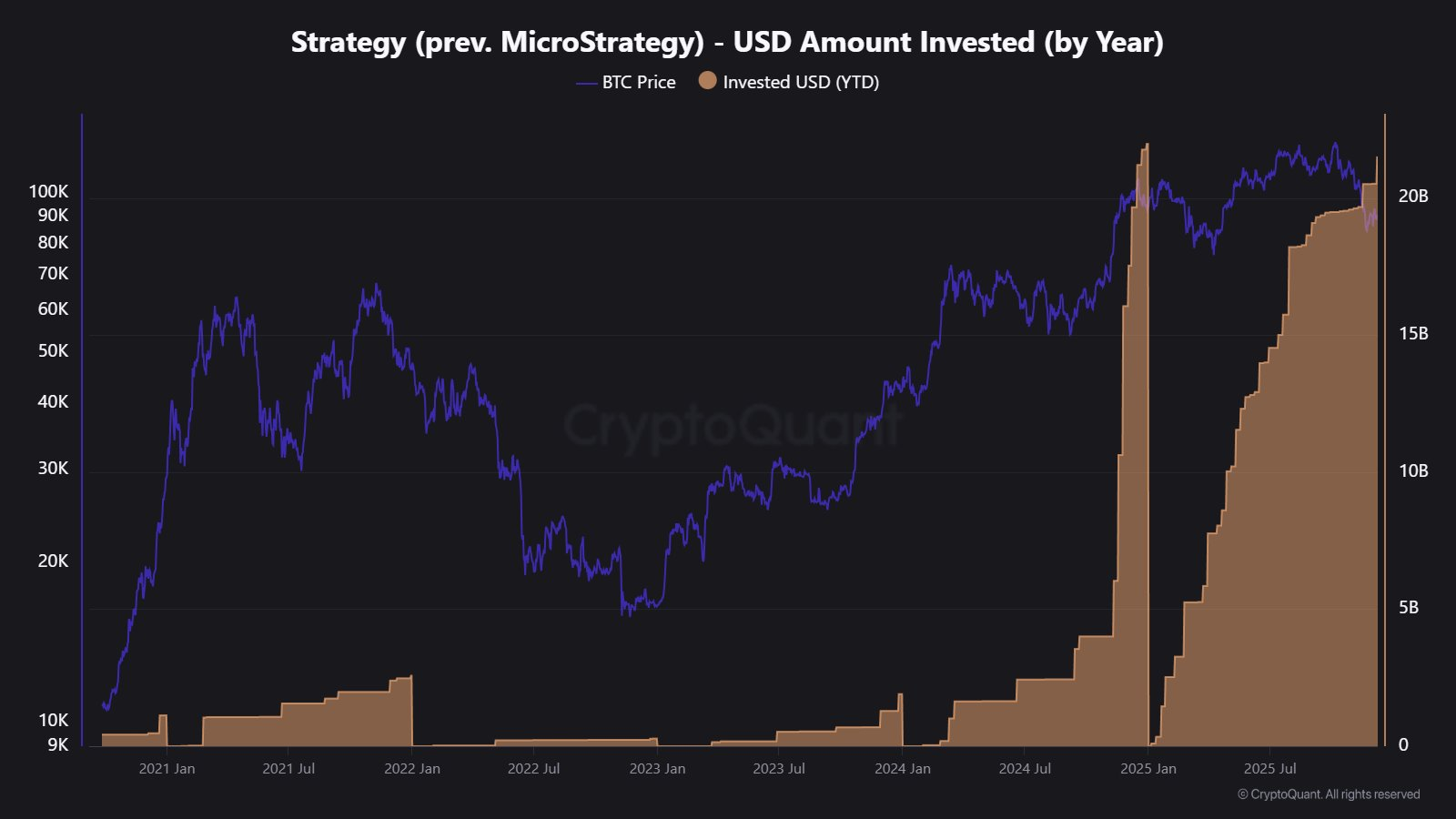
Strategy, US dollar amount invested. Source: CryptoQuant

Over 1 million Bitcoin worth $90.2 billion is already held in public company treasuries, representing 4.7% of the total supply, according to data from BitcoinTreasuries.NET.

An additional 1.49 million Bitcoin, or 7% of the supply, is held by spot Bitcoin exchange-traded funds.
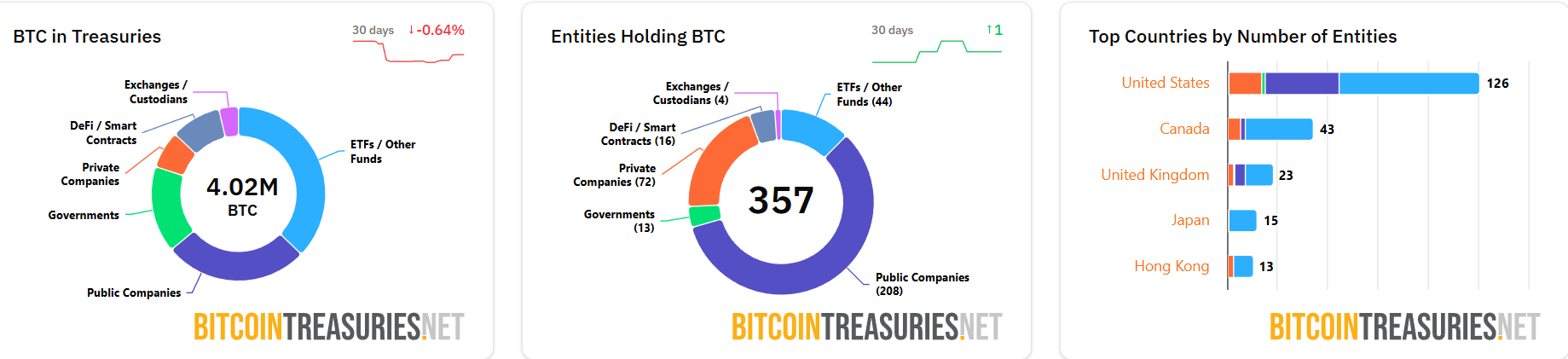
Bitcoin holdings in treasuries. Source: BitcoinTreasuries.NET

Related: Silk Road-linked Bitcoin wallets move $3M to new address

DATs slow crypto purchases as Ether treasury investments fall 81%

Digital asset treasury (DAT) acquisitions are also slowing down. Ripple-backed Evernorth Holdings has been inactive since the end of October, when it acquired $950 million XRP (XRP) tokens.

Evernorth’s XRP holdings were facing nearly $80 million in unrealized losses weeks after the purchases amid the market decline and growing pressure on DATs.

BitMine Immersion Technologies, the largest corporate Ether (ETH) holder, has also slowed its Ether acquisitions in recent months from a peak of $2.6 billion in July to just $296 million of ETH in December.

Cumulative investments from Ether treasury firms fell by 81% in the past three months, from 1.97 million ETH acquired in August to 370,000 ETH in November.

Magazine: Mysterious Mr Nakamoto author — Finding Satoshi would hurt Bitcoin

Lecturas Relacionadas

AI Benefits Senior Staff? 40% of CEOs Plan to Cut Junior Positions, Young People's Jobs Are More at Risk

The traditional assumption that senior employees are first in line during layoffs is being inverted in the AI era. A survey of 415 CEOs by Oliver Wyman and the NYSE reveals 43% plan to cut entry-level positions in the next 1-2 years to shift towards a mid-to-senior talent structure, a sharp rise from 17% last year. The logic is that AI excels at automating routine, cognitive tasks typically handled by junior staff (e.g., coding, data review), while the experience and judgment of senior employees remain harder to replicate. Research indicates this shift primarily manifests as a hiring freeze for junior roles rather than mass layoffs. Goldman Sachs estimates AI currently nets a loss of about 16,000 US jobs monthly, disproportionately impacting Generation Z concentrated in highly automatable white-collar roles. This raises long-term concerns about a broken talent pipeline, as companies risk having no future senior managers trained internally. Despite the dominant trend, a minority of successful AI adopters, like IBM and Salesforce, are expanding junior hiring, arguing these employees are adept at using and building AI tools. However, most companies are still in early AI deployment phases, with 67% in planning/pilot stages and many reporting returns below expectations. The overarching reality is a weakening of job security across all levels, as organizations reshape for an AI-augmented, leaner future.

marsbitHace 35 min(s)

AI Benefits Senior Staff? 40% of CEOs Plan to Cut Junior Positions, Young People's Jobs Are More at Risk

marsbitHace 35 min(s)

Physical AI is Hot, Some New Thoughts from Me

The term "Physical AI" is gaining significant traction, marking a shift from AI that processes information to AI that understands and interacts with the physical world. Unlike traditional AI confined to screens, Physical AI involves integrating intelligence into robotic bodies to perform tasks in environments governed by gravity, friction, and inertia. The concept, formally defined in a 2020 paper, focuses on creating embodied systems that can complete perception-to-action cycles. 2026 is identified as a pivotal "deployment year," where the focus moves from demonstrations to practical utility. Companies like China's Zhiyuan Robotics have transitioned to live, unscripted factory deployments and announced mass production targets. Internationally, Figure AI, after a major funding round, shifted to its own neural system, while NVIDIA partnered with major industrial robot firms to upgrade millions of existing units with AI capabilities. A key trend is the crossover from the automotive supply chain. Companies like Aptiv and Valeo are entering the Physical AI space, leveraging their expertise in sensors, control systems, and mass production from the autonomous vehicle sector. This "technology spillover" is accelerating development, as seen with Tesla's plans to repurpose automotive production lines for its Optimus robot. The technical breakthrough enabling this progress is the engineering maturity of "world models." Previously theoretical, these AI models can now simulate physical interactions and generate vast, realistic synthetic training data for robots. Innovations from NVIDIA's Cosmos, Ant's LingBot-World, and others have made this capability more accessible, drastically reducing the cost and time needed for real-world data collection. This is driving a fundamental architectural shift in robotics: from the traditional "sense-plan-act" model, reliant on pre-programmed rules, to a "sense-reason-act" paradigm where neural networks reason and make decisions. This change represents a new paradigm where machines understand the world's physics. The competition is intense, with the landscape still forming. While the direction is clear, success will depend not just on AI algorithms but on manufacturing scalability, supply chain resilience, and efficient data strategies, with infrastructure providers potentially capturing significant value in this new era.

marsbitHace 52 min(s)

Physical AI is Hot, Some New Thoughts from Me

marsbitHace 52 min(s)

Trading

Spot
Futuros

Artículos destacados

Cómo comprar SATS

¡Bienvenido a HTX.com! Hemos hecho que comprar SATS(SATS) (SATS) sea simple y conveniente. Sigue nuestra guía paso a paso para iniciar tu viaje de criptos.Paso 1: crea tu cuenta HTXUtiliza tu correo electrónico o número de teléfono para registrarte y obtener una cuenta gratuita en HTX. Experimenta un proceso de registro sin complicaciones y desbloquea todas las funciones.Obtener mi cuentaPaso 2: ve a Comprar cripto y elige tu método de pagoTarjeta de crédito/débito: usa tu Visa o Mastercard para comprar SATS(SATS) (SATS) al instante.Saldo: utiliza fondos del saldo de tu cuenta HTX para tradear sin problemas.Terceros: hemos agregado métodos de pago populares como Google Pay y Apple Pay para mejorar la comodidad.P2P: tradear directamente con otros usuarios en HTX.Over-the-Counter (OTC): ofrecemos servicios personalizados y tipos de cambio competitivos para los traders.Paso 3: guarda tu SATS(SATS) (SATS)Después de comprar tu SATS(SATS) (SATS), guárdalo en tu cuenta HTX. Alternativamente, puedes enviarlo a otro lugar mediante transferencia blockchain o utilizarlo para tradear otras criptomonedas.Paso 4: tradear SATS(SATS) (SATS)Tradear fácilmente con SATS(SATS) (SATS) en HTX's mercado spot. Simplemente accede a tu cuenta, selecciona tu par de trading, ejecuta tus trades y monitorea en tiempo real. Ofrecemos una experiencia fácil de usar tanto para principiantes como para traders experimentados.

238 Vistas totalesPublicado en 2024.12.10Actualizado en 2025.03.21

Cómo comprar SATS

Discusiones

Bienvenido a la comunidad de HTX. Aquí puedes mantenerte informado sobre los últimos desarrollos de la plataforma y acceder a análisis profesionales del mercado. A continuación se presentan las opiniones de los usuarios sobre el precio de SATS (SATS).

活动图片