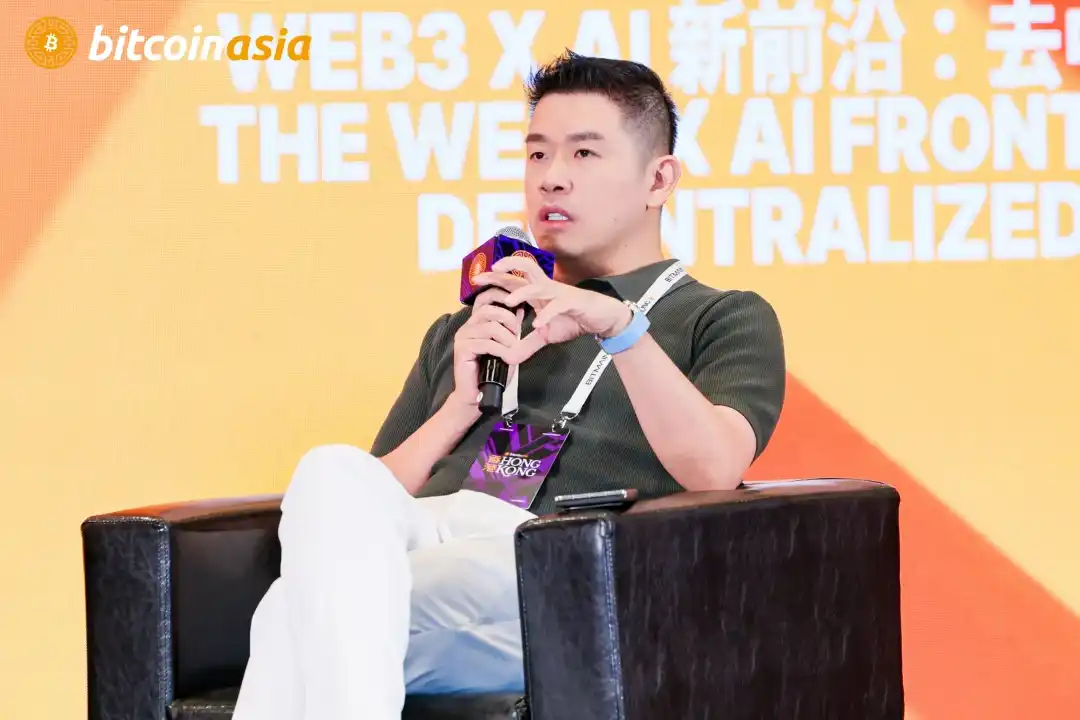
At the 'Deep Integration and Development of AI and Crypto' roundtable forum held during the Bitcoin Asia conference, Livio Weng, CEO of Bitfire (New Huo Group), stated that the core narrative for the integration of AI and Crypto in the coming years may focus on the 'agential economy.' With the continuous maturation of infrastructure such as AI identity recognition, authorized wallets, and payment protocols, AI will gradually gain the ability to autonomously use, manage, and transact assets. This will lead to a deep integration with existing crypto industry sectors such as trading, prediction markets, asset management, and payments.
Livio believes that real-world assets (RWA) will become a crucial bridge connecting carbon-based humans and silicon-based AI. On one hand, RWA can tokenize traditional assets, enabling AI to use and trade assets from human society. On the other hand, 'AI assets' such as AI computing power, AI data, and AI-generated services can also be made available to humans in the form of RWA, for purchase, analysis, and trading. This process will drive carbon-based humans and silicon-based AI into a deeper stage of integration.
'Currently, there are approximately 100 to 200 million active crypto users globally. The next 100 to 200 million new crypto users may no longer be humans, but rather AI Agents,' Livio said. He added that future critical infrastructure and applications might also no longer be primarily written by humans but autonomously generated by AI. As AI gradually evolves from an information assistant to a wealth management assistant and further develops the ability to autonomously execute tasks, AI Agents are expected to become significant participants in the Crypto ecosystem.
Livio also pointed out that the deep integration of AI and Crypto still requires the improvement of underlying infrastructure. This includes a settlement layer supporting machine-autonomous transactions, an identity and authorization layer granting AI independent identity and enabling entity recognition, and a reward/punishment layer establishing accountability mechanisms for fraud and misconduct. Among these, protocols like X402 are exploring applications such as machine-autonomous payments, and protocols like EIP-8004 continue to advance the development of AI identity and entity interaction mechanisms. However, the industry still needs to address issues related to security, governance, and ethics.
Regarding business practices, Livio mentioned that New Huo is actively embracing RWA to seize the opportunities presented by the integration of AI and Crypto. New Huo officially announced the launch of its RWA comprehensive operator services on August 26 and released Hong Kong's first compliant crypto asset quantitative strategy. This strategy is expected to provide more cross-asset allocation and risk hedging opportunities through the introduction of RWA assets, helping investors balance volatility across different asset classes and market cycles.
Livio stated that RWA is not only a vehicle for traditional assets to enter the on-chain world but may also become important infrastructure for AI to participate in the real economy, use real-world assets, and provide services to humans. As the machine economy gradually develops, there will be a broader intersection of applications between AI and Crypto, and related fields still possess significant potential for innovation and growth.