This Week in Crypto Watch|Grayscale Zcash ETF Goes Live Today, Virtuals Lands Solana AI Agent Ownership

marsbitPublicado a 2026-08-25Actualizado a 2026-08-25

Resumen

This week in crypto, Grayscale's Zcash Trust (ZEC) is set to debut as the first U.S. spot ETF directly holding a privacy coin, pending approvals. The ZEC price surged over 70% ahead of the anticipated listing. Meanwhile, Virtuals Protocol has expanded to Solana, enabling users to own and tokenize AI Agents. Its Automated Capital Formation mechanism has raised over $6.8M for Agents. In macro news, U.S. Treasury Secretary Scott Bessent launched "Operation Economic Outcast," a major financial offensive targeting Iran, with digital assets named as a key focus area. Kinetiq announced Elysium, an EVM L2 for Hyperliquid, where 50% of sequencer fees will fund KNTQ buybacks and burns. Polygon co-founder Sandeep Nailwal is advancing a staking and tokenomics overhaul, which could nearly double staking rewards for POL holders. Other notable updates include NEAR's plans for confidential perps, Extended's European compliance strategy, and Fed Chair Kevin Warsh's upcoming key speech at Jackson Hole.

Author: Claude, Deep Chao TechFlow

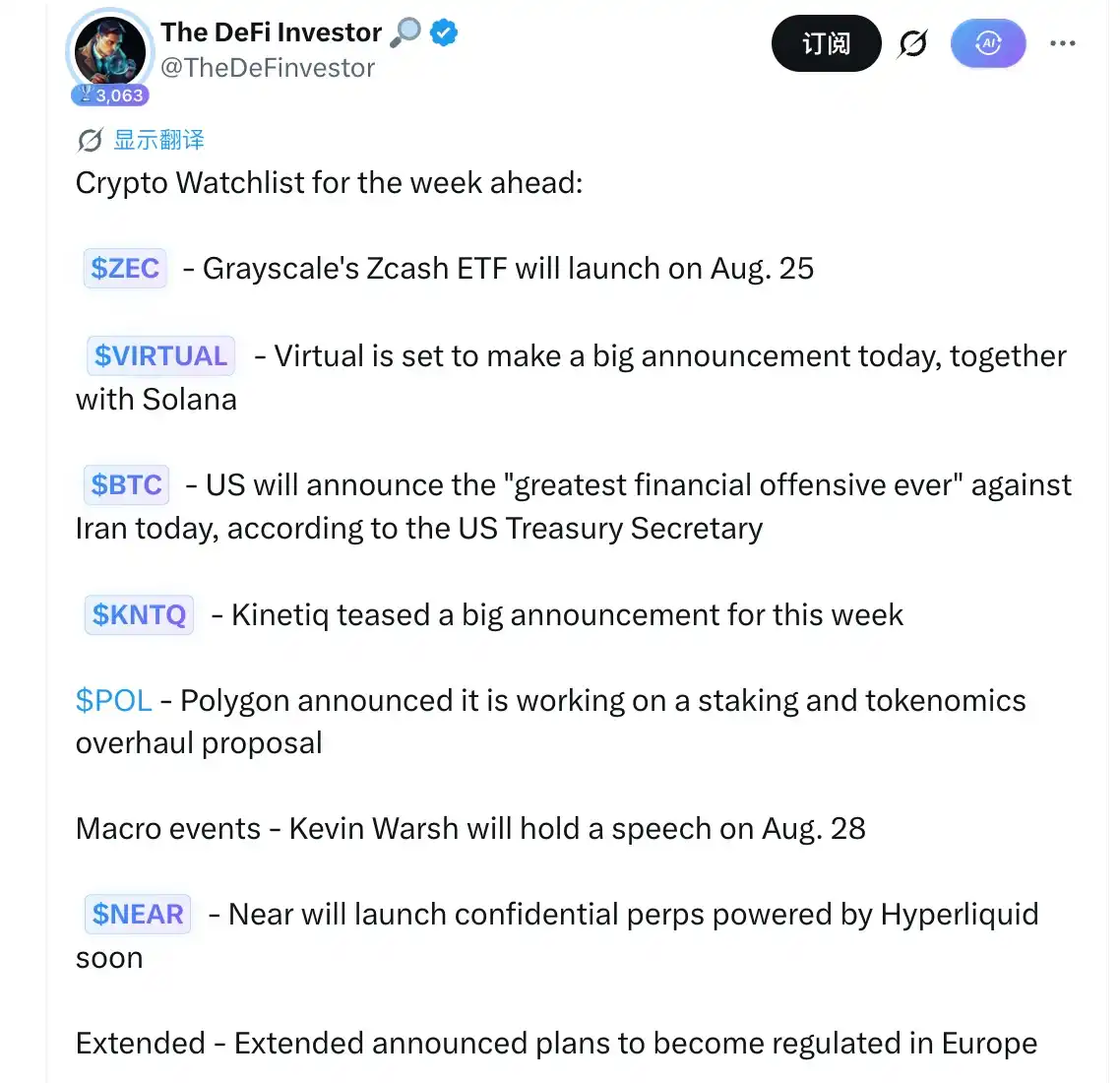
Deep Chao Guide: Crypto KOL @TheDeFinvestor lists this week's catalyst watchlist.

The biggest news is the Grayscale Zcash Trust is expected to list on NYSE Arca on August 25 under the ticker ZCSH, becoming the first US spot ETF to directly hold a privacy coin. ZEC has risen over 70% in the past week, hitting an 8-year high.

Meanwhile, the Virtuals Protocol officially opened AI Agent ownership and tokenization to Solana users on August 24. The ACF mechanism has cumulatively raised over $6.8 million for Agents. US Treasury Secretary Scott Bessent also announced the launch of "Operation Economic Outcast" on the same day, calling it the "largest financial offensive ever" against Iran, with digital assets listed as one of the key target areas. Kinetiq announced Elysium, an L2 network for Hyperliquid, with 50% of sequencer fees to be used for KNTQ buyback and burn. Polygon co-founder Sandeep Nailwal is advancing proposals for staking and tokenomics reform, with POL staking yields potentially nearly doubling.
ZEC: Grayscale Zcash ETF Expected to List on August 25, First US Privacy Coin Spot Product

This is the most certain event of the week.

According to a Form 8-K filed by Grayscale with the SEC on August 21, shares of the Grayscale Zcash Trust (ZEC) are expected to begin trading on NYSE Arca around August 25 under the ticker ZCSH. The trust will be renamed The Zcash ETF concurrently. Listing is still subject to obtaining relevant regulatory approvals, and the filing explicitly states "no assurance can be given that the Shares will commence trading as expected."

The amended S-3 filing sets the sponsor fee at an annual rate of 2.5% (calculated based on NAV, accrued daily), which is the trust's only general recurring expense. The trust currently holds approximately 391k to 393k ZEC, with assets under management totaling about $263.5 million as of August 21. Coinbase Custody serves as the custodian, and Jane Street Capital and Virtu Americas act as authorized participants.

DCG International Investment Company is still in discussions to contribute about 200k ZEC to the trust in exchange for shares, but this transaction has not been finalized. The market has reacted strongly: ZEC has risen over 70% in the past week, once touching an 8-year high of around $885 before falling back to around $820. Futures open interest has also surpassed that of DOGE and BNB.

If successfully listed, this will be the first spot ETF in the US market to directly track a privacy coin. The privacy features themselves still face regulatory and exchange access risks, but opening an institutional channel changes accessibility.

VIRTUAL: Virtuals Officially Opens AI Agent Ownership to Solana Users

On August 24, the Virtuals Protocol and Solana jointly announced: millions of users can now directly own working AI Agents on Solana.

According to official and Solana-related reports, Virtuals has extended its tokenized AI Agent system to Solana. Users can create tokens tied to AI Agents and connect the Agents to wallets and on-chain services. Agents can autonomously raise capital, set taxes, fund their own intelligence, and trade with their own wallets, with profits shared by the owners.

The core mechanism, Automated Capital Formation (ACF), has cumulatively raised over $6.8 million for Agents on the platform as of August 24. Tokens are traded via Meteora DBC pools with a 1% fee, of which 70% goes to the creator and 30% to the Virtuals treasury. Upon cumulatively reaching 42k VIRTUAL tokens, a token automatically "graduates," with liquidity migrating to a public Meteora pool and LP tokens locked for 10 years.

VIRTUAL tokens had previously been bridged to Solana via LayerZero, with foundations laid in early 2025 and further developments in June with the launch of the Agent creation launchpad and cross-chain asset bridge. As of August 23, there were approximately 28.2k VIRTUAL holders on Solana. This move shifts the focus from "creation" to "ownership" for a broader Solana user base.

Macro: US Launches "Largest Financial Offensive Ever" Against Iran

US Treasury Secretary Scott Bessent announced the launch of Operation Economic Outcast on August 24.

Bessent used the same phrase repeatedly in statements and media appearances: "the single greatest financial offensive ever marshaled against an adversary," calling it an "economic D-Day." The operation's goal is to sever every economic lifeline for Iran and its supporters, with a focus on five key areas: digital assets, technology, gold, aviation, and shipping.

The Treasury has imposed sanctions on over 60 entities, individuals, and vessels worldwide and expanded the scope of secondary sanctions. Any entity assisting Iran in money laundering will be cut off from the dollar system. "The clock has already started ticking," Bessent said, adding that Iran now has only two paths: complete global isolation or a return to a normal economy.

The potential impact on the crypto market stems mainly from digital assets being explicitly listed as a target, alongside broader risk-off sentiment and changes in dollar liquidity. As a macro asset, BTC could see short-term sentiment-driven volatility.

KNTQ: Kinetiq Launches Hyperliquid L2 Elysium, 50% Fees for Buyback & Burn

Kinetiq (the largest liquid staking protocol on Hyperliquid) officially announced Elysium on August 24.

Elysium is a high-performance EVM L2 specifically built for the Hyperliquid ecosystem, using HYPE as its gas token and deeply integrated with HyperCore. Its goals are to address HyperEVM throughput and peak fee issues while significantly improving spot trading experience, PropAMM deployment, and the token lifecycle (from long-tail AMM launch → deep liquidity → HyperCore spot order book → HIP-3 perps).

Sequencer fee allocation is clear: 25% to developers, 25% to the Kinetiq treasury, and 50% for open market KNTQ buybacks, all of which will be burned (via the Hyperliquid Assistance Fund). Kinetiq stated that Elysium is launching soon, with technical specifications and core partner information to follow.

KNTQ rose over 30% briefly after the announcement before paring some gains.

POL: Polygon Advances Staking and Tokenomics Reform, Staking Yields Could Double

Polygon co-founder Sandeep Nailwal stated on August 23-24 that, in response to strong community demand, the team is advancing proposals for staking and tokenomics reform.

Key elements include: introducing native staking mechanisms on Polygon PoS similar to L1s (which can run parallel to Ethereum staking); priority fees from each transaction will be distributed to POL stakers (PIP-85 has been approved, native staking can simplify implementation); staking yields are expected to nearly double, with the increase mainly coming from real network fees rather than inflation; staking POL may receive additional incentives like gas discounts; and sPOL remains liquid and usable in DeFi.

Nailwal also revealed that Polygon's revenue has grown 10x this year, currently reaching 5000 TPS, with block time already reduced by 25%, and efforts are underway to push block time below 1 second. Polygon Labs will be responsible for code development and submitting it to the community forum for approval.

Other Catalyst Overview

NEAR: Confidential perps powered by Hyperliquid are coming soon.

NEAR had previously launched Hyperliquid perps on near.com, allowing users to deposit assets directly from 35+ chains to trade 50+ markets. The official team previously explicitly stated that "the next step is confidential perps." Combined with NEAR's already-launched Confidential Intents (private shard execution to avoid MEV and strategy exposure), a confidential version of perpetuals is seen as a natural extension.

Extended: Announces European compliance pathway.

Extended plans to establish a dedicated regulatory framework in Europe to gain direct access to EU retail users, as well as B2B distribution via brokers, fintechs, and consumer platforms. The project emphasizes this is a major expansion of its existing business, which will also affect the preparation for TGE (including compliance work for the token and corporate structure).

Macro Event: Kevin Warsh's Jackson Hole Speech on August 28.

Fed Chair Kevin Warsh will deliver his first major public speech since taking office at the Jackson Hole Economic Symposium. The market is focused on his communication style, inflation path, and interest rate framework, especially against the backdrop of record US Treasury yields and public debt.

Preguntas relacionadas

QWhen is the Grayscale Zcash Trust (ZEC) expected to list on NYSE Arca and what is its proposed ticker symbol?

AThe Grayscale Zcash Trust (ZEC) is expected to list on NYSE Arca on or around August 25, with the proposed ticker symbol ZCSH.

QWhat is the Automated Capital Formation (ACF) mechanism in the Virtuals Protocol and how much total funding has it raised for AI Agents?

AThe Automated Capital Formation (ACF) mechanism in the Virtuals Protocol allows AI Agents to autonomously raise capital. As of August 24, it has cumulatively raised over $6.8 million for platform Agents.

QWhat is the name of the financial operation launched by the US against Iran, and which five areas were listed as key targets?

AThe US launched 'Operation Economic Outcast' against Iran. The five key target areas are digital assets, technology, gold, aviation, and shipping.

QWhat is the name of the L2 network launched by Kinetiq for Hyperliquid, and what percentage of sequencer fees will be used to buy back and burn KNTQ tokens?

AKinetiq launched an L2 network called Elysium for Hyperliquid. 50% of the sequencer fees will be used for public market buybacks of KNTQ tokens, which are then entirely burned.

QWhat are the core elements of the proposed staking and tokenomics reform for Polygon (POL) as mentioned by co-founder Sandeep Nailwal?

AThe core proposals include introducing native staking on Polygon PoS, distributing transaction priority fees to POL stakers (as per approved PIP-85), which could nearly double staking yields, and allowing staked POL (sPOL) to remain liquid for use in DeFi.

Lecturas Relacionadas

Zcash's ETF Gilding: How a Privacy Coin Was Packaged by Wall Street into a Compliant Asset

The article traces the decade-long path of Zcash (ZEC), a privacy-focused cryptocurrency, to its potential launch as the first privacy coin spot ETF, with Grayscale's ZCSH filing in August 2026. It argues ZEC's suitability stemmed not from regulatory acceptance of its privacy technology, but from its centralized, institutional structure from inception—a commercial company (ECC) with venture capital backing and a Founder's Reward—making it easier to package than decentralized alternatives. Three key institutions, intertwined in a network, drove the process: Grayscale (owned by DCG, an early ZEC investor), which had held ZEC in a trust since 2017; Coinbase, providing custody, prime brokerage, derivatives, and venture investment; and ZODL, a new for-profit entity formed in 2026 when ECC's core development team split from the non-profit foundation. The major regulatory hurdle was SEC scrutiny (2023-2026) over ZEC's historical structure, which resembled an unregistered investment contract due to automatic block rewards to ECC and the Foundation. This was resolved through governance changes (NU6 upgrade in 2024) that ended direct funding and shifted control to community voting, coinciding with a broader shift in SEC enforcement policy. Notably, the law firm Davis Polk represented both the Zcash Foundation in its SEC defense and Grayscale in the ETF filing. The push is also driven by DCG's dire financial needs amid Genesis bankruptcy lawsuits, seeking high-fee products (the ZEC ETF charges 2.5%). Concurrently, major mining operations by entities like Cypherpunk Technologies (backed by Winklevoss Capital) and DCG's Fortitude Mining expanded, motivated by profitability and aiming to influence the network. The article concludes with irony: to become a compliant ETF asset, ZEC must shed its core privacy feature for the fund's holdings, which will be held in transparent, auditable addresses. Wall Street is not adopting privacy technology but packaging the *concept* of privacy into a tradable, fee-generating financial product. The transformation was not a single master plan but the result of a network of aligned interests capitalizing on regulatory, governance, and market shifts over ten years.

marsbitHace 8 min(s)

Zcash's ETF Gilding: How a Privacy Coin Was Packaged by Wall Street into a Compliant Asset

marsbitHace 8 min(s)

Bitcoin Core Developer Warns That Bitcoin Payments Are Disappearing at 'Bitcoin Beach'

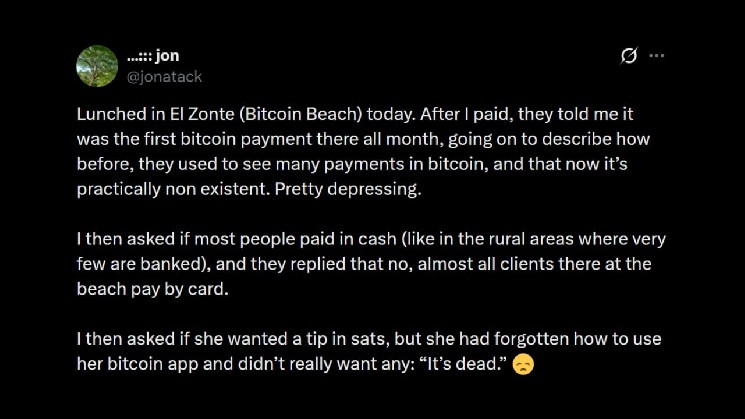
A Bitcoin Core developer, John Atack, who has lived in El Salvador since 2022, shared a concerning anecdote about Bitcoin adoption in the country. While dining at El Zonte, a region known as "Bitcoin Beach," he paid with Bitcoin and was told it was the first such payment the establishment had received in a month. Staff explained Bitcoin payments, once common, have now virtually disappeared, with nearly all customers using cards. An employee even declined a Bitcoin tip, stating she had forgotten how to use her wallet and declaring "It's already dead." Atack emphasized this was a single observation but noted the employee had witnessed the payment evolution over three years. His comments sparked mixed reactions. Some disputed his experience, with one user confirming successful Bitcoin payments in the same area. However, Bitcoin reporter Juan Galt acknowledged an underlying "economic problem," arguing that expecting price appreciation makes using Bitcoin for everyday transactions counterintuitive to economic incentives needed for a circular crypto economy. Despite the concerning report, Atack also reflected that El Salvador remains a global leader in cryptocurrency adoption and progressive legislation, sometimes causing locals to take these advancements for granted. The story highlights the ongoing challenges of mainstream Bitcoin adoption for daily commerce, even in pioneering nations.

cryptonews.ruHace 11 min(s)

Bitcoin Core Developer Warns That Bitcoin Payments Are Disappearing at 'Bitcoin Beach'

cryptonews.ruHace 11 min(s)

A Huge 'Sleeping' Wave of New Bitcoin Buyers Has Not Even Bought Bitcoin Yet

A recent study by the Federal Reserve Bank of Cleveland, titled "Do You Even Crypto, Bro? Cryptocurrencies in Household Finance," reveals that Bitcoin and other crypto assets are less understood than other financial assets in US households. The primary reasons for not owning crypto are a lack of knowledge and the perception that it is a poor investment. Even among owners, the main motivations are profit-seeking and portfolio diversification rather than an understanding of the underlying technology's benefits, such as independence from banks. The research found that showing respondents Bitcoin's past 12-month performance increased their desired portfolio allocation by about 47%, indicating investment decisions are driven more by recent returns than fundamental comprehension. Crypto gains are often treated like lottery winnings, leading to one-off luxury purchases rather than sustained increases in spending. While non-owners largely view crypto as high-risk, owners are somewhat less likely to do so, though they exhibit greater uncertainty about future returns compared to traditional assets like stocks or gold. This ambiguity about Bitcoin's nature and valuation contributes directly to its price volatility. The study concludes that this volatility will persist, but education efforts combined with price appreciation could convert today's uninformed non-owners into future Bitcoin holders.

cryptonews.ruHace 13 min(s)

A Huge 'Sleeping' Wave of New Bitcoin Buyers Has Not Even Bought Bitcoin Yet

cryptonews.ruHace 13 min(s)

Grain Prices Haven't Taken Off Yet, So Why Have Fertilizer Prices Risen First?

Fertilizer prices are rising ahead of a potential global food price surge, driven primarily by supply-side constraints rather than current agricultural demand. While a strong El Niño is forecast for late 2026, its impact is expected to be initially limited to specific crops like palm oil and rubber, not leading to immediate, broad-based grain shortages. The fertilizer market is currently propelled by its own dynamics: **Urea** faces domestic oversupply in China, with its price reliant on the potential to export to higher-priced international markets. **Phosphate fertilizers** are experiencing a rare "supply-led" cycle due to global sulfur shortages, shipping disruptions, and production cuts overseas, placing Chinese producers with integrated resources and export channels in a key position. **Potash** supply is tightening due to planned maintenance and production cuts at major global producers, underpinning its long-term resource scarcity narrative. Looking ahead to 2027, a prolonged El Niño could shift the market into a second phase of "demand-supply resonance." If extreme weather significantly impacts crop yields and global grain inventories, rising food prices and farmer income would boost fertilizer application demand. This potential demand surge, layered onto the existing supply constraints, could amplify the price cycle. The overarching theme is that **food security is redefining the strategic value of fertilizers**, particularly for resource-constrained phosphate and potash. Policy priorities balancing domestic supply guarantees with export opportunities, coupled with resource ownership and global supply chain access, are becoming critical determinants of profitability beyond short-term weather cycles.

marsbitHace 16 min(s)

Grain Prices Haven't Taken Off Yet, So Why Have Fertilizer Prices Risen First?

marsbitHace 16 min(s)

Trading

Spot
活动图片