Bitcoin is currently testing the $69,000 level as resistance after rebounding from the $64,000 zone, attempting to recover from its recent corrective phase. While the short-term momentum appears constructive, broader market conditions suggest that conviction remains limited. The move higher is unfolding in an environment characterized by reduced participation and compressed liquidity.
According to top analyst Darkfost, February is on track to close as the month with the lowest Bitcoin spot trading volumes since the beginning of 2024. This contraction in activity coincides with BTC revisiting price levels last observed last year, reinforcing the perception of a market stuck in a defensive posture rather than entering a renewed expansion phase.
Despite the slowdown, Binance continues to dominate spot trading with nearly $75 billion in monthly volume, significantly ahead of Gate.io at $25 billion and Bybit at $20 billion. However, overall liquidity across the crypto market remains constrained, particularly following the October 10 shock that saw open interest decline by more than 70,000 BTC — roughly $8 billion in notional value.
Spot Volume Contraction Signals Market Caution
The ongoing decline in spot trading activity provides a useful lens for understanding current Bitcoin market dynamics. Darkfost notes that participation across major exchanges has fallen markedly since the October peak, with aggregate spot volumes roughly halved. Binance’s monthly volume has dropped from about $198 billion to $75 billion, Gate.io from $53 billion to $25 billion, and Bybit from $41 billion to roughly $20 billion. The fact that this pattern spans multiple leading venues suggests a systemic shift rather than exchange-specific behavior.
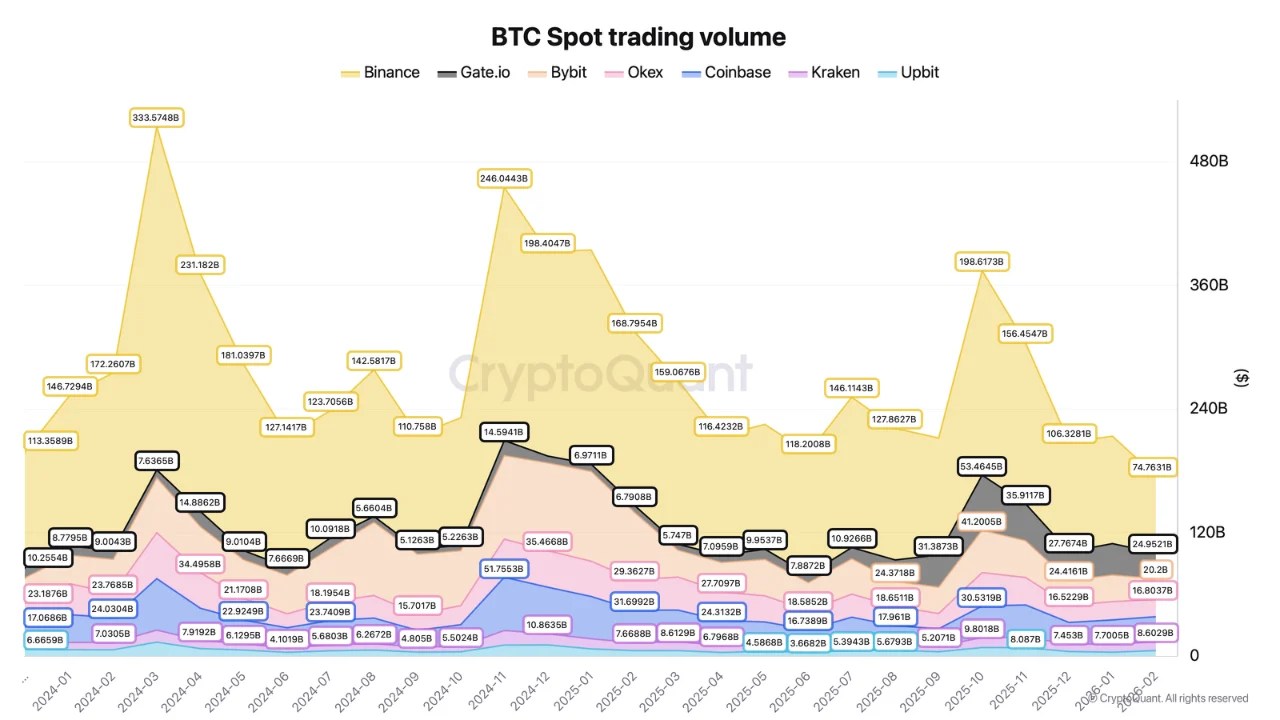
From a market-structure perspective, shrinking spot volumes typically indicate reduced conviction. When liquidity thins, price moves can become less reliable because they are driven by smaller capital flows. This environment often coincides with consolidation phases, where both buyers and sellers adopt a wait-and-see approach rather than aggressively positioning.
Importantly, weaker spot participation can delay trend formation. Sustained bullish recoveries historically require expanding spot demand, as derivatives-driven rallies alone tend to lack durability. Conversely, declining spot flows may also reflect capital rotation toward other asset classes amid macro uncertainty.
The key variable will be whether spot participation stabilizes or begins to recover. A meaningful rebound in volumes would signal renewed confidence, whereas continued contraction would reinforce the current defensive market posture.