From Pizza to Unit of Account: A Prehistory of Bitcoin Price Discovery

marsbitPublicado a 2026-05-19Actualizado a 2026-05-19

Resumen

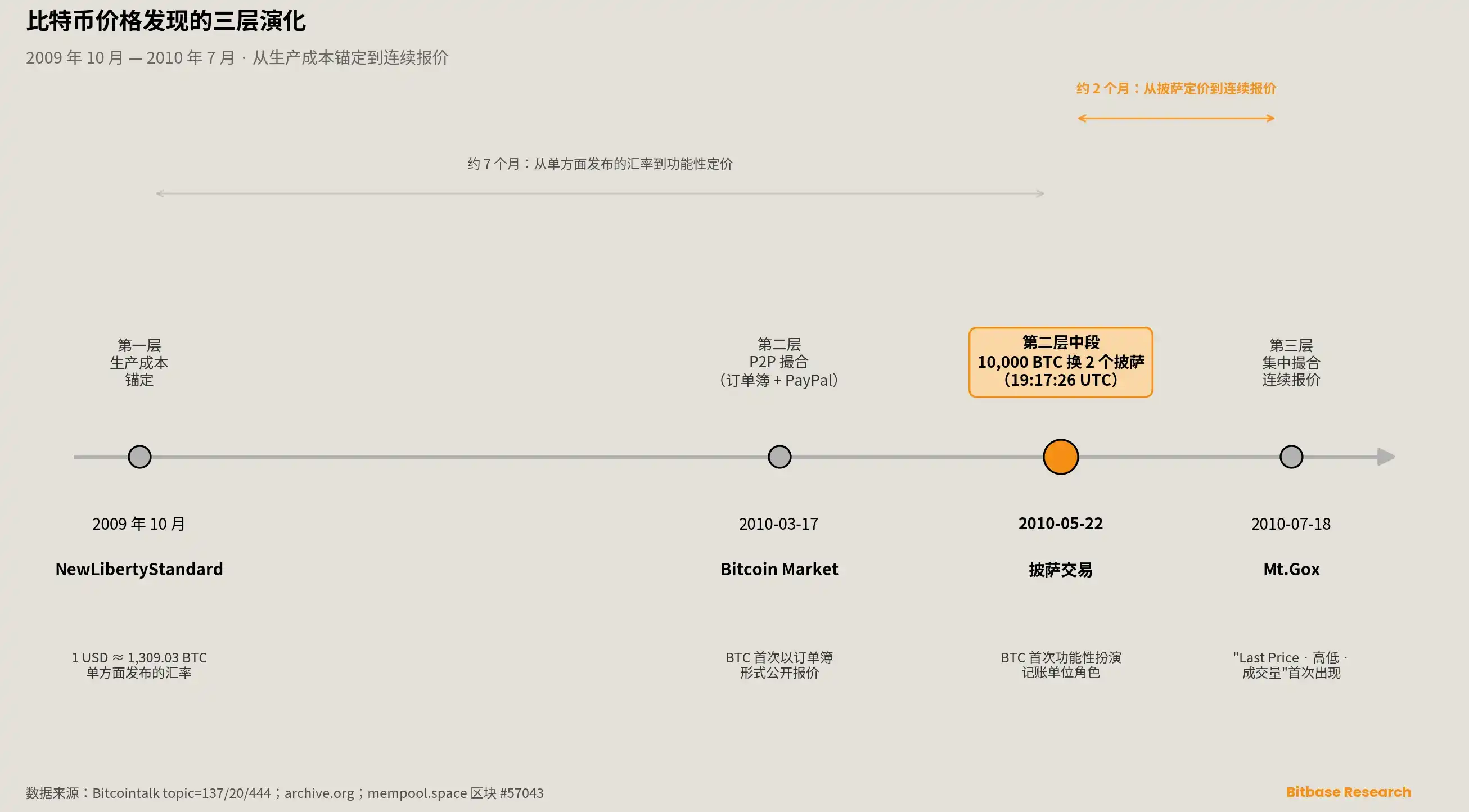
From Pizza to Unit of Account: The Prehistory of Bitcoin Price Discovery This article traces Bitcoin's earliest price discovery mechanisms, focusing on its functional evolution as a unit of account rather than its price trajectory. The analysis centers on a nine-month period from October 2009 to July 2010, identifying three distinct, sequential layers of price formation. The narrative begins with the cost-of-production anchor established by NewLibertyStandard in October 2009, which calculated a unilateral USD/BTC exchange rate based on the electricity cost of mining. This constituted a posted rate, not a market-discovered price. The second layer emerged with peer-to-peer (P2P) discovery mechanisms starting in March 2010. This included Dustin Dollar's Bitcoin Market platform, which introduced a basic public order book, and forum-based实物 trades. The pivotal event in this phase was Laszlo Hanyecz's purchase of two pizzas for 10,000 BTC on May 22, 2010. Critically, the offer was made exclusively in BTC ("10,000 bitcoins for a couple of pizzas"), marking the first documented instance where Bitcoin functionally acted as a unit of account to price another good in a real transaction, 21 days before Hanyecz later provided a USD anchor (~$25). The third layer commenced in July 2010 with Jed McCaleb's launch of the Mt.Gox exchange. Its continuous order book, with last price, highs, lows, and volume, provided the first standardized, externally referenceable format for BTC/USD prices....

Prologue

On May 22, 2010, Laszlo Hanyecz exchanged 10,000 BTC for two pizzas. This day was later dubbed Bitcoin Pizza Day, commemorated annually by the crypto community in a specific way—multiplying the value of 10,000 BTC from that day by the current fiat price to produce a starkly contrasting figure, captioned "the most expensive pizza in history."

This article does not calculate that compound interest.

This article discusses something else: on May 22, 2010, Bitcoin (BTC) was, for the first time, used as a unit to price another commodity in a real transaction. This is the verifiable moment when BTC first functionally played the "unit of account" role among the three functions of money (medium of exchange / unit of account / store of value). This moment sits at the midpoint of a longer timeline of mechanisms—from cost-of-production anchoring (NewLibertyStandard), to P2P matching and discovery (Bitcoin Market), to centralized matching with continuous quotes (Mt.Gox). What Bitbase Research aims to reconstruct is this nine-month prehistory and its comparable forms with the evolutionary paths of price discovery mechanisms for various asset classes throughout history.

Chapter One · What is a "Price"—The Birth of a Unit of Account

1.1 The Three Functions of Money and the Conceptual Boundary of "Price"

The functions of money are standardly defined in financial economics textbooks. Frederic Mishkin, in Chapter 3 of the 13th edition of "The Economics of Money, Banking, and Financial Markets," divides monetary functions into three items [1]: medium of exchange, unit of account, store of value. John Hicks's judgment in the opening of "Critical Essays in Monetary Theory" (Oxford, 1967) is more concise—"money is what money does"; money is defined by its functions, not its physical form [2].

This distinction has specific methodological significance for this article. Something "having an exchange rate" is not the same as "having a price." An exchange rate can be unilaterally published—a third-party observer calculates the conversion ratio between two assets and then announces it; it does not require market participants to conclude transactions based on it, nor does it require others to reference this ratio to price their goods. Price is different. Price is the product of market matching; it requires at least two parties to agree on a conversion ratio for a specific transaction at a specific moment, and this ratio can be recognized, referenced, and reused by third parties.

By this distinction, before May 22, 2010, BTC was in a specific semantic state: it had an exchange rate, but it did not have a market price in the market sense.

1.2 The Functional Performance of "Unit of Account"

Among the three functions of money, medium of exchange and unit of account are often intuitively conflated, but they are not equivalent. The former describes "using this thing as an intermediary in a transaction"—as long as both parties are willing, anything can perform this function. The latter describes "using this thing as the unit for pricing other things." A commodity being used as a payment instrument in a transaction does not necessarily mean it simultaneously functions to price that commodity.

On May 18, 2010, Laszlo Hanyecz wrote in the initiating post of Bitcointalk topic=137: "I'll pay 10,000 bitcoins for a couple of pizzas," and explicitly allowed the other party to order Papa John's pizzas on his behalf [3]. No US Dollar (USD) amount appears in the entire initiating post—he did not say "pizzas worth how many dollars"; he said "10,000 bitcoins for two pizzas." When the completion of this transaction was reported at 19:17:26 UTC on May 22 [4], something happened at the functional level: two pizzas were priced in units of "10,000 BTC."

This is the verifiable moment when BTC was first functionally performed as a unit of account. "Functionally performing this role" and "fully satisfying this function in monetary definition" are two different things. The latter requires this unit to be consistently used as a pricing identifier across groups of traders, a condition only partially met after Mt.Gox's continuous quoting. May 22 is the first time this function appeared in an actual transaction.

Notably, the figure "about $25" does not appear in the initiating post of May 18. Hanyecz gave this fiat anchor for the first time in a subsequent reply in the same thread on June 12, 2010, at 20:14:44 UTC [5]. BTC first assumed the function of pricing pizzas in a transaction; the semantic act of "reverse identification between BTC and USD" occurred 21 days later. This temporal sequence has methodological significance: BTC's functional performance as a unit of account occurred before the bidirectional identification between BTC and USD was completed.

Chapter Two · Mechanism Timeline

This chapter reconstructs the three-tier mechanism evolution from October 2009 to July 2010 in chronological order. Each section provides firsthand timestamps, firsthand post IDs, and a description of the mechanism itself.
2.1 Tier One · Cost-of-Production Anchoring (From October 2009)

NewLibertyStandard (hereafter NLS) published a BTC-to-USD exchange rate formula on its webpage newlibertystandard.wetpaint.com in October 2009. The website is now offline. As of May 14, 2026, the earliest recorded archive.org snapshot is from December 29, 2009, 13:26:10 UTC [6]. The formula on the snapshot reads:

During 2009 my exchange rate was calculated by dividing $1.00 by the average amount of electricity required to run a computer with high CPU for a year, 1,331.5 kWh, multiplied by the average residential cost of electricity in the United States for the previous year, $0.1136, divided by 12 months divided by the number of bitcoins generated by my computer over the past 30 days.

The methodology of this formula is to anchor BTC's value to the "marginal production cost of running a miner"—electricity cost divided by BTC output per unit time. It is essentially an extension of the classical labor-energy theory of value to digital assets: BTC had no market; it was priced by the electric meter. This is a "unilaterally published exchange rate," not a market-matched price.

The first exchange rate figure publicized by NLS, 1 USD ≈ 1,309.03 BTC, has been widely reused in secondary narratives, but there is no original post by NLS himself on the Bitcointalk forum citing this number [7]. This study adopts the archived snapshot data and honestly notes: as of May 14, 2026, this specific number is only available from the first-hand source of the archive snapshot.

Separate from NLS, the earliest recorded BTC-to-USD transaction was conducted by Martti Malmi, an early Bitcoin core contributor—on October 12, 2009, Malmi transferred 5,050 BTC to NLS, received $5.02 via PayPal, and confirmed it in a tweet on January 15, 2014 [8].

2.2 Tier Two · P2P Matching and Discovery (From March 2010)

The second tier mechanism was initiated by dwdollar (real identity Dustin Dollar). On January 15, 2010, at 09:42:18 UTC, dwdollar initiated a motion in Bitcointalk topic=20 msg=100 [9]: "I'm in the process of building an exchange. ... It will be a real market where people will be able to buy and sell Bitcoins with each other."

The platform Bitcoin Market began service on March 17, 2010. dwdollar's update post that day read: "Looks like we had our first real trade around noon!"—this was the first BTC-to-USD transaction matched via a quasi-public order book.

The matching mechanism of Bitcoin Market needs to be stated factually: it was not the complete form of order book matching. dwdollar self-described in msg=265 on February 6, 2010, at 22:37:44 UTC: "ONLY the limit orders work. Market orders will come later." [10]—the platform only supported limit orders, market orders were not implemented; settlement relied on PayPal intermediation, not pure on-chain settlement. Nevertheless, Bitcoin Market was the first platform to publicly display BTC quotes in an order book form; this form itself has mechanistic significance.

Parallel to Bitcoin Market during the same period was P2P physical matching on Bitcointalk. Hanyecz's pizza event is a representative case of this form. The two paths coexisted in parallel from March to July 2010—the dwdollar path proved BTC could be matched with USD to produce quotes, the Hanyecz path proved BTC could be matched with physical goods to produce quotes.

2.3 Midpoint · The Pizza Transaction (May 22, 2010)

Hanyecz's pizza transaction sits at the midpoint of the second tier in the mechanism timeline. Reconstructed in UTC chronological order:

  • 2010-05-18 00:35:20 UTC: Hanyecz issued the invitation in Bitcointalk topic=137 msg=1141 [3]. Hanyecz was located in Jacksonville, Florida, USA (EDT, UTC−4), corresponding to the local time of 2010-05-17 20:35. This timezone conversion explains why some secondary narratives date the initiation to May 17.

  • 2010-05-22 18:16:31 UTC: txid a1075db55d416d3ca199f55b6084e2115b9345e16c5cf302fc80e9d5fbf5d48d was included in block #57043 [11].

  • 2010-05-22 19:17:26 UTC: Hanyecz reported completion in msg=1195—"I just want to report that I successfully traded 10,000 bitcoins for pizza. Thanks jercos!" [4]

The 61-minute difference between the on-chain block time and the Bitcointalk confirmation post time is consistent with the narrative of "posting confirmation after pizza delivery." This time difference also independently confirms that the Bitcointalk forum displays timestamps in UTC, not Eastern Time.

The real identity and location of the counterparty jercos are often misstated in secondary narratives. jercos is Jeremy Sturdivant, who stated in a written interview with Bitcoin Who's Who on January 30, 2016: "I have yet to travel outside of the US, and am living on the west coast, near Santa Cruz, California." [12] According to Sturdivant's own account, he is an American, living near Santa Cruz, California, was 19 years old on May 22, 2010, and had never left the United States. The widely circulated description of a "19-year-old British person" is inconsistent with firsthand records.

Hanyecz withdrew the open invitation on June 4, 2010, at 17:51:05 UTC [13], stating "I can't afford that many more." Eight days later, on June 12, he reopened the invitation in msg=1526 and gave the USD anchor for the first time: two pizzas costing about $25, maybe $30 with a tip [5].

2.4 Tier Three · Centralized Matching with Continuous Quotes (From July 2010)

On July 18, 2010, at 01:57:19 UTC, username mtgox posted an announcement in Bitcointalk topic=444 msg=3866: "Hi Everyone, I just put up a new bitcoin exchange." [14] The operator behind this account was Jed McCaleb—founder of eDonkey, the original holder of the mtgox.com domain (an acronym for Magic: The Gathering Online eXchange). The Wayback Machine's earliest recorded capture of mtgox.com is August 17, 2007 [15], about 17 months before the BTC genesis block; this domain was repurposed as a BTC exchange in July 2010.

McCaleb described the platform's quoting architecture in msg=3873 (2010-07-18 02:15:09 UTC) of the same thread [14]: "Last Price ... High ... Low ... Volume ... Current Lowest Buy Price; Current Highest Sell Price ... All trades are between users."—"Last Price," "24-hour high/low," "volume," "best bid/ask"; this set of terms appeared for the first time in the Bitcoin context, marking that BTC now had a standard format for continuous quoting. The mechanistic difference was structural: matching between users rather than intermediary settlement, automatic continuous operation of the order book, 24/7 availability.

From this moment, BTC gained external referentiality in the unit of account dimension—others could say "my thing is worth X BTC," and X BTC had an uninterrupted USD identifier. Mt.Gox was announced to be transferred by McCaleb to MagicalTux (later Mark Karpelès) on March 6, 2011 [16]; its subsequent fate is another independent timeline not expanded here.

Chapter Three · Structural Similarity—The Same Curve Across Three Hundred Years

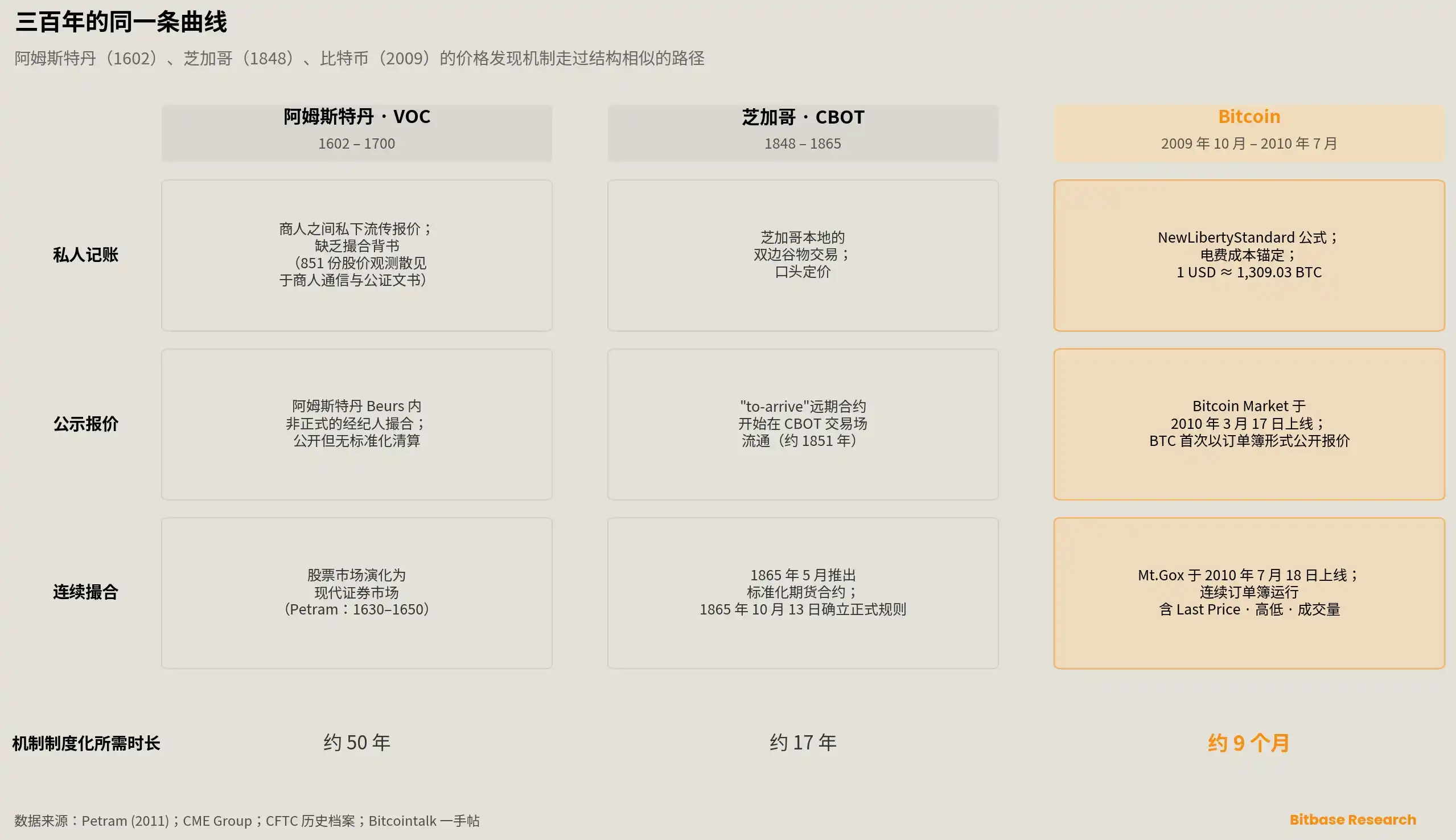
The proposition of this chapter is: The three-tier mechanism evolution completed by BTC between October 2009 and July 2010—cost-of-production anchoring → P2P matching and discovery → centralized matching with continuous quotes—has comparable structural forms with the evolutionary paths of various asset classes throughout history. This chapter presents two cases for structural comparison and does not construct a quantifiable cross-asset comparison model.

3.1 Amsterdam · The 17th-Century VOC Secondary Market

The Dutch East India Company (VOC) was established in 1602, issuing shares to 1,143 subscribers; share transfers required in-person registration by the company bookkeeper at the East India House [17]. This is generally regarded as the earliest identifiable scenario of an equity secondary market [17].

The maturation of its price discovery mechanism occurred about half a century later. Lodewijk Petram, in his 2011 PhD dissertation "The world's first stock exchange" at the University of Amsterdam, states: the stock market "evolved into a modern securities market" between 1630 and 1650, and "a continuous price discovery process took shape in that period" [17]. Petram's judgment is based on 851 sets of 17th-century stock price observation data. These data were not from official exchange records—neither the VOC nor the exchange systematically recorded prices; data were scattered in merchant correspondence, notarial deeds, and occasional newspapers. The very "dataset" of 17th-century VOC share prices grew from private bookkeeping and oral exchange rates.

The structural similarity with BTC's early path is specific. The NLS formula is to BTC what privately circulated VOC quotes among 17th-century merchants were: unilaterally published, private bookkeeping, lacking matching endorsement. Bitcoin Market is to BTC what informal broker matching within the Amsterdam Beurs was: public but lacking standardized clearing. Mt.Gox is to BTC the starting point of continuous quoting institutionalization—not the end point.

3.2 Chicago · 19th-Century CBOT Standardized Futures Contracts

The second comparison comes from 19th-century American grain trading. The Chicago Board of Trade (CBOT) was founded in 1848, initially as a spot market for commodities [18]. Around 1851, "to-arrive" forward contracts began circulating at CBOT—traders promised to deliver grain at a future date at a specified price [18].

The key institutionalization date for the price discovery mechanism is 1865. CME Group historical archives and the official history of the U.S. Commodity Futures Trading Commission (CFTC) both record [18][19]: CBOT introduced standardized futures contracts in May 1865 and established formal trading rules on October 13, 1865. There is academic controversy over this—one view holds that mature futures trading did not appear until around 1874 [18]. This study adopts 1865 as the starting point and acknowledges this periodization dispute.

The structural similarity between the CBOT path and the BTC path lies in this: the evolution from dispersed bilateral forward contracts to standardized, tradable futures contracts with margin and delivery rules follows the same curve of price discovery mechanism institutionalization. Chicago took 17 years, Bitcoin took 9 months. The difference in time scale does not dissolve the structural similarity. Price discovery in all markets does not start from an exchange; it grows from specific bilateral transactions, oral exchange rates, and private bookkeeping.
3.3 The Explanatory Power and Boundaries of Structural Similarity

Placing BTC's early path within the three-hundred-year sequence of Amsterdam–Chicago–Bitcoin yields a judgment at the mechanism level, not a quantitative model. Three assets, three institutional environments, three technological conditions, yet the price discovery mechanisms all follow the same coarse-grained path: private bookkeeping → publicized quotes → continuous matching. In other words, crypto derivatives infrastructure was not invented out of thin air; it lies on a financial institution evolution line spanning centuries.

This structural similarity argument is not a causal argument. It does not claim "BTC inevitably followed the same path as VOC and grain futures," nor does it claim "all future digital assets will follow the same curve." It claims that: when an observer faces a new asset class, the "prehistory of price discovery mechanisms" is a more enduring subject of study than "asset price trends."

Chapter Four · Acknowledging Limitations and Leaving Gaps

This piece does not expand on contemporary price discovery mechanism comparisons. ETF fund flows, CME open interest, Perpetual Futures funding rates, on-chain market-making—these are the current forms of this 16-year path, but the space and methodology required to expand on them are left for subsequent research.

There are three reverse signals for this article's core argument. First, if academic or on-chain archaeology research reveals an earlier effective entity publishing exchange rates before NewLibertyStandard, the positioning of the "first externally publicized exchange rate" needs revision. Second, if the timestamps of the three core Bitcointalk threads—topic=20, topic=137, topic=444—are proven false at the archival layer, the event anchors need resetting. Third, if the "semantic transition of unit of account" framework is replaced by a more precise monetary function evolution theory, the core argument requires revision.

This article acknowledges the following boundaries. First, "BTC's first functional performance as a unit of account" is an interpretive proposition, not the full establishment of the function in monetary definition. Second, labeling Bitcoin Market as "P2P matching and discovery" is a simplification. Third, the structural similarity argument with Amsterdam and Chicago serves only as a mechanism-level comparison and does not construct a quantifiable cross-asset comparison model. This article does not predict BTC price movements and makes no statements regarding BTC's investment attributes as a single asset.

Preguntas relacionadas

QWhat was the key significance of the Bitcoin Pizza Day transaction on May 22, 2010, according to the article?

AThe transaction marked the first documented instance where Bitcoin (BTC) functionally acted as a unit of account, pricing the two pizzas at 10,000 BTC, distinct from its use merely as a medium of exchange.

QDescribe the three-layer evolution of Bitcoin's price discovery mechanism in its first nine months as outlined in the article.

AThe evolution comprised: 1) Cost-of-production anchoring (NewLibertyStandard, October 2009), 2) P2P matching discovery (Bitcoin Market platform and Bitcointalk bartering, starting March 2010), and 3) Centralized continuous matching and quoting (Mt.Gox, starting July 2010).

QHow does the article distinguish between 'having an exchange rate' and 'having a price' in the context of early Bitcoin?

A'Having an exchange rate' refers to a unilaterally published conversion ratio that doesn't require market consensus or real transactions. 'Having a price' refers to a ratio resulting from market matching where at least two parties agree on a specific transaction, making the ratio identifiable and reusable by third parties.

QWhat structural similarity does the article draw between Bitcoin's early price discovery and the 17th-century Amsterdam VOC stock market?

ABoth followed a similar path: starting with private valuations or unilaterally published rates (NLS formula/merchant quotes), moving to informal public matching (Bitcoin Market/Beurs brokerages), and eventually evolving towards a formalized system of continuous, standardized quoting (Mt.Gox/VOC's mature price discovery process in the 1630s-1650s).

QAccording to the article, what are the potential signals that would require a revision of its core arguments?

AThe core arguments would need revision if: 1) An entity earlier than NewLibertyStandard publishing a valid exchange rate is discovered. 2) The timestamps in the core Bitcointalk threads (topics 20, 137, 444) are proven false. 3. A more precise theoretical framework for the evolution of monetary functions replaces the 'semantic leap as a unit of account' framework.

Lecturas Relacionadas

Base Native Leveraged Prediction Market OmenX Officially Launches on Mainnet

Base-native leveraged prediction market platform OmenX has officially launched on mainnet. It currently supports up to 5x leverage, with plans to increase to 10x based on platform liquidity and market conditions. Unlike traditional prediction markets where users fully collateralize YES/NO positions and wait for settlement, OmenX aims to create a trading platform-like experience. Users can open leveraged positions on event outcomes, and actively trade, adjust, or hedge these positions before the event concludes for greater capital efficiency. Alongside the mainnet launch, OmenX introduced a "Hedge-to-Earn" campaign targeting existing users of other prediction markets (initially Polymarket). This initiative allows users to claim incentives or hedging benefits on OmenX based on their existing positions, aiming to introduce them to leveraged trading and active risk management. OmenX positions itself as a derivatives trading platform for prediction market assets. The team believes that as platforms like Polymarket mainstream prediction markets, event outcomes are becoming a new tradable asset class. The next phase of demand will focus on leverage, liquidity, and advanced trading tools. Post-launch, OmenX plans to expand supported market types, optimize liquidity, and develop APIs and additional trading tools. The team is also in discussions with investors and partners to secure resources for further development.

链捕手Hace 15 min(s)

Base Native Leveraged Prediction Market OmenX Officially Launches on Mainnet

链捕手Hace 15 min(s)

South Korea’s KB Financial Completes Stablecoin Pilot As Lawmakers Press For Regulatory Framework

South Korea's KB Financial Group has completed a Proof-of-Concept (PoC) for a won-denominated stablecoin in partnership with several companies. The pilot integrated the entire financial process—from stablecoin issuance to offline payments, merchant settlements, and international remittances—into a single blockchain-based workflow. A key test involved offline payments at a coffee shop via QR code without requiring a digital wallet. For international transfers, the model converted the won stablecoin to a dollar stablecoin, completing the process within three minutes and reducing fees by approximately 87% compared to traditional methods. KB aims to launch services once digital asset regulations are established. However, South Korea's Digital Asset Act, which would establish rules for such stablecoins, faces significant delays due to a disagreement between the Financial Services Commission (FSC) and the Bank of Korea (BOK). The central bank advocates for a consortium of banks to hold a majority stake in any issuer, while the FSC worries this could stifle innovation and tech firm participation. Lawmakers and experts have urged the National Assembly to prioritize the legislation, warning that South Korea is falling behind in the global digital asset market despite accounting for 10% of global transactions. Bank of Korea Deputy Governor Chang Cheong-soo acknowledged the potential of won-pegged stablecoins as a competitive future payment method.

bitcoinistHace 1 hora(s)

South Korea’s KB Financial Completes Stablecoin Pilot As Lawmakers Press For Regulatory Framework

bitcoinistHace 1 hora(s)

Trading

Spot
Futuros

Artículos destacados

Qué es BITCOIN

Entendiendo HarryPotterObamaSonic10Inu (ERC-20) y Su Posición en el Espacio Cripto En los últimos años, el mercado de criptomonedas ha sido testigo de un aumento en la popularidad de las monedas meme, capturando el interés no solo de los comerciantes, sino también de aquellos que buscan compromiso comunitario y valor de entretenimiento. Entre estos tokens únicos se encuentra HarryPotterObamaSonic10Inu (ERC-20), un proyecto intrigante que mezcla referencias culturales en el tejido de las criptomonedas. Este artículo profundiza en los aspectos clave de HarryPotterObamaSonic10Inu, explorando sus mecanismos, ethos impulsado por la comunidad y su relación con el paisaje cripto más amplio. ¿Qué es HarryPotterObamaSonic10Inu (ERC-20)? Como su nombre sugiere, HarryPotterObamaSonic10Inu es una moneda meme construida sobre la blockchain de Ethereum, clasificada bajo el estándar ERC-20. A diferencia de las criptomonedas tradicionales que pueden enfatizar la utilidad práctica o el potencial de inversión, este token prospera en el valor de entretenimiento y la fuerza de su comunidad. El proyecto tiene como objetivo fomentar un entorno donde los usuarios comprometidos puedan reunirse, compartir ideas y participar en actividades inspiradas por diversos fenómenos culturales. Una característica notable de HarryPotterObamaSonic10Inu es su cero impuestos en las transacciones. Este atractivo elemento tiene como objetivo incentivar el comercio y la participación comunitaria, sin cargos adicionales que puedan disuadir a los comerciantes de pequeña escala. El suministro total de la moneda está establecido en mil millones de tokens, una cifra que marca su intención de mantener una circulación sustancial dentro de la comunidad. Creador de HarryPotterObamaSonic10Inu (ERC-20) Los orígenes de HarryPotterObamaSonic10Inu están algo envueltos en misterio; los detalles sobre el creador siguen siendo desconocidos. El desarrollo de este token carece de un equipo identificable o de un plan explícito, lo cual no es inusual dentro del sector de monedas meme. En cambio, el proyecto ha surgido de manera orgánica, con su progreso muy dependiente del entusiasmo y la participación de su comunidad. Inversores de HarryPotterObamaSonic10Inu (ERC-20) En cuanto a inversiones externas y respaldo, HarryPotterObamaSonic10Inu también sigue siendo ambiguo. El token no lista ninguna fundación de inversión conocida o apoyo organizacional significativo. En cambio, la savia del proyecto es su comunidad de base, que informa su crecimiento y sostenibilidad a través de la acción colectiva y el compromiso en el espacio cripto. ¿Cómo Funciona HarryPotterObamaSonic10Inu (ERC-20)? Como una moneda meme, HarryPotterObamaSonic10Inu opera principalmente fuera de los marcos tradicionales que a menudo rigen el valor de los activos. Hay varios aspectos distintivos que definen cómo funciona el proyecto: Transacciones Sin Impuestos: Sin tarifas impositivas en las transacciones, los usuarios pueden comprar y vender el token libremente sin preocuparse por costos ocultos. Compromiso Comunitario: El proyecto prospera en la interacción comunitaria, aprovechando plataformas de redes sociales para crear entusiasmo y facilitar la participación. Las discusiones, el intercambio de contenido y el compromiso son elementos cruciales que ayudan a expandir su alcance y fomentar la lealtad entre los seguidores. Sin Utilidad Práctica: Cabe señalar que HarryPotterObamaSonic10Inu no ofrece utilidad concreta dentro del ecosistema financiero. Más bien, se clasifica como un token principalmente para actividades de entretenimiento y comunitarias. Referencia Cultural: El token incorpora astutamente elementos de la cultura popular para atraer interés, conectando con entusiastas de los memes y seguidores de las criptomonedas por igual. HarryPotterObamaSonic10Inu ejemplifica cómo las monedas meme operan de manera diferente a los proyectos de criptomonedas más tradicionales, ingresando al mercado como construcciones sociales innovadoras en lugar de activos utilitarios. Cronología de HarryPotterObamaSonic10Inu (ERC-20) La historia de HarryPotterObamaSonic10Inu está marcada por varios hitos notables: Creación: El token surgió de un meme viral, capturando la imaginación de muchos entusiastas de las criptomonedas. Las fechas específicas de creación no están disponibles, subrayando su ascenso orgánico. Listado en Exchanges: HarryPotterObamaSonic10Inu ha llegado a varios exchanges, permitiendo un acceso y comercio más fácil por parte de la comunidad. Iniciativas de Compromiso Comunitario: Actividades continuas destinadas a mejorar la interacción comunitaria, incluyendo concursos, campañas en redes sociales y generación de contenido por parte de fanáticos y defensores. Planes de Expansión Futuros: La hoja de ruta del proyecto incluye el lanzamiento de una colección de NFT, mercancía y un sitio de comercio electrónico relacionado con sus temas culturales, involucrando aún más a la comunidad e intentando añadir más dimensiones a su ecosistema. Puntos Clave Sobre HarryPotterObamaSonic10Inu (ERC-20) Naturaleza Impulsada por la Comunidad: El proyecto prioriza la participación colectiva y la creatividad, asegurando que la involucración de los usuarios esté a la vanguardia de su desarrollo. Clasificación como Moneda Meme: Representa la epítome de las criptomonedas basadas en el entretenimiento, diferenciándose de los vehículos de inversión tradicionales. Sin Afiliación Directa con Bitcoin: A pesar de la similitud en el nombre del ticker, HarryPotterObamaSonic10Inu es distinto y no tiene relación con Bitcoin u otras criptomonedas establecidas. Enfoque en la Colaboración: HarryPotterObamaSonic10Inu está diseñado para crear un espacio para la colaboración y el intercambio de historias entre sus poseedores, proporcionando una vía para la creatividad y el vínculo comunitario. Perspectivas Futuras: La ambición de expandirse más allá de su premisa inicial hacia NFTs y mercancías describe un camino para que el proyecto potencialmente ingrese a avenidas más tradicionales dentro de la cultura digital. A medida que las monedas meme continúan capturando la imaginación de la comunidad de criptomonedas, HarryPotterObamaSonic10Inu (ERC-20) se destaca debido a sus lazos culturales y su enfoque centrado en la comunidad. Si bien puede no encajar en el molde típico de un token impulsado por la utilidad, su esencia radica en la alegría y la camaradería fomentadas entre sus seguidores, destacando la naturaleza en evolución de las criptomonedas en una era cada vez más digital. A medida que el proyecto continúa desarrollándose, será importante observar cómo las dinámicas comunitarias influyen en su trayectoria en el cambiante paisaje de la tecnología blockchain.

1.5k Vistas totalesPublicado en 2024.04.01Actualizado en 2024.12.03

Qué es BITCOIN

Cómo comprar BTC

¡Bienvenido a HTX.com! Hemos hecho que comprar Bitcoin (BTC) sea simple y conveniente. Sigue nuestra guía paso a paso para iniciar tu viaje de criptos.Paso 1: crea tu cuenta HTXUtiliza tu correo electrónico o número de teléfono para registrarte y obtener una cuenta gratuita en HTX. Experimenta un proceso de registro sin complicaciones y desbloquea todas las funciones.Obtener mi cuentaPaso 2: ve a Comprar cripto y elige tu método de pagoTarjeta de crédito/débito: usa tu Visa o Mastercard para comprar Bitcoin (BTC) al instante.Saldo: utiliza fondos del saldo de tu cuenta HTX para tradear sin problemas.Terceros: hemos agregado métodos de pago populares como Google Pay y Apple Pay para mejorar la comodidad.P2P: tradear directamente con otros usuarios en HTX.Over-the-Counter (OTC): ofrecemos servicios personalizados y tipos de cambio competitivos para los traders.Paso 3: guarda tu Bitcoin (BTC)Después de comprar tu Bitcoin (BTC), guárdalo en tu cuenta HTX. Alternativamente, puedes enviarlo a otro lugar mediante transferencia blockchain o utilizarlo para tradear otras criptomonedas.Paso 4: tradear Bitcoin (BTC)Tradear fácilmente con Bitcoin (BTC) en HTX's mercado spot. Simplemente accede a tu cuenta, selecciona tu par de trading, ejecuta tus trades y monitorea en tiempo real. Ofrecemos una experiencia fácil de usar tanto para principiantes como para traders experimentados.

4.9k Vistas totalesPublicado en 2024.12.12Actualizado en 2025.03.21

Cómo comprar BTC

Qué es $BITCOIN

ORO DIGITAL ($BITCOIN): Un Análisis Integral Introducción al ORO DIGITAL ($BITCOIN) ORO DIGITAL ($BITCOIN) es un proyecto basado en blockchain que opera en la red Solana, cuyo objetivo es combinar las características de los metales preciosos tradicionales con la innovación de las tecnologías descentralizadas. Aunque comparte un nombre con Bitcoin, a menudo referido como “oro digital” debido a su percepción como un refugio de valor, ORO DIGITAL es un token separado diseñado para crear un ecosistema único dentro del paisaje Web3. Su meta es posicionarse como un activo digital alternativo viable, aunque los detalles sobre sus aplicaciones y funcionalidades aún están en desarrollo. ¿Qué es ORO DIGITAL ($BITCOIN)? ORO DIGITAL ($BITCOIN) es un token de criptomoneda diseñado explícitamente para su uso en la blockchain de Solana. A diferencia de Bitcoin, que proporciona un papel de almacenamiento de valor ampliamente reconocido, este token parece centrarse en aplicaciones y características más amplias. Aspectos notables incluyen: Infraestructura Blockchain: El token está construido sobre la blockchain de Solana, conocida por su capacidad para manejar transacciones de alta velocidad y bajo costo. Dinámicas de Suministro: ORO DIGITAL tiene un suministro máximo limitado a 100 cuatrillones de tokens (100P $BITCOIN), aunque los detalles sobre su suministro circulante no se han divulgado actualmente. Utilidad: Si bien las funcionalidades precisas no están delineadas explícitamente, hay indicios de que el token podría ser utilizado para diversas aplicaciones, potencialmente involucrando aplicaciones descentralizadas (dApps) o estrategias de tokenización de activos. ¿Quién es el Creador de ORO DIGITAL ($BITCOIN)? En la actualidad, la identidad de los creadores y el equipo de desarrollo detrás de ORO DIGITAL ($BITCOIN) sigue siendo desconocida. Esta situación es típica entre muchos proyectos innovadores dentro del espacio blockchain, particularmente aquellos alineados con las finanzas descentralizadas y fenómenos de monedas meme. Si bien tal anonimato puede fomentar una cultura impulsada por la comunidad, intensifica las preocupaciones sobre la gobernanza y la responsabilidad. ¿Quiénes son los Inversores de ORO DIGITAL ($BITCOIN)? La información disponible indica que ORO DIGITAL ($BITCOIN) no tiene patrocinadores institucionales conocidos ni inversiones destacadas de capital de riesgo. El proyecto parece operar en un modelo de peer-to-peer centrado en el apoyo y la adopción de la comunidad en lugar de rutas de financiamiento tradicionales. Su actividad y liquidez se sitúan principalmente en intercambios descentralizados (DEX), como PumpSwap, en lugar de plataformas de trading centralizadas establecidas, lo que resalta aún más su enfoque de base. Cómo Funciona ORO DIGITAL ($BITCOIN) Los mecanismos operativos de ORO DIGITAL ($BITCOIN) pueden elaborarse en función de su diseño blockchain y atributos de red: Mecanismo de Consenso: Al aprovechar el único proof-of-history (PoH) de Solana combinado con un modelo de proof-of-stake (PoS), el proyecto asegura una validación de transacciones eficiente que contribuye al alto rendimiento de la red. Tokenómica: Si bien los mecanismos deflacionarios específicos no se han detallado extensamente, el vasto suministro máximo de tokens implica que podría atender microtransacciones o casos de uso nicho que aún están por definirse. Interoperabilidad: Existe el potencial de integración con el ecosistema más amplio de Solana, incluyendo varias plataformas de finanzas descentralizadas (DeFi). Sin embargo, los detalles sobre integraciones específicas permanecen no especificados. Cronología de Eventos Clave Aquí hay una cronología que destaca hitos significativos relacionados con ORO DIGITAL ($BITCOIN): 2023: El despliegue inicial del token ocurre en la blockchain de Solana, marcado por su dirección de contrato. 2024: ORO DIGITAL gana visibilidad al estar disponible para trading en intercambios descentralizados como PumpSwap, permitiendo a los usuarios comerciar contra SOL. 2025: El proyecto presencia actividad de trading esporádica y potencial interés en compromisos liderados por la comunidad, aunque no se han documentado asociaciones notables o avances técnicos hasta el momento. Análisis Crítico Fortalezas Escalabilidad: La infraestructura subyacente de Solana soporta altos volúmenes de transacciones, lo que podría mejorar la utilidad de $BITCOIN en varios escenarios de transacción. Accesibilidad: El potencial bajo precio de trading por token podría atraer a inversores minoristas, facilitando una participación más amplia debido a oportunidades de propiedad fraccionada. Riesgos Falta de Transparencia: La ausencia de patrocinadores, desarrolladores o un proceso de auditoría conocidos públicamente puede generar escepticismo sobre la sostenibilidad y confiabilidad del proyecto. Volatilidad del Mercado: La actividad de trading depende en gran medida del comportamiento especulativo, lo que puede resultar en una volatilidad de precios significativa y en incertidumbre para los inversores. Conclusión ORO DIGITAL ($BITCOIN) surge como un proyecto intrigante pero ambiguo dentro del ecosistema de Solana en rápida evolución. Si bien intenta aprovechar la narrativa del “oro digital”, su alejamiento del papel establecido de Bitcoin como refugio de valor subraya la necesidad de una diferenciación más clara de su utilidad y estructura de gobernanza previstas. La aceptación y adopción futura dependerán probablemente de abordar la actual opacidad y de definir sus estrategias operativas y económicas de manera más explícita. Nota: Este informe abarca información sintetizada disponible hasta octubre de 2023, y pueden haber ocurrido desarrollos más allá del período de investigación.

83 Vistas totalesPublicado en 2025.05.13Actualizado en 2025.05.13

Qué es $BITCOIN

Discusiones

Bienvenido a la comunidad de HTX. Aquí puedes mantenerte informado sobre los últimos desarrollos de la plataforma y acceder a análisis profesionales del mercado. A continuación se presentan las opiniones de los usuarios sobre el precio de BTC (BTC).

活动图片