Strategy sells MSTR shares, buys back $25M in STRC preferred stock

cointelegraphPublicado a 2026-07-27Actualizado a 2026-07-27

Resumen

Strategy, the business intelligence firm and corporate Bitcoin leader, adjusted its capital structure last week by selling 5.43 million shares of its Class A common stock (MSTR) for $544.5 million in net proceeds. Concurrently, it repurchased $25 million worth of its STRC preferred stock. These moves increased the company's US dollar reserve to $3.75 billion. Strategy reported no Bitcoin purchases or sales during the period, leaving its holdings unchanged at 843,775 BTC. The update followed executive chairman Michael Saylor's social media post hinting at strategic moves, which also reignited debate over Bitcoin's relationship with traditional banks, highlighting a divide within the crypto community.

Strategy, the business intelligence firm that has built the largest corporate Bitcoin treasury, continued adjusting its capital structure last week through a combination of stock sales and preferred share repurchases.

Strategy sold 5,429,160 shares of its Class A common stock (MSTR) through its at-the-market (ATM) offering program between July 20 and July 26, generating $544.5 million in net proceeds.

The MSTR share price was up more than 2% in Monday’s premarket activity, according to Yahoo Finance. The STRC preferred shares were up 2.3% to $88.90 ahead of the Nasdaq open.

The company also repurchased 288,930 shares of its STRC preferred stock for $25 million, according to a Form 8-K filed with the US Securities and Exchange Commission on Monday.

The update comes after Strategy executive chairman Michael Saylor sparked speculation on Sunday with his “We’re gonna need another color” post on X, which some market observers interpreted as a hint at a new move involving the company’s preferred stock strategy.
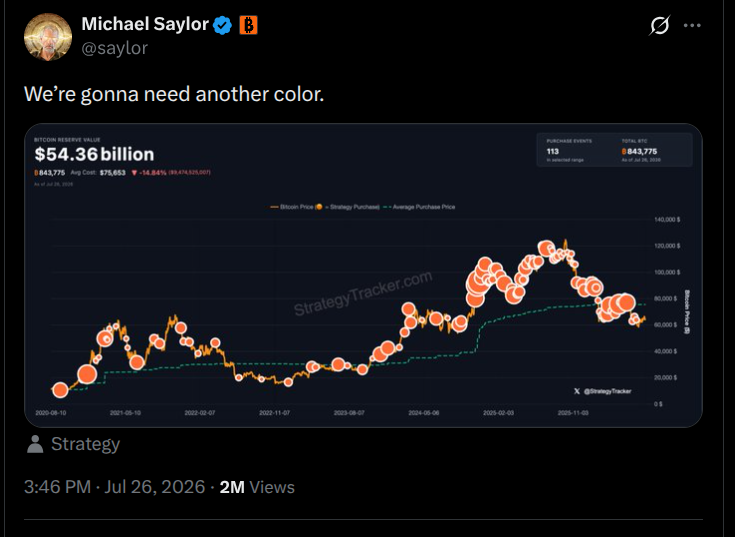
Source: Michael Saylor on X.com

Stock sales boost dollar reserve $3.75B

Following additional capital raised through its ATM stock offering program, Strategy increased its US dollar reserve to $3.75 billion as of July 26, up from $3.225 billion the previous week.

However, Strategy reported no Bitcoin purchases or sales during the July 20-26 period, leaving its holdings unchanged at 843,775 BTC, acquired at an average purchase price of $75,476 per Bitcoin, or $63.69 billion in aggregate. The biggest crypto was last trading hands at roughly $64,971 at time of publication.

Related: Strive’s SATA recovers most of June decline, trades within 3% of par

Strategy’s growing cash reserve highlights management’s efforts to maintain liquidity as it expands its capital markets activity through common stock offerings and preferred stock instruments. The reserve is intended to support dividend payments on preferred stock and interest payments on the company’s outstanding debt.

Saylor sparks debate over BTC future role for banks

The update came shortly after Saylor reignited a debate over whether banks have a place in Bitcoin’s future after arguing that the crypto asset’s growth depends on integration with traditional financial institutions.

Saylor wrote on X on Sunday that rejecting Bitcoin’s links to financial infrastructure would deny access to most potential users. His comments drew criticism from some BTC supporters, who contend that greater involvement from banks conflicts with the network’s original goal of enabling transactions without intermediaries.

Several users pushed back against Saylor’s argument by citing Bitcoin’s white paper, which introduced the asset as a peer-to-peer electronic cash system designed to remove the need for financial institutions. The exchange highlighted a growing divide between advocates who view banks as necessary gateways for mainstream adoption and those who see them as a threat to Bitcoin’s decentralized foundation.

Magazine: Strategy became a symbol of the dot-com crash: Could history repeat?

Preguntas relacionadas

QWhat actions did Strategy take to adjust its capital structure last week, as detailed in the article?

AStrategy sold 5,429,160 shares of its Class A common stock (MSTR) through its ATM offering program, generating $544.5 million in net proceeds. It also repurchased 288,930 shares of its STRC preferred stock for $25 million.

QAccording to the article, what is Strategy's current Bitcoin (BTC) holding and its average purchase price?

AStrategy's Bitcoin holdings remain unchanged at 843,775 BTC, acquired at an average price of $75,476 per Bitcoin, for an aggregate cost of $63.69 billion.

QHow did Strategy's US dollar reserve change following its recent stock sales, and what is the stated purpose of this reserve?

AFollowing the stock sales, Strategy's US dollar reserve increased to $3.75 billion as of July 26, up from $3.225 billion. The reserve is intended to support dividend payments on preferred stock and interest payments on the company's outstanding debt.

QWhat was the market speculation triggered by Michael Saylor's post on X, and what debate did his subsequent comments reignite?

ASaylor's 'We're gonna need another color' post on X sparked speculation about a new move involving the company's preferred stock strategy. His later comments reignited a debate over whether banks have a place in Bitcoin's future, with critics arguing that bank integration conflicts with Bitcoin's original decentralized, peer-to-peer vision.

QWhat were the price movements for MSTR and STRC preferred shares mentioned in the article?

AThe MSTR share price was up more than 2% in Monday's premarket activity. The STRC preferred shares were up 2.3% to $88.90 ahead of the Nasdaq open.

Lecturas Relacionadas

Wall Street Traders Shift Crypto Market Activity to Weekdays

For decades, Wall Street adhered to a strict Monday-Friday schedule, a rhythm initially challenged but not fully overturned by the 24/7 nature of cryptocurrencies. However, institutional adoption is now fundamentally reshaping crypto market dynamics, shifting most price discovery and trading activity to traditional U.S. market hours (9:30 AM - 4:00 PM ET). According to Kaiko Research, weekend trading volume has fallen from roughly 25% to about 16% of the total. This concentration creates a significant "liquidity vacuum" on weekends when institutional support withdraws. Analysis by BridgePort shows the market becomes more vulnerable: trading costs rise by an average of 11% due to wider spreads, market depth for $100k trades worsens by nearly 9%, and displayed liquidity drops over 5%. Consequently, smaller trades can trigger sharper price swings. The massive success of U.S. spot Bitcoin ETFs has been a key driver of this structural shift. While providing steady weekday demand, their complete inactivity on weekends exacerbates the liquidity gap. Large capital movements, like the over $0.5 billion withdrawn from U.S. spot ETFs since October 2023, are easily absorbed on weekdays but can cause significant turbulence on thinner weekends. Ultimately, weekend trading now requires heightened caution due to a "thin" market, absent major market makers, and multiplied risks of sudden price jumps and slippage. Understanding these hidden liquidity mechanisms has become crucial for navigating the new financial reality.

cryptonews.ruHace 22 min(s)

Wall Street Traders Shift Crypto Market Activity to Weekdays

cryptonews.ruHace 22 min(s)

Trading

Spot
活动图片