The Black Swan Was This: The Real Reason Behind This Bitcoin Crash

Odaily星球日报Publicado a 2026-02-08Actualizado a 2026-02-08

Resumen

Bitcoin experienced a sharp sell-off on February 5th, with prices briefly crashing to $60,000 and over $2.6 billion in liquidations. The primary catalyst was likely a broad-based de-leveraging event within multi-strategy hedge funds, triggered by extreme underperformance in software stocks and correlated risk assets. This forced liquidation included delta-neutral positions like basis trades (selling spot Bitcoin while buying futures), exacerbating the downturn. Despite the severe price drop, Bitcoin ETFs, including IBIT, saw net inflows of over $300 million, contradicting expectations of significant outflows. The sell-off was amplified by negative gamma dynamics in the options market, where dealers were short puts and forced to aggressively hedge by selling underlying assets as volatility spiked. The event highlighted Bitcoin's integration into traditional finance, with the initial selling pressure originating from non-crypto systemic de-risking rather than directional bearishness. The rapid rebound on February 6th suggested the sell-off was primarily technical and hedging-driven, not fundamental. The resilience of ETF inflows indicates underlying institutional demand, potentially setting the stage for a sharp upward move once market conditions stabilize.

Author | Jeff Park (CIO, Bitwise)

Compiled by | Odaily Planet Daily (@OdailyChina)

Translator | DingDang (@XiaMiPP)

Editor's Note: On February 5th, the crypto market experienced another sharp decline, with over $2.6 billion in liquidations within 24 hours. Bitcoin briefly crashed to $60,000, yet the market seemed to lack a clear consensus on the cause of this drop. Bitwise CIO Jeff Park offers a new analytical framework from the perspective of options and hedging mechanisms.
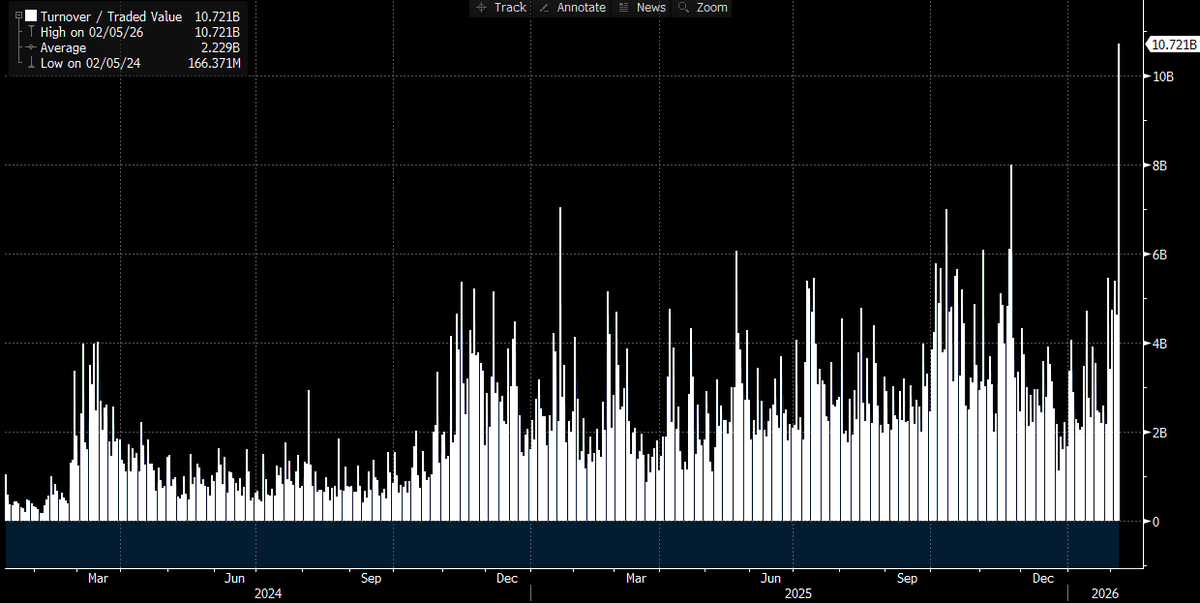
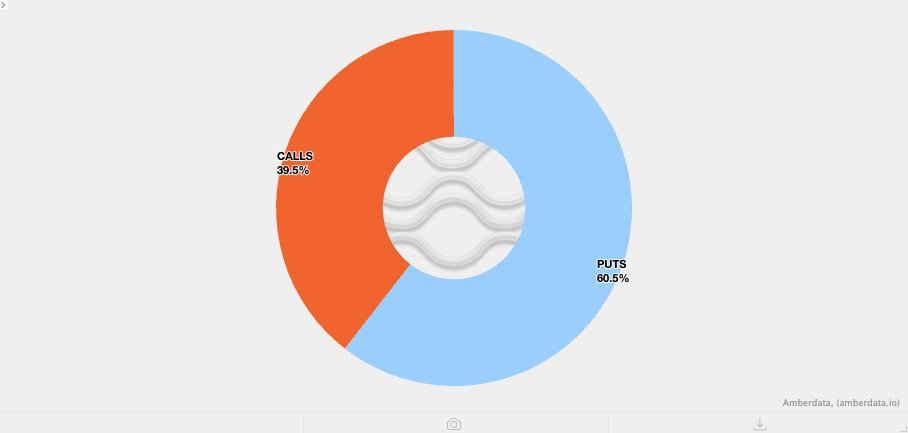
As time passes and more data becomes available, the picture is becoming clearer: this severe sell-off is likely related to the Bitcoin ETF, and the day itself was one of the most turbulent trading days in recent capital market history. We can draw this conclusion because IBIT's trading volume hit a record high that day—exceeding $10 billion, double the previous record (a truly staggering number), while options volume also set a new record (see chart below, showing the highest number of contracts since the ETF's launch). Somewhat unusually compared to the past, the volume structure showed that options trading was clearly dominated by puts, not calls (we will elaborate on this later).
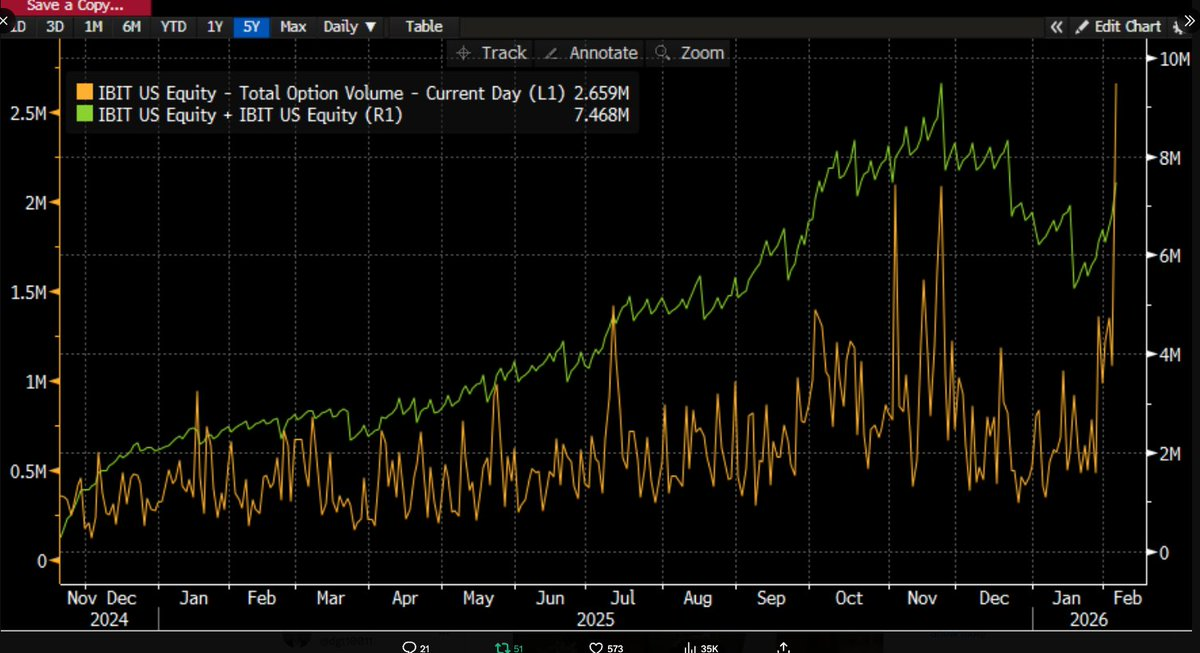
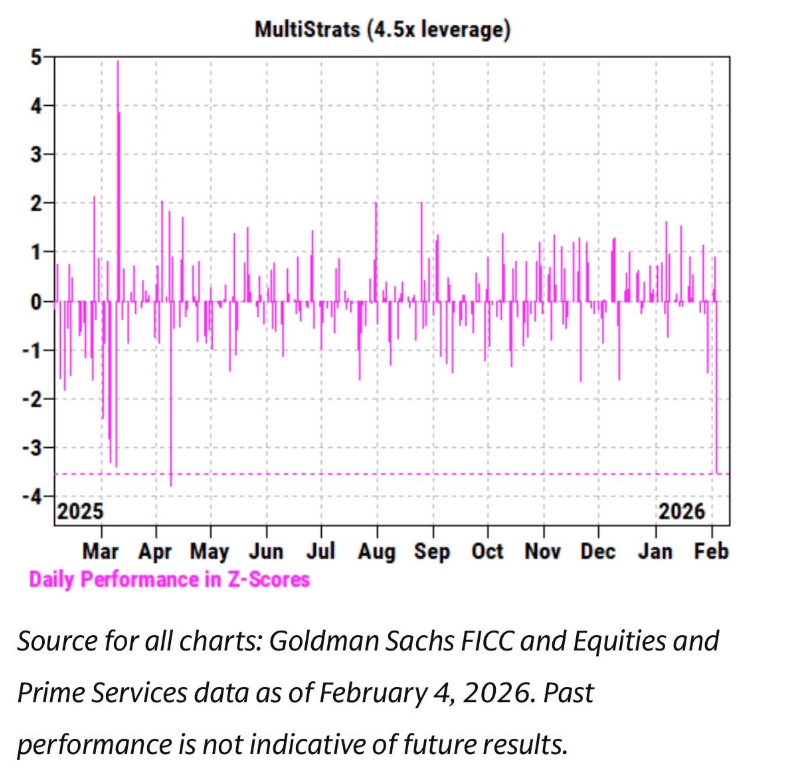
Simultaneously, over the past few weeks, we have observed an extremely tight correlation between IBIT's price movements and software stocks, as well as other risk assets. Goldman Sachs' Prime Brokerage (PB) team also reported that February 4th was one of the worst single days on record for multi-strategy funds, with a Z-score as high as 3.5. This means it was an extreme event with a probability of only 0.05%, ten times rarer than a 3-sigma event (the classic "black swan" threshold, probability ~0.27%). It was, by all accounts, a catastrophic shock. Typically, it is after such events that risk managers at multi-strategy funds (pod shops) quickly intervene, demanding all trading teams immediately, indiscriminately, and urgently deleverage. This explains why February 5th also turned into a bloodbath.
With so many records broken and a clear downward price direction (a 13.2% single-day drop), we originally expected a high likelihood of seeing net outflows from the ETF. This judgment isn't far-fetched based on historical data: for example, on January 30th, IBIT saw a record $530 million outflow after a 5.8% drop the previous day; or on February 4th, IBIT saw about $370 million in outflows amid consecutive declines. Therefore, expecting at least $500 million to $1 billion in outflows in the market environment of February 5th was entirely reasonable.

But the opposite happened—we saw widespread net inflows. IBIT added approximately 6 million shares that day, corresponding to an increase in Assets Under Management (AUM) of over $230 million. Meanwhile, other Bitcoin ETFs also recorded inflows, with the entire ETF system attracting over $300 million in net inflows.

This outcome is somewhat puzzling. Theoretically, one could勉强conceive that the strong price rebound on February 6th somewhat alleviated redemption pressure, but transitioning from "potentially reduced outflows" to "net inflows" is a completely different matter. This suggests that multiple factors were likely at play simultaneously, but these factors don't form a single, linear narrative framework. Based on the information we currently have, several reasonable preliminary assumptions can be made, and on these assumptions, I will present my overall inference.

First, this round of Bitcoin selling likely affected a type of multi-asset portfolio or strategy that is not purely crypto-native. This could be the multi-strategy hedge funds mentioned earlier, or it could be funds like BlackRock's model portfolio business, which allocates between IBIT and IGV (a software ETF) and were forced into automatic rebalancing during the sharp volatility.

Second, the acceleration of the Bitcoin sell-off was likely related to the options market, particularly structures related to the downside.

Third, this selling did not ultimately translate into outflows at the Bitcoin asset level, meaning the main driving force behind the price action came from the "paper money system," i.e., position adjustment behavior dominated by dealers and market makers, overall in a hedged state.

Based on the above facts, my core hypothesis is as follows.

  1. The direct catalyst for this sell-off was a broad deleveraging triggered by multi-asset funds and portfolios after the downside correlation of risk assets reached a statistically anomalous level.
  2. This process then triggered an extremely violent deleveraging, which also included Bitcoin exposure, but a significant portion of this risk was actually in "Delta neutral" hedged positions, such as basis trades, relative value trades (e.g., Bitcoin vs. crypto stocks), and other structures where the residual Delta risk is typically "boxed" by the dealer system.
  3. This deleveraging then triggered a negative Gamma effect, further amplifying the downward pressure, thus forcing dealers to sell IBIT. However, because the selling was so fiercely, market makers had to go net short Bitcoin regardless of their own inventory. This process, in turn, created new ETF inventory, thereby reducing the market's original expectation of large-scale outflows.

Subsequently, on February 6th, we observed positive inflows into IBIT, as some IBIT buyers (the question is, what type of buyers were these chose to allocate on the dip after the decline, further offsetting what might have been a small net outflow.

First, I personally lean towards the view that the initial catalyst for this event came from the sell-off in software stocks, especially considering the high correlation Bitcoin showed with software stocks, even higher than its correlation with gold. Please refer to the two charts below.
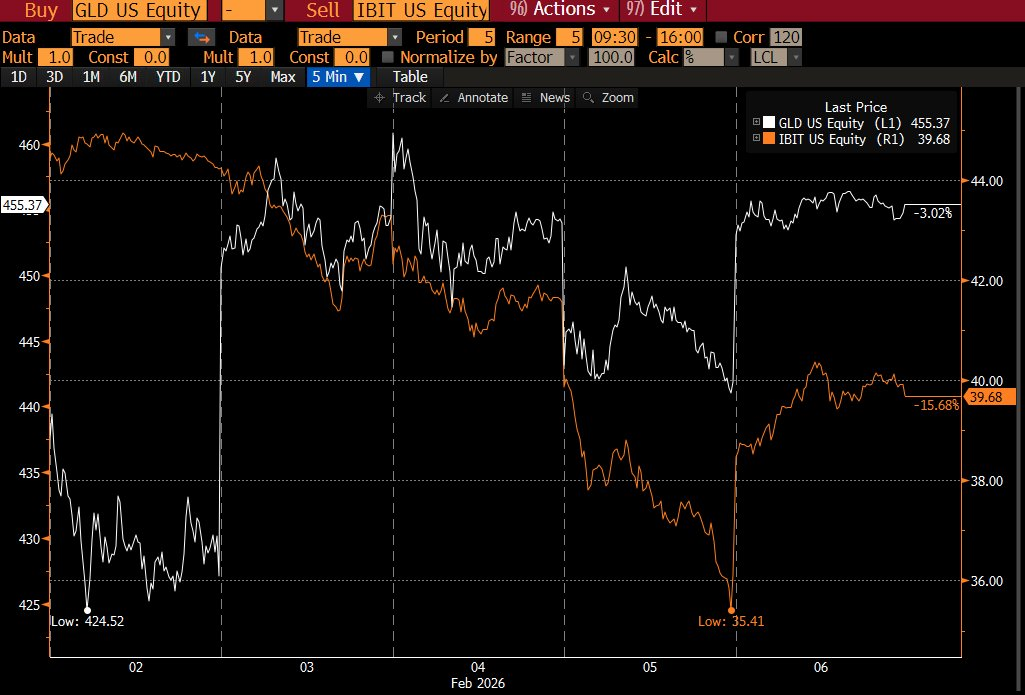
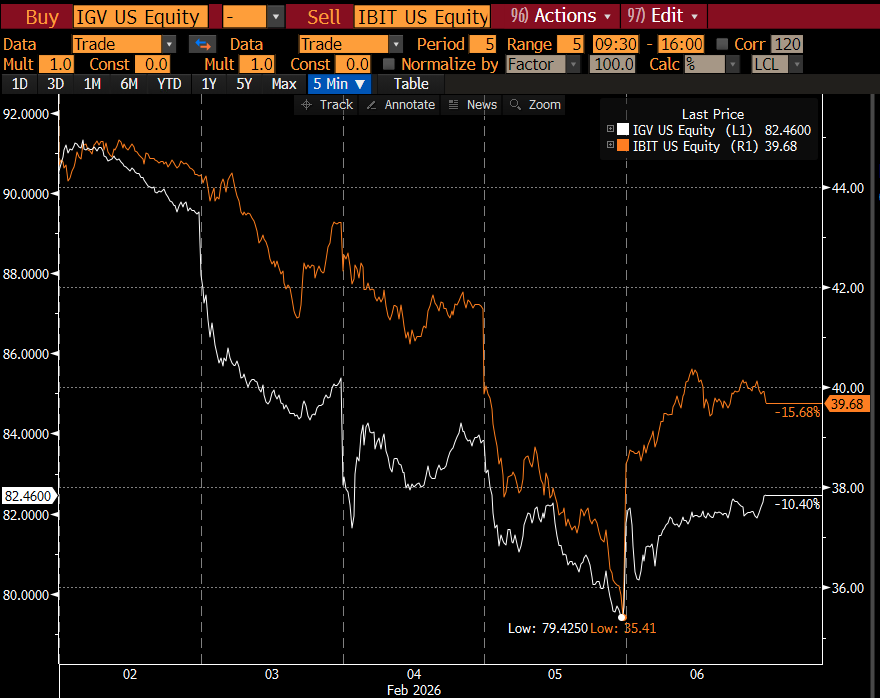
This is logically sound because gold is typically not an asset held in large quantities by multi-strategy funds engaged in financing trades, although it might appear in RIA model portfolios (pre-designed asset allocation schemes). Therefore, in my view, this further supports the judgment that: the epicenter of this turmoil is more likely located within the multi-strategy fund system.

This makes the second judgment seem more reasonable, namely that this violent deleveraging process did indeed include hedged Bitcoin risk. Take the CME Bitcoin basis trade as an example, a strategy long favored by multi-strategy funds.

Looking at the complete data from January 26th to yesterday, covering the CME Bitcoin basis movements for 30, 60, 90, and 120-day tenors (thanks to top-tier industry researcher @dlawant for the data), one can clearly see the near-month basis jumping from 3.3% to as high as 9% on February 5th. This is one of the largest jumps we have personally observed in the market since the ETF launch, which almost unequivocally points to one conclusion: basis trades were forcibly liquidated on a large scale under指令.

Imagine institutions like Millennium, Citadel, being forced to liquidate basis trade positions (selling spot, buying futures). Considering their volume within the Bitcoin ETF system, it's easy to understand why this operation would cause剧烈impact on the overall market structure. I have previously written down my own reasoning on this point.

Odaily Planet Daily adds: Currently, a significant portion of this undifferentiated US-based selling is likely coming from multi-strategy hedge funds. These funds often employ delta hedging strategies, or run some form of relative value (RV) or factor-neutral trades, and these trades are currently widening spreads, possibly accompanied by spillover from growth stock equity correlations.

A rough estimate: About 1/3 of Bitcoin ETF holdings are of the institutional type, and roughly 50% (possibly more) of that is believed to be held by hedge funds. This is a considerable amount of fast money flow, which can easily capitulate and liquidate once financing costs or margin requirements rise in the current high-volatility environment and risk managers intervene, especially when the basis yield no longer justifies the risk premium. It's worth noting that MSTR's USD trading volume today is among the highest in its history.

This is why the biggest factor最容易causing hedge fund failures is the notorious "common holder risk": multiple seemingly independent funds hold highly similar exposures, and when the market turns down, everyone rushes for the same narrow exit, causing all downside correlations to tend towards 1. Selling in such poor liquidity conditions is typical "risk-off" behavior, which we are seeing today. This will eventually be reflected in the ETF flow data. If this hypothesis holds, I suspect prices will reprice quickly once this all clears, though rebuilding confidence will still take some time afterwards.

This leads to the third clue. Now that we understand why IBIT was sold amid broad deleveraging, the question becomes: What was accelerating the decline? A possible "accelerant" is structured products. Although I don't believe the structured products market is large enough to trigger this sell-off on its own, when all factors align异常ly and perfectly simultaneously in a way beyond any VaR (Value at Risk) model's expectations, they can certainly act as an acute event triggering连锁liquidation behavior.

This immediately reminds me of my time at Morgan Stanley. There, structured products with knock-in put barriers (options that only "activate" into effective put options if the underlying asset price touches/crosses a specific barrier level) often had highly destructive consequences. In some cases, the change in option Delta could even exceed 1, a phenomenon not even considered in the standard Black-Scholes model—because in the standard Black-Scholes framework, for plain vanilla options (the most basic European call/put options), the delta can never exceed 1.

Take a note priced by JPMorgan last November as an example; its knock-in barrier was set exactly at 43.6. If these notes continued to be issued in December, and the Bitcoin price fell another 10%, one can imagine a large accumulation of knock-in barriers in the 38–39 range, the so-called "eye of the storm".
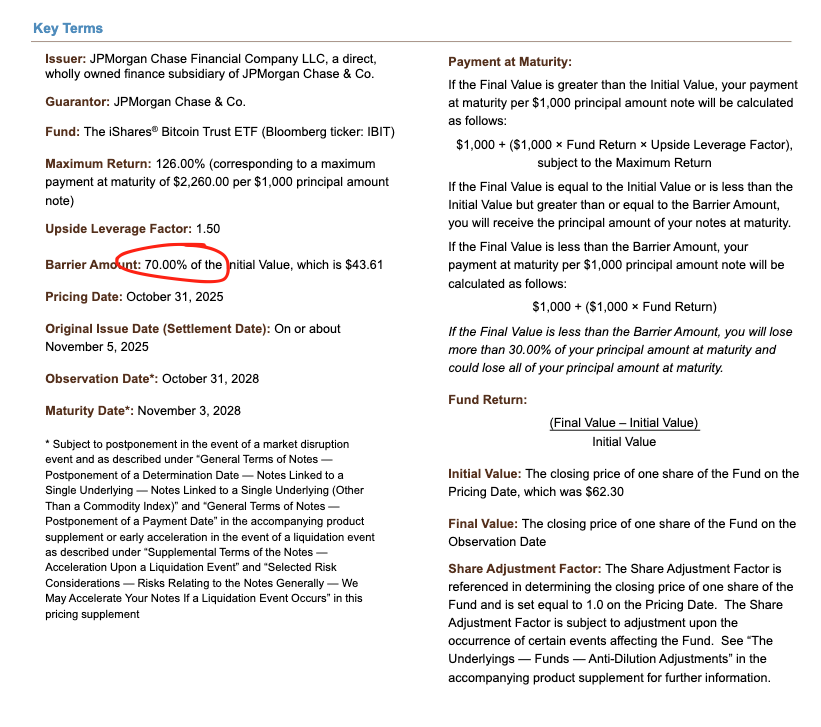
In the event these barriers are breached, if the dealer hedged the knock-in risk by, say, selling puts, then under negative Vanna dynamics, the rate of change of Gamma can be extremely rapid. At this point, as a dealer, the only viable response is to aggressively sell the underlying asset as the market weakens. This is precisely what we observed: implied volatility (IV) collapsed to near 90%, a historical extreme, almost reaching a catastrophic squeeze level. In such a situation, dealers were forced to expand their IBIT short positions to the extent that they ultimately created net new ETF shares. This part确实requires some degree of inference and is difficult to fully confirm without more detailed spread data, but given the record volume that day and the deep involvement of Authorized Participants (APs), this scenario is entirely plausible.

Combining this negative Vanna dynamic with another fact makes the logic even clearer. Due to the overall low volatility in the previous period, crypto-native market clients had generally been inclined to buy puts over the past few weeks. This means crypto dealers were naturally in a short Gamma state and had underpriced the potential for outsized moves. When the big move finally arrived, this structural imbalance further amplified the downward pressure. The position distribution chart below also clearly shows this, with dealers heavily positioned short Gamma on puts in the $64k to $71k range.
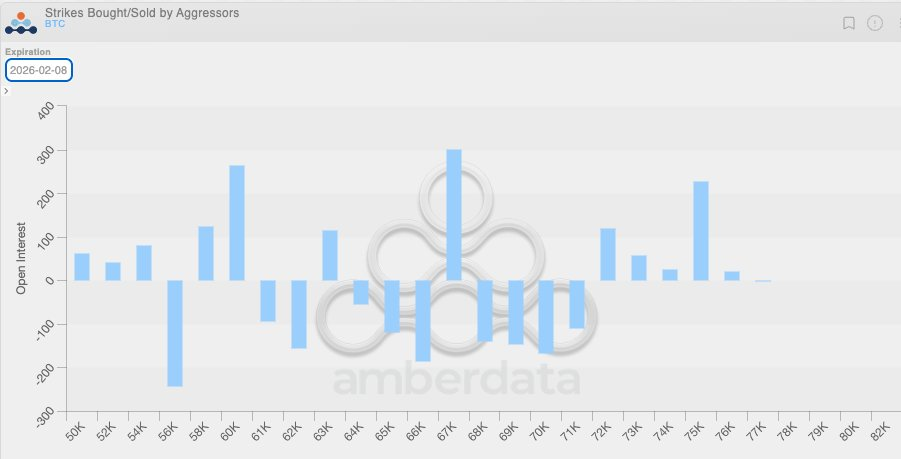
This brings us back to February 6th, when Bitcoin staged a strong rebound of over 10%. A notable phenomenon here is that the CME's open interest (OI) expanded明显faster than Binance's (again, thanks to @dlawant for aligning the hourly data to 4 PM ET). From February 4th to 5th, a clear collapse in CME OI can be seen, again confirming the judgment that basis trades were massively unwound on February 5th; on February 6th, these positions were likely re-established to take advantage of the higher basis levels, thereby offsetting the impact of outflows.
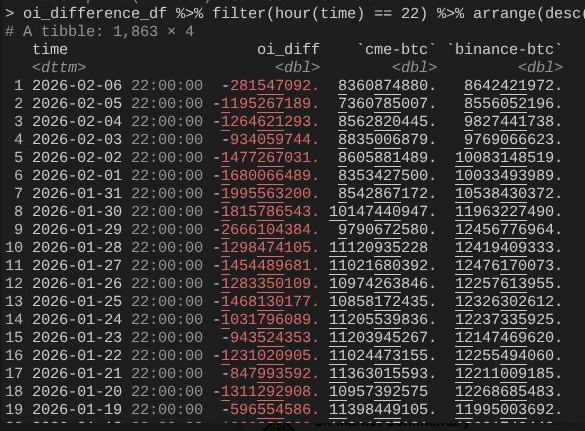
At this point, the entire logical chain closes: IBIT was roughly flat in terms of creations and redemptions because CME basis trades had recovered; but prices remained偏低because Binance's OI showed a clear collapse, meaning a significant portion of the deleveraging pressure came from short Gamma positions and liquidations within the crypto-native market.

The above is my best explanation for the market performance on February 5th and subsequently on February 6th. This reasoning is built on several assumptions and is not entirely satisfying because it lacks a clear "culprit" to blame (like the FTX incident). But the core conclusion is this: The trigger for this sell-off came from de-risking behavior in traditional finance outside crypto, and this process恰好pushed the Bitcoin price into a range where short Gamma hedging behavior would accelerate the decline. This drop was not driven by directional bearishness but triggered by hedging needs, and ultimately reversed quickly on February 6th (unfortunately, this reversal primarily benefited market-neutral capital in traditional finance, not directional strategies in crypto-native markets). While this conclusion may not be exciting, it is at least somewhat reassuring that: the previous day's sell-off likely has nothing to do with a 10/10 event.

Yes, I don't believe what happened last week is a continuation of the 10/10 deleveraging process. I read an article suggesting this turmoil might originate from a non-US, Hong Kong-based fund involved in a failed JPY carry trade. But this theory has two obvious flaws. First, I don't believe a non-crypto prime broker would be willing to service such a complex multi-asset trade while also providing a 90-day margin buffer, without falling into insolvency first when the risk framework tightened. Second, if the carry trade money was "bailed out" by buying IBIT options, then the Bitcoin price drop itself wouldn't accelerate the risk release—these options would just go out-of-the-money, their Greeks rapidly to zero. This means the trade itself must have contained real downside risk. If someone was long USD/JPY carry and simultaneously selling IBIT puts, then that prime broker, frankly, doesn't deserve to exist.

The next few days will be crucial, as we will get more data to judge whether investors are using this dip to build new demand; if so, that would be a very bullish signal. For now, I am quite encouraged by the potential for ETF inflows. I still firmly believe that true RIA-style ETF buyers (not relative value hedge funds) are savvy investors, and at the institutional level, we are seeing substantial, real, and profound progress, evident throughout the industry's advancement and among my friends at Bitwise. For this reason, I am focusing on net inflows that are not accompanied by an expansion in basis trading.

Finally, all this also shows once again that Bitcoin has integrated into the global financial capital markets in an extremely complex and mature way. This also means that when the market finds itself on the other side of a squeeze in the future, the upside move will be steeper than ever before.

The fragility of traditional finance's margin rules is Bitcoin's antifragility. Once the rebound comes—which I see as inevitable, especially after Nasdaq raised the options open interest cap—it will be a spectacular sight to behold.

Preguntas relacionadas

QAccording to the article, what was the primary catalyst for the author believes initiated the Bitcoin sell-off?

AThe author believes the initial catalyst was a broad de-leveraging event from multi-strategy hedge funds, triggered by a statistically anomalous level of downside correlation in risk assets, particularly software stocks.

QWhy was the significant net inflow into Bitcoin ETFs on February 5th considered counterintuitive?

AIt was counterintuitive because, given the record-breaking sell-off and price drop, a net outflow of at least $5-10 billion was expected based on historical precedent, but the ETFs instead saw net inflows of over $300 million.

QWhat specific trading strategy, popular with multi-strategy funds, does the author point to as being unwound during the sell-off?

AThe author points to the CME Bitcoin basis trade (selling spot Bitcoin and buying futures) as a key strategy that was forcibly unwound during the de-leveraging event.

QWhat market dynamic, related to options, acted as an 'accelerant' and amplified the downward pressure on Bitcoin's price?

AA negative Vanna dynamic, where dealers were forced to aggressively sell the underlying asset (Bitcoin) as price fell due to their short Gamma position and the hedging of structured products with knock-in put barriers.

QWhat is the author's overall conclusion about the fundamental nature of the sell-off?

AThe author concludes the sell-off was not driven by directional bearishness but was a hedging-driven event catalyzed by traditional finance de-risking, which pushed Bitcoin's price into a zone where short-Gamma hedging accelerated the decline.

Lecturas Relacionadas

Trading

Spot
Futuros

Artículos destacados

Qué es BITCOIN

Entendiendo HarryPotterObamaSonic10Inu (ERC-20) y Su Posición en el Espacio Cripto En los últimos años, el mercado de criptomonedas ha sido testigo de un aumento en la popularidad de las monedas meme, capturando el interés no solo de los comerciantes, sino también de aquellos que buscan compromiso comunitario y valor de entretenimiento. Entre estos tokens únicos se encuentra HarryPotterObamaSonic10Inu (ERC-20), un proyecto intrigante que mezcla referencias culturales en el tejido de las criptomonedas. Este artículo profundiza en los aspectos clave de HarryPotterObamaSonic10Inu, explorando sus mecanismos, ethos impulsado por la comunidad y su relación con el paisaje cripto más amplio. ¿Qué es HarryPotterObamaSonic10Inu (ERC-20)? Como su nombre sugiere, HarryPotterObamaSonic10Inu es una moneda meme construida sobre la blockchain de Ethereum, clasificada bajo el estándar ERC-20. A diferencia de las criptomonedas tradicionales que pueden enfatizar la utilidad práctica o el potencial de inversión, este token prospera en el valor de entretenimiento y la fuerza de su comunidad. El proyecto tiene como objetivo fomentar un entorno donde los usuarios comprometidos puedan reunirse, compartir ideas y participar en actividades inspiradas por diversos fenómenos culturales. Una característica notable de HarryPotterObamaSonic10Inu es su cero impuestos en las transacciones. Este atractivo elemento tiene como objetivo incentivar el comercio y la participación comunitaria, sin cargos adicionales que puedan disuadir a los comerciantes de pequeña escala. El suministro total de la moneda está establecido en mil millones de tokens, una cifra que marca su intención de mantener una circulación sustancial dentro de la comunidad. Creador de HarryPotterObamaSonic10Inu (ERC-20) Los orígenes de HarryPotterObamaSonic10Inu están algo envueltos en misterio; los detalles sobre el creador siguen siendo desconocidos. El desarrollo de este token carece de un equipo identificable o de un plan explícito, lo cual no es inusual dentro del sector de monedas meme. En cambio, el proyecto ha surgido de manera orgánica, con su progreso muy dependiente del entusiasmo y la participación de su comunidad. Inversores de HarryPotterObamaSonic10Inu (ERC-20) En cuanto a inversiones externas y respaldo, HarryPotterObamaSonic10Inu también sigue siendo ambiguo. El token no lista ninguna fundación de inversión conocida o apoyo organizacional significativo. En cambio, la savia del proyecto es su comunidad de base, que informa su crecimiento y sostenibilidad a través de la acción colectiva y el compromiso en el espacio cripto. ¿Cómo Funciona HarryPotterObamaSonic10Inu (ERC-20)? Como una moneda meme, HarryPotterObamaSonic10Inu opera principalmente fuera de los marcos tradicionales que a menudo rigen el valor de los activos. Hay varios aspectos distintivos que definen cómo funciona el proyecto: Transacciones Sin Impuestos: Sin tarifas impositivas en las transacciones, los usuarios pueden comprar y vender el token libremente sin preocuparse por costos ocultos. Compromiso Comunitario: El proyecto prospera en la interacción comunitaria, aprovechando plataformas de redes sociales para crear entusiasmo y facilitar la participación. Las discusiones, el intercambio de contenido y el compromiso son elementos cruciales que ayudan a expandir su alcance y fomentar la lealtad entre los seguidores. Sin Utilidad Práctica: Cabe señalar que HarryPotterObamaSonic10Inu no ofrece utilidad concreta dentro del ecosistema financiero. Más bien, se clasifica como un token principalmente para actividades de entretenimiento y comunitarias. Referencia Cultural: El token incorpora astutamente elementos de la cultura popular para atraer interés, conectando con entusiastas de los memes y seguidores de las criptomonedas por igual. HarryPotterObamaSonic10Inu ejemplifica cómo las monedas meme operan de manera diferente a los proyectos de criptomonedas más tradicionales, ingresando al mercado como construcciones sociales innovadoras en lugar de activos utilitarios. Cronología de HarryPotterObamaSonic10Inu (ERC-20) La historia de HarryPotterObamaSonic10Inu está marcada por varios hitos notables: Creación: El token surgió de un meme viral, capturando la imaginación de muchos entusiastas de las criptomonedas. Las fechas específicas de creación no están disponibles, subrayando su ascenso orgánico. Listado en Exchanges: HarryPotterObamaSonic10Inu ha llegado a varios exchanges, permitiendo un acceso y comercio más fácil por parte de la comunidad. Iniciativas de Compromiso Comunitario: Actividades continuas destinadas a mejorar la interacción comunitaria, incluyendo concursos, campañas en redes sociales y generación de contenido por parte de fanáticos y defensores. Planes de Expansión Futuros: La hoja de ruta del proyecto incluye el lanzamiento de una colección de NFT, mercancía y un sitio de comercio electrónico relacionado con sus temas culturales, involucrando aún más a la comunidad e intentando añadir más dimensiones a su ecosistema. Puntos Clave Sobre HarryPotterObamaSonic10Inu (ERC-20) Naturaleza Impulsada por la Comunidad: El proyecto prioriza la participación colectiva y la creatividad, asegurando que la involucración de los usuarios esté a la vanguardia de su desarrollo. Clasificación como Moneda Meme: Representa la epítome de las criptomonedas basadas en el entretenimiento, diferenciándose de los vehículos de inversión tradicionales. Sin Afiliación Directa con Bitcoin: A pesar de la similitud en el nombre del ticker, HarryPotterObamaSonic10Inu es distinto y no tiene relación con Bitcoin u otras criptomonedas establecidas. Enfoque en la Colaboración: HarryPotterObamaSonic10Inu está diseñado para crear un espacio para la colaboración y el intercambio de historias entre sus poseedores, proporcionando una vía para la creatividad y el vínculo comunitario. Perspectivas Futuras: La ambición de expandirse más allá de su premisa inicial hacia NFTs y mercancías describe un camino para que el proyecto potencialmente ingrese a avenidas más tradicionales dentro de la cultura digital. A medida que las monedas meme continúan capturando la imaginación de la comunidad de criptomonedas, HarryPotterObamaSonic10Inu (ERC-20) se destaca debido a sus lazos culturales y su enfoque centrado en la comunidad. Si bien puede no encajar en el molde típico de un token impulsado por la utilidad, su esencia radica en la alegría y la camaradería fomentadas entre sus seguidores, destacando la naturaleza en evolución de las criptomonedas en una era cada vez más digital. A medida que el proyecto continúa desarrollándose, será importante observar cómo las dinámicas comunitarias influyen en su trayectoria en el cambiante paisaje de la tecnología blockchain.

641 Vistas totalesPublicado en 2024.04.01Actualizado en 2024.12.03

Cómo comprar BTC

¡Bienvenido a HTX.com! Hemos hecho que comprar Bitcoin (BTC) sea simple y conveniente. Sigue nuestra guía paso a paso para iniciar tu viaje de criptos.Paso 1: crea tu cuenta HTXUtiliza tu correo electrónico o número de teléfono para registrarte y obtener una cuenta gratuita en HTX. Experimenta un proceso de registro sin complicaciones y desbloquea todas las funciones.Obtener mi cuentaPaso 2: ve a Comprar cripto y elige tu método de pagoTarjeta de crédito/débito: usa tu Visa o Mastercard para comprar Bitcoin (BTC) al instante.Saldo: utiliza fondos del saldo de tu cuenta HTX para tradear sin problemas.Terceros: hemos agregado métodos de pago populares como Google Pay y Apple Pay para mejorar la comodidad.P2P: tradear directamente con otros usuarios en HTX.Over-the-Counter (OTC): ofrecemos servicios personalizados y tipos de cambio competitivos para los traders.Paso 3: guarda tu Bitcoin (BTC)Después de comprar tu Bitcoin (BTC), guárdalo en tu cuenta HTX. Alternativamente, puedes enviarlo a otro lugar mediante transferencia blockchain o utilizarlo para tradear otras criptomonedas.Paso 4: tradear Bitcoin (BTC)Tradear fácilmente con Bitcoin (BTC) en HTX's mercado spot. Simplemente accede a tu cuenta, selecciona tu par de trading, ejecuta tus trades y monitorea en tiempo real. Ofrecemos una experiencia fácil de usar tanto para principiantes como para traders experimentados.

4.0k Vistas totalesPublicado en 2024.12.12Actualizado en 2025.03.21

Qué es $BITCOIN

ORO DIGITAL ($BITCOIN): Un Análisis Integral Introducción al ORO DIGITAL ($BITCOIN) ORO DIGITAL ($BITCOIN) es un proyecto basado en blockchain que opera en la red Solana, cuyo objetivo es combinar las características de los metales preciosos tradicionales con la innovación de las tecnologías descentralizadas. Aunque comparte un nombre con Bitcoin, a menudo referido como “oro digital” debido a su percepción como un refugio de valor, ORO DIGITAL es un token separado diseñado para crear un ecosistema único dentro del paisaje Web3. Su meta es posicionarse como un activo digital alternativo viable, aunque los detalles sobre sus aplicaciones y funcionalidades aún están en desarrollo. ¿Qué es ORO DIGITAL ($BITCOIN)? ORO DIGITAL ($BITCOIN) es un token de criptomoneda diseñado explícitamente para su uso en la blockchain de Solana. A diferencia de Bitcoin, que proporciona un papel de almacenamiento de valor ampliamente reconocido, este token parece centrarse en aplicaciones y características más amplias. Aspectos notables incluyen: Infraestructura Blockchain: El token está construido sobre la blockchain de Solana, conocida por su capacidad para manejar transacciones de alta velocidad y bajo costo. Dinámicas de Suministro: ORO DIGITAL tiene un suministro máximo limitado a 100 cuatrillones de tokens (100P $BITCOIN), aunque los detalles sobre su suministro circulante no se han divulgado actualmente. Utilidad: Si bien las funcionalidades precisas no están delineadas explícitamente, hay indicios de que el token podría ser utilizado para diversas aplicaciones, potencialmente involucrando aplicaciones descentralizadas (dApps) o estrategias de tokenización de activos. ¿Quién es el Creador de ORO DIGITAL ($BITCOIN)? En la actualidad, la identidad de los creadores y el equipo de desarrollo detrás de ORO DIGITAL ($BITCOIN) sigue siendo desconocida. Esta situación es típica entre muchos proyectos innovadores dentro del espacio blockchain, particularmente aquellos alineados con las finanzas descentralizadas y fenómenos de monedas meme. Si bien tal anonimato puede fomentar una cultura impulsada por la comunidad, intensifica las preocupaciones sobre la gobernanza y la responsabilidad. ¿Quiénes son los Inversores de ORO DIGITAL ($BITCOIN)? La información disponible indica que ORO DIGITAL ($BITCOIN) no tiene patrocinadores institucionales conocidos ni inversiones destacadas de capital de riesgo. El proyecto parece operar en un modelo de peer-to-peer centrado en el apoyo y la adopción de la comunidad en lugar de rutas de financiamiento tradicionales. Su actividad y liquidez se sitúan principalmente en intercambios descentralizados (DEX), como PumpSwap, en lugar de plataformas de trading centralizadas establecidas, lo que resalta aún más su enfoque de base. Cómo Funciona ORO DIGITAL ($BITCOIN) Los mecanismos operativos de ORO DIGITAL ($BITCOIN) pueden elaborarse en función de su diseño blockchain y atributos de red: Mecanismo de Consenso: Al aprovechar el único proof-of-history (PoH) de Solana combinado con un modelo de proof-of-stake (PoS), el proyecto asegura una validación de transacciones eficiente que contribuye al alto rendimiento de la red. Tokenómica: Si bien los mecanismos deflacionarios específicos no se han detallado extensamente, el vasto suministro máximo de tokens implica que podría atender microtransacciones o casos de uso nicho que aún están por definirse. Interoperabilidad: Existe el potencial de integración con el ecosistema más amplio de Solana, incluyendo varias plataformas de finanzas descentralizadas (DeFi). Sin embargo, los detalles sobre integraciones específicas permanecen no especificados. Cronología de Eventos Clave Aquí hay una cronología que destaca hitos significativos relacionados con ORO DIGITAL ($BITCOIN): 2023: El despliegue inicial del token ocurre en la blockchain de Solana, marcado por su dirección de contrato. 2024: ORO DIGITAL gana visibilidad al estar disponible para trading en intercambios descentralizados como PumpSwap, permitiendo a los usuarios comerciar contra SOL. 2025: El proyecto presencia actividad de trading esporádica y potencial interés en compromisos liderados por la comunidad, aunque no se han documentado asociaciones notables o avances técnicos hasta el momento. Análisis Crítico Fortalezas Escalabilidad: La infraestructura subyacente de Solana soporta altos volúmenes de transacciones, lo que podría mejorar la utilidad de $BITCOIN en varios escenarios de transacción. Accesibilidad: El potencial bajo precio de trading por token podría atraer a inversores minoristas, facilitando una participación más amplia debido a oportunidades de propiedad fraccionada. Riesgos Falta de Transparencia: La ausencia de patrocinadores, desarrolladores o un proceso de auditoría conocidos públicamente puede generar escepticismo sobre la sostenibilidad y confiabilidad del proyecto. Volatilidad del Mercado: La actividad de trading depende en gran medida del comportamiento especulativo, lo que puede resultar en una volatilidad de precios significativa y en incertidumbre para los inversores. Conclusión ORO DIGITAL ($BITCOIN) surge como un proyecto intrigante pero ambiguo dentro del ecosistema de Solana en rápida evolución. Si bien intenta aprovechar la narrativa del “oro digital”, su alejamiento del papel establecido de Bitcoin como refugio de valor subraya la necesidad de una diferenciación más clara de su utilidad y estructura de gobernanza previstas. La aceptación y adopción futura dependerán probablemente de abordar la actual opacidad y de definir sus estrategias operativas y económicas de manera más explícita. Nota: Este informe abarca información sintetizada disponible hasta octubre de 2023, y pueden haber ocurrido desarrollos más allá del período de investigación.

83 Vistas totalesPublicado en 2025.05.13Actualizado en 2025.05.13

Discusiones

Bienvenido a la comunidad de HTX. Aquí puedes mantenerte informado sobre los últimos desarrollos de la plataforma y acceder a análisis profesionales del mercado. A continuación se presentan las opiniones de los usuarios sobre el precio de BTC (BTC).

活动图片