On July 30, Apple disclosed its latest fiscal quarter results. The company's revenue reached $109.4 billion for the first time, which Apple called its strongest June quarter ever. According to the company's press release, iPhone, Mac, and Services businesses all set new records for the period.
What's truly worth unpacking are two curves moving at different speeds. Revenue grew 16.4% year-over-year, while EPS grew 28.7%. The former indicates Apple sold more, while the latter also includes the effect of a tariff refund. According to the earnings press release Apple issued on the same day, this refund was separately noted in the explanations for gross margin and earnings per share.
How the $100 Billion Threshold Was Crossed
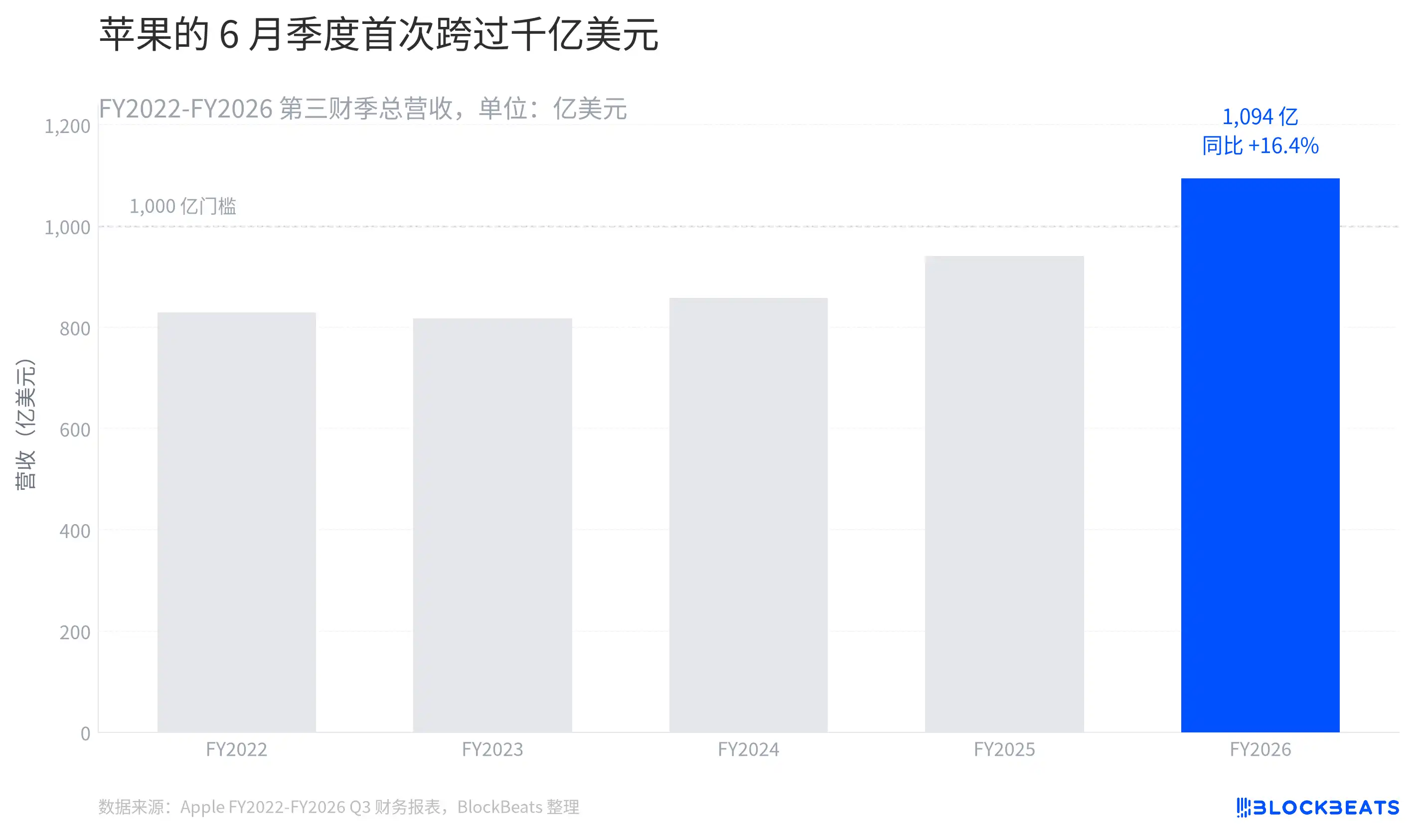
The last blue bar in the chart shows a clearly visible gap compared to the previous four June quarters. Apple didn't sprint here from a straight, upward runway. Revenue in the same period of FY2023 had actually seen a slight dip, before accelerating year after year. According to Apple's consolidated financial statements for each quarter, this quarter's growth rate is the fastest among these five comparable periods.
According to Apple's FY2026 Q3 earnings report, the significance of $109.4 billion lies not in crossing an integer threshold. It pushes the quarter most easily labeled as a "new product lull period" for Apple to a scale close to that of traditional peak seasons. This scale itself changes the intuitive perception of the June quarter's position within Apple's fiscal year.
The revenue increase wasn't confined to just one market either. Apple's segment table shows all five geographic regions achieved double-digit growth. Europe contributed the largest absolute increase, while Greater China's year-over-year growth rate tied with Europe for the highest. Looking at these regions together, Apple's growth this quarter is broader than if it relied solely on the Americas market.
What Pushed the Increment onto the iPhone
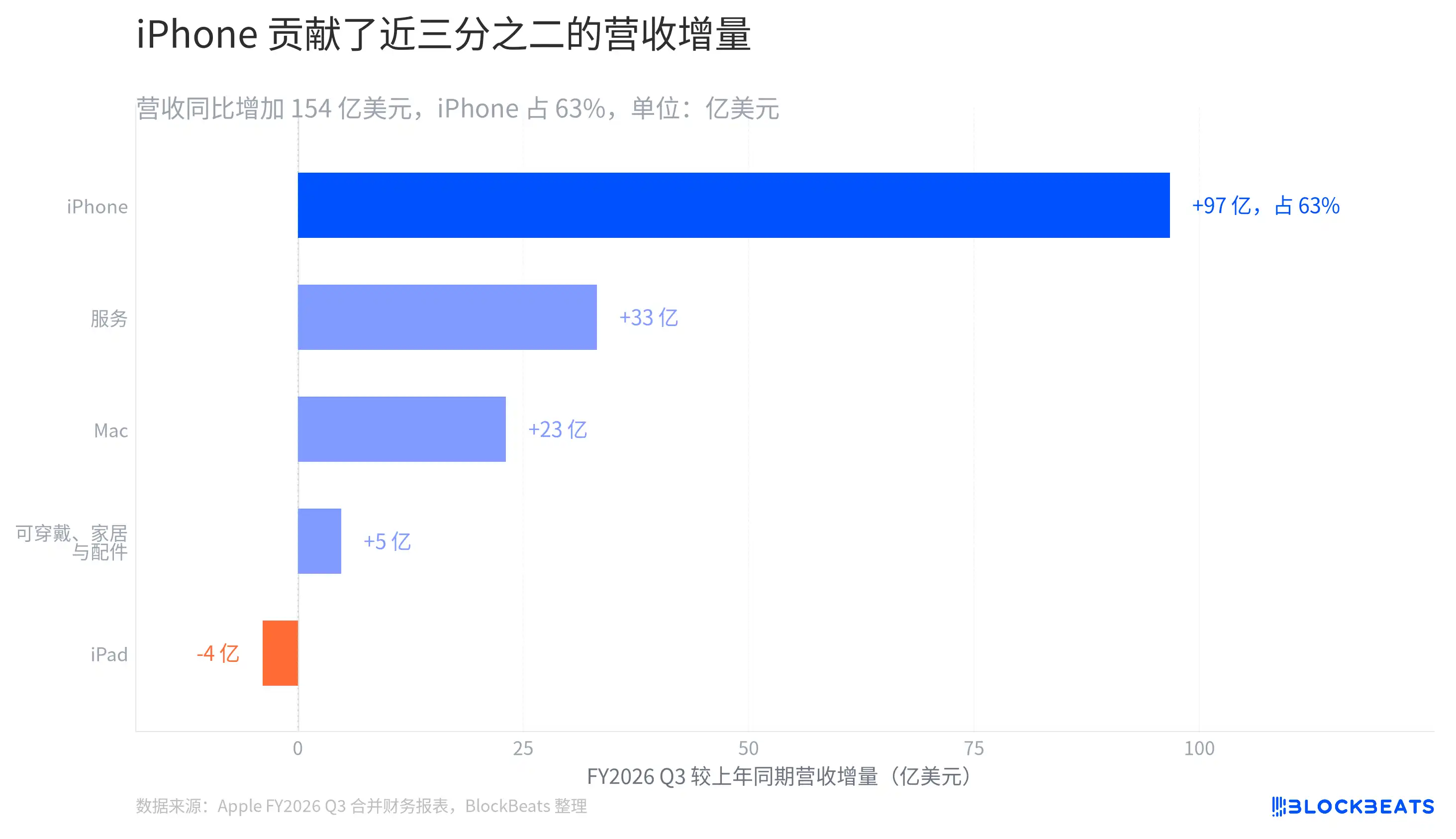
According to Apple's consolidated financial statements for this quarter, the company generated $15.4 billion more in revenue compared to the same period last year. The iPhone alone accounted for nearly two-thirds of that increase, represented by the longest blue bar in the chart. This explains why the pace of this quarter's earnings report feels faster than the June quarters of the past few years.
Services and Mac haven't receded into the background either. The former brought in the second-largest amount of new revenue, with the latter following closely. iPad was the only category to decline. The picture formed by the bars is straightforward: Apple didn't rely on a single product category to pull the numbers up this quarter, though the thrust from the iPhone was exceptionally strong.
This distinction is important. If the Services business alone supported the growth, readers would see a company gradually reducing hardware volatility. The current combination is more like two engines accelerating simultaneously, with hardware providing a longer runway for acceleration, and the Services business continuing to fill in the high-margin portions within it. According to Apple's earnings report, iPhone, Mac, and Services businesses all refreshed their own June quarter records this quarter.
Beyond the product table, the segment table adds another layer of explanation. According to Apple's segment table for this quarter, Europe ranked first in absolute revenue increment, while revenue in Greater China grew 22.4% year-over-year. Changes in these two markets don't alter the fact that the iPhone is the largest source of incremental revenue, but they mean the answer to "where is growth coming from" is no longer confined to a single region.
Services Make Every Dollar of Revenue Thicker
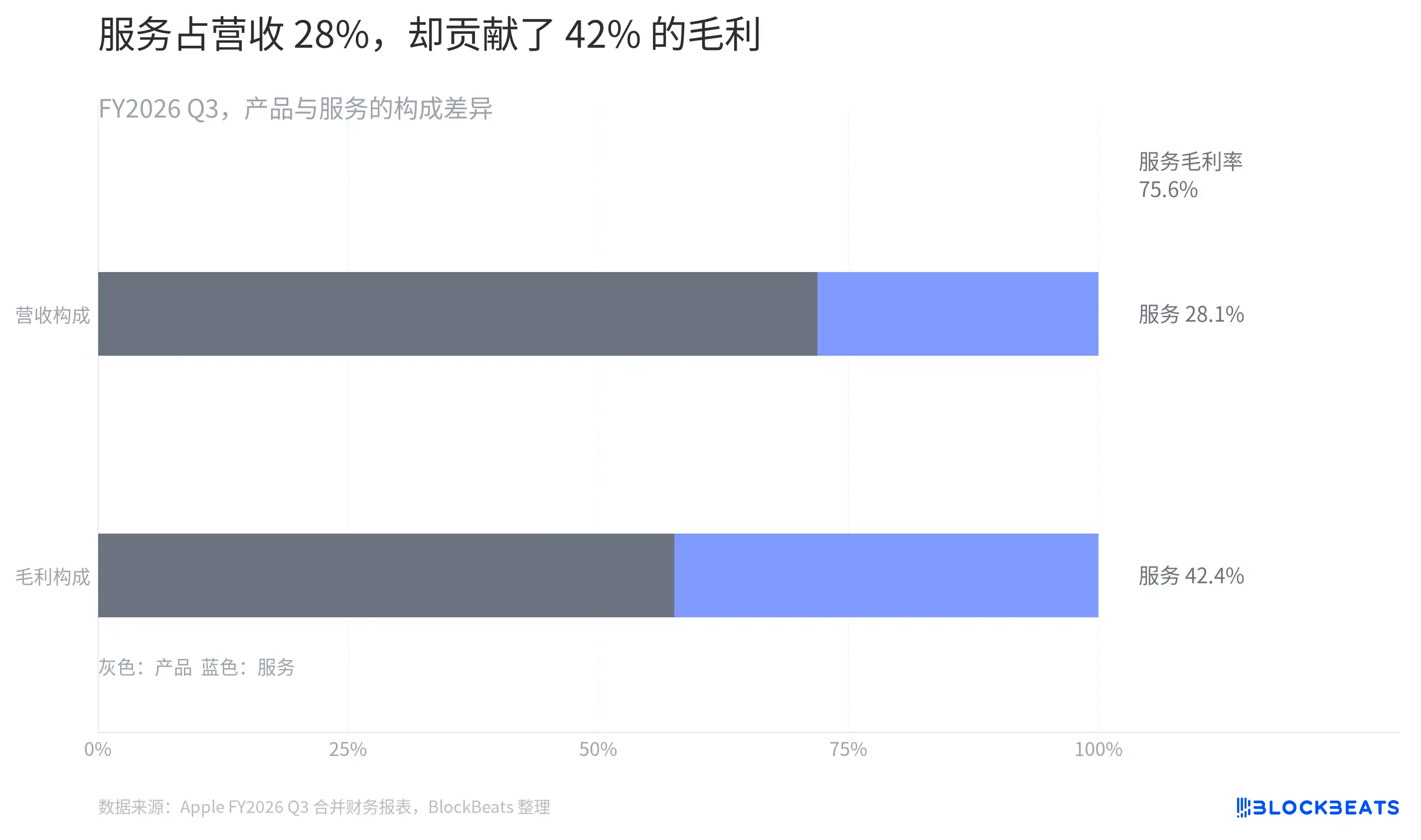
Apple's consolidated statements contain a detail rarely carried away by news headlines. It separately lists the cost of sales for Products and for Services. This allows the layer of gross profit beyond revenue to also be examined separately.
According to Apple's quarterly earnings report, Services accounted for only 28.1% of the company's revenue, yet contributed 42.4% of the gross profit. In everyday terms, for every hundred dollars of revenue Apple generates, Services makes up less than thirty dollars, but the gross profit it leaves behind is already close to half.
The gross margin for the Services business is 75.6%, compared to 40.1% for the Products business. The former acts like a thick base layer; when more devices are sold, this layer continues to support the entire company. This structure also explains why Services revenue didn't capture the largest share of new revenue, yet remains an unavoidable part of reading the earnings report. According to Apple's consolidated financial statements, these two percentages are derived by subtracting the respective cost of sales from their respective revenue.
The majority of the new gross profit this quarter still came from the Products business. According to Apple's consolidated financial statements, it contributed 77.2% of the incremental gross profit. This connects with the rebound of iPhone and Mac seen in the previous chart. Services hasn't taken over hardware's role; it makes the profit left behind when hardware scales up even thicker.
What Did That Refund Change About the Profit Curve
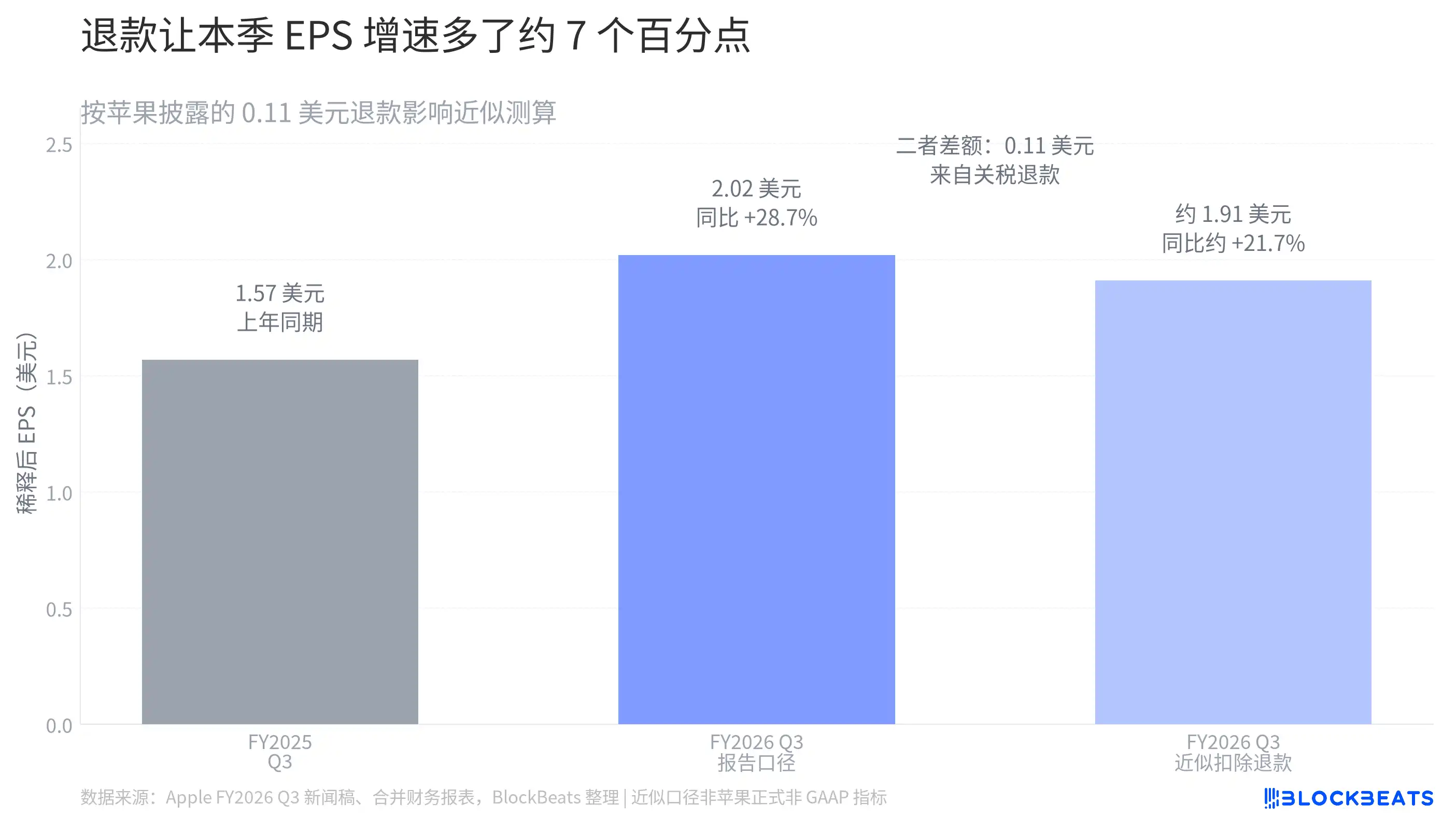
Apple disclosed in its press release that the tariff refund had a positive impact of approximately 2 percentage points on this quarter's gross margin and added $0.11 to EPS. This isn't a number easily spotted at first glance in the main financial statements, but it's significant enough to alter the interpretation of profit growth.
Making an approximate deduction based on the disclosed impact, the year-over-year growth rate for EPS this quarter would be about 21.7%. The reported figure differs from this approximate figure by about 7 percentage points. The light blue bar in the chart is not a non-GAAP metric released by Apple; it merely separates the refund impact already given in the press release from the reported numbers.
This breakdown doesn't erase Apple's operating performance. Even after deducting the refund, EPS still grew faster than revenue. It simply separates two things: one is the growth driven collectively by iPhone, Mac, and Services businesses; the other is the slope added to the profit curve by the one-time refund.
The outline of Apple's earnings report thus becomes clear: hardware recovery has re-accelerated scale, Services makes every dollar of revenue thicker, and a refund reminds us that the slope of profit should be read after being taken apart.