Meme Coin Reappears, Does the Bitcoin Ecosystem Really Have Something New?

marsbitPublicado a 2026-05-26Actualizado a 2026-05-26

Resumen

The Bitcoin ecosystem is heating up again with new projects and substantial price surges. Key developments include: **Bound Exchange:** Merging former entities radfi and Bound, this platform has gained attention after its $BOUND token surged ~46x. It simplifies trading by allowing deposits in various cryptocurrencies (SOL, ETH, etc.) for conversion to BTC to trade Runes, avoiding long Bitcoin confirmation waits. It features a 2-of-2 multi-signature wallet with a timelock for user asset security and a price protection mechanism for launchpad tokens to manage sell pressure. **Tacit:** This privacy-focused protocol for Bitcoin assets remains active, with its $TAC token holding a stable ~$5.5M market cap. Developers recently implemented double-blind tokens and are working on a permissionless ETH-BTC bridge using zero-knowledge proofs. **Alkanes & $DIESEL:** While not new, the Alkanes protocol's $DIESEL token has risen ~17x since late April. Its limited circulating supply (under 10% of the total 1.562 million) and a revised mining mechanism—where participants bid for block rewards—contribute to its volatile "meme coin" status. These projects, featuring simplified UX, security innovations, and speculative assets, are driving renewed excitement and questions about substantial new developments in the Bitcoin ecosystem.

The recent emergence of the new Bitcoin asset protocol Tacit has reignited market interest in the Bitcoin ecosystem. And lately, a new 10x "golden dog" has appeared in the Bitcoin ecosystem, making everyone exclaim that the familiar "ordi" flavor is back. Why has the Bitcoin ecosystem been so hot recently? Has something genuinely new emerged?

Bound Exchange

The predecessor of this platform was radfi, which previously gained attention due to the "Node Monkey" strategy coin $NODESTRAT. $NODESTRAT is similar to $PUNKSTR on Ethereum, both utilizing trading fees to repurchase NFTs, then listing them for sale with different profit targets. The profits from selling these NFTs are then partially used to buy back and burn the token, creating a flywheel effect.

Previously, radfi and Bound operated separately. radfi handled Bitcoin/Rune AMM and Launchpad, while Bound focused on stablecoins. Now, the two have merged into Bound. The merged platform offers comprehensive features, including trading, lending, Launchpad, and an NFT marketplace.

Bound recently attracted market attention because its token $BOUND has surged approximately 46 times since May 21st.
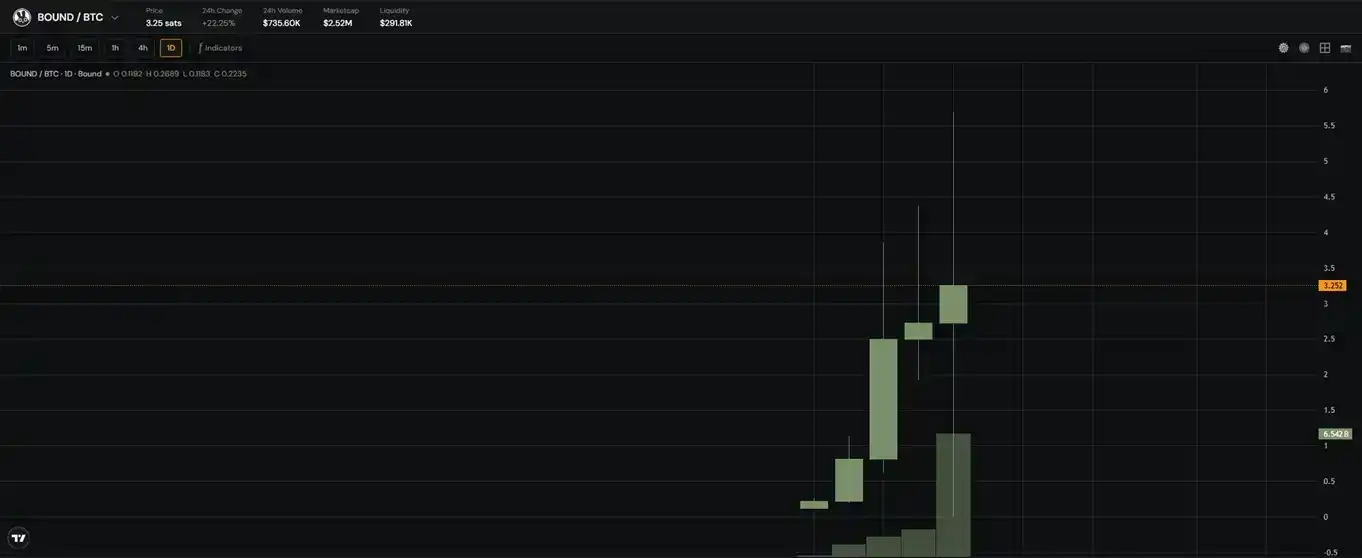
Returning to the project itself, the main points praised by the community about Bound are as follows:

Greatly simplified trading process. Traditional Rune AMMs typically require depositing Bitcoin first, then waiting for several block confirmations. This confirmation time can be as short as half an hour, but longer if block production is slow, potentially taking over an hour. On Bound, besides depositing Bitcoin, users can also deposit SOL, ETH, HYPE, or BNB. These are swapped to BTC via corresponding BTC trading pairs, allowing users to directly trade Rune tokens on the platform. The overall time required is significantly reduced, naturally enhancing the user experience.

Instant trade confirmation. Avoiding long waits for Bitcoin block confirmations has been a goal for platforms dealing with Runes in the Bitcoin ecosystem. This isn't inherently difficult; once funds are deposited and confirmed on the platform, trades can be processed internally/off-chain first, using the Bitcoin mainnet as a confirmation layer. However, the key issue is solving the security problem. Previous platforms like odin.fun also gained popularity but eventually faded after repeated asset theft incidents. Bound's solution is to add a 2-of-2 multisig to user asset deposit addresses. One signature is held by the user (stored as a passkey on the user's device), and the other is held by the platform's backend.

This means even if the Bound platform is hacked, assets cannot be stolen because the hacker can only satisfy one signature layer. There's another question: what if the platform runs away? Therefore, Bound added a timelock. If Bound's signature expires after 3 months, users can directly withdraw their assets using their own passkey.

Price protection mechanism. Bound's official Twitter account retweeted an explanation by @SkyAAmen regarding this mechanism: "For Rune tokens launched via Launchpad, the post-launch token price is calculated based on the average minting price. 75% of the raised liquidity is placed below this price to act as a floor against potential selling pressure, while the remaining 25% is paired above this price."
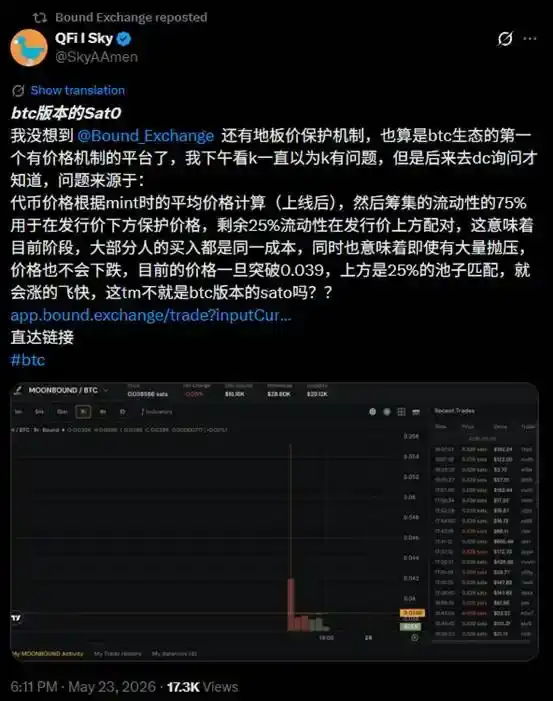
Regarding token issuance, Bound also introduced a virtual mempool, which can be understood as a virtual chain tracking Bitcoin mainnet block production. Users minting new Rune tokens on the Launchpad don't pay fees to miners; the money is instead used for the aforementioned price protection and liquidity provision. Additionally, to reward holders, those who mint 1 million tokens or more and do not sell can share 50% of the trading fees.

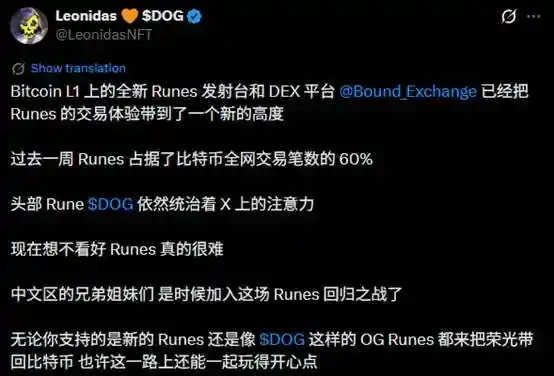
The above three points are the main advantages. Furthermore, Leonidas, a well-known figure in the Bitcoin ecosystem, has also expressed support for Bound:
Tacit

BlockBeats previously published a detailed article introducing Tacit:

New Protocol Tacit: The ZEC of the Bitcoin Ecosystem?

Currently, the price of Tacit's leading token $TAC remains stable, with a corresponding market cap of approximately $5.5 million. The developer @z0r0zzz continues to maintain a high update frequency. On May 23rd, they implemented double-blind tokens on Bitcoin, further strengthening the protocol's privacy features. Additionally, work is ongoing on a permissionless ETH-BTC bridge implemented via SP1 zero-knowledge proofs.

Alkanes

We have also previously introduced Alkanes: Another 10x Runner in Bitcoin Ecosystem, What is the New Asset Protocol Alkanes? This protocol gained attention because $DIESEL has risen approximately 17 times since late April and is still climbing:
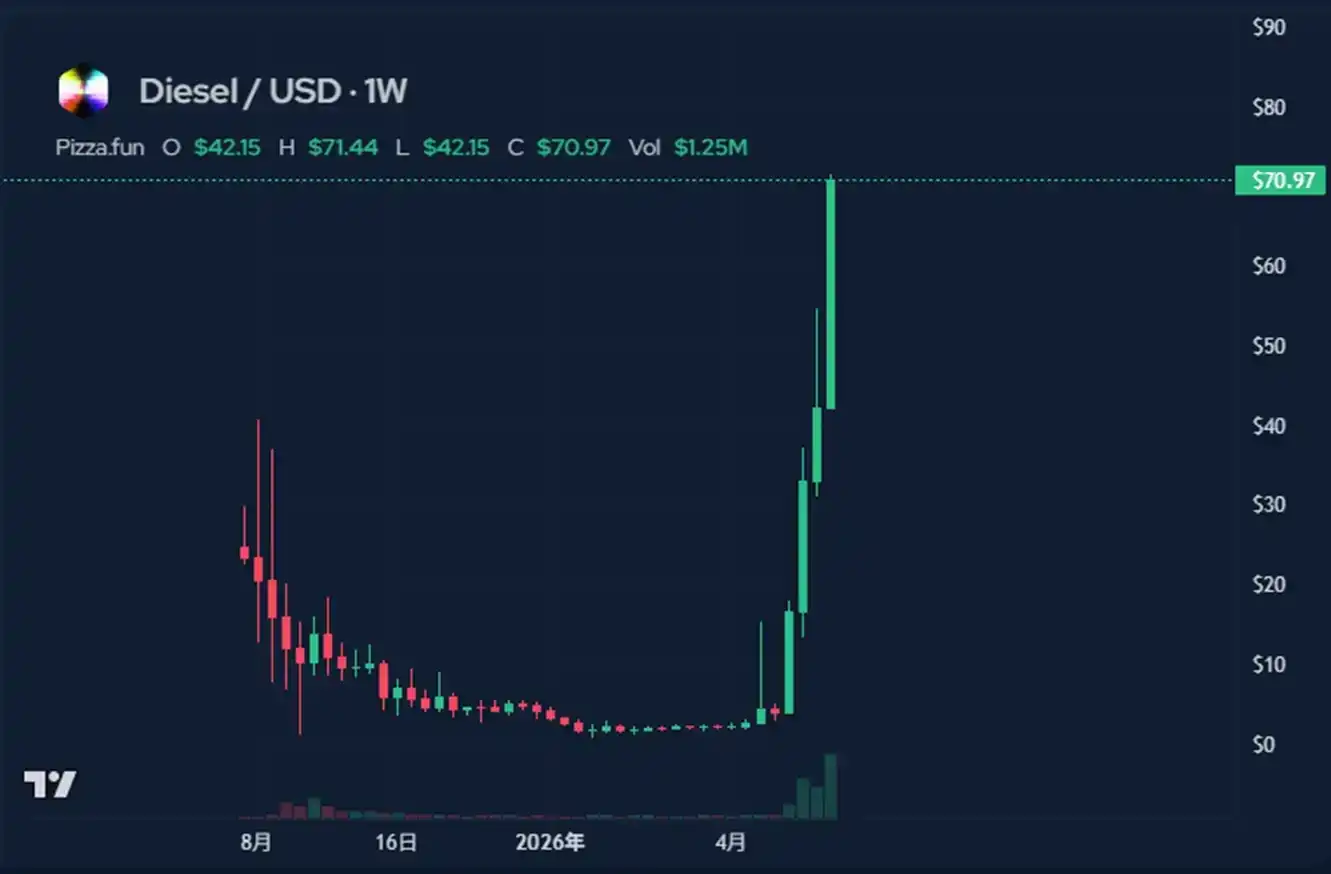
Alkanes isn't a new protocol. In fact, Oyl Wallet, which initially led it, is no longer active. The subfrost team now responsible for protocol updates and maintenance consists of the original technical team from Oyl Wallet that handled Alkanes. Despite Oyl's disbandment, the subfrost team has been consistently updating, implementing significant performance optimizations such as embedding contracts into the indexer.

However, the substantial rise of $DIESEL is likely due to its very small actual circulating supply. The previous mining mechanism for $DIESEL awarded the entire block's $DIESEL reward to the single minting transaction that paid the highest miner fee within that block. This essentially allowed "scientists" (automated traders/bots) to dominate, making it difficult for ordinary users to participate. In August last year, the mining mechanism was updated. Now, all successful minting transactions in a block share the $DIESEL reward proportionally based on their bid amount. This means those who believe in $DIESEL's value can mine more. Mining has become a small "beast" (auction) occurring every block, with a fixed total reward (currently about 3.125 $DIESEL per block, synchronized with Bitcoin's halving cycle), but the bidding situation within each block changes.

Simultaneously, 50% of all funds bid for minting $DIESEL within a block are converted into $DIESEL and directed to the project's treasury for protocol development. Therefore, although the $DIESEL production per block is about 3.125 tokens, the amount users actually receive from minting is less, as a portion goes directly to the project team.

The total supply of $DIESEL is 1,562,000 tokens. Currently, approximately 640,000 tokens have been mined and are potentially circulating, but the actual amount available for trading might be less than 10% of the total supply. Combined with the recent massive price surge, I'd call it the "meme coin" of the Bitcoin ecosystem.


Preguntas relacionadas

QWhat is the Bound platform, and why has it recently gained significant attention in the Bitcoin ecosystem?

ABound is a comprehensive financial platform formed by merging radfi and Bound's previous services. It offers trading, lending, Launchpad, and an NFT marketplace. It gained significant attention because its token $Bound surged approximately 46 times since May 21st. Key praised features include a simplified trading process using multiple cryptocurrencies, instant transaction confirmations via a 2-of-2 multi-sig security model, and a price protection mechanism for new token launches.

QHow does the Bound platform address the security concerns associated with off-chain trading confirmations?

ABound addresses security by implementing a 2-of-2 multi-signature setup for user deposit addresses. One signature key is held by the user (a passkey on their device), and the other is held by the platform's backend. This means even if the platform is hacked, assets cannot be stolen as the hacker only controls one signature. Additionally, a timelock feature is added: if Bound's signature expires after 3 months, users can withdraw their assets directly using their own passkey.

QWhat is the Alkanes protocol, and what is notable about its token $DIESEL?

AAlkanes is a Bitcoin-native asset protocol. Its notable token, $DIESEL, has increased in price by about 17 times since late April and is still rising. It is considered a 'weird coin' or '妖币' in the Bitcoin ecosystem. This dramatic rise is attributed to its very small circulating supply (likely less than 10% of its total 1.562 million supply is tradeable). Its mining mechanism was updated to allow proportional reward distribution based on bidding, making it more accessible than its previous 'scientist-dominated' model.

QWhat recent update did the Tacit protocol implement, and what is its primary focus?

AOn May 23rd, the Tacit protocol implemented dual-blind tokens on Bitcoin, significantly enhancing the protocol's privacy features. Tacit's primary focus is on privacy, aiming to be a privacy-preserving asset protocol within the Bitcoin ecosystem, similar to Zcash (ZEC). The developer is also working on a permissionless ETH-BTC bridge using SP1 zero-knowledge proofs.

QAccording to the article, what is a major user experience improvement offered by the Bound platform for trading Runes?

AA major user experience improvement is the significant simplification and speed-up of the trading process. Instead of only depositing Bitcoin and waiting for multiple block confirmations (which can take 30 minutes to over an hour), users on Bound can deposit various cryptocurrencies like SOL, ETH, HYPE, or BNB. These are converted to BTC via corresponding trading pairs on the platform, allowing users to trade Rune tokens almost immediately without the long Bitcoin network confirmation wait, greatly enhancing the user experience.

Lecturas Relacionadas

CEO's Unexpected Passing: Will ONDO's 'Tokenization Narrative' Change?

Ondo Finance, a leading project in the RWA (Real World Assets) and tokenization space, faces a significant challenge following the unexpected passing of its founder and CEO, Nathan Allman. Known for his traditional finance background and pivotal role in shaping Ondo's strategy, Allman was central to its evolution from a DeFi structured yield platform to a key player tokenizing assets like US treasuries, stocks, and ETFs. The company announced that President Ian De Bode, a former McKinsey partner with deep experience in digital assets and corporate strategy, will assume the CEO role. The leadership transition presents a critical test for Ondo. While Allman's vision and execution were instrumental in establishing its "tokenization narrative," the project's medium to long-term trajectory will depend on the existing team's ability to maintain business continuity. Analysts note short-term concerns regarding vision continuity, institutional partnerships, and market sentiment for the ONDO token. However, Ondo has built a substantial product suite (OUSG, USDY, Ondo Global Markets) and a management team with strong traditional finance credentials. De Bode's background in strategy and execution may align well with the next phase of RWA growth, which focuses heavily on compliance, scaling, and institutional adoption. Ultimately, the event shifts focus to whether Ondo is a founder-driven story or a sustainable financial infrastructure. Its future as a "first tokenization asset" will be determined by the new leadership's success in delivering product growth, asset scaling, and real-world demand, rather than narrative alone.

marsbitHace 46 min(s)

CEO's Unexpected Passing: Will ONDO's 'Tokenization Narrative' Change?

marsbitHace 46 min(s)

Trading

Spot
Futuros

Artículos destacados

Qué es MEME 2.0

Memecoin 2.0: El Ascenso de $MEME 2.0 en el Mundo de las Criptomonedas Introducción En el panorama siempre cambiante de las criptomonedas, ha surgido un nuevo contendiente. Memecoin 2.0, simbolizada como $MEME 2.0, lleva el concepto de las monedas meme a un emocionante nuevo nivel. Como un subproducto del Memecoin original, este proyecto ha capturado la atención de la comunidad cripto al cambiar el enfoque de los incentivos financieros típicos a una experiencia comprometida y entretenida. Operando en la blockchain de Ethereum, Memecoin 2.0 redefine audazmente la participación de la comunidad en la esfera cripto. ¿Qué es Memecoin 2.0, $MEME 2.0? En su núcleo, Memecoin 2.0 es un proyecto de criptomoneda que prioriza el espíritu comunitario y la diversión asociada con la cultura meme. A diferencia de las criptomonedas convencionales, que se concentran en casos de uso prácticos y beneficios tangibles, Memecoin 2.0 se distingue al abrazar el lado más liviano de la moneda digital. El proyecto existe sin promesas de utilidad, un mapa estructurado o retornos financieros, enfocándose en cambio en fomentar una comunidad vibrante centrada en memes y en el disfrute compartido. Al hacerlo, aprovecha la creciente tendencia de la cultura meme en el espacio en línea, convirtiéndose en un jugador único en el mundo de los activos digitales. Creador de Memecoin 2.0, $MEME 2.0 A pesar de la extensa investigación sobre los orígenes de Memecoin 2.0, la identidad explícita de su creador sigue siendo desconocida. Esta anonimidad no es inusual en la comunidad cripto, donde muchos proyectos son liderados por individuos o grupos que prefieren permanecer en las sombras. La falta de información disponible públicamente sobre el creador podría verse como un movimiento estratégico, poniendo el foco en la participación comunitaria en lugar de la notoriedad individual dentro del espacio. Inversores de Memecoin 2.0, $MEME 2.0 La información sobre los inversores o el respaldo financiero de Memecoin 2.0 es escasa. Esta ausencia de detalles puede sugerir que el proyecto es autofinanciado o que su enfoque en la comunidad en lugar de las estructuras de inversión tradicionales ha atraído a un tipo diferente de apoyo. Dado que el mundo de las monedas meme generalmente involucra una participación más de base en lugar de inversión institucional, este enfoque está alineado con la ética de los proyectos impulsados por la comunidad. ¿Cómo Funciona Memecoin 2.0, $MEME 2.0? Memecoin 2.0 opera completamente en la blockchain de Ethereum, capitalizando sus robustas características de seguridad y escalabilidad. Al aprovechar las fortalezas de Ethereum, Memecoin 2.0 puede ofrecer un entorno seguro para las interacciones de los usuarios, asegurando que las transacciones sean tanto eficientes como rentables. Uno de los atributos únicos de Memecoin 2.0 radica en su estructura impulsada por la comunidad. El valor y la popularidad del token $MEME 2.0 derivan de la participación activa de sus usuarios, en vez de de una utilidad inherente. Este diseño refuerza el enfoque del proyecto en el aspecto de entretenimiento de las criptomonedas, lo que implica que la risa y la participación comunitaria son las verdaderas monedas que impulsan su éxito. Además, el proyecto encaja dentro del ecosistema más amplio de las monedas meme, donde el valor de cada moneda meme oscila basado en la cultura, tendencias y la participación de la comunidad, en lugar de principios económicos tradicionales. Cronología de Memecoin 2.0, $MEME 2.0 Para entender mejor la evolución y los hitos de Memecoin 2.0, aquí hay una cronología que destaca eventos significativos en su historia: 2024: Se reconoce la creación de Memecoin 2.0 como una ramificación del Memecoin original, estableciéndose dentro del contexto próspero de las monedas meme mientras opera en la blockchain de Ethereum. 13 de julio de 2024: Memecoin 2.0 se posiciona oficialmente como una moneda meme centrada en la comunidad en la red de Ethereum, enfatizando su enfoque centrado en el entretenimiento que invita a los usuarios a participar y crecer. Puntos Clave Sobre Memecoin 2.0, $MEME 2.0 Varios rasgos críticos definen a Memecoin 2.0: Enfoque Centrado en la Comunidad: La misión principal de Memecoin 2.0 es crear una experiencia comunitaria divertida y atractiva, capitalizando en el disfrute colectivo derivado de la cultura memética. Construido sobre Ethereum: Operar en la blockchain de Ethereum proporciona al proyecto una infraestructura esencial que garantiza seguridad y escalabilidad. Falta de Utilidad o Hoja de Ruta: En un notable desvío de las criptomonedas tradicionales, Memecoin 2.0 no promete características utilitarias ni retornos financieros, reafirmando su compromiso con la participación comunitaria y el compromiso social. Enfoque en la Cultura Memética: Al abrazar los aspectos humorísticos y culturales del fenómeno meme, Memecoin 2.0 proporciona una plataforma para que los usuarios interactúen con cripto tanto fuera de línea como en línea. Contexto Adicional: La Importancia de las Monedas Meme Las monedas meme han surgido como una clase distinta de criptomonedas, a menudo impulsadas por el humor y un enfoque desenfadado para el comercio. Estas monedas generalmente carecen de una utilidad significativa o hojas de ruta de desarrollo, atrayendo a los usuarios con la promesa de diversión, interacción comunitaria y relevancia cultural. En el panorama del ecosistema cripto más amplio, las monedas meme reviven la importancia de la participación comunitaria, revirtiendo enfoques únicamente motivados por el lucro. Proyectos como Memecoin 2.0 inauguran una era donde el entretenimiento puede armonizar con las aspiraciones financieras, convirtiendo la blockchain en un parque de diversiones para la creatividad y la interacción social. Conclusión Memecoin 2.0, o $MEME 2.0, encarna una nueva ola de criptomonedas que prioriza la participación comunitaria sobre estructuras financieras rígidas. Con un enfoque en el humor y la interacción social, capitaliza sobre la fascinación que rodea la cultura meme. Al operar en la blockchain de Ethereum, Memecoin 2.0 aprovecha las capacidades de la tecnología mientras se mantiene firme en su compromiso con el valor de entretenimiento de la moneda digital. A medida que el espacio alrededor de las criptomonedas continúa evolucionando, Memecoin 2.0 sirve como un testimonio de la noción de que el futuro de los activos digitales podría depender, en gran medida, de experiencias compartidas, risas y sólidas conexiones comunitarias. En el mundo impredecible de las criptomonedas, quizás la alegría pueda ser tan valiosa como la ganancia financiera tradicional.

95 Vistas totalesPublicado en 2024.04.04Actualizado en 2024.12.03

Qué es MEME 2.0

Cómo comprar MEME

¡Bienvenido a HTX.com! Hemos hecho que comprar Memeland (MEME) sea simple y conveniente. Sigue nuestra guía paso a paso para iniciar tu viaje de criptos.Paso 1: crea tu cuenta HTXUtiliza tu correo electrónico o número de teléfono para registrarte y obtener una cuenta gratuita en HTX. Experimenta un proceso de registro sin complicaciones y desbloquea todas las funciones.Obtener mi cuentaPaso 2: ve a Comprar cripto y elige tu método de pagoTarjeta de crédito/débito: usa tu Visa o Mastercard para comprar Memeland (MEME) al instante.Saldo: utiliza fondos del saldo de tu cuenta HTX para tradear sin problemas.Terceros: hemos agregado métodos de pago populares como Google Pay y Apple Pay para mejorar la comodidad.P2P: tradear directamente con otros usuarios en HTX.Over-the-Counter (OTC): ofrecemos servicios personalizados y tipos de cambio competitivos para los traders.Paso 3: guarda tu Memeland (MEME)Después de comprar tu Memeland (MEME), guárdalo en tu cuenta HTX. Alternativamente, puedes enviarlo a otro lugar mediante transferencia blockchain o utilizarlo para tradear otras criptomonedas.Paso 4: tradear Memeland (MEME)Tradear fácilmente con Memeland (MEME) en HTX's mercado spot. Simplemente accede a tu cuenta, selecciona tu par de trading, ejecuta tus trades y monitorea en tiempo real. Ofrecemos una experiencia fácil de usar tanto para principiantes como para traders experimentados.

201 Vistas totalesPublicado en 2024.12.12Actualizado en 2025.03.21

Cómo comprar MEME

Discusiones

Bienvenido a la comunidad de HTX. Aquí puedes mantenerte informado sobre los últimos desarrollos de la plataforma y acceder a análisis profesionales del mercado. A continuación se presentan las opiniones de los usuarios sobre el precio de MEME (MEME).

活动图片