Chainalysis Estimates Taxable Crypto Activity at $457 Billion, Says CARF Covers Only a Small Portion

cryptonews.ruPublicado a 2026-08-26Actualizado a 2026-08-26

Resumen

A new Chainalysis report estimates that potentially taxable on-chain cryptocurrency activity reached at least $457 billion globally in 2025. However, international reporting rules like the OECD's Crypto-Asset Reporting Framework (CARF) cover only a fraction of this amount. CARF, which came into effect on January 1, 2026, requires covered crypto service providers to report client transaction data to tax authorities. According to Chainalysis, CARF rules apply to only about 14% of the identified taxable on-chain activity. The remaining 86%, which includes decentralized exchange trading, peer-to-peer transfers, on-chain income (like staking and mining rewards), and crypto-denominated payments, largely falls outside the framework's scope. The report notes regional breakdowns, with North America leading at $134.6 billion (including an estimated $112.6 billion for the U.S.), followed by the European Union at $125.1 billion. The analysis covers six major blockchains but excludes trading activity on centralized exchanges. The gap is attributed to CARF's focus on regulated intermediaries. Experts involved in CARF's development note it was designed around businesses facilitating crypto transactions. Consequently, much of decentralized finance (DeFi) activity, where no centralized operator or custodial relationship exists, is currently not covered. Regulators are monitoring developments in anti-money laundering rules to potentially address reporting requirements for DeFi platforms in ...

According to a new report from Chainalysis, potentially taxable on-chain crypto activity globally reached at least $457 billion in 2025, while international reporting rules may only cover a portion of it.

The United States accounted for an estimated $112.6 billion of the total, and North America led all regions with $134.6 billion, followed by the European Union with $125.1 billion.

The estimates include realized gains, income from activities such as mining, staking, and lending, as well as payments denominated in cryptocurrency, across the six largest blockchains, but do not account for trading and other activity within centralized exchanges.

Chainalysis stated that transactions falling under the OECD's Crypto-Asset Reporting Framework (CARF) cover only 14% of the taxable on-chain activity it identified. The remaining 86% includes activity on decentralized exchanges, peer-to-peer transfers, on-chain sources of income, and payments.

Developed by the OECD in 2022, CARF requires covered crypto service providers to report customer transaction data to tax authorities.
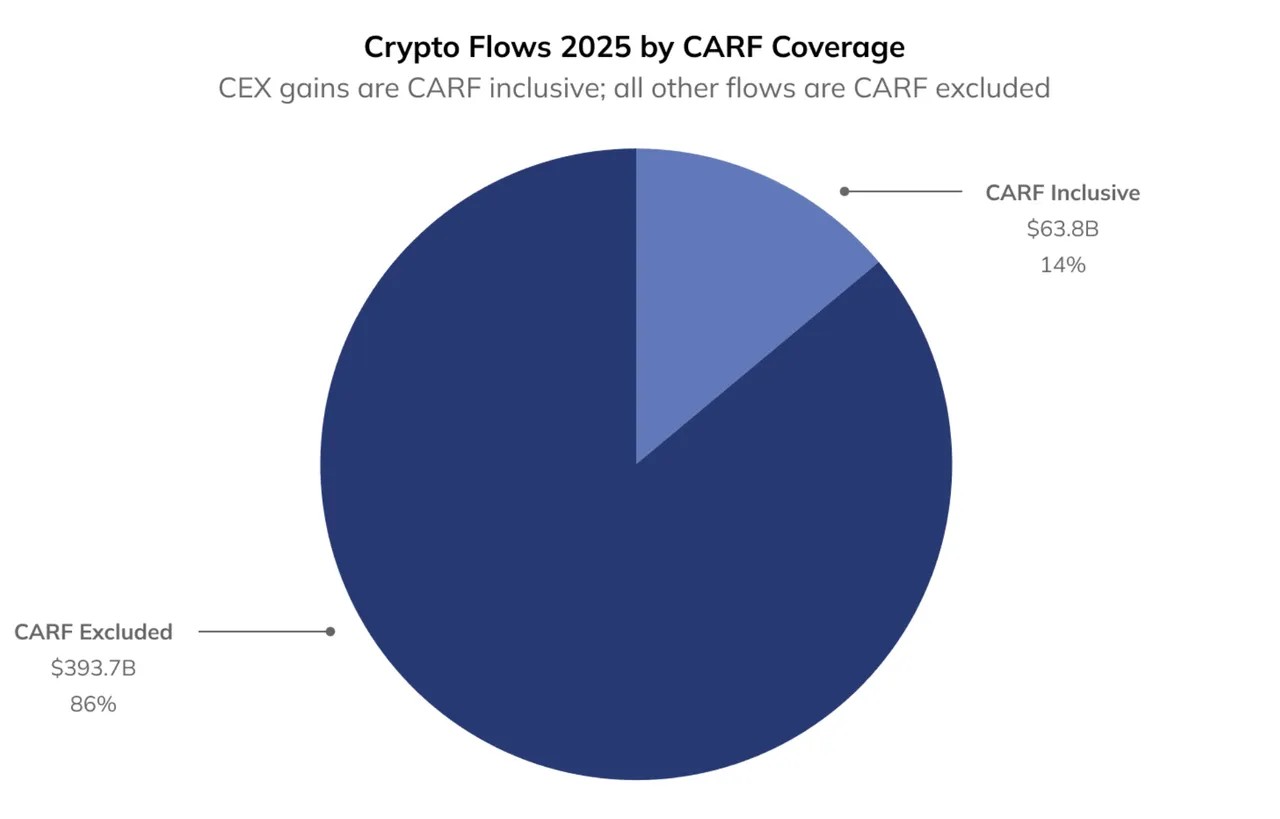
CARF covers only 14% of potentially taxable on-chain crypto activity.
Source: Chainalysis

Related: Chainalysis Sues U.S. Over $95M ICE Contract With TRM Labs

Limitations of CARF for Reporting On-Chain Activity Taxes

Data collection under CARF began on January 1, 2026, in 48 jurisdictions, including the United Kingdom and the European Union, and requires covered crypto platforms to collect additional information about customers and their tax residency.

Under CARF, covered crypto service providers collect information about customers and their tax residency and report transaction data to national tax authorities, which can then exchange this information across borders.
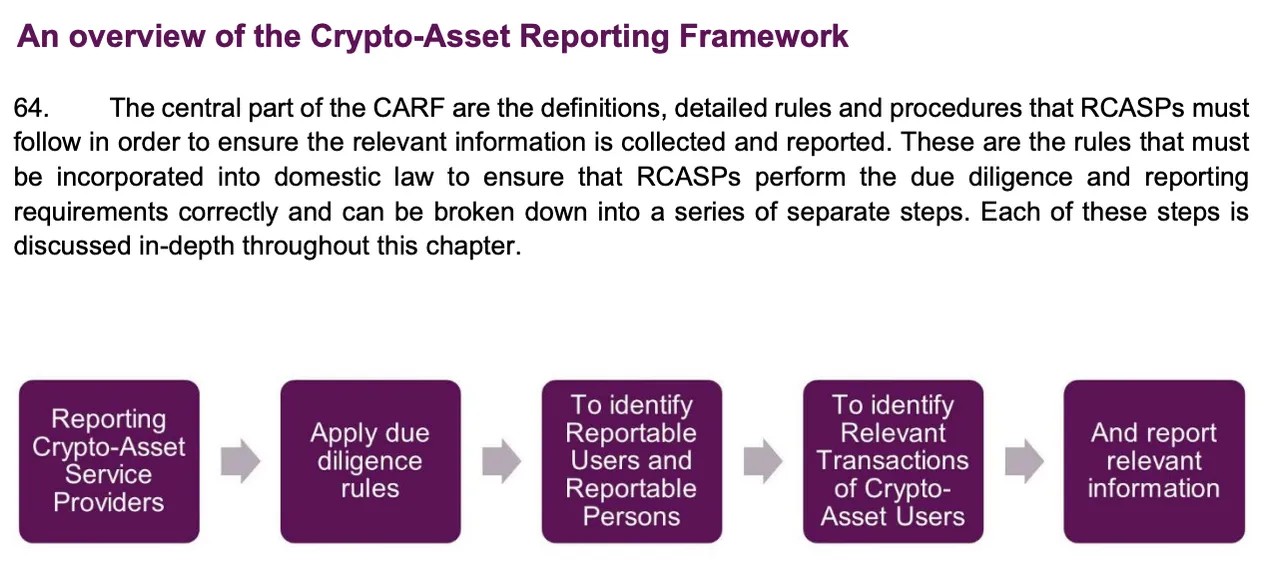
The CARF Framework. Source: OECD

CARF's focus on crypto intermediaries also helps explain the gaps highlighted by Chainalysis. Colby Mangles, a former OECD advisor involved in drafting CARF, told Cointelegraph in January that the framework was designed with intermediaries in mind—those that facilitate crypto transactions as a business.

A significant portion of decentralized finance therefore remains outside the reporting perimeter, as there may be no centralized operator or custodial relationship on which to impose reporting obligations.

This may change as regulators develop rules for decentralized platforms. Mangles stated that tax authorities are monitoring developments in anti-money laundering regulation, including attempts to define when DeFi platforms or their operators should be considered regulated crypto service providers.

Magazine: Proposed SEC crypto rules likely won't spark a new ICO boom

end-content

Preguntas relacionadas

QAccording to the Chainalysis report, what was the estimated value of potentially taxable on-chain crypto activity in 2025?

AThe estimated value of potentially taxable on-chain crypto activity in 2025 was at least $457 billion.

QWhich region had the highest amount of this estimated taxable crypto activity in 2025, and what was its value?

ANorth America had the highest amount with an estimated $134.6 billion.

QWhat percentage of the identified taxable on-chain activity does the OECD's CARF (Crypto-Asset Reporting Framework) cover according to Chainalysis?

AAccording to Chainalysis, CARF covers only 14% of the identified taxable on-chain activity.

QWhat types of crypto transactions are largely excluded from CARF's reporting requirements?

ACARF largely excludes activity on decentralized exchanges (DEXs), peer-to-peer transfers, on-chain income sources, and payments, which together account for 86% of the identified activity.

QWhy does a significant portion of Decentralized Finance (DeFi) activity fall outside the scope of CARF?

AA significant portion of DeFi activity falls outside CARF's scope because the framework was designed with intermediaries in mind, and many DeFi platforms may lack a centralized operator or custodial relationship on which reporting obligations can be placed.

Lecturas Relacionadas

How 5G Will Be Launched in Russia: The Digital Ministry's Proposal and the Roadmap to 2035

Russia's Ministry of Digital Development has proposed a plan for launching 5G networks. It allows the "Big Four" mobile operators (Beeline, Megafon, MTS, T2) to deploy 5G on existing 4G/LTE base stations and frequencies, and will allocate them the new 4.63–4.99 GHz band. A key element is "technological neutrality," permitting the use of foreign equipment until September 2026. The new 4.63–4.99 GHz band is intended for more advanced services and industrial applications. However, a phased transition to Russian-made base stations will begin in 2027, with a target of at least 50% domestic equipment by 2030. The rollout timeline aims for 5G in cities with over 1 million people by the end of 2027, expanding to 84 cities by 2035. Initial "5G Ready" service, operating over existing infrastructure, will offer minimal speed improvements. Significant speed gains (4-10x over LTE) will require the new band and corresponding equipment. The plan addresses long-standing regulatory delays, including the military's hold on the global standard 3.4–3.8 GHz band. This forced Russia to adopt the 4.63–4.99 GHz range, overlapping with a Chinese band, making Chinese equipment a potential transitional solution. The success of the rollout will depend on equipment supply and the pace of production localization, while a challenge lies in smartphone compatibility with this non-standard frequency band.

cryptonews.ruHace 1 hora(s)

How 5G Will Be Launched in Russia: The Digital Ministry's Proposal and the Roadmap to 2035

cryptonews.ruHace 1 hora(s)

The Federal Reserve Bank of Dallas Announces a Colossal $700 Billion Allocation! How Will This Affect Bitcoin?

The Federal Reserve Bank of Dallas warns that the growing adoption of tokenized deposits in the banking sector could pose unforeseen risks to the financial system. Tokenized deposits, which transfer traditional bank deposits to blockchain infrastructure, offer features like instant settlement and programmable payments. While issued by regulated banks and maintaining deposit characteristics, they could enable customers to move funds between banks much faster in search of higher yields. This would significantly weaken banks' liquidity management and lending capacity. The Fed's analysis estimates that an increase in deposit interest rate sensitivity by 10% could reduce the interest rate risk banks can bear by approximately $700 billion over ten years. Similarly, a 10% shortening of the average deposit maturity could reduce the banking system's capacity to convert deposits into loans by about $580 billion. This acceleration of deposit movement could force banks to rely on more expensive wholesale funding, increasing borrowing costs for consumers and businesses and potentially making traditional banks resemble non-bank financial institutions. While the report does not directly address Bitcoin, the described shifts could have long-term implications. Firstly, the tokenization of deposits by banks could promote institutional adoption of blockchain-based financial infrastructure, indirectly legitimizing digital asset classes like Bitcoin. Secondly, faster-moving deposits and resulting higher funding costs could increase the price of liquidity in the financial system. This could create near-term headwinds for risk assets, including Bitcoin, due to tighter financial conditions and potential selling pressure. The report concludes that widespread adoption of this technology could impact many areas, from payment systems to monetary policy transmission mechanisms.

cryptonews.ruHace 1 hora(s)

The Federal Reserve Bank of Dallas Announces a Colossal $700 Billion Allocation! How Will This Affect Bitcoin?

cryptonews.ruHace 1 hora(s)

Trading

Spot
活动图片