Robinhood Chain's First Breakout Hit Is a Meme Cat: Retail Investors Dig Out CashCat's 'Original Name,' CEO Jumps on the Trend

marsbitPublicado a 2026-07-08Actualizado a 2026-07-08

Resumen

Robinhood Chain launched its mainnet on July 1st, promoting tokenized U.S. stocks as its core feature. However, the first asset to gain significant traction was a meme token called CASHCAT, which surged over 1700% in 24 hours, reaching a market cap of $120 million. The token's narrative stems from Robinhood's early history: CEO Vlad Tenev revealed the company's initial working name was "CashCat." CASHCAT has no official ties to Robinhood and declares itself as "pure cat" with zero utility. Tenev added fuel by tweeting on July 8th that the chain is "great for memes," which the community saw as implicit approval. The hype has attracted copycat tokens on other chains like Solana and impersonator accounts promoting scams. The article highlights the extreme volatility and risks associated with this new, illiquid meme token on a fledgling blockchain, cautioning investors to verify contracts and treat any investment as high-risk speculation.

Author: Claude, Shenchao TechFlow

Shenchao Introduction: One week after the Robinhood Chain mainnet launch, while the officially promoted stock token hasn't gone viral yet, a Meme cat called CASHCAT has taken off first, with its price surging over 1700% in 24 hours at one point and its market cap exceeding $120M. Its entire narrative boils down to one sentence: the working name for Robinhood during its startup phase was CashCat. CEO Tenev himself shared this history and even tweeted a meme on the day of the surge. Meanwhile, copycat tokens and fake 'Roaring Kitty' shilling accounts are already in position.
Attracting traffic and retail investor attention still depends on Memes.

Robinhood spent a year paving the way for its own blockchain, pitching tokenized stocks as the core story. However, the first truly viral asset on the chain turned out to be a cartoon cat holding cash.

According to GMGN monitoring, on July 8th, the market capitalization of the Meme token CASHCAT on Robinhood Chain exceeded $120 million, with a 24-hour increase of over 1700%. In the following hours, readings from different data platforms continued to rise. According to CoinGecko data, CASHCAT primarily trades on the Uniswap V3 deployed on Robinhood Chain, with the CASHCAT/WETH pair seeing a 24-hour trading volume of approximately $28 million. For a new chain that has only been live for a week and has very few ecosystem applications, this cat is the current traffic itself.

Seventh Day Post-Mainnet Launch, The First Viral Asset Is a Meme

First, some background.

On July 1st, Robinhood officially launched the public mainnet for Robinhood Chain at an event in London. This is an Ethereum Layer 2 based on Arbitrum technology, unveiled by CEO Vlad Tenev and crypto business head Johann Kerbrat. The official positioning of this chain is quite 'serious'. Its core product, Stock Tokens, tracks the price performance of over 200 US stocks and ETFs and is open to users in over 120 jurisdictions (excluding US users). DeFi protocols like Uniswap and 1inch were deployed on day one, and Robinhood pledged to cover all Gas fees for the first 90 days.

According to the official script, the protagonists of this chain should have been tokenized stocks and RWA (Real World Assets). However, the script didn't follow the plan. In the first week after the mainnet launch, the most actively traded pair on the chain wasn't any stock token, but CASHCAT. Retail investors set the tone for this 'retail broker's chain' first.

A clear warning for holders: CASHCAT's current trading depth is concentrated on a single trading pair within a single DEX. Liquidity is thin on a new chain, price readings vary significantly across platforms, and both slippage and wick risk upon entry/exit are far higher than for Memes on mature chains.

Archaeology of the 'Original Name', Tenev Himself Told the CashCat Story

CASHCAT's success relies on a real piece of company history.

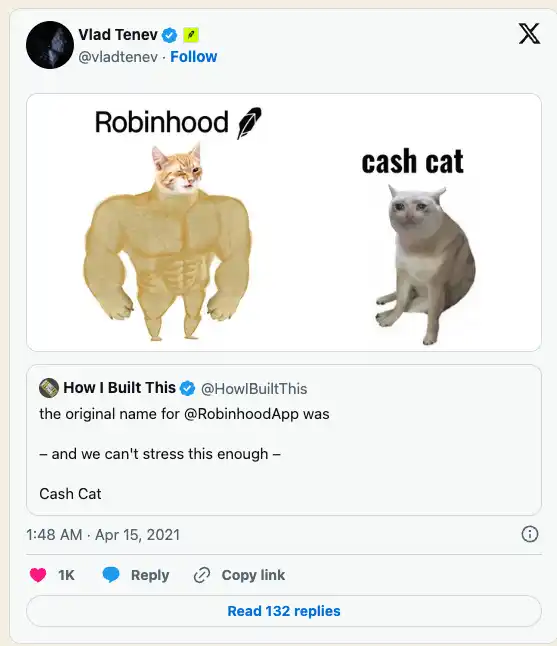
In early interviews, Tenev recalled the company naming process: "The original working name was actually CashCat, but everyone felt it wasn't powerful enough. My wife would introduce me to her friends by saying, 'They're the Robin Hoods of finance, doing things for the little guy.' That's how the name Robinhood stuck." This account has been cited in numerous company retrospectives after the GameStop saga, making it verifiable 'archaeological material.' This is the biggest difference between CASHCAT and other cat/dog coins built on fabricated stories.

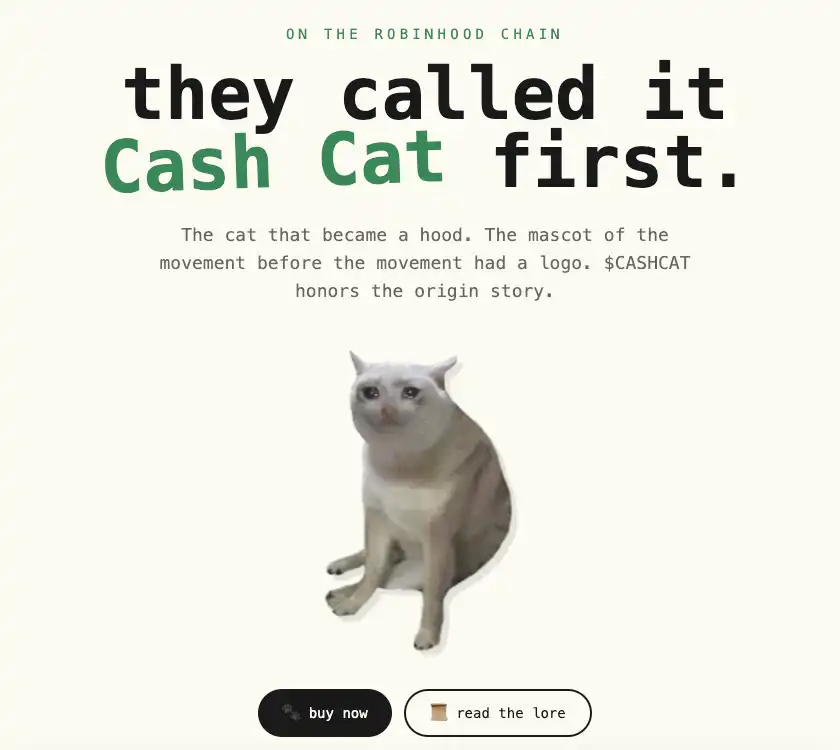
The token's structure is as simple as it gets. According to the project's website, the total supply is 1 billion tokens, with zero buy/sell taxes. The liquidity pool tokens have been fully burned, and it self-identifies as "zero utility, one hundred percent cat." The website also explicitly states that the project has no affiliation with Robinhood, calling it "fan fiction with a ticker."

The narrative is real, the product is unrelated. Readers need to distinguish these two facts: Robinhood's history provides this cat with viral material, but the company does not endorse it. The token's value is built entirely on attention, with no safety net when that attention fades.
Tenev Tweets Meme, Market Interprets It as Semi-Endorsement

What truly pushed the frenzy to its peak was Tenev himself.

On July 8th, Tenev posted on X (formerly Twitter): "We're making Robinhood Chain the best RWA public chain... but it runs Memes really well too." The post garnered over 500,000 views within hours. While he didn't mention CASHCAT by name, the timing coincided with the day of the massive surge. The community interpreted it as implicit approval, if not an assist, for the Meme frenzy on the chain.

There's a layer of historical irony here. During the 2021 GameStop short squeeze, Robinhood was thrust into Congressional hearings for restricting retail buys of GME, becoming the 'villain' in the retail narrative. Five years later, this company's blockchain completes its cold start, precisely relying on the Meme culture that retail investors excel at, with the object of speculation being the name the company itself discarded. The CASHCAT website even specifically plays on this irony: "Cash Cat doesn't do options, and it doesn't do PFOF (Payment for Order Flow)."
For traders, it's necessary to heavily discount the actual value of this tweet. A playful tweet from Tenev and an official Robinhood endorsement are separated by an entire compliance department. The company has no commitments regarding custody, listing, or providing liquidity for the Meme token. The effectiveness of such sentiment catalysts typically lasts only hours.

Copycat Tokens and Fake 'Roaring Kitty' Accounts Are Already in Position

Once the heat arrived, the tools to hunt retail investors followed.

First, cross-chain copycat tokens. According to aggregated monitoring information from CoinGecko, an identically named CASHCAT has already been deployed on the Solana chain. The original contract is deployed on Robinhood Chain with an address starting with 0x020b and ending with 18b4; identically named tokens on other chains are unrelated to the original.

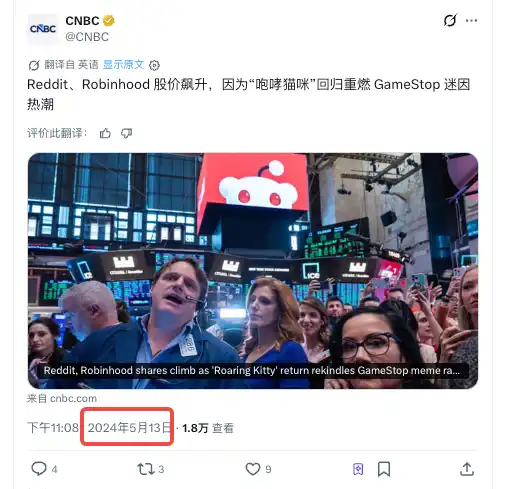
Second, impersonator accounts shilling. For example, an X account with the handle "RK" and a username highly similar to GameStop saga protagonist 'Roaring Kitty' Keith Gill tweeted, "CASHCAT is the first major Meme on Robinhood chain," and included a Solana contract address in the post.

New chain, new Meme, fake accounts, cross-chain copycats—this combination has claimed victims in every past Meme cycle. If you still decide to participate now, at least do these three things: verify the contract address, use only official or reputable cross-chain bridges, and keep your position size to lottery-ticket levels.

CASHCAT's current total value is just a good story plus a wave of attention, neither of which has a retention mechanism.


Criptos en tendencia

Preguntas relacionadas

QWhat is CASHCAT, and why did it become the first viral asset on Robinhood Chain after its mainnet launch?

ACASHCAT is a meme token featuring a cartoon cat holding cash. It became the first viral asset on Robinhood Chain, launched on July 1, due to its connection to Robinhood's early history. The name 'CashCat' was Robinhood's original working name before it adopted 'Robinhood,' a fact shared by CEO Vlad Tenev. The token's price surged over 1700% in 24 hours, capturing significant market attention and liquidity on the new chain.

QWhat historical anecdote about Robinhood gives CASHCAT its narrative foundation?

AThe narrative foundation for CASHCAT comes from an anecdote shared by Robinhood CEO Vlad Tenev. He revealed that the company's original working name during its early days was 'CashCat,' but it was changed to 'Robinhood' because the latter was perceived as more powerful and aligned with the idea of 'stealing from the rich to give to the poor.' This true piece of company history differentiates CASHCAT from other meme tokens with fabricated backstories.

QHow did Robinhood CEO Vlad Tenev's actions on social media contribute to the hype around CASHCAT?

AOn July 8, Vlad Tenev posted on X, stating, 'We're building Robinhood Chain to be the best RWA public chain... but it runs Memes pretty well too.' Although he didn't mention CASHCAT by name, the timing coincided with the token's massive price surge. The community interpreted the post as a tacit endorsement or acknowledgment of the meme token activity on the chain, significantly fueling the hype and market speculation.

QWhat are the key risks associated with trading CASHCAT as highlighted in the article?

AThe article highlights several key risks: 1) The token's trading is concentrated on a single DEX (Uniswap V3) and a single trading pair (CASHCAT/WETH) on the new Robinhood Chain, leading to thin liquidity. 2) This results in high slippage, price volatility, and significant differences in price readings across data platforms. 3) The token's value is based solely on a historical narrative and market attention, with no underlying utility or backing from Robinhood, making it highly susceptible to rapid value loss when hype fades.

QWhat fraudulent activities emerged following CASHCAT's price surge, and what precautions should investors take?

AFollowing the surge, fraudulent activities included: 1) The deployment of fake 'CASHCAT' tokens on other blockchains like Solana, which are unrelated to the original Robinhood Chain token. 2) Impersonator accounts on social media, such as one mimicking 'Roaring Kitty' (Keith Gill), promoting these fake tokens. Investors are advised to: verify the correct contract address (the original starts with 0x020b and ends with 18b4), use only official or reputable cross-chain bridges, and limit their investment to an amount they are prepared to lose ('lottery ticket' sized positions).

Lecturas Relacionadas

Former Huawei 'Genius Teen' Who Questioned DeepSeek Interview Lands in 'Crossfire' from Web3 Investor

Former Huawei "Genius Youth" Li Bojie recently drew public attention by criticizing his interview experience with DeepSeek. The controversy escalated when Du Jun, co-founder of Web3 investment firm ABCDE Capital, publicly accused Li of being "the founder with the least sense of contractual spirit" he had ever cooperated with, sparking a dispute over Li's startup project, Metagent. Li detailed a frustrating DeepSeek interview where he was accused of potential plagiarism, leading him to end the session. The spotlight then shifted to his venture, Metagent, a Web3+AI project aiming to tokenize AI agents. ABCDE invested $1.5 million, with an initial $500k disbursed. Du Jun claimed the project's progress was severely lacking, with a poor-quality demo and minimal social media activity. He alleged Li stopped communicating, deleted his Telegram, and failed to provide proper financial reporting. In response, Li argued the remaining $1 million was never received, crippling operations and forcing salary cuts. He stated he left Metagent in October 2024 due to family reasons and Web3 compliance concerns, with board approval. He claimed to have fulfilled disclosure duties and that his subsequent projects avoided conflicting fields. Other investors, including ArkStream Capital, shared negative due diligence experiences, citing unprofessional contracts and evasive answers on tokenomics. Metagent's social media went silent in June 2024, effectively stalling. Li has since moved to a new consumer AI agent platform, Pine AI (formerly Logenic AI), which has raised $25 million in Series A funding. He served as its Chief Scientist but recently left, clarifying he was not the founder and departed due to a shift in research interests.

Foresight NewsHace 23 min(s)

Former Huawei 'Genius Teen' Who Questioned DeepSeek Interview Lands in 'Crossfire' from Web3 Investor

Foresight NewsHace 23 min(s)

SemiAnalysis: Anthropic's Q3 Profit to Exceed $1 Billion

Research firm SemiAnalysis reveals that Anthropic is reshaping the AI commercialization landscape with profitability and growth rates far exceeding competitors. Leveraging a high-margin, API-centric business model, Anthropic has become a leader in the B2B AI market. The report projects that Anthropic will achieve a GAAP EBIT of $1 billion in Q3 2026, with a 6% margin. Its Annual Recurring Revenue (ARR) has surged from $9 billion at the end of 2025 to over $60 billion currently. If it maintains a Net New ARR (NNARR) of approximately $15 billion per month, its ARR could reach $300 billion by the end of 2027, implying a $6 trillion enterprise value and making it the world's most valuable company. Anthropic secretly filed for an IPO on June 1st. SemiAnalysis argues the timing is strategically urgent due to narrowing capital market windows as rivals like Alphabet and Meta secure major funding. The superior financials and business model suggest Anthropic should go public before OpenAI to seize the competitive initiative. The performance inflection stems from the explosive adoption of Claude Code, which now accounts for over 7% of all GitHub commits, driving monthly NNARR from $3 billion in January to $11 billion in March. Anthropic's revenue structure differs significantly from OpenAI's. Approximately 75-85% of Anthropic's ARR comes from usage-based API fees, with consumer subscriptions constituting only about 5%. In contrast, over 65% of OpenAI's Q1 2026 revenue was from subscriptions, with ~40% from consumers. The API model's key advantage is no per-user revenue cap, enabling growth within existing accounts. Anthropic's Net Revenue Retention (NRR) is an extraordinary 500%. This drives superior gross margins, now in the mid-60% range versus -94% in 2024, with API margins exceeding 80%. Core drivers are improved inference efficiency and a largely enterprise-focused model without the cost of serving hundreds of millions of free users. The report introduces "EBTIT" (Earnings Before Training & Interest & Taxes) to measure re-investment capacity, projecting Anthropic's cumulative EBTIT through 2028 will be $250 billion higher than OpenAI's. Over 65% of lab ARR currently comes from programming use cases. Cybersecurity is seen as the next major vertical, with upcoming model releases like Fable expected to further increase token pricing and expand NNARR. Indirect sales via hyperscaler platforms (AWS Bedrock, Azure Foundry) now account for 15-20% of ARR. A core constraint is compute supply. By 2030, combined unconstrained compute demand from Anthropic and OpenAI could exceed 100 GW, far outstripping projected new capacity. IPO proceeds are seen as crucial to lock in future compute resources. Key risks include potential price cuts by OpenAI, competitive pressure from Google DeepMind and Meta in coding models, potential government restrictions on frontier model releases, and margin dilution from growing indirect "Token-as-a-Service" sales. Regulatory actions that narrow the capability gap between open-source and proprietary models are highlighted as a fundamental threat to Anthropic's moat.

marsbitHace 36 min(s)

SemiAnalysis: Anthropic's Q3 Profit to Exceed $1 Billion

marsbitHace 36 min(s)

Trading

Spot

Artículos destacados

Cómo comprar CAT

¡Bienvenido a HTX.com! Hemos hecho que comprar Simon's Cat (CAT) sea simple y conveniente. Sigue nuestra guía paso a paso para iniciar tu viaje de criptos.Paso 1: crea tu cuenta HTXUtiliza tu correo electrónico o número de teléfono para registrarte y obtener una cuenta gratuita en HTX. Experimenta un proceso de registro sin complicaciones y desbloquea todas las funciones.Obtener mi cuentaPaso 2: ve a Comprar cripto y elige tu método de pagoTarjeta de crédito/débito: usa tu Visa o Mastercard para comprar Simon's Cat (CAT) al instante.Saldo: utiliza fondos del saldo de tu cuenta HTX para tradear sin problemas.Terceros: hemos agregado métodos de pago populares como Google Pay y Apple Pay para mejorar la comodidad.P2P: tradear directamente con otros usuarios en HTX.Over-the-Counter (OTC): ofrecemos servicios personalizados y tipos de cambio competitivos para los traders.Paso 3: guarda tu Simon's Cat (CAT)Después de comprar tu Simon's Cat (CAT), guárdalo en tu cuenta HTX. Alternativamente, puedes enviarlo a otro lugar mediante transferencia blockchain o utilizarlo para tradear otras criptomonedas.Paso 4: tradear Simon's Cat (CAT)Tradear fácilmente con Simon's Cat (CAT) en HTX's mercado spot. Simplemente accede a tu cuenta, selecciona tu par de trading, ejecuta tus trades y monitorea en tiempo real. Ofrecemos una experiencia fácil de usar tanto para principiantes como para traders experimentados.

109 Vistas totalesPublicado en 2024.12.13Actualizado en 2026.06.02

Cómo comprar CAT

Qué es TRUMP CAT

Familia Gato Trump, $Gato Trump: Un Misterio Desenredado Introducción En el paisaje en constante evolución de proyectos de criptomonedas e innovaciones web3, ha surgido un fenómeno curioso—uno que parece estar en la línea entre la criptomoneda y la cultura de memes de internet. Este es el enigmático “Familia Gato Trump”, también conocido como “$Gato Trump”. Aunque puede despertar curiosidad entre los entusiastas de las criptomonedas, la realidad parece estar muy alejada de la definición estándar de un proyecto cripto. Este artículo tiene como objetivo explorar el concepto de Familia Gato Trump, sacando a la luz el contexto que lo rodea y aclarando su estatus en el ámbito cripto. ¿Qué es Familia Gato Trump, $Gato Trump? A primera vista, uno podría pensar que “Familia Gato Trump” se refiere a una criptomoneda legítima o un proyecto web3. Sin embargo, tras una investigación más profunda, se hace evidente que el término carece de las características de una empresa cripto tradicional. En cambio, “Gato Trump” parece estar predominantemente asociado con la cultura de memes virales que surgió tras las declaraciones controvertidas del ex presidente de EE. UU. Donald Trump sobre los inmigrantes haitianos. La cobertura mediática provocó una miríada de memes, interpretaciones humorísticas y una ola de comentarios sociales. Estos memes representan diversas formas de sátira centradas en el diálogo de Trump, a menudo utilizando gatos en escenarios cómicos y a veces absurdos. En lugar de ser un proyecto estructurado destinado a abordar avances tecnológicos o transacciones financieras, el concepto de “Familia Gato Trump” existe predominantemente en el ámbito del humor de internet. ¿Quién es el Creador de Familia Gato Trump, $Gato Trump? En la investigación de quién está detrás de la “Familia Gato Trump”, se hace evidente que no existe un creador identificable o figura fundadora. El fenómeno parece haber surgido de la expresión colectiva de internet, en lugar de un visionario singular con un objetivo de proyecto definido. Esta anonimidad enfatiza aún más su estatus como un meme en lugar de una iniciativa estructurada similar a la mayoría de los proyectos cripto conocidos. ¿Quiénes son los Inversores de Familia Gato Trump, $Gato Trump? Dado que “Familia Gato Trump” no se ajusta a las características de un proyecto cripto reputado, la cuestión de la inversión se vuelve irrelevante. No ha habido fundaciones u organizaciones establecidas expresando apoyo a un proyecto con este nombre. En cambio, lo que existe son contribuyentes individuales a la cultura de memes—aficionados, artistas y usuarios de redes sociales que colectivamente pueblan internet con sus interpretaciones y humor en torno al término “Gato Trump”. Este crecimiento orgánico dentro de la comunicación humana digital refleja más un comentario social que un paisaje de inversión financiera. ¿Cómo Funciona Familia Gato Trump, $Gato Trump? Si uno busca establecer cómo opera “Familia Gato Trump”, la respuesta es muy diferente de lo que podría esperarse de los proyectos cripto estándar. No hay mecanismos operativos, innovaciones tecnológicas o características únicas inherentes a este fenómeno. En cambio, existe a través de la propagación viral en línea, dependiendo de las plataformas de redes sociales para su proliferación. El “cómo” reside en el ámbito de la cultura y la comunicación—su esencia deriva de la dinámica de la interacción social en lugar de los protocolos cripto establecidos o las funcionalidades de blockchain. Lo que hace único a “Gato Trump”, si es que hay algo, es la forma en que dramatiza un diálogo político a través del humor. Las personas utilizan visuales atractivos, bromas internas y narrativas inventivas para transmitir sentimientos sobre figuras políticas y problemas sociales. El poder de los memes trasciende la comunicación tradicional, encapsulando pensamientos complejos en una forma que resuena ampliamente, pero que sigue siendo elusiva en términos de éxito cuantificable o metas estructuradas. Cronología de Familia Gato Trump, $Gato Trump Septiembre de 2024: El discurso en torno a los comentarios de Donald Trump sobre los inmigrantes haitianos que supuestamente consumen mascotas gana tracción en línea, llevando a una florecimiento de memes e interpretaciones paródicas en varias plataformas. Impacto Continuo: Tras este período, el fenómeno “Gato Trump” sigue vivo mientras los usuarios de redes sociales aprovechan el humor para abordar, criticar o simplemente celebrar la absurdidad de las conversaciones y eventos políticos. Es esencial notar que, dado que “Familia Gato Trump” carece de la estructura formal de un proyecto tradicional, la cronología consiste principalmente en observaciones anecdóticas en lugar de hitos notables comúnmente encontrados en empresas cripto reconocidas. Puntos Clave Cultura de Memes: En lugar de una iniciativa cripto estructurada, “Gato Trump” se alinea más con el paisaje en evolución de los memes de internet. Origen del Término: La génesis de “Gato Trump” se relaciona directamente con los comentarios del presidente Trump sobre los inmigrantes haitianos, provocando una representación humorística generalizada. Ausencia de un Marco de Proyecto: El término no se alinea con ningún objetivo de proyecto definido, creadores o inversores, marcándolo como una experiencia cultural novedosa en lugar de un proyecto cripto. Conclusión En resumen, la investigación sobre “Familia Gato Trump, $Gato Trump” revela un fenómeno arraigado en la cultura de memes de internet en lugar de un proyecto reconocido dentro de los sectores de criptomonedas o web3. La viralidad que rodea el término nace de la participación colectiva de los usuarios, reflejando el discurso digital moderno en lugar de una iniciativa formalizada con estructura o previsión estratégica. Por toda la curiosidad que pueda invocar entre aquellos que buscan el próximo gran proyecto cripto, “Familia Gato Trump” sirve como un testimonio de la creatividad, humor y a menudo absurda relación de la humanidad con la política en la era digital.

270 Vistas totalesPublicado en 2025.01.22Actualizado en 2025.01.22

Qué es TRUMP CAT

Discusiones

Bienvenido a la comunidad de HTX. Aquí puedes mantenerte informado sobre los últimos desarrollos de la plataforma y acceder a análisis profesionales del mercado. A continuación se presentan las opiniones de los usuarios sobre el precio de CAT (CAT).

活动图片